

Situated Learning Theory: Lave and Wenger, With Examples
Situated learning theory from Lave and Wenger's 1991 book: legitimate peripheral participation, communities of practice, examples, cases and templates.

Situated learning theory is Jean Lave and Etienne Wenger's account of learning as taking part in the practice of a community: newcomers learn by moving from small, real tasks that are part of the work towards full participation, through access to people, activity and tools.
- Lave and Wenger called legitimate peripheral participation a way of understanding learning, not a teaching technique, so any steps built on it are someone's design.
- The meat cutters' apprenticeship in Lave and Wenger's book often failed: apprentices were kept on the wrapping machine, where some could not watch the cutting.
- In Jean Lave's Adult Math Project, shoppers got 98% of supermarket sums right but averaged 59% on school-style arithmetic tests.
- Communities of practice became a developed theory in Etienne Wenger's 1998 book, seven years after the term appeared in the 1991 book.
- Of 104 course requests typed into Coursebox over 90 days, 6 were for onboarding, and none asked for shadowing, a buddy or staged real tasks.
Five questions, about a minute. Answer for one role your team onboards, thinking about what new starters actually do in their first few weeks. This is a planning checklist, not a validated measure of learning, motivation or effectiveness.

Go from storyboard to an interactive course in minutes
Picture a graduate engineer five weeks into a job with a building company. They passed the induction, finished the quality-system module with a good quiz score and have spent most days in the site office filing delivery dockets. Then the senior site engineer asks them to check a slab before tomorrow's concrete pour, and they freeze. They do not know what to look at first, who on site to ask, or when a problem is big enough to stop the pour.
I'm an instructional designer at Coursebox, where we make instructional design software that turns a brief into a course outline, so I'll mention our product where I tested it. Jean Lave and Etienne Wenger's situated learning theory explains what went wrong for that graduate: they were kept away from the work they were meant to learn. Here I set out the theory in Lave and Wenger's own words, the five apprenticeships from their book, three real studies and a 12-week onboarding plan with two free templates.
What is situated learning theory?
Situated learning theory is Jean Lave and Etienne Wenger's account of learning as taking part in the practice of a community: newcomers learn by moving from small, real tasks that are part of the work towards full participation, through access to people, activity and tools.
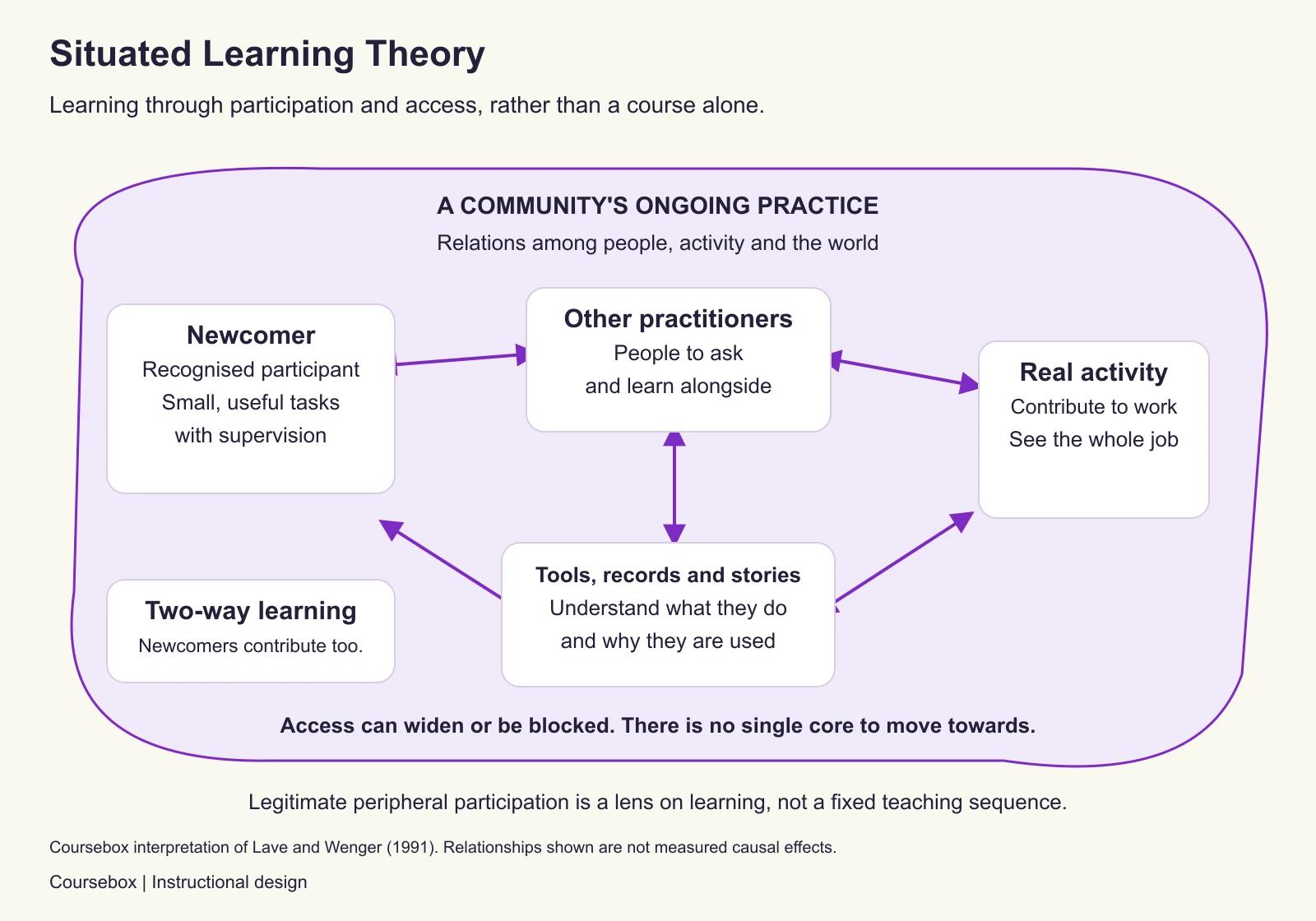
Lave and Wenger set it out in their 1991 book from Cambridge University Press, Situated Learning: Legitimate Peripheral Participation. Lave is a social anthropologist. When the book came out she was professor of education at the University of California, Berkeley, and Wenger was a research scientist at the Institute for Research on Learning in Palo Alto, where both had worked in 1988. Their central idea has a long name:
"Learning viewed as situated activity has as its central defining characteristic a process that we call legitimate peripheral participation. By this we mean to draw attention to the point that learners inevitably participate in communities of practitioners and that the mastery of knowledge and skill requires newcomers to move toward full participation in the sociocultural practices of a community." (p. 29)
Each word in the phrase does a job:
- Legitimate means the newcomer is accepted as a real, if junior, member, with a recognised right to be there.
- Peripheral means their first tasks are part of the actual work but small, and the costs of getting them wrong are low.
- Participation means they learn by taking part in what the community does, rather than by receiving knowledge about it somewhere else.
The scope is wider than the workplace. Lave and Wenger drew on studies of midwives, tailors, navy quartermasters, butchers and members of Alcoholics Anonymous, and they argued that participation-based learning can occur with or without an intentional educational programme (p. 40). Learning, on this view, is less about what goes on in one person's head and more about how a person's place in a community changes over time, including who they become. Lave and Wenger said the same about the community itself: "A community of practice is a set of relations among persons, activity, and world, over time and in relation with other tangential and overlapping communities of practice" (p. 98). They were emphatic that a community of practice "has no single core or center" (p. 36), so do not picture newcomers moving in towards a bullseye.
Here are the main ideas at a glance, with the question each one asks of training.
| Idea | In Lave and Wenger's words | The question it asks of your training | What it looks like at work |
|---|---|---|---|
| Legitimate peripheral participation | "newcomers ... move toward full participation in the sociocultural practices of a community" (1991, p. 29) | What real part of the work can a newcomer do in week one? | A new starter does a small, real task that experienced staff rely on |
| Peripheral tasks | "A newcomer's tasks are short and simple, the costs of errors are small" (1991, p. 110) | Are the first tasks low-risk but part of the actual work? | Checking a delivery against the order, not filing it unread |
| Access | "The key to legitimate peripherality is access by newcomers to the community of practice" (1991, p. 100) | Who and what can newcomers see, join and ask? | Standing beside the expert while the work is done |
| Learning curriculum | "a field of learning resources in everyday practice viewed from the perspective of learners" (1991, p. 97) | Where do newcomers learn now, outside any course? | Questions at the morning meeting, stories on the walk round |
| Transparency | "The black box can be opened, it can become a 'glass box'" (1991, p. 102) | Can newcomers see how the tools and records work and why? | Being shown why a form exists, not only how to fill it in |
| Community of practice | "a set of relations among persons, activity, and world, over time" (1991, p. 98) | Which group's practice is the newcomer joining? | A site team, a ward, a support desk or a fire station watch |
Lave and Wenger were explicit: legitimate peripheral participation "is not itself an educational form, much less a pedagogical strategy or a teaching technique. It is an analytical viewpoint on learning, a way of understanding learning" (1991, p. 40). They also said their idea "was more encompassing in intent than conventional notions of 'learning in situ' or 'learning by doing'" (p. 31). So "situated learning" is not another name for hands-on learning, and any list of steps for applying it is an interpretation.
Because it is a lens, most of the evidence comes from researchers who used it to look closely at real workplaces. The first study shows what happens to a team when newcomers stop arriving.

Case study: Firefighters and new recruits in the north of England
This was a study of existing workplaces through Lave and Wenger's ideas, not a programme designed on the theory. One of the UK's largest fire and rescue services hired no probationary firefighters between 2009 and 2017, and the number of incidents its crews attended had fallen by 57% over 15 years. Each watch, a team of 4 to 10 firefighters, was treated as a community of practice.
- What the researchers did: Between November 2015 and May 2016 they ran 15 focus groups with 62 firefighters across 12 watches, 15 interviews and seven months of observation. When recruitment resumed, they went back in 2019 and talked to new probationers and their mentors.
- Evidence and result: Brooks, Grugulis and Cook reported in Work, Employment and Society in 2020 that "Every single one of the 12 participating watches regretted the freeze on recruitment". Watches with novices finished a training drill after a call-out cut it short, and experienced watches did not, though "There was no formal guidance mandating this". All 12 station managers said they refreshed their own knowledge of the core skills, and novices brought newer techniques with them. The authors concluded that "Old-timers learned from novices and novices learned from old-timers in a radial rather than a centripetal manner."
- Limitation: It is a qualitative study of one service, built on what firefighters said and what researchers saw. The first phase relied on memories of past practice, and the authors note that novices may have been "particularly highly regarded because of their absence". No incident, competence or retention figures were measured.
- Lesson: Newcomers are not only on the receiving end. Their questions make experienced staff go back over the basics and explain what they do, so put newcomers into real teams early and give them a recognised voice.
Where situated learning theory came from
Situated learning sits among four related strands of work, from 1988 to 2002, each with its own authors and date. Several of the people involved worked at, or with, the Institute for Research on Learning in Palo Alto.
| Strand | Who and when | The main idea | Read it for |
|---|---|---|---|
| Cognition in practice | Jean Lave, 1988 | People's maths works differently in daily life than on school-style tests | The evidence that skill depends on the setting |
| Situated cognition | Brown, Collins and Duguid, 1989 | Knowledge is partly a product of the activity and culture where it is used | The link to cognitive apprenticeship and authentic activity |
| Legitimate peripheral participation | Lave and Wenger, 1991 | Newcomers learn by moving towards full participation in a community's practice | The core theory and the five apprenticeships |
| Communities of practice | Wenger, 1998, then Wenger, McDermott and Snyder, 2002 | A community of practice is held together by shared engagement, purpose and ways of working | Running or supporting a community at work |
Lave's grocery maths (1988)
Before the 1991 book, Lave led the Adult Math Project, which followed the same adults through daily life to see how they used arithmetic. In her 1988 book from Cambridge University Press, Cognition in Practice, she reported on 35 people in Orange County, California: 25 in a supermarket study and about 10 in a study of new members of a weight-loss programme. The researchers spent about 40 hours with each person. One dieter, asked to serve three-quarters of a two-thirds cup of cottage cheese, "filled a measuring cup two-thirds full of cottage cheese, dumped it out on a cutting board, patted it into a circle, marked a cross on it, scooped away one quadrant, and served the rest" (p. 165). No written calculation was involved.
The supermarket figures are the best known.
The same people who did almost perfect maths while choosing between products did much worse on paper. That does not mean school maths is useless. Anderson, Reder and Simon pointed out in a 1996 critique in the journal Educational Researcher that "it does not follow from these examples that arithmetic procedures taught in the classroom cannot be used by a shopper" (p. 6). It does mean a test taken away from the work can misjudge what someone can do in it, which is a reason to check newcomers in the work as well as on a quiz.
Situated cognition (1989)
John Seely Brown, Allan Collins and Paul Duguid set out situated cognition for educators in a 1989 article, "Situated cognition and the culture of learning". They argued that knowledge is partly a product of the activity, context and culture in which it is developed and used, and that facts learned only as abstract definitions often stay unused. They described authentic activities as the ordinary practices of a culture, and gave the example of apprentice tailors who start by ironing finished garments. As an alternative to conventional practices, they proposed cognitive apprenticeship, crediting it to Collins, Brown and Newman, whose chapter appeared the same year. Cognitive apprenticeship is a teaching method with modelling, coaching and fading, and our guide to the cognitive apprenticeship model covers it. It is not part of Lave and Wenger's theory.
Legitimate peripheral participation (1991)
Lave and Wenger first presented their ideas at a conference in July 1988, and Cambridge University Press published the book in 1991. They described "situated learning" as "a transitory concept, a bridge" (p. 34) towards their real claim, that learning is one part of taking part in social practice. Legitimate peripheral participation was the name they gave that claim. The idea started, they wrote, "in research on craft apprenticeship among Vai and Gola tailors in Liberia" (p. 30).
Communities of practice (1998 onwards)
The 1991 book used the term community of practice but did not develop it. Lave and Wenger said so: "The concept of 'community of practice' is left largely as an intuitive notion" (p. 42). Wenger turned it into a full theory in 1998, and a management version followed in 2002.
Which book to read
- Lave and Wenger, Situated Learning: Legitimate Peripheral Participation (1991). Read this one. It is short, and chapter 3, on the five apprenticeships, is the most useful part for anyone designing onboarding.
- Wenger, Communities of Practice: Learning, Meaning, and Identity (1998). Read it for the theory of communities of practice. Wenger built it on a claims processing office.
- The Wenger-Trayners' introduction page (2015). Read Etienne and Beverly Wenger-Trayner's introduction to communities of practice for a current, plain definition. It is free to read.
Situated learning examples: the five apprenticeships
Lave and Wenger's own examples are five apprenticeships. Chapter 3 summarises five studies, four by other researchers and one by Lave, and Lave and Wenger noted that across all five "there is very little observable teaching; the more basic phenomenon is learning" (p. 92). They judged four to be effective forms of learning and said the butchers' apprenticeship "often doesn't work" (p. 65). Each one shows a designer something different.
Yucatec Maya midwives, Mexico
In Jordan's study, apprentice midwives were "almost always the daughters of experienced midwives" (p. 66), so they learned as part of family life rather than in lessons. The apprenticeship "is integrated into daily life and it is only recognized after the fact" (p. 67). The study also found that biomedical training courses changed how the midwives talked about birth, and that this had "no effect on their existing practice" (p. 107).
The lesson for a designer: a course can change the words people use without changing the work they do.
Vai and Gola tailors, Liberia
Lave's own fieldwork, between 1973 and 1978, followed tailors' apprentices through an apprenticeship of about five years. They "first learn to make hats and drawers" and end with what the book calls the "Higher Heights suit" (p. 71). Within each garment they learn the production steps in reverse, starting with finishing and moving "backward through the production process to cutting jobs" (p. 96). Mistakes at the finishing end cost little, and the apprentice sees what the finished garment has to look like from the start.
The lesson: start newcomers at a low-risk point where they can still see what the whole job produces.
US Navy quartermasters
Hutchins studied navigation teams on a US Navy helicopter-transport ship. New quartermasters "move from peripheral to key distributed tasks in the collaborative work of plotting the ship's position" (p. 73). The work was shared, so a newcomer's small part sat inside the whole team's task, and the book stresses "the importance for learning of having legitimate, effective access to what is to be learned" (p. 73).
The lesson: give newcomers a small part of a shared task, so they hear and see the rest of it.
Supermarket meat cutters, United States
This is the apprenticeship that failed, and it is the most useful for onboarding. Marshall's study found trade-school classes of "book work and written examinations", where "Most assignments are not relevant to the supermarket" (p. 77). In the stores, an apprentice was usually put on the automatic wrapping machine and "kept there until another apprentice comes" (p. 79). Some meat departments were laid out so that apprentices at the wrapping machine "could not watch journeymen cut and saw meat" (p. 78). One apprentice said, "I'm scared to go in the back room. I feel so out of place there" (p. 78).
Lave and Wenger's verdict was that the butchers' apprentices "participate legitimately, but not peripherally" (p. 104). They were real employees doing real work, but the work was cut off from the skill they were there to learn.
The lesson: a newcomer can be busy and accepted and still learn almost nothing about the job.
Nondrinking alcoholics in Alcoholics Anonymous
The fifth study, by Cain, is one the book admits "is not usually described as a form of apprenticeship" (p. 65). Newcomers learn to tell their own story the way experienced members do, and Lave and Wenger summarise Cain's argument that "the main business of A. A. is the reconstruction of identity, through the process of constructing personal life stories" (p. 80).
The lesson: joining a practice changes who people think they are, not only what they can do.
Watch for any first job that keeps a newcomer useful but out of sight of the real work: filing, data entry, stock counts or a back-office queue. These jobs feel like a gentle start, and they can be. They become the meat cutters' problem when the newcomer stays there for weeks and cannot see, hear or ask about the work they were hired to learn.
Communities of practice: what Wenger added in 1998
Wenger's 1998 book from Cambridge University Press, Communities of Practice: Learning, Meaning, and Identity, is where the term became a theory. It drew on his fieldwork in 1989 and 1990 at a medical claims processing office of a large US insurer, which he called Alinsu. He argued that "practice defines a community through three dimensions: mutual engagement, a joint enterprise, and a shared repertoire" (p. 152):
- Mutual engagement: people work together and deal with each other regularly.
- A joint enterprise: they pursue a shared purpose.
- A shared repertoire: they share routines, words, tools and stories. In the claims office, "the height of certain piles of paper on desks indicates the state of processing" (p. 82).
For anyone designing onboarding, the key passage is on newcomers. To open up a practice, Wenger wrote, peripheral participation "must provide access to all three dimensions of practice" (p. 100), and "there is a big difference between a lesson that is about the practice but takes place outside of it, and explanations and stories that are part of the practice and take place within it" (p. 100).
In 2002, Wenger, McDermott and Snyder turned the idea towards management in Cultivating Communities of Practice, defining communities of practice as "groups of people who share a concern, a set of problems, or a passion about a topic, and who deepen their knowledge and expertise in this area by interacting on an ongoing basis" (p. 4). The current plain version is the Wenger-Trayners': "Communities of practice are groups of people who share a concern or a passion for something they do and learn how to do it better as they interact regularly." They add that "Having the same job or the same title does not make for a community of practice unless members interact and learn together." Their later work talks about landscapes of practice and social learning spaces.
Wenger's 1998 dimensions are mutual engagement, joint enterprise and shared repertoire. The domain, community and practice trio comes from the 2002 management book and the Wenger-Trayners' later writing. Both come from Wenger and his co-authors, but they describe a community from different angles, so do not merge them into one list.
A well-known company example is Xerox's Eureka database for copier field engineers, which grew out of Julian Orr's study of how technicians shared fixes through stories. In published accounts, engineers wrote up their fixes, respected peers checked them and each tip kept its author's name. Two Xerox researchers wrote in a 2000 workshop paper that it was "estimated to have saved Xerox roughly $50 million since its inception". Treat that figure with care. It is the company's own estimate, other company accounts give different savings figures, I found no independent evaluation, and Eureka was a knowledge-sharing system rather than an onboarding programme.
Access: why newcomers learn or stall
If one idea from the book should change how you onboard people, it is access. "The key to legitimate peripherality is access by newcomers to the community of practice and all that membership entails" (p. 100). Full membership, Lave and Wenger wrote, "requires access to a wide range of ongoing activity, old-timers, and other members of the community; and to information, resources, and opportunities for participation" (p. 101). They went as far as saying that "in a sense, all that we have said so far is about access" (p. 101).
Access can go either way: "Depending on the organization of access, legitimate peripherality can either promote or prevent legitimate participation" (p. 103). Three of their points translate directly into onboarding decisions:
- Peripheral tasks. "A newcomer's tasks are short and simple, the costs of errors are small, the apprentice has little responsibility for the activity as a whole" (p. 110). Small is fine. Removed from the work is not.
- Transparency. Newcomers need to see how the tools and records work and why they exist: "The black box can be opened, it can become a 'glass box'" (p. 102). The book says this applies "to all forms of access to practice", not only to technology.
- The labour conflict. Old-timers control access, and they may need a newcomer's labour more than they want to teach. Lave and Wenger name the conflict "between the master's desire for labor and the apprentice's desire to learn ... as among the meat cutters" (p. 115).
Fuller and Unwin's study of apprentices in England shows the same problem in modern firms. Getting someone productive fast is not the same as onboarding them well.

Case study: Apprentices at steel and engineering firms in England
This was a study of existing workplaces through Lave and Wenger's ideas, not a programme designed on the theory. Between 2000 and 2003, researchers followed the UK's Modern Apprenticeship programme in four English companies to see what kind of workplace participation turns an apprentice into a capable, qualified worker.
- What the researchers did: They interviewed apprentices and staff, observed review sessions run by a training provider and asked apprentices to keep weekly learning logs for 8 weeks. Their article describes three of the companies: a steel polishing firm of about 40 people with 2 apprentices, a steel stockholder with 1 apprentice and a shower manufacturer with a long apprenticeship tradition.
- Evidence and result: In Fuller and Unwin's 2003 article in the European Educational Research Journal, the steel polishing apprentices became full participants in under a year and were training others, yet "2 years into their Modern Apprenticeships, neither Barry nor Carl has attained the mandatory qualifications". Their training provider visited about every 6 weeks for "15 minutes or so". The shower manufacturer moved apprentices round most departments every 6 to 9 weeks, and "Each secondment is linked to a learning plan". At the stockholder, a move between departments left the apprentice "relocated back to the periphery of a different department". In a companion paper, the authors called the two ends of this range expansive and restrictive participation.
- Limitation: The numbers are very small, the logs are self-reports and the firms are anonymised. No completion, productivity or comparison figures were measured.
- Lesson: Speed to full participation can hide a narrow apprenticeship. Plan each stage with a written goal, give newcomers access to more than one team, and protect their status as learners while they are also useful.
A worked example: graduate site engineers on one building site
Here is the hypothetical example I'll plan with. A mid-size building company builds mid-rise apartment blocks. Its graduate site engineers join one live site, a seven-storey apartment block now at the level 3 slab, for their first 12 weeks. They hold a civil engineering degree and have done the company's two-day induction and general construction induction evidenced by a white card, as well as this site's own safety induction. None has worked on a live site, so the degree alone does not show they can run an inspection.
The community they are joining has named roles: the site manager, a senior site engineer who acts as each graduate's buddy, the formwork and steel-fixing foremen, the concrete pump and supply crew, and the external structural engineer who inspects reinforcement before each pour.
The problem is the old approach. Graduates did the induction and an e-learning module on the quality system and inspection and test plans (ITPs), then spent weeks in the site office filing dockets and updating registers. They passed the module's quiz. At their first pre-pour inspection they did not know what to look at, who to ask or when to stop the pour. The paperwork kept them away from the practice it records, the same trap as the meat cutters' wrapping machine.
The practice they are working towards is the pre-pour inspection of a concrete slab: checking the formwork, the reinforcement (bar size, spacing, cover and laps), cast-in services and penetrations against the structural drawings and the ITP, recording it with photos, and coordinating the structural engineer's inspection. The slab cannot be poured until the hold point is released, and in this hypothetical company, only the authorised buddy or site manager can release it, after the structural engineer's sign-off. Actual authority follows the site's approved ITP. A graduate never releases it.
So that their decisions can be judged, the proposed course uses a site-specific job pack, which the company would need to supply: the level 3 slab reinforcement drawing, the pre-pour ITP for that slab, the site diary, two concrete delivery dockets, the request for information (RFI) log and three photos of installed reinforcement. Photo A shows bar chairs spaced too far apart, so concrete cover is at risk. Photo B shows a cast-in electrical conduit from the drawing is missing. Photo C is correct.
The intended outcome is that by week 12 a graduate can carry out a pre-pour inspection on a typical slab with the buddy reviewing, raise a nonconformance or an RFI, and knows who on site to ask about what. It is not certified competence and gives no authority to release a hold point. The example suits situated learning because participation in this site team requires access to its people, work and records. Classroom explanation and simulation can also prepare graduates; they do not replace learning how this particular team carries out and authorises its inspections.
How to use situated learning theory to plan onboarding
Lave and Wenger wrote no design method, so this workflow is my own, built on their idea of legitimate peripheral participation and carried through the site engineers' first 12 weeks.
- Find where newcomers learn now. Ask recent starters what they did in their first fortnight, where they picked things up and whom they asked. On the example site, the answer is the site office.
- Name the practice and the community. Write down the work the newcomer is joining and the people who do it. Here, the pre-pour inspection and the six roles on site, from the site manager to the structural engineer.
- List real peripheral tasks. Choose short, simple tasks with small costs of error that are part of the actual work and let the newcomer see the whole job, as the tailors did. Logging delivery dockets against the order qualifies. Filing them unread does not.
- Write down the order of access. Set out which tasks come first and what has to happen before the newcomer takes on more. Newcomers who have to guess the order tend to stall or overreach.
- Name who gives access, and give them time. A buddy who is also running the pour is likely to use the newcomer as labour. Put the buddy's time for walking and checking into the plan.
- Open up the tools and records. Show newcomers the drawings, the ITP, the RFI log and the site diary, and explain why each one exists, not only how to fill it in.
- Check the work as well as the quiz. Lave's shoppers show that a test away from the work can misjudge what someone can do in it. Have the buddy review real ITP checklists, and use an observation checklist for the led inspection.
- Use the course for what a course can do. A course can set out the route, prompt the conversations, give a place to record real tasks and use the real records. It cannot give anyone access to a slab.
Ducheneaut's study of the Python project shows what happens without step 4: a real community where the route from newcomer to developer existed but nobody wrote it down.

Case study: Newcomers to the Python open source project
This was a study of an existing community through Lave and Wenger's ideas, not a programme designed on the theory. The Python programming language is built by a distributed group of volunteer and company-sponsored developers, and permission to change the code is not automatic. The question was how newcomers move from the edge of the project to its core, and why most do not.
- What the researcher did: Ducheneaut, then at Xerox PARC, observed the project through 2002 and mapped its mailing list and code archives, testing whether a process like legitimate peripheral participation was at work.
- Evidence and result: In his 2005 paper in Computer Supported Cooperative Work, 284 people took part in 2002, and 136 of them posted a single message and never returned. Of the 60 newcomers that year, 4 became code committers, 6 became well connected without committing code and 50 stayed on the edge. All 4 who succeeded had posted to the mailing list for one to six months before they started coding. The usual route had six steps, starting with "peripheral monitoring of the development activity" and moving through bug reports, small fixes and then a project of their own. One newcomer who asked for his own module to be added a week after his first bug report "only received contempt from the core members". Ducheneaut found "little evidence of explicit coaching or teaching", and newcomers had "to discover by themselves what the norms of participation are".
- Limitation: One project, one year and only 4 successful newcomers. The newcomers were already skilled programmers, so the study shows people learning to take part in a community, not learning a trade, and it is a volunteer setting rather than employment.
- Lesson: In this project, the route into participation was largely implicit and most newcomers remained peripheral. The study cannot tell us that everyone on the edge gave up, or why they stayed there. Write the low-risk first tasks and the order of access into onboarding, and say which moves are too early.
The 12-week plan for the graduate site engineers
Here is the site engineers' route as a plan. Each stage adds access to more of the practice, and each one ends with a check before the graduate moves on.
| Stage | Weeks | Real tasks on site | Who gives access | Records used | Check before moving on |
|---|---|---|---|---|---|
| Peripheral: watch and record | 1 and 2 | Walk the site daily with the buddy; attend the 6.30 am pre-start; log the delivery dockets against the order; photograph reinforcement before each pour; write the day's site diary entry | Senior site engineer (buddy); site manager for the pre-start | Delivery dockets, site diary, reinforcement drawing | Buddy has read the diary entries; the graduate can name who to ask about what |
| Joint: check alongside the buddy | 3 to 6 | Check reinforcement with the buddy on the level 3 slab; fill in the ITP checklist for the buddy to review and sign; raise one RFI about a drawing clash with the buddy | Buddy; steel-fixing foreman | Pre-pour ITP, reinforcement drawing, RFI log, photos A, B and C | Buddy has signed ITP checklists the graduate filled in |
| Fuller, still supervised: lead with review | 7 to 12 | Lead the pre-pour inspection on a slab pour; walk it with the steel-fixing foreman; walk it again with the buddy before the structural engineer's inspection | Buddy; steel-fixing foreman; structural engineer | Pre-pour ITP, drawing, site diary, RFI log | Buddy reviews the led inspection with an observation checklist; the hold point is released by the buddy or site manager, never the graduate |
A stage-by-stage plan for a newcomer's first 12 weeks, from watching and recording to leading with review, plus a weekly task log and the buddy's 15-minute check-in questions, filled in for the graduate site engineers with blank pages for your own team. Editable Word file, no email required.
Write down the three or four real tasks a newcomer will do in weeks 1 and 2, and who will take them there. If the list is all reading, induction and admin, the newcomer has been given a seat, not access.
What onboarding course requests ask for
To see how people brief onboarding, I looked at course requests typed into Coursebox in the 90 days to 7 October 2026: one per person, from English-language browsers, with no uploaded file. Of 266 prompts, 104 were course requests. Two independent AI readers each classified all 104 against written definitions, and every positive call was re-read by hand. They agreed on all six onboarding requests and on the zeros. Counts are the union of the two readers and remain classification estimates. Agreement on these requests cannot establish an upper bound or detect every missed item.
Five of the six asked for content with quizzes, tests or video: a new hire course with unscored ice-breaker questions, a warehouse safety induction with a test to pass before starting work, a refinery safety induction and an onboarding course on company policies and culture with a quiz in each module. In Lave and Wenger's terms, the briefs described a teaching curriculum, "constructed for the instruction of newcomers" (p. 97), and none described access to the practice newcomers learn from. The sample is small and covers requests, not finished courses, and organisations may run buddy schemes that never appear in a prompt. Still, if you want a course to send people into the work, you have to write the people, the first tasks and the real records into the brief yourself.
Situated learning vs cognitive apprenticeship, constructivism and other theories
Situated learning is often taught alongside theories that do different jobs. The table is my synthesis, not a ranking. I found no study comparing them head to head.
| Theory | Best for | Weak spot | Use it when |
|---|---|---|---|
| Situated learning (Lave and Wenger) | Understanding how newcomers learn by joining a community's real work, and what blocks them | A lens, not a method, so it needs translating into a plan | You are designing onboarding or any learning that has to happen inside a team's practice |
| Cognitive apprenticeship (Collins, Brown and Newman) | Making an expert's thinking visible through modelling, coaching and fading | Needs an expert with time to model and coach | You need a teaching method for a skill where the thinking is hidden |
| Constructivism | Designing activities where learners build understanding, with guidance | A broad family of ideas, so it needs narrowing to a method | You are designing the learning activities themselves |
| Social cognitive theory (Bandura) | Learning by watching models and building self-efficacy | Focuses on individual learners rather than communities | Observation and confidence are the main barrier |
| Kolb's experiential learning cycle | Planning a sequence of experience, reflection, concepts and trying things out | A model of individual learning, silent on access and power | You are planning a course or programme around practice |
| Connectivism | Learning across networks of people and sources | Describes networks more than how to design a sequence | Knowledge changes fast and lives across many people |
The closest neighbour is cognitive apprenticeship: situated learning explains why a buddy and real tasks help, and cognitive apprenticeship gives the buddy a method for modelling and coaching the inspection. Constructivism and social cognitive theory focus more on the individual learner. Kolb's experiential learning theory helps sequence practice and reflection, and Schön's reflective model fits the buddy's review after a led inspection. Connectivism suits knowledge spread across a wide network rather than one site team. For the site engineers, I would use situated learning to plan the 12 weeks and cognitive apprenticeship to plan what the buddy does on each walk.
Criticisms of situated learning theory
Six criticisms come up in the research.
- It is a lens, not a method. Anderson, Reder and Simon noted that Lave and Wenger "explicitly abstain from making any educational recommendations" (1996, p. 10). Every design said to be "based on" situated learning, mine included, is an interpretation.
- Its strongest claims were overstated by others. Anderson, Reder and Simon contested four claims, about situated action, transfer, abstraction and social instruction, that they took from a US National Research Council report, not from Lave and Wenger. They "fully concur" that action is grounded in its situation (p. 6), and they summarised their own view as "while cognition is partly context-dependent, it is also partly context-independent" (p. 10). Greeno replied in 1997 that they had "incorrectly called" the four propositions claims of situated learning, and by 2000 the four authors set out points of agreement, including that "Learning can be general, and abstractions can be efficacious, but they sometimes aren't".
- Modern workplaces are not craft apprenticeships. Fuller and colleagues, drawing on research in UK manufacturing and secondary schools, argued in a 2005 paper in the British Educational Research Journal that Lave and Wenger's work "has significant limitations", relating to "contemporary workplaces in advanced industrial societies and to the institutional environments in which people work". The Python study adds that newcomers are not always novices.
- Power and access get too little attention. Lave and Wenger admitted that "unequal relations of power must be included more systematically" (p. 42). Contu and Willmott argued in the journal Organization Science in 2003 that the theory's early attention to power was, in later management writing, "displaced by a managerial preoccupation with harnessing (reified) 'communities of practice'" to corporate goals.
- "Community" is a loose word. Handley and colleagues argued in the Journal of Management Studies in 2006 that people take part in many communities at once, creating "fluidity and heterogeneity within and beyond communities". A graduate on site belongs to the site team, the company's engineering group and their profession at the same time.
- The evidence is mostly ethnographic. The studies show how newcomers learn and what blocks them, not how much a design improves results. I found no programme built explicitly on situated learning, legitimate peripheral participation or communities of practice that has an independently measured outcome.
Using situated learning theory with an AI course builder
On 8 October 2026 I briefed Coursebox to build a short course for the graduate site engineers. Coursebox is our product, so weigh my account with that in mind. The brief asked for a course that sends graduates to real site tasks and real people rather than replacing them: who's who on site, the weeks 1 and 2 tasks with a log, the ITP and photos A, B and C with open-text answers, checking alongside the buddy in weeks 3 to 6, the first led inspection, a weekly buddy check-in guide and a wrap-up last. It also set the hold-point rule and asked for open-text logs instead of quizzes.
Much of it came back as briefed. The course framed itself as pointing to real site work. It started with a route through the twelve weeks, then who's who on site and a weeks 1 and 2 site record, traced the level 3 hold point and kept the wrap-up, "Keep the Habit", as the last section.
The on-site parts were where it slipped. The first outline had no step for checking the real level 3 slab alongside the buddy in weeks 3 to 6, and no exercise on photos A, B and C. The weekly buddy check-in guide came back as a 5-question quiz, and the escalation choice was a quiz too. A quiz can assess an escalation judgement, but it cannot replace a buddy conversation or a record of site work. The larger gap was the missing route into supervised on-site tasks.
One follow-up message added the missing on-site steps and changed the requested records to open text. I asked for the missing on-site steps from my brief, in open text and with no quizzes, then reloaded the outline (not the generated pages) and checked it. It now had an open-text review of photos A, B and C, a new "Check Alongside Your Buddy" section with an open-text ITP record and the weeks 3 to 6 escalation scenario, an open-text reflection and a "Weekly Buddy Check-In Guide" in the led-inspection section, with no quizzes left, and the course description said the on-site tasks, buddy support and hold-point decisions happen on site, not in the course. That is the right limit: no course can assign a buddy or put a graduate on the slab, and only what graduates do on site in weeks 1 to 12 will show whether it worked. It came to about 74 minutes against the 40 I asked for, across 6 sections and 13 pages, so it needs trimming. The revised outline names the site tasks and buddy reviews. The generated prompts and site records still need checking, and the company must arrange the access and supervision outside the course.
Before you brief a course like this, it helps to check what access newcomers actually have, because the course can only point to it.
A short audit for managers and designers that uses legitimate peripheral participation as a lens on onboarding: real first tasks, people, the work itself, tools and records, the order of access and the newcomer's status as a learner, filled in for the graduate site engineers with a blank version and an action plan. Editable Word file, no email required.
Putting situated learning theory to work
Situated learning theory answers a question onboarding plans often skip: where will newcomers actually learn the job? Lave and Wenger's answer is in the work, through small but real tasks, access to the people who do it and a route towards fuller participation. Use the theory as a lens, not a recipe. It tells you what to look for, such as the wrapping-machine job, the missing buddy time and the records nobody explains, and leaves the design to you. A course can set out the route and prompt the conversations, but it cannot give anyone access.
Start with one role you onboard. Write down what a newcomer actually does in their first two weeks, and replace one job that keeps them away from the work with a real, low-risk task beside someone experienced.
Frequently Asked Questions
Situated learning theory is Jean Lave and Etienne Wenger's account of learning as taking part in the practice of a community: newcomers learn by moving from small, real tasks that are part of the work towards full participation, through access to people, activity and tools. Lave and Wenger set it out in their 1991 book, Situated Learning: Legitimate Peripheral Participation.
Legitimate peripheral participation is Lave and Wenger's name for how newcomers become full members of a community of practice. They start with small, real tasks that are accepted as part of the work, then take on more as they gain access to people, activity and tools. Lave and Wenger described it as a way of understanding learning, not a teaching technique.
Apprentice tailors in Liberia, studied by Jean Lave, started by making hats and drawers and learned each garment's steps from finishing back to cutting, so early mistakes were cheap. A hypothetical workplace example is a graduate site engineer who logs deliveries and checks reinforcement alongside a senior site engineer before leading an inspection.
Situated cognition is the argument, made by Brown, Collins and Duguid in 1989, that knowledge is partly a product of the activity and culture where it is used. Situated learning, in Lave and Wenger's 1991 book, describes how newcomers learn by taking part in a community's practice. The two are related but come from different authors.
Critics argue that the theory is a lens rather than a method, that strong claims about transfer were overstated, that modern workplaces differ from craft apprenticeships, that it gives too little weight to power and that "community" is loosely defined. Most of the evidence comes from ethnographic studies rather than measured outcomes.
Carolina Martin
Carolina is a highly experienced learning designer with tech start-up experience. She is based in Sydney and previously designed courses alongside Coursebox founder Travis in a previous job. She is passionate about delivering engaging learning experiences and brings the same perspective to customer experience too. She manages our customer support documentation and product testing processes.

