

Built by an instructional designer: the principles behind Coursebox
Coursebox co-founder Travis Clapp on what good learning feels like, why AI is an extension of the instructional designer, and the 5 principles we build every course on.

The rule hasn't changed in 15 years: make something the learners will appreciate.
In 2011 I built a 9-hole golf game for a golf industry body. Each hole was a learning objective, each one a par 3, 4 or 5, and a right answer sank the putt while a wrong answer missed. Their people were golf fanatics, and they loved it.
The CTO at Workstar, where I worked back then, saw it differently: "The most expensive and overpriced piece of work that we did was that gamified education that Travis decided." He had a point, because it took weeks to design, approve and build in Flash. The same interaction takes about 5 minutes to build now.
Why does an instructional designer end up building software?
Because for years I did all of it by hand. My background is a degree in mathematics and computer science and a masters in interactive multimedia, and for a while I taught interactive multimedia, web design and Photoshop at a university.
With a client, it might be a month of back and forward just to get to a course structure everyone was happy with. Coursebox builds that structure in under a minute. I tell the full story of how Alex and I started the company in The tool I wish I had.
What does good learning feel like?
Flying broke my brain in the best way. A few years ago I learned to fly a plane, and I really felt like I could feel my neurons firing as I learned the radio calls and how to get the plane up in the air and not crash it.
I saw the same thing in the courses that worked best when I was designing them. In a jewellery sales course I built, a perfect 10 on a quiz won a diamond in the corner of the screen, and the salespeople chased those diamonds.
One of our customers in Germany trains drivers who are on the road all day. They wanted their people doing their training on the phone, just speaking, so the course became a podcast and the drivers answer the quizzes and assignments hands free.
Why do so many online courses get clicked through?
Too much of online training is just clicking through compliance stuff. When I built the golf game, I really wanted to make it fun and enjoyable, and that is still what training teams ask us for.
"Learners just scroll and it kind of gets a bit boring."
A training team that came to Coursebox from another authoring tool
The other half is feedback. Grading used to take evenings, and with Coursebox a learner can upload a 3-page written answer and get it graded, with feedback against the rubric, in about 10 seconds.

Does AI replace the instructional designer?
I see AI as an extension of the instructional designer. A designer can build at scale with it, and the person is still responsible for checking the content before publishing it. On a compliance course, Coursebox gets about 90 to 95% of the way there in the first hour, and the designer spends 1 or 2 days finalising it.
That last 5 to 10% is the most important part. It's the decisions about what learners should struggle with, practise and prove.
Nobody should be scared that AI is going to replace them. It's there anyway, so use it as a tool, just like the calculator when it came out. I also disagree with the talk about cutting back on junior hires. I think companies need them more than ever, because they are the most likely to pick these tools up fast and 3x what they can deliver.

What principles do we build Coursebox on?
There are 5, and they all come from the years I spent building courses by hand:
- The outcome is the point. A course is how a learner gets somewhere, so every course comes with a tutor, grading, tracking and certificates around it.
- If we wouldn't use it, it isn't ready. If it's not good enough that we'd want to eat it ourselves, it's just not good enough. My own test is whether I would be proud to send the course to my Mum.
- AI drafts, a person decides. Nothing is published until a person publishes it, and AI grading can be moderated by a person before results go out.
- Practice beats reading. Learners should practise, make safe mistakes and get real feedback on the spot, which is why we built Custom Interactions.
- Learning fits the learner. The AI tutor answers each learner in their own language at any hour, and a course can be listened to like a podcast on the move.
Secure Meters shows the third principle at work. Their subject matter experts write the courses in Coursebox for their Secure Academy, and their General Manager, Shafik Ahmad, reviews every course for quality before it reaches a learner.
"We want to give our people lifetime employability, not just jobs. Coursebox gave us a way to deliver that promise at scale."
Shafik Ahmad, General Manager, Secure Meters
How do we build at Coursebox?
I read every support conversation from overnight, every morning, and anything worth improving goes to the team the same day. I still build courses in Coursebox myself, too. I was building a piano course for beginners recently, and Coursebox gave me an interaction where the learner clicks the keys, hears the notes and tries them out in sequence with feedback.
We also use AI to test our own work. That's how we do some of our user testing: we get Claude to go through the learning the way a learner would.
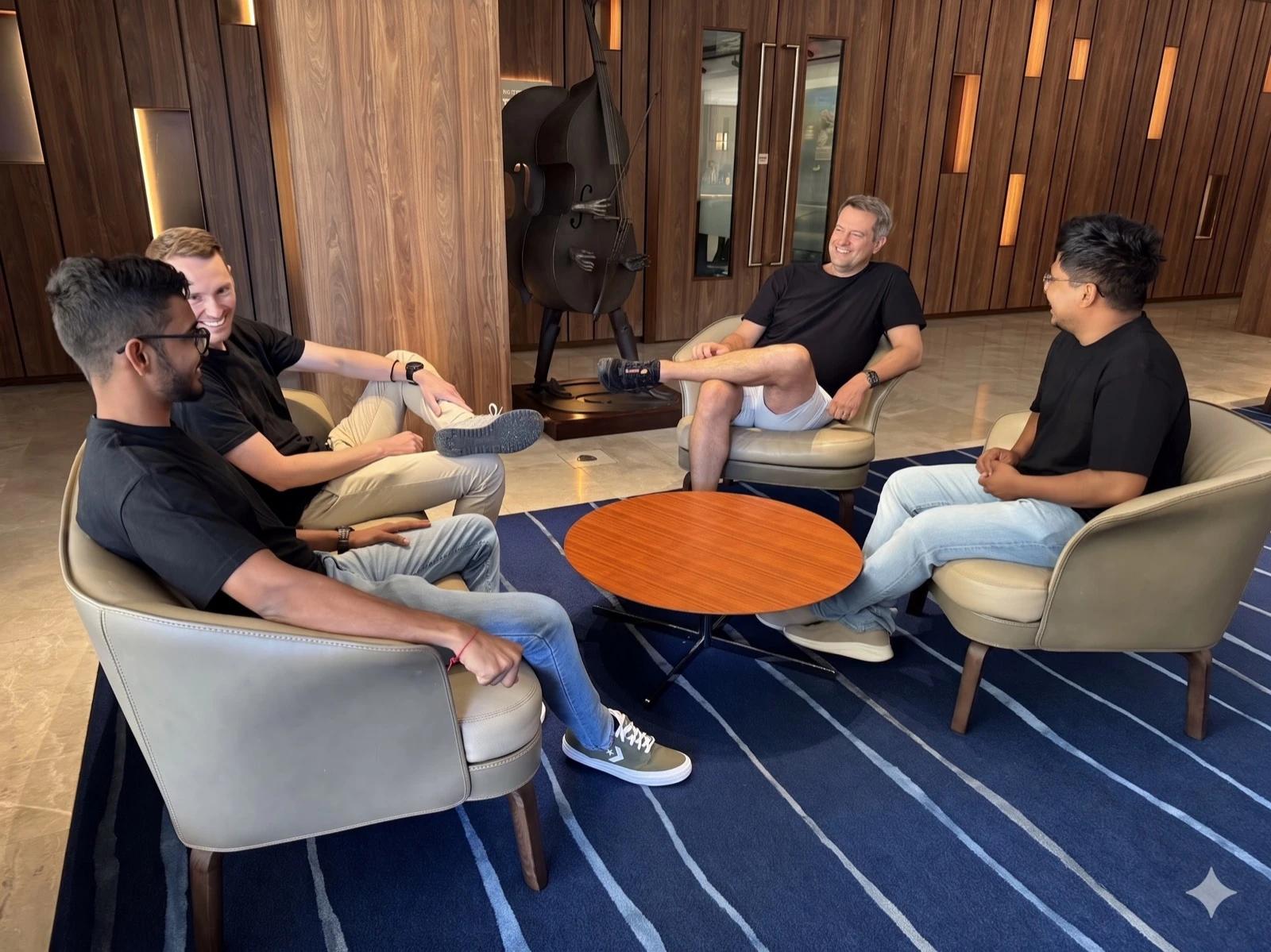
And we lean on the experts on our team. On our compliance builds, Carolina Martin, our Learning Experience Manager, is the expert in that last 10%.
What comes next for learning design?
I can't wait for the break my brain and adaptive learning stuff. I tried it on myself first: I gave Claude the transcripts of my own sales calls and asked it to break my brain, push me as hard as it could with ideas and questions, and tell me where I had gone wrong.
Now picture that inside a course. A learner is learning to code, has watched the videos and done the assignments, and then the course asks them to type in the CSS themselves and gives them real-time feedback. My team doesn't love the phrase break my brain, and we're not quite sure what to call it yet, but this is the part of learning design I'm most excited about.
The Coursebox story
Before Coursebox I spent 7 years building a socialised LMS, and before that I ran Web Design Cafe and worked as an instructional design consultant. 4 years ago I met Alex Hey through a Y Combinator co-founder matching service, and together we turned the company hard toward AI. We build Coursebox from Adelaide, Perth and a growing international team, for training businesses and L&D teams in more than 180 countries.
Frequently Asked Questions
There are 5: the learner's outcome is the point, nothing is ready until the team would use it themselves, AI drafts and a person decides, practice beats reading, and learning fits the learner's language, device and hours.
Travis Clapp sees AI as an extension of the instructional designer. Coursebox gets a compliance course about 90 to 95% of the way in the first hour, and the designer makes the decisions in the last 5 to 10%: what learners should struggle with, practise and prove.
Nothing is published until a person publishes it. Designers review and edit every page, and AI grading can be moderated by a person before results reach learners.
An activity Coursebox builds from a description of what learners should be able to do, such as putting on protective equipment in the right order or playing notes on a piano, with feedback on every attempt.
Travis Clapp
Travis Clapp is the original founder and CEO of Coursebox. As an experienced instructional designer, he has lived through the process of building high quality courses. These experiences brought about his idea to upload all your documents and ideas into a virtual box that could convert those magically into a course. Prior to Coursebox, he successfully founded and built a social based LMS. Travis has 15+ years of experience designing courses and EdTech platforms from university MOOCs to enterprise LMS. Travis has built training for reputable companies like Johnson & Johnson, Electrolux, Michael Hill and SA Health. One of his courses reached 20,000+ learners which was a flagship edX course. He is based in the Adelaide, South Australia office and passionately works on customer support, sales and bringing the original product vision to life every day.

