

Connectivism Learning Theory: 8 Principles and the Debate
Connectivism theory explained: Siemens's eight principles in his own words, Downes's network properties, the four critiques and how to use it at work.

Connectivism learning theory is George Siemens's 2004 account of learning as building and using networks of people, sources and tools, where knowing where to find current knowledge, and how to judge it, counts for more than what you already know.
- Siemens published connectivism on his own in December 2004, and Stephen Downes developed the parallel idea of connective knowledge from 2005.
- Siemens's eight principles describe one network from different angles, so they are not steps to follow in order.
- Several published critiques, starting with Pløn Verhagen's in 2006, question whether connectivism is a learning theory at all.
- CCK08 had about 2,200 free registrants, but its studies measured participation and experience rather than demonstrated learning.
- Connectivism suits knowledge that changes faster than a course can be rebuilt, and a structured course still suits a novice learning a fixed procedure.
Five questions, about a minute. Answer for one team whose product, policy or rules change often, such as a support or sales team. This is an unvalidated planning check. Inspect each answer and test the resulting design with learners; the total does not certify learning or effectiveness.

Go from storyboard to an interactive course in minutes
A payroll software company ships a release every Thursday. On Friday morning a support agent answers a customer's email about a changed pay run screen with advice from a chat thread written last month, and the advice is wrong. The onboarding course the agent took was accurate on launch day. Nobody can rebuild it every week, and the knowledge that would have caught the mistake sat in this week's release note, the engineering changelog and the heads of two senior agents.
I'm an instructional designer at Coursebox, where we make instructional design software. I also write our knowledge base and test each release, so I deal with knowledge going stale between releases every week. Connectivism, the theory George Siemens published in 2004, is about this kind of problem: learning that depends on staying connected to people and sources that keep changing. I walk through what the theory says, Siemens's eight principles in his own words, Stephen Downes's network properties, the argument over whether it is a learning theory at all, and that support team's training redesigned with it, including a test in our own course builder.
What is connectivism theory?
Connectivism learning theory is George Siemens's 2004 account of learning as building and using networks of people, sources and tools, where knowing where to find current knowledge, and how to judge it, counts for more than what you already know.
Siemens set it out in a short article, Connectivism: A Learning Theory for the Digital Age. He describes it as "the integration of principles explored by chaos, network, and complexity and self-organization theories". He treats learning as "actionable knowledge" that "can reside outside of ourselves (within an organization or a database)", and he argues that "the connections that enable us to learn more are more important than our current state of knowing."
The theory's starting point is a complaint about the older theories. Siemens argued that behaviourism, cognitivism and constructivism all treat learning as something that happens inside one person's head, and that "They also fail to describe how learning happens within organizations". Siemens's alternative is a network: nodes, which can be people, documents, databases or tools, and the connections between them. Learning is forming, keeping and pruning those connections, and judging what comes through them. Two of his lines carry the idea:
- Know-where: "Know-how and know-what is being supplemented with know-where (the understanding of where to find knowledge needed)."
- The pipe: "The pipe is more important than the content within the pipe."
He also applied it to organisations, which is the part most relevant to training teams: "Knowledge that resides in a database needs to be connected with the right people in the right context in order to be classified as learning."
Two qualifications shape how the theory is used today. First, whether it is a learning theory at all has been argued since 2006, and the critics have a case, which I cover below. Second, later writing often means Stephen Downes's four network properties when it says "connectivism", not Siemens's eight principles. I found no revised version of the eight principles, and in 2006 Siemens wrote that "The core of what I wrote in the initial article is still valid".
The 8 principles at a glance
The wording in the second column is Siemens's own, from the 2005 article, with US spelling kept. For principle 8 the table shows only the first of its three sentences. The last two columns are my reading of each principle for workplace training.
| Principle | Siemens's wording | The question it asks of your training | What it looks like at work |
|---|---|---|---|
| 1. Diversity of opinions | Learning and knowledge rests in diversity of opinions. | Who else holds part of the answer? | Support, product and compliance staff answer the same question together |
| 2. Connecting nodes | Learning is a process of connecting specialized nodes or information sources. | Do people know which person or source answers which question? | A new starter knows whom to ask about billing and where the pricing rules live |
| 3. Non-human appliances | Learning may reside in non-human appliances. | What do your tools and systems hold, and how current is it? | A knowledge base, search tool or AI assistant people consult before replying |
| 4. Capacity to know more | Capacity to know more is more critical than what is currently known | Are people taught to find the next answer, or only to remember this one? | Onboarding practises looking things up, not memorising screens |
| 5. Nurturing connections | Nurturing and maintaining connections is needed to facilitate continual learning. | Who looks after the connections once training ends? | A channel with a named owner that people keep using after onboarding |
| 6. Seeing connections | Ability to see connections between fields, ideas, and concepts is a core skill. | Do people link a change in one area to its effect in another? | Spotting that a new regulation changes a product screen |
| 7. Currency | Currency (accurate, up-to-date knowledge) is the intent of all connectivist learning activities. | How do people check that what they know is still current? | A routine for reading release notes or policy updates |
| 8. Decision-making | Decision-making is itself a learning process. | Do people practise choosing between conflicting answers? | Judging an old thread against this week's release note |
The names are close and the ideas are not. Connectionism is Edward Thorndike's term for learning as bonds between a stimulus and a response, and later the name for neural-network models of how the mind works. Connectivism is Siemens's theory about learning through networks of people, sources and tools. Anything that treats them as one theory describes one of them wrongly.
Who developed connectivism, and when?
George Siemens published the theory on his own. The article first appeared on his elearnspace site on 12 December 2004 and was republished, with identical text, in the International Journal of Instructional Technology and Distance Learning in January 2005. That is why you see both years cited. Both are right.
Stephen Downes developed a parallel idea, connective knowledge, starting with An Introduction to Connective Knowledge on 22 December 2005. Downes himself credits the name to Siemens: in his 2012 book he writes that Siemens "coined the term 'Connectivism' to describe learning networks and has been generous enough to share it with me." So Siemens introduced the theory, and Downes's own work on it began a year later, though the two worked closely together afterwards.
In 2008 they ran an open online course together, Connectivism and Connective Knowledge, known as CCK08. The term MOOC, for massive open online course, came from Dave Cormier, who traced it to a chat with Siemens about what to call the course. CCK08 is widely described as the first MOOC, but Fini, who surveyed its participants, notes that "The CCK08 is not the first open online course", because Alec Couros and David Wiley had run open courses in 2007 and 2008. It is safer to call it the course the term MOOC was coined for.
CCK08 and its successors were connectivist MOOCs, often called cMOOCs: participants built their own networks across blogs, forums and feeds. The large courses that platforms such as Coursera and edX launched from 2012 follow a different, instructor-led model, usually called xMOOCs. Their completion data and design choices are not evidence for or against connectivism, so do not cite them as connectivism in action.
Siemens's recent work has moved on to generative AI. A 2025 paper by Moldoveanu and Siemens proposes a new set of design principles called Interactionalism and cites the 2005 article only in passing. It does not claim that connectivism explains large language models.

Case study: The 2008 open course where connectivism met practice
From September to December 2008, Siemens and Downes ran Connectivism and Connective Knowledge, a 12-week online course at the University of Manitoba in Canada. A small group took it for credit, and anyone else could join free. The question it raises for anyone designing with connectivism is how many people take part when a course is run as an open network.
- What they did: Connectivism was the explicit design basis, and the course was also about the theory. There was no single course space: learning was spread across forums, participants' own blogs, live online sessions and a daily newsletter, and participants chose where and how to take part.
- Evidence and result: Downes counted 24 students paying for credit and about 2,200 free registrants. A 2010 study by Mackness, Mak and Williams found that about 150 were actively interacting at various times. In Fini's 2009 survey, answered by 83 of the 415 people invited, 4 of the 70 informal respondents said they had finished the course, against 11 of the 13 taking it for credit.
- Limitation: The samples were small and self-selected, completion was self-reported, and the studies measured participation, completion and experience, not learning. Mackness and colleagues also found that the course's open-ended autonomy let disruptive trolling in the forums "go unchecked".
- Lesson: Registration and visible participation were different measures, and reading without posting did not establish that someone failed to learn. Of the survey respondents, those taking it for credit, with a deadline and a grade, mostly said they finished. In a workplace, the equivalent of credit is a manager's expectation and a task that needs the network to complete it.
Siemens's and Downes's writing: which to read
- Start with Siemens's 2005 article. It is short, free and contains the definition and the eight principles. Quote the principles from it, not from a summary.
- For Downes's version, read his 2007 post What Connectivism Is, then his 2012 book Connectivism and Connective Knowledge, which is free as a PDF under a Creative Commons licence.
- For the debate, read Kop and Hill's 2008 paper, Connectivism: Learning theory of the future or vestige of the past? It is free and fair to both sides.
The 8 principles of connectivism, worked through one support team
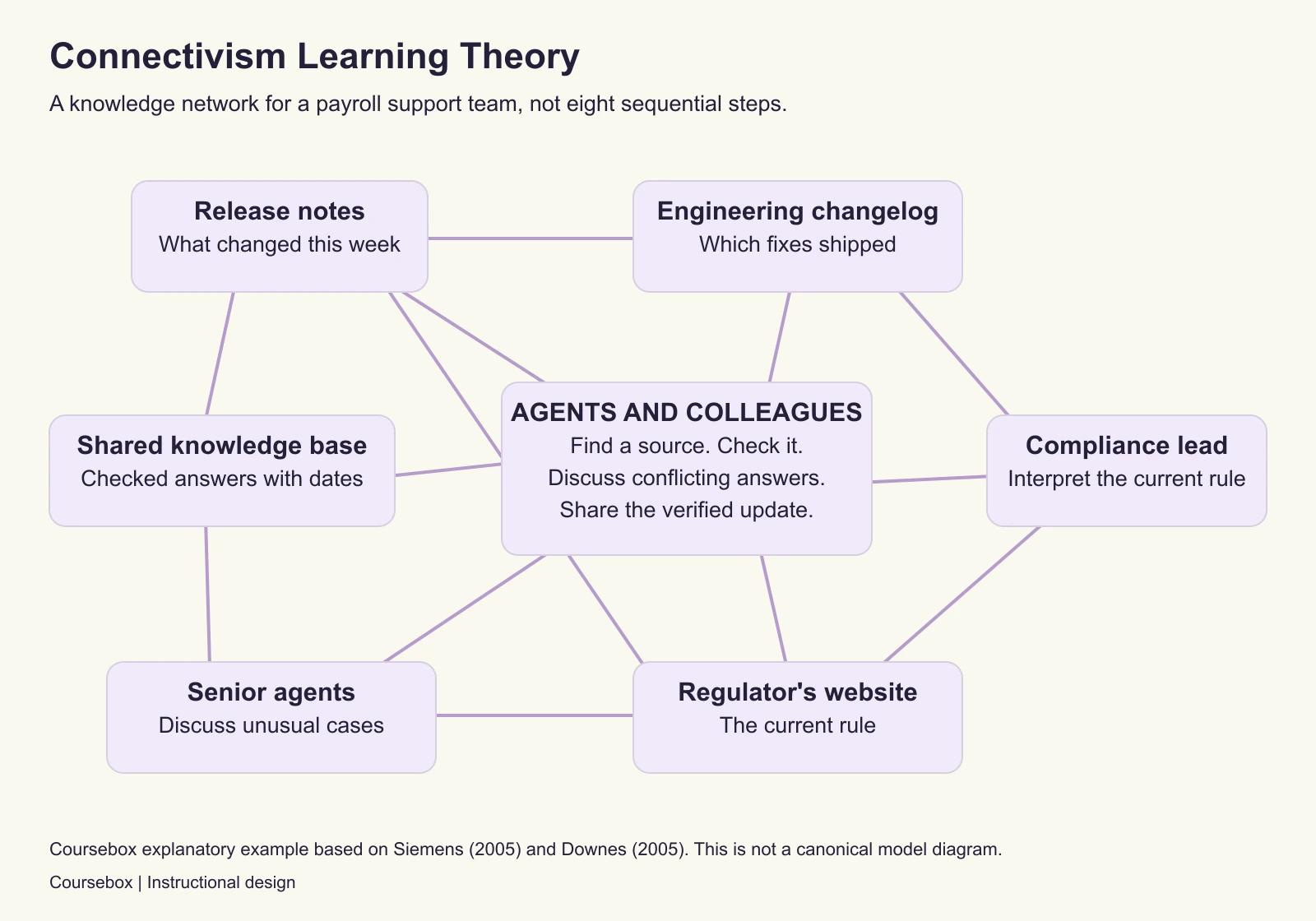
To show what each principle changes, I carry one hypothetical team through the rest of this guide, the team from the opening scene. It is a 30-person tier-1 support team at a mid-sized payroll software company. Agents answer customer tickets by email in the help desk. The product ships a release every Thursday, which changes screens, fixes bugs and sometimes changes how a payroll rule is applied after a regulator's update.
The problem is the one from the opening: the onboarding course was accurate on launch day and stale within a month, and agents fill the gaps from whoever sits nearby or old chat threads. The current knowledge is spread across the weekly release notes, the engineering changelog, the payroll compliance lead, two senior agents and the regulator's website. Rebuilding the course every week is not realistic. The intended outcome is that, after each release, an agent can find what changed, judge whether a source is current and authoritative, answer a ticket about a changed feature correctly, and pass on what they could not resolve to the right person.
The team suits connectivism because its most important knowledge changes faster than a course can be rebuilt and sits in people and systems rather than one document. It also shows the theory's limits: the stable core of the job, such as the help desk tool, tone, escalation rules and payroll basics, still needs a structured course.
The eight principles are not steps, and Siemens gives them no order. They describe one network from eight angles, so a single design choice, such as a release questions channel, can serve several of them at once. For fast-changing knowledge like this, principles 5, 7 and 8 do most of the design work in my reading. The other five mostly shape the source list and how you frame the problem.
1. Diversity of opinions
Siemens's first principle is "Learning and knowledge rests in diversity of opinions." No single person holds the whole answer, and views from different roles give a fuller picture.
- What it means: Put people with different knowledge in the same conversation, instead of relying on one expert.
- In the support team: Questions about a changed payroll rule go to the team's release questions channel, where agents, a product manager and the payroll compliance lead can all answer.
- How you would see it working: Answers in the channel come from more than one role, and agents say who confirmed what.
2. Connecting specialised nodes
The second principle reads "Learning is a process of connecting specialized nodes or information sources." A node can be a person, a document, a database or a tool.
- What it means: Knowing which source answers which kind of question is part of what people learn.
- In the support team: Agents learn that the release notes answer screen changes, the engineering changelog answers bug fixes, the compliance lead and the regulator's website answer payroll rules, and the two senior agents answer unusual cases.
- How you would see it working: Given a new ticket, an agent can name the right source before asking around.
3. Learning in non-human appliances
The third principle is "Learning may reside in non-human appliances." Note the word "may". This principle drew some of the sharpest objections. Pløn Verhagen objected in 2006 that it defines learning as a result rather than a process, and Bell noted in 2011 that technology appears "only tangentially" in the principles.
- What it means: Tools and systems can hold knowledge people rely on, such as a knowledge base or a search index.
- In the support team: Saved replies in the help desk and any AI assistant trained on the release notes hold answers agents use, but only as current as their last update.
- How you would see it working: Agents check the date of what a tool is drawing on before they trust it.
Connectivism does not predict or vouch for AI tools. Treat an AI assistant as one more source to check, not as proof that the theory applies.
4. Capacity to know more
Siemens's fourth principle reads "Capacity to know more is more critical than what is currently known", with no full stop in the original. The point is the ability to find out what you need next, not a general preference for learning over knowing.
- What it means: Teach people how to find the next answer, not only today's answer.
- In the support team: Onboarding has agents look up this week's changes in the release notes and changelog, rather than memorise this month's screens.
- How you would see it working: In a practice ticket about a feature that changed after their training, an agent finds the current answer before replying.
5. Nurturing and maintaining connections
The fifth principle is "Nurturing and maintaining connections is needed to facilitate continual learning." Connections fade unless someone looks after them.
- What it means: A network needs a place, a routine and someone who keeps it going after training ends.
- In the support team: The release questions channel has a named owner, one of the senior agents, and a Friday ticket readiness check in which agents review open tickets the release affects.
- How you would see it working: Questions get answered by the owner or a colleague, and new agents post as well as read.

Case study: Health workers across 19 Francophone African countries
Female genital schistosomiasis (FGS) is missing from most health curricula and continuing education, which the study's authors describe as largely driven by materials from higher-income countries. Of the health workers accepted into a 2023 virtual program run by The Geneva Learning Foundation with Bridges to Development, 14% had never heard of FGS and 62% had no experience with it.
- What they did: In Phase 1, participants learnt about FGS, wrote an action plan for their own setting and peer reviewed other participants' plans. Phase 2 supported them to put their plans into practice. The program was built on the foundation's peer learning-to-action model, and the researchers then analysed it through the lens of connectivism, so connectivism was the evaluation lens, not the design basis.
- Evidence and result: In the 2025 mixed-methods study, 786 of 1,686 applicants were accepted and 255 completed Phase 1. Of the 145 who applied for Phase 2, 71 completed it. Among survey respondents, the share who reported comprehensive knowledge of FGS rose from 18.0% to 47.2%, and those who found peer support useful reported larger knowledge gains. After Phase 2, 23% had completed their action plans and 71% had begun them.
- Limitation: Every outcome was self-reported, survey response rates were 31% to 49%, there was no control group and no observed clinical outcome, and the authors work or worked for the organisations that ran the program. About a third of accepted participants finished Phase 1.
- Lesson: Asking peers to review each other's real work plans put the network to work on the teaching. Reach is not application, though: under a quarter had finished their plans. Track completion and use, not sign-ups.
6. Seeing connections between fields
The sixth principle reads "Ability to see connections between fields, ideas, and concepts is a core skill."
- What it means: People learn to link a change in one area to its effect in another.
- In the support team: An agent notices that a regulator's update changes how a payroll rule is applied on the pay run screen, and flags it before tickets arrive.
- How you would see it working: Agents link a ticket to the release or rule change behind it, in the ticket notes.
7. Currency
The seventh principle is "Currency (accurate, up-to-date knowledge) is the intent of all connectivist learning activities."
- What it means: Activities exist to keep knowledge current, not to cover a topic once.
- In the support team: Every Thursday each agent reads the release note and scans the changelog for anything touching their ticket types.
- How you would see it working: Replies about changed features match the current release, and stale saved replies get flagged.
Siemens's article quotes the claims that knowledge doubles every 18 months and that half of what is known today was not known 10 years ago. He is quoting Gonzalez (2004), who attributes them to "the American Society of Training and Documentation (ASTD)", a misnaming of the American Society for Training and Development, and no underlying study is cited. Use your own evidence of change instead, such as the number of releases or policy updates in a quarter.
8. Decision-making
Siemens's eighth principle has three sentences: "Decision-making is itself a learning process. Choosing what to learn and the meaning of incoming information is seen through the lens of a shifting reality. While there is a right answer now, it may be wrong tomorrow due to alterations in the information climate affecting the decision." The second and third sentences carry the point for workplace training: today's right answer can be wrong after the next change.
- What it means: Choosing which information to trust is itself something people learn and practise.
- In the support team: Agents practise on one ticket about a changed feature with three conflicting answers: an old chat thread, this week's release note and a senior agent's reply from before the release. They choose one and explain why.
- How you would see it working: An agent's reason names how current and how authoritative each source is, not just which one sounds right.
If you can change only a few things, give the network an owner and a routine (5), tie that routine to the change cycle, such as the Thursday release (7), and have people practise choosing between conflicting sources (8). The other principles mostly tell you what to put on the source list.
Downes's connective knowledge and the four properties of a healthy network
Stephen Downes's version of connectivism is about the nature of knowledge itself. In 2007 he wrote that "connectivism is the thesis that knowledge is distributed across a network of connections, and therefore that learning consists of the ability to construct and traverse those networks." Here learning is a skill, the ability to build and move through a network, rather than a store of facts.
This is where connectivism parts company with constructivism. Downes writes that "In connectivism, a phrase like 'constructing meaning' makes no sense", and that connectivism "denies that knowledge is propositional". His view of teaching follows from it: "to teach is to model and demonstrate, to learn is to practice and reflect."
Downes also describes what makes a network good at producing knowledge. He names four properties, though their order and the name of the fourth vary across his writing: autonomy, diversity, openness and interactivity, which he also calls connectivity or connectedness. The questions in the table are paraphrased from his 2005 essay, and the last two columns apply them to the support team's network. Use them as prompts, not as a score.
| Property | Downes's question, paraphrased | In the support team's network | Warning sign |
|---|---|---|---|
| Autonomy | Do people contribute of their own accord, from their own knowledge and judgement? | Agents decide what to post and ask | Only the channel owner ever posts |
| Diversity | Does the network include the widest range of points of view? | Support, product and the payroll compliance lead are all in the channel | Every answer comes from the same two senior agents |
| Openness | Can any perspective be entered, heard and responded to? | Any agent, including new starters, can ask a question | New agents read but never ask |
| Interactivity | Is knowledge produced by interaction, or is it a mere aggregation of views? | Answers come out of conversation in replies | The channel is one-way announcements |
The same four properties pulled against each other in CCK08. Mackness, Mak and Williams found that autonomy, diversity, openness and connectedness "present paradoxes which are difficult to resolve in an online course", and concluded that "autonomy is, paradoxically, jeopardised in the absence of constraints". For a workplace network, that means some structure and a named moderator, not a channel left to run itself.
How to use connectivism to design training
Connectivism does not come with a design method of its own, so this is the order I would use. It keeps a structured course for what is stable and builds the network for what changes.
- Split the stable core from the moving edge. List what will still be true in six months, such as the help desk tool, tone and escalation rules, and teach it in a course. List what changes with each release or rule update, and plan the network for that.
- Map where current knowledge lives. For each source, person or system, note what it is reliable for, who owns it, how often it changes and how someone checks it is current.
- Give the network a place and an owner. One channel for questions about changes, with a named person who answers or redirects.
- Tie a routine to the change cycle. A short, fixed routine on release day and the day after, rather than a reminder to "stay up to date".
- Practise judging sources. Use real tickets with conflicting answers and ask for a choice plus a reason.
- Ask people to share back. Each person posts one change that affected their work and replies to a colleague, so the network grows from the inside.
- Assess what people produce and decide. Collect the routine's outputs and look at real work after the next change, as the assessment section below describes.
The support team's weekly change routine
The routine below turns steps 3 to 6 into a week for the payroll support team.
| When | What agents do | Source or place | Evidence it happened |
|---|---|---|---|
| Thursday, release day | Read the release note and scan the engineering changelog for changes to their ticket types | Release notes and engineering changelog | A line in the agent's weekly change log |
| Thursday afternoon | Post any question about a change | Release questions channel | Question answered by the channel owner or a colleague |
| Friday morning | Ticket readiness check: list open tickets the release affects and what each reply now needs | Help desk queue | Affected tickets tagged with the release |
| Friday | Post one change that affected a customer ticket and reply to one colleague's post | Release questions channel | One post and one reply per agent |
| When a payroll rule changes | Check the regulator's website and confirm with the payroll compliance lead before replying | Regulator's website and compliance lead | Saved reply updated with the date it was checked |
| When an agent cannot resolve a ticket | Escalate with what was already checked, then post the answer for the next agent | Escalation queue and release questions channel | A knowledge handoff note in the channel |
A one-week routine tied to a product release, a weekly change log and review questions, with the payroll support team filled in as an example and blank pages for your own team. Editable Word file, no email required.
How do you assess learning in a connectivist design?
Assess what people produce and decide with the network, not what they can recall. Downes's slogan points the same way: if learning is practice and reflection, the evidence is the practice. The table lists the evidence I would collect for the support team and what each piece cannot tell you.
| Evidence | What it shows | What it cannot show |
|---|---|---|
| Source-check task with a written reason | Whether the agent weighs how current and how authoritative each source is | Whether they do the same under time pressure on live tickets |
| Weekly change log | Whether the agent follows the routine and records what changed | Whether the change log is accurate |
| Posts and replies in the release questions channel | Whether the agent contributes to the network, not only reads it | Whether the agent learned anything; posting is engagement, not learning |
| Agent's own source map, kept up to date | Whether the agent knows where current knowledge lives | Whether they use it when it counts |
| Review of replies to tickets about changed features after a release | Whether the routine reaches the work customers see | Which part of the design caused any change |
None of this adds up to a validated score, and a count of posts says nothing about whether answers improved. The strongest evidence is in the last row, which is also the slowest to collect.

Case study: Emergency physicians' online case discussions
The Academic Life in Emergency Medicine (ALiEM) website is run by emergency physicians in Canada and the United States. Its team wanted to reach clinicians with faculty development, and they wrote that "It is difficult to engage clinicians in continuing medical education that does not focus on clinical expertise."
- What they did: From August 2013 to January 2014, the site posted a realistic case about a medical education dilemma each month, opened it to a one-week discussion on the site and on Twitter, then curated the discussion into a community commentary published with expert responses and downloadable resources. The team describes the series as using "connectivist and constructivist approaches", so connectivism was part of the design basis, alongside constructivism.
- Evidence and result: In their 2015 report on the first six cases, each case drew a median 767 unique visitors, from a median 45 countries, and 30 comments in its first week. The open discussion posts carried a median 4,313 words of participant writing, against 333 for the curated wrap-up posts. By February 2014, six readers had told the team they had used the resources to run local teaching sessions.
- Limitation: The authors say they "used only surrogate measures of reader engagement. These metrics do not necessarily equate to learning". It covers six cases, with no control group, and connectivism was combined with constructivism.
- Lesson: An open, moderated discussion of a messy real case drew far more writing than the polished summary. That is engagement, so decide up front how you will check whether people apply what they discussed.
What do course requests ask for?
To see whether people brief courses with a network in mind, I looked at a sample of requests typed into Coursebox in the 90 days to 7 October 2026: one per person, from English-language browsers, with no uploaded file. Of the 266 prompts in the sample, 109 were course requests. AI models read each request and classified it by meaning, not by keywords, and every positive was checked by hand against the original text. These are classification estimates, not audited upper bounds. The course-request count can vary with the coding definitions; this pass classified 109 requests, while the Kolb and Gibbs passes classified 104.
None asked for a way to keep knowledge current. Peer discussion or group work came up in about 6, curated outside resources in 2, judging sources in 2 (both as the topic of the course, such as spotting misinformation) and an ongoing community in 1. One request asked for two of these, so they add up to more than 10. This is a sample of requests, not of finished courses, and it says nothing about what creators add after generation. Still, most requests describe a course as a closed package. If your topic changes often, the network layer has to go into the brief on purpose: who learners stay connected to, which sources they check and how they find out what changed.
Is connectivism a learning theory? The four critiques
The debate started within two years of the article, and it decides how much weight connectivism can carry in a training strategy. Four critiques carry most of it.
- Pløn Verhagen (2006): a pedagogical view, not a learning theory. In Connectivism: a new learning theory? Verhagen argued that Siemens's questions belong "at the level of the curriculum", which is "concerned with what is learned and why", rather than at the instructional level, where learning theories explain how learning happens. He also said the elements "are not at all new". Siemens replied the next day in Connectivism: Learning Theory or Pastime for the Self-Amused?, arguing that knowledge sits across a network and that "The learning is the network."
- Kop and Hill (2008): important, but not a separate theory. In their 2008 paper they conclude that connectivism's contributions do not "warrant it being treated as a separate learning theory in and of its own right", but that it "continues to play an important role in the development and emergence of new pedagogies". They also point out that "not all people are autonomous learners."
- Bell (2011): insufficient on its own and untested. In a 2011 IRRODL paper on connectivism's place in research, Bell writes that "connectivism alone is insufficient to inform learning and its support by technology", that it is "perceived as relevant by its practitioners but as lacking in rigour by its critics", and that "it is yet untested". The paper explores other frames, such as actor-network theory and activity theory, for studying technology-enabled learning.
- Clarà and Barberà (2014): three problems. In Three problems with the connectivist conception of learning, they name the lack of a solution to the learning paradox, the underconceptualisation of interaction and the inability to explain concept development.
The defenders have a case too. In a 2019 review of recent work, Downes found that where connectivism was explicitly evaluated, "Most outcomes were positive or at worst neutral". He describes the review himself as a snapshot of the discussion "rather than an empirical review", and he is reviewing his own theory.
My reading is that Verhagen's point is the useful one. Connectivism is strongest at the curriculum level, deciding what people must stay connected to and where current knowledge lives. It says much less about how a newcomer learns a concept or a procedure, which is the gap Clarà and Barberà's third problem names. That is why the support team still gets a structured course for the stable core.
What does the evidence show?
Most of the published evidence comes from open courses and from networks of health and teaching professionals, and it is mostly self-report, participation data and interviews. I found no controlled outcome trials in the sources I read. The table summarises the studies behind this guide.
| Program | Year | Design | Who was counted | What was measured |
|---|---|---|---|---|
| CCK08 open course, Canada | 2008 | Surveys and interviews | 83 survey respondents of 415 invited; 22 interviews of 58 invited | Participation, completion and experience |
| PLENK2010 open course, Canada | 2010 | Surveys and activity tracking | 1,641 registrants; 40 to 60 regular contributors; 4 facilitators | Participation and support |
| Emergency medicine case discussions | 2013 to 2014 | Descriptive report on 6 cases | Web analytics for each case | Visitors, comments and words written |
| Health workers in 19 Francophone African countries | 2023 | Pre and post surveys, no control group | 255 of 786 accepted finished Phase 1; 31% to 49% response | Self-reported knowledge and confidence |
| Teachers' learning networks, a related approach | Published 2016 | Cross-sectional survey | 732 teachers; 420 to 537 answers per question | Self-reported effects on practice and students |
The teachers' row is Trust, Krutka and Carpenter's 2016 survey of professional learning networks, a related approach that does not name connectivism.
The participation figures are the most consistent finding. In PLENK2010, an open connectivist course on personal learning networks, the organisers counted the regular contributors against the final registration.
That is about 2% to 4% of registrants. CCK08 was counted differently, but both courses show the same shape: a small active core and a large group who rarely post, which Kop, Fournier and Mak's study surveyed separately as lurkers. Plan for a few active contributors, a quiet majority and someone whose job is to keep the conversation going.
I could not find a verified case of a company that used connectivism as the explicit design basis for its training and measured the results. Corbett and Spinello's 2020 literature review reaches a similar view: "connectivism needs more academic research to establish it firmly as a learning theory".
Connectivism vs constructivism, social learning theory and communities of practice
Connectivism is most often confused with constructivism. The journal that published Siemens's article added an editor's note that it "should not be con fused [sic] with constructivism", and Downes's line about "constructing meaning" explains why: constructivism describes learners building understanding in their own minds, while connectivism places knowledge in the connections between people and sources. Two other neighbours come up in workplace training: Albert Bandura's social learning theory, which he later developed into social cognitive theory, and Jean Lave and Etienne Wenger's communities of practice, which grew out of situated learning theory.
The table is my synthesis for deciding which lens to use, not a ranking.
| Question | Connectivism | Constructivism | Social learning theory | Communities of practice |
|---|---|---|---|---|
| Where learning happens | In connections across people, sources and tools | In the learner, building on what they already know | By watching others and the results of their actions | By taking part in a group that shares a practice |
| Originators | George Siemens and Stephen Downes | Jean Piaget, Lev Vygotsky and others | Albert Bandura | Jean Lave and Etienne Wenger |
| Best for | Knowledge that changes fast and sits across many people and systems | Understanding built by working through problems | Skills and behaviour people can see done well first | Bringing newcomers into a craft or profession over time |
| Weak spot | Says little about how a newcomer learns a concept; thin evidence | Says little about knowledge held outside the learner, in Siemens's view | Says little about finding or judging information sources | Needs an existing community, which takes time to form |
| Use it when | You must decide what people stay connected to and how they stay current | Learners need to work through problems to understand them | People need to see a skill modelled before they try it | A group already shares its work and newcomers learn by joining in |
Connectivism is the wrong main lens in three situations:
- A novice learning a fixed procedure, especially a safety-critical or compliance procedure. Give a structured course with practice and feedback. Kop and Hill warn that not everyone learns autonomously. CCK08 completion figures do not establish how novices learn a fixed procedure, so choose the teaching method from the task and learners' prior knowledge.
- Knowledge that rarely changes and has one authoritative source. Start with the authoritative source. Add peer connections when they help people interpret it or apply it to difficult cases.
- A team with no one to look after the network. Even with facilitators, the open courses showed most people reading without posting, and in CCK08 trolling went unchecked.
For most teams the answer is a blend: a course for the stable core and a network for the moving edge.
Using connectivism with an AI course builder
Two product details shape the network layer before you build anything. Our AI tutor answers from the material it was trained on, and the page says to retrain it from the course editor whenever you update that material, so it is a source agents should date-check like any other. And our pricing page notes that a self-hosted SCORM export leaves out features that need a live connection, including the AI tutor, assignment submissions and discussions, and does not update when you edit the course. If your team runs training from its own LMS, plan the channel outside the course. A course also cannot create or moderate the team's network, or keep the release notes and the regulator's website current by itself.
On 7 October 2026 I briefed Coursebox for the support team's course. It is our product, so weigh my read with that in mind. The brief described tier-1 agents at a payroll software company, a release every Thursday and tickets answered by email, and asked for six parts: why product knowledge goes out of date, where current knowledge lives, a weekly routine for finding what changed, checking a source before replying, escalating and sharing what you learn, and a wrap-up.
The outline followed all six parts. Why Knowledge Ages opened the course. Trusted Knowledge Sources compared release notes with the engineering changelog and covered the payroll rule authorities. The Weekly Change Routine had a Thursday release scan, a Friday ticket readiness page and a page on posting in the release questions channel. Check Before Replying worked through a ticket about a changed feature with source check cards, Escalate and Share included a knowledge handoff, and Keep It Current was the final section.
One piece was missing. Escalate and Share covered handing off an escalated answer, but nothing asked agents to post what changed for each other, so the outline included using the network but no explicit task for contributing to it.
I asked for a page where agents post one change that affected a customer ticket and reply to a colleague's post. When I reloaded the outline, it showed Share What Changed for Your Customers as a discussion assignment, and the final outline ran about 56 minutes across 6 sections and 17 pages. That confirms the outline only: the discussion block itself is added in the course editor after the course is generated, and trialling the routine and checking the accuracy of ticket replies will show whether it helps; channel activity alone will not. With that page in place, the outline covers all three parts of the network design: where to look, how to check and how to share back.
Map where your team's current knowledge lives, check the network against Downes's four properties and practise choosing between conflicting answers, with the payroll support team filled in as an example and blank pages to use. Editable Word file, no email required.
Putting connectivism to work
Connectivism answers a narrower question than its name suggests. It does not explain how a new agent learns the help desk tool or a payroll calculation; a structured course with practice still does that. It is most useful as a design lens for the part of a job where the right answer changes faster than training can be rebuilt. There it tells you to decide what people must stay connected to, where current knowledge lives, who looks after the connections and how people judge what they find. The evidence behind it is mostly participation data and self-report, so treat it as a planning frame, not a promise of results.
Before your next release or policy change, fill in a source map for one team: each source they rely on, what it is reliable for, who owns it and how people check that it is current. After the change, judge it by the replies customers received, not by activity in the channel.
Frequently Asked Questions
Connectivism learning theory is George Siemens's 2004 account of learning as building and using networks of people, sources and tools, where knowing where to find current knowledge, and how to judge it, counts for more than what you already know. It is set out in eight principles in his 2005 journal article.
George Siemens published it on his elearnspace site on 12 December 2004 and in a journal in January 2005. Stephen Downes developed the parallel idea of connective knowledge from 2005, and the two ran an open online course on the theory, CCK08, together in 2008.
Constructivism describes learners building understanding in their own minds from what they already know. Connectivism places knowledge in the connections between people, sources and tools, and treats learning as forming and using those connections. Downes argues that "constructing meaning" makes no sense in connectivism.
No. Connectionism is Edward Thorndike's term for learning as bonds between a stimulus and a response, and later the name for neural-network models of the mind. Connectivism is Siemens's 2004 theory of learning through networks of people, sources and tools.
In a classroom it usually means learners building their own networks, such as following experts, contributing to shared blogs or forums and judging online sources, with the teacher modelling how to do it. At work the same idea becomes a curated source list, a channel with an owner and a routine for checking what changed.
Carolina Martin
Carolina is a highly experienced learning designer with tech start-up experience. She is based in Sydney and previously designed courses alongside Coursebox founder Travis in a previous job. She is passionate about delivering engaging learning experiences and brings the same perspective to customer experience too. She manages our customer support documentation and product testing processes.

