

Kolb's Experiential Learning Cycle: Theory, Stages, Examples
Kolb's experiential learning cycle explained: the four modes, how they connect, what the evidence says about learning styles, and two free templates.

Kolb's experiential learning cycle is David Kolb's model of how people learn from experience, through four modes: having an experience, reflecting on it, making sense of it with concepts, and trying out what they concluded, in a repeating spiral.
- Kolb says a learner can enter the cycle at any of the four modes, and a full loop touches all four.
- Kolb's learning style profile is a self-reflection tool, and his own guide rules out using it for selection or job assignment.
- In a retest study reported in Kolb's own 2013 guide, 47% of business students changed learning style category.
- Of 104 course requests typed into Coursebox over 90 days, about 8 were classified as asking for reflection; none were classified as asking for all four modes. These are estimates, not a census.
Five questions, about a minute. Answer for one course or module you are building or reviewing. This is an unvalidated planning check. Inspect each answer and test the resulting design with learners; the total does not certify learning or effectiveness.

Go from storyboard to an interactive course in minutes
Picture a new shift team leader watching a forklift reverse out of an aisle and miss a picker by a metre. The driver skipped the pre-shift check that morning. The team leader finished a safety leadership module last week: three pages on giving feedback, a model with a neat acronym, and a quiz they passed. Back on the floor, they say nothing, because nothing in the module ever asked them to have that conversation.
I'm an instructional designer at Coursebox, where we make instructional design software that turns a designer's brief into a course outline. Much of my work is deciding what a course asks people to do, not only what it tells them. David Kolb's experiential learning cycle is one of the best tools I know for that decision. I walk through what the cycle is in Kolb's own words, how its four modes connect, what the evidence says about his learning styles, and one coaching course for team leaders built with it, including a test in our own product.
What is Kolb's experiential learning cycle?
Kolb's experiential learning cycle is David Kolb's model of how people learn from experience, through four modes: having an experience, reflecting on it, making sense of it with concepts, and trying out what they concluded, in a repeating spiral.
Kolb's own definition of learning is shorter. In the second chapter of Experiential Learning: Experience as the Source of Learning and Development (1984, p. 38), he writes: "Learning is the process whereby knowledge is created through the transformation of experience." Knowledge, in this view, is not something handed over and stored. It is built and rebuilt each time someone takes in an experience and does something with it.
The cycle has four modes. Kolb's names are Concrete Experience, Reflective Observation, Abstract Conceptualization and Active Experimentation, and his institute now uses the plain names Experiencing, Reflecting, Thinking and Acting. I keep Kolb's US spelling for the mode and style names and use Australian spelling everywhere else. The modes are often called stages, but they are not steps that every course must march through in the same order.
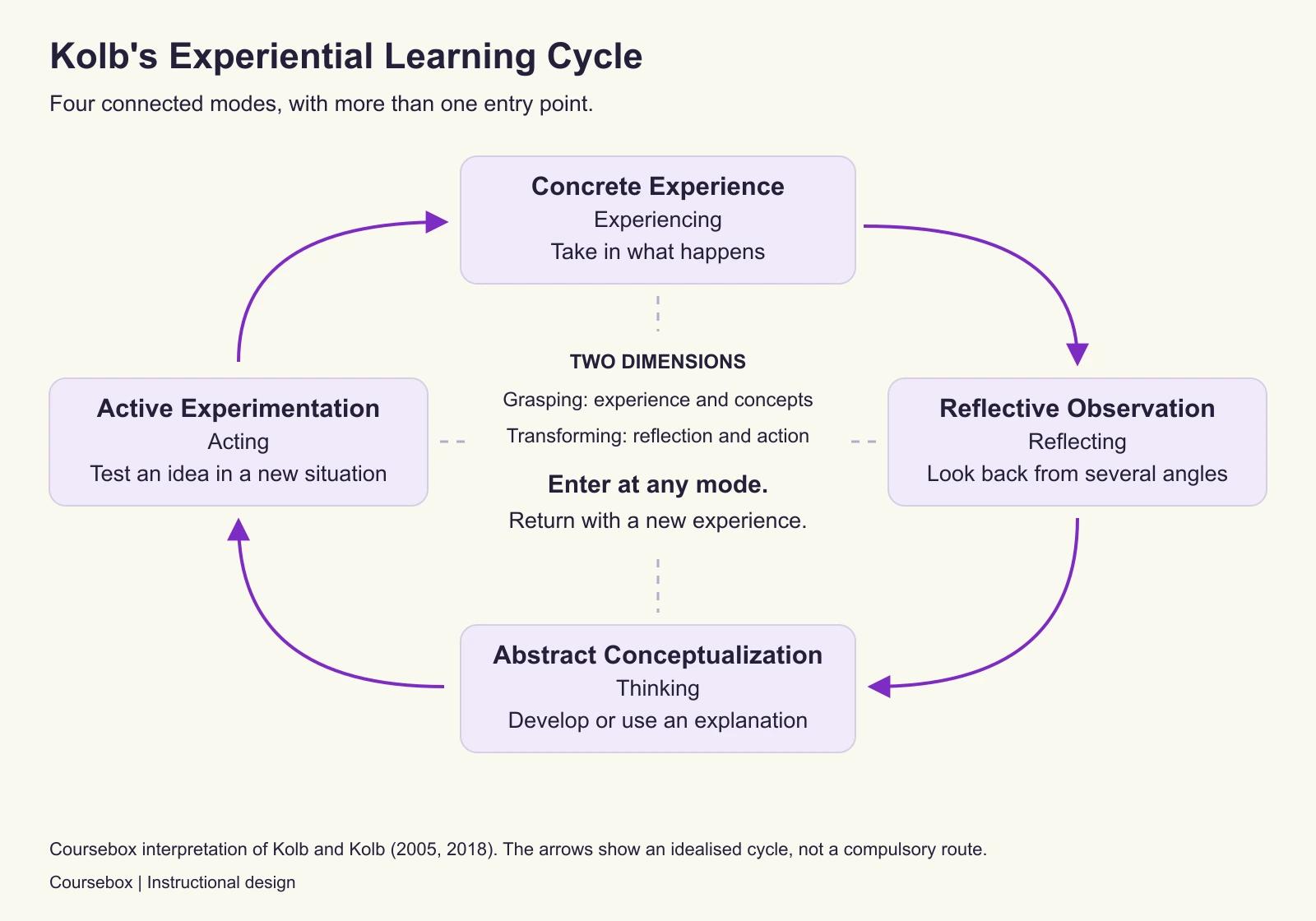
| Mode | Plain name | What the learner does | The question it asks of your course | What it can look like at work |
|---|---|---|---|---|
| Concrete Experience | Experiencing | Takes in an experience directly, with feeling and attention | What will learners go through, see or feel? | A scenario, a role-play, a real task or a shift on the floor |
| Reflective Observation | Reflecting | Looks back at the experience from different angles | When do learners stop and look at what happened? | A debrief, open reflection questions, a review with a manager |
| Abstract Conceptualization | Thinking | Builds or uses concepts that explain the experience | Which model or principle makes sense of what happened? | A feedback model, a procedure explained, a worked example |
| Active Experimentation | Acting | Tests those ideas in a new situation | Where do learners try it for real, and how is it recorded? | A second scenario, a task on the next shift, a project at work |
The two dimensions behind the cycle
The four modes sit on two dimensions. In their 2005 paper on learning styles and learning spaces, Alice and David Kolb describe "two dialectically related modes of grasping experience", Concrete Experience and Abstract Conceptualization, and "two dialectically related modes of transforming experience", Reflective Observation and Active Experimentation (p. 194).
- Grasping is how a learner takes in an experience: directly, through what happens to them (Concrete Experience), or through concepts and models (Abstract Conceptualization).
- Transforming is what the learner does with it: watches and reflects (Reflective Observation), or acts and tests (Active Experimentation).
The two poles of each dimension pull against each other, and Kolb sees that tension as what drives learning. Across a full learning cycle, plan both halves of each pair. A module that only explains a model and quizzes it grasps through concepts and never gives learners an experience to make sense of.
Many diagrams label Concrete Experience as "doing". In Kolb's terms, doing is Active Experimentation. Concrete Experience is taking in an experience directly, which can be a scenario, a conversation or even a lecture. In their 2018 summary of the cycle, Alice and David Kolb write that the Experiencing mode "is widely misunderstood", because cycle images "equate experiencing with doing" (p. 9).
A cycle, a spiral, and more than one way in
Kolb draws the modes as a circle, but he does not treat the circle as a fixed route. The 2005 paper calls it "an idealized learning cycle or spiral where the learner 'touches all the bases'" (p. 194). In the 2018 summary, Alice and David Kolb write that "The idea that learning must always begin with concrete experience and proceed through the other stages around the cycle is not an iron law" (p. 12). They also note that some experiential educators they know argue strongly for starting with a direct experience, which is a design decision, not a rule of the theory.
The spiral is the useful part for course design. The try-out at the end of one loop becomes the experience that starts the next one, a little more complex each time. The same 2018 summary advises designers to "Organise your course or curriculum as a series of learning cycles" (p. 9).
Where the cycle came from
In the 1984 book, Kolb credits three earlier thinkers. He ties the theory to its "intellectual origins in the work of Dewey, Lewin, and Piaget" (p. 20), and the shape of the cycle comes from Kurt Lewin's model of action research and laboratory training, which also began with here-and-now experience. Kolb's later papers add William James, Carl Jung, Paulo Freire and Carl Rogers among others.
The dates are often given wrongly. The cycle was first used in the late 1960s in an organisational psychology course for MBA students at MIT's Sloan School of Management, according to Alice and David Kolb's 2017 guide for experiential educators. The first published statement of the theory was in 1971, the book followed in 1984, and a second edition came out in 2015. The Learning Style Inventory was created in 1969 and first published in 1971. A 1976 version was widely used, so some sources date the inventory to 1976.
The 2005 paper also sets out six propositions that the theory shares with those earlier thinkers:
- "Learning is best conceived as a process, not in terms of outcomes."
- "All learning is relearning."
- "Learning requires the resolution of conflicts between dialectically opposed modes of adaptation to the world."
- Learning involves the whole person, adapting to the world through thinking, feeling, perceiving and behaving.
- "Learning results from synergetic transactions between the person and the environment."
- "Learning is the process of creating knowledge."

Case study: AI reskilling at Ericsson in North America
Ericsson's North American business paired telecom specialists with data scientists, but the data scientists lacked telecom knowledge, some left, and online courses had not helped staff apply AI concepts to the business.
- What they did: With the University of Texas at Arlington, Ericsson built a reskilling program on Kolb's cycle, which the authors call a learn, ideate, apply and reflect model. Four graduate-level courses ran in six-week units on Ericsson's campus, with classes of no more than 15. Cross-functional teams worked on real business problems with a manager as sponsor, presented to sponsors and senior managers after each unit, then reflected and revised.
- Evidence and result: A 2025 case study in the Journal of Information Systems Education reports six cohorts since 2019. It is based on interviews with 13 people (7 graduates, 4 managers or sponsors and 2 senior managers). The authors estimate the projects' current and future value at "several million dollars", and managers described graduates moving into other groups and starting AI interest groups.
- Limitation: This is an insider account: the program designers and an Ericsson executive wrote it. The dollar figure is an estimate with no stated method, the total number of participants is not reported, and there was no test, baseline or comparison group.
- Lesson: The cycle can run as a spiral across a whole program, not only inside one module. Tie each loop to a real problem with a named sponsor, make the review with that sponsor the reflection step, and leave weeks between units so people apply what they learn.
Which Kolb sources to read, and how to cite them
- Start with the 2018 summary of eight things to know about the cycle by Alice and David Kolb. It is seven pages, free on Kolb's own site, and states his current position on entry points and learning styles.
- For course design, read the 2017 guide for experiential educators. It covers the spiral and the four roles an educator plays around the cycle.
- For the theory in full, read the book itself, in its 2015 second edition from Pearson. The 1984 first edition is the one most papers cite.
To reference the book in APA style, use the edition you read:
- Kolb, D. A. (1984). Experiential learning: Experience as the source of learning and development. Prentice-Hall.
- Kolb, D. A. (2015). Experiential learning: Experience as the source of learning and development (2nd ed.). Pearson Education.
Page numbers differ between the two editions, so a 1984 page number should not appear in a citation to the 2015 edition.
The four modes, worked through one course
To show the modes in use, I carry one hypothetical course through the rest of this guide. A regional distribution centre has promoted experienced warehouse operators to shift team leader. They know the work and the site's traffic rules well, but most have never given a colleague feedback about unsafe behaviour, and a new title does not give them that skill. After a near miss, such as a forklift driver who skipped the pre-shift check or a picker who walked through a marked pedestrian exclusion zone, new leaders either say nothing or tell the person off in front of the team, and the behaviour repeats.
The intended outcome is a short private conversation on the warehouse floor, face to face, about two minutes long. The leader describes the situation, the specific behaviour and its impact, asks for the team member's view, agrees one next step, and follows up on the next shift. For the middle part, the course uses the Center for Creative Leadership's Situation-Behavior-Impact feedback model, often shortened to SBI. To practise, learners get what a real leader would have: what they saw, the site's rule that applies, and the near-miss report.
This course shows the cycle well for three reasons. The skill is learned by doing it and looking back at it. Two of the modes happen partly on the warehouse floor rather than in the course, so the decision about where each mode happens is real. And the first real conversation becomes the experience that starts the next loop.
The coaching task begins after immediate hazards have been controlled and the site's incident-reporting and escalation steps followed. A private conversation is part of the learning follow-up; it does not replace those procedures or authorise continued use of unsafe equipment.
For each mode I give the role Kolb assigns the educator in his 2017 guide, prompts that suit it, and what it looks like in the near-miss course.
1. Concrete Experience (Experiencing)
The learner takes in an experience directly, with attention and feeling, whether it comes before or after an explanation. In a self-paced course, a scenario the learner plays usually gives a more direct experience than a story they read.
- Your role: Facilitator. In Kolb's description, facilitators "help learners get in touch with their personal experience and reflect on it".
- Prompts that work: "You're the team leader. What do you say first?" "What do you notice about how the driver reacts?"
- In the near-miss course: The course opens with The Forklift Near Miss, a branching scenario in which the learner plays the team leader, makes three choices in the conversation with the driver and sees the consequence of each. No model is explained before it. A scenario-based learning page like this is where an online course can supply the experience itself.
2. Reflective Observation (Reflecting)
The learner looks back at the experience and considers it from more than one angle. Reflection needs time and an open question. A multiple-choice quiz tells learners there is a right answer before they have looked at what happened.
- Your role: Facilitator, still. The job is to slow learners down so they notice what happened before they explain it.
- Prompts that work: "What did you say, word for word?" "What happened next?" "How did the driver react, and why do you think they reacted that way?" "What would you change?"
- In the near-miss course: Open-text questions about the scenario the learner has played. In the second loop, the same questions are asked about the real conversation on the floor, in a short review with the shift manager.
3. Abstract Conceptualization (Thinking)
The learner builds or uses a concept that explains the experience and can carry over to the next one. This mode is about making sense, not planning. A question such as "What will you do differently next time?" belongs to Active Experimentation.
- Your role: Subject expert. Kolb's subject experts "help learners organize and connect their reflections to the knowledge base of the subject matter".
- Prompts that work: "Which part of your reply described the behaviour, and which part judged the person?" "Why did the driver get defensive at that point?"
- In the near-miss course: A short page on the three parts of SBI and a two-minute worked example, then a page that links each SBI part to the choices the learner made in the forklift scenario. The learner rewrites their own scenario reply using the model.
4. Active Experimentation (Acting)
The learner tests the ideas in a new situation, where the result can surprise them. This is the doing mode. Self-paced courses often leave it out, because the real test usually happens at work.
- Your role: Standard-setter and evaluator, then coach. Kolb's evaluators "help learners master the application of knowledge and skill in order to meet performance requirements", and coaches "help learners apply knowledge to achieve their goals".
- Prompts that work: "Here is a new situation. Build your opening line." "On your next shift, hold one conversation and note what you said and how the person responded."
- In the near-miss course: A second scenario, The Exclusion Zone Choice, in which a picker walks through a marked pedestrian exclusion zone and the learner builds the coaching message. Then a task for the next shift: hold one real conversation using a one-page prompt card and record what happened. That conversation is the concrete experience that starts the second loop.

Case study: Combat casualty care training in China
Staff on mobile medical logistics teams at the Chinese PLA General Hospital, with a median of seven to eight years' service, had few chances to practise combat casualty decisions under pressure, and their training focused on skills rather than reasoning.
- What they did: The researchers built a serious game on Kolb's cycle and mapped each mode to a part of it: battlefield case scenarios for experience and reflection, a teacher presentation and skills review for concepts, and game simulation to try decisions again, with reflection on later missions starting the next round. After each case the game showed the learner's errors and a standard rescue flow chart.
- Evidence and result: In a randomised study published in JMIR Formative Research in 2024, 148 of 155 staff were analysed (70 game, 78 video course). Knowledge test scores after training were 82.20 for the game group and 78.77 for the video group (P = .02). Self-rated confidence on three decision items was higher in the game group, and overall satisfaction did not differ.
- Limitation: The comparison was a Kolb-designed game against a video course, with about 30 more minutes for the game group, so the gain cannot be credited to Kolb's cycle alone. The knowledge test was taken straight after training, confidence was self-rated, and nobody measured performance in exercises or in the field.
- Lesson: When you build a simulation, decide where each mode happens: the scenario, the debrief, the short explanation and the retry. Show learners their errors right after each attempt, and test their decisions, not only what they recall.
How the four modes connect across a blended program
The cycle is a design check, not a script. Every course in the program should grasp experience both ways, through what happens and through concepts, and transform it both ways, through reflection and action. That does not mean every module must hold all four modes in one sitting, and it does not mean the order is fixed.
In a blended program, two of the modes often happen outside the course. Alice and David Kolb point out that "all modes of the learning cycle are experiences", and the practical question for a designer is where each one takes place. For the near-miss program, I would plan it like this.
| Mode | In the course | On the warehouse floor | In the review with the shift manager |
|---|---|---|---|
| Concrete Experience | The Forklift Near Miss scenario | The real conversation on the next shift | The leader recounts the conversation |
| Reflective Observation | Open questions about the scenario | A few notes straight after the conversation | Questions about what was said and how the person reacted |
| Abstract Conceptualization | SBI linked to the learner's scenario choices | The prompt card as a reminder | Which part of SBI held up and which did not |
| Active Experimentation | The Exclusion Zone Choice scenario | One real conversation, recorded | One change to try in the next conversation |
Two things follow. First, in this blended programme the course alone does not complete the planned cycle, so the try-out and the review need an owner outside the course, usually the leader's manager. Second, the review is where the spiral turns: the leader goes into the next near miss with one change to test, and the next loop starts from a real conversation rather than a scenario.
Some new leaders will have coached people informally as senior operators. They can start at Abstract Conceptualization: read the SBI page, compare it with how they already handle near misses, then try it on the next shift. Kolb's 2018 guidance allows learners to begin with their preferred mode, as long as they keep moving around the cycle.
For activity ideas for each mode, our list of experiential learning activities has more options.
How to use Kolb's cycle to design a course
Kolb gives principles rather than a step-by-step design method, so here is a workflow built on his 2017 and 2018 guidance.
- Write the outcome as something people do at work. For the near-miss course, that is a private two-minute conversation after a near miss, followed up on the next shift. Measurable learning outcomes make the later steps easier.
- Choose the experience that starts the first loop. Decide whether learners start with a scenario, a real task or a model, based on what they already know.
- Plan all four modes, and decide where each one happens. Mark each activity as in the course, on the job or in a review, and name who runs the parts outside the course.
- Write the reflection questions before the content. They should refer to the experience learners have had, and they should be open questions.
- Link the concept back to the experience. The model page should name the choices learners made, not stand alone.
- Build a try-out in a new situation, with a way to record it. A second scenario in the course, then a real task at work with a prompt card.
- Schedule the review that starts the next loop. Agree when it happens and who asks the questions, then plan the next round a little harder.
- Evaluate behaviour, not only the quiz. Whether leaders actually hold the conversation is a behaviour question, the third level of the Kirkpatrick model.
The near-miss course, mode by mode
| Step | Mode | Where it happens | Educator role | What the team leader does |
|---|---|---|---|---|
| The Forklift Near Miss | Concrete Experience | In the course | Facilitator | Plays the team leader and makes three choices in the conversation with the driver |
| Reflect on the scenario | Reflective Observation | In the course | Facilitator | Writes what they said, what happened next and what they would change |
| SBI and a worked example | Abstract Conceptualization | In the course | Subject expert | Rewrites their own scenario reply using Situation, Behavior and Impact |
| The Exclusion Zone Choice | Active Experimentation | In the course | Standard-setter and evaluator | Builds a coaching message for a picker in the exclusion zone, checked against the three SBI parts |
| Next-shift conversation | Active Experimentation, then Concrete Experience | On the warehouse floor | Coach | Holds one real conversation with the prompt card and notes what happened |
| Review the try-out | Reflective Observation, in loop two | Review with the shift manager | Facilitator and coach | Talks through the conversation and agrees one change for the next one |
Plan a course or module around Kolb's four modes, with a guide to each mode, the educator role and prompts that suit it, the near-miss coaching course filled in as an example, and blank planning pages that ask where each mode happens and who runs it. Editable Word file, no email required.
What do course requests ask for?
To see how people brief courses, we looked at a sample of requests typed into the Coursebox course builder in the 90 days to 7 October 2026: one per person, from English-language browsers, with no uploaded file. Of 266 prompts, 104 were course requests. A language model read each one against written definitions of Kolb's four modes and quoted the words behind every positive, and I checked every flagged quote by hand. Borderline cases were included, so treat the figures as classification estimates. Checking flagged quotations does not establish an upper bound or detect every missed request.
About 8 asked for reflection, none asked for all four modes, and none asked to start with the experience. About 6 asked learners to apply or try out what they learned, about 5 asked for a model to make sense of experience, and 39 only listed topics to cover. The counts describe what people typed, not what their finished courses contained, and one 90-day sample of English requests says nothing about Coursebox users as a whole. What it does suggest is that the reflection and the try-out rarely appear in a brief. If you want them in the course, write them into the brief by name: the experience, the reflection questions and the task back at work.
Kolb's learning styles, and what the evidence says
Kolb's cycle and Kolb's learning styles are two different things, and the evidence treats them differently.
A learning style, in Kolb's 2005 paper, describes "the learner's preference for employing different phases of the learning cycle". The classic four styles each combine two modes:
| Style | Modes it favours | Plain description |
|---|---|---|
| Diverging | Concrete Experience and Reflective Observation | Looks at a concrete situation from many angles |
| Assimilating | Abstract Conceptualization and Reflective Observation | Organises information into concepts and models |
| Converging | Abstract Conceptualization and Active Experimentation | Applies ideas to solve practical problems |
| Accommodating | Concrete Experience and Active Experimentation | Learns by acting on experience and adjusting |
Two errors come up often with these styles. Assimilating combines reflection with abstract concepts, so it is the style most drawn to theory, not the least. And Activist, Reflector, Theorist and Pragmatist are not Kolb's styles: they come from Peter Honey and Alan Mumford's questionnaire.
The model has also moved on. Version 4.0 of Kolb's inventory, released in 2011 and described in a 2013 guide, expanded the four styles to nine: Initiating, Experiencing, Imagining, Reflecting, Analyzing, Thinking, Deciding, Acting and Balancing. It added a Learning Flexibility Index, and it calls the styles "not fixed traits but dynamic states". The current instrument is the Kolb Experiential Learning Profile, released in 2021, which Kolb describes as the seventh version of the 1971 inventory.
How reliable is the style inventory?
Kolb's own guide is candid about it. It reports that no test-retest study of the 4.0 version had been done, and it describes an earlier study of the randomised-format inventory with 253 business students.
Kolb's guide also reports a test-retest study with correlations above .9, so the evidence is mixed rather than one-sided. In the 2005 paper, the Kolbs summarise a meta-analysis by Iliff in which most correlations fell between .2 and .5, which Iliff judged "not sufficient to meet standards of predictive validity", while noting that the inventory was never meant to be a predictive test. In that one study, nearly half the students landed in a different box on a retest, so a single result is a weak basis for sorting staff.
Does matching training to a style help?
There is no good evidence that it does. A 2008 review by Pashler and colleagues set out what a fair test needs, a crossover in which each style does best with its own method, and "found virtually no evidence" of that pattern across learning style models. That review did not run a Kolb-specific test. The 2004 review of learning styles by Coffield and colleagues for the UK's Learning and Skills Research Centre looked at Kolb's inventory in detail and concluded that "There is no evidence that 'matching' improves academic performance in further education".
Kolb accepts much of this. In the 2017 guide, Alice and David Kolb write that there has been "substantial critique of this matching model with few empirical studies supporting it". Their position is that a style is a starting preference, and that most learning requires people to keep moving around the whole cycle. That is a better reason to design for all four modes than to profile learners first.
I've been in enough kickoff meetings with L&D managers to recognise the request to profile a team and split it by learning style. Kolb's own guide rules that out. It says the inventory "is not intended for use to predict behavior for purposes of selection, placement, job assignment, or selective treatment", and that includes sending learners to different versions of a course. Use a profile, if at all, for a conversation about how someone learns and which modes they could practise more.
Kolb vs Honey and Mumford, Gibbs and Schön
Three models are often confused with Kolb's cycle, and each is built for a different job.
- Honey and Mumford built their Learning Styles Questionnaire in 1982 on Kolb's cycle, because Kolb's inventory had, in Coffield's words, "low face validity with managers". Their Activist, Reflector, Theorist and Pragmatist styles line up with the stages of the cycle, but Kolb argues that Activist confuses Concrete Experience with Active Experimentation. The questionnaire carries the same evidence problem as Kolb's inventory.
- Gibbs wrote in Learning by Doing (1988) that his four-stage model of learning by doing "is that of Kolb". The Gibbs reflective cycle began in the same book as a structured debriefing sequence: description, feelings, evaluation, analysis, conclusions and an action plan. Gibbs also wrote that the cycle "can be entered by the learner at any point, but its stages must be followed in sequence", which is Gibbs's view, not Kolb's.
- Schön's The Reflective Practitioner (1983) is about how professionals think in action, as its subtitle puts it. Kolb places Schön with the work on single and double loop learning. A Schön reflective practice approach suits people learning inside live work rather than a designed course.
| Model | Best for | Weak spot | Use it when |
|---|---|---|---|
| Kolb's experiential learning cycle | Designing a sequence of learning activities across a course or program | Says little about how to run each step; the style inventory is weak evidence | You are planning what learners experience, reflect on, learn and try |
| Honey and Mumford's learning styles | Prompting managers to talk about how they prefer to learn | Same evidence problem as any style questionnaire | You want a conversation starter, never a sorting tool |
| Gibbs reflective cycle | Structuring one debrief or written reflection | Fixed order can feel mechanical for experienced staff | You need a reflection step with set questions, inside Kolb's Reflective Observation |
| Schön's reflective practice | Reflection during and after live professional work | Less help for planning a course | Experienced staff are learning on the job rather than in a module |
Limitations of Kolb's cycle
Kolb's cycle is widely used, but the evidence for it is thinner than its popularity suggests, and critics have raised real problems.
- The diagram oversimplifies. A 2010 critique by Bergsteiner, Avery and Neumann argues that the basic model has "fundamental graphic syntax errors" and "misconstrued bi-polarities". Kolb's own description of the cycle as idealised partly answers this.
- Stepwise reading. In a 2008 paper in the Journal of Experiential Education, Jayson Seaman argues that stepwise cycle models do not adequately explain how people learn from experience. Kolb's 2018 rejection of a fixed start meets part of that criticism, but the circle on the page still invites a fixed sequence.
- Individual and cognitive focus. The Kolbs themselves summarise critics who see the theory as "individualistic, cognitivist, and technological".
- The style inventory. Its reliability and validity have been disputed for decades. Coffield's review concluded that problems with reliability, validity and the learning cycle itself "continue to dog this model". Keep the cycle and the inventory apart when you judge either.
- Thin outcome evidence. The published workplace cases mostly measure knowledge straight after training, self-rated confidence or satisfaction. I found no case that observed people's behaviour at work after a Kolb-designed program.
- Not the best tool for every skill. For an exact procedure, the Peyton method produced stronger results on three self-administered CPR subscales in one study with inconsistent allocation reporting. That does not establish superiority across procedures or observed workplace performance.
One more problem is a myth that travels with the cycle rather than a weakness of the theory.
Charts claiming people remember 10% of what they read and 90% of what they do are often shown beside Kolb's cycle. They are not Kolb's, and they are not research. In a 2009 ASEE paper, James Stice traced the numbers to a 1967 article by a Mobil Oil employee that cited no research, and retracted his own 1987 use of them in an article on the Kolb cycle.
One comparison of CPR training methods for nurses shows where the cycle fits and where it does not.

Case study: CPR training for hospital nurses in Iran
Nurses employed in teaching hospitals affiliated with Kashan University of Medical Sciences, each with at least a year of clinical experience, needed better CPR knowledge and skills. Earlier local data had shown poor results on both.
- What they did: All 108 nurses had the same one-hour lecture and a six-hour training day in groups of six, in one of three arms of 36. The Kolb arm ran three resuscitation scenarios through the four modes: perform CPR as a team on a manikin, share observations, conceptualise the process, and perform it again. The Peyton arm used a four-step method of demonstrate, deconstruct, comprehend and perform. The control arm had routine in-service training.
- Evidence and result: In a 2025 study in BMC Medical Education, overall knowledge scores did not differ significantly between groups at the reported time points. The authors report stronger results for Peyton on cardiac massage, breathing and defibrillator questionnaire subscales. These were self-administered measures, not observations of CPR on patients.
- Limitation: The paper describes random allocation in its methods but lists the lack of randomisation as a limitation, so describe it as a quasi-experimental study with inconsistent reporting of allocation. The control group was older, more experienced and started highest, the performance tool was self-administered, one trainer delivered every arm, and follow-up stopped at six weeks.
- Lesson: Both intervention groups reported gains, but baseline differences, allocation reporting and self-administered measures limit the comparison. The result supports considering a demonstrate-then-practise method for an exact procedure, not declaring it universally superior. Use Kolb's cycle for judgement, teamwork and messy situations, and put a demonstration inside the concept step when a procedure must be exact.
Using Kolb's cycle with an AI course builder
On 7 October 2026 I briefed Coursebox for the near-miss coaching course. Coursebox is our product, so weigh my read with that in mind. The brief described the learners and the problem, and asked for seven sections in a fixed order: an introduction, the forklift scenario before any model, open-text reflection on it, SBI with a worked example linked to the learner's choices, a second scenario plus a next-shift task, a review of the real conversation, and a wrap-up.
Most of the structure came back as I had asked. The outline kept the order and put The Forklift Near Miss scenario before any explanation. The Reflect section had pages called "What Did You Say?", "What Happened Next?" and "What Would You Change?". The Make Sense Of It section had Three Parts of Clear Feedback, A Two-Minute Worked Example and Linking Choices to Outcomes, and the Try It section held The Exclusion Zone Choice scenario, Use the Prompt Card and a Next-Shift Coaching Task. A later section held Review Your Real Conversation.
One thing did not match the brief. The Reflect section ended with a four-question quiz, although I had asked for open-text answers. I checked the outline only: I did not inspect the generated pages or test the course with team leaders, and whether real near-miss conversations improve can only be seen in the next-shift follow-up.
I asked for that quiz to be replaced with an open-text reflection page. When I checked the outline again, a page called Write Your Reflection sat in its place, and the Reflect section had no quiz. The only quiz left was a feedback check in the Make Sense Of It section, and the final outline ran about 59 minutes across 7 sections and 16 pages.
A one-page prompt card for a two-minute coaching conversation after a near miss, built on the Situation-Behavior-Impact model, plus a reflection sheet for reviewing the real conversation with a manager, with a filled example and blank copies. Editable Word file, no email required.
Putting Kolb's cycle to work
Kolb's experiential learning cycle is most useful as a check on what a course asks people to do. Used that way, it shows where a course stops at explanation and a quiz, and it puts the design work into the reflection, the try-out and the review that starts the next loop. It suits skills that depend on judgement and on other people, such as coaching, feedback and handling incidents, and it suits blended programs where part of the learning happens at work. For an exact procedure, add a demonstration, and leave the learning style inventory out of any decision about people.
Take one module you already run and mark each activity with the mode it serves and where it happens. For a workplace skill, plan a suitable real task and a review if they are missing. A classroom or simulation can also support a full cycle; on-the-job activity is not a rule of Kolb's theory.
Frequently Asked Questions
The four stages, which Kolb calls modes, are Concrete Experience (having an experience), Reflective Observation (reflecting on it), Abstract Conceptualization (making sense of it with concepts) and Active Experimentation (trying out what was learned). Learners can enter at any mode, and a full loop touches all four.
The classic four are Diverging (Concrete Experience and Reflective Observation), Assimilating (Abstract Conceptualization and Reflective Observation), Converging (Abstract Conceptualization and Active Experimentation) and Accommodating (Concrete Experience and Active Experimentation). Since version 4.0 of the inventory in 2011 there have been nine styles, and the evidence does not support matching training to a style.
The cycle describes how anyone learns from experience, through four modes. The styles describe which modes a person tends to prefer, measured with Kolb's inventory, now called the Kolb Experiential Learning Profile. The cycle is a design tool, while the inventory is a self-reflection tool with disputed reliability.
In APA style: Kolb, D. A. (1984). Experiential learning: Experience as the source of learning and development. Prentice-Hall. Kolb's definition of learning is on page 38. For the second edition, use Kolb, D. A. (2015), 2nd ed., Pearson Education, with page numbers from that edition.
A new team leader plays a scenario about a forklift near miss, reflects on what they said, learns the Situation-Behavior-Impact feedback model and links it to their choices, then holds a real coaching conversation on the next shift. Reviewing that conversation starts the next loop.
Carolina Martin
Carolina is a highly experienced learning designer with tech start-up experience. She is based in Sydney and previously designed courses alongside Coursebox founder Travis in a previous job. She is passionate about delivering engaging learning experiences and brings the same perspective to customer experience too. She manages our customer support documentation and product testing processes.

