

Social Cognitive Theory: Bandura's Key Concepts and Examples
Social cognitive theory explained: Bandura's key concepts, self-efficacy, the Bobo doll studies, one course designed step by step and two free templates.

Social cognitive theory is Albert Bandura's theory, named in 1986, that people learn by observing others and act through mutual influence among their thoughts and beliefs, their behaviour and their environment, with self-efficacy at its centre.
- Bandura renamed his social learning theory in 1986 because other, unrelated theories shared the label and his own covered far more than learning.
- Observational learning runs through attention, retention, production and motivation, and people often learn a modelled skill without using it until the incentives support it.
- Self-efficacy is a task-specific judgement of capability, built most strongly through mastery experience, and it is different from general confidence or self-esteem.
- In a meta-analysis of 117 studies, behaviour modelling training changed learning most and job behaviour less, so plan the transfer back to work.
Five planning prompts for one course. This is an unvalidated checklist. Inspect each answer separately; the total cannot establish alignment, readiness or effectiveness.

Go from storyboard to an interactive course in minutes
Picture a retail chain that promotes its best sales assistant to team leader. In her first week she sees that a team member skipped the end-of-day cash count, and she says nothing. She knows the cash procedure well. What she has never had is a good example of someone raising a problem like this, a safe place to try it, or much reason to expect the conversation to go well. Those gaps are what Albert Bandura's social cognitive theory explains, and they are why a course that only restates the procedure rarely changes what a new team leader does.
I'm an instructional designer at Coursebox, where we make instructional design software that turns a brief into a course. I test every release, and I have a stake in how courses get built. This guide sets out Bandura's concepts from his own papers, what changed when social learning theory became social cognitive theory, and what the Bobo doll studies did and did not show. Then it designs one hypothetical feedback course concept by concept, with three workplace cases, two templates and a test I ran in Coursebox.
What is social cognitive theory?
Social cognitive theory is Albert Bandura's theory, named in 1986, that people learn by observing others and act through mutual influence among their thoughts and beliefs, their behaviour and their environment, with self-efficacy at its centre.
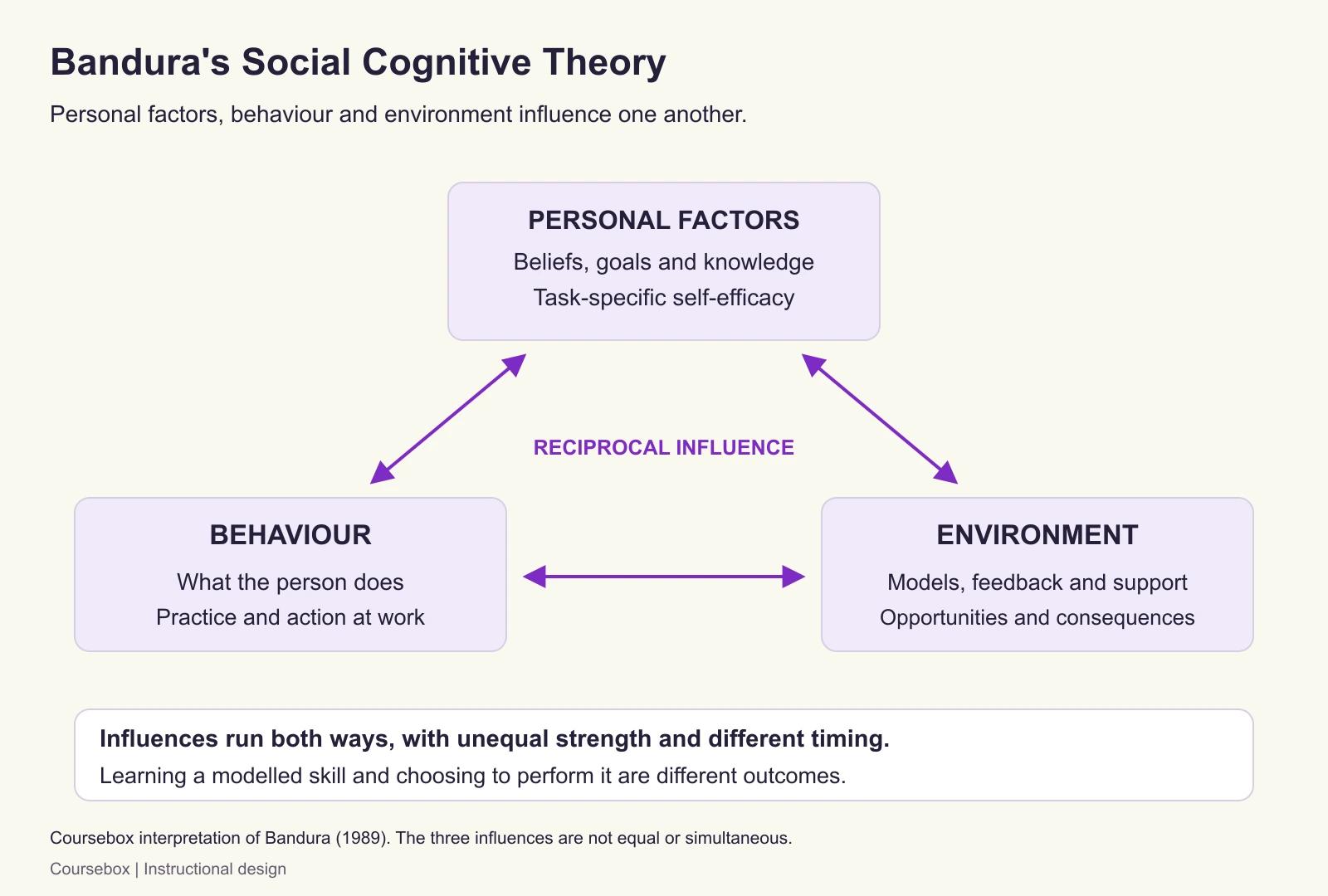
Bandura set the theory out in his 1986 book Social Foundations of Thought and Action: A Social Cognitive Theory. In a 1989 summary in American Psychologist, he described people as neither "autonomous agents" nor "mechanical conveyers" of their surroundings: they "make causal contribution to their own motivation and action within a system of triadic reciprocal causation" (p. 1175). In the same article he wrote that among the mechanisms of personal agency, "none is more central or pervasive than people's beliefs about their capabilities to exercise control over events that affect their lives". That belief is self-efficacy.
The theory extends beyond acquiring knowledge and skills. It also explains motivation, goals, self-regulation and agency. Bandura's 2004 health-behaviour account identifies knowledge, self-efficacy, outcome expectations, goals and perceived facilitators and impediments. These offer useful workplace planning questions, although a health-domain summary is not a validated universal workplace checklist.
| Concept | What Bandura means | The question it asks of a course | What it looks like at work |
|---|---|---|---|
| Triadic reciprocal causation | Personal factors, behaviour and the environment influence one another in both directions, with unequal and shifting strength | What in the workplace will help or block the behaviour, and how will the behaviour change the workplace? | A busy counter makes a corrective conversation harder, and a calm conversation changes how the team responds next time |
| Observational learning | Learning from models through attention, retention, production and motivation | Who will learners watch, what will they remember, how will they practise, and why would they use it? | A new team leader watches an experienced leader handle the conversation, then rehearses it |
| Self-efficacy | A person's judgement of their capability to perform a specific task | Will learners finish the course believing they can do this task, and is that belief earned? | A leader who has succeeded in practice is more likely to raise the next problem |
| Outcome expectations | Expected physical, social and self-evaluative results of acting | What do learners expect to happen if they act, and does the workplace confirm it? | A leader who expects the team to resent feedback avoids giving it |
| Goals and self-regulation | Setting standards, watching one's own behaviour, judging it and reacting to it | Will learners set a goal and check their own progress after the course? | A leader sets a goal for the next conversation and rates how it went |
| Facilitators and impediments | The social and practical conditions that make change easier or harder | What support, time or rules will learners meet back at work? | A store manager who expects feedback to be given and backs it up |
Many health-education sources list six constructs: reciprocal determinism, behavioural capability, observational learning, self-efficacy, expectations and reinforcement. It is a useful classroom summary, but it is not Bandura's own structure. His 2004 list of core determinants is knowledge, self-efficacy, outcome expectations, goals and perceived facilitators and impediments, resting on triadic reciprocal causation.
How is social cognitive theory different from social learning theory?
Social cognitive theory is Bandura's later name and fuller version of his social learning theory. He explained the change in his 2006 autobiography: the label "social learning theory" had been given to several theories "founded on divergent tenets", including Miller and Dollard's drive theory and Rotter's expectancy theory, which "created untold confusion in the literature". His own theory "had always been much broader than the initial descriptive label", covering motivation, self-regulation and social systems as well as learning (p. 65).
| Feature | Social learning theory | Social cognitive theory |
|---|---|---|
| Main book | Social Learning Theory, 1977 | Social Foundations of Thought and Action, 1986 |
| Name of the label | Shared with earlier theories, including Miller and Dollard's from 1941 | Bandura's own name, chosen to end the confusion |
| Self-efficacy | Introduced in a separate 1977 journal article, framed as a social learning analysis | The central mechanism of personal agency |
| Causal model | Reciprocal determinism, already described in the 1970s | Triadic reciprocal causation, with people as agents |
| Third observational-learning process | Motor reproduction | Production, turning a mental picture of the skill into action |
| What it covers | How people learn from models and consequences | Learning plus motivation, goals, self-regulation and collective action |
Two common errors follow from the overlap. Self-efficacy was not added in 1986: Bandura published it in Psychological Review in 1977, where he called it "this social learning analysis" (p. 195). And Bandura did not invent social learning. Miller and Dollard's Social Learning and Imitation came out in 1941, and Bandura cited them in his early experiments.
Social cognitive theory is also different from Lev Vygotsky's sociocultural theory, which is usually filed under social constructivism.
A short timeline
- 1941: Miller and Dollard publish Social Learning and Imitation.
- 1961: Bandura and his colleagues Ross and Ross publish the first Bobo doll experiment.
- 1963: Bandura and Walters publish Social Learning and Personality Development.
- 1965: Bandura shows that a model's consequences change what children perform, not what they learn.
- 1977: Social Learning Theory (the book) and the self-efficacy article in Psychological Review.
- 1986: Social Foundations of Thought and Action renames the theory.
- 1997: Self-Efficacy: The Exercise of Control, the full treatment of self-efficacy.
- 2001: "Social cognitive theory: An agentic perspective", in Annual Review of Psychology.
- 2021: Bandura dies at his Stanford home on 26 July, aged 95, as the Stanford Report obituary records.
Which of Bandura's works to read
- For the theory in ten pages: "Human agency in social cognitive theory" (American Psychologist, 1989).
- For self-efficacy: the 1977 Psychological Review article, then the 1997 book if you need the detail.
- For workplace training, read this one first: "Organisational applications of social cognitive theory" (Australian Journal of Management, 1988). It began as an invited address at the Australian Graduate School of Management in Sydney, and it is Bandura's own account of how to build skills training at work.
What did the Bobo doll experiments show?
The Bobo doll experiments showed that young children could learn new, specific acts by watching an adult once. Bandura wrote that they were designed "to clarify the processes governing observational learning". They did not show that watching violence makes people violent.
In the 1961 study, the participants were 72 children from the Stanford University Nursery School, aged 37 to 69 months. Each child spent about 10 minutes in a room where an adult model either attacked a 5-foot inflatable Bobo doll in unusual ways or played with other toys without attacking it. The children were then mildly frustrated, by being shown attractive toys and told they could not play with them, and observed for 20 minutes in another playroom that held a Bobo doll. Children who had seen the aggressive model reproduced much of the model's physical and verbal aggression "substantially identical with that of the model" (p. 580). Children who saw a non-aggressive model, or no model, rarely did.
The 1965 follow-up used a filmed model who was rewarded, punished or left without consequences. Children who saw the model punished copied less. When all the children were then offered attractive rewards for showing what the model had done, the incentive "completely wiped out the previously observed performance differences" (p. 589). They had all learned the acts; consequences decided whether they performed them. For workplace training, I find that difference between learning and performing the most useful idea in the theory.
The studies still draw criticism. A 2022 psychoanalytic critique by Galanaki and Malafantis raises the ethics of exposing children to aggression and argues that the deliberate frustration step and the unusual setting may explain part of what the children did, while conceding that their argument is "not supported by research data". To the common objection that a Bobo doll is a toy designed to be hit, Bandura replied in a 2011 chapter that the researchers measured whether children used the novel modelled acts, such as mallet blows and invented phrases, which children in the control condition never showed.
The core concepts, worked through one course
The worked example is a hypothetical short course for newly promoted team leaders in a retail chain. They know the store's procedures from their time on the floor, but most have never given a colleague corrective feedback. The task is one conversation: a team member skipped the end-of-day cash count, and the team leader has to raise it. The course gives learners what that decision needs: the store's cash-handling procedure, what the leader saw (the count sheet was not signed off), and a four-step pattern for the conversation:
- State the issue clearly.
- Use facts, not assumptions.
- Ask for their view.
- Agree on a next action.
Practice moves from a receptive team member, who admits the miss straight away, to a defensive one, who says the count is a waste of time. The intended outcome is a leader who raises the issue in the next real case, and the course ends with a goal and a self-rating for that conversation. I chose this example because each part of the theory shows up in it: people learn this skill largely by watching others, a leader's belief in their own capability affects whether they start the conversation, and the store affects whether the new habit lasts.
1. Triadic reciprocal causation
Bandura's causal model has three sets of influences: personal factors (thoughts, beliefs, feelings and biology), behaviour, and the environment. In a 1989 chapter on the theory he described them as "interacting determinants that influence each other bidirectionally", and added that this "does not mean that the different sources of influence are of equal strength", nor that they "all occur simultaneously". In a busy store at closing time, the environment may dominate; in a quiet back office, the leader's beliefs may.
- Sample goal: Before the conversation, name one thing in the store that could push it off course, such as other staff within earshot or the end-of-shift rush, and plan around it.
- How to assess it: In the practice plan, the leader names a private time and place for the conversation and what they will do if the team member becomes defensive.
- In the course: The same opening line played out twice, once at the counter in front of others and once in the back office, so learners see the setting change the reply, and the reply change the leader's next move.
2. Observational learning
Observational learning is learning from models, whether a person in the room or on video. Bandura described it as governed by four subprocesses, which in his 1989 wording are:
- Attention: what people notice in the model and what they take from it.
- Retention: turning what they saw into rules and images they can remember.
- Production: turning that memory into action, adjusting until the action matches their idea of it.
- Motivation: whether they use what they learned, which depends on direct, vicarious and self-produced incentives.
In the 1970s Bandura called the third process "motor reproduction", which is why both names circulate. He also insisted that modelling is not copying. In his 1974 presidential address, he called observational learning "an actively judgmental and constructive, rather than a mechanical copying, process" (p. 864). Observers extract the rule behind what they see and use it to produce new behaviour, and a model who talks through their thinking makes that reasoning visible.
- Sample goal: Use the four steps in a conversation the learner has not seen modelled, such as a missed stock check.
- How to assess it: A role-play with a new incident, scored by an observer against the four steps.
- In the course: A short demonstration of an experienced team leader handling the cash count, with the leader's thinking spoken aloud, the four steps written as short rules beside it, and a second, weaker version for comparison. Then guided practice with corrective feedback.
The classic workplace studies of this method were published as applications of social learning theory, around the time of the 1986 renaming. Bandura presented this line of work as organisational applications of social cognitive theory in his 1988 paper.

Case study: Behaviour modelling for first-line supervisors
Latham and Saari tested whether supervisors could learn interpersonal skills, such as giving recognition, correcting poor work habits and handling complaints, through a programme built on Bandura's principles. The organisation is not named in the published abstract.
- What they did: Supervisors watched filmed models handling each situation, discussed summary guidelines, then practised in role-plays based on incidents from their own jobs, with feedback. After each session they were asked to use the skills at work in the following week and report back, and difficult incidents were re-enacted and practised again.
- Evidence and result: In the 1979 study, 40 male first-line supervisors were randomly assigned to the training or to a control group. Trained supervisors scored significantly better on a learning test at 6 months, on role-play simulations at 3 months, and on performance ratings collected on the job a year after training. When the control group was trained later, it reached the same level.
- Limitation: The sample was small, all male and from one organisation in the late 1970s. I read the abstract and Bandura's 1988 description, not the full paper, so the size of the differences is not given here.
- Lesson: Modelling worked here as a package: models, practice on the supervisors' own incidents, feedback, and a structured return to the job.
Modelling alone does not guarantee that result. A 1984 study by Russell, Wexley and Hunter covered 44 supervisors, 22 trained with behaviour modelling and 22 in a control group, and found favourable reactions and more learning, but no behaviour change on the job and no improvement in performance results. The largest review of the method, a 2005 meta-analysis of 117 studies by Taylor, Russ-Eft and Chan, found effects "largest for learning outcomes, smaller for job behavior, and smaller still for results outcomes". Skills grew most when the learning points were presented as rule codes, and transfer was greatest with mixed positive and negative models, practice on scenarios the trainees wrote themselves, goal setting, training for the trainees' own managers, and rewards and sanctions at work.
A more recent example comes from manufacturing. A 2025 trial in two electronics assembly plants in Iran selected three women as role models in the workplace for safer postures. Its outcomes were self-reported, and each group came from one site.
3. Self-efficacy
Self-efficacy is a person's belief in their capability to perform a particular task to a particular standard. In Bandura's 2006 guide to building self-efficacy scales, it is "not a global trait but a differentiated set of self-beliefs", and it is not self-esteem: "Perceived efficacy is a judgment of capability; self-esteem is a judgment of self-worth" (pp. 307 to 309). A team leader can feel sure of themselves on the sales floor and still doubt they can tell a colleague they made a mistake.
Self-efficacy also differs from an outcome expectation. In the 1977 article, an efficacy expectation is "the conviction that one can successfully execute the behavior required", while an outcome expectancy is the estimate that the behaviour "will lead to certain outcomes" (p. 193). Belief is not enough either: "Expectation alone will not produce desired performance if the component capabilities are lacking" (p. 194).
Bandura named four sources of self-efficacy, with slightly different names in 1977 and 1997:
| Source (1997 name) | 1977 name | What Bandura says about it | In the feedback course |
|---|---|---|---|
| Enactive mastery experience | Performance accomplishments | The strongest source, because it rests on the person's own success; repeated failures lower it, especially early ones | Practise with the receptive team member first, so the first attempt succeeds, then move to the defensive one |
| Vicarious experience | Vicarious experience | Less dependable than one's own success, and stronger when the model seems similar | The model is an experienced team leader in a similar store, not a head-office trainer |
| Verbal persuasion | Verbal persuasion | Weaker on its own, and easier to undermine belief this way than to raise it | Feedback names what the learner did well, then the one change to make, and shows how |
| Physiological and affective states | Physiological states, or emotional arousal | Stress reactions can be read as a sign of low capability | Tell learners that nerves before a hard conversation are normal, and give them an opening line to rehearse |
- Sample goal: Hold the defensive conversation in practice and reach an agreed next action without dropping the issue.
- How to assess it: Before and after practice, learners rate how sure they are that they can handle each version of the conversation, and an observer scores the role-play separately. The rating tracks belief, not performance.
- In the course: Practice graded from easy to hard, with corrective feedback after each attempt, so success comes before difficulty.

Case study: Self-management training for public servants' attendance
Frayne and Latham worked with unionised state government employees who had low job attendance. The agency and state are not named in the published abstracts.
- What they did: Employees were trained in self-regulatory skills: how to manage the personal and social obstacles that kept them from work. The researchers report that the training also raised the employees' perceived self-efficacy that they could influence their own attendance.
- Evidence and result: In the 1987 study, 20 employees were trained and 20 formed a control group. Attendance was significantly higher in the trained group, and the higher an employee's perceived self-efficacy, the better their later attendance. In a 1989 follow-up, the gains held over time, and when the control group was trained by a different trainer, it showed the same improvement three months later.
- Limitation: The groups were small and from one public employer in the 1980s. The abstracts report significance but no attendance figures, and the link between self-efficacy and attendance is a correlation within the trained group.
- Lesson: Teaching people to plan around their own obstacles was followed by higher belief and better attendance. A second trainer got the same result, which suggests the effect did not rest on one trainer.
4. Outcome expectations
Outcome expectations are what people expect to happen if they act. Bandura's 2006 guide groups them into "physical, social, and self-evaluative outcomes", each positive or negative, with the positive ones acting as incentives and the negative ones as disincentives (p. 309). For the new team leader they look like this:
- Physical and material: the till stays balanced, or a discrepancy is found a day late.
- Social: the team member accepts the point, or resents the new leader, and the store manager notices either way.
- Self-evaluative: "I handled that fairly", or "I'm turning into the kind of boss I disliked".
Bandura's 1965 finding applies here. People can learn the four steps perfectly in a course and still not use them, if the store teaches them that raising problems costs more than it gains. Vicarious reinforcement, seeing what happens to a model, works in both directions.
- Sample goal: Name the likely result of raising the missed count and of letting it go, for the till, the team and themselves.
- How to assess it: In a short written reflection, the learner lists one cost and one benefit of each choice and how they would reduce the cost.
- In the course: The modelled conversation ends with an agreed next action and a better working relationship, a store manager explains why they expect the conversation to happen, and learners discuss what usually happens in their store when someone raises a problem.
5. Goals and self-regulation
Self-regulation is how people guide their own behaviour once nobody is instructing them. In a 1991 paper on self-regulation, Bandura described three subfunctions: "self-monitoring of one's behavior", "judgment of one's behavior in relation to personal standards and environmental circumstances", and "affective self-reaction" (p. 248). Goals give that process its standard.
- Sample goal: "In my next corrective conversation, I will ask for the team member's view before I suggest a fix."
- How to assess it: After the real conversation, the leader rates each of the four steps, notes what to change, and checks the rating with their store manager where possible.
- In the course: A final page where each learner writes one goal for their next real conversation and gets a self-rating sheet to fill in afterwards.
Give store managers a short briefing on what the new leaders learned and what to ask them after their first real conversation. Training the trainees' own managers was one of the conditions linked to the most transfer in the 2005 meta-analysis.
How the concepts fit together
Social cognitive theory is not a sequence of stages. Bandura's causal model is mutual influence, and in his 1983 reply to critics he wrote that the factors "work their mutual effects sequentially over variable time courses", not all at once. The relative weight of each one, he wrote in 1978, "will vary in different individuals and under different circumstances".
In the feedback course, that plays out as a loop. The team member's defensive reply (environment) can lower the leader's self-efficacy (personal) and make them drop the issue (behaviour). A leader who has practised that exact reply holds the point calmly, the team member backs down, and the next conversation starts from a different place. The four observational-learning processes describe what has to happen for modelling to work, not four course sections that must appear in order. Attention and retention can happen in one short video, and motivation is mostly decided back in the store.
A common error is to read triadic reciprocal causation as three equal forces acting at once. Bandura said the opposite: the influences differ in strength, take time to act, and vary by person and situation. When the store's routines strongly discourage feedback, in-course confidence building is unlikely to outweigh them, so fix the environment as well as the learner.
How to use social cognitive theory to design training
Bandura's own method for workplace skills, set out in his 1988 Australian Journal of Management paper, has three parts: model the skills, give "guided practice under simulated conditions", then help people apply the skills at work "in ways that will bring them success" (p. 276). He called the third part a transfer programme: people try the new skill first in situations likely to go well, discuss their successes and difficulties, and take on harder cases as they improve (p. 277). This is the order I work in:
- Pick one behaviour from the job and the situations where it happens.
- Break it into a few learning points, written as short rules learners can remember.
- Choose credible models whose role and task experience learners can relate to. Show effective and ineffective versions, with the model's reasoning made visible. Physical resemblance alone is not the requirement.
- Plan practice from easier to harder situations, ending with incidents learners bring from their own work.
- Give corrective feedback that names what went well and shows the fix, rather than only replaying the attempt.
- Set a goal for the first real attempt and plan a debrief after it.
- Brief the learners' managers and check what the workplace rewards or punishes.
- Measure task-specific self-efficacy and observed behaviour separately.
Observers need something concrete to score in step 4. An observation checklist built from the four steps works for role-plays, and role-play simulation examples give ideas for structuring them online.
The feedback course, planned
| Design element | Plan for the feedback course |
|---|---|
| Behaviour | Raise a missed end-of-day cash count with the team member responsible |
| Learning points | State the issue clearly; use facts, not assumptions; ask for their view; agree on a next action |
| Model | An experienced team leader from a similar store, thinking aloud, plus a weaker version that skips asking for the team member's view |
| Practice 1 | A receptive team member who admits the miss straight away |
| Practice 2 | A defensive team member who says the count is a waste of time |
| Practice 3 | An incident the learner brings from their own store |
| Feedback | What went well, the one change to make, and a short corrective demonstration of that step |
| Goal and self-rating | One goal for the next real conversation and a self-rating against the four steps afterwards |
| Transfer | A store manager briefing, a check-in after the first real conversation, and a harder case once it goes well |
| Measures | Self-efficacy ratings before and after practice, an observer's checklist for the role-plays, and the manager's check-in on the real conversation |
Plan a behaviour modelling course step by step: learning points, the model, practice from easy to hard, feedback, the transfer plan and measures, with the feedback course filled in and a blank planner to use. Editable Word file, no email required.
The planner adapts Bandura's 1988 method and the design factors in the 2005 meta-analysis. It is a planning aid, not a validated instrument.

Case study: Sales training in seven stores of a chain retailer
Sales associates selling large appliances, radios and televisions in seven stores of a large chain retailer, in one metropolitan area, took part in behaviour modelling training to improve their selling. The researchers noted that studies of the method had rarely measured actual changes in job performance.
- What they did: The researchers, Meyer and Raich, compared the associates' sales records before and after the training with those of similar associates in seven matched stores, who took other kinds of sales training during the same period.
- Evidence and result: In the 1983 evaluation, associates who received behaviour modelling training increased their sales by an average of 7% over the following six months, while the comparison stores showed a 3% decrease. The ERIC record gives 58 sales representatives, without saying how they split between the groups.
- Limitation: The stores were matched, not randomly assigned, so local markets or store managers could explain part of the gap. The comparison group had different training rather than none, and the abstract reports no significance test.
- Lesson: Measure what the business already records. Sales, attendance or error rates show whether modelled skills reached the job in a way that a post-course survey cannot.
Measuring self-efficacy without measuring confidence
A post-course question such as "How confident do you feel?" does not measure self-efficacy. Bandura's 2006 guide states that "There is no all-purpose measure of perceived self-efficacy" (p. 307), and that items should be phrased "in terms of can do rather than will do" (p. 308). Write items for the specific task, at graded levels of difficulty:
- "I can raise a missed cash count with a team member who admits it straight away."
- "I can raise a missed cash count with a team member who says it is a waste of time."
- "I can raise a missed cash count at closing time, with customers still in the store."
Learners rate each item from 0 to 100 for how sure they are that they can do it now. A rise between the start and end of a course indicates a change in reported belief. It does not establish that the conversation happened or improved. In Kirkpatrick's framework, workplace application is Level 3 and needs an appropriate observation or record. A manager's check-in is useful follow-up, but its evidential strength depends on what was actually observed or documented.
Self-efficacy ratings can go up after a course for reasons that have nothing to do with skill, including a pleasant session and an easy role-play. Report them beside an observed measure, never instead of one.
What course requests ask for
To see whether people briefing courses ask for the parts of the theory, we classified a sample of requests typed into Coursebox in the 90 days to 7 October 2026: one per person, from English-language browsers, leaving out uploads, follow-up answers and copies of templates. That left 266 prompts, and a language model judged 99 of them to be course requests. The classifier counted generously; a spot check showed it counting requests for "real-world examples" as requests for modelling, so these are model-coded estimates, not audited upper bounds or estimates of all Coursebox users.
about 25 of the 99 requests asked for a demonstration or worked example for learners to watch. about 16 asked learners to practise after seeing the skill modelled, and about 13 asked for goal setting or self-assessment.
Self-efficacy is the mechanism Bandura put at the centre of the theory, and fewer than one in ten course requests mentioned it. If your learners need to do something they are nervous about, such as the cash-count conversation, write the practice ladder and the self-rating into the brief rather than expecting them to appear.
Social cognitive theory vs self-determination theory and ARCS
Social cognitive theory explains how people acquire a skill and come to believe they can use it. Two neighbouring models explain motivation in other terms. Self-determination theory, from Edward Deci and Richard Ryan, focuses on autonomy, competence and relatedness. John Keller's ARCS model is a design checklist of attention, relevance, confidence and satisfaction. ARCS's "confidence" overlaps with self-efficacy, but social cognitive theory says more precisely where that belief comes from.
| Theory | Best for | Weak spot | Use it when |
|---|---|---|---|
| Social cognitive theory | Interpersonal and procedural skills people learn by watching and practising, where belief in their own capability affects whether they act | Hard to test as a whole, and the strongest workplace evidence is decades old | Learners must perform a visible behaviour at work and may hesitate to start |
| Self-determination theory | Sustaining motivation over time, especially for optional or ongoing learning | Says little about how to teach a specific skill | You worry learners will disengage or feel controlled |
| ARCS model | A quick check that a course holds attention and feels relevant and achievable | A checklist rather than an explanation of how skills develop | You are reviewing an existing course for motivation gaps |
Social cognitive theory also differs from behaviorism, cognitivism and constructivism. Bandura kept a role for consequences, but treated people as agents who learn by observation and think about what they see, rather than as responders to reinforcement.
Criticisms and limitations of social cognitive theory
The theory is widely used and widely criticised, and the criticism that most affects training design concerns self-efficacy.
- It is hard to test as a whole. Teaching materials in public health often describe the theory as loosely organised and hard to operationalise, because it does not say how much each of the three influences contributes. Bandura's answer was that the balance varies by person and situation, which is true but also hard to falsify.
- Reciprocal determinism was challenged as a causal principle. In 1983 Phillips and Orton argued that it treated the influences as determining each other at the same time. Bandura replied that the effects run in sequence over time, not simultaneously.
- The direction of the self-efficacy link is debated. Studies by Vancouver and colleagues found that, within the same person over time, higher self-efficacy sometimes predicted lower performance on the next attempt. A 2013 meta-analysis by Sitzmann and Yeo concluded that within-person self-efficacy "is primarily a product of past performance rather than the driving force affecting future performance". Judge and colleagues found its unique contribution small once ability, personality and experience were controlled, except on simpler tasks. Bandura and Locke replied in 2003, citing nine meta-analyses, that these findings do not show belief in one's capability to be self-defeating.
- Training effects shrink on the way to the job. Behaviour modelling changes learning more than job behaviour, and a 2000 study by May and Kahnweiler with 38 supervisors and managers found that extra mastery practice improved retention and in-workshop skill but found no effect on transfer.
- The workplace evidence is old and mostly American. The strongest controlled studies with on-the-job outcomes date from 1979 to 1989, and the organisations are not named.
Experimental evidence helps with the causal question. A 2016 meta-analysis of 204 experimental tests in health behaviour found that raising self-efficacy led to small to medium changes in behaviour. The best-known workplace figure is correlational:
That figure, from Stajkovic and Luthans's meta-analysis, compares people with each other: those with higher self-efficacy tend to perform better. It does not show that raising one person's self-efficacy will raise their performance, which is why the feedback course earns belief through successful practice and measures the behaviour itself.
Using social cognitive theory with an AI course builder
On 7 October 2026 I briefed Coursebox for the feedback course: show the skill modelled first, then practice with a receptive and then a defensive team member, from easy to hard so that early success builds self-efficacy, and a self-regulation goal at the end. It is our product, so weigh my read with that in mind.
Most of the structure came back as briefed. Coursebox estimated the generated course, Giving Corrective Feedback, at about 40 minutes. The receptive-conversation section had Try a Friendly Response, a four-turn branching scenario in which the learner plays the team leader, followed by Choose Your Next Line and Rehearse the Conversation. The defensive-conversation section had Meet the Defensive Response and Handle the Defensive Turn. An explainer page, Feedback at a glance, set out the four-step pattern.
The modelled demonstration was missing, and it is the part Bandura's 1988 method puts first. The content I had briefed for the first section had been replaced by a generic welcome page, because Coursebox reserves the first page of a course for a welcome page.
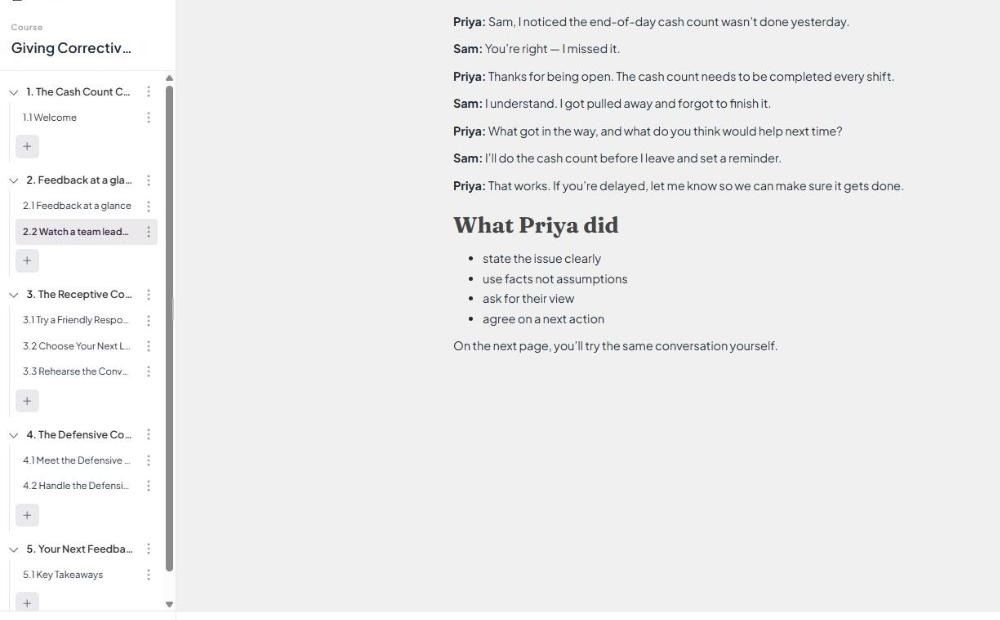
In the course editor, I added a page called Watch a team leader do it after the explainer, and asked the editor's AI chat for a short dialogue in which an experienced team leader, Priya, gives the feedback to a receptive team member, Sam, followed by a list of what Priya did and a line handing over to practice. When I reloaded the course in view mode, the page held a seven-line dialogue between Priya and Sam, a "What Priya did" list of the four steps, and a handover line, placed before the practice scenarios. That proves the course now shows the model before the practice. I did not inspect the closing goal page or check the quality of the scenario feedback, and only a pilot would show whether team leaders' real conversations improve.
Rate how sure you are that you can handle each version of a task, set one goal for your next real attempt, then rate yourself afterwards, with the cash-count conversation filled in and a blank version to use. Editable Word file, no email required.
The worksheet adapts the item-writing rules in Bandura's 2006 guide. Its ratings are for planning and reflection, and no total on it certifies that anyone can do the task.
Putting social cognitive theory to work
Social cognitive theory explains why people who know a procedure still do not act on it: they have not seen it done well, have not succeeded at it in practice, or expect it to go badly where they work. For training, that makes it most useful when the goal is a visible behaviour that people hesitate to start, such as giving feedback, raising a safety concern or handling a difficult customer. It is less useful for content people only need to know.
Take one behaviour from a course you are building and plan a credible model, supported practice from easy to hard, a goal for the first real attempt and a briefing for managers. Measure reported self-efficacy separately from observed behaviour. Compare performance with a baseline and consider workplace changes before attributing improvement to the course. Successful practice supports belief; confidence alone is not the outcome.
Frequently Asked Questions
Social cognitive theory is Albert Bandura's theory, named in 1986, that people learn by observing others and act through mutual influence among their thoughts and beliefs, their behaviour and their environment, with self-efficacy at its centre. It also explains how people motivate themselves, set goals and regulate their own behaviour.
Two lists of four are commonly meant. Observational learning has four processes: attention, retention, production and motivation. Self-efficacy has four sources: mastery experience, vicarious experience, verbal persuasion, and physiological and emotional states. Neither list is the whole theory, which also includes outcome expectations, goals and self-regulation.
Albert Bandura, a Stanford psychologist born in 1925 in Mundare, Alberta, who died in 2021, developed social cognitive theory and named it in 1986. He built on earlier social learning research, including Miller and Dollard's 1941 book Social Learning and Imitation.
Social cognitive theory is Bandura's 1986 renaming and expansion of his social learning theory. He changed the name because unrelated theories shared the old label, and because his theory covered motivation, self-regulation and agency as well as learning. Self-efficacy is older than the new name: Bandura introduced it in a 1977 article.
Vicarious reinforcement is the effect of seeing a model rewarded or punished on whether an observer performs the same behaviour. In Bandura's 1965 study, children who saw a model punished copied less. When all the children were then offered a reward to show what the model did, the differences disappeared, so all of them had learned it.
Carolina Martin
Carolina is a highly experienced learning designer with tech start-up experience. She is based in Sydney and previously designed courses alongside Coursebox founder Travis in a previous job. She is passionate about delivering engaging learning experiences and brings the same perspective to customer experience too. She manages our customer support documentation and product testing processes.

