

Interleaving: What Interleaved Practice Is and When It Helps
Interleaving mixes similar cases in one practice set. Learn when interleaved practice helps, when it does not and how to build one for a workplace course.

Interleaving is a way of arranging practice so that items of different kinds are mixed together, and learners must work out which category, procedure or concept each item needs before they can answer it, instead of practising one kind at a time.
- Interleaving helps most when learners confuse similar cases, such as look-alike photos, diagnoses or problems that need different procedures.
- A 2019 meta-analysis of 59 studies found a moderate average benefit from mixing, with blocking ahead only for learning words.
- The largest classroom trial suggests giving each new case a short block first and feedback on every mixed answer.
- Most interleaving research used students, so a workplace team should try one mixed set before redesigning a whole course.
Five questions, about a minute. Pick one course where people have to sort cases at work, such as claims, faults, requests or customer problems. This is an unvalidated planning aid. The total organises suggestions; it does not assess competence or prove that the method will work. Review each answer.

Go from storyboard to an interactive course in minutes
A returns assessor at an online furniture retailer opens a claim with a photo of a wardrobe door split along one edge. It could have been crushed in the delivery van, made with a faulty panel or forced onto the wrong hinge screw, and each answer sends the claim somewhere different. In this hypothetical team, every assessor passed a quiz at the end of each module, one module per kind of damage. On the claims queue, the photos do not arrive sorted by module.
I'm Travis, cofounder of Coursebox. Before that I was a learning designer on edX courses at the University of Adelaide, and I still design courses with customers on calls, where my first question is where the learner actually practises. Coursebox makes AI software for building employee training courses, so I have a commercial interest in how practice gets built. This guide explains what interleaved practice is, why it helps when people confuse similar cases, where it does not help and how to build one mixed practice set. It includes two real trials, a worked returns-team example and two editable Word worksheets.
What is interleaving?
Interleaving is a way of arranging practice so that items of different kinds are mixed together, and learners must work out which category, procedure or concept each item needs before they can answer it.
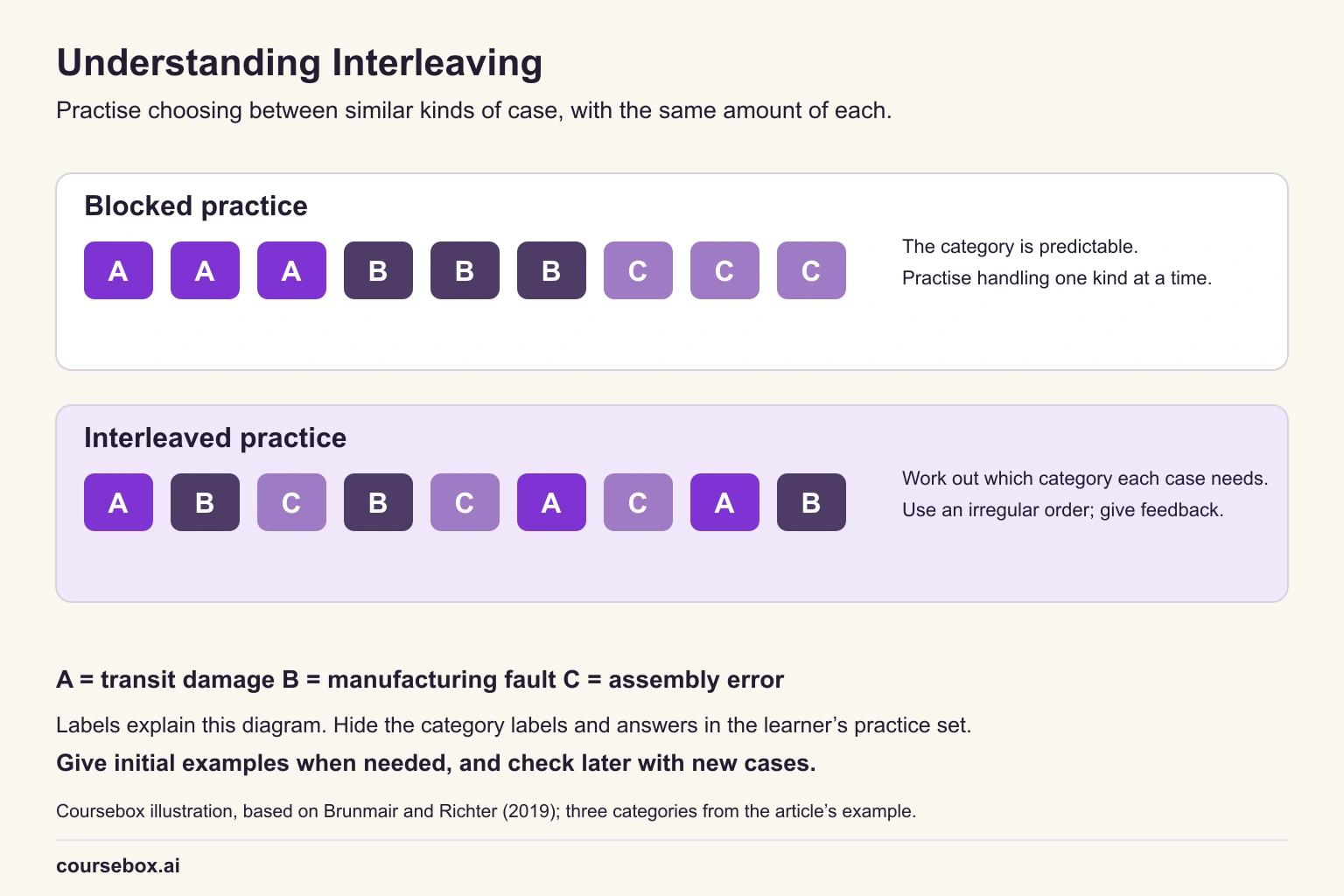
View the full-size interleaving diagram
The opposite is blocked practice: all the items of one kind, then all of the next. In the largest classroom trial, Rohrer and colleagues defined interleaved practice as an assignment arranged "so that no two consecutive problems require the same strategy, where strategy is defined loosely to include a procedure, formula, or concept." A blocked set might run AAABBBCCC; an interleaved set covering the same items might run ABCBCACAB.
Interleaving comes in two kinds, and they work for different reasons:
- Telling categories apart. Learners see examples of several categories mixed together and learn to classify new examples: painting styles, bird species, ECG diagnoses, types of damage in a photo. Most of the effect sizes in Brunmair and Richter's meta-analysis come from this kind.
- Choosing the right procedure. Learners solve problems that each need a different method, so they must first decide which method applies. This is the kind used in mathematics classrooms.
Both kinds also space out each type of item, because the other types sit between them. The table puts the three common practice orders side by side.
| Practice order | What a set looks like | What the learner has to decide | Where it fits at work |
|---|---|---|---|
| Blocked | All items of one kind, then all items of the next | Only how to handle a case whose type is already known | The first few examples of a new category or procedure |
| Interleaved | Items of several similar kinds in a mixed order | Which kind each item is, then how to handle it | Cases staff confuse once they can handle each one alone |
| Spaced | The same kind of item practised again after a gap of days or weeks | How to handle a case they have not seen for a while | Keeping a skill that is used rarely |
Interleaving is not shuffling a whole course at random, and it is not a revision timetable. It changes the order of items inside a practice set so that the learner has to identify each item before acting on it.
Coaches and motor-learning researchers often call the same contrast blocked versus random practice: repeating one shot or movement many times, or rotating between several. In skills training, interleaving usually means rotating tasks rather than learning them one at a time.
One of the clearer tests in professional education involved first-year medical students reading ECGs, where several diagnoses look alike on the trace.

Case study: ECG practice for medical students at McMaster University, Canada
First-year medical students must learn to tell apart ECG diagnoses that look alike on the trace, such as infarction, ventricular hypertrophy, bundle branch blocks, pericarditis and ischaemia. A McMaster University team in Hamilton, Ontario, tested whether the order of practice changed how well novices could diagnose new ECGs.
- What they did: 66 students were taught the same material in two separate 2-hour sessions of 33. One group practised four new examples straight after each diagnosis was taught. The other practised the same 12 ECGs at the end, mixed across the diagnoses, and was encouraged to compare the features of competing diagnoses.
- Evidence and result: on a 6-item test of new ECGs straight after the session, the mixed group scored 47% and the blocked group 30%, Hatala, Brooks and Norman reported.
- Limitation: the authors say that "strictly speaking, students were not randomized", it was a single session with an immediate test, and the mixed practice also came later in the session, so mixing and spacing are not separated.
- Lesson: mixing look-alike cases helped novices identify new ones, but both groups still scored under half. A mixed set adds discrimination practice; it does not replace enough examples of each category.
Key papers on interleaving: which to read
Interleaving has no single originator or edition. Three papers cover what a course designer needs:
- 2019: Brunmair and Richter's meta-analysis of interleaved learning in Psychological Bulletin, the current synthesis of interleaving studies and the conditions that change the effect.
- 2020: Rohrer, Dedrick, Hartwig and Cheung's classroom trial in the Journal of Educational Psychology, the largest field test of choosing-the-procedure interleaving, with four caveats for practice design.
- 2021: Samani and Pan's undergraduate physics study in npj Science of Learning, open access, which tracked how students judged interleaved homework.
If you only read one, read Brunmair and Richter. Its discussion section says which materials benefit, which do not and how far the evidence reaches beyond university students.
Why does interleaving work?
Researchers point to three things happening in a mixed set. Which one carries the benefit depends on the kind of interleaving.
Contrast between similar cases. When a photo of a crushed corner sits next to a photo of a peeling panel, the features that separate them are easier to notice than when each sits among others of its own kind. Brunmair and Richter's results fit this explanation, called the discriminative contrast hypothesis. The benefit grew when categories were more similar to each other, when examples within a category varied more, and when the material was more complex. It was larger when items came one after another with no gap or distraction between them.
Choosing the procedure. In a blocked set, the heading tells the learner which method to use, so they never practise that choice. On the job, nobody labels the problem first. Rohrer and colleagues argue that interleaved maths practice "combines three potent learning strategies": choosing a strategy from the problem itself, more spacing and possibly retrieval practice.
In their trial, 54 grade 7 maths classes in the United States did interleaved or blocked assignments over four months, then both groups did one interleaved review. A month later the students sat an unannounced test.
That gap comes from schoolchildren practising maths over months, with feedback on every assignment. It shows what choosing-the-procedure practice can do under those conditions, not what a one-hour workplace module will produce.
Spacing built in. Each kind of item comes back after the others, so mixing also spaces it out. Brunmair and Richter note that this may explain part of the effect, but suggest that long gaps between items may make the contrast harder to see.
Mixed practice also feels harder. In Samani and Pan's physics course, students did better on surprise tests after interleaved homework, yet "tended to rate the technique as more difficult and incorrectly believed that they learned less from it." A satisfaction survey after a mixed set is likely to undersell it.
When does interleaving help, and when does it not?
The answer depends on the material and on what learners have to decide. Brunmair and Richter pooled 59 studies with 238 effect sizes, and the effect varied a great deal by material.
| Material or task | What the research found | Mix or block? |
|---|---|---|
| Look-alike pictures, such as paintings or photos | 0.67 for paintings, 0.35 for photographs | Mix, after a short block of each |
| Problems that each need a different procedure | Small in the meta-analysis (0.34); large in Rohrer's classroom trial | Mix, with feedback on each item |
| Words and category names | Blocking did better (about -0.39) | Block |
| Expository text, such as explanations people read | Ambiguous, no significant overall effect | Teach it in a sensible order |
| Categories that are easy to tell apart | Smaller effect as similarity between categories falls | May add less; test whether strategy selection still needs practice |
In the meta-analysis, Brunmair and Richter write that they are "reluctant to recommend interleaving for learning materials such as mathematical tasks, expository texts, grammar rules, foreign languages or words", where it "could even impede learning". Their maths figure (0.34, from 45 effect sizes) pools earlier studies, some of them by Rohrer. The 2020 classroom trial ran for four months with feedback on every assignment and found a much larger gap, which is why the two papers read differently on maths.
Rohrer and colleagues add four caveats for practice design:
- It takes longer. Every teacher in the trial reported that the interleaved assignments took more time, so part of the benefit may come from extra time on task.
- The benefit may be smaller on a test soon after practice. Their large gap was measured a month later.
- Learners may need a little blocked practice first. The authors write that "the data do not suggest that students should entirely avoid blocked practice."
- Feedback may be necessary. Students in their trial saw the solutions and corrected their errors.
Randomising a quiz can produce interleaving if its items require choosing between related categories or methods. Shuffling unrelated recall questions does not ensure that practice. Mixing unrelated topics, such as fire safety with expense claims, gives learners nothing to compare. Mix the cases staff actually confuse, and keep the feedback.
How to use interleaved practice in a course
Seven steps build one mixed practice set:
- Find the categories, problem types or procedures that people confuse at work, from errors and quality checks rather than the course outline.
- Leave out vocabulary and terms, where blocking did better; explanatory text such as policy wording, where the results were unclear; and topics people rarely confuse.
- Teach each new category with a short block of examples and name the feature that decides it.
- Write new examples for a mixed set, with variety inside each category.
- Order the set so that no two items in a row need the same answer, and place confused pairs next to each other.
- Write feedback for every item that names the deciding feature.
- Check later with new examples, scored by category, and revise the set from the errors.
This hypothetical online furniture retailer has a returns team of eight assessors. Customers upload photos with each damage claim, and the assessor decides which of four categories it falls into under the retailer's returns policy:
- Transit damage: the item was damaged in delivery, so the retailer replaces it and claims from the carrier.
- Manufacturing fault: the item left the factory faulty, so the retailer replaces it and claims from the supplier.
- Assembly error: the customer damaged it while putting it together, so the policy offers parts and instructions rather than a refund.
- Normal wear: marks from ordinary use, which the policy does not cover.
The first three can look alike in a photo, and a wrong call means paying a refund the policy does not require or losing a valid carrier or supplier claim. The current course teaches each category in its own module with a quiz at the end. Assessors pass every quiz, yet a quality check of their decisions keeps finding the same mix-ups.
This example suits interleaving because the job is sorting complex photos into categories that are hard to tell apart, the conditions Brunmair and Richter recommend it for. The pooled effect for photographs (0.35) was smaller than for paintings (0.67). Neither figure predicts the improvement this returns team will see; test the set with new cases. The features and routing rules are illustrative. Photos may not establish the cause of damage, so real cases need enough evidence to decide, an escalation route for uncertainty and a policy checked against the customer’s applicable rights.
For the returns team, those steps come down to five stages.
1. List the cases staff confuse
Interleaving pays off where people mix things up, so start from real errors rather than the course outline.
- Sample decision: the quality check shows two confusions: transit damage taken for a manufacturing fault, and assembly cracks around screw holes taken for a faulty panel. Normal wear is rarely misjudged.
- How to check it: count the categories in a sample of decisions the quality check overturned.
- In the course: the mixed set puts the three look-alike categories side by side and uses normal wear as a contrast.
2. Give each new category a short block first
Assessors need a short look at each category on its own before they compare them, whether they are new or already on the queue.
- Sample decision: four photos of each category in a short block, each with the feature that decides it named.
- How to check it: an assessor classifies two new photos of that category correctly before moving on.
- In the course: the existing modules stay, cut down to the examples and the deciding features.
3. Build one mixed set of look-alike cases
The mixed set is where assessors practise the decision they make on the queue: which category is this?
- Sample decision: 16 new photos, four from each category, ordered so that no two in a row come from the same category and the commonly confused pairs often sit next to each other.
- How to check it: read the order back. If three transit photos come together, it has slipped back into a block.
- In the course: one practice page after the last module, before the final assessment.
4. Give feedback on every item
An assessor who guesses wrong and moves on may repeat the mistake.
- Sample decision: after each answer, show the correct category and the feature that decides it, such as "The crack starts at the screw hole and the panel face is undamaged, so this is an assembly error."
- How to check it: every item has a feedback line that names a visible feature, not a bare "Incorrect".
- In the course: a wrong answer on a confused pair brings back one more example of that pair later in the set.
5. Check with new photos weeks later
A score straight after a mixed set can understate what it built, and a score straight after a blocked set can overstate it.
- Sample decision: a check four weeks after the course with 12 photos the assessors have not seen, mixed across all four categories.
- How to check it: score each category separately, so a strong result on normal wear cannot hide continued confusion between transit and manufacturing damage.
- In the course: the results decide which pair gets more examples in the next version.
In the McMaster ECG study, students in the mixed group were asked to compare the features of competing diagnoses. Ask assessors to name the feature that decided each photo, so feedback can correct their reasoning and not only their answer.
The mixed practice set planner, filled in for the returns team
The planner records the first six steps for one practice set. These features and counts belong to the hypothetical example; the returns policy owner would confirm the real ones. The download has the filled example and a blank version.
| Category | Feature that decides it | Most often confused with | Block-first examples | Examples in the mixed set |
|---|---|---|---|---|
| Transit damage | Crushed corners or punctures that match damage to the carton | Manufacturing fault | 4 | 4 |
| Manufacturing fault | Faults on surfaces nothing touched, such as peeling veneer or a misdrilled hole | Transit damage and assembly error | 4 | 4 |
| Assembly error | Cracks that start at screw or cam holes, or panels fitted the wrong way round | Manufacturing fault | 4 | 4 |
| Normal wear | Scratches or fading on surfaces people use, on an item months old | Manufacturing fault | 4 | 4 |
A Word planner for listing the cases learners confuse, the feature that decides each one, the short block that comes first and the order of the mixed set. Includes the filled returns-team example and a blank version.
When scenarios carry the practice, our guide to scenario-based learning shows how to write each case so it gives the learner enough information to decide. The delayed check in step 7 is formative: it decides what to practise next, which our guide to formative and summative assessment covers.
Rotating between several tasks has been tested with people already in professional training, though only on simulator tasks.
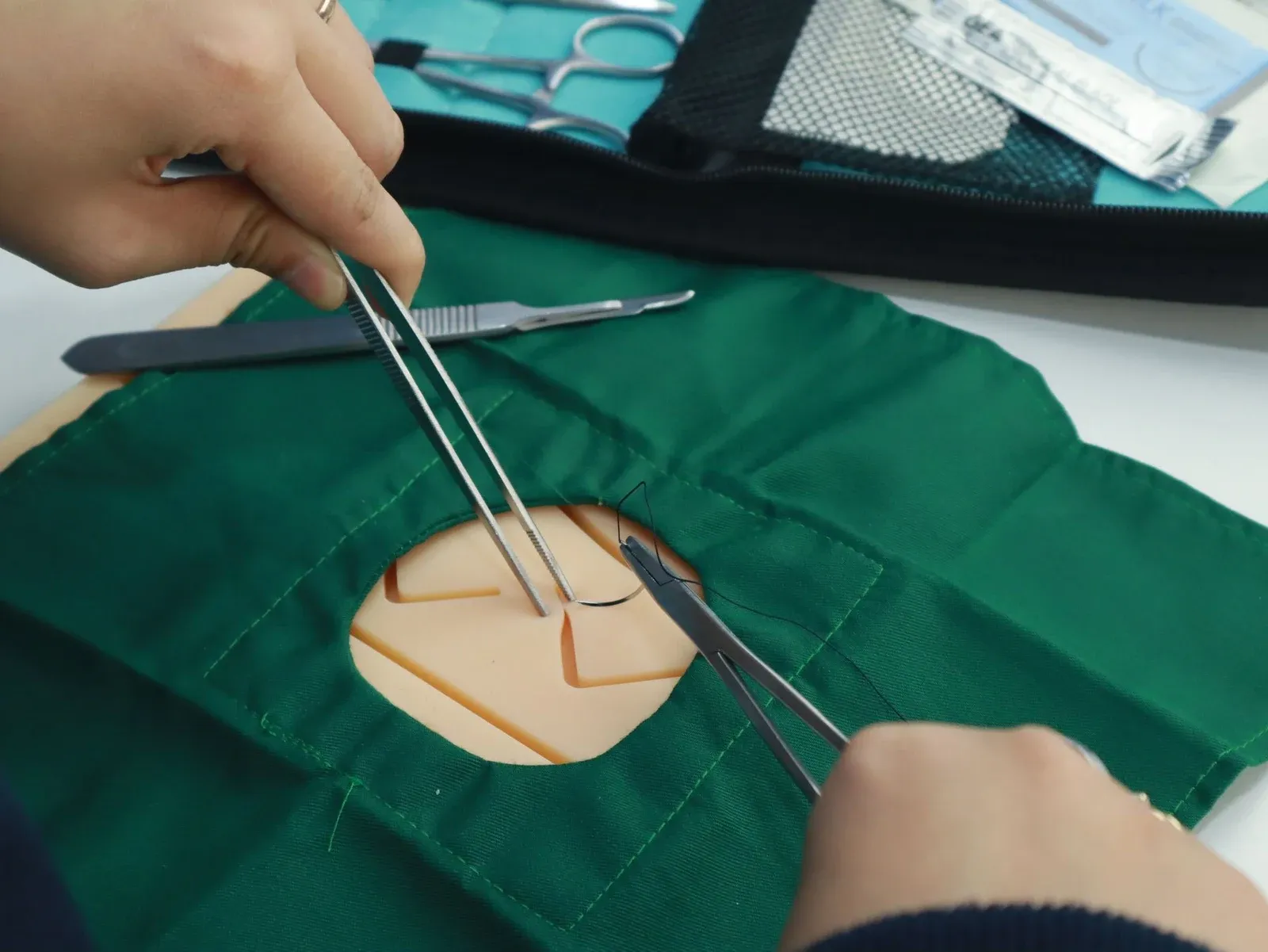
Case study: Surgical residents at the University of South Florida
Surgical residents train for certification in Fundamentals of Laparoscopic Surgery, which is assessed on simulator tasks. A University of South Florida team in Tampa compared two ways of practising four of them, noting that the recommended approach was to practise one task at a time until proficient.
- What they did: residents were randomised to blocked or interleaved practice of 20 trials on each of four tasks: peg transfer, pattern cut, and two kinds of suturing. Four weeks later they returned for two more trials of each.
- Evidence and result: the interleaved group did significantly better on peg transfer. Its scores were also ahead on both suturing tasks, though not significantly, and not on the pattern cut, Goldin and colleagues reported.
- Limitation: one programme, simulator scores rather than performance in surgery, and a significant result on one of four tasks. The published abstract does not report how many residents took part.
- Lesson: when people will switch between several procedures at work, rotating them in practice can help. Score each task separately, because the benefit was not the same for every task.
What course requests show about mixed practice
I looked at the course requests people typed into the Coursebox course generator from 18 August to 15 November 2026: one first request per person, English browsers, staff excluded. I removed prefilled and shared template prompts that recurred word for word across three or more people, which left 143 independent requests. An AI classifier labelled what each asked for, and I read every request in the categories I report by hand.
Sixteen were workplace courses that asked for an assessment. Four asked for a quiz per module and nine for a cumulative or final test, with one asking for both. The other four asked for quizzes or an evaluation without saying how they were organised.
Sixteen requests is a small pool, and zero in a pool that size shows only that mixed practice was absent from these briefs. A request describes the course someone wants built, so a team may plan mixed review elsewhere. Where these requests said how questions were organised, they were set per module or saved for the end, so the decision about mixing has to be made deliberately in the brief.
Support questions point the same way. A search of support threads from 2024 to 2026 found none that mentioned interleaving, and six that asked about shuffling the order of answers or questions within one quiz. One of those wanted a fixed question order instead.
Interleaved vs blocked vs spaced practice
The three orders answer different questions, and a well-built course usually uses all three: blocked practice to learn a new case, interleaved practice to tell it apart from its look-alikes, and spaced practice to keep it.
| Question | Blocked practice | Interleaved practice | Spaced practice |
|---|---|---|---|
| Best for | First examples of a new category or procedure | Telling similar cases apart and choosing the right procedure | Keeping a skill over weeks or months |
| Weak spot | Learners never practise working out which kind of case they face | Takes longer, feels harder and may confuse complete beginners | Does not help learners tell look-alike cases apart unless they are mixed |
| Use it when | Learners meet a category or procedure for the first time | Learners can handle each case alone but mix them up | The skill will not be used for a while after the course |
Interleaving and spacing are easy to merge because a mixed set spaces each kind of item. They are separate decisions: interleaving mixes kinds of item within a session, while spacing spreads practice of the same item over time. Our guide to spaced repetition covers choosing intervals, and the forgetting curve guide covers what happens to learning between sessions. For retrieval practice and the other methods that sit alongside mixing, see our overview of learning strategies.
Limitations of interleaving
- The evidence comes mostly from students. Brunmair and Richter write that "relatively few studies have employed nonstudent samples", and the effect was larger for younger participants.
- The best evidence uses pictures. Of the 238 effect sizes in the meta-analysis, 152 came from pictures such as paintings, photographs of birds and butterflies, and artificial images. Text-heavy workplace content, such as a policy explained in writing, is the kind of material where the authors are reluctant to recommend it.
- Professional studies are few and small. The McMaster ECG study and the Florida surgical-simulator study are single programmes with short or simulator-based measures. A systematic review of radiology education found that of 1,316 records, eight studies met its criteria and two of those tested interleaving.
Brunmair and Richter's pooled result sets the size of the effect to expect across all those studies.
A moderate average from laboratory experiments does not predict the result for one workplace course. Try one mixed set on the cases your staff confuse most, and compare the delayed check with the blocked version before redesigning everything.
Using interleaving with an AI course tool
I tried this in Coursebox on 16 November 2026, in an unpublished test course. I described the returns team and its two quality-check mix-ups, then asked for one short module per category and a mixed practice page: twelve cases, no two in a row from the same category, and feedback on every item naming the deciding feature. I also asked what it could not build.
It built one page per category, then a practice page called "Twelve mixed damage-photo cases". It said it could not use real customer photos, because I had uploaded none, so each case describes the photo in writing. It also said the planned interactive scenario had not run, so the practice page used a self-check accordion.
Its message said the cases alternated the four categories three times and that both mix-ups were addressed. When I opened the page, every case title named its answer, such as "Transit damage, crushed corner and chipped panel", and the order was the same rotation each time. The builder had followed my rule to the letter, and a learner could have scored 12 out of 12 from the titles or positions alone.
I asked the AI editor to take the categories out of the titles and reorder the cases irregularly, still with no two in a row. After reloading, I checked the page. The titles now describe only the evidence, such as "Case 2: crack beside a fastener", and the order has no two in a row and no repeating cycle. Each answer and feedback line sits inside its expandable case, and nothing records which category a learner chose.
Whatever tool builds your mixed set, read the titles and the order as a learner would before you publish it.
A Word sheet for deciding, topic by topic, whether to mix practice or keep it in blocks, based on the conditions in the research. Includes the filled returns-team example and a blank version.
Putting interleaving to work
Interleaving helps when people at work have to recognise which kind of case is in front of them, and the cases look alike. It does little for vocabulary or topics nobody confuses, and the results for explanatory text such as policy wording were unclear. Give each case a short block first and feedback on every answer. Choose the two categories your staff confuse most, from real errors. Write eight new examples of each, four for a short block and four for one mixed practice page after the existing modules, each with a feedback line naming the deciding feature. Check a few weeks later with cases they have not seen, and keep the mixed set if that check improves on the blocked version for those categories.
Frequently Asked Questions
Interleaving is a way of arranging practice so that items of different kinds are mixed together, and learners must work out which category, procedure or concept each item needs before they can answer it. Blocked practice is the opposite: all items of one kind, then the next.
A returns assessor practising with damage photos from four categories in a mixed order, rather than all transit-damage photos first, is doing interleaved practice. Each photo requires deciding which category it is before deciding what to do. In maths, a homework set that mixes problems needing different methods is the classroom equivalent.
No. Interleaving mixes different kinds of item within one practice session, while spaced practice spreads practice of the same item over days or weeks. A mixed set does space out each kind of item, which may explain part of its benefit, but the two are planned separately.
Blocked practice repeats one kind of item before moving to the next, so the learner always knows which method or category applies. Interleaved practice mixes the kinds, so the learner has to work it out each time. Blocked practice suits the first examples of something new; interleaved practice suits cases people confuse.
Possibly, but the evidence is thin. A 2019 meta-analysis found that relatively few studies used people other than students and that the effect was larger for younger participants. Trials with medical students and surgical residents found benefits on specific tasks, so test one mixed set with your own staff and check the result.
Travis Clapp
Travis Clapp is the original founder and CEO of Coursebox. As an experienced instructional designer, he has lived through the process of building high quality courses. These experiences brought about his idea to upload all your documents and ideas into a virtual box that could convert those magically into a course. Prior to Coursebox, he successfully founded and built a social based LMS. Travis has 15+ years of experience designing courses and EdTech platforms from university MOOCs to enterprise LMS. Travis has built training for reputable companies like Johnson & Johnson, Electrolux, Michael Hill and SA Health. One of his courses reached 20,000+ learners which was a flagship edX course. He is based in the Adelaide, South Australia office and passionately works on customer support, sales and bringing the original product vision to life every day.

