

Retrieval Practice: What It Is and How to Use It at Work
What retrieval practice is, how answer formats differ, when learning carries over to a new task, and how to design practice for experienced staff.

Retrieval practice is learning by pulling information out of memory, such as answering a question, explaining a step or deciding a case without notes, instead of reading or hearing the material again. Researchers call the boost it gives to later memory the testing effect.
- A meta-analysis of 122 experiments found testing carried over strongly to questions asking people to apply or infer, and weakly to material that was never tested.
- Randomised trials with practising doctors are split: two of the four I read found a benefit from quizzing, and two found none.
- For experienced staff, aim the questions at what has changed and at known errors, and give feedback after every answer.
- Retrieval practice needs no special software, because a typed answer, a spoken case review and a scenario on paper all count.
Five questions, about a minute. Pick one course that experienced staff in your team complete, ideally one about a change to how they work. This is an unvalidated planning aid. The total organises suggestions; it does not assess competence or prove that the method will work. Review each answer.

Go from storyboard to an interactive course in minutes
Picture a biosecurity inspection officer with ten years at a regional port. Last month the list of goods her team must hold for inspection changed, and she scored 100% on the online module about it. This morning a consignment the new list says to hold comes through her lane, and she releases it, because that is what the old list allowed. The module asked her to pick the new rule from four options. Nothing in it asked her to make the call herself, from memory, the way the job does.
I'm an instructional designer at Coursebox. I test every Coursebox release and write our knowledge base. We make an AI quiz generator for training courses, so I have a commercial interest in questions, and you should weigh my view of our product with that in mind. This guide explains what retrieval practice is for working adults, how producing and selecting answers differ, when the benefit carries over to the job, what trials with practising doctors found, and how I would design it for experienced staff. Along the way I fill in a question planner for the port example, and both the planner and a question rewrite sheet are free Word downloads.
What is retrieval practice?
Retrieval practice is learning by pulling information out of memory, such as answering a question, explaining a step or deciding a case without notes, instead of reading or hearing the material again.
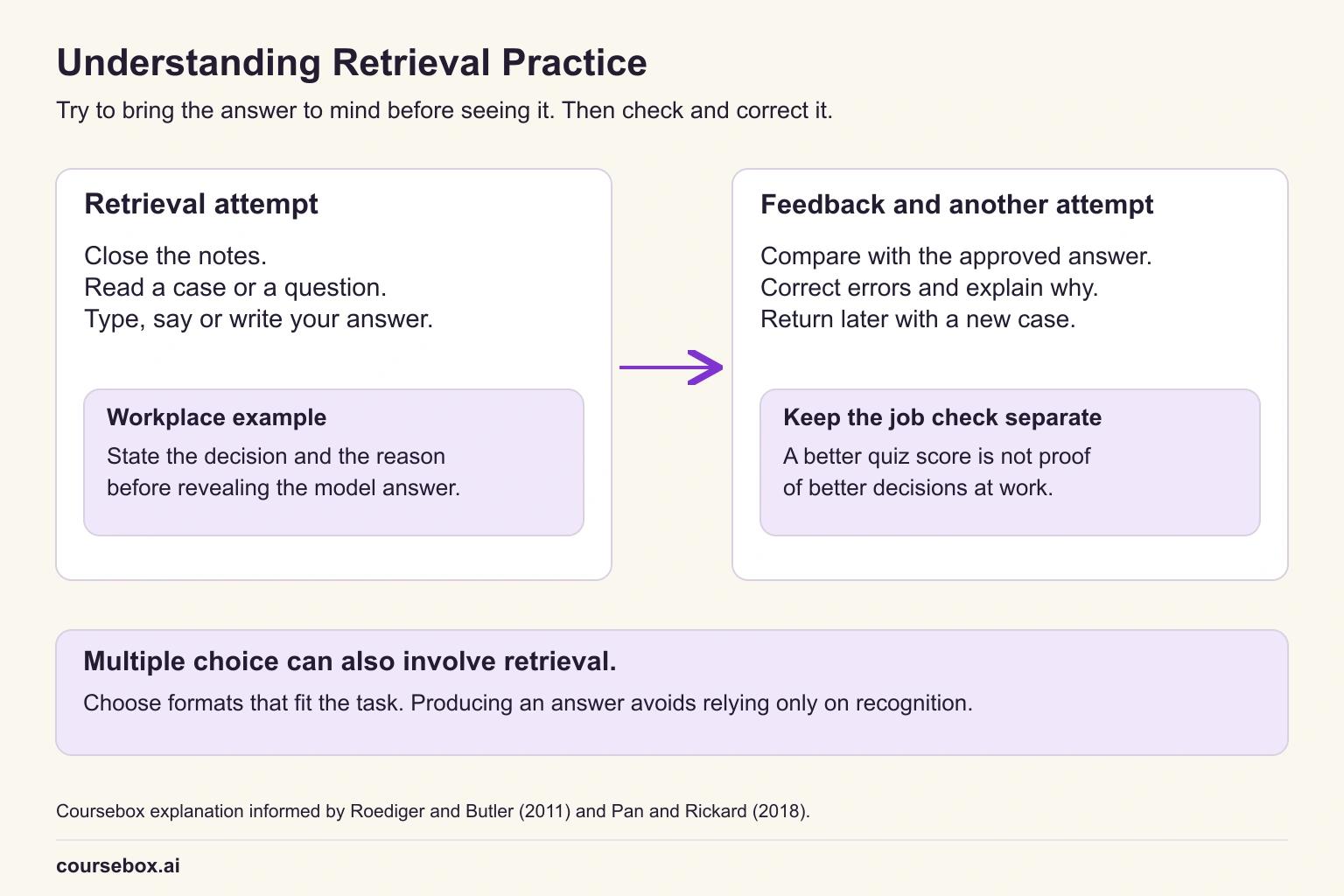
View the full-size retrieval practice diagram
The act of retrieving is the learning event, not only a measure of it. In their review in Trends in Cognitive Sciences, Henry Roediger and Andrew Butler describe retrieval practice as "a powerful mnemonic enhancer, often producing large gains in long-term retention relative to repeated studying." The same review says it "promotes the acquisition of knowledge that can be flexibly retrieved and transferred to different contexts." Researchers call the effect the testing effect, or test-enhanced learning, and the practice itself retrieval practice.
A review written for continuing professional development planners, by Van Hoof, Madan and Sumeracki, puts the mechanism plainly: "Retrieval practice requires one to examine long-term memory to work with priority information again in working memory." That is the whole idea. The learner has to go and get the information, rather than meet it again on a slide.
Retrieval practice is not one format. Any activity counts if the learner has to bring the answer to mind before seeing it:
| Form | What the learner does | Produce or recognise | What it looks like at work |
|---|---|---|---|
| Short-answer question | Types or says the answer with nothing to choose from | Produce | "What are the three checks before you release a vehicle?" |
| Explain in your own words | Writes or tells a colleague how and why a step works | Produce | A new supervisor explains the escalation path at a team huddle |
| Scenario decision | Reads a case and decides what to do before seeing options | Produce | A pharmacist decides whether to dispense a changed prescription |
| Free recall | Writes down everything they remember about a topic | Produce | A sales rep lists the objections and answers from yesterday's session |
| Flashcard | Answers the prompt on the front, then turns it over | Produce | A technician recalls fault codes before checking the card |
| Multiple choice | Picks the answer from a list | Recognise | A quiz on which form to use for an incident report |
Most of the evidence on practice testing comes from classrooms and laboratories, and it underpins most learning strategies advice. This guide is about adults at work, where the content is a procedure, a rule or a judgement and the test that counts is the next real case.
A retrieval question is there to make people remember, so it is usually low stakes, ungraded and followed straight away by the answer. A graded test can also produce the effect, but its main job is a decision about the learner. Keep the two apart in your planning, so that the questions meant for learning are not written like exam items.
Producing an answer versus recognising one
A short-answer question gives the learner nothing to work from. They have to search memory and build the answer, which is the "examine long-term memory" step the definition describes. A multiple-choice item supplies possible answers. It can still require retrieval and application, but a weak item may be answered from familiarity alone. Producing an answer removes those supplied options; it is not automatically superior for every learning goal.
The job rarely offers four options. An inspection officer, a nurse or a contact-centre agent meets a situation and has to produce the response. So a question that asks people to produce the answer is closer to the work in two ways: the effort of retrieval, and the form of the response.
That second point has support in the transfer research. In Pan and Rickard's 2018 meta-analysis, "response congruency and elaborated retrieval practice, as well as initial test performance, strongly influence the likelihood of positive transfer." As I read it, the benefit is more likely to carry over when the answer people practise is the answer they will later need, when retrieval asks them to do more than recall a single item, and when they get enough of the practice right. The same review also found strong transfer across test formats. So the format of the answer is one factor, not a rule, and the four trials with doctors do not separate the two formats: each format appears once among the positive results and once among the null ones.
Multiple choice still has a place. Options make a question quick to answer and mark, and well-written wrong options can teach. One of the trials with practising doctors used multiple-choice tests and still found a benefit. My rule is simpler than a ban: when the job asks people to produce something, at least some of the practice should ask them to produce it too. For how to write good options and feedback, see our guide to writing an e-learning knowledge check.

Case study: Quizzing after American Academy of Neurology meeting courses
Conference courses are a common way for practising clinicians to keep up. Larsen and colleagues tested whether short-answer quizzing after four courses at the American Academy of Neurology annual meeting would keep more of the content than restudying.
- What they did: each key point from the courses was randomly assigned to repeated short-answer quizzing, repeated studying of the same information, or no further exposure, so every participant had all three conditions. A final test came 5.5 months after the course.
- Evidence and result: 35 participants across the four courses completed the study. On the final test, quizzed points scored 55%, against 46% for restudied points and 44% for points with no further exposure, the team reported in Neurology. The pretest average was 36%.
- Limitation: 35 completers who volunteered, and the abstract does not give the number recruited. The outcome is a knowledge test, not what the neurologists did with patients.
- Lesson: short-answer quizzing kept more of a one-off course for almost six months than restudying the same points. It compares quizzing with rereading, not one question format with another. If a course ends with a summary handout, turn the key points into short-answer questions and send them again afterwards.
Does retrieval practice carry over to the job?
Sometimes, and the conditions are specific. Pan and Rickard pooled "192 transfer effect sizes extracted from 122 experiments and 67 published and unpublished articles (N = 10,382)". Transfer here means a benefit on a different question or task from the one practised, which is the situation every workplace course is in.
That average hides a wide spread. The Pan and Rickard abstract reports transfer was greatest "to application and inference questions" and "to problems involving medical diagnoses". It was weakest "to untested materials seen during initial study" and to problems involving worked examples. After correcting for publication bias, the predictions were "substantially reduced, often indicating no positive transfer when none of the aforementioned moderators are present."
For a training designer, three rules follow:
- Ask the question the job asks. A question that makes people apply a rule to a case is more likely to help with the next case than a question that asks them to recall the rule's wording.
- Untested slides are not covered. Retrieval helps the content it touches. A five-question check on a 40-slide module helps least with the slides its questions never touch.
- Check that the answers come out right. Initial test performance is one of the moderators, so a check most people fail, with no feedback, is not doing the job.
The outcomes reported are test scores, not workplace performance. They show a better score on a different test, which is a reason to design for transfer, not proof that a quiz changes what people do.
Does retrieval practice work for experienced staff?
The evidence is mixed. McConnell's 2022 review in the Journal of Continuing Education in the Health Professions says that although test-enhanced learning is well established with trainees, "there are mixed findings of whether testing facilitates learning within continuing professional development". Four randomised trials with practising doctors show the split. All four measured knowledge or vignette tests, not patient care.
| Trial | Who | What the tested group did | Result |
|---|---|---|---|
| Toronto CPD conference, 2018 | 126 physicians analysed, of 186 randomised | An online multiple-choice test before the workshop without feedback, and another 14 days after it with feedback | Benefit on a case-based test at four weeks |
| American Academy of Neurology courses | 35 course participants | Repeated short-answer quizzing on some key points, restudying on others, nothing on the rest | 55% against 46% for restudying at 5.5 months |
| CME trial, 2015 | 56 physicians tested, of 83 randomised | One 10-question short-answer test straight after a session | 42.5% against 41.2%, no difference at four weeks |
| CME trial, 2018 | 49 physicians | Two 20-item multiple-choice quizzes, at the event and four weeks later | 75% against 77%, no difference at eight weeks |
The 2015 trial's own authors offered two explanations, without testing either. In their trial report in the Journal of Continuing Education in the Health Professions, they wrote that "it is possible that TEL [test-enhanced learning] is specific to novices and not generalizable to experts", or that the result shows "the importance of repeated, distributed testing with feedback." The 2018 trial by the same group, which gave two multiple-choice quizzes four weeks apart, also found no difference. McConnell's 2022 review adds a third angle: how a profession's learning culture shapes what experienced people think a test is for.
The trial with one short test straight after a session found no difference four weeks later. If the plan for experienced staff is one check at the end of a briefing, do not count on it. Spreading the tests out is not a guarantee either: the 2018 trial gave two quizzes four weeks apart and also found no difference.
Reading the four together, I see three reasons experienced staff are a harder case, which are my interpretation rather than tested findings. First, they already know most of a topic, so a quiz on the whole topic spends retrieval on answers they could give anyway. Second, the new rule competes with an old one they have used for years, and the old one is the answer that comes to mind under pressure. Third, a test can feel like a judgement of their competence, which is the cultural point McConnell raises.

Case study: Testing physicians at a CPD conference in Toronto
In April 2016, 308 physicians from across Canada registered for the four-day continuing professional development conference run by the University of Toronto's Department of Paediatrics. The conference was built around workshops. Feldman and colleagues tested whether a low-cost online add-on would help the content last.
- What they did: 186 consenting physicians were randomised within 15 workshops. The tested group took an online multiple-choice test before their workshop, with no feedback, and another 14 days after it, with feedback. The control group had no tests.
- Evidence and result: 126 physicians provided complete data. On a case-based retention and application test four weeks after the conference, the pooled effect was moderate (Hedges g 0.46), the team reported in Academic Medicine.
- Limitation: the outcome was a vignette test, not practice, and 60 of the 186 randomised physicians did not provide complete data. The design combined a pretest and a delayed post-test, so their separate contributions are unknown.
- Lesson: two online tests, one before the workshop and one two weeks after with feedback, moved a case-based test a month out. The trial cannot say which of the two did the work.
How to design retrieval practice for experienced staff
Here is the hypothetical example in full. A regional port's biosecurity team has 16 inspection officers, most with more than five years in the role. An updated import list moves three kinds of goods into a stricter category: used farm machinery carrying soil, untreated timber packaging and one fresh fruit newly listed as a host for a pest. Officers decide at the inspection point whether each consignment is held, inspected or released. The team lead has a 30-minute online module that ends with 12 multiple-choice questions on the general inspection process, and a supervisor who reviews a sample of decisions each week.
This example shows the design problem clearly. The officers are experienced, so most of the module is familiar. The change contradicts habits they have used for years, and the decision is made at the inspection point. Practice can improve recall, while approved job aids and escalation remain available for live decisions. The steps below show how the team lead could turn the module's end quiz into retrieval practice. The goods, rules and numbers are illustrative, and the port's procedure owner sets the real ones.
1. Start from what changed and what people get wrong
Give changed and error-prone decisions priority. Experienced staff may also need practice on familiar tasks they use rarely or perform unreliably; use evidence of their work to decide.
- Sample question: "A consignment of used farm machinery arrives with dried soil on the tracks. What do you do, and why?"
- What a good answer contains: hold the consignment for inspection, and the reason under the updated list.
- In the course: the module replaces its 12 general questions with four cases, all on the three changed categories and the one release error the supervisor's review found most often.
2. Ask for the decision in the form the job uses
The job asks the officer to produce a decision and a reason, so the practice should too.
- Sample question: a short case describing a consignment, its paperwork and what the officer can see, followed by an open box: "Hold, inspect or release? Give your reason in one line."
- What a good answer contains: the correct decision, plus the feature of the case that triggers it, such as the missing treatment mark on the timber.
- In the course: each case appears with no options. Learners type their answer before the model answer is shown.
Draft the situation an officer will actually meet, with the paperwork and what they can see, then ask what they would do. A question written from the rule ("Which goods moved category?") tests the rule's wording. A question written from the case tests the decision.
3. Give feedback after every answer
Roediger and Butler's review found that retrieval practice "is often effective even without feedback (i.e. giving the correct answer), but feedback enhances the benefits of testing." For experienced staff, feedback also has to beat the old habit.
- Sample question: the same machinery case.
- What a good answer contains: after the learner submits, the feedback shows the model answer, names the old rule that would have released the consignment, and says what changed.
- In the course: every case has written feedback that names the specific feature of the case, not only "correct" or "incorrect".
4. Bring the questions back later with new cases
One trial with doctors tested a single check straight after a session and found no difference. Spacing is no guarantee either, since another trial gave two quizzes four weeks apart and also found none. Still, bringing the decisions back with new cases means the officer retrieves the rule rather than remembering the earlier question.
- Sample question: two weeks later, a different consignment: a tractor the paperwork describes as new, with soil visible in the wheel arches.
- What a good answer contains: hold for inspection, because what the officer can see shows used machinery with soil, whatever the paperwork says.
- In the course: a five-minute set of three new cases at two weeks and again at six weeks. Our guide to spaced repetition covers how to choose and adjust those gaps.
5. Check the decision on the job
A higher quiz score shows the officer can make the decision on a test. The supervisor's weekly sample shows whether they make it at the inspection point.
- Sample question: none. The check is the officer's real decisions.
- What a good answer contains: the supervisor records each decision on the three changed categories as correct or incorrect against the updated list.
- In the course: errors from the weekly sample become new cases for the next set of questions, so the practice follows the mistakes people actually make.
The retrieval question planner, filled in for the port officers
The planner applies the five steps item by item. The goods and timings are illustrative, and the procedure owner must review them. The filled example and a blank version are in the download.
| Item | Changed or error-prone | Answer format | Feedback names | Comes back | Checked on the job by |
|---|---|---|---|---|---|
| Used machinery with soil | Changed | Type the decision and reason | The soil, and the old release rule | Week 2 and week 6, new cases | Weekly supervisor sample |
| Untreated timber packaging | Changed | Type the decision and reason | The missing or mismatched treatment mark | Week 2 and week 6, new cases | Weekly supervisor sample |
| Newly listed fresh fruit | Changed | Type the decision and reason | The new host listing | Week 2 and week 6, new cases | Weekly supervisor sample |
| Most frequent release error | Error-prone | Type the decision and reason | The feature officers missed | Week 2, then as the sample shows | Weekly supervisor sample |
| Entry codes in the system | Neither | Look up, no question | Not applicable | Not applicable | System validation |
A Word planner for choosing which items get retrieval questions, setting the answer format and feedback, and planning when each question comes back and how the decision is checked at work. Includes the filled port-inspection example and a blank version.
Common retrieval practice mistakes
Each of these mistakes comes from treating a quiz as proof that retrieval happened.
- Testing the whole topic for people who know it. Experienced staff answer the familiar questions on autopilot. Spend the questions on what changed.
- Recognition only, when the job asks for production. If every question offers options, nobody practises producing the decision.
- Questions written from the rule, not the case. Recalling the wording of a rule is not the same as applying it, and application questions are where transfer was greatest.
- No feedback. Feedback adds to the benefit of retrieval, and a wrong option left uncorrected can be learned as fact, as our guide to writing knowledge check feedback explains.
- One check, once. The one trial with doctors that tested a single check straight after a session found no difference. Bringing questions back later is not a guarantee, but a check that never returns gives people only one retrieval.
- Treating the score as a job outcome. A quiz result is a learning measure. Check the real decisions too.
- Framing it as an exam. For experienced staff, say what the questions are for: practice on a change, not a judgement of their competence.
What Coursebox course requests ask for
I looked at a sample of first course requests typed into Coursebox between 18 August and 15 November 2026, one per person, from English-language browsers, with staff excluded. I removed prefilled and shared template prompts that recurred word for word across many people, which left 130 independent requests. An AI model classified them against definitions I wrote, and I read every hit in the categories below by hand. Only 14 were for workplace courses and asked for questions of any kind, so this is a small pool from one sample.
Of the same 14, at most two asked for answers in the learner's own words, three named only multiple choice, and the other nine did not say what format they wanted. Four asked for questions that apply the content to a situation, and four asked for questions that check recall of facts. A request describes the course someone wants built, so teams may plan more practice elsewhere, in an LMS or a team meeting. Most requests leave the answer format unstated, which means the tool or the designer decides it. If you are writing a brief for a course or an AI tool, say which decisions learners should answer in their own words.
Retrieval practice vs knowledge checks and spaced repetition
The three terms overlap, and people often use them interchangeably. Retrieval practice is the learning mechanism. A knowledge check is one place to use it, inside a lesson. Spaced repetition is a way to time it.
| Question | Retrieval practice | Knowledge check | Spaced repetition |
|---|---|---|---|
| What it is | Learning by pulling information out of memory | A few low-stakes questions inside or straight after a lesson | A schedule of practice spread over time |
| Best for | Deciding what learners should produce and in what form | Catching misunderstandings before learners move on | Keeping decisions available until they are needed |
| Weak spot | Benefit is less certain for experienced staff and untested content | Often written as recognition items on the content read a moment earlier | Interval rules get quoted as universal when they depend on the material |
| Use it when | You are designing what any question in a course asks for | You are building a lesson | You know what to practise and need the dates |
Use retrieval practice to decide what the questions should ask; write and time them after that. Our forgetting curve guide explains what Ebbinghaus measured about relearning, which helps when deciding whether a course needs follow-up at all.
Limitations of retrieval practice
- The strongest evidence is from students and trainees. McConnell's review calls the evidence in continuing professional development mixed, and the four trials with doctors split two and two.
- Transfer is conditional. Pan and Rickard found that, after correcting for publication bias, there was often no positive transfer when none of the moderators were present.
- Knowledge is not performance. A higher quiz score shows people can recall the material, not that they make better decisions at work, so check the work itself.
- Untested content gets little help. The benefit is concentrated on what the questions touch, so coverage choices decide what improves.
- Combined programmes hide the quiz's share. When quizzes sit inside a larger programme, a good result belongs to the programme.

Case study: Mental health training for employees of six Hong Kong corporations
With funding from the Hong Kong government, researchers built a web and mobile programme on workplace mental health and tested it with employees of six large corporations, recruited through their human resources departments. Participants ranged from manual workers to senior executives.
- What they did: offices or units were randomised to the programme or a wait-list. Modules were released over time, and a short quiz at the end of each module had to be passed before the learner could move to the next level.
- Evidence and result: of 456 participants, 236 (51.8%) responded to the follow-up survey. After the programme, the trained groups recognised a mental health problem more readily, reported more willingness to seek help and showed less stigma than the control group, allowing for the fact that whole offices were randomised, Lam and Lam reported in JMIR Mental Health.
- Limitation: the outcomes were self-reported knowledge and attitudes, not behaviour, and nearly half the participants did not respond at follow-up. The quizzes were one part of a spaced programme, so the result cannot be credited to retrieval alone.
- Lesson: the trial did not test retrieval practice. Its quizzes were a gate inside a larger programme that ran with employees from manual workers to senior executives. It shows the package worked, not that the quizzes did, so test a quiz's own contribution before crediting it.
Using retrieval practice with an AI course tool
I tested the port example in Coursebox on 16 November 2026, in an unpublished test course. I asked for a 30-minute course for the 16 officers where, instead of multiple choice, they type a decision (hold, inspect or release) and a reason for each case before seeing the answer, get feedback on the reason, and meet the same kinds of case again two weeks and six weeks later, and asked what it could not build.
The builder first asked for the import list and which country's rules applied. I had not uploaded one, so I told it to use general principles and keep the cases policy-neutral.
It built five pages: what has changed, a consistent reason for the decision, a 10-minute set of first-round cases, and five-minute sets for week two and week six. On the first-round page I found a "Your decision" box, a "Your reason" box and a "Reveal the model answer" button. I typed "release" with a weak reason, and the reveal showed a model decision of hold with the reasoning. It did not mark my answer right or wrong, so the officer compares their own answer with the model.
The builder said it could not schedule, remind or deliver the two later sets, and could not judge and save every free-text reason, so each case gives a model answer and feedback criteria instead. Its message said those sets must be assigned or scheduled. On the pages, they were pages 4 and 5 of the same course, so an officer could finish all three sets on day one.
My takeaway: the open answer and the model-answer reveal came out as I asked, but the spacing did not. Release the week-two and week-six sets separately in your LMS or a calendar, or they become one sitting.
A Word sheet for turning recognition questions into questions that ask learners to produce a decision, with a model answer and feedback for each. Includes the filled port-inspection example and a blank version.
Putting retrieval practice to work
Retrieval practice is most likely to help when the question makes people produce what the job needs, comes back later and is followed by feedback. With experienced staff the evidence is mixed, so treat a quiz as practice on the change, not a guarantee. Take one course your experienced staff complete, pick the three decisions most likely to go wrong, rewrite their questions as cases with an open answer and written feedback, and plan a check of those decisions at work a few weeks later.
Frequently Asked Questions
Retrieval practice is learning by pulling information out of memory, such as answering a question, explaining a step or deciding a case without notes, instead of reading or hearing the material again. Researchers call the boost to later memory the testing effect.
Closing a manual and writing down the steps of a procedure, then checking them against the manual, is retrieval practice. So is answering a short case at work, such as deciding whether to release a consignment, before seeing the answer. Rereading the manual is not, because nothing has to come from memory.
The testing effect is the finding that retrieving information from memory improves long-term retention more than studying it again. A review by Roediger and Butler describes retrieval practice as often producing large gains in long-term retention relative to repeated studying, with feedback adding to the benefit.
Retrieval practice is the learning mechanism: bringing information to mind before seeing it. A knowledge check is a short set of low-stakes questions inside or straight after a lesson. A knowledge check uses retrieval practice, but retrieval practice can also be a case discussion, a flashcard or writing a procedure from memory.
The evidence is mixed. Studies with students and trainees are largely positive. Four randomised trials with practising doctors split evenly, with two finding a benefit and two finding none. Questions that ask people to apply what they learned, spaced over time and followed by feedback, give it the best chance.
Carolina Martin
Carolina is a highly experienced learning designer with tech start-up experience. She is based in Sydney and previously designed courses alongside Coursebox founder Travis in a previous job. She is passionate about delivering engaging learning experiences and brings the same perspective to customer experience too. She manages our customer support documentation and product testing processes.

