

Forgetting Curve: What Ebbinghaus Measured and How to Use It
What the Ebbinghaus forgetting curve measured, his table and formula, why '70% in 24 hours' is wrong, and how to time refresher training at work.

The forgetting curve is the pattern of memory loss that Hermann Ebbinghaus published in 1885: forgetting is fastest in the first hours after learning, then slows to a long, shallow decline, and some trace of the learning lasts for weeks.
- Ebbinghaus measured how much faster he could relearn a list, not how much he recalled, across seven intervals from 20 minutes to 31 days.
- A day after learning, Ebbinghaus could relearn a list in about one third less time than it first took.
- Popular figures like "70% forgotten in 24 hours" and the 2-7-30 rule do not appear anywhere in Ebbinghaus's book.
- Plan follow-up practice around the task, its risks and later performance. The curve does not prescribe a six-week refresher or replace required recurring training.

Go from storyboard to an interactive course in minutes
Imagine a head office that trains its floor wardens in February but gives them no further practice before the August drill. A warden hesitates over the approved sweep procedure; another cannot recall the backup assembly point. Booking the same course next February would leave those problems unresolved for months. This hypothetical situation raises a practical question: what should happen between the first course and the next time the skill is needed?
I'm Travis, cofounder of Coursebox. Before that I was a learning designer building edX courses at the University of Adelaide, and I still design courses with customers on calls. Coursebox makes AI course software used for compliance training, so I have a commercial interest in refresher design. This guide explains the forgetting curve, what Ebbinghaus measured and what his numbers can tell a training team. It includes real studies, a floor-warden planning example and two editable Word worksheets.
What is the forgetting curve?
The forgetting curve is the pattern of memory loss that Hermann Ebbinghaus published in 1885: forgetting is fastest in the first hours after learning, then slows to a long, shallow decline that still leaves a trace of the learning weeks later.
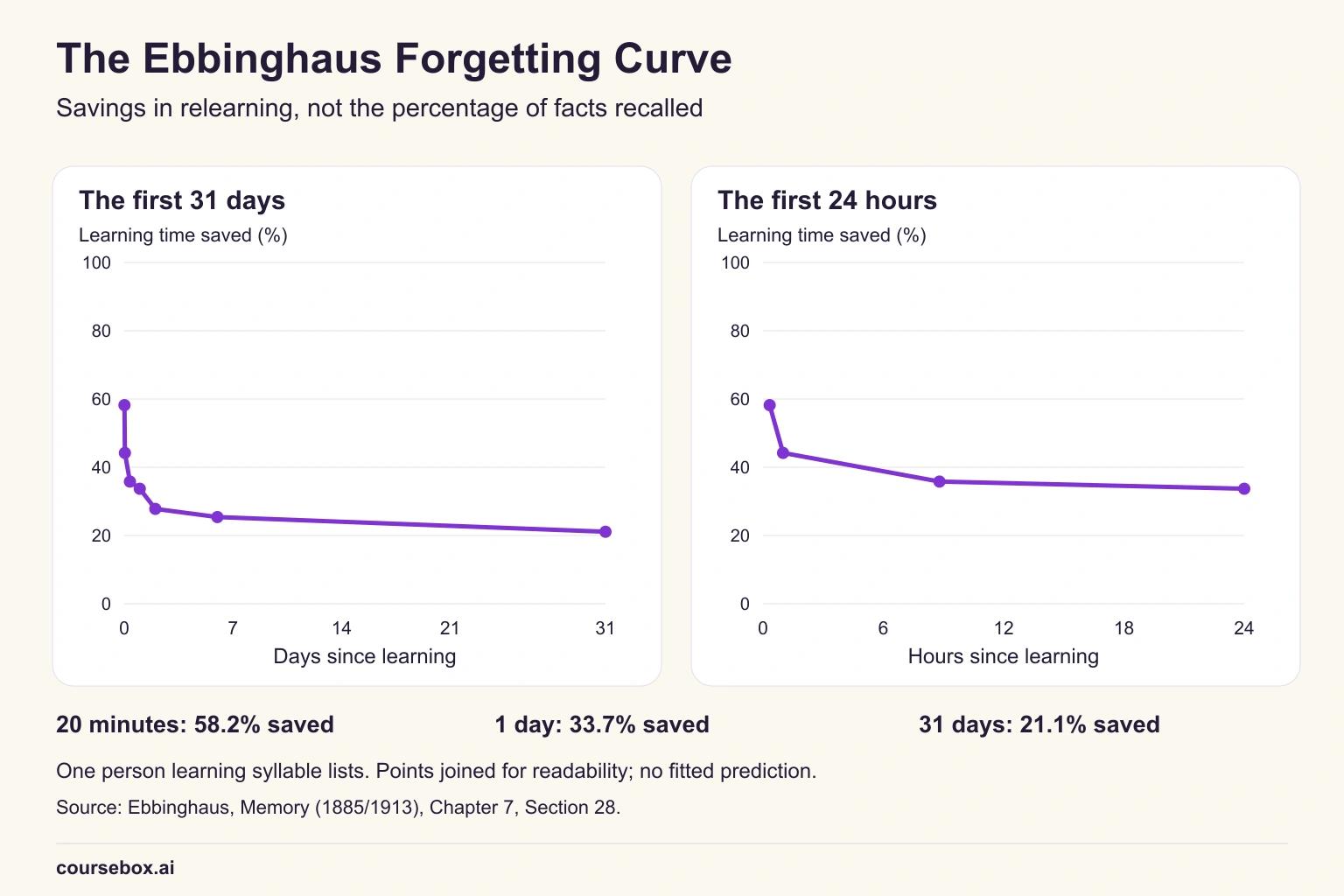
View the full-size forgetting curve diagram
Ebbinghaus wanted a repeatable way to measure forgetting. In chapter 1 of his book he lists the questions he wanted answered, starting with how forgetting "depend[s] upon the length of time during which no repetitions have taken place", and ends: "These and similar questions no one can answer."
His answer was a method called savings. He learned a list until he could recite it twice without error, waited, then learned it again and timed the second attempt. If relearning took less time than the first learning, the difference was what he still held, even when the list felt completely gone. In his own words, a poem that seems "totally forgotten" still "in a certain sense exists", because "the second learning requires noticeably less time".
Savings can reveal an effect of earlier learning even when someone cannot recall the material unaided. For a training team, that suggests measuring both what people can do now and how much help they need to regain a standard. The table below gives the savings values from chapter 7 of the 1913 English translation. The remaining-effort column is 100 minus savings; neither column is a percentage of facts recalled.
| After learning | Time saved when relearning | Remaining effort relative to first learning |
|---|---|---|
| 20 minutes | 58.2% | 41.8% |
| 1 hour | 44.2% | 55.8% |
| 8.8 hours | 35.8% | 64.2% |
| 1 day | 33.7% | 66.3% |
| 2 days | 27.8% | 72.2% |
| 6 days | 25.4% | 74.6% |
| 31 days | 21.1% | 78.9% |
The steep early decline followed by a slower fall is the useful general picture. Its exact percentages belong to one person learning largely meaningless syllables. Later research has compared several mathematical descriptions, including power functions and sums of exponentials; there is no single equation that predicts forgetting for every person and task.
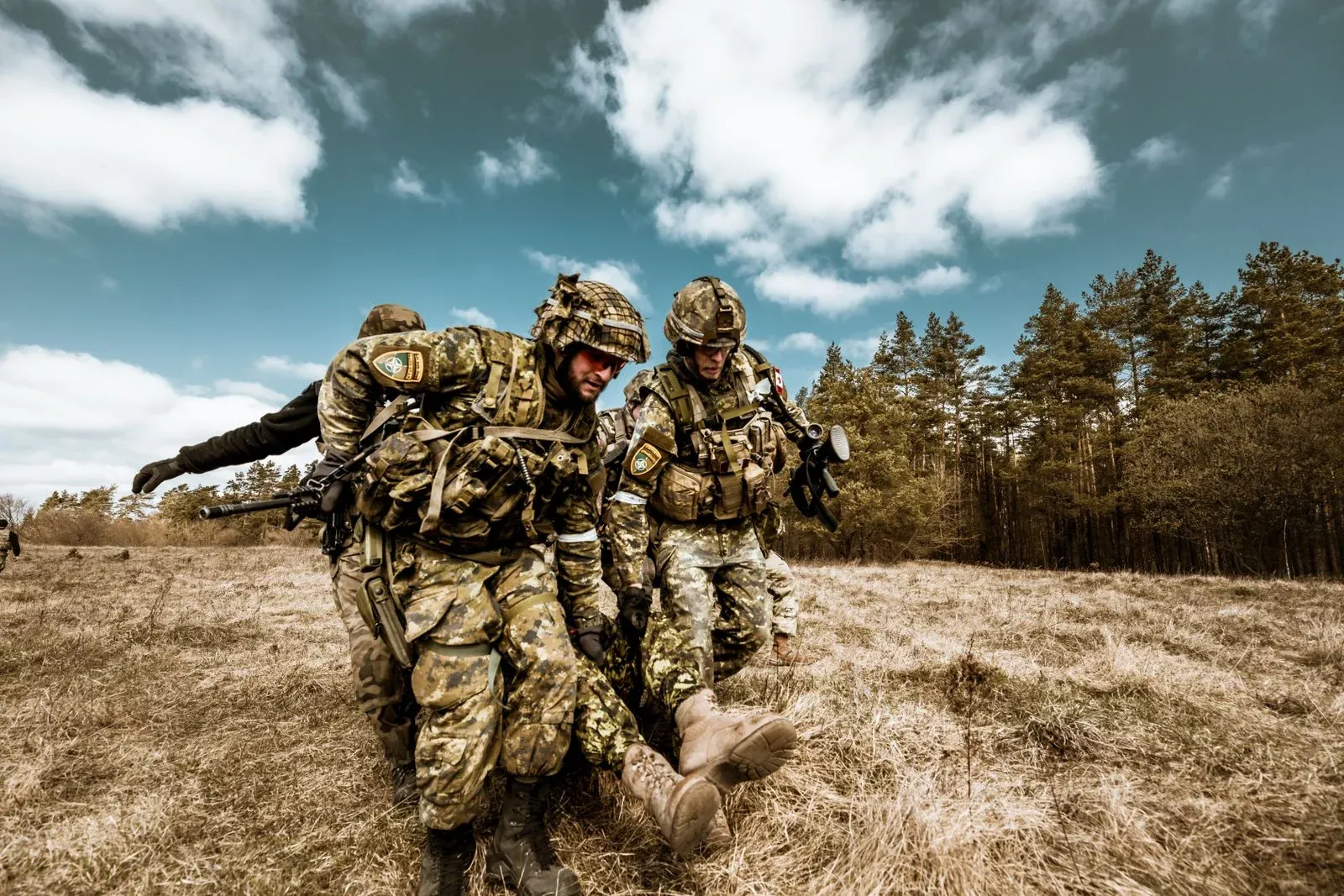
Case study: Combat lifesaver training in the Royal Netherlands Army
Combat lifesavers are soldiers trained to give first care to wounded colleagues until a medic arrives. Researchers from TNO and the Royal Netherlands Army's health department wanted to know how long that skill lasts without practice.
- What they did: 40 combat lifesavers were enrolled, trained in either an individual or a classroom style, and tested straight after training and again at 2 and 6 months, in two 20-minute mannequin scenarios scored by an instructor.
- Evidence and result: the groups did not differ significantly in critical actions; the individualised group was faster and had some other advantages. Performance had already dropped by 2 months, and at 6 months the group made "almost six critical errors per scenario", the team reported in Military Psychology.
- Limitation: a small group in simulated scenarios, with no refresher arm, so the authors' advice to hold a refresher within 2 months is their inference, not a tested result.
- Lesson: important errors were already evident before the six-month check. That supports checking these particular skills earlier; it does not establish that most skill was lost, or provide a universal refresher interval.
How Ebbinghaus measured forgetting
Ebbinghaus ran the forgetting experiment in 1879 and 1880, with himself as the only subject. Murre and Dros, who repeated it in 2015, note that "in all experiments reported by Ebbinghaus, he used only himself as a subject." He named the risk himself in chapter 3: an experimenter working alone forms expectations about the results.
His materials were nonsense syllables: a consonant, a vowel and a consonant, about 2,300 of them, drawn at random into lists. He chose them, he wrote, "in part because of this very lack of meaning", so that interest, associations and memorable phrasing would not disturb the measurements. He read each list aloud at a fixed pace of 150 strokes a minute and learned by repetition alone.
The forgetting study itself comprised 163 double tests. Most tests used eight lists of 13 syllables; 38 used six lists. He learned them to two error-free recitations and relearned them to the same criterion after one of seven intervals, from about 20 minutes to 31 days.
The method explains the curve's main strength and its main limit for a training designer. Savings is a sensitive measure: it picks up memory that a recall test would score as zero. But the material was chosen to have none of the meaning, interest or prior knowledge that workplace content depends on.
Ebbinghaus's book and the replication: which to read
Three sources cover the curve at first hand:
- 1885: Über das Gedächtnis (Duncker and Humblot, Leipzig), the German original. The forgetting table is on page 103.
- 1913: Memory: A Contribution to Experimental Psychology, the English translation by Henry Ruger and Clara Bussenius (Teachers College, Columbia University), free to read online.
- 2015: Replication and Analysis of Ebbinghaus' Forgetting Curve by Jaap Murre and Joeri Dros, open access in PLOS ONE.
If you only read one, read chapter 7 of the 1913 translation. It is short, and it holds the table, the formula and his own warnings about both. The translation rounds two figures: where the German says "more than half" at one hour and "almost two thirds" at 8 hours, the English says "one half" and "two thirds".
Is the forgetting curve still good science?
Yes, with limits. Murre and Dros repeated the experiment in 2015 with one subject, Dros himself, who spent about 70 hours learning and relearning 69 lists of Dutch nonsense syllables. They found a broadly similar savings curve, although their 31-day result was lower than the original and earlier replications.
The fitted curves did not capture every observation. The authors examined relatively high savings around one or two days compared with the fitted decline. They considered sleep as an explanation, while saying that these savings experiments did not establish it as the cause. This is a limit of that particular finding, not a claim that sleep has no established role in memory.
A wider check comes from Rubin and Wenzel's 1996 review, which fitted 210 published data sets of memory over time to 105 different equations. The same few curve shapes, all fast then slow, fitted most of them. What does not hold up is any claim that the curve gives a fixed rate of forgetting for real content, which the original experiment cannot support.
The forgetting curve formula
Ebbinghaus fitted his own equation to his seven data points in section 29 of chapter 7:
b = 100k / ((log t)^c + k)
Here b is the percentage of original learning work saved on relearning, log is the common logarithm, and k = 1.84 and c = 1.25 are fitted constants. Ebbinghaus counted t in minutes from one minute before learning ended. Thus t = 1 at completion, allowing the equation to give 100% savings at that point.
The formula fits his data closely. At one day (1,440 minutes) it gives 30.4% saved, against the 33.7% he observed. At 31 days it gives 21.2%, against 21.1%.
He was clear about what it was worth. He called it "a shorthand statement of the above results which have been found but once and under the circumstances described", and added that he could not say whether it would hold "under other circumstances or with other individuals".
Many diagrams of the curve print the exponential R = e^(-t/S), where S is the strength of the memory. That equation is a later simplification, not Ebbinghaus's. The 2015 replication compared several fitted functions; a single exponential performed poorly for those savings data. A convenient curve in a diagram should not be presented as a universal memory law.
The equation summarises the measured intervals, which ended at 31 days. Extending it to six months would extrapolate beyond those observations, before even considering the change from syllable lists to workplace performance. It cannot tell you whether a warden will remember the backup assembly point.
How much do we forget in 24 hours?
Nobody can give you a single figure, and Ebbinghaus never did. His table reports time saved when relearning, not a percentage of facts recalled. The figures that circulate in training material do not come from his book:
- "70% forgotten in 24 hours": not in Ebbinghaus. His relearning effort after a day was 66.3%, so the claim may be that column misread as recall, but its origin is undocumented.
- "90% forgotten in a week": not in Ebbinghaus. Even the column people misread as recall reaches only 74.6% at six days.
- The 2-7-30 rule (review on day 2, day 7 and day 30): not in Ebbinghaus. His experiments do not establish that review timetable, and the rule's origin is undocumented too.
His report, How Much Do People Forget?, sets out each case with its materials and conditions, and shows how much the way something is taught and tested changes the result.
What are the four types of forgetting?
Lists of four types usually name decay, interference, retrieval failure and motivated forgetting. University psychology texts group the causes a little differently. The Noba psychology textbook chapter on forgetting, by Nicole Dudukovic and Brice Kuhl of New York University, gives five:
- Encoding failure: the information never made it into memory, often because attention was elsewhere.
- Decay: memories fade with time, although the authors note it is hard to prove a memory has decayed rather than become hard to reach.
- Retrieval failure: the memory is there, but the cue needed to bring it to mind is missing.
- Interference: other memories get in the way, as when an old procedure keeps coming back after a new one replaces it.
- Deliberate forgetting: people push a memory out of mind on purpose, the type usually called motivated forgetting.
A downward curve does not reveal why a particular answer was missed. If the explanation was never understood, teach it with a suitable example and check understanding. If someone learned it but cannot retrieve it, practice with useful cues and representative situations may help. Changed rules, competing procedures and missing resources also need investigation.
What changes how fast people forget
Material, initial learning, practice, task and test conditions can change the result. A course owner can use these factors when planning and interpreting a later check.
Meaning
Ebbinghaus tested meaningful material too. In chapter 5 he learned stanzas of Byron's Don Juan and estimated that meaning, rhythm and rhyme reduced the repetitions needed to around a tenth of those for comparable amounts of nonsense material. That concerns initial learning effort, not proof of a particular forgetting rate. In a course, explain the reason for a procedure and connect it with work people recognise.
How well it was learned in the first place
In chapter 6, more initial repetitions generally reduced the work needed to relearn the next day, with diminishing returns. For a course, give learners feedback and enough representative practice to meet the intended standard. An easy-feeling answer or a fixed number of attempts alone does not establish that standard.
Spacing
Ebbinghaus found that 38 repetitions spread over three days were as effective as 68 crammed into the day before. This comparison concerned his syllable-learning task; it does not establish a universal ratio for workplace practice. Chapter 8 describes the repeated-learning experiments.
The kind of task
Arthur and colleagues' 1998 meta-analysis pooled 189 data points from 53 articles on skill retention. Across the studies, longer periods without use were associated with greater losses. Physical, natural and speed-based tasks showed less decay than cognitive, artificial and accuracy-based ones. These are average study patterns, not a way to rank every step of an evacuation procedure: walking a changed route can fail too. Check each required task.
How you test it
The same review found that recognition tests, similar retrieval conditions and behavioural evaluation criteria were associated with less measured loss. Choose a check that resembles the required performance. A multiple-choice item can test a decision, but it does not show whether someone can carry out the full procedure under working conditions.
What the forgetting curve means for workplace training
Here is the hypothetical example in full. A 300-person head office has twelve floor wardens. In February they complete a 40-minute online course and walk the route with the facilities manager. The next planned drill is in August, though a real alarm could occur earlier. The procedure owner must approve the training and checks; the example supplies no evacuation instructions and changes no required drill or refresher schedule.
For this planning exercise, the procedure owner identifies two kinds of requirement. Some are decisions they must make from memory with an alarm sounding: when to sweep a floor and when to leave, what to do about a person who refuses to go, and which assembly point to use when the main one is blocked. Others are details they can look up: what goes in the warden kit and how the roll-call sheet works.
The concern is the long period without planned practice, especially for decisions that could be needed at any time. The following steps show how the procedure owner could plan support and gather evidence, rather than predict a date when memory will fail.
1. Sort what must be remembered from what can be looked up
The curve applies to anything held in memory, so the first job is to hold less there.
- Sample decision: the three sweep and assembly decisions must be remembered; the kit list and roll-call steps go on a laminated card in the warden kit.
- How to check it: ask whether a warden could stop and read the step during an alarm without harm. If yes, it belongs on the card.
- In the course: the kit and roll-call content shrinks to a short walkthrough of the card, and the time saved goes to practising the three decisions.
2. Practise the decisions to the agreed standard
Establish the required performance before interpreting any later decline.
- Sample decision: wardens practise in scenarios that change the floor, the blocked exit and the person who will not leave.
- How to check it: an open-answer scenario at the end of the course, where the warden writes what they would do before seeing any options.
- In the course: a branching scenario replaces most of the reading on the procedure.
3. Plan follow-up and check what needs relearning
Savings suggests that relearning may need less work than initial learning. It does not establish how much a particular warden retains in March, or the safest time for a refresher. Choose a first check using the procedure, risk and available evidence, then adjust practice from the results.
- Sample decision: a provisional 10-minute session in week 6, with equivalent scenarios and new details. Week 6 is an illustrative planning choice, not a safe waiting period; the procedure owner may require an earlier check or more practice.
- How to check it: record the first attempt, errors, help and time needed to regain the approved criterion. Compare learning and relearning time only when task difficulty, aids, timing and criterion are comparable; changes in those conditions can change the result.
- In the course: add the provisional week-6 and week-20 sessions to the plan. Keep required recurrent training and drills. A short booster supplements them unless the responsible owner has evidence and authority to change the programme.
4. Check the real task later
A quiz score at the end of the course says little about August.
- Sample decision: the August drill doubles as the delayed check, with the facilities manager scoring each warden on the three decisions.
- How to check it: the facilities manager observes against the current approved procedure, recording correct, incorrect and not-observed actions plus feedback and reassessment. Do not infer safe performance from a total that hides a consequential error. This is the kind of application evidence considered at Level 3 of a Kirkpatrick evaluation.
- In the course: the results decide which decision gets more practice in next year's version.
Record the first attempt and time to regain the same criterion. A shorter relearning time can be useful alongside error patterns, but it cannot on its own identify what caused an error or prove that someone is ready for independent work.
A 2026 randomised study of 478 police officers separated skill maintenance from savings during relearning. Officers practised child-abuse investigative interviews with AI avatars and received a booster at six months, or at both one and six months. Two boosters supported better maintenance, but the study found no significant difference in relearning savings at six months. The result concerns simulated interview performance, not evidence of improved real investigations. It shows why current performance and speed of relearning answer different questions.
How to reduce forgetting after training
Run on any course, the same steps make one workflow:
- List every item the course teaches.
- For each item, note how often people use it on the job and what a mistake would cost.
- Note the performance the task requires, and decide with its owner what must be remembered and what can be looked up.
- Move look-up items to a job aid that sits where the work happens.
- Practise must-remember tasks with feedback until the approved criterion is met.
- Agree an initial follow-up check, practise missed items and adjust later sessions from the results. Preserve required recurrent training.
- Set a delayed check on the real task, and use its results to revise the course.
The forgetting-risk planner, filled in for the floor wardens
The planner applies the workflow item by item. These dates and risk labels are illustrative; the procedure owner must review them. Emergencies can occur before a planned check. The filled example and a blank planning page are in the download below.
| Item | Use | Impact | Memory or reference | First follow-up | Later check |
|---|---|---|---|---|---|
| When to sweep and when to leave | Drill or real alarm only | High | Remember | Week 6 | August drill |
| A person who refuses to leave | Rare | High | Remember | Week 6 | August drill |
| Backup assembly point | Drill or real alarm only | High | Remember | Week 6 | August drill |
| Walking the floor route | Drill or real alarm only | Medium | Remember | Week 20 route practice | August drill |
| Warden kit contents | At each drill | Low | Look up | None | Kit check in August |
| Roll-call sheet | At each drill | Medium | Look up | None | Sheet audit after the drill |
A Word planner for sorting each course item into remember or look up, choosing when people relearn it and setting a delayed check. Includes the filled floor-warden example and a blank version.
Spaced repetition flattens the curve
Spaced repetition uses practice distributed over time to support retention. Ebbinghaus found that lists relearned on successive days subsequently needed less relearning work. That supports planned practice, not a guarantee that every review produces a particular flatter curve. Our guide to spaced repetition explains how to choose and adjust intervals.

Case study: CPR and AED skills of airline cabin crew in New Zealand
Airline cabin crew are trained to use the defibrillator and resuscitation kit carried on board. Researchers at the University of Otago's aviation medicine department in Wellington assessed one airline's crew 12 months after their recurrent CPR and defibrillator training.
- What they did: 35 cabin crew ran a mock resuscitation using the defibrillator and bag-valve mask from the medical kit, and completed a first aid knowledge test and a confidence rating.
- Evidence and result: 33 of the 35 failed to use the bag mask correctly, only 13 reached the correct compression depth, only 20 placed the defibrillator pads correctly, and the average time to first shock was 110 seconds, the researchers reported in Resuscitation. Their first aid knowledge was high.
- Limitation: one airline, a small group and no test straight after the training, so the size of the decline cannot be calculated.
- Lesson: knowledge was high while the hands-on skill was poor, so knowledge results alone could have concealed practical difficulties. The study does not report that every crew member passed a quiz. Check the skill itself.
What course requests and support questions show
We analysed a sample of requests sent to the Coursebox course generator. An AI classifier labelled 295 of 450 sampled prompts as course requests. After removing duplicates and prefilled example prompts, 263 independent requests remained, and the classifier checked whether they mentioned follow-up reviews, boosters, reminders or later assessments. Selected labels were manually checked; we did not measure how many mentions the classifier missed.
A manual check confirmed one request for an annual compliance refresher among two the model flagged. Separately, four support threads reviewed from February to October 2026 concerned annual renewal, a recurring course or certificate expiry. None of those four asked about a short follow-up after the course. These are selected support questions, not a count of all customers planning repeat training.
A request to build a course may omit a follow-up already planned in an LMS or calendar, and a classifier can miss relevant wording. The useful question for a course brief is therefore explicit: who owns practice and checking after delivery? These data do not show that teams have no follow-up plans or establish how long to wait.
Forgetting curve vs spaced repetition
The two are often treated as the same idea. The forgetting curve describes what happens to learning over time; spaced repetition is a method for timing practice against it.
| Question | Forgetting curve | Spaced repetition |
|---|---|---|
| What it is | A description of how memory fades over time | A schedule of practice sessions spread over time |
| Best for | Recognising the need to inspect retention; local evidence determines timing and content | Building the review timetable for facts and decisions |
| Weak spot | The original percentages describe one person and task; later studies cover others | Interval rules are often quoted as universal when they depend on the material |
| Use it when | You are deciding whether a course needs follow-up at all | You have decided it does and need the dates |
Use the forgetting curve first, to decide which items need relearning and before which long gap. Then use spaced repetition for the timetable. The knowledge retention guide covers measuring what people keep after training, and learning strategies covers retrieval practice and the other methods that make each session count.
Limitations of the forgetting curve
- One subject. Ebbinghaus tested only himself, and the 2015 replication also had one subject. The shape has held across many later studies, but the exact numbers have not.
- No meaning. Nonsense syllables were chosen to strip out meaning and interest. Workplace content has both, and Ebbinghaus's own tests with poetry showed how much that changes learning.
- Savings is not recall. Murre and Dros obtained different shapes for their recall and savings measures. Converting one into the other produces numbers neither measured.
- His formula is a fit, not a law. Later work compares several functions, with no universal equation for every task.
- Task and test type change decay. Arthur and colleagues found that task type and the kind of test change decay a lot, so a curve for syllables cannot stand in for a curve for a physical skill or a judgement call.
A general forgetting percentage cannot quantify the loss from a particular course. Measure your course with a suitable task and consistent conditions, then interpret the result within those limits.
Preparing follow-up practice with an AI course tool
Use the approved source course and current procedure to brief the authoring tool: name the decisions, give the answer criteria, ask for equivalent practice cases and specify the feedback each error needs. An AI-generated module is a draft for the procedure owner to check. Compare its instructions, answers and branching with the approved material before learners use it.
In Coursebox, start with the approved material you would give any course author. Before assigning the follow-up, check the learner view, feedback and attempt records in your actual setup. Name who assigns the next session and when; use a calendar and the companion check sheet to keep the plan and observations together.
The check sheet records first-attempt performance, learning and relearning minutes, missed actions and support. Its invented sample gives Warden A 18 initial minutes and 6 relearning minutes: (18 - 6) / 18 x 100 = 66.7%, shown as 67%. This is a time comparison, not 67% of knowledge retained. The Word file does not calculate results. Mark missing or incomparable timings as NA; record an unmet criterion as unmet, with the support and next attempt needed. A negative saving means the later attempt took longer under those conditions.
A Word sheet for timing how long each person takes to get back to the standard in a relearning session, alongside their score, using the floor-warden scenarios as the example. Includes a blank version.
Putting the forgetting curve to work
The forgetting curve gives a reason to plan beyond course completion. It does not supply a percentage your team will lose or a universal refresher date. Choose one course, agree the performance people need, move suitable details into accessible job aids and assign responsibility for a later check. Use errors, support needed and comparable relearning records to decide what to practise next. Keep required recurrent training in place. A short, well-targeted follow-up becomes useful when it responds to what people can actually do.
Frequently Asked Questions
The 2-7-30 rule suggests reviewing new material two days, seven days and thirty days after learning it. It does not come from Ebbinghaus, whose experiments do not establish that timetable, and its origin is not documented. Spacing reviews over time does help, but the best intervals depend on the material and on when it will be used.
There is no fixed figure. Ebbinghaus found that after 24 hours, relearning a list of nonsense syllables still took about a third less time than learning it the first time. Studies of meaningful material show forgetting rates anywhere from almost none to most of what was learned, depending on the material, how well it was learned and how it is tested.
The shape is. A 2015 replication by Murre and Dros produced a curve very similar to Ebbinghaus's, and reviews of a century of memory data find the same fast-then-slow pattern. His exact numbers and formula are specific to one person learning nonsense syllables, and should not be used as a general rate of forgetting.
The four usually listed are decay, interference, retrieval failure and motivated forgetting. University psychology texts often add encoding failure, where the information was never properly learned, which makes five. Check whether people learned the material initially, can retrieve it later and have conflicting procedures or missing cues. The cause informs the next step.
Use meaningful explanations, representative practice, feedback and accessible job aids. Schedule follow-up from the task, its risk and observed performance, rather than a universal interval. Check the actual task later; a completion record or a score alone may not cover it.
Travis Clapp
Travis Clapp is the original founder and CEO of Coursebox. As an experienced instructional designer, he has lived through the process of building high quality courses. These experiences brought about his idea to upload all your documents and ideas into a virtual box that could convert those magically into a course. Prior to Coursebox, he successfully founded and built a social based LMS. Travis has 15+ years of experience designing courses and EdTech platforms from university MOOCs to enterprise LMS. Travis has built training for reputable companies like Johnson & Johnson, Electrolux, Michael Hill and SA Health. One of his courses reached 20,000+ learners which was a flagship edX course. He is based in the Adelaide, South Australia office and passionately works on customer support, sales and bringing the original product vision to life every day.

