

Formative vs Summative Assessment: What to Use When
Discover the difference between formative vs summative assessments, when to use each, and how both methods improve learning and overall employee performance.


Go from storyboard to an interactive course in minutes
In corporate training, measuring progress is as important as delivering the content itself. Leaders need to know whether employees are developing the right skills, how quickly they’re improving, and whether the final results match business expectations.
The major challenge at this stage is choosing the right type of assessment. And this is where the debate between formative vs summative assessment becomes essential.
One helps you guide employee development in real time, while the other evaluates performance at the end of a learning cycle. In this guide, you’ll learn the difference between the two and how they affect overall learning outcomes.
Key Takeaways: Formative vs Summative Assessment
- Formative Assessment: Used during training to guide learning in real time. Helps employees correct mistakes early, stay engaged, and build skills step-by-step.
- Summative Assessment: At the end of a unit or program, this type of assessment is used to measure final performance.
- Key Distinctions: Formative improves learning as it happens. Meanwhile, summative measures learning after it’s complete. Together, they create a balanced, effective training system.
What Is Formative Assessment?
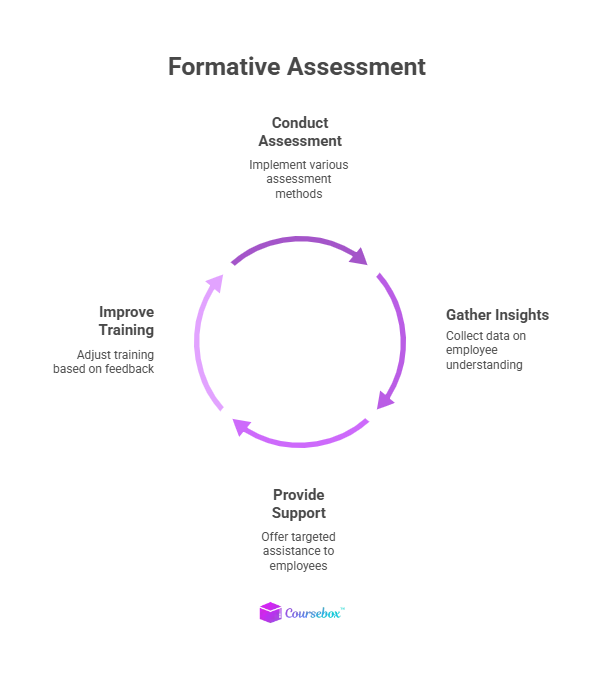
Formative assessment is a continuous way to check how employees are learning while training is still happening. Instead of waiting until the end of a program, it helps trainers see what employees understand and where extra support is needed.
It uses small checkpoints, such as short quizzes, quick discussions, pulse surveys, practical tasks, or scenario-based learning. Each one gives instant insight into employee progress. The goal is improvement during the process, not after it.
Research strongly supports this approach. It shows that formative assessment increases achievement by 0.4 to 0.7 standard deviations.
Key Characteristics
This type of assessment focuses on real-time improvement rather than final results. Here are the key characteristics of formative assessment:
- Immediate Feedback: Gives quick insights that help employees improve right away.
- Low-Stakes Approach: Focuses on support and guidance, not grading or pressure.
- Employee-Centered: Encourages active participation and learning engagement during sessions.
Example
Formative assessment can take many simple and practical forms in a corporate setting. Trainers may use short quizzes to check understanding during a workshop. Quick pulse surveys help reveal areas of confusion. Meanwhile, scenario-based questions enable employees to apply new skills in a realistic context.
What Is Summative Assessment?
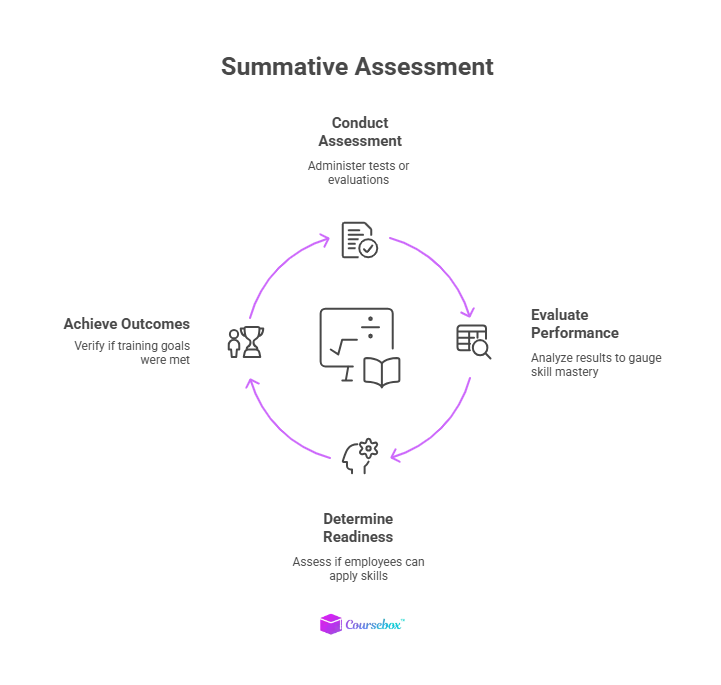
Summative assessment is used to measure learning after a training program, workshop, or learning cycle is complete. It shows whether employees reached the required performance level and whether the training achieved its intended outcomes.
This type of assessment often appears as final tests, certification exams, end-of-module evaluations, or performance assessments. It gives leaders a clear snapshot of skill mastery and helps determine if employees are ready to apply what they’ve learned.
This is also where AI marking comes in, with grading done through intelligence.
Key Characteristics
The key characteristics of summative assessment include:
- Results-focused: Determines whether employees have achieved required skills or competencies.
- Standardized Criteria: Uses consistent scoring or benchmarks to ensure fairness.
- Training Effectiveness Indicator: Shows whether the learning program delivered the expected outcomes.
Example
Final exams or tests are common because they show whether employees grasped the core material. Moreover, certification assessments are frequently used in corporate environments where compliance with industry standards is required. Many programs also include end-of-module evaluations that confirm whether learning objectives were achieved.
Formative vs Summative Assessment: Key Differences
When you compare formative vs summative assessment, you can clearly see how each one supports learning differently. If you want your team to improve training outcomes, here’s what you need to know:
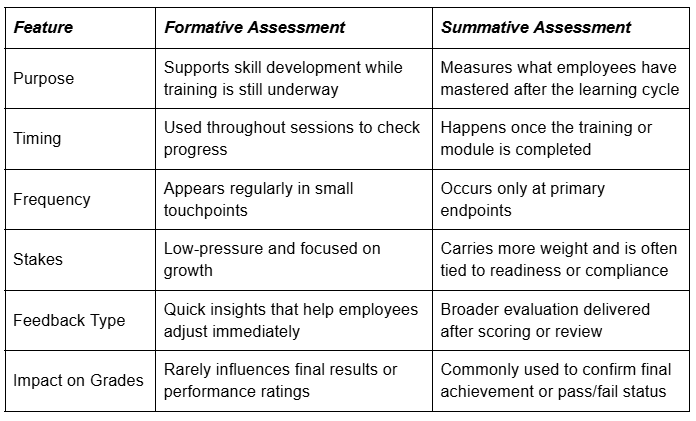
Finding the right balance between formative vs summative assessments depends on your goals.
If the focus is skill-building, formative methods help employees adjust quickly. When you need clear proof of competence or compliance, summative assessments provide the certainty you need.
When to Use Formative Assessment
Even when you understand the formative vs summative assessment difference, it’s just as important to know where each one fits. These are the situations where formative assessment adds the most value:
1. Before Teaching New Concepts
Using formative assessment at the beginning of a session helps you identify what employees already know and where the gaps are. As a result, you avoid moving too quickly or teaching content that doesn’t match the group’s skill level.
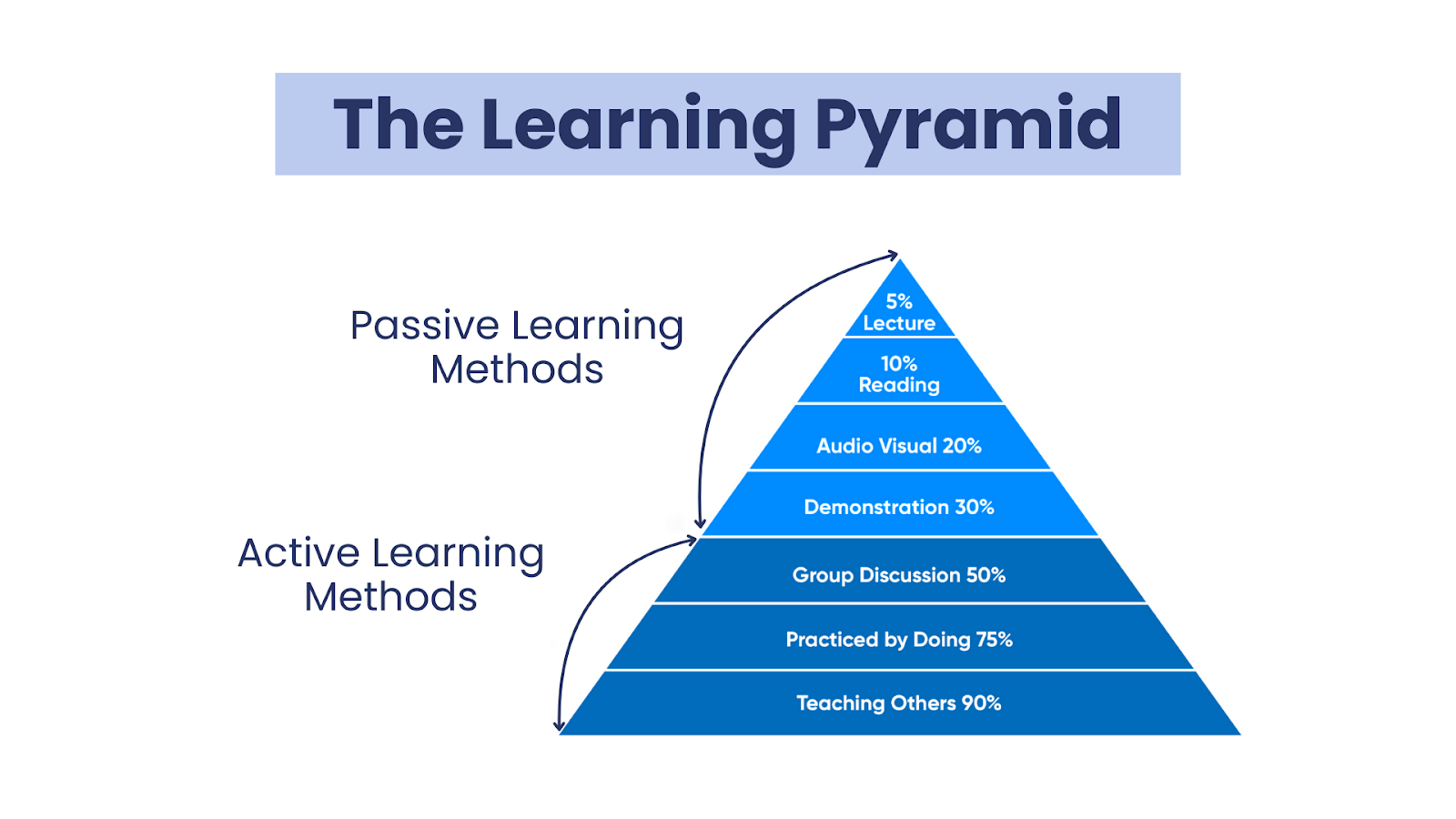
A quick diagnostic quiz or brief discussion can reveal the team’s readiness. This matters because the learning pyramid shows that employees retain only 5% of information from passive lectures, but retention jumps when training aligns with their baseline knowledge.
2. During Lessons When Employees Need Support
Formative assessment is most potent in the middle of training, when learners are actively processing new concepts. Small check-ins, such as pulse surveys, scenario questions, or live polls, show which employees understand the material and who need additional help.
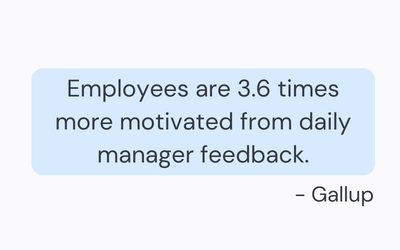
This approach boosts motivation. According to Gallup, employees who receive regular feedback are 3.6 times more likely to feel motivated and engaged at work. That’s why mid-lesson feedback is so valuable.
3. When Identifying Misconceptions
Misconceptions can slow down an entire training program if they aren’t addressed early. However, you can make these misunderstandings visible by using formative assessment techniques like scenario tasks or quick problem-solving exercises.
By fixing misconceptions, you can easily improve accuracy in the long term. Many employees prefer immediate correction because it prevents them from repeating mistakes. This keeps learning clean and ready for more advanced topics.
4. For Personalizing Instruction
Not everyone learns at the same speed. Some employees move quickly, while others need more examples or guidance. Formative assessments reveal these differences and allow trainers to adapt the session.
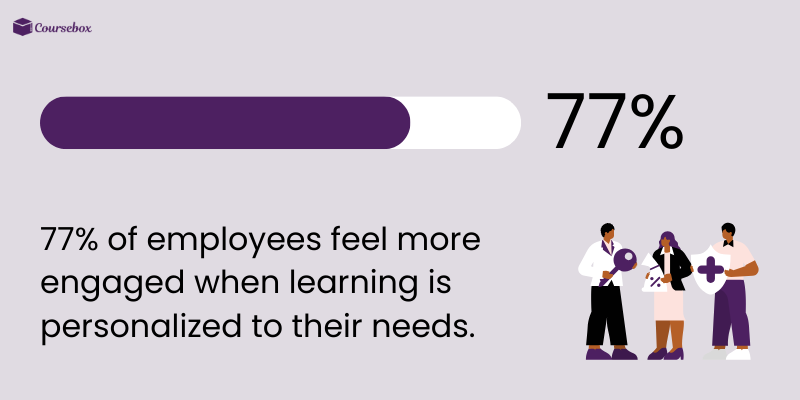
Remember, personalization goes a long way. Research suggests that 77% of employees feel more engaged when learning is personalized to their needs.
Where Summative Assessment Works Best
Summative assessment is most effective when you need to measure final performance, confirm mastery, or report overall results. Here are the scenarios where this type of assessment has the strongest value:
1. End of a Unit
Unlike formative assessment, summative assessment works well at the end of a training unit as it provides a complete picture of what employees learned. It helps trainers confirm whether the objectives were met.
This is especially important in structured corporate training programs where each step builds on the previous one. End-of-unit assessments also highlight broader patterns, such as skill gaps across the team that may need reinforcement in future sessions.
2. Demonstrating Mastery
Summative assessment is ideal when employees must demonstrate that they can perform a task or apply knowledge without support. This is common in safety-critical roles, technical jobs, finance, healthcare, aviation, and leadership training.
Final simulations, practical exams, or performance tasks help you confirm that people can do the work to the required standard. It also helps identify those ready for more responsibility, making it useful for succession planning.
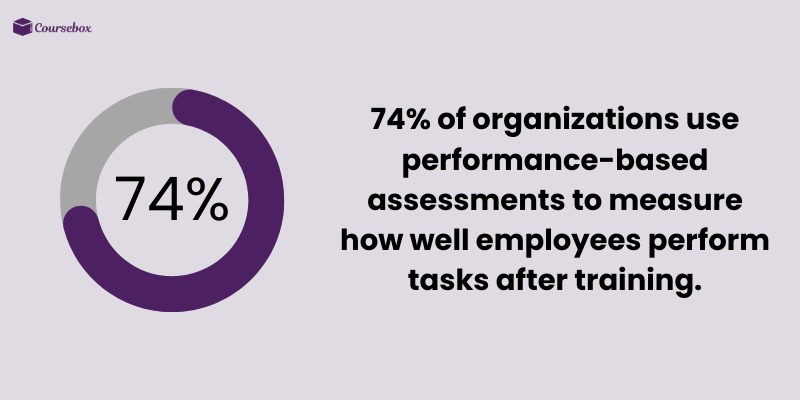
Research from SHRM also highlights its significance. According to them, about 74% of organizations use performance-based assessments to measure how well employees perform tasks after training.
3. Reporting Final Grades
The primary tool you may need for final scores or certification results is a summative assessment. It provides structured data that can feed into performance reviews, learning records, and HR systems.
This is especially valuable in onboarding programs and role-based pathways where a clear pass/fail or proficiency level is required. Since the results are consistent, they help leaders track progress across teams.
4. Meeting Curriculum Requirements
Compliance remains one of the most common forms of workplace training, and it’s a key area where summative assessment becomes critical.
When organizations need to demonstrate that their training meets internal benchmarks or legal obligations, final evaluations provide the necessary proof. Quizzes, scenario-based assessments, and certification exams offer concrete evidence during audits or inspections.
If creating these assessments feels time-consuming, Coursebox’s AI Quiz Generator can simplify the process. With a single prompt, you can generate a complete quiz in just 10 seconds.

Common Mistakes Trainers Make
Assessments play a crucial role in learning, but poor implementation can weaken an otherwise solid program. These are the mistakes that silently reduce employee retention and create confusion.
1. Using Summative Assessments Too Frequently
Many trainers rely on summative assessments far more often than needed. These evaluations are meant for the end of a learning cycle, not every few days. When used too frequently, they create pressure and make learning feel like a series of tests.
Employees start focusing on scoring instead of understanding. Summative tools should confirm mastery, not interrupt the learning journey.
2. Not Giving Timely Feedback
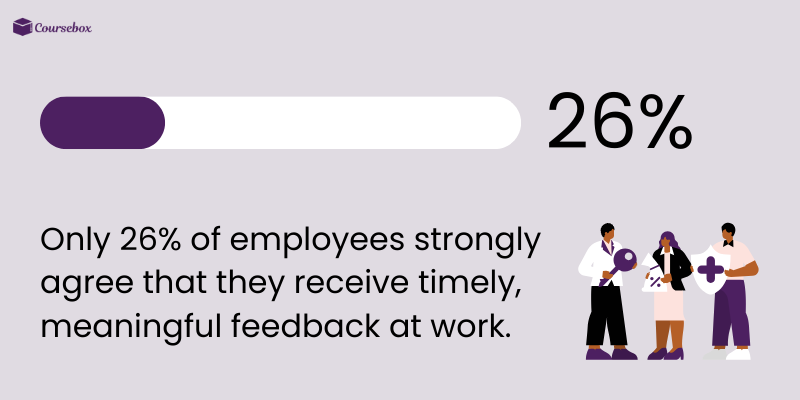
Here’s something you might find surprising: according to Gallup, only 26% of employees strongly agree that they receive timely, meaningful feedback at work.
It’s important to know this because delayed feedback makes it hard for employees to correct mistakes. When trainers wait until the end of a session or program to share insights, learners lose the chance to adjust at the moment.
3. Over-Testing Instead of Observing
Another common mistake trainers make is relying on too many tests when simple observation would reveal more accurate insights. Not every skill needs a quiz. Sometimes watching employees solve a problem gives a clearer picture of their understanding.
Observation reduces pressure and allows trainers to collect richer, more realistic data on performance. It also helps employees feel supported rather than constantly evaluated.
Real Workplace Training Examples
Seeing how assessment works in real situations makes the concepts easier to apply. Here are simple examples of how different training areas effectively use both formative and summative methods.
Example 1: Compliance Training
In compliance programs, formative assessments include quick scenario questions or short check-ins during the session to confirm employees understand rules and risks. In the end, a summative assessment, such as a final quiz, ensures that everyone meets regulatory standards.
Example 2: Customer Service Skills
During customer service training, trainers often use role-plays, live discussions, and brief feedback moments as formative assessments to help employees. As for the summative evaluation, it may involve a final mock call or recorded interaction to confirm they can handle real customer situations.
Example 3: Software Training
When teaching new software, trainers use hands-on checkpoints, such as small tasks, to identify who needs help. These are formative assessments that support real-time learning. At the end, a summative assessment might involve completing a test project to show the employee can use the tool independently.
Turn Better Training into Real Results
Choosing the right assessment approach can completely change how useful your training becomes. Once you understand how formative vs summative assessment works together, you can support employees while they’re learning.
However, if you feel content creation is a headache, you don’t have to start from scratch. With Coursebox’s AI training video generator, you can create courses within minutes. It’s a simple way to deliver high-quality learning experiences.

Try Coursebox today and make more engaging learning content!
FAQs
1. Can I use the same activity as both formative and summative?
Yes, many activities can serve both purposes. The difference lies in how you use them. If it’s for guiding improvement, it’s formative. On the other hand, if it measures final performance, it’s summative. The format can stay the same, but the intention and timing change the role.
2. What tools help teachers create better assessments?
Tools like Coursebox, Google Forms, and other Learning Management Systems can help create effective assessments. They offer quizzes, surveys, analytics, and automatic feedback. These tools make the process easier, faster, and more organized for both trainers and learners.
3. Should I design assessments before or after teaching the unit?
It’s best to design assessments before teaching. Planning ahead ensures your lessons align with the skills and outcomes you want employees to achieve. It also keeps the instruction focused and helps you create checkpoints that support learning throughout the unit, not just at the end.
4. What if employees don’t take formative assessments seriously?
This usually happens when the purpose isn’t clear. Explain that formative assessments help them learn faster, not grade them. Keep the tasks short, practical, and relevant to real work. When employees see the value and receive quick feedback, engagement and participation naturally increase.
Alex Hey
Digital marketing manager and growth expert

