

Transformative Learning Theory: Mezirow's 10 Phases at Work
Mezirow's transformative learning theory for workplace training: the 10 phases, real studies, one role-change course worked through and two free templates.

Transformative learning theory is Jack Mezirow's account of how adults change the assumptions they use to make sense of their experience, often after a disorienting dilemma, through critical reflection and discussion with others, and then act on the new perspective.
- Mezirow's ten phases run from a disorienting dilemma to living with a new perspective, and people do not always move through them in order.
- Transformative learning applies when people must change how they see their role, their clients or themselves, not when they only need a new skill.
- In a Swedish study of 15 workplaces, the five where managers had no motivation or support stayed stuck at the dilemma.
- A course can set up the dilemma, the discussion and a safe first try at the new role, but it cannot schedule the change.
Five questions, about a minute. Answer for one course that moves people into a new or changed role, such as new managers or specialists taking on client work. This is an unvalidated planning aid. The total organises suggestions; it does not assess competence or prove that the method will work. Review each answer.

Go from storyboard to an interactive course in minutes
Picture an accounting practice that tells twelve experienced bookkeepers their reconciliation work is moving to software and that they will run client advisory meetings instead. The training plan is an online course on reading cash-flow forecasts, with a quiz at the end. Three months later, everyone has passed the quiz. In client meetings, though, most of them still read out the numbers and wait to be asked a question. The skill arrived; their idea of what the job is for did not. This hypothetical practice is the example I use throughout this guide.
I'm Alex, cofounder and COO of Coursebox. I manage most of our Perth office team, so development conversations after someone's role changes are part of my job. Coursebox makes AI course software for employee training, so I have a commercial interest in how role-change courses get built. This guide explains Jack Mezirow's theory, his ten phases and what a course can and cannot do about them. It includes two real studies, the accounting practice walked through the phases and two editable Word files.
What is transformative learning theory?
Transformative learning theory is Jack Mezirow's account of how adults change the assumptions they use to make sense of their experience, often after a disorienting dilemma, through critical reflection and discussion with others, and then act on the new perspective.
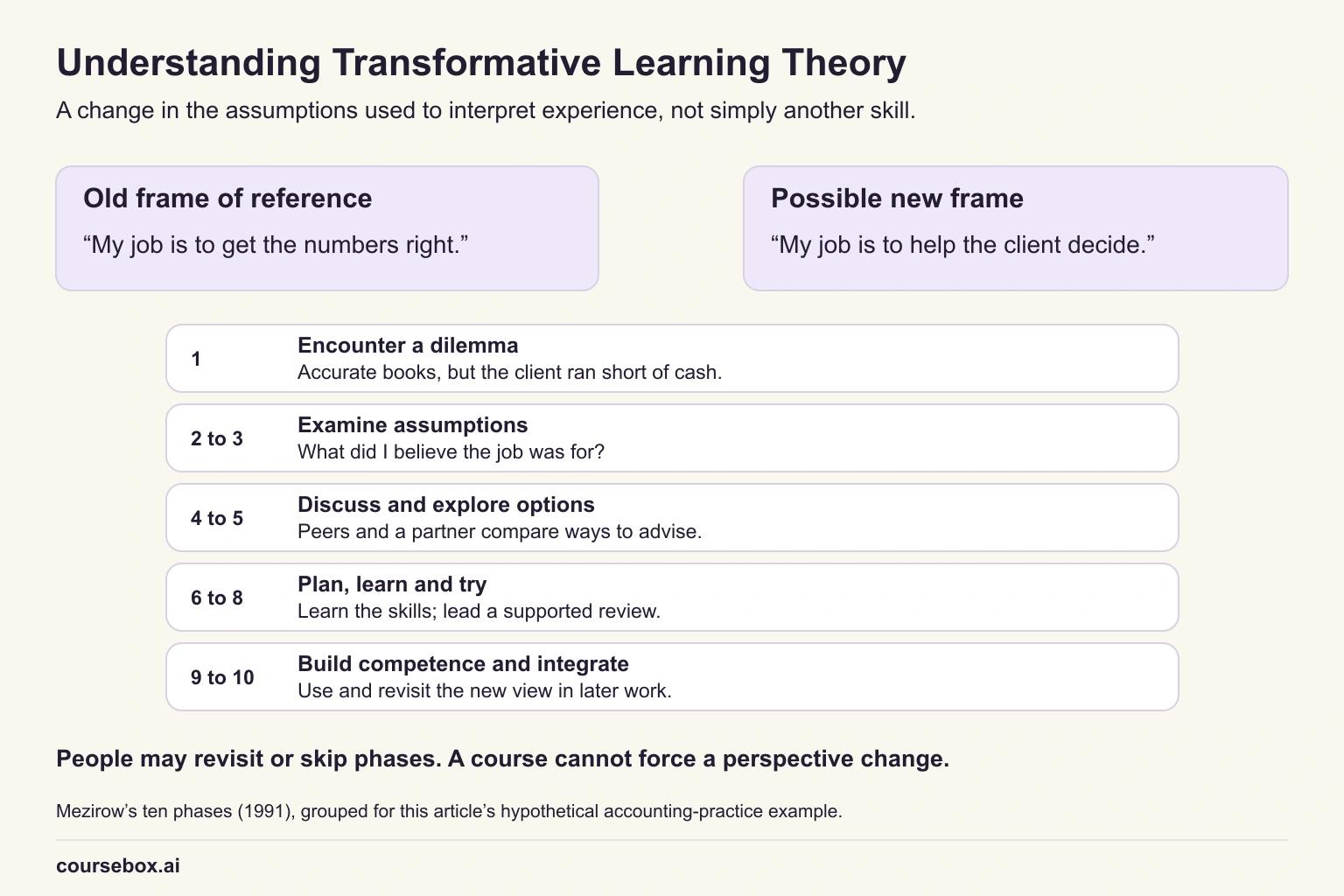
View the full-size transformative learning theory diagram
Mezirow set out the idea in a 1978 journal article called Perspective transformation. He described "the learning most uniquely adult" as "becoming aware that one is caught in one's own history and is reliving it", which leads to "a structural change in the way we see ourselves and our relationships". He also noted that a change in behaviour often follows from such a transformation: people often act differently because they have come to see differently.
The theory deals with assumptions that people rarely notice they hold. Mezirow called the set of assumptions a person brings to experience a meaning perspective, and in later writing a frame of reference. A frame of reference can be about a job ("my job is to get the numbers right"), about other people or about oneself. Most learning works inside an existing frame: you add a skill or a fact and the frame stays put. Transformative learning is the less common case where the frame itself changes.
The theory has also grown since 1978. Mezirow revised it over the following decades, and other researchers proposed versions that give more weight to emotion, relationships and social change. In 2016 Chad Hoggan argued that the term was "increasingly being used to refer to almost any instance of learning", and proposed treating it as a metatheory with a typology of outcomes. So when someone calls a course "transformative learning", ask which assumption it expects people to change.
The table gives the key ideas at a glance, with the question each one asks of a workplace course.
| Idea | What Mezirow meant | Question it asks of your course | What it looks like at work |
|---|---|---|---|
| Meaning perspective | The set of assumptions a person uses to interpret experience | Which assumption about the job has to change? | A bookkeeper who sees the job as getting the numbers right |
| Disorienting dilemma | An experience the old assumptions cannot explain | What situation will show the old view no longer works? | A client with accurate books who still ran out of cash |
| Critical reflection | Examining the assumption itself, not only the method | Where do learners question why they work the way they do? | A prompt asking what the bookkeeper thought the job was for |
| Discourse | Testing the new view in discussion with others | Who will learners talk it through with? | A group session with a partner who already made the move |
| Acting on the new perspective | Trying new roles and building competence in them | Where do learners try the new role with support? | Leading a first client review with a partner observing |

Case study: First-line managers in 15 Swedish workplaces
Between 2008 and 2011, Swedish researchers worked with first-line managers from 15 private and public workplaces, including car manufacturing, banks, government agencies and health care. The aim was to change how the managers led learning and dialogue in their own teams, which meant changing how they saw their role.
- What they did: 18 managers joined a learning network of eight monthly workshops. Each workshop opened with joint reflection on a task the managers had tried at work since the last one, looked at what their own employees had said in a survey, and ended with each manager setting a new task for the next month.
- Evidence and result: more than 300 employees answered surveys six months before and six months after the workshops. One workplace improved dramatically, four improved a lot, four moderately, five showed minor or no change and one declined. In the five with little change, there was no motivation or support to take on the task, and those workplaces "got stuck in the disorienting dilemma and did not progress any further", the research team reported.
- Limitation: there was no control group, the surveys measured how employees saw dialogue and autonomy rather than performance, and the researchers judged the quality of learning mainly from the managers' own accounts, which they name as a limitation.
- Lesson: All 15 workplaces had the same workshops and monthly tasks. The ones that moved also had a reason to learn, a problem that was important and manageable, and time and place to talk, so plan those conditions at work before you plan the content.
Mezirow's articles and book: which to read
Mezirow was an American adult educator who developed the theory over several decades. Three of his works carry the core of it:
- 1978: Perspective transformation, the 11-page journal article in Adult Education where the idea first appears.
- 1991: Transformative Dimensions of Adult Learning (Jossey-Bass), which sets out the ten phases.
- 1997: Transformative learning: Theory to practice, a short article for practitioners.
If you only read one, read the 1978 article. It is short and states the central idea in Mezirow's own words. For how the theory changed after that, Kitchenham's 2008 review traces it from its first version to Mezirow's later definitions.
Mezirow's 10 phases of transformative learning
In his 1991 book, Mezirow described ten phases that people reported as their meaning perspectives changed:
- A disorienting dilemma.
- Self-examination, often with feelings of guilt or shame.
- A critical assessment of assumptions.
- Recognising that the discontent and the process of change are shared, and that others have made a similar change.
- Exploring options for new roles, relationships and actions.
- Planning a course of action.
- Gaining the knowledge and skills to carry out the plan.
- Trying out new roles on a provisional basis.
- Building competence and self-confidence in the new roles and relationships.
- Reintegrating the new perspective into one's life.
Later versions of the theory reword some of them.
Mezirow described phases people went through in some form, not compulsory steps in a fixed order. Some people skip phases or loop back, and a change can build up slowly rather than start with one dramatic event. Do not design a course that marches learners through all ten and then marks them as changed.
The phases worked through one course
Here is the example in full. A three-office accounting practice in Western Australia is moving twelve experienced bookkeepers into client advisory roles, because much of their reconciliation work is now automated. They need two new skills: reading a cash-flow forecast and running a quarterly review meeting with a client. Those are the easy part. The harder part is the assumption the bookkeepers have built over years: "my job is to get the numbers right". The new role needs a different one: "my job is to help the client make a decision with the numbers."
The practice's first attempt was the online course and quiz. The redesigned training has three parts: an online course, two facilitated group sessions with all twelve, and a first client review on the job. A practice partner who already runs advisory meetings facilitates the sessions and sits in on each bookkeeper's first review. This example suits the theory because the skills alone did not change behaviour in client meetings; the assumption about the job is what has to shift.
For course design, I group the ten phases into five, by what a course can do about each. The grouping is mine, not Mezirow's.
1. The disorienting dilemma (phase 1)
A dilemma is an experience the old assumption cannot explain. In the 1978 article, it is what makes a person aware that they are "caught in one's own history".
- Sample goal: each bookkeeper meets a situation where correct numbers were not enough.
- How to assess it: there is nothing to grade here. Note what each person says the situation shows, to use in the first session.
- In the course: a case packet built from one of the practice's own client files, anonymised: a client whose books were reconciled perfectly every month and who still ran short of cash, and who asked why nobody had warned them.
2. Self-examination and critical assessment (phases 2 and 3)
This is where people look at the assumption itself. Mezirow's later work separates reflection on what you did, how you did it and why you hold the premise at all, and treats the third as the kind that questions the frame itself.
- Sample goal: each bookkeeper can state, in their own words, the assumption they worked by and where it came from.
- How to assess it: check that the statement names an assumption, not a task. Do not grade how anyone feels about it; discomfort here is normal and not a measure of progress.
- In the course: three written prompts after the case. What did you check on this file? How did you decide the file was finished? What did you think your job on this file was for?
3. Shared discontent and new options (phases 4 and 5)
People find that others feel the same unease, and that some have already made the change. Then they look at what the new role could involve.
- Sample goal: the group describes two or three ways an advisory meeting could run, and what each would ask of them.
- How to assess it: the facilitator's notes from the session, recording which options people raised and which concerns came up more than once.
- In the course: the first facilitated session. Bookkeepers share their answers to the prompts, then the partner describes their own move from compliance work into advice, including what felt wrong at first.
4. Planning, new skills and a first try (phases 6 to 8)
This is the part most training already covers: a plan and the skills to carry it out. The difference is the provisional try, where people practise the new role somewhere a mistake is cheap.
- Sample goal: each bookkeeper leads one quarterly review that ends with a decision the client has made.
- How to assess it: the partner observes the first review against three points: the bookkeeper opened with the client's question, explained what the forecast means for it and closed on a decision with an owner.
- In the course: online modules on reading a forecast and structuring the meeting, a sit-in on one of the partner's reviews, then the bookkeeper's own first review with the partner present.
5. Competence and reintegration (phases 9 and 10)
Confidence grows with repetition, and the new view becomes how the person works without thinking about it. A course can support these phases but cannot make them happen on a timetable.
- Sample goal: by the third quarterly review, the bookkeeper runs it alone and the client notes record a decision.
- How to assess it: a follow-up conversation four weeks after the first review, plus a look at the client notes from later meetings.
- In the course: the second facilitated session, where people bring what happened in their first review and plan the next one.
Before you build anything, write the assumption the course has to change in one sentence, in the words a learner would use. If you cannot write it, the course probably needs a skill, not a change of perspective.
Do the phases happen in order?
Not reliably. Mezirow's phases describe what people reported, not a required order. Taylor's 1997 review of 39 studies also found a larger role for context, and a smaller role for critical reflection, than the original theory gave them.
In practice, that means three things for the accounting practice. Some bookkeepers will reach the new view during their first client review rather than after the case packet, so the first try is part of the learning, not a test at the end of it. Some will feel worse before they feel better: the Swedish researchers found that a dip in survey scores could mean "a struggle in the learning process" rather than lost ground. And some will not change at all within the programme, because nothing about their own work has yet made the old view fail.
One study of role transitions points the same way. A small interview study by Isopahkala-Bouret, of specialists moving into first-time manager roles in a large international technology organisation, found that new managers wondered about their abilities, compared themselves with role models and became aware of the power in the role. That reflection led to a new view of themselves, but it also involved adapting to the organisation's norms.
The trainer's role: what you can and cannot make happen
A trainer can set up the conditions for a change of perspective; they cannot cause it. Mezirow's 1997 article argues that critical and autonomous thinking should take precedence over absorbing knowledge uncritically, which puts the trainer's job in fostering that thinking, not in handing over a new set of beliefs. In the accounting practice, that means the course designer controls the case packet, the prompts, the sessions and the supported first review. They do not control when, or whether, a bookkeeper starts to see the job differently.
The Swedish researchers list the conditions they found in workplaces that moved: the problem was important and manageable, and "time and place for interaction are available". Without those conditions, workplaces got stuck at the dilemma. For a trainer, that makes the discussion sessions and protected time for the first try part of the design, not extras to cut when the schedule is tight.
Psychological safety is part of it too. A survey of 132 employees at a US steel manufacturer found psychological safety associated with transformative learning outcomes, through social support, attitude toward uncertainty and criticality. It was one survey at one point in time, so it shows an association rather than proof that safety causes the learning. It still fits the trainer's job in the accounting practice: the first sessions are where people admit the old view no longer works, and they will not do that in front of a partner who judges them for it.
Isopahkala-Bouret warns that perspective changes at work "should not be taken innocently as examples of 'empowerment'". When the organisation decides how employees must see their job, say so openly, and leave room in the discussion for people to disagree with the new view.
How to design training for transformative learning
This workflow is my adaptation for workplace courses. It draws on the conditions in the Swedish study and on Taylor's review of classroom studies, which found group ownership, experiential activities, attention to feelings and awareness of context among the practices that supported the theory.
- Name the change the training must produce, and decide whether it is a skill gap or a frame-of-reference gap.
- For each frame gap, write the old assumption and the new one in one sentence each.
- Find a situation from the learners' own work where the old assumption fails. Use it as the dilemma.
- Plan time for discussion in a small group, with someone who has already made the change.
- Teach the skills the new role needs, after people see why they need them.
- Plan a supported first try at the new role on the job, with an observer and a few agreed things to look for.
- Follow up after the first try, and look for evidence in what people do rather than in a quiz score.
Some ideas fit well with step 3. The experiential learning activities guide covers simulations and case work that can produce the kind of situation a dilemma needs, and effective teaching methods for adult learning covers the discussion formats for step 4.

Case study: Pain education for primary care nurses in Singapore
SingHealth Polyclinics runs continuing education for primary care nurses, who regularly advise patients with musculoskeletal pain. A team there tested whether a live online workshop designed around the theory would change nurses' beliefs about pain, not only their knowledge of it.
- What they did: 240 nurses consented and were randomised. Both groups attended a live online workshop with the same slides. The intervention group's version added reflection and interactive activities built around Mezirow's phases; the control group had the usual lecture with questions at the end.
- Evidence and result: 192 nurses completed the first questionnaire (95 and 97), and 53 and 54 were analysed at one month. Both groups improved, and the gains held at one month. The redesigned group did better on the advice given in a written patient case (d = 0.528) and on attitudes to pain (d = -0.390), the researchers reported in BMC Nursing.
- Limitation: 38% of nurses who completed the first questionnaire could not attend, and a further 10% dropped out. The outcomes were knowledge, a written case and attitudes, not observed practice with patients.
- Lesson: adding reflection and interactive activities to the same slides made a measurable difference on the attitude and written-case advice measures. A check on real practice is still needed before calling it a change in how people work.
The skill gap or frame gap planner, filled in for the accounting practice
The planner applies steps 1 to 7 to each change the training must produce. Two of the four changes in the table are skills and need no dilemma; two are frame gaps. The filled example and a blank planning page are in the download.
| Change the training must produce | Skill or frame gap | Old assumption | Situation that unsettles it | Discussion and first try | Evidence weeks later |
|---|---|---|---|---|---|
| Read a cash-flow forecast | Skill | None | Not needed | Practice in the online course | Correct reading in a client file |
| Run a quarterly review meeting | Skill | None | Not needed | Sit in on a partner's review | Partner's observation of the first review |
| See the job as helping the client decide | Frame | My job is to get the numbers right | Client with accurate books who ran short of cash | Session 1 with the partner, then the first review | Client notes record a decision |
| Raise a problem the client has not asked about | Frame | Speaking up beyond the numbers is not my place | Client who asked why nobody had warned them | Session 1, then a prepared question in the first review | Bookkeeper raises an issue unprompted by the third review |
A Word planner for sorting each change a training programme must produce into a skill gap or a frame-of-reference gap, then planning the dilemma, discussion, first try and later evidence. Includes the filled accounting-practice example and a blank version.
How to tell whether it happened
A quiz cannot show a changed assumption. A bookkeeper can answer every question about advisory meetings correctly and still run the meeting as a report. Look for evidence in what people do over the following weeks:
- Observation: the partner's notes from the first review, against the three points agreed in advance.
- Work records: whether client notes from later meetings record a decision the client made.
- Conversation: a follow-up four weeks after the first review, asking what the bookkeeper now thinks the job is for and what changed their mind.
- Survey: for research or a larger programme, the Transformative Learning Outcomes and Processes Survey (TROPOS), which was validated with 132 employees of a steel manufacturer.
These sit at the behaviour level of an evaluation plan. The guide to evaluating the effectiveness of a training programme covers how to set one up.
What Coursebox course requests show about role-change training
I looked at a sample of first requests typed into the Coursebox course generator between 18 August and 15 November 2026: English browsers, staff excluded, one request per person. An AI classifier sorted them, then I collapsed identical prompts, removed prefilled example prompts and read every remaining hit in the categories I report. That left 150 independent requests, and 70 of them were requests for workplace courses.
Eight of the workplace requests prepared people for a new or changed role. Most were onboarding into a new job, along with career moves and one course for a successor in a family business. None of those eight asked for learners to discuss anything with each other. The three requests that did ask for discussion were other kinds of course, such as an executive communication course.
The numbers are small and come from one 90-day sample. A request describes the course someone wants built, so discussion may already be planned outside it, in a team meeting or a coaching session. What they do show is that none of these eight role-change briefs asked for discussion. If your programme needs the discussion phase, write it into the brief.
Transformative learning vs andragogy, Kolb's cycle and reflective cycles
Transformative learning is one of several adult learning theories, and it is the one aimed at the deepest change: the assumptions people use to interpret their work. The adult learning theory guide shows where it sits among the others.
| Question | Transformative learning | Andragogy | Kolb's experiential cycle | Gibbs's reflective cycle |
|---|---|---|---|---|
| What it explains | How adults change the assumptions they interpret experience with | Assumptions about adults’ need to know, experience, self-direction and motivation | How people learn from concrete experience | How to structure reflection on one event |
| Best for | Role changes, culture change and changes of belief | Designing any course for adults | Building skill through practice and review | Debriefing a single incident or placement |
| Weak spot | Slow and hard to see, and a course cannot schedule it | Says little about changing deep assumptions | Treats learning as a tidy cycle | Can stay at what happened without questioning why |
| Use it when | The skills are there but people still see the job the old way | You are setting the basic approach to adult learners | The gap is missing experience, not a missing view | You need one reflection written up well |
Use transformative learning only for the frame gaps in the planner. For the skill gaps, Kolb's experiential learning theory gives a better structure for practice, and Gibbs's reflective cycle helps learners write up a single experience, such as a bookkeeper's first client review.
Limitations of transformative learning theory
- Not a complete theory of adult learning. Sharon Collard and Michael Law argued in 1989 that it says too little about social action. Mezirow replied that real constraints often stop people acting collectively.
- Too rational. Edward Taylor and others argued that emotion and context play a bigger part than the theory's focus on rational reflection allows.
- Normal development counted as change. Mark Tennant argued in 1993 that some examples of perspective transformation are no more than the development society expects of adults.
- The term is used too loosely. Hoggan's 2016 metatheory starts from the problem that the term now covers almost any learning.
- It may not exist as a separate thing. Michael Newman argued in 2012 that it may not be an identifiable phenomenon and proposed calling it "good learning" instead.
- Thin workplace evidence. I found no controlled test of a design based on the theory in a non-health workplace with a performance outcome.
Researchers have kept testing it.
Taylor's 2007 update found that research had moved away from identifying the experience in different settings and towards how to foster it. That shift helps course designers, but a count of studies is not evidence that any one programme changed how people work.
Using transformative learning theory with an AI course tool
I gave Coursebox the accounting practice as a test brief. I asked for a course for the twelve bookkeepers covering both skills, with a realistic dilemma case where correct numbers were not enough, a peer discussion where they compare how they see their role, and an on-the-job try-out with one real client followed by a reflection. I also asked which of these it could not build.
The builder took the theory seriously. The outline had four sections and 20 pages. The first section included a dilemma page where the forecast is right but the advice is missing, and an activity comparing a "numbers producer" with a "decision partner". The last section was built around a review with a real client and a reflection on what changed.
The builder said it could not provide a built-in peer discussion, so it had written prompts for a facilitator-led conversation instead. When I opened the role-comparison page, that is what I found: four steps, an accordion of discussion prompts and a written commitment template, all written for an in-person or facilitated conversation. But the block menu had a Discussion block under Interactions all along. I added it to that page in one click and checked it: learners get a box to share a post, with file attachments, and a list of posts.
I would review the course length before using it. The outline came to 4 hours 37 minutes; I would check each page against the two new skills, discussion and supported first review, then remove content that does not serve them.
My takeaway: check the block menu yourself before you accept what the builder says it cannot do. A course can set up the dilemma, the conversation and the try-out. Whether anyone's view of the job changes happens in the try-out and the conversation after it, not on the page.
A Word session plan for the accounting-practice example: a case packet outline, discussion prompts for each kind of reflection, a first-try task at work and a follow-up conversation guide. Includes a blank version for your own programme.
Putting transformative learning theory to work
Transformative learning theory is useful for a narrow but common training problem: people have the skills for a new role and still see the job the old way. For that problem, the theory says a course can do three things well. It can set up a situation the old view cannot explain, give people time to talk it through with someone who has made the change, and protect a first try at the new role. It cannot decide when the change happens. Before you build the next role-change course, write the old assumption and the new one in one sentence each. Then check that the plan has a dilemma from the learners' own work, a discussion and a supported first try. If any of the three is missing, you are building an information course, which is fine for a skill gap but not for this one.
Frequently Asked Questions
Mezirow's ten phases are a disorienting dilemma, self-examination, a critical assessment of assumptions, recognising that others share the discontent, exploring options for new roles, planning a course of action, gaining knowledge and skills, trying new roles provisionally, building competence and confidence, and reintegrating the new perspective. People do not always move through them in order.
Transformative learning theory is Jack Mezirow's account of how adults change the assumptions they use to make sense of their experience, often after a disorienting dilemma, through critical reflection and discussion with others, and then act on the new perspective. Mezirow first set it out in 1978.
A bookkeeper moving into client advisory work is a workplace example. The skills of reading a forecast and running a meeting are easy to teach. The change is in the assumption underneath: from "my job is to get the numbers right" to "my job is to help the client make a decision with the numbers", which usually follows a client situation where accurate numbers were not enough.
Mezirow described ten phases, not four stages. "Four stages" is a shorthand that groups them into a disorienting dilemma, critical reflection, discussion with others and acting on the new perspective. It helps as a summary, as long as nobody treats it as a fixed sequence.
Yes. Both names refer to Mezirow's theory, and transformative learning is his own term. Transformational learning should not be confused with transformational leadership, which is a separate theory about how leaders motivate and develop their teams.
Alex Hey
Alex Hey is a technical marketer with 10 years of hands-on growth and digital marketing experience. He cofounded Coursebox together with Travis Clapp who he met online when looking for a cofounder to build a globally impactful software product. He works in the Perth, Western Australia office as the COO. He built the world's first automated funnel for patient recruitment before building Coursebox. After launching Coursebox in mid 2023, he drove +400k organic sign ups for Coursebox. Alex leads the marketing and digital growth of Coursebox and works with the product development team bringing a passion for data-driven product decision and exceptional user experience. Alex is determined to build the world's easiest way to build the perfect course.

