

Benefits of Blended Learning for Workplace Training
What blended learning gives a training team, what the research does and does not show, and a four-week workplace programme you can copy and adapt.

Blended learning combines online and face-to-face learning in an integrated programme. The parts support the same learning objectives; a blend can fit within a short session or extend across weeks. A common workplace version is online pre-work followed by a practical workshop.
- A US Department of Education meta-analysis, mostly of university and professional learners, found a small to moderate advantage for blended courses, an average effect size of 0.35.
- The studies often gave blended groups extra learning time and materials, so the average advantage cannot be assigned to the medium alone.
- In this example, online preparation supports face-to-face practice and observed application. Other blends can divide the activities differently.
- Optional pre-work often goes undone, so give people work time for it and check it at the start of the session.
- A blended programme has two sets of material, online and in person, and both have to change together when the procedure changes.
Five questions, about a minute. Answer for one training programme you are planning that mixes online learning with in-person or on-the-job parts. This is an unvalidated planning check, not a prediction of learning or results. Read each answer on its own; a high total cannot cancel an important gap. This check does not verify learner competence; review every weak answer separately.

Go from storyboard to an interactive course in minutes
A training coordinator has two hours with twelve people, three cars in a car park and a new inspection procedure to teach. If she spends the first hour on slides, each person gets a few minutes at a car, and the part nobody can learn from a screen, doing the inspection while a customer watches, barely happens. If the slides go online beforehand, the whole two hours can go on the cars.
That trade is what blended learning is for. I'm an instructional designer at Coursebox, where we make an AI tool for employee training that builds the online parts of programmes like this one. I'll say where our product fits and where it does not: it builds the online parts, and it does not run the workshop. In this guide I explain what blended learning is, the main models, what the research does and does not show about its benefits, and when it fails. Then I walk through one four-week workplace programme, with a planner you can download, two real health-workforce cases and a product test.
What is blended learning?
Blended learning combines online and face-to-face learning in an integrated programme. The parts support the same learning objectives; a blend can fit within a short session or extend across weeks.
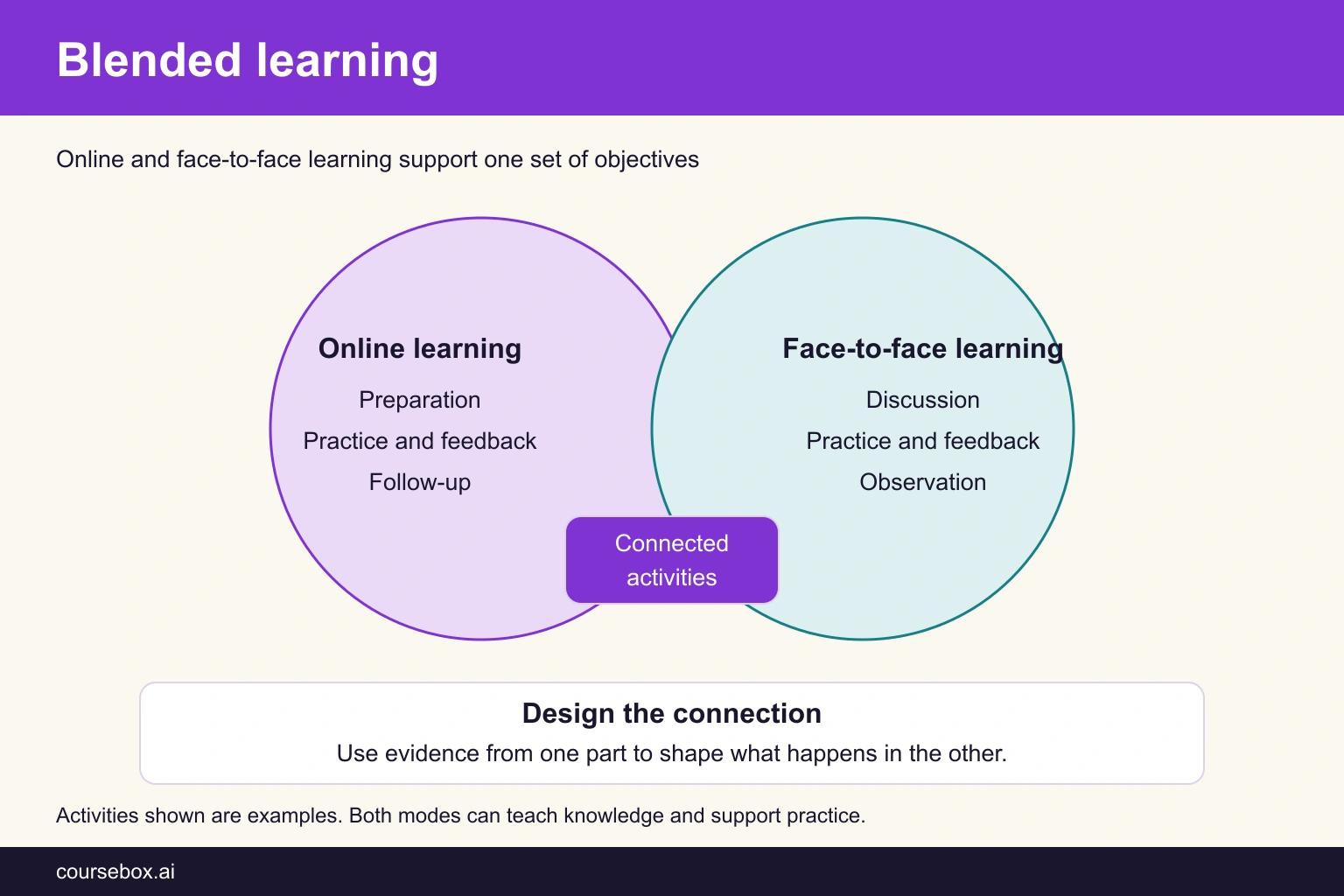
The term gets stretched, so it helps to pin it down. In his chapter in The Handbook of Blended Learning, Charles Graham sets out three definitions in use: combining delivery media, combining teaching methods, and "combining online and face-to-face instruction". He argues the first two are so broad that they describe almost any learning system, and he builds his working definition on the third. That third sense is the one in this guide.
The Clayton Christensen Institute's definition, written for schools, adds the part that is easiest to forget: the online and in-person parts are "connected to provide an integrated learning experience". An unrelated course link after a workshop does not establish a blend. Relevant online follow-up can be part of one when it extends the same learning objectives. A programme where the online part prepares people for the workshop, and the workshop sends them back online with something to do, is.
At work, no single delivery format dominates any more. In CIPD's Learning at Work 2023 survey, with 1,108 respondents mostly in the UK, the share of organisations where face-to-face delivery made up most of their learning fell from 44% in 2020 to 25%. The report's own summary is that "there is no longer a dominant delivery model for learning".
Blended vs hybrid learning
In this guide, blended learning describes a programme that moves the same people between online and in-person parts over time. Hybrid learning is one live session with some people in the room and some joining remotely at the same moment; our guide to hybrid learning explains how to run one. Some sources, Graham's chapter among them, use the two words for the same thing ("hybrid (i.e., blended) courses"), so agree on the word before you agree on a plan. A third format, HyFlex learning, lets each learner choose how they take part.
Blended learning models, and what they look like at work
The Christensen Institute's models page lists seven ways schools blend, and says a programme generally uses one or more of them. The names come from schools, so the table gives each model's school version in the institute's terms and then a workplace version in mine. The last row is a workplace practice, not one of the institute's models.
| Model | The school version (Christensen Institute) | The workplace version |
|---|---|---|
| Station rotation | Students rotate through stations on a fixed schedule, and at least one station is online | A workshop where small groups rotate through practice stations, including an online station within the rotation |
| Lab rotation | Like station rotation, but the online learning happens in a dedicated computer lab | A training day that sends groups to a computer room for an online module between practical sessions |
| Individual rotation | Each student rotates on their own schedule, set by a teacher or by software | Each person follows their own sequence of online modules and practical sessions |
| Flipped classroom | Students learn online at home, and class time goes on teacher-guided practice or projects | Online pre-work replaces the lecture, and the workshop is spent on practice |
| Flex | Students move on fluid schedules, and online learning is the backbone | Mostly online learning, with a trainer or coach available in person when people need help |
| A la carte | A student takes a full course online alongside face-to-face courses | One fully online course inside a programme that is otherwise in person |
| Enriched virtual | Most coursework is done online, with required face-to-face sessions | Mostly online, with required in-person sessions such as a practical assessment |
| On-the-job follow-up (workplace practice) | Not part of the school list | Online learning, then practice at work that a manager observes and signs off |
A workplace programme often uses more than one of these. Graham describes a corporate version from IBM with three phases: online self-paced learning for background, then a face-to-face "learning lab focused on active learning and application experiences instead of lecture", then online learning and support "for transferring the learning to the workplace environment".
The flipped pattern: online pre-work, then in-person practice
The flipped model "flips the traditional relationship between class time and homework", in the Christensen Institute's words: learners take in the content online, and the time together goes on guided practice. At work, the pre-work replaces the lecture, and the workshop is where people do the task with a trainer watching.
A large review of this pattern comes from health professions education. Khe Foon Hew and Chung Kwan Lo pooled 28 comparative studies in health professions education, covering medical students, residents, doctors and nurses, in which learners watched pre-recorded videos before class meetings they had to attend.
The review found a small to moderate average advantage. Studies using quizzes at the start of class had larger effects, but that subgroup association does not show that adding a quiz caused the difference. Some learners said the videos took extra time. For this programme, I would use a short check to find misconceptions and provide protected time for the pre-work.
A trial in Malawi used the same shape at work, with a follow-up stretched over a year.

Case study: Lay HIV health workers in Malawi, tablets first and a practice weekend after
Lay health workers at 33 Ministry of Health and Christian Health Association of Malawi facilities, in Machinga and Balaka districts, run HIV index case testing: they counsel people with HIV to name partners and children who should be tested. Their standard training was a 4-day offsite course with 2 hours on index testing. A facilitator-led hotel course would have meant, in the authors' words, that "each healthcare worker would have missed a week of clinical activities".
- What they did: Health workers at 11 facilities completed five self-paced tablet sessions during work hours, 8 hours over 3 weeks. Then came a weekend of small-group sessions (14 hours) practising skills on set scenarios, a one-to-one feedback call, and 2-hour quality-improvement meetings six times over the following year. Health workers at the other 22 facilities kept the standard training.
- Evidence and result: In Rosenberg and colleagues' 2026 cluster randomised trial (125 health workers in the enhanced arm, 181 in the standard arm), Ministry of Health registers over one year showed more contacts named (rate ratio 1.37), more contacts tested (1.45) and more HIV self-test kits handed out (2.29). The effect on new HIV diagnoses was positive but not statistically significant. A companion cost analysis modelled the cost at US $125 per additional contact tested.
- Limitation: The enhanced group got about 35 extra hours of training, so the trial compares more, better-designed training with a short course, not blended with in-person training. The authors could not tell which part worked. Health workers were paid US $10 per study activity, and every site had outside programme support.
- Lesson: Put the self-paced part on work time, bring people together only to practise and get feedback, keep a short improvement loop running afterwards, and measure what changes in the job, not the quiz score.
What are the benefits of blended learning?
The benefits of blended learning come in two kinds. There is a modest learning advantage, which the research ties to how a blend is redesigned rather than to the technology. And there are practical gains a training team can plan for, such as fewer classroom days and more practice time.
What the research shows
The most cited evidence is a meta-analysis that SRI International prepared for the US Department of Education. Barbara Means and colleagues reviewed online and blended learning studies published from 1996 to 2008, each comparing an online or blended course with face-to-face teaching and measuring learning objectively. Most learners were university students or professionals, including medical trainees; the search also covered corporate and military training.
Using the report's conventions, 0.35 is a small to moderate average effect. The fully online comparisons had an average effect of 0.05 and no statistically reliable difference from classroom teaching. A non-significant difference does not establish equivalence.
The authors' own warning is the part to take to a manager. The blended groups "often included additional learning time and instructional elements not received by students in control conditions", so the gain "should not be attributed to the media, per se". In other words, the blended groups often got more learning time and more material than the classroom groups. Moving content online alone does not guarantee that result.
Two later reviews land in a similar place:
- Bernard and colleagues: In 117 comparisons in higher education, blended courses beat classroom teaching "by about one-third of a standard deviation", according to the published abstract of their 2014 meta-analysis. Blends that built in interaction, or gave learners tools to support their thinking rather than only presenting content, did better.
- Spanjers and colleagues: Their 2015 review found blended learning "somewhat more effective" than traditional teaching, but learners "seemed to perceive it as more demanding", and results "differed much between studies". Studies using frequent quizzes had larger effects; the review does not isolate quizzes as their cause.
Most of this research is on students, not employees, so read it as a guide to design, not a forecast for your team. Our comparison of blended and traditional learning goes further into that head-to-head question.
Effect sizes are measured in standard deviations, not percentages. The percentage claims that circulate about blended learning, for effectiveness or for retention, have no primary source I could trace. If you need a number for a business case, say "a small to moderate average advantage in these studies, with extra time and material among the differences between groups".
What a training team gains
At work, the practical benefits are often easier to plan for than the learning gain:
- More practice time in person. When the explanation moves online, the session can go on doing the task.
- Fewer classroom days and less travel. People learn the knowledge half where they work.
- Consistent material at every site. Everyone receives the same pre-work, examples and check; local observations still need to confirm performance.
- A record of the online part. Completions and quiz scores are logged as people go.
- Pace for the knowledge half. People read and retake checks in quiet periods, at their own speed.
Three of these have limits. The extra practice time only appears if the workshop stops repeating the pre-work. The online record covers only the online part. And the travel saving depends on the online part actually being done. A national health programme in Ethiopia built its app around that.

Case study: Ethiopia's health extension workers swap three classroom days for an offline app
Ethiopia's Health Extension Program employs over 40,000 government health extension workers. Their refresher training in reproductive, maternal, newborn and child health was a fully in-person, seven-day course held at district or zonal level. The Ministry of Health and Last Mile Health, a non-government organisation, tested a blended version between November 2021 and May 2022.
- What they did: In 20 districts across four regions, 1,000 workers did 4 days in person and 5 days of self-paced learning on an offline app, about 2 hours a day, in three blocks: in person, then the app, then in person again. The app worked offline and in local languages, and supervisors received reports on learner performance. In 20 comparison districts, 970 workers did the standard seven-day course.
- Evidence and result: In Asmamaw and colleagues' 2025 evaluation, learners used the app for an average of 2.8 hours a day. Knowledge scores rose by 8.85 percentage points in the blended group and 7.11 in the classroom group, a difference the authors call "not programmatically meaningful". Recurring costs for the blended course were 39% lower, and it was still cheaper once app development was counted.
- Limitation: The districts were not randomised, the evaluation ran for 7 months with no measure of service delivery, and the two groups sat their tests in different formats (digital and paper). The implementer evaluated its own programme and did its own costing.
- Lesson: This programme recorded knowledge gains and lower costs with an offline, locally supported app. It did not establish that the two formats were equivalent or that the blend caused the savings everywhere. Plan access, language, work time and supervision, then measure your own costs and learning.
Does blended learning increase engagement?
The achievement results cited here do not establish that a blend increases engagement. Spanjers and colleagues found that learners "seemed to perceive it as more demanding", and Bernard and colleagues found that blends with built-in interaction did better than blends that only presented content.
Do not assume that mixing modes will engage learners. Plan specific participation, such as a check on pre-work followed by task practice, then inspect participation and learning separately.
How to implement blended learning: a four-week programme, worked through
To make the design concrete, here is one programme from start to finish. The example is hypothetical; the company, the people and the numbers are illustrative.
A car and van rental company in Western Australia has 9 branches: Perth Airport, Perth CBD, Fremantle, Joondalup, Rockingham, Mandurah, Bunbury, Busselton and Kalgoorlie. When a vehicle comes back, staff often cannot show whether a mark was already there at pickup, because pickup records are patchy: a few photos in no set order, and marks missing from the diagram. Customers dispute the marks, and branch managers spend their time on the disputes. The operations manager introduces a 7-point vehicle walkaround, done with the customer at pickup and repeated at return, recorded in the branch tablet app:
- Booking and vehicle match: check the registration against the booking and photograph the odometer.
- Fuel or charge level: photograph the gauge on the dashboard.
- Four sides in the same order (front, driver side, rear, passenger side): one wide photo of each side, corner to corner.
- Every existing mark: mark each scratch, dent or chip on the app's car diagram and take a close-up photo of it.
- Glass and wheels: windscreen chips or cracks, and kerb marks on the rims, each with a close-up.
- Interior: seats, stains, the cargo area, and that the spare wheel and jack kit are there.
- Customer review: the customer looks over the marked diagram on the tablet and signs before the keys are handed over.
The learners are 36 customer service agents, 4 at each branch. They already rent cars and use the booking system and the tablet app. What is new is the walkaround order, the photo standard and doing it with the customer present. The goal is that each agent can complete the walkaround with a customer at pickup, record every point in the app, compare a return against the pickup record, and explain a new mark calmly. Deciding who pays for damage stays with the branch manager.
This example shows blending well because the skill splits in two. The 7 points, the photo standard and the reasons behind them can be learned alone, online. Doing a walkaround on a real car while a customer waits cannot. The branches are also spread out, some of them hours apart, so every day in a classroom costs travel.
The programme has four parts over four weeks:
| Part | When | Mode | Length | Who runs it | Tracked how |
|---|---|---|---|---|---|
| 1. Pre-work (flipped) | Week 1, before the workshop | Online, self-paced | About 25 minutes | Each agent, in a quiet period on shift | Completion and an 8-question check |
| 2. Depot workshop | Week 2, 9.00 to 11.00 | In person, station rotation on three real cars | 2 hours | Leanne, the regional training coordinator, with a branch manager | Leanne's observation checklist for each agent, and attendance |
| 3. Observed pickups | Weeks 2 to 4, at the agent's own branch | In person, on the job | 3 real pickups per agent | The branch manager, for example Hamid at Bunbury | Manager signs off 3 walkarounds on the same checklist |
| 4. Return disputes and recap | Week 3, after the workshop; sign-off confirmed by the end of week 4 | Online, self-paced | About 15 minutes | Each agent | Both responses reviewed with feedback; manager observations retained and learner dates confirmed |
All four parts together make a blended programme, and parts 1 and 2 form a flipped segment inside it. Nobody joins a session remotely while others are in the room, so none of it is hybrid.
Part 1: online pre-work
The pre-work does the job a lecture would otherwise do. Self-paced material suits content people can take in alone; our comparison of asynchronous and synchronous learning covers that choice in more detail, and our guide to eLearning delivery methods covers the formats the online half can take.
- What happens: Two illustrative disputes where the pickup record could not show whether a mark was already there, then one short page per point with a good and a poor photo, such as a side photo that cuts off a corner. It ends with what to bring to the workshop: closed shoes, a hi-vis vest and a working tablet login.
- Who runs it: Each agent, alone, in a quiet period on shift, in about 25 minutes.
- The check: 8 questions, at least 4 of them situations, with the answer and reason shown after each. One reads: "The customer is late for a flight and asks you to skip the walkaround. What do you say and which points can you not skip?"
Part 2: the depot workshop
The workshop runs three times, once at each hub, with 12 agents at each:
- Perth Airport: agents from Perth Airport and Perth CBD, plus the Kalgoorlie agents, who fly in.
- Fremantle: agents from Fremantle, Joondalup and Rockingham.
- Bunbury: agents from Mandurah, Bunbury and Busselton.
The workshop begins with a readiness check, not a repeat lecture. The 12 agents split into three groups of 4 and rotate through three practical stations, 30 minutes each. These face-to-face rotations are a workshop arrangement, not the Christensen station-rotation model, which includes an online station.
- Station A, the walkaround: a fleet car with 5 existing marks, taken from the fleet's damage records and listed by Leanne in advance. In pairs, one agent does the full walkaround in the app while the other plays the customer. Partners swap roles so each agent attempts the inspection. Leanne checks each record against her list. Pilot the timing; add supervised practice if every agent cannot complete an attempt in the allotted time.
- Station B, the customer conversation: role-play cards for a customer in a hurry, a customer who says a mark on the diagram is not there, and a customer who will not sign. The branch manager observes.
- Station C, the return comparison: a tablet with a pickup record and the same car at return with one new mark. Agents find it by comparing photos side by side, then practise what they would say first.
| Time | Segment | What happens | Leanne (trainer) | Branch manager |
|---|---|---|---|---|
| 9.00 | Pre-work check | Leanne goes through the two pre-work questions most people got wrong, in 10 minutes | Runs it | Checks tablets are logged in |
| 9.10 | Station rotation 1 | Groups split across stations A, B and C | Observes station A with the checklist | Observes station B |
| 9.40 | Station rotation 2 | Groups move on | Station A | Station B |
| 10.10 | Station rotation 3 | Groups move on | Station A | Station B |
| 10.40 | Debrief | Each group shows one station A record on the screen, and the room finds what is missing | Runs it | Notes who needs a second observed pickup |
| 10.55 | Next steps | The 3 observed pickups at each branch, part 4's scenarios due by the end of week 3 and the sign-off confirmed by the end of week 4 | Explains | Agrees dates with own agents |
The planner has this programme filled in, with a blank version for your own.
A planning template for a blended training programme. It covers what goes online, in person and on the job, the programme schedule, a pre-work and workshop checklist, a "what counts as trained" record and an observation checklist for the workshop and the job. It is filled in for the vehicle walkaround programme and includes blank pages for yours. It is a planning aid, not a validated instrument, and it gives no score. It is an editable Word file, and no email is required.
Part 3: observed pickups
- What happens: Within two weeks of the workshop, each agent does 3 real pickups with customers while their branch manager watches. If a walkaround misses a point, the manager coaches on the spot, it does not count, and the agent does another.
- Who runs it: The branch manager, such as Hamid at Bunbury.
- The check: The same observation checklist Leanne used at station A: all 7 points recorded, and the customer reviews the diagram and signs before the keys are handed over.
Part 4: return disputes and recap
- What happens: Two open-text scenarios, both returns. In one, a new scratch on the rear bumper is not on the pickup diagram, and the customer says it was already there. In the other, a windscreen chip is on the pickup diagram, but the customer says nobody showed them. A model answer appears after each submission, followed by a recap of the 7 points.
- Who runs it: Each agent, online, in about 15 minutes: the scenarios by the end of week 3, the sign-off confirmation by the end of week 4.
- The check: Both scenarios submitted, and a confirmation of the 3 signed-off pickups with their dates.
Challenges of blended learning, and when it fails
Blended learning tends to go wrong in three places: the online and in-person material drift apart, the pre-work does not get done, and the evidence of who is trained ends up in three places. Each one can be planned for, and the walkaround programme has a fallback for each.
Two sets of material to build and keep in step
A blend needs online material and an in-person session plan, and the two drift apart the moment one changes. If the pre-work teaches one order and the workshop checklist uses another, people learn the procedure twice and trust neither version.
In the walkaround programme, the workshop uses the same 7 points, the same order and the same photo examples as the pre-work, and the station A checklist is the one branch managers use for the observed pickups. If the procedure changes, all three are updated together.
The pre-work does not get done
Pre-work that is optional and done in people's own time often stays undone. In Uganda, nurses, midwives, clinical officers and doctors at six Kampala hospitals were asked to work through at least 16 of 32 optional online cases before a five-day World Health Organization emergency care course.
Friedman and colleagues found no significant difference in test scores after the course between those offered the cases and those who were not. Participants named time, connectivity and a lack of devices as barriers, and the authors judged the biggest barrier to be motivation to do "uncompensated and uncredited independent learning". That matches the time complaint in the flipped-classroom research, and Spanjers and colleagues' finding that learners see blends as more demanding.
The fix is to treat pre-work as part of the job. Two days before each workshop, Leanne checks completion and the branch managers arrange protected catch-up time. At 9.00, the short check identifies remaining misconceptions. An agent who has missed the instruction does not become ready by taking that check: provide the missing instruction and feedback, then check readiness before their practical attempt. If needed, they observe a rotation and complete supervised practice later.
Evidence of who is trained splits across modes
In a blend, the proof that someone can do the job sits in more than one place. The pre-work check lives in the online course, the workshop observation lives on Leanne's checklist, and the on-the-job sign-off lives with the branch manager. Unless you decide what counts as trained before the programme starts, nobody can answer "who is trained?" without chasing three people.
In the walkaround programme, the record is complete only when all four parts are evidenced: the pre-work and corrected misunderstandings; workshop practice checked against all 7 points; manager-observed pickups; and both return scenarios reviewed with feedback. Three pickups are an illustrative practice budget, not a validated threshold. The manager checks varied relevant situations and arranges further practice when any required action is missing. The learner's online confirmation points to the manager's record; it does not replace it.
If you use Coursebox's training management software for the online parts, the sign-off page gives each agent a place to record the observed pickups. The observation itself happens on a car with a manager watching, and the manager's checklist remains its evidence.
Use one controlled checklist for workshop and job observations, with a named owner and version date. Update both copies when the procedure changes, and keep the manager's evidence alongside the learner's confirmation.
When not to blend
In my judgement, a single format is the better call in these cases:
- Small, one-off audiences. Compare development time with the value of pre-work. Existing online material may help, while building a new course may take more effort than one practical session.
- Skills with no knowledge half. If nearly everything has to be practised with a trainer present, there is little worth putting online.
- No protected time for pre-work. Check available time and access before relying on completion, then arrange catch-up for anyone who needs it.
- Nobody to own both halves. If one team builds the course and another runs the workshop with no shared plan, the halves will drift.
- An unclear goal. If you have not yet worked out what people cannot do, start with a training needs analysis questionnaire before choosing a format.
Some arguments for blending lean on charts that claim people remember a fixed percentage of what they read, hear or teach. Lalley and Miller's review of the "learning pyramid" found "no specific credible research" to support it. A better reason to blend is that part of the skill can be learned alone and part has to be practised.
Building the online half with an AI course tool
On 24 October 2026 I asked the Coursebox course agent to build the online half of the walkaround programme. Coursebox is our product, so weigh my account with that in mind. The brief described the four-part programme for 36 agents and gave the 7 points in their exact words and order, the photo standard, the three workshop stations, the observed pickups and the two return disputes. It asked the agent to describe the workshop and the observed pickups as in-person events, not to teach them as reading or quizzes.
That last instruction was the one I expected it to miss, and it did not. The first outline came back with seven sections in the briefed order. The section after the pre-work check described the depot workshop as an event: "The two-hour depot workshop runs from 9.00 to 11.00, is led by Leanne, and takes place at Perth Airport, Fremantle or Bunbury. It uses real cars." It described stations A, B and C and the three observed pickups at the branch, with no quiz on the page. The 7 points came back in the briefed words and order. The pre-work check opened with situations and gave a reason after each answer. The return-dispute scenarios kept out of who pays: "Do not decide liability, payment or outcome."
The problem was on the sign-off page, the one place where the in-person half meets the course record. It was an embedded widget that asked for "yes" or "not yet" and three dates, and the agent's own hand-over note said it "does not save or track entries". So the course could show who had finished the pre-work, but nobody could see who had done the observed pickups.
In the page editor I added a short-answer assignment to that page. It asks each agent to record whether their branch manager has signed off the three observed pickups, the date of each pickup and the manager's name, with a model answer. After I reloaded the learner view, the page showed the question, an answer box and a Send button.
I checked the outline, the pages and the block I added. I did not enrol learners or submit an answer. A self-reported sign-off is a record of the observation, not the observation itself, and none of this shows that the programme will make agents better at walkarounds. The course describes the workshop instead of trying to teach it online, and the sign-off page now gives each agent somewhere to record the observed pickups.
One remaining content gap was the reference page: it named the 7 points without the actions under each one. I would expand that page before using it as a job aid. The changes recommended here to readiness checks and the complete four-part evidence record have not been retested in the generated course.
The planner for the walkaround programme in this article: what goes online, in person and on the job, the programme schedule, a pre-work and workshop checklist, a "what counts as trained" record and an observation checklist for the workshop and the job, with blank pages for your own programme. It is a planning aid, not a validated instrument, and it gives no score. It is an editable Word file, and no email is required.
Putting blended learning to work
Blended learning helps when the online and face-to-face parts support the same task and each earns its development time. In this example, online preparation leaves room for practical work, with observed pickups and return scenarios to check application. Research reports a modest average advantage, but extra time, materials and teaching methods are mixed into that comparison. Choose the blend for the learning need and check its results.
Your next step: take one programme you run now and list every part of the skill in three columns, online, in person and on the job. If the in-person column is mostly explanation, move that explanation into short pre-work and start the session with a check on it.
Frequently Asked Questions
Blended learning combines online and face-to-face learning in an integrated programme. The parts support the same learning objectives; a blend can fit within a short session or extend across weeks. A common workplace version is online pre-work followed by a practical workshop.
The pros are more practice time in person, fewer classroom days, the same material at every site and a record of the online part. Studies of mostly university and professional learners also show a small to moderate learning advantage over classroom-only courses, with extra time and material among the differences between groups. The cons are two sets of material to keep in step, pre-work that often goes undone, and evidence of who is trained split across the online course, the trainer and the manager.
The four families usually cited are rotation (station, lab, individual and flipped), flex, a la carte and enriched virtual. The Christensen Institute's models page lists all seven by name. At work, the flipped pattern (online pre-work, then in-person practice) and on-the-job follow-up are common starting points.
In the hypothetical example in this guide, customer service agents at a car rental company do 25 minutes of online pre-work on a new vehicle inspection, then a 2-hour workshop practising it on real cars. Their branch manager then observes three real pickups, and a short online part covers customer disputes afterwards.
Blended learning moves the same people between online and in-person parts over the course of a programme. Hybrid learning is one live session with some people in the room and some joining remotely at the same time. Some sources use the two words for the same thing, so it helps to check which one is meant.
Carolina Martin
Carolina is a highly experienced learning designer with tech start-up experience. She is based in Sydney and previously designed courses alongside Coursebox founder Travis in a previous job. She is passionate about delivering engaging learning experiences and brings the same perspective to customer experience too. She manages our customer support documentation and product testing processes.

