

Anchored Instruction: Meaning, Principles and Examples
Anchored instruction from its developers' own papers: what it is, the seven Jasper principles, examples, the evidence on transfer and how to design one.

Anchored instruction is a design approach, developed by the Cognition and Technology Group at Vanderbilt around 1990, that builds learning around a realistic problem story, the anchor, with the facts learners need embedded in it, so learners find and solve the problems themselves.
- The Vanderbilt group set out seven design principles for its Jasper Woodbury maths adventures, including embedded data and pairs of related adventures.
- An anchor does not have to be a video, and its developers wrote that anchors could be verbally based.
- In the developers' own data, learning transferred strongly to the matching part of a second adventure but not to its new part.
- Anchored instruction was never meant to be unguided: Jasper teachers coached, and later adventures built in short teaching scenes.
- Of 11 Coursebox course requests that asked for video or a story, none set a problem inside it for learners to solve.
Five questions, about a minute. Answer for one story, case or video you plan to build a lesson around, such as a site visit, a customer case or a day on the job.

Go from storyboard to an interactive course in minutes
Picture a fire safety officer in their second month at a regional council. They came from building certification, so they can name every measure on a fire safety schedule, from exit signs to the fire indicator panel. Then they inspect a three-storey building with a café downstairs and apartments above, and walk past a stair door held open with a rubber wedge. Nothing they learned was wrong. It did not come to mind in a real, untidy building.
I'm an instructional designer at Coursebox, where we make instructional design software that turns a brief into a course, so I'll mention our product where I tested it. Knowledge that is there when someone asks for it but missing when a problem needs it is what anchored instruction was designed for. In this guide I set out what the Cognition and Technology Group at Vanderbilt meant by the term, their seven design principles from their own table, the Jasper Woodbury series they built, what the evidence shows about transfer, and how it compares with scenario-based and problem-based learning. Then I design one anchor for new fire safety officers, with two real cases, a product test and two free templates.
What is anchored instruction?
Anchored instruction is a design approach, developed by the Cognition and Technology Group at Vanderbilt around 1990, that builds learning around a realistic problem story, the anchor, with the facts learners need embedded in it, so learners find and solve the problems themselves.
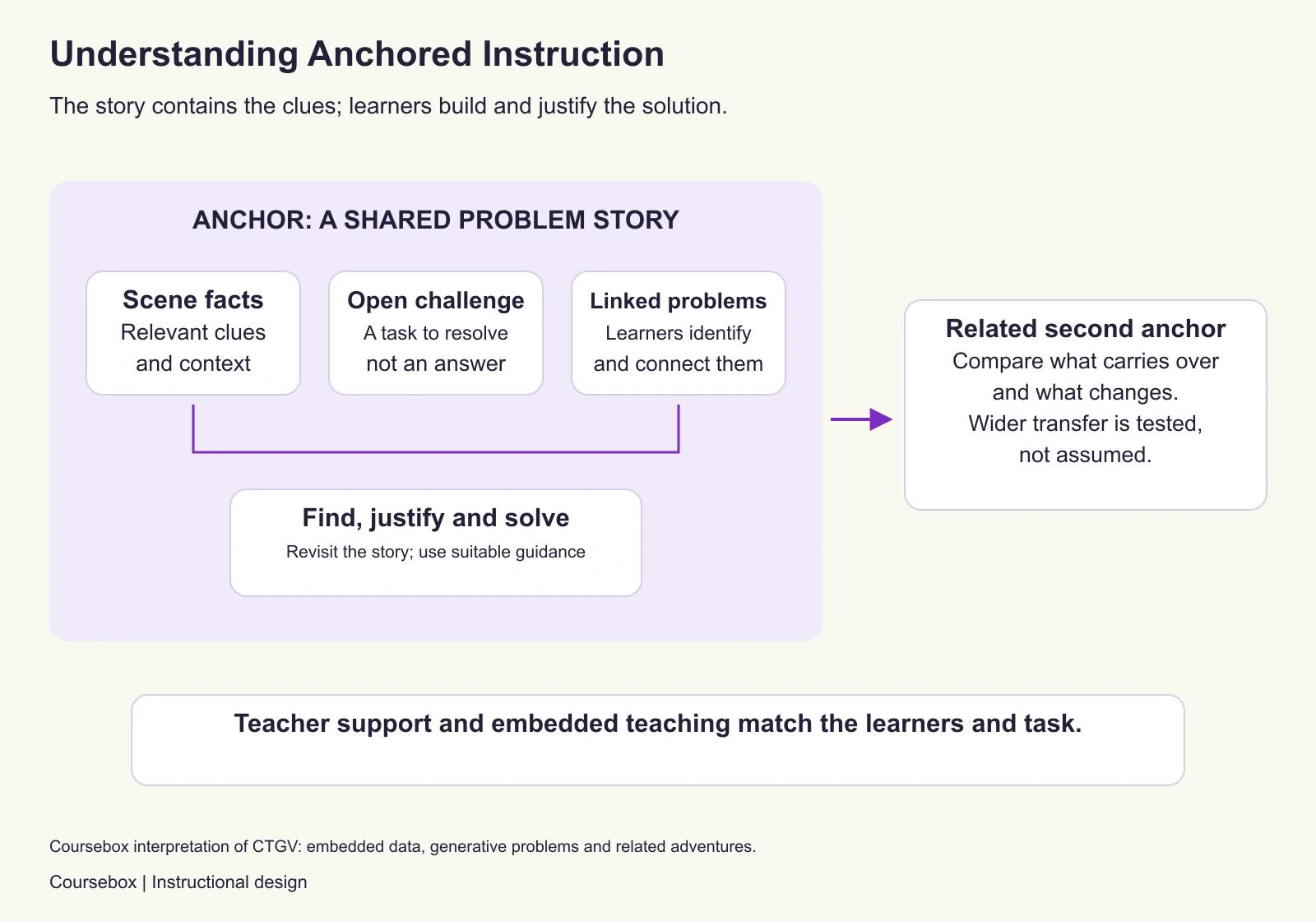
The group's own definition comes from the abstract of their 1990 article in Educational Researcher: "instruction is anchored (situated) in videodisc-based, problem-solving environments that teachers and students can explore" (p. 2). The medium is dated; the idea is not.
The Cognition and Technology Group at Vanderbilt, usually shortened to CTGV, was "a multidisciplinary team of researchers" at the Learning Technology Center at Vanderbilt University in Nashville (p. 2). The 1990 article lists 21 people in the group. John Bransford established the Learning Technology Center in 1984 and led much of this work. Anchored instruction, though, was published under the group's collective name.
Anchored instruction started from a problem the group called inert knowledge: "knowledge that can usually be recalled when people are explicitly asked to do so but is not used spontaneously in problem solving even though it is relevant" (p. 2). Their example was entering college students who knew logarithms but "thought of them only as math exercises performed to find answers to logarithm problems" (pp. 2 to 3). The group credited the idea to Alfred North Whitehead, whose phrase was "inert ideas". In his January 1916 address to the Mathematical Association, later the title essay of The Aims of Education (1929), Whitehead warned against "ideas that are merely received into the mind without being utilised, or tested, or thrown into fresh combinations" (1917 printing, p. 4).
CTGV stated the purpose plainly: "The major goal of anchored instruction is to overcome the inert knowledge problem" (p. 3). Their answer was to set the learning inside a problem big enough to explore. Short end-of-chapter cases, which they called microcontexts, were not enough: "we anchor instruction in complex problem spaces. We refer to these as macrocontexts" (p. 3). A macrocontext, in their words, lets learners explore "a problem space for extended periods of time from many perspectives" (p. 3).
Three points set the scope:
- It is a design approach for whole problems, not a media format. The group preferred video for 1990s classrooms, but wrote that "anchors could be verbally based rather than video based" (p. 9). A written case, a narrated photo story or a short film can all carry an anchor if the design principles hold.
- It grew from situated cognition. John Seely Brown, Allan Collins and Paul Duguid argued in a 1989 article on situated cognition that knowledge is partly a product of the activity, context and culture in which it is developed and used, and that facts learned only as abstract definitions often stay unused. CTGV saw anchored instruction as a way "to recreate some of the advantages of apprenticeship training" in classrooms (p. 2). Our guides to situated learning theory and the cognitive apprenticeship model cover that background.
- It is not anchor charts or the anchoring bias. Teachers use "anchor charts" and "anchor texts" for reference posters and model texts, and psychologists use "anchoring" for a judgement bias. Anchored instruction is CTGV's design for learning inside a problem story.
The group's design principles are easiest to see in their Jasper Woodbury maths series, which they described in a table of seven principles in a July 1991 manuscript. Here they are at a glance.
| Principle | In CTGV's words | The question it asks of your anchor | What it looks like at work |
|---|---|---|---|
| 1. Video-based format | "Video-based format" | Can learners revisit the relevant situation and details, using video or another suitable medium? | A short walkthrough video or narrated photos of a site |
| 2. Narrative with realistic problems | "Narrative with realistic problems (rather than a lecture on video)" | Is it a story with people and a problem, or an explanation? | A day on the job told in scenes, not a presenter explaining rules |
| 3. Generative format | "the stories end and students must generate the problems to be solved" | Do learners work out what the problems are? | The story ends with a manager's request and no list of issues |
| 4. Embedded data design | "all the data needed to solve the problems are in the video" | Is every fact learners need shown or said inside the story? | Dates, readings and comments seen in passing, as at work |
| 5. Problem complexity | "each adventure involves a problem of at least 14 steps" | Does the problem have enough linked parts to need a plan? | Several faults that interact, not one question per screen |
| 6. Pairs of related adventures | "Pairs of related adventures" | Is there a second, similar case that differs in a deciding fact? | A second site where the same skills apply but the answer changes |
| 7. Links across the curriculum | "Links across the curriculum" | Where else will learners use what they found? | Links to the procedure, the report template and the next module |
The seven names in the table come from CTGV's own table, reproduced in a 1992 US Office of Technology Assessment report (p. 278) from the group's July 1991 manuscript. An April 1991 conference paper by Robert Sherwood and the group listed six principles, without pairs of related adventures, so a six-item list is the earlier version. The seventh principle is "Pairs of related adventures"; CTGV never listed a principle called "opportunities for transfer". The benefits CTGV gave for each principle, such as "More motivating", were the benefits they expected, not results they had measured.
A hospital in Beijing used anchored teaching with nursing interns on placement, which shows what an anchor looks like in a working setting, and why its results need care.

Case study: Nursing interns at a Beijing heart hospital
Nurse educators at Beijing Anzhen Hospital, Capital Medical University, teach emergency and critical care nursing to nursing interns on clinical placement. Interns struggled to link theory to practice and to assess complex conditions quickly, so the hospital compared anchored teaching with its usual lectures.
- What they did: Teachers chose real cases the interns "may encounter in their future careers" as the anchor, presented as a story, through multimedia or directly. Small groups took roles like a care team, worked tasks such as assessing the patient or talking with the family, and presented a plan for critique before the teacher explained and extended the key points. In the clinical phase, interns also worked through the six steps of Gibbs' reflective cycle.
- Evidence and result: In Tian and colleagues' 2025 paper in Medical Education Management, the 30 interns from the 2020 intake taught this way scored 83.3 out of 100 on a teacher-set theory exam and 94.2 on a simulated CPR test, against 52.5 and 85.2 for 30 interns from the 2019 intake taught by lecture. In the anchored group, 96.7% said they were very satisfied, against 66.7%.
- Limitation: The design bundled anchored cases with Gibbs reflection and a selected teaching team, so the anchor's share of the gain cannot be separated. The anchored group also had 20 practical hours against 6, which alone could explain the CPR gap. The cohorts were a year apart, the tests were set by the teachers, and the outcomes were exam and simulated CPR scores, not care on the ward.
- Lesson: An anchor in a workplace can be a case the learners will plausibly face, worked in small groups in their real roles. If you want to know whether the anchor helped, give both groups the same hours and the same test.
Where anchored instruction comes from: the Jasper Woodbury series
Anchored instruction came out of classroom projects at Vanderbilt in the late 1980s. The best known is The Adventures of Jasper Woodbury, a series of video maths adventures for upper primary and middle school students. Each one is a short story that ends in a challenge, with the numbers students need scattered through it.
The series grew over a decade, and its size depends on the year you read about it:
- 1990: two adventures were finished, for fifth and sixth grade, and the group planned "6 to 10" (CTGV 1990, p. 5). The first posed a problem with "approximately 15 subgoals", and "Its complexity was intentional." Thomas Sturdevant led the script writing and produced and directed the adventures.
- 1991: four discs were finished by April, and the six principles became seven by July, when the group added pairs of related adventures.
- 1992 and 1993: two main papers on Jasper appeared in 1992. By 1993 there were six adventures, two for each major topic, each 14 to 18 minutes long, and the group had worked with students in nine US states.
- Late 1990s: the finished series had 12 adventures in four strands: trip planning, statistics and business plans, geometry and algebra. The group's book, The Jasper Project, appeared in 1997.
The first two adventures show the pairing. The first, Journey to Cedar Creek, is set around a boat trip. The second, Rescue at Boone's Meadow, involves an eagle rescue by ultralight plane, and was built so students could "discuss the analogies between the first and second episode" (CTGV 1990, p. 6). Students saw the video solution only "after they have solved the problems themselves", according to the 1992 Office of Technology Assessment report (p. 277).
The idea is still in use. Brian Bottge and colleagues had tested a version called enhanced anchored instruction in US middle school maths for about 20 years by 2018. When their early lessons "fell well short" for fractions, they added "much more explicit instruction and practice with fractions", as they described in a 2018 paper in Exceptional Children (p. 3). The current form, in other words, mixes anchors with direct teaching.
Which sources to read
- Read this one first: CTGV's 1990 article, Anchored instruction and its relationship to situated cognition, in Educational Researcher. Nine pages, with the definition, the inert knowledge problem, macrocontexts and embedded data.
- For what the developers learned: CTGV's 1993 article, "Anchored instruction and situated cognition revisited", in Educational Technology 33(3). It covers the teacher's role, embedded teaching, cost and where transfer worked and where it did not.
- For the whole project: CTGV's 1997 book, The Jasper Project: Lessons in curriculum, instruction, assessment, and professional development, credited to the group, not to one author.
When to use anchored instruction, and when not to
Use an anchor when the job is a complex problem with many linked parts, when learners already know the facts but fail to use them, and when the real situation is rare, risky or slow to reach on the job. Use direct teaching with worked examples when learners are new to the knowledge itself or the task is a fixed procedure.
Part of that is CTGV's own reasoning and part comes from later research on guidance. An anchor targets inert knowledge, so it works best when learners have some knowledge to activate. A video context compresses time: "hours and days can be compressed into minutes" (CTGV 1990, p. 8). And the group expected anchors to build problem solving rather than replace content teaching. They noted that people saw Jasper as "better for teaching problem solving than for teaching mathematics", and said their aim was to supplement the standard curriculum, not replace it (CTGV 1993, pp. 62 to 63).
| Question | Points to an anchor | Points to direct teaching |
|---|---|---|
| Is the job a problem with many linked parts? | Yes, one situation throws up several problems at once | No, it is one step or a fixed procedure |
| Do learners know the facts but miss them in practice? | Yes, they can name the rules but do not notice when they apply | No, the facts themselves are new |
| Is the real situation rare, risky or slow to reach? | Yes, new staff might wait months to meet one, or a miss is costly | No, they meet it daily with help nearby |
| Can every fact learners need be shown inside a story? | Yes, it can be seen, said or shown in scenes | No, it needs long explanation or calculation tables |
| Is there time for learners to explore and discuss? | Yes, a session or more | No, it has to fit in a few minutes |
The seven principles of anchored instruction, worked through one anchor
Here is the hypothetical example I'll design with from here on; every figure in it is illustrative. A regional council in Australia has a building compliance team that inspects the fire safety of existing buildings. The learners are newly appointed fire safety officers in their first two months. They come from building certification or council building assistant roles, so they can read plans and know the names of the fire safety measures, but none has run an inspection or decided what council should do on their own. A senior fire safety officer coaches them and signs off their work.
The problem is the one CTGV described. New officers can list the measures, but a real inspection throws up many linked problems at once, the evidence is spread around the building, and inspections are too infrequent for a new officer to learn by trial. Mistakes have life-safety consequences.
The anchor is a 6 to 8 minute walkthrough of one inspection, told as a story. On a Thursday at 9:40 am a resident emails council: the fire alarm "beeps at night" and the back stair door is "always propped open". The senior officer takes the new officer to 14 Harbour Street, three storeys, with a café on the ground floor and 9 apartments above. These facts are embedded in the story, never listed:
- At the desk: the council file shows the last annual fire safety statement was received 14 months ago. The building's fire safety schedule lists exit signs, emergency lighting, fire doors, portable extinguishers, a fire indicator panel with smoke detection, and a hose reel.
- In the lobby: a handwritten note on the fire indicator panel reads "Zone 3 fault, tech booked", dated 3 weeks ago. Zone 3 covers the level 2 apartments. The senior officer reads the contractor’s report in the council file: detection in zone 3 remains out of service.
- On the level 1 stair: the fire door on the apartments’ escape stair is held open with a rubber wedge, and a resident says it is "to let air through".
- At the rear exit: stacked café chairs narrow the passage to about half the door width. The exit sign above the door is not lit, and the emergency light beside it works when tested.
- In the café: the extinguisher tag says it was last inspected 8 months ago, and the tag says service every 6 months.
- Elsewhere: the hose reel is present with a current tag, and the owner's agent says on the phone, "the statement's with our contractor, we'll send it next week".
The council's own procedure, which the senior officer carries, has three ranks. Rank 1 includes a blocked or obstructed exit, a fire door held open on the apartments’ escape stair, or confirmed detection out of service where people sleep: act the same day. A fault note alone requires urgent investigation and confirmation of what has failed. Rank 2 is a defective measure that is not immediately dangerous: a written direction within 7 days, with 28 days to fix. Rank 3 is administrative, such as an overdue statement: a reminder letter within 14 days. The procedure is the council's own; the course does not teach any state's fire safety law, and anyone adapting it should check their own state's rules.
The story ends with the senior officer's challenge: "By 5 pm I want your recommendation for 14 Harbour Street: what is wrong, how urgent each problem is, and what council does first." The learner writes an inspection finding, the actions and their timing, and a note on what to check at the follow-up visit. The intended outcome is that a new officer notices the problems in an unfamiliar building, ranks them with the procedure and writes a recommendation the senior officer can defend. It does not certify competence or give anyone authority to issue orders.
The example passes every question in the when-to-use table: the job is a linked problem, the officers know the measures but have not used that knowledge in a building, real inspections are infrequent and risky to learn on, every fact can be shown in scenes, and the course has time for learners to explore and discuss. Each principle below gets the same three parts: what it looks like in this anchor, how to check it, and a common slip.
1. Video-based format
CTGV preferred video because it "is dynamic, visual and spatial; and students can more easily form rich mental models of the problem situations", which they thought "particularly important for low-achievement students and for students with little knowledge in the domain of interest" (1990, p. 3). Their table expected video to be "Easier to search" and "Especially helpful for poor readers". Those were their reasons, and none of them is about learning styles. The same article allows a verbal anchor (p. 9).
- In the anchor: a narrated walkthrough, filmed on a phone or built from photos with narration, with each scene as a separate clip learners can return to.
- How to check it: ask whether a learner who wants to look at the panel note again can find that scene in a few seconds.
- Common slip: a presenter talking to camera about fire safety measures. That is a lecture on video, which the next principle rules out.
2. Narrative with realistic problems
The second principle is a story, in CTGV's words "rather than a lecture on video". Their 1993 article put it in one line: their anchors "were stories rather than lectures" (p. 52). A story gives the facts a setting, people and a reason to be noticed.
- In the anchor: the Thursday email, the drive over, the walk through the building, the resident on the stair and the agent's call, in the order an officer would meet them.
- How to check it: read the script and mark every sentence that explains rather than shows. Move each one out of the story.
- Common slip: pausing the story to explain what an exit sign must do. Learners stop investigating and start waiting to be told.
3. Generative format
In a generative anchor, "the stories end and students must generate the problems to be solved". Sherwood and the group put it another way in 1991: "the resolution of the story must be provided by students" (p. 4). Finding and defining the problem is part of what is learned.
- In the anchor: the story ends with the 5 pm challenge and nothing else. The first activity is an open-text task: list every problem you noticed and the evidence for each, before any list appears.
- How to check it: look at the first question after the story. If it names a problem, the learner is recognising, not finding.
- Common slip: a multiple-choice question such as "Which issue at 14 Harbour Street is Rank 1?", which hands over the problems the learner was meant to find.
4. Embedded data design
Embedded data means "all the data needed to solve the problems are in the video". In 1990 CTGV wrote that students "have to find relevant mathematical information that was presented throughout the video story" (p. 5). Sherwood's paper gave the best analogy: "At the end of a good mystery, one can see that all the clues were provided, but they had to be noticed as being relevant and put together in just the right way" (p. 5). CTGV also expected embedded data to show "how relevance of data depends on specific goals", so a good anchor includes facts that turn out to be irrelevant.
- In the anchor: the 14-month-old statement, the wedge, the chairs, the unlit sign, the 8-month tag against 6-monthly service and the 3-week-old zone 3 note and contractor report confirming detection out of service, each seen or said in passing. The current hose reel is there too, and it is not a problem.
- How to check it: list every fact the expert's answer depends on and find the scene where it appears. Any fact with no scene has to be added, or the problem it reveals has to go.
- Common slip: pulling the facts out into a summary page or a "what to notice" list. The story is then decoration, and the learner has nothing left to find.
5. Problem complexity
CTGV's table gives "each adventure involves a problem of at least 14 steps", and the group expected complexity to overcome "the tendency to try for a few minutes and then give up". The number belongs to Jasper's maths problems. For a workplace anchor, the point is several linked sub-problems that need a plan, not a fixed step count.
- In the anchor: at least seven sub-problems, some of them linked. The beeping and zone 3 note suggest a connection that needs confirmation. Zone 3 covers sleeping areas, which affects the response under the fictional procedure.
- How to check it: solve the anchor yourself with the senior officer before anyone builds it. CTGV found it "imperative that teachers first go through the experience of solving the adventures themselves" (1993, p. 54).
- Common slip: seven separate one-step questions, one per fault, so nobody has to connect the beeping to the panel.
The most common way to lose an anchor is to keep the story and change what comes after it. If the facts are listed for learners, or the questions name the problems, learners are checking a list someone else made. Keep the facts inside the story and make the first task open: what is wrong here, and how do you know?
6. Pairs of related adventures
CTGV added this principle in July 1991, expecting a second, related adventure to give "extra practice on core schema" and to clarify "what can be transferred and what cannot". By 1993 they had "two adventures for each major topic" (p. 56). The group had warned in 1990 that "spontaneous transfer will be limited if students work only in the Jasper boating context" (p. 6).
- In the anchor: a second, shorter story at 3 Mill Lane, a two-storey backpacker hostel. Guests sleep on both floors, the statement is current, and the exit signs and doors are fine. A contractor has isolated the fire indicator panel for renovation work on the ground floor and not restored it, and a kitchen extinguisher is missing from its bracket. Finding and ranking measures should carry over. What changes is that an isolated panel where everyone sleeps is Rank 1 even though the paperwork is perfect.
- How to check it: write down the one deciding fact that differs between the two buildings. If you cannot name it, the second anchor is a repeat.
- Common slip: a recap quiz on Harbour Street labelled "transfer". A new building tests the intended transfer under stated assessment conditions; retain any aids that the real task permits.
7. Links across the curriculum
CTGV expected links across the curriculum to extend maths "to other areas (e.g., history, science)" and to encourage "the integration of knowledge". At work, the equivalent is linking the anchor to the procedures, templates and later training that use the same knowledge.
- In the anchor: the council's procedure page is shown inside the story, the inspection finding uses the council's own template, and later modules can return to Harbour Street, for example to write the direction for the unlit exit sign.
- How to check it: ask where else in the job learners will need what they found at Harbour Street, and link to it.
- Common slip: a stand-alone anchor that is never mentioned again, so learners treat it as a one-off story.
Start with the last line of the anchor: the request that ends the story. Then list the sub-problems an expert would find, then the facts that reveal each one, and only then write the scenes. A story written first tends to leave out the facts the challenge needs.
Does anchored instruction leave learners to work it out alone?
No. CTGV built guidance into the anchor and into the teacher's role, and the current version adds direct teaching. The question comes up because anchored instruction is often grouped with problem-first approaches that critics call minimally guided.
In a 2006 paper in Educational Psychologist, Paul Kirschner, John Sweller and Richard Clark argued that minimally guided instruction "is less effective and less efficient than instructional approaches that place a strong emphasis on guidance of the student learning process", and that the advantage of guidance recedes "only when learners have sufficiently high prior knowledge to provide 'internal' guidance" (p. 75). They did not name anchored instruction or Jasper. Cindy Hmelo-Silver and colleagues replied in 2007 that problem-based and inquiry learning "are highly scaffolded" (p. 99), and they described anchored instruction as "Another variant of PBL" (p. 103).
The developers' own account supports the scaffolded reading:
- Embedded teaching. Later Jasper adventures included short teaching scenes, which CTGV saw "as analogous to the use of 'embedded data.'" (1993, p. 55).
- Just-in-time teaching. Jasper teachers "often engage in 'just in time teaching'" (p. 55), rather than teaching everything first and using the anchor as an exercise.
- The teacher as coach. The hardest part for teachers was changing from a "provider of information" to a coach, and "knowing when students really need guidance versus when students are struggling in a constructive way" (p. 54).
Guidance has limits too. In a 2014 study with 32 fifth graders, Zydney, Bathke and Hasselbring found that structured, as-needed guidance helped "on conceptually easy problems, but not for more complex problems" (I read the abstract only). And the right amount depends on what learners already know. Slava Kalyuga and colleagues named the expertise reversal effect: "Instructional techniques that are highly effective with inexperienced learners can lose their effectiveness and even have negative consequences when used with more experienced learners" (2003, p. 23). Our guides to cognitive load theory and discovery learning set out what that means for worked examples and hints.
For Harbour Street, that means two kinds of help. Check what each officer actually knows; those who can recognise the measures can attempt the anchor with appropriate support. A previous role alone does not establish that knowledge. After their first attempt they can open an optional scene in which the senior officer explains, for a different building, why a fault where people sleep outranks paperwork. Someone with no building background would first watch the senior officer work through a different inspection from start to finish.
What the evidence says about anchored instruction
The evidence is mostly from US school maths and teacher education, much of it run by the developers, and it is strongest on problem solving and weakest on transfer to new kinds of problem. I found no controlled study of anchored instruction with employed staff that I could read in full.
The developers worked with classes in nine US states. Their project pages reported that Jasper students did as well as or better than comparison classes on standardised tests, despite three or four weeks less on the regular maths curriculum, and did much better on planning problems. In their 1993 article they conceded "we do not have control over the content taught in the comparison classes" (p. 59). In a 2001 study of 19 fifth-grade classrooms, with one of the developers as an author, Hickey, Moore and Pellegrino compared classrooms in matched schools and found "Significantly larger gains" on a standardised problem-solving test in the 10 classrooms that used Jasper. The largest gains were where the classrooms also fitted the district's wider reforms. I read only the abstract.
The clearest small comparison is in Sherwood and the group's 1991 conference paper. One above-average fifth-grade class was split by stratified random assignment. One half worked through a Jasper adventure, and the other practised matched word problems. Both averaged 77% on routine word problems. On a new adventure-style video, the gap was wide.
The result shows learners carrying a way of working to a similar problem, from a single class, in a paper that gives no group sizes. It is a reason to take the design seriously, not proof that it works everywhere.
Transfer is where the developers were most candid. In 1993 they wrote: "Our data indicate strong transfer for the part of the second Jasper adventure that is analogous to the first one. In contrast, we found no effect of having worked on the first adventure for the optimization part of the second adventure" (p. 60). Students also rarely made connections on their own: "few students spontaneously made connections between these events and the Jasper materials. However, when they were then explicitly asked to make the connections they could do so in considerable detail" (p. 61). A 1992 paper by Young and Kulikowich, with 121 middle school students, reported transfer to analogous content and "absence of transfer across content domains" (abstract only).
So an anchor teaches the anchor, a related second anchor carries the parts that match, and learners need to be asked to compare. For Harbour Street, the debrief asks what carried over to Mill Lane and what changed the ranking.
The closest workplace study I found was with Boeing employees on an 8-hour introductory composites course. In a 2012 study of Boeing employees, O'Mahony and colleagues, with Bransford as a co-author, reported that a challenge-based design "performed significantly better on posttest items requiring integration and synthesis of concepts" than a lecture. The abstract does not call it anchored instruction, and I could read only the abstract. A 2011 research synthesis by Thomas and Rieth noted that "a comprehensive review of findings on the multimedia anchored instruction (MAI) model has not been conducted", and covered only preservice teacher education.
The most useful workplace lesson comes from teachers who carried anchors into their first jobs, or did not.

Case study: New science teachers in Texas
The preservice science teacher programme at Texas State University taught new teachers to build anchored project units, then followed graduates into their first teaching jobs. Classic anchors like Jasper were long and needed whole-class viewing, and the question was whether new teachers would use anchors at work.
- What they did: Small groups designed four to six week project units around a driving question, each opened by a 3 to 5 minute anchor video they made themselves, such as a skit, a slide show or a filmed scene. The videos were kept short and deliberately did not hold every fact, so pupils had to gather more, and the instructor taught them to make video that lets pupils generate their own sub-problems.
- Evidence and result: In Dickinson and Summers' 2010 paper in Contemporary Issues in Technology and Teacher Education, 459 preservice teachers made anchor videos over seven years. Of 59 graduates surveyed in their teaching jobs, "Only three of the 59 teachers surveyed, however, reported using the videos they produced as preservice teachers". Seven of the 59 mentioned using anchor videos without being asked, and 73% used project-based teaching to some degree. Anchors carried over in project-based and technology magnet schools; in traditional schools, "few actually did".
- Limitation: There was no comparison group, the job outcomes were mostly self-reported, and observation covered only three teachers who did use their anchors. The learners built anchors rather than solved them.
- Lesson: Short, home-made anchors were practical for new teachers to produce, but the school decided whether they were used. In the authors' words, "teacher predisposition and school culture play a significant role in transfer to in-service practice." Plan the job conditions that receive the learner, not only the course.
For the fire safety course, the job condition is the senior officer. The next real inspection each new officer attends should start with the same question as the anchor, and the senior officer can ask for an initial finding and ranking while retaining required safety intervention and review.
How to design an anchored course
CTGV's principles describe what an anchor contains. This workflow is my own; it puts the principles in a design order and adds the lessons from the cases. It follows the Harbour Street course.
- Check the task should be an anchor. Run the questions in the when-to-use table. An inspection passes. Filling in the council's finding template does not, so it stays a short demonstration.
- Solve the problem with an expert first. Sit with the senior officer and list every sub-problem they would find at a building like Harbour Street, with the fact that reveals each one and its rank.
- Write the challenge line. One request, from a person in the story, that sets the deliverable without naming any problem.
- Write the facts into scenes. Give every fact a scene where it is seen, said or shown. Add one or two facts that turn out to be irrelevant, such as the current hose reel.
- Choose the medium last. A phone video, narrated photos or a written walkthrough can all work. Keep it short enough to revisit; the Texas teachers used 3 to 5 minutes.
- Plan the help. An optional scene from the senior officer on a different building, available after the first attempt, and a worked inspection first for anyone without the background.
- Build the second anchor. Change one deciding fact. At Mill Lane, the paperwork is perfect and the panel is isolated where people sleep.
- Plan the debrief, the job follow-up and the evaluation. Ask what carried over and what changed. Have the senior officer start the next real inspection with the same question. If you compare against the old course, give both groups the same hours and the same test on a building neither has seen; the Kirkpatrick model helps set what to measure on the job.
The sub-problem map for 14 Harbour Street
This is the senior officer's model answer, which the learner's list is compared against after they submit. The ranks come from the council's procedure in the example.
| Sub-problem | The fact in the story that reveals it | Rank and what council does |
|---|---|---|
| Rear exit obstructed | Stacked café chairs narrow the passage to about half the door width | Rank 1: act the same day |
| Detection fault where people sleep | Panel note plus contractor report confirming detection remains out of service; zone 3 covers the level 2 apartments | Rank 1: act the same day |
| The resident's complaint explained | The reported beeping may relate to the fault; confirm the source rather than assuming it | Part of the evidence for the detection fault |
| Stair fire door held open | Rubber wedge on the level 1 stair door; resident says it is "to let air through" | Rank 1 in the senior officer's answer: the stair is the way out for the apartments |
| Exit sign not lit | Sign above the rear door is dark; the emergency light beside it works | Rank 2: written direction within 7 days, 28 days to fix |
| Extinguisher service overdue | Café tag last inspected 8 months ago; tag says every 6 months | Rank 2: written direction within 7 days, 28 days to fix |
| Annual statement overdue | Council file shows it was received 14 months ago; the agent says it is with the contractor | Rank 3: reminder letter within 14 days |
| Not a problem | Hose reel present, tag current | No action |
The map shows why the embedded data has to be complete. Without the tag’s service interval, the overdue extinguisher cannot be identified. Ranking the detection issue also needs the zone coverage, confirmation of what is out of service and the fictional procedure. The learner is then guessing, not inspecting.
A map of the sub-problems in your first anchor, each with the fact that reveals it and the expert's answer, then a planner for a second, related anchor that changes one deciding fact. Includes debrief questions on what carried over and a rating sheet for the expert who reads the learner's written finding, with each criterion judged on its own and no total score. Filled in for the 14 Harbour Street and 3 Mill Lane example, with blank pages for your own. Editable Word file, no email required.
What people ask for when they brief a story or video
To see whether people brief anything like an anchor, I looked at course requests typed into Coursebox in the 90 days to 7 October 2026: one per person, from English-language browsers, with no uploaded file. Of 266 prompts, 104 were course requests. Two independent AI readers each classified all 104 against written definitions built from CTGV's principles, and I re-read every positive call in full. Counts combine requests flagged by either reader. They are classification estimates, not statistical upper bounds.
Eleven requests asked for video or a story. In every one, the video or story delivered content and none ended in a problem: "video lessons", "training videos", a "video-first structure", or a children's story with a matching task at the end.
The combined classifications flagged 3 of the 104 requests asked learners to solve a realistic problem at all, and 2 of those were for workplace learners. The one request that used the word "anchor" meant a storyline for a children's geography course.
The sample is small, it covers what people typed rather than what they built, and some may have added problems later by editing. Still, the pattern is clear enough to act on. A brief that asks only for "a video" or "a story" gives a builder, whether a person or an AI, no reason to end it in a problem, so the usual result is an explanation followed by a quiz. CTGV's design is the reverse: the story ends in a problem, and the learner has to dig the facts out of it. If you want an anchor, write the problem, the embedded facts and the open challenge into the brief before you mention media.
Anchored instruction vs scenario-based, problem-based and case-based learning
These approaches can use realistic problems, but they need not all start before instruction or use the same degree of guidance. They differ in who defines the problem, where the facts live and what the learner does. The comparison table is my synthesis, based on the sources below, not a ranking.
| Approach | Who defines the problem | Where the facts are | What the learner does | Best for | Weak spot |
|---|---|---|---|---|---|
| Anchored instruction | The learner, from a story that ends in a challenge | Embedded in the story | Investigates, finds and solves linked sub-problems | Knowledge learners have but do not use; complex, infrequent problems | Slow to write well; A related second anchor supports comparison; wider transfer is not guaranteed |
| Scenario-based learning | The designer, through a trigger and decisions | Supplied as case data | Acts in a role and makes decisions with consequences | Judgement calls and conversations at work | Costly to write; Prior knowledge and guidance must match the task |
| Problem-based learning | Usually a group, from an open problem | Researched by the group | Researches and argues a solution with a tutor | Building knowledge in a field over weeks | Needs a skilled tutor; slow for one workplace skill |
| Case-based learning with short cases | The designer, one question per case | In the case text | Analyses a case, which can include deciding what should happen next | Discussing a specific issue | Microcontexts: little practice finding the problem |
| Direct teaching with worked examples | The designer | In the explanation | Studies solved examples, then practises | Novices and fixed procedures | Little practice in noticing problems |
CTGV drew the first line themselves: anchors are macrocontexts, while short cases are "minicases that serve as microcontexts that focus on a specific subset of a larger problem" (1990, p. 3). Hmelo-Silver and colleagues trace problem-based learning to medical education and the work of Barrows and Tamblyn in 1980 (2007, p. 100), and they call anchored instruction "Another variant of PBL" (p. 103). The Vanderbilt project's own pages described Jasper as problem-based learning modified for school, with a visual story, embedded data and embedded teaching.
The nearest workplace cousin is scenario-based learning. In Ruth Colvin Clark's definition, the learner "assumes the role of an actor" making decisions. In an anchor, the learner is an investigator: they watch a situation unfold and then work out what the problems are. Many courses use both. For Harbour Street, I would use the anchor for the inspection and a scenario for the conversation with the café operator about the chairs. For how these approaches sit alongside whole-course models such as Merrill's principles of instruction and 4C/ID, see our guide to instructional design models.
Limitations of anchored instruction
Anchored instruction is demanding to build and run, and its developers listed most of the problems themselves.
- Transfer is narrow unless you design for it. Strong transfer to the analogous part of a second adventure, none to its new part, and few spontaneous connections (CTGV 1993, pp. 60 to 61). Plan a second anchor and ask learners to compare.
- It takes production effort. Jasper had professional scripts and a producer-director. In 1991 the developers sold research copies at "$125 per adventure if it is ordered on videodisc" (Sherwood 1991); I found no production cost. Video is cheaper now, but the real cost is writing a complex story with every fact in place.
- The facilitator's role changes, and that takes time. CTGV wrote, "we seriously underestimated the amount of time it would take" for teachers to move from "teller" to coach (1993, p. 64). At work, the senior officer needs time to coach, not only to mark.
- It builds problem solving more than content. The developers accepted that Jasper seemed "better for teaching problem solving than for teaching mathematics" (1993, p. 62). New content may need direct teaching alongside the anchor.
- Beginners need more guidance than an anchor gives on its own. Learners with no background will struggle to find problems they cannot recognise. A worked example first, and help on request, are the fixes.
- The evidence base is thin outside school maths. Most studies were run by the developers with school students, I found no general review, and workplace studies are rare. The two cases in this guide had no clean comparison.
- Its theoretical base is contested. In a 1996 critique, John Anderson, Lynne Reder and Herbert Simon argued that "What is authentic is typically ill-defined" and that cognition "is partly context-dependent" but "also partly context-independent". They criticised situated learning claims in general and did not name anchored instruction.
Using anchored instruction with an AI course builder
On 12 October 2026 I briefed Coursebox to build the Harbour Street course. Coursebox is our product, so weigh my account with that in mind. The brief asked for a course of about 40 minutes, described the learners, gave every fact from the story and the council's procedure, asked for the facts to appear only inside the story, and set eight sections in order: a short "Before you start", the inspection story ending in the challenge, "Find the problems" as open text before any list, "Rank and decide" with an optional "Ask the senior officer" scene, "Write it up", the Mill Lane story worked without hints, a debrief on what carried over, and a wrap-up. It also said not to add recall quizzes or state any law.
The first outline folded "Find the problems" into the story section as a one-question quiz and merged "Write it up" into "Rank and decide". I sent one revision asking for the eight sections in order, the problem list in open text before any list, and no quiz. The second outline had all eight sections in the order I asked for, with no quizzes and five assignments, across 10 pages and an estimated 1 hour 1 minute, longer than the 40 minutes I asked for.
Most of the structure then worked. The "Find the problems" page asked learners to "List every problem you noticed in the story" and to give the evidence for each, and said the senior officer's list would follow as feedback after they submit. The "Ask the senior officer" scene, the ranking, the written finding, the Mill Lane task, the debrief and the wrap-up all came in order, with the second building after the first.
The issue was the anchor itself. The story page had lost its embedded data. It opened with a "Scene order to follow" list that told learners which equipment to look at, and the scenes summarised the visit without the facts that make a problem: "the team then moves through the café exit passage, where the exit sign is in view. An emergency light is checked nearby, and an extinguisher tag is shown." There was no wedge on the fire door, no chairs in the passage, no unlit sign, no overdue tag date, no 3-week-old zone 3 fault and no 14-month-old statement. A learner cannot find problems a story does not contain, and the list pointed at the equipment instead of leaving them to notice it.
I checked the outline and the rendered pages; I did not run the course with fire safety officers. An open-text task that renders shows that the task renders, not that anyone inspects better, and transfer to Mill Lane is designed, not shown. The Mill Lane page also came back as a fact list rather than a story, so it needs the same rewrite.
To fix the anchor, I rewrote the story page in the editor. I replaced the scene list with "Read the inspection as it happened. Nobody will list the problems for you", then wrote the visit as scenes with every fact seen, said or shown: the email and the council file, the panel note and the zone chart, the wedge and the resident's "to let air through", the chairs and the unlit sign, the extinguisher tag, the hose reel, the agent's call and the senior officer's challenge word for word. Then I reloaded the learner view and checked each fact. "rubber wedge", "half the width of the door", "is not lit", "last inspected 8 months ago", "dated three weeks ago", "14 months ago" and "By 5 pm I want" all render, and "Scene order to follow" is gone. With those facts back inside the scenes, the story now gives learners something to find.
A worksheet built on CTGV's seven design principles: a check on whether the task should be an anchor at all, a prompt and writing space for each principle, and an embedded data checklist that pairs every fact with the scene where it appears and the problem it reveals, so you can check the built pages. Filled in for the 14 Harbour Street fire safety inspection, with a blank version for your own anchor. Editable Word file, no email required.
Putting anchored instruction to work
Anchored instruction builds learning around a realistic story that ends in a challenge, with every fact learners need inside it, so they find the problems before anyone names them. It was designed for knowledge people have but do not use, and it suits complex, infrequent problems where learners already know the vocabulary. CTGV's seven principles are the best check on whether a "story-based" course is an anchor: if the facts sit outside the story, or the first question names the problem, it is an explanation with a quiz.
Use it for problems that need noticing and planning, add help on request and a worked example for beginners, and build a second, related anchor, because in the developers' own data, transfer reached the parts of a second adventure that matched the first and not its new part. Judge it on a new case and on the job, not on how engaging the story felt.
Your next step: take one complex problem from a course you are building, write the challenge line and list the facts an expert would use to answer it, then check with that expert that each fact can be shown inside a single story before you choose any media.
Frequently Asked Questions
Anchored instruction is a design approach, developed by the Cognition and Technology Group at Vanderbilt around 1990, that builds learning around a realistic problem story, the anchor, with the facts learners need embedded in it, so learners find and solve the problems themselves. Its aim is to overcome inert knowledge: knowledge people can recall when asked but do not use when a problem needs it.
The best-known example is The Adventures of Jasper Woodbury, a series of video maths adventures. In Rescue at Boone's Meadow, students watch a story about an eagle rescue by ultralight plane and must work out the rescue plan themselves from numbers given in passing. A workplace example: new fire safety officers watch one building inspection, with every problem shown but none named, then decide what is wrong, how urgent each problem is and what to do first.
The Cognition and Technology Group at Vanderbilt (CTGV), a multidisciplinary team at Vanderbilt University's Learning Technology Center, set out anchored instruction in a 1990 article in Educational Researcher. John Bransford founded the centre and led much of the work. The approach, though, was published under the group's collective name.
The main difference is where the facts live: in anchored instruction they are embedded in a designed story that ends in a challenge, while problem-based learning usually has a group research an open problem with a tutor and find much of the information themselves. Anchored instruction is often described as a variant of problem-based learning, which comes from medical education, and its developers also built short teaching scenes into the story.
No. The Jasper anchors were videos, and the developers preferred video for classrooms because they expected it to help learners picture complex situations, but their 1990 article says anchors "could be verbally based rather than video based". A written case, narrated photos or a short phone video can work, as long as the story ends in a problem and holds every fact learners need.
Carolina Martin
Carolina is a highly experienced learning designer with tech start-up experience. She is based in Sydney and previously designed courses alongside Coursebox founder Travis in a previous job. She is passionate about delivering engaging learning experiences and brings the same perspective to customer experience too. She manages our customer support documentation and product testing processes.

