

Gibbs Reflective Cycle (1988): The 6 Stages With Examples
Gibbs' reflective cycle explained from the 1988 source: the six stages, Gibbs' own questions, a worked team debrief, the evidence and two free templates.

Gibbs' reflective cycle is a structured way to learn from an experience, set out by Graham Gibbs in 1988, that moves through six stages: description, feelings, evaluation, analysis, conclusions and an action plan for what to do differently next time.
- Gibbs' own 1988 diagram splits conclusions into general and specific, so the familiar six stages are a merged version of his seven steps.
- Gibbs wrote the cycle for further education teachers as a group debrief, not as a nursing model or a form.
- Evaluation and analysis do different jobs, because one judges what was good or bad and the other explains why it happened.
- A 2013 review of 46 samples found debriefs improved performance by about 25%, though it covered debriefs in general.
- Of 104 course requests typed into Coursebox, about 6 were classified as naming incidents or complaints, and none as asking for a structured debrief. These are estimates.
Five questions, about a minute. Answer for the last time your team reviewed something that went wrong, such as a complaint, a near miss or a failed launch. This is an unvalidated planning check. Inspect each answer and test the resulting design with learners; the total does not certify learning or effectiveness.

Go from storyboard to an interactive course in minutes
A customer emails your support team in the evening: the invoice run that an agent told them was fixed a few hours earlier has failed again, and they want a service credit. The agent had closed the ticket with the standard "resolved" reply. The next morning the team lead calls a review. Within ten minutes the discussion has jumped from what happened to a new rule about closing tickets, and nobody has asked why closing it looked right at the time.
I'm an instructional designer at Coursebox, where we make instructional design software that turns a brief into a course outline. I also work in our support team, so reviewing support tickets that went wrong is part of my week. Graham Gibbs described the tendency to jump to fixes in 1988, when he set out his reflective cycle as a way to run a structured debrief. Below I cover the cycle as Gibbs wrote it, his own questions for each stage, one support team's incident debrief worked through every stage, the evidence on structured reflection, how it compares with Kolb, Schön and after-action reviews, and two free templates.
What is Gibbs' reflective cycle?
Gibbs' reflective cycle is a structured way to learn from an experience, set out by Graham Gibbs in 1988, that moves through six stages: description, feelings, evaluation, analysis, conclusions and an action plan for what to do differently next time.
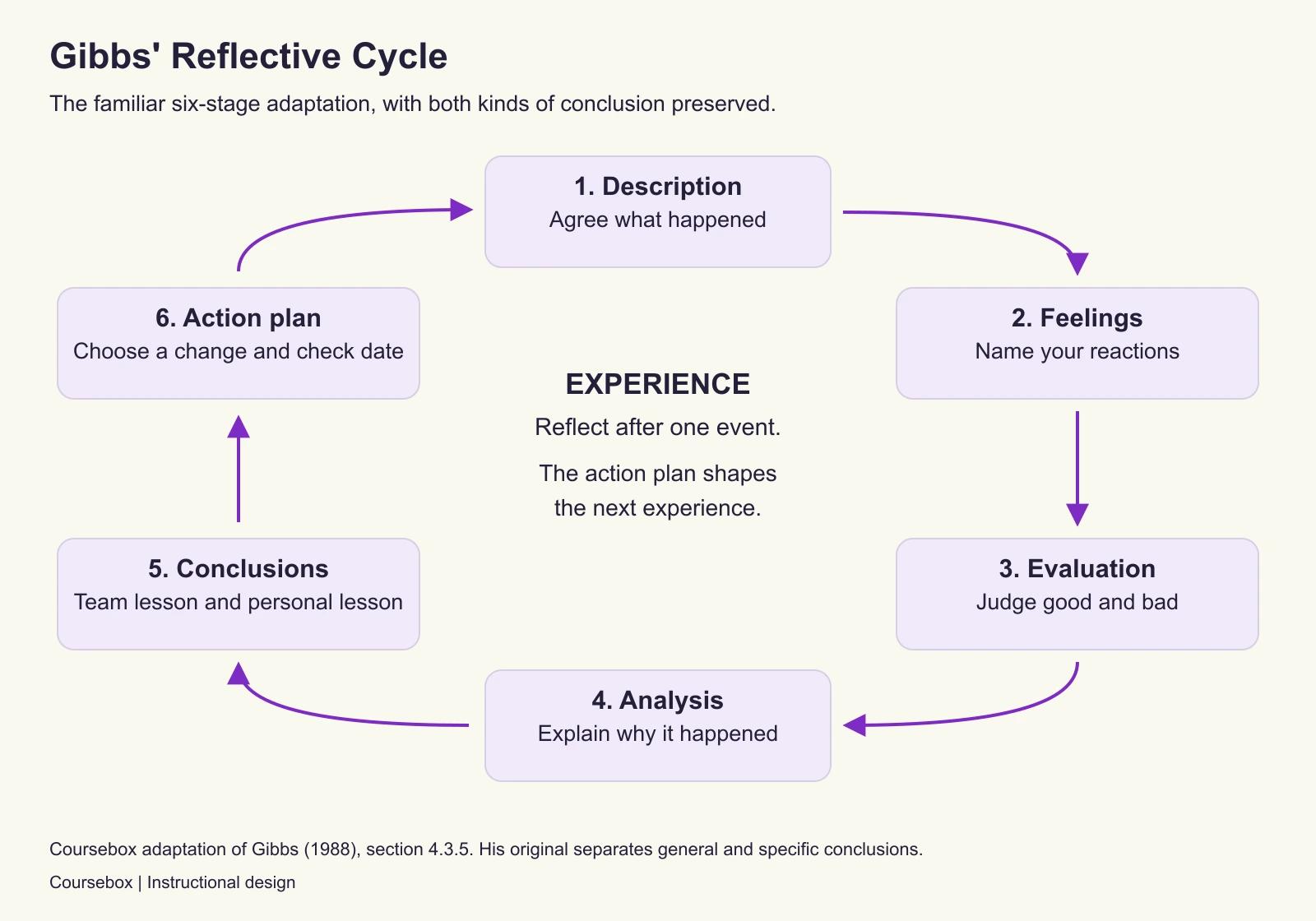
It comes from Gibbs' book Learning by Doing: A guide to teaching and learning methods, in a section called "Structured debriefing" (section 4.3.5, pages 49 to 50 of the free 2013 reissue). Gibbs was writing for teachers who ran practical sessions, such as role plays, and needed a way to turn the discussion afterwards into learning. He introduced the cycle with a diagram that "relates the stages of a full structured debriefing to the stages of the experiential learning cycle", which is David Kolb's cycle of experience, reflection, ideas and testing.
So the cycle has two uses today:
- A facilitated debrief. A group works through the stages together after an event, which is how Gibbs presented it.
- A written reflection. One person writes through the same stages after an experience, which is how most students and health professionals meet it.
The purpose is the same in both: to stop people jumping from a quick account of what happened to a fix, by making room for reactions, judgement and explanation first. The cycle does not tell you what the right conclusion is, and it is not a scoring scheme.
Here are the six stages at a glance. The questions are Gibbs' own, shortened where they run long.
| Stage | The question Gibbs asks | What it does in a debrief | What it can look like at work |
|---|---|---|---|
| Description | What happened? | Gets the facts on the table before anyone judges | A timeline of a complaint, a near miss or a failed launch |
| Feelings | What were your reactions and feelings? | Lets reactions be said so they stop steering the discussion | Each person says how they reacted at the time, without explaining it yet |
| Evaluation | What was good or bad about the experience? | Makes value judgements, both good and bad | Listing what went well in the handling as well as what went wrong |
| Analysis | What sense can you make of the situation? | Explains the event, using ideas from outside it | Checking the policy, the tools, the workload and how others saw it |
| Conclusions | What can be concluded, generally and for your own way of working? | Separates the team's lesson from each person's | A team rule, plus one thing each person will check differently |
| Action plan | What are you going to do differently in this type of situation next time? | Turns conclusions into steps someone will take | A specific change, an owner and a date to check it |
In Learning by Doing, the debrief diagram starts from an "Initial experience (e.g. role play)" and runs through description, feelings or reactions, evaluation, analysis, "conclusions (general)", "conclusions (specific)" and personal action plans, then back to the start. The six-box version most people use merges the two conclusions. Its prompts, such as "What else could you have done?", come from other sections of the same book or from later guides, not from Gibbs' debrief itself.

Case study: Emergency nurses' records in two Iranian hospitals
Nursing records in emergency departments often fall short of documentation standards. Researchers in Fars Province, Iran, tested whether training built explicitly on Gibbs' reflective model would improve the records nurses wrote on real shifts.
- What they did: Nurses at one hospital had four reflection-based sessions over four weeks. In one session they reviewed their own recent documentation errors, looked at the thoughts and feelings involved, evaluated the experience, identified causes, proposed ways to prevent them and wrote a corrective action plan. The sessions also refreshed the Ministry of Health documentation standards. Nurses at the second hospital had only the hospital's routine documentation training.
- Evidence and result: In a cluster-randomised trial published in BMC Medical Education in 2026, 68 nurses took part, 34 per hospital, with randomisation done at the hospital level. A month after training, a researcher audited three real records per nurse against a 43-item checklist (maximum 86 points). Overall quality rose by an average of 19.11 points in the Gibbs group against 4.27 points in the comparison group.
- Limitation: There were only two hospitals, and the intervention hospital started higher (57.47 against 44.29), so the study compared change scores. One researcher delivered the training and did every audit, so the assessor was not blind. The programme also added a standards refresher and more contact time, so Gibbs' cycle cannot take the credit alone.
- Lesson: Reflection was tied to each nurse's own recent errors, ended in an action plan, and was checked a month later against real work. Measure a reflection programme the same way, by auditing the work it is meant to change rather than giving a quiz.
Where Gibbs' cycle comes from, and how to reference it
Learning by Doing was published by the Further Education Unit (FEU) in 1988. It came out of a project between Graham Gibbs of Oxford Polytechnic and Bob Farmer and Diana Eastcott of Birmingham Polytechnic, and it was a guide for teachers in further education, the vocational sector. Its case studies range from self-assessment of welding skills and office practice to engineering learning journals and a basic nursing course. The cycle was not "originally designed for nursing", although nursing and other health professions took it up widely.
The book builds on Kolb. Gibbs writes that "It is not enough just to do, and neither is it enough just to think", and he uses Kolb's four stages to explain how doing and thinking connect. Our guide to Kolb's experiential learning theory covers that cycle in detail. Gibbs' contribution was the debrief: a practical sequence of questions a facilitator can use to take a group round Kolb's cycle after an experience.
In 2013 the Oxford Centre for Staff and Learning Development at Oxford Brookes University, the polytechnic's successor, reissued the book as a free ebook from the Oxford Brookes shop under a Creative Commons non-commercial licence. Three details trip people up:
- The year is 1988. The reissue's own blurb says "first published in 1998", which is a typo; the 1988 ISBN record and the book itself say 1988.
- The publisher is the Further Education Unit. Oxford Brookes University did not exist under that name in 1988, so "Oxford Brookes University, 1988" is an anachronism. It is the 2013 reissuer.
- The place of publication varies across citations, so it is safest to leave it out unless you are working from the original imprint.
A reference in Harvard style:
Gibbs, G. (1988) Learning by Doing: A Guide to Teaching and Learning Methods. Further Education Unit. Reprinted 2013 by the Oxford Centre for Staff and Learning Development, Oxford Brookes University.
If you read the book, start with section 4.3.5 on structured debriefing, then section 4.3.8 on "mutual interviewing", where many of the popular stage questions come from. Skip the learning styles chapter as a guide to practice: it links a learning style to each stage of the cycle, and later research has found little support for teaching to learning styles.
The worked example: a support team's incident debrief
To show each stage, I'll carry one hypothetical example through the rest of this guide, the incident from the opening scene. A mid-size B2B software company has a 12-person customer support team that handles customer issues by email ticket. During a partial outage of the billing integration, an agent replied to a customer's urgent ticket with the standard "resolved" macro after the status page turned green, and closed the ticket. Engineering had not yet confirmed the fix. The customer's invoice run failed again that evening, and the customer escalated to their account manager and asked for a service credit. Nobody was harmed. The cost was a credit, two days of follow-up and some of the customer's trust.
The learners are agents in their first six months, plus the team lead, who facilitates. They already know the ticketing tool and the escalation policy, but they cannot be expected to know the details of this incident, so the debrief starts from an incident pack: the ticket thread, the status-page timeline with timestamps, the macro text, the escalation policy, engineering's incident note and the account manager's summary. The intended outcome is that each agent can take part in a structured debrief of a real incident and leave with a specific, owned action plan and a date to check it, and that the team lead can run the stages without the discussion lurching from description to blame or to fixes.
The example suits Gibbs' cycle because it has an emotional charge (embarrassment, defensiveness, frustration), people saw it differently (the agent, the lead, the engineer on call and the customer), it has good and bad parts, and it needs both a team conclusion and a personal one.
The six stages, worked through one incident
Each stage below gives Gibbs' question, what tends to go wrong at that stage, and what it looks like in the support team's debrief.
1. Description
Description sets out what happened, in order, without judging it. Gibbs' instruction is blunt: "Don't make judgements yet or try to draw conclusions; simply describe." The point is a shared account that everyone agrees on before anyone argues about it.
- Gibbs asks: "What happened?"
- Watch for: Words like "should have" or "careless" in the timeline. They belong in later stages.
- In the support debrief: Each person builds the timeline from the incident pack: the customer's urgent email during the outage, the first reply sent within the target time with an apology, the status page turning green, the "resolved" macro sent and the ticket closed, engineering's note showing the fix was not yet confirmed, the failed invoice run that evening, and the escalation to the account manager.
2. Feelings
Feelings asks people to say how they reacted at the time. Gibbs asks for reactions to be stated, not set aside, and adds "Again don't move on to analysing these yet." Reactions that are never said tend to resurface later, when the group should be planning.
- Gibbs asks: "What were your reactions and feelings?"
- Watch for: A lecture on managing emotions with customers. This stage records reactions; it does not correct them.
- In the support debrief: In pairs, the agent says they felt relieved when the status page went green, then embarrassed and defensive when the escalation arrived. The team lead says they felt let down by the process rather than by the agent. The customer's emails in the thread show frustration, which the group notes but does not explain yet.
3. Evaluation
Evaluation makes value judgements about what was good and what was bad. Gibbs asks for both. In a 2005 study of soldiers on successive navigation exercises, Ellis and Davidi found that those debriefed on their successes and failures after each training day improved more than those who reviewed only their failures.
- Gibbs asks: "What was good or bad about the experience? Make value judgements."
- Watch for: A list of faults only, or an early jump to why things went wrong, which is the next stage.
- In the support debrief: Good: the first reply went out within the target time, and the apology was clear. Bad: the ticket was closed on a status-page signal, and the macro's wording promised a fix nobody had confirmed.
4. Analysis
Analysis explains the event. Gibbs asks people to "Bring in ideas from outside the experience to help you", and adds "What was really going on? Were different people's experiences similar or different in important ways?" That outside view is what separates it from evaluation: you stop judging and start explaining, using policy, data, research or other people's accounts.
- Gibbs asks: "What sense can you make of the situation?"
- Watch for: One person's theory treated as the cause, or a list of causes handed to the group instead of worked out by it.
- In the support debrief: In groups of four, the team finds that the macro has no step to confirm the fix with engineering, that a green status page in this company's incident process means the problem is mitigated rather than fixed, and that end-of-shift pressure to clear the queue pushed toward closing. They compare how other agents handled tickets during the same outage.
5. Conclusions: general and specific
Gibbs splits conclusions in two. General conclusions ask "What can be concluded, in a general sense, from these experiences and the analyses you have undertaken?" Specific conclusions ask what each person concludes "about your own specific, unique, personal" situation or way of working. At work the split keeps a team lesson from hiding an individual one, and the reverse.
- Gibbs asks: One general question for the group and one specific question for each person.
- Watch for: A single "lessons learned" list that nobody owns.
- In the support debrief: The whole team concludes that a "resolved" macro needs a confirmed fix, and that a green status page is not confirmation. Alone, the agent writes: "I close tickets fast when the queue is long. I should check the incident note before I use any resolution macro."

Case study: Technical support agents at Wipro in India
This case used daily written reflection on key lessons, not Gibbs' six stages, so it shows what a short conclusions-style reflection did at work. New agents at Wipro BPO in India were training to answer technology support questions by telephone for a Western technology company's customers, with four weeks of process training before going live.
- What they did: From the sixth day of training, agents in the reflection group spent the last 15 minutes of each day writing about at least two key lessons from the day, for 10 days. The comparison group spent those 15 minutes on more practice. Batches of 10 to 25 new joiners were assigned to one condition or the other.
- Evidence and result: In a Harvard Business School working paper by Di Stefano and colleagues, 101 agents were analysed, 56 of them in the reflection group. The reflection group scored 14.8 points higher on the company's end-of-training test, out of 100, a gain equal to about 23% of the sample's average score. Their likelihood of top customer ratings rose by 19.1% in the first month on the job, and that effect disappeared after the first month.
- Limitation: It is a working paper, not a peer-reviewed article in the version I read, and batches rather than individuals were assigned, so trainers or timing may have differed. The test measured knowledge, not observed call handling. The results come from one account and an older working-paper version, so use them as a reason to test reflection locally rather than a forecast for your team.
- Lesson: Swapping 15 minutes of practice for written reflection cost no extra time and came with a better end-of-training score. The customer effect faded within a month, so build a follow-up into the job rather than relying on one round of reflection in training.
6. Action plan
The action plan turns conclusions into steps. Gibbs asks "What are you going to do differently in this type of situation next time? What steps are you going to take on the basis of what you have learnt?" A useful plan is specific, has an owner and has a date when someone will check it.
- Gibbs asks: "What are you going to do differently in this type of situation next time?"
- Watch for: Plans like "be more careful", which nobody can check.
- In the support debrief: The team lead and the agent rewrite the "resolved" macro by Friday so it asks for engineering's confirmation. The agent adds a pre-close check on incident-linked tickets. The lead reviews 10 closed incident tickets in two weeks to see whether the check is being used.
Gibbs suggests a group leader be "very explicit about which stage of the process the group should be working on". It helps to write the current stage on the screen or whiteboard and close each one with a line such as "We've covered how it felt; now, what was good and what was bad about it?" When someone jumps ahead with a fix, park it for the action plan.
How the stages fit together
The six stages are a sequence for a discussion, not boxes on a form. Gibbs explains the order by the problems it prevents. Debriefs, he writes, "often lurch from superficial descriptions of what happened to premature conclusions about what to do next, without adequate reflection or analysis". When an experience was powerful, discussion may never get past description and feelings. And if description and feelings are not dealt with properly, people return to them later, when they should be planning.
The order answers each of those. Description and feelings come first so they are dealt with, not skipped. Evaluation comes before analysis so that "was it good or bad?" and "why did it happen?" are asked separately. Keeping them apart stops a verdict from standing in for an explanation. Conclusions and action plans come last, once there is something to conclude from.
Gibbs was also practical about the order. "If you have enough time you should try to move logically from one step to the next," he writes, and he suggests changing the grouping at each stage to "mark the transitions positively". The cycle then returns to the start: the action plan shapes the next experience, which becomes the next thing to reflect on. In a written reflection, treat the stages as a structure for thinking rather than boxes to fill. A short, honest analysis serves better than six equal paragraphs.
How to run a Gibbs debrief with a team
Gibbs suggested a different grouping for most stages. This is the order I suggest, using his groupings where he gives one:
- Before the meeting, build the incident pack. Collect the records people need to describe and judge the event, so the debrief is not a memory contest.
- Description, individually. Each person notes the timeline from the pack. Compare notes and agree one version.
- Feelings, in pairs. Pairs share their reactions at the time. Each person decides what to share with the whole group.
- Evaluation, as a whole group. Gibbs gives no grouping for this stage. Keeping the whole group together works here, with good and bad listed side by side.
- Analysis, in fours. Small groups work out why it happened, using the policy, system data and each other's accounts.
- General conclusions, as a whole group. Agree what the team concludes.
- Specific conclusions, alone. Each person writes what they conclude about their own way of working. Gibbs suggests displaying these on posters; at work, a shared document can do the same job.
- Action plans, individually, then a round. Each person writes their plan, then reads it out in a final round.
- Check the plans on their dates. Look at the work itself, such as closed tickets, not only whether people remember the plan.
The last step is a behaviour check, the third level of Kirkpatrick's model.
For a team spread across shifts, the individual stages can move into a short self-paced module. Agents can read the incident pack and write their timeline before the meeting, and write their specific conclusions and action plan afterwards, as a short microlearning unit. Feelings in pairs, analysis and general conclusions work better live. That split is my adaptation of Gibbs' groupings, not something he tested.
The support team's debrief plan
The timings below are suggestions for a 45-minute meeting, not Gibbs' rules. He gave no timings.
| Stage | Grouping | Suggested time | Prompt for this incident | What the stage produces |
|---|---|---|---|---|
| Description | Individually | 5 minutes | Using the pack, list what happened from the customer's first email to the escalation | One agreed timeline |
| Feelings | Pairs | 5 minutes | How did you react when the status page went green, and when the escalation came in? | Reactions said, not analysed |
| Evaluation | Whole group | 7 minutes | What went well in the handling, and what went badly? | Two lists, good and bad |
| Analysis | Groups of four | 10 minutes | Why did closing the ticket look right at the time? Use the policy, the macro and the status-page process | Causes the group can explain |
| General conclusions | Whole group | 7 minutes | What should the whole team conclude about resolution macros during incidents? | A team rule |
| Specific conclusions | Alone | 4 minutes | What do you conclude about your own way of working? | One personal conclusion each |
| Action plans | Individually, then a round | 7 minutes | What will you do differently, who owns it and when will it be checked? | Owned, dated plans |
Run a structured team debrief with Gibbs' own question for each stage, the grouping he suggests, suggested timings, transition lines and the three problems to watch for, with the support incident filled in and a blank plan for your own event. Editable Word file, no email required.
Writing a Gibbs reflection on your own
The same stages work for a written reflection, such as a reflective log, a CPD record or an assignment.
- Keep the description short. Give enough for a reader to follow, then move on. Most of the value sits in the later stages.
- Name your reactions plainly. "I felt defensive" is enough; you will explain it in the analysis.
- Evaluate both sides. Say what went well as well as what went badly.
- Bring something in from outside. A policy, a procedure, a colleague's view or a piece of research. Analysis without an outside idea is usually evaluation again.
- Write two conclusions. One about situations like this in general, and one about your own way of working.
- Make the action plan checkable. Say what you will change, by when, and how you will know it happened.
Reflective writing is often marked against the six stages. A marking guide like that can show that each stage is present, but the cycle is not a validated assessment instrument, and a well-structured reflection does not show that anyone now works differently. If you assess reflections, treat the mark as formative feedback and check the action plan against the work later.
Does structured reflection improve performance?
The best evidence is on debriefs and structured reflection in general, not on Gibbs' six stages specifically. I found no study that compared Gibbs' cycle with another debrief format head to head.
The largest body of evidence comes from two meta-analyses. Tannenbaum and Cerasoli's 2013 meta-analysis in Human Factors pooled studies of team and individual debriefs:
The effect was similar for teams and individuals, in simulated and real settings, and in medical and non-medical samples, and the authors point to facilitation and structure as factors that may strengthen it. A later meta-analysis of after-action reviews by Keiser and Arthur covered 61 studies and found a large average improvement across training measures (an effect size of d = 0.79). In that review a highly structured review beat a loosely structured one in the military, but in healthcare the two did about equally well, so structure alone is not a guarantee.
Studies that name Gibbs' cycle are newer and smaller. Most are in nursing, many measure outcomes by questionnaire, and several combine the cycle with lectures or scenarios, as in a 2026 trial with 120 nurses where reflective discussions using the cycle were one part of a four-session programme. The emergency nurses' documentation trial in Iran is one of the few that checked real work a month later. The practical reading: a structured debrief is a reasonable use of training time, Gibbs' cycle is one sound structure for it, and you should measure its effect on the work rather than assume it.
What incident courses ask for
To see how people brief courses about things going wrong, I looked at course requests typed into Coursebox in the 90 days to 7 October 2026: one per person, from English-language browsers, with no uploaded file. Of 266 prompts, 104 were course requests. I classified them by hand against written definitions and recorded the words behind every positive call. With one reader and generous calls, treat the figures as classification estimates. They are not audited upper bounds and may include missed or borderline requests.
Most of the incident topics were about reporting, such as accident reporting in a warehouse induction, near-miss reporting in a refinery induction and documenting an incident after it was resolved. Only one request, an audit course, asked for root-cause analysis and corrective action. None named a reflective model or a staged debrief, and about 2 of all 104 asked for a personal action plan. The sample is small and covers requests, not finished courses. But if you want a course to help people learn from an incident rather than only log it, write the feelings, analysis and action plan stages into the brief yourself.
Gibbs vs Kolb, Schön and after-action reviews
Gibbs' cycle sits beside several other approaches to reflection, and they suit different jobs. The table is my synthesis of how they are used, not a ranking: I found no evidence that one beats another.
| Approach | Best for | Weak spot | Use it when |
|---|---|---|---|
| Gibbs' reflective cycle | One significant event with an emotional charge, as a team debrief or a written reflection | Slower than a quick review, and it depends on a facilitator who holds the stages | People's reactions would otherwise take over the discussion |
| After-action review | Frequent reviews of routine team work, comparing what was planned with what happened | Reactions get less room unless the facilitator adds them | The team reviews operations often and needs a quick format |
| What? So what? Now what? | Short, frequent individual reflections | Three broad questions, with less prompting to separate judgement from explanation | You need a quick written reflection, such as a shift log |
| Kolb's experiential learning cycle | Designing a whole learning experience around doing, reflecting, concluding and trying again | A model of learning, not a debrief script | You are planning a course or programme, not reviewing one event |
| Schön's reflection-in-action and reflection-on-action | Understanding how professionals reflect during the work as well as after it | Describes reflection rather than giving steps | You want people to adjust during the work, not only afterwards |
Gibbs built his debrief on Kolb's cycle, so the two are not rivals. Kolb describes how people learn from experience, and Gibbs gives the questions to ask after one experience. Gibbs' cycle is a reflection-on-action tool in Schön's terms, used after the event. The three-question version is usually credited to Rolfe, Freshwater and Jasper's 2001 book Critical Reflection for Nursing and the Helping Professions, and before that to Borton in 1970, and the after-action review comes from military practice. If your team already runs after-action reviews, Gibbs' feelings stage can add room for reactions that a quick review tends to skip.
Limitations of Gibbs' reflective cycle
The cycle is a useful structure, but it has known weak points, several of which Gibbs named himself.
- Depth is not built in. Gibbs warned that debriefs "lurch" to premature conclusions, and following the stages does not stop that on its own. Studies of reflective writing, such as Hatton and Smith's 1995 work in teacher education, separate descriptive writing from critical reflection, and a reflection can visit every stage while staying descriptive.
- The evidence is thinner than its popularity. A 2009 systematic review of reflection in health professions education by Mann and colleagues found the evidence for these interventions "remains largely theoretical". Gibbs-specific trials have grown since, but most are recent, small, single-site, in nursing and based on self-report. In a 2026 cluster-randomised trial with 77 nursing students, a 14-week reflective programme with guided debriefing, not named as Gibbs' cycle in the published summary, did no better than the standard curriculum.
- I found no measured workplace case outside healthcare in the sources reviewed. I could not find a business, technology or public-sector organisation that used Gibbs' cycle by name and measured a result. The workplace evidence outside health care is about structured reflection and debriefs in general.
- The feelings stage can feel exposing in a team. Gibbs' suggested grouping puts feelings in pairs rather than the whole group, which keeps the audience small. I found no study of how safe people feel in a Gibbs debrief, so agree what can be shared, allow private reflection, and avoid requiring people to disclose personal reactions publicly.
- It is easily turned into a form. Gibbs presented a facilitation sequence, not a template, and a form filled in for its own sake records stages without anyone learning.
- Effects can fade. In the Wipro study, the customer-rating effect disappeared after the first month. That study does not test check-back dates, but it is a reason to measure later performance rather than assume an early benefit persists.
Using Gibbs' cycle with an AI course builder
On 7 October 2026 I briefed Coursebox to build the support team's incident debrief as a self-paced course. Coursebox is our product, so weigh my account with that in mind. The brief described the incident and the incident pack, asked for one section per stage of Gibbs' cycle in order, with team and personal conclusions kept apart, and asked for open-text reflection questions in every stage, with no multiple choice.
Most of what I needed came back. The outline turned the stages into pages grouped under a few sections. It kept Description and Feelings apart: "What Happened, Factually?" had an incident timeline, and "What Did People Feel Then?" had a reflection on reactions. Analysis stayed apart from Evaluation as "What Sense Can We Make?", with a causal view of the incident and the queue pressure. The outline ended with "Write and Schedule Your Action Plan".
One thing did not match the brief. The outline added multiple-choice quizzes to the Evaluation and Conclusions stages, although I had asked for open-text reflection.
It took two follow-up messages to fix. I asked for the quizzes to become open-text reflections that keep team and personal conclusions apart, and for the live-debrief wrap-up from my brief. The final outline had no quizzes. It showed "Evidence-Based Evaluation Reflection" and "Team and Personal Conclusions Reflection", then the action plan, then a wrap-up page, "Run the debrief live with your team". It came to about 51 minutes across 5 sections and 9 pages. I checked the outline only. I did not inspect the generated pages or run the course with agents, and an outline in the right order does not prove the debrief works.
Write your own reflection through Gibbs' stages, with general and specific conclusions kept apart and an action plan that is specific, owned and dated, with the support agent's sheet filled in as an example. Editable Word file, no email required.
Putting Gibbs' cycle to work
Gibbs' reflective cycle is a way to learn from one experience by slowing the jump from what happened to what to do about it. It suits a single event that people felt strongly about, such as a complaint, a near miss or a failed launch, where reactions would otherwise take over the discussion. Use it as a facilitated sequence with a group, or as the structure of a written reflection, and keep evaluation and analysis as separate stages. For quick, routine reviews, an after-action review or the three-question format will usually be enough.
Pick the next incident your team has to review, build the incident pack before the meeting, and run the stages with Gibbs' groupings: feelings in pairs, analysis in fours, conclusions split between the team and each person. Give every action plan an owner and a date, then check the work on that date. That check shows whether the planned change appears in the work. Compare with a baseline and consider other changes before attributing an improvement to the debrief.
Frequently Asked Questions
The six stages are description, feelings, evaluation, analysis, conclusions and an action plan. In Gibbs' 1988 debrief, the conclusions stage is split into general conclusions about the situation and specific conclusions about your own way of working, so his diagram shows seven steps after the experience.
A good Gibbs reflection keeps the description short, names reactions plainly, evaluates what went well as well as what went badly, and brings in an outside idea such as a policy, procedure or piece of research to explain what happened. It ends with conclusions and an action plan that says what will change, by when and how anyone will know.
The cycle can be followed stage by stage while staying descriptive, it is easily turned into a form to fill in, and the feelings stage can feel exposing in a group. The research base is mostly small nursing studies with self-reported outcomes, and the strongest evidence is for debriefs in general rather than Gibbs' cycle specifically.
Gibbs, G. (1988) Learning by Doing: A Guide to Teaching and Learning Methods. Further Education Unit. Reprinted 2013 by the Oxford Centre for Staff and Learning Development, Oxford Brookes University. The year is 1988, not 1998, and Oxford Brookes is the 2013 reissuer, not the original publisher.
Kolb's experiential learning cycle explains how people learn from experience through four stages: experience, reflection, forming ideas and trying them out. Gibbs built on Kolb and turned the reflection into a practical debrief, with questions for each stage that a person or a group can work through after a specific event.
Carolina Martin
Carolina is a highly experienced learning designer with tech start-up experience. She is based in Sydney and previously designed courses alongside Coursebox founder Travis in a previous job. She is passionate about delivering engaging learning experiences and brings the same perspective to customer experience too. She manages our customer support documentation and product testing processes.

