

Cognitive Load Theory: Types of Load, Germane Load, Effects
Cognitive load theory explained: intrinsic, extraneous and germane load, what Sweller changed since 1998, 17 dated effects and how to fade support.

Cognitive load theory is John Sweller's account of how working memory limits shape learning: new information passes through a working memory that handles only a few interacting elements at once, so good instruction spends that capacity on the task itself.
- Sweller and his colleagues named three types of load in 1998, but since 2019 the theory counts only intrinsic and extraneous load as basic categories.
- Germane load now means the working memory a learner devotes to the task itself, so treating it as a separate third load to increase is outdated advice.
- Worked examples help novices most, and the support should fade through partly completed problems until learners can do the task alone.
- Of 107 course requests typed into Coursebox over 90 days, none asked for support to fade as learners improve.
- Cognitive load research comes mostly from short randomised studies, and the evidence from real workplaces is much thinner.
Five questions, about a minute. Answer for the hardest task in one course you are building or reviewing, thinking of a learner who has never done that task. This is a planning checklist, not a validated measure of learning, motivation or effectiveness.

Go from storyboard to an interactive course in minutes
Picture a new load controller at a regional airline, twenty minutes before a departure. The booking figures, the bag and cargo manifest, the fuel figure, a limits sheet, an index table and a trim envelope are open on the desk. Then the gate sends a change: four late passengers for the back of the cabin, and 150 kg of cargo coming off the rear hold. Almost every number on the sheet moves at once, and the controller has to say whether the flight is still within its limits before the sheet goes to the captain.
I'm an instructional designer at Coursebox, where we make instructional design software that turns a brief into a course outline, so I'll mention our product where I tested it. Cognitive load theory explains why that moment swamps a new controller and barely troubles an experienced one. I cover what the theory says now, including what happened to germane load, and how to count the load in a real task. Then come the main effects with the year each was first reported, how to fade support from a worked example to solo practice, how to measure load and where the theory is criticised. Three real cases and two free templates go with it.
What is cognitive load theory?
Cognitive load theory is John Sweller's account of how working memory limits shape learning: new information passes through a working memory that handles only a few interacting elements at once, so good instruction spends that capacity on the task itself.
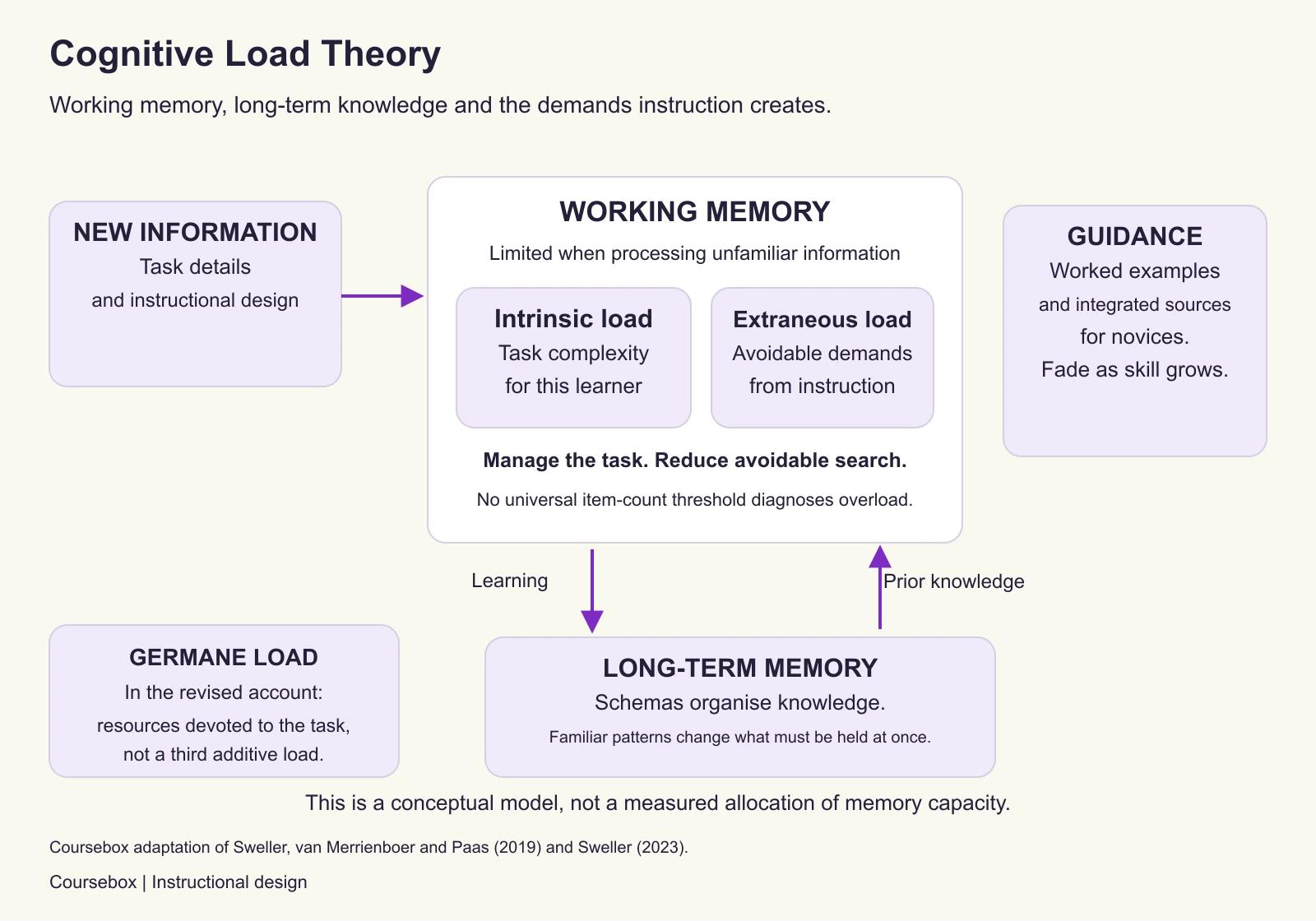
The roots go back to Sweller's problem-solving experiments in 1982, and the first full description came in his 1988 paper in Cognitive Science. Over the next decade the theory grew in a small group of researchers at the University of New South Wales in Sydney and the University of Twente in the Netherlands. Their 20-year review in Educational Psychology Review states the premise plainly: "human cognitive processing is heavily constrained by our limited working memory which can only process a limited number of information elements at a time" (p. 262).
The theory rests on two kinds of memory. Working memory is where you hold and process what you are dealing with right now, and it is small. Long-term memory is effectively unlimited and stores what you know as organised structures, often called schemas. The two behave very differently. New information is squeezed through working memory, but "Once information is stored in long-term memory, the capacity and duration limits of working memory disappear" (2019, p. 261). An expert load controller sees "four passengers aft and some cargo off the rear" as one familiar pattern. A new controller sees a dozen separate numbers.
Three points set the scope:
- It applies to complex material. Sweller and colleagues write that "cognitive load theory is only relevant for complex learning" (2019, Table 1, p. 266). A long list of facts can be hard work without being complex.
- It is about knowledge we have to be taught. Drawing on David Geary, the theory separates knowledge we evolved to pick up without teaching, such as speaking our first language, from knowledge our culture decided we need, such as reading or weight and balance. Sweller's 2023 paper says the theory "is concerned with the acquisition of biologically secondary knowledge" (p. 3).
- It is a design theory. Its output is a set of tested instructional effects, such as worked examples and integrated diagrams, rather than a model of the brain. It belongs to the cognitivist tradition in learning theory.
The theory has also changed. The best-known version, with three types of load that add up to a total, dates from 1998, and Sweller and his colleagues have since revised it. Here are the main ideas at a glance, as they stand now.
| Idea | In the sources | The question it asks of your training | What it looks like at work |
|---|---|---|---|
| Limited working memory | Processes "a limited number of information elements at a time" (2019, p. 262) | How many new things must a learner hold at once? | A new controller juggling passengers, holds, fuel and limits on one sheet |
| Long-term memory and schemas | Limits "disappear" once information is stored (2019, p. 261) | What do experienced staff already know that novices lack? | A senior controller reads a late change as one familiar pattern |
| Element interactivity | Depends on the material and "the knowledge of the person" (2019, p. 264) | Which parts of the task can be learned alone, and which only together? | What a cabin zone is (alone) versus judging a late change (together) |
| Intrinsic load | Changes only with what is learned or the learner's expertise (2019, p. 264) | Is the task the right size for these learners right now? | Teaching zones and holds before the full sheet |
| Extraneous load | Set by "how the information is presented" (2019, p. 264) | What in the design wastes working memory? | Figures on one page and the diagram they refer to on another |
| Germane load, current meaning | Working memory "devoted to dealing with intrinsic cognitive load" (2019, p. 264) | Is the learner's effort going on the task, or on the design? | Effort spent reading the envelope, not hunting for the index table |
| Expertise reversal | Effects "first decrease in size, then disappear, and can eventually reverse" (2019, p. 277) | What should change for experienced staff? | Skipping the full worked example for a controller transferring from another airline |
How much can working memory hold?
On Nelson Cowan's estimate, people hold about four chunks of new information at once, and fewer when the pieces have to be related to each other. The figure most people remember is seven, from George Miller's 1956 paper, but Miller framed the limit of immediate memory in chunks rather than items, and in his 1956 paper he suspected the recurring sevens were "a pernicious, Pythagorean coincidence" (p. 96). Later work by Nelson Cowan put the central limit lower.
Cowan's 2001 review argued for a single central limit averaging about four chunks, and his 2010 summary gives 3 to 5 meaningful items in young adults. Two cautions apply. These are short-term memory span estimates, while cognitive load theory talks about processing new elements, which is harder than holding them. And the limit applies to new information only. A chunk can be large: for an expert, a whole familiar pattern counts as one.
Sweller's papers and books: which to read
Most of the theory sits in journal articles, and several are free to read.
- Sweller, van Merrienboer and Paas, "Cognitive architecture and instructional design: 20 years later" (2019). Read this one first. It is open access, explains the revised view of germane load and lists every effect with the paper that first reported it.
- Sweller, "The development of cognitive load theory" (2023). Read it for the history. Sweller explains how failed replications led to new effects and why germane load was folded in.
- Sweller, Ayres and Kalyuga, Cognitive Load Theory (Springer, 2011). Read it if you want the book-length account. The 2019 review cites it as the source of the germane reconceptualisation.
The worked example: load control at a regional airline
Here is the hypothetical example I use from here on. A regional airline flies a single turboprop type. Its load control office builds a load and trim sheet for every departure in the airline's load-planning system, at a desk. The learners are newly appointed load controllers in their first eight weeks. Most come from check-in or ramp roles, so they know passengers, bags and holds, but none has built a load and trim sheet, and a ramp background does not show that they can.
The task: for one departure, enter passengers by cabin zone (A, B and C), bags and cargo by hold (forward and rear) and the planned fuel; check the totals against the maximum zero-fuel, take-off and landing weights; check that the balance falls inside the trim envelope; and handle a late change from the gate before the sheet goes to the captain. So that learners' decisions can be judged, the course supplies a job pack: a booking summary by zone, a bag and cargo manifest by hold, the planned fuel, a limits sheet, an index table and a trim envelope. Every figure here is illustrative, and none is an approved procedure for a real aircraft. A senior controller checks every sheet before release.
The intended outcome is that new controllers produce a correct sheet for a standard flight, recognise when a late change takes the flight outside a limit or the envelope, and choose a fix that brings it back. The example suits cognitive load theory because almost nothing on a load sheet means anything alone: every passenger, bag and kilogram of fuel changes both the weight and the balance, and the result only means something against the limits.
Types of cognitive load: intrinsic, extraneous and germane
The three types of cognitive load are intrinsic, extraneous and germane. Sweller, van Merrienboer and Paas set out all three in 1998, and they are still the names you will meet. In the current theory, only intrinsic and extraneous load count as separate sources of load; germane load has been redefined.
Intrinsic load
Intrinsic load comes from the task itself: how many elements must be processed together for this learner to understand it. It is not fixed. It falls as expertise rises, because schemas let an experienced person treat many elements as one.
- In the source: Intrinsic load "only can be changed by changing what needs to be learned or changing the expertise of the learner" (2019, p. 264).
- On the load sheet: Judging whether the gate change keeps the flight within limits is high in intrinsic load for a new controller and low for a senior one.
- In the course: Teach the parts that can be learned alone first, then the full sheet, and treat experienced transfers differently from new starters.
Extraneous load
Extraneous load comes from the design: how the information is presented and what the instruction makes learners do. It does nothing for learning, and it is the load a designer can change most directly. The 2019 review says "the vast bulk of the instructional effects" come from "variations in extraneous cognitive load" (p. 264).
- In the source: It is set by "how the information is presented and what the learner is required to do by the instructional procedure" (2019, p. 264). Sweller's 2023 paper says instruction "should be designed to minimise or eliminate" it (p. 4).
- On the load sheet: The hold diagram on one page, the index table on another and the trim envelope on a third, so the learner has to keep flicking between them.
- In the course: Put the weights and index values on the diagram, beside the parts they refer to, and cut anything learners must read past.
Germane load
Germane load was introduced in 1998 as the "good" load that builds schemas, assumed to add to the total. It now means the working memory resources a learner devotes to the intrinsic load of the task, rather than to the design. It is no longer treated as a separate source of load.
- In the source: Germane load "refers to the working memory resources that are devoted to dealing with intrinsic cognitive load rather than extraneous cognitive load" (2019, p. 264).
- On the load sheet: Effort spent working out what the late passengers do to the balance is germane. Effort spent finding the index table is not.
- In the course: Do not add difficulty merely to raise a third load. Useful self-explanation or varied practice can still support learning when learners have the capacity for it. Cut avoidable search and size the task to the learner.
What happened to germane load?
Germane load was folded into intrinsic load between 2010 and 2019. Sweller, van Merrienboer and Paas now say that "only intrinsic and extraneous cognitive load are distinguished as basic categories of cognitive load" (2019, p. 281), and germane load describes how working memory is shared out, not a third load.
The reason was empirical. In 1998 the group assumed that when a design cut extraneous load, germane load filled the freed space, so the total stayed the same. The 2019 review is candid about the change: "This characterisation of germane cognitive load is a departure from the 1998 paper. In that paper we assumed that germane cognitive load contributed to total cognitive load by substituting for extraneous load" (p. 264). But "Numerous empirical studies indicated a reduction in load following a reduction in extraneous load" (p. 264). If cutting extraneous load lowers the total, germane load was not taking up the space.
Sweller went further in 2023. Because the resources devoted to learning are set by intrinsic and extraneous load, "no instructional consequences of germane cognitive load have been identified and so germane cognitive load is no longer considered an independent source of load and the term is less commonly used" (pp. 4-5). He also explains where the idea came from: germane load "was not generated from data. It was developed because it seemed to be a plausible and interesting idea" (p. 5). Slava Kalyuga had made a similar case in a 2011 paper, arguing that germane load could not be told apart from intrinsic load and that two types were enough.
The debate is not closed. Measurement researchers still build three-factor questionnaires. Melina Klepsch and colleagues tested both views in a 2017 validation study: a two-factor model came close to their three-factor one, but they wrote, "we prefer GCL to be considered as a separable factor" (p. 13). For a designer, the practical advice is the same either way. Cut extraneous load, and set intrinsic load to what these learners can handle.
The advice to increase or optimise germane load comes from the 1998 version, which treated it as a separate, productive load. In the current theory there is no separate germane load to increase. An add-on activity that is not part of the task can itself be extraneous load. Spend the effort removing what wastes working memory and sizing the task for the learner.
Element interactivity: counting the load in a real task
Element interactivity is the number of elements a learner must process together because they affect each other. It is the source of intrinsic load, and it also drives extraneous load. Sweller's 2023 paper gives the contrast: learning the vocabulary of a second language or the symbols of the periodic table is low in interactivity, because "each element can be learned in isolation", so such a task "may be difficult, but ... it is not necessarily complex" (p. 4). Pollock, Chandler and Sweller gave the high end: grammar, or how an electrical circuit works, where no part makes sense alone.
Interactivity also depends on the learner. It "depends on a combination of both the nature of the information and the knowledge of the person processing the information" (2019, p. 264). So count it for a novice, not for yourself. Here is a rough count on the load sheet for a new controller.
| Part of the task | What a novice must hold at once | Interactivity | Design move |
|---|---|---|---|
| Knowing what cabin zone C is | One fact: the rows that make up the zone | Low | Teach it alone, on its own short page |
| Finding the index units for one zone | The zone, the passenger count and the right row of the index table | Low to moderate | Teach it alone, with one practice item |
| Checking zero-fuel weight against its limit | Dry operating weight, passengers, hold loads and the limit, about 4 elements | Moderate | Show it worked, then ask for it |
| Judging the gate change | The late passengers and their zone, the offload and its hold, the new zero-fuel weight and its limit, take-off and landing weights against theirs, the combined index and the envelope at the new weight, about 9 elements | High | Worked example first, then fade the support |
| The same gate change for a senior controller | About 2 chunks: the load change and the full weight-and-balance recheck | Low | A brief reminder or none |
The counts are a design heuristic, not a measure. Different designers would split the elements differently, and nobody can see a learner's schemas. What the count does show is where the trouble is. Learning the parts is not where a new controller overloads. Judging the gate change is, because about nine things change together and each only means something against the others.
With this course's illustrative figures, the change adds 190 kg net: four passengers at a standard 85 kg, less the 150 kg offload. That takes the zero-fuel weight from 30 kg under its limit to 160 kg over it. Adding passengers aft and removing cargo aft have opposing moment effects, but the net index and balance require the supplied aircraft-specific data and a fresh calculation. A novice who checks only the balance passes the sheet. A further 200 kg offload would put zero-fuel weight 40 kg below its limit in this illustrative calculation. It is only a candidate response: the complete job pack is needed to recalculate every weight and the balance, then have the senior controller check the result. That weight arithmetic alone does not approve a flight.
That order, the separate parts first and then the whole, is the isolated elements effect. A Sydney study with electrical trainees and apprentices tested it in a workplace setting.

Case study: Electrical safety training for trainees and apprentices in Sydney
This study tested one cognitive load effect on its own: isolated elements. Learners at a Sydney company's training courses had to master electrical safety tests, where a learner must "simultaneously consider what the test aims to achieve, the required setting of the volt meter, the on/off status of the appliance" and more, all at once.
- What they did: One group first studied only the step-by-step procedure for three tests on a 240 volt kettle, steps that could be learned one at a time, and then the full material with the purpose of each test and how the circuit works. The other group studied the full material both times. Both groups did the tests on a real kettle as they read, in two sessions within 48 hours.
- Evidence and result: In Pollock, Chandler and Sweller's 2002 paper in Learning and Instruction, first-year trainees who started with the isolated steps (11 per group) scored 35.00% against 17.58% on the questions that needed the whole procedure, and rated the work as less effortful. Apprentices who had already shown competence in basic electrical testing (12 and 13 per group) showed no difference between the two methods.
- Limitation: The groups were small, the tests came within 48 hours, the hands-on test had only two scored items and missed significance, and mental effort was a single self-rating. Nothing was measured on the job.
- Lesson: For true novices on a procedure where many parts interact, teach the parts on their own first, then show how they work together. The same order did nothing for apprentices who had the basics, so it is a tool for novices, not a rule for everyone.
Cognitive load effects: a dated catalogue
A cognitive load effect is an instructional technique that beat a conventional alternative in randomised experiments, with load as the explanation. Many came from failures. In Sweller's own account, "Chandler and Sweller (1991) had difficulty replicating the split-attention effect, but they found a new effect, the redundancy effect" (2023, p. 11), and failed replications with low-interactivity material led to expertise reversal. The 2019 review lists 17 effects with the paper that first reported each. Several, marked compound, describe how other effects change rather than a technique of their own.
| Effect | First reported | What it says | On the load and trim course |
|---|---|---|---|
| Goal-free | 1982, Sweller and Levine | Problems with no specific goal can teach more than conventional ones | Ask "work out every total you can" before "is the flight within limits?" |
| Worked example | 1985, Sweller and Cooper | Studying a solved example beats solving the same problem cold | Flight 1 fully worked, with the reason for each step |
| Completion problem | 1987, van Merrienboer and Krammer | Finishing a partly solved problem beats solving from scratch | Flights 2 to 4 with fewer steps given each time |
| Split attention | 1988, Tarmizi and Sweller | Sources that only make sense together should be physically integrated | Weights and index values written on the hold diagram |
| Redundancy | 1991, Chandler and Sweller | Information a learner does not need costs working memory | No paragraph repeating what the diagram already shows |
| Element interactivity (compound) | 1994, Sweller | The effects appear with complex material, not simple material | The effects apply to the gate change, not to zone names |
| Variability | 1994, Paas and van Merrienboer | Varied examples raise intrinsic load and can improve transfer when capacity allows | Practice flights with different loads, not the same flight twice |
| Modality | 1995, Mousavi and colleagues | Short spoken explanation with a diagram can beat printed text | A brief voice-over pointing to parts of the envelope |
| Self-explanation | 1998, Renkl and colleagues | Prompts to explain a worked example help if total load stays manageable | "Why is the zero-fuel weight checked before fuel is added?" |
| Imagination | 2001, Cooper and colleagues | Imagining a procedure helps once it can be imagined, not before | Picture the change on the envelope, after the worked flights |
| Isolated elements | 2002, Pollock and colleagues | Parts first, then the whole, helps novices with complex material | Zones, holds, limits and index units before the full sheet |
| Expertise reversal (compound) | 2003, Kalyuga and colleagues | Help for novices can become a burden for experienced learners | Experienced transfers skip the full worked flight |
| Guidance fading (compound) | 2003, Renkl and Atkinson | Worked examples should give way to problems as expertise grows | The flight sequence that ends with the gate change solo |
| Collective working memory | 2009, Kirschner and colleagues | Groups learn complex tasks better than individuals; simple tasks the reverse | Pairs work the hardest gate change, individuals the routine sheet |
| Transient information (compound) | 2011, Leahy and Sweller | Long spoken or animated passages overload because they vanish | No long narrated walkthrough of the whole sheet |
| Human movement | 2012, Paas and Sweller | Concerns learning tasks that involve human movement | Little use for a desk-based sheet |
| Self-management (compound) | 2012, Roodenrys and colleagues | Learners can be taught to apply the effects themselves to manage their own load | Show controllers how to lay out the job pack side by side |
The dates come from the 2019 review's table. Not every effect has the same weight of evidence. Five of them bear most directly on the load sheet course.
Split attention and redundancy
Split attention happens when learners have to combine two sources that cannot be understood alone, such as a diagram and the text that explains it on another page. They "must mentally integrate the two sources of information in order to understand the solution, a process that yields a high cognitive load and hampers learning" (2019, p. 268). It is not the same as distraction. The fix is to integrate the sources, as in the load sheet diagram with its figures written on it. Redundancy is the opposite problem: anything a learner does not need, such as a paragraph restating a self-explanatory diagram, costs working memory. Chandler and Sweller tested both with electrical engineering material in 1991, including one experiment that ran for three months in an industrial training setting.

Case study: Diagnostic training for eye doctors in Hangzhou
Cognitive load theory guided this trial, and one arm came close to testing a single technique: visual cueing on the images themselves. Ophthalmology residents at the Eye Center of the Second Affiliated Hospital, Zhejiang University School of Medicine, have to read subtle clinical and imaging signs to judge how active and how severe thyroid eye disease is.
- What they did: The researchers randomised 45 residents to one of three 45-minute sessions: a static review of five cases, an adaptive learning system that tailored the cases, or a visual cueing atlas that pointed to the diagnostic features on each image.
- Evidence and result: In Xie and colleagues' 2026 paper in Frontiers in Medicine, overall diagnostic accuracy on test cases was 66.0% in both the cueing and the adaptive arms against 51.3% for static review straight after the session, with 15 residents per arm. Two weeks later it was 52.7% (cueing) and 54.0% (adaptive) against 41.3%.
- Limitation: It was a single-centre pilot with a small convenience sample. Prior exposure to the disease was not recorded, the adaptive arm saw more cases, and accuracy was measured on test cases, not patients. The results report accuracy, not cognitive load.
- Lesson: Residents who had the diagnostic features marked on each image diagnosed test cases more accurately than those who reviewed the cases alone, with no statistically significant difference from the adaptive arm. That does not establish that the methods are equally effective. Accuracy fell in every arm by two weeks, so cueing is a start, not a substitute for practice. Cueing is closer to Mayer's signalling than to one of Sweller's effects; what it shares with integrated diagrams is less wasted search, which is extraneous load.
Transient information
Spoken words and animation disappear as they play, so learners have to hold them in working memory. The modality effect says a short spoken explanation with a diagram can beat printed text, because it uses both visual and auditory working memory. But when the spoken part runs long, the advantage can reverse. Wayne Leahy and Sweller showed this in 2011 with primary school students learning from long and short spoken explanations of temperature graphs.
The modality effect is often passed on as "always pair audio with visuals". It holds when a short spoken explanation goes with a diagram that needs it. A long narrated walkthrough of a whole load sheet is transient information, and narration that reads out the same words printed on screen adds redundancy. Keep narration short and tied to one part of the diagram, and leave longer reference material in print.
Expertise reversal
Techniques that help novices can stop helping, and even get in the way, as learners gain expertise. With rising expertise, the effects "first decrease in size, then disappear, and can eventually reverse" (2019, p. 277). Kalyuga and colleagues, who named the effect in a 2003 paper, drew the design lesson: instruction "should be tailored to the level of experience of intended learners. Without such tailoring, the effectiveness of instructional designs is likely to be random" (p. 29). The learner variable the theory tracks is prior knowledge, not a preferred style. For the airline, a controller transferring from another carrier should start further along the sequence than a new starter, after a short check of what they can already do.
Collective working memory
Groups can pool working memory, but coordination has a cost. A 2018 review by Kirschner, Sweller, Kirschner and Zambrano concludes that learning in a team beats learning alone "if the complexity of the to-be-learned material is so high that it exceeds the limits of each individual learner's working memory" (p. 222). For simple tasks, individual learning is more efficient. So pair new controllers on the hardest gate changes, and let them do routine sheets alone.
Guidance fading: from a worked example to solo practice
Guidance fading means withdrawing support on the same kind of task as learners improve, from a fully worked example, through problems with less and less of the solution given, to solving alone. In the words of the 2019 review, "Past a certain point, studying worked examples may be counterproductive and they should be faded out and replaced by problems" (p. 277). Jeroen van Merrienboer, Paul Kirschner and Liesbeth Kester set out the sequence in a 2003 paper: "giving sizable early support for learning tasks and no support for the final tasks in the same task class", starting with worked examples, moving through completion assignments where larger and larger parts must be finished, and ending with conventional problems (p. 8).
Here it is on one task. The sheet has six steps: passengers by zone, bags and cargo by hold, zero-fuel weight against its limit, fuel with take-off and landing weights against theirs, the index against the trim envelope, and the final check before the sheet goes to the senior controller.
- Isolated elements. One short page each on cabin zones, holds, the three weight limits, index units and the trim envelope, with one practice item each.
- Worked example. Flight 1 is fully worked, one step per page, with the reason for each step and the figures written on the hold and cabin diagram.
- Completion problems. Flights 2, 3 and 4 give fewer steps each time, with feedback beside each step.
- Independent practice. One flight with the gate change, done alone, with a written judgement on whether it is still within limits and what to change.
- Adjust for experience. Experienced transfers do flight 4 unaided as a check. Use their performance to choose the entry point; do not assume one correct answer proves mastery of the remaining tasks.
| Flight | Steps already done | The learner completes | Support |
|---|---|---|---|
| Flight 1, worked example | All six, with the reason for each | No steps; studies the sheet and explains one step in their own words | Full |
| Flight 2 | Steps 1 to 4 | Index and envelope, then the final check | Feedback beside each step |
| Flight 3 | Steps 1 to 3 | Fuel and weights, index and envelope, final check | Feedback beside each step |
| Flight 4 | Step 1 only | Steps 2 to 6 | Feedback beside each step |
| Independent flight with the gate change | None | All six, plus the late change and a written decision | None until the senior controller's check |
A topic progression is not fading. Courses that move from "beginner" topics to "advanced" ones change the content. Fading keeps the task the same and takes the help away. This sequence is also a form of instructional scaffolding, with the difference that the cognitive load research specifies what the support is (the given steps of a worked solution) and that it is withdrawn as expertise grows.
Not every fading decision has a research answer. The research gives no fixed number of completion problems and no universal point to switch to solo practice, so watch how learners do on each flight and move on when they complete their steps correctly without needing the feedback.
Build a fading sequence for one task, from a fully worked example through completion problems to independent practice, with step feedback and a plan for experienced staff. Filled in with the airline load and trim sheet flights (illustrative figures) and blank pages for your own task. Editable Word file, no email required.
Fading also answers the wider argument about how much guidance novices need. Kirschner, Sweller and Richard Clark argued in a 2006 paper that "The advantage of guidance begins to recede only when learners have sufficiently high prior knowledge" (p. 75). Cindy Hmelo-Silver and colleagues replied in 2007 that problem-based and inquiry learning, done well, are themselves heavily scaffolded. Both sides agree that novices need support; they disagree about how much and in what form, and the constructivist case puts more weight on learners building understanding through problems. For whole programs built around complex tasks, the 4C/ID model, first described by van Merrienboer in 1992 and built on cognitive load research, builds fading into every task class.
What course briefs leave out
To see whether people brief courses with what this theory needs, I looked at course requests typed into Coursebox in the 90 days to 7 October 2026: one per person, from English-language browsers, with no uploaded file. Of 266 prompts, 107 were course requests. Two AI readers each classified half against written definitions, and every positive call was re-read in full by hand. There was no second independent rater, so treat these figures as classification estimates. Checking positive calls does not find all missed requests or establish an upper bound.
People did ask for things that sound close. About 10 were classified as asking for topics running from beginner to advanced, and about 7 as asking for step-by-step instructions. Neither is a worked example or fading. And most briefs did not say who the learners were in relation to the task, which is the input the theory needs most, because prior knowledge decides whether a worked example helps or gets in the way. "None said experienced" does not mean every learner was a novice; most briefs simply did not say. The sample is small and covers requests, not finished courses. If you want a builder or a colleague to produce a fading sequence, write the novice level, the worked example and the completion steps into the brief yourself.
How to measure cognitive load, and what it cannot tell you
The most common measure is a single rating of mental effort, and it gives an overall reading only. Fred Paas introduced it in 1992, and Paas, van Merrienboer and Adam described the wording in 1994: learners rate their invested mental effort on "a 9-point symmetrical category scale", from "very, very low mental effort" to "very, very high mental effort" (p. 422). It is quick and has shown useful reliability in research, but the 2019 review says it "provides an overall measure of cognitive load (i.e. intrinsic plus extraneous load) and therefore cannot easily be used to differentiate between the different types of cognitive load" (p. 281).
The problems go further. Ton de Jong's 2010 review in Instructional Science found that the questionnaire has "no standard format" across studies (p. 114) and that in many studies "there is no direct measurement of cognitive load" at all (p. 114). Jimmie Leppink and colleagues built a 10-item questionnaire in 2013 that rates items such as how complex the topic was and how unclear the explanations were from 0 to 10, to separate the types. Even its authors note that a question about difficulty "could refer to EL for some learners and to IL for other learners" (p. 1069), and their samples were statistics students at one Dutch university.
De Jong concluded that the existing measures "cannot be used to measure overload; the critical level indicating overload is unknown" (2010, p. 118). There is no score above which a module is too much. Compare versions of a design against each other, and always read effort next to performance.
For a pilot of a redesigned module, a practical set is:
- the one-item effort rating after each practice flight, not only once at the end, because the 2019 review notes that a single rating after learning tends to come out higher than the average of ratings taken during it;
- the Leppink items once, if you want to see whether a change cut extraneous load or raised intrinsic load;
- a performance check on the same flights, such as the share of sheets with every limit right;
- the outcome you care about later, such as sheets returned by senior controllers, which belongs with your Kirkpatrick evaluation.
Read effort and performance together. High effort with good sheets on a hard flight is not a problem in itself. High effort with poor sheets is a reason to investigate task complexity, design and prior knowledge, rather than a diagnosis of overload, and low effort with poor sheets can mean learners are not engaging with the task. The largest workplace trial I found shows why the load types need separate readings.

Case study: Technical refresher training at a power company in China
Cognitive load theory framed this trial as the mechanism, but the intervention was a bundle, so the theory cannot take the credit alone. State Grid Zhengzhou Power Supply Company ran the same annual technical refresher for staff in engineering, operations and maintenance, marketing and support roles, and the researchers argued that uniform delivery treated a young engineer and a veteran foreman as identical learners.
- What they did: Researchers from Zhengzhou University and the company's HR department matched training batches in six county-level companies and randomised them. Half used an adaptive platform with an entry diagnostic, a mastery estimate per topic and rerouting to prerequisites. Half took the same syllabus in the same order through classroom sessions and fixed-sequence e-learning.
- Evidence and result: In Tang and colleagues' 2026 paper in Frontiers in Psychology, 2,574 staff were analysed (1,284 adaptive, 1,290 standard). The adaptive group scored 1.15 points higher on a 20-point knowledge test after training, when 1,243 and 1,251 responded (d = 0.29), and 1.07 higher about six weeks later, when 1,200 and 1,206 responded (d = 0.26). On the Leppink scale, extraneous load fell (d = -0.34) but intrinsic load rose (d = 0.28), so the combined score barely moved (d = -0.09).
- Limitation: The authors say the estimate is the effect of the package, not of adaptivity, because the medium, instructor contact, pacing and retrieval practice all differed. Load was self-reported with modest reliability, the analysis plan was not publicly registered, the outcome was a knowledge test rather than job performance, and the paper is new with no replication yet.
- Lesson: Measure the load types separately. Staff on the adaptive package reported less extraneous load but more intrinsic load, and a single "how hard was it?" rating would have shown almost no change. The gain was small, about one test item, and a similar knowledge advantage remained at six weeks. It was not a measured gain in job performance.
Criticisms of cognitive load theory, and the responses
The theory's core claim, that working memory is limited, is not in dispute. As de Jong put it, "The general assertion of cognitive load theory that the capacity of working memory is limited is not disputed" (2010, p. 110). The criticisms concern the rest, and the theory has answered some of them.
| Criticism | Response | Still open |
|---|---|---|
| The three types of load cannot be told apart, in theory or in data | Germane load folded into intrinsic load between 2010 and 2019, leaving two basic categories | Some measurement researchers still model three factors |
| The theory explains any result after the fact | With germane load no longer a separate "good" load, fewer outcomes can be explained away | Load is still often inferred from test scores rather than measured |
| Load measures are a single self-rating with no agreed meaning | Multi-item questionnaires now separate intrinsic and extraneous load | No validated threshold for overload |
| Studies use short lessons and uninvested students | Most data come from randomised trials, and one split attention study ran for three months in industrial training | Few long workplace trials, and lab lessons rarely allow the notes real workers use |
| Low load is treated as the goal | Only extraneous load should be minimised; variability raises intrinsic load and can help | When to add difficulty for a given learner is a judgement call |
The sharpest critique is de Jong's: with "good", "bad" and neutral loads, the theory was "constructed in such a way that it is hard or even impossible to falsify" (2010, p. 125). He also noted that in real settings "learners will use devices (e.g., a notepad) to offload memory" (p. 123), which lab studies rarely allow, and that low intrinsic and extraneous load "doesn't guarantee that learning will take place" (p. 126). His suggested fix, distinguishing only processes that do and do not contribute to learning, is close to what the 2019 revision did. And he credits the theory with having "created unity in a diverse set of instructional design principles" (p. 126).
The evidence base has its own limits. The 2019 review admits that many early experiments "did not attempt to directly measure comparative cognitive load" (p. 265). The workplace record is thin: the three cases I found with measured results come from Australia and China, and I found no verified workplace case in finance, software development or aviation, including load control. Be wary of very large claimed effects for training "based on cognitive load theory" when load was never measured and the package also included rewards or game elements. In one nurse-training trial of that kind, the reported effect on an attitude scale was d = -3.22, with no baseline measure and no measure of load.
Cognitive load theory, Mayer's theory and 4C/ID: which to use
Cognitive load theory explains why a design overloads learners. Two neighbours turn it into narrower design advice, and each suits a different job. The table is my synthesis, not a ranking.
| Approach | Best for | Weak spot | Use it when |
|---|---|---|---|
| Sweller's cognitive load theory | Deciding how much guidance a task needs, for whom and when to remove it | Gives effects, not a step-by-step design process | The task is complex and learners differ in prior knowledge |
| Mayer's cognitive theory of multimedia learning | Screen-level decisions about words, pictures and narration | Says little about sequencing practice across a course | You are designing or reviewing slides, video or e-learning screens |
| 4C/ID (van Merrienboer) | Whole training programs for complex tasks, with fading built in | Heavy to apply to a short course | You are planning many weeks of training for a complex job |
Richard Mayer's cognitive theory of multimedia learning is a separate theory that borrows from cognitive load theory, and the 2019 review describes it as having "an exclusive focus on the design of multimedia materials" (p. 274). The two overlap on split attention, redundancy and modality, but they use different vocabularies, and they define redundancy differently: Mayer's version is narrower, while in cognitive load theory anything a learner does not need can be redundant, and more becomes redundant as expertise grows. Mayer's principles, such as coherence and signalling, are his and are not part of Sweller's effects list. Use one theory's vocabulary per document. For the load sheet course, I would use cognitive load theory to decide the sequence from isolated elements to the solo gate change, and Mayer's principles to check each screen.
Using cognitive load theory with an AI course builder
On 8 October 2026 I briefed Coursebox to build the load and trim sheet course. Coursebox is our product, so weigh my account with that in mind. The brief described the new controllers, the job pack and the illustrative figures, and asked for the parts of the sheet taught on their own first, a fully worked flight with the figures on the diagram, three completion flights with less help each time, an independent flight with the gate change, a checklist, then a wrap-up as the very last section. I asked for about 40 minutes.
The first outline got most of the sequence right. "Parts of the Sheet" came before the worked example, with pages on cabin zones and holds, and on limits, index and envelope. "Worked Example Flight 1" included the load and trim diagram. Completion flights 2 and 3 followed ("Flight 2: Last Two Checks" and "Flight 3: Finish the Sheet"), and then an "Independent Gate-Change Assessment".
The fading was cut short, though. Flight 4, where only the first step is done, was missing, so the outline jumped from finishing half a sheet to doing a whole one alone, which is the step the sequence exists to bridge. The checklist had also been merged into the wrap-up.
One follow-up message added the missing completion flight and separate checklist to the outline. I reloaded the outline and checked it: it now showed Flights 2, 3 and 4 in order, with "Flight 4: Only the First Step Done" and step feedback, then the independent assessment, then a separate "Checking Your Sheet" section with a checklist to use before the senior controller, and the Wrap-up last. It came to about 54 minutes against the 40 I asked for, across 6 sections and 12 pages. I checked the outline only, so some things still need a look. The independent task came back as a one-question quiz where I had asked for an open-text answer, and a short quiz on the parts of the sheet remains. Whether the figures sit on the diagram, rather than in a separate table that would split attention, can only be checked in the rendered pages. With flight 4 back in place, the outline now runs from a fully worked sheet through three completion flights, each giving less, to the gate change done alone.
Count what a novice must hold at once in each part of a task, decide what to teach as isolated elements, plan the fading sequence and the changes for experienced staff, and choose how to measure load with its limits. Filled in for the load and trim sheet course (illustrative figures) with blank pages for your own course. Editable Word file, no email required.
Putting cognitive load theory to work
Cognitive load theory answers a narrow but useful question: how much help does this learner need on this task right now, and in what form? The answer depends on two things: how many parts of the task interact, and what the learner already knows. That is why the same course can help a novice and hold back an expert, and why the useful design moves are cutting the load your design adds and sizing the task to the learner, not adding activities to raise germane load. The evidence is strongest in short randomised studies and thinner at work, so treat its effects as good bets to pilot rather than guarantees.
Your next step: take the hardest task in the course you are building and list what a new starter has to hold in mind at once to do it. Use the list to locate interacting unfamiliar elements, then check the learners' prior knowledge. Pilot a worked example and completion problems where novices struggle, and fade the support as their performance improves. Four or five listed items is not a validated threshold for choosing a design.
Frequently Asked Questions
Cognitive load theory is John Sweller's account of how working memory limits shape learning: new information passes through a working memory that handles only a few interacting elements at once, so good instruction spends that capacity on the task itself. Once knowledge is stored in long-term memory, those limits largely disappear, which is why experts find the same task easy.
The three types are intrinsic load (from the complexity of the task for that learner), extraneous load (from the design and presentation) and germane load (in 1998, the load thought to build schemas). They come from Sweller, van Merrienboer and Paas's 1998 paper. Since 2019 the theory treats only intrinsic and extraneous load as basic categories, and germane load means the working memory devoted to the intrinsic load.
Germane load now means the working memory resources a learner devotes to the task itself rather than to the design. In 1998 it was treated as a separate, productive load to encourage. Sweller wrote in 2023 that no instructional consequences of germane load have been found, so it is no longer considered an independent source of load, although some measurement researchers still treat it separately.
A new airline load controller checking whether a late change keeps a flight within its weight and balance limits carries high intrinsic load, because about nine figures change together and each only means something against the others. If the diagram, the index table and the limits sit on separate pages, flicking between them adds extraneous load. An experienced controller sees the same change as one familiar pattern.
The main criticisms are that the types of load are hard to tell apart and measure, that the theory can explain almost any result after the fact, that most studies use short lessons with students, and that no rating can show when a learner is overloaded. The theory's limit on working memory is not in dispute, and the 2010 to 2019 revisions and multi-item questionnaires answered part of the criticism.
Carolina Martin
Carolina is a highly experienced learning designer with tech start-up experience. She is based in Sydney and previously designed courses alongside Coursebox founder Travis in a previous job. She is passionate about delivering engaging learning experiences and brings the same perspective to customer experience too. She manages our customer support documentation and product testing processes.

