

4C/ID Model: Four-Component Instructional Design Explained
The 4C/ID model explained: the four components, task classes, fading support, the Ten Steps (2024 edition), real examples and two free templates.

4C/ID teaches complex skills through realistic whole tasks, from simple to complex, including supported simulations. Jeroen van Merriënboer first described it in 1992.
- Its four parts are learning tasks, supportive information, procedural information and part-task practice.
- Help is high at the start of each task class and fades to none, then rises again when the tasks get harder.
- Reviews report positive average learning effects, with substantial variation and important design limits; they do not guarantee better results in your programme.
- AI course builders can use the 4C/ID words and still build topics first, so the task design is still your job.
- 4C/ID is built for programmes lasting weeks to years, not a 20-minute procedure.
Name one whole task and what makes it hard. The tool applies the 4C/ID rules and builds your task classes, with support that fades.
Here are the task classes for the service desk example in this post: new analysts learning to resolve user tickets. Change the answers to build your own.
Task classes, simple to complex
- Class 1: one user, one system, a clear symptom, such as a password lockout.
- Class 2: a vaguer symptom across two systems, such as Teams calls that keep dropping.
- Class 3: several users affected, an unclear cause and a manager waiting for an update.
- Class 4: the real job, with all its pressure and ambiguity.
Support that fades inside each class
- Start with a worked example, move to a half-finished ticket the learner completes, then finish with tickets they resolve alone.
The other three components
- Supportive information: how identity, devices and networks fit together, and how an experienced analyst decides what to check first.
- Procedural information: reset steps, ticket fields and scripts, shown inside the task and withdrawn once learners no longer need them.
- Part-task practice: only for categorising tickets quickly and correctly.

Go from storyboard to an interactive course in minutes
Here is a made-up but typical case. A company's new IT service desk analysts work through a course with a module on networks, a module on accounts, a module on printers and a module on ticketing, each ending in a quiz they pass. On their first real shift, a user says "nothing works since this morning", and the analyst freezes. They know every topic. They have never practised working out which topic this is.
The 4C/ID model, short for four-component instructional design, is built for that problem. It is a whole-task approach for complex skills, grounded in cognitive load theory: learners begin with realistic whole tasks, including supported simulations, to practise putting knowledge together for use on the job. I'm an instructional designer at Coursebox, where we make instructional design software, so I see how quickly a course turns into a list of topics.
What is the 4C/ID model?
The 4C/ID model is an instructional design model for teaching complex skills, the kind where people must combine knowledge, judgement and routine steps to do a real task. Jeroen van Merriënboer first described it with colleagues in 1992 and set it out fully in his 1997 book Training Complex Cognitive Skills. He died in November 2023. 4cid.org, the model's reference site, is maintained by Jimmy Frèrejean and Iwan Wopereis with support from Maastricht University's School of Health Professions Education and the Open University of the Netherlands.
Its central idea is to organise the programme around whole learning tasks. The other components support learners as they complete them.
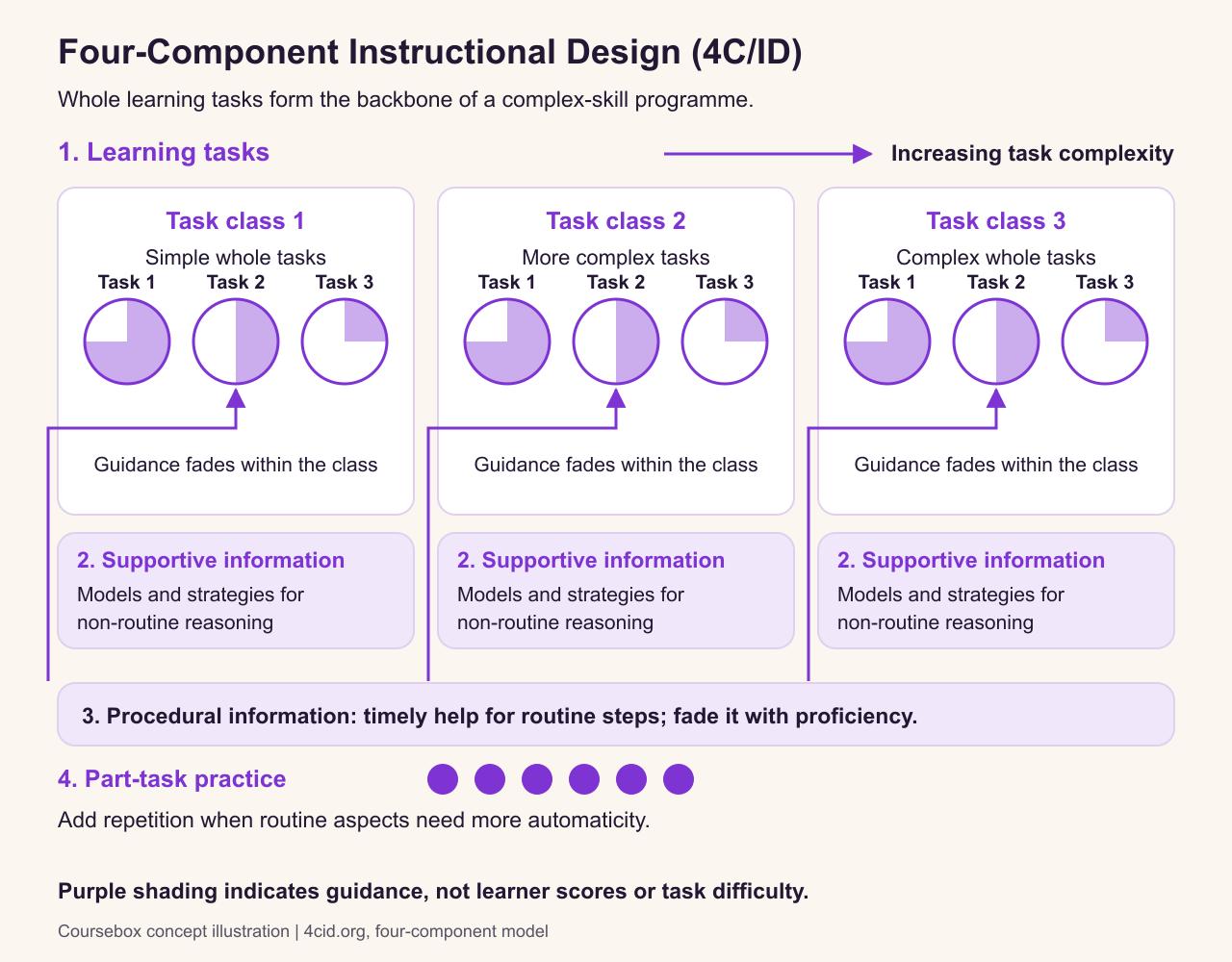
| Component | What it is | In the service desk course |
|---|---|---|
| Learning tasks | Whole, realistic tasks, grouped into task classes from simple to complex | Resolve a real-style ticket from first report to fix or escalation |
| Supportive information | Helps with the non-routine (non-recurrent) parts: problem solving, reasoning and decisions | How systems connect, and how an expert narrows down a problem |
| Procedural information | Step-by-step help for the routine (recurrent) parts, given at the moment it is needed | Reset steps, ticket fields and scripts, shown inside the task |
| Part-task practice | Extra drill for routine steps that must become automatic | Fast, accurate ticket categorisation, only if the whole tasks do not give enough practice |
Procedural information helps with recurrent steps that follow a stable procedure. Supportive information helps learners reason through the parts that change between cases.

Case study: Decision-making training for German police officers
In a 2024 German Police University experiment, 45 experienced officers were assigned to 4C/ID-based blended training or an active control. Video explanations supported whole scenario practice; additional part-task drills were not used.
In the response-time analysis, the intervention group (n = 17) improved from 969 to 551 milliseconds; the control group (n = 21) changed from 948 to 931 milliseconds. These are the analysed samples, not all 45 recruited officers.
The groups did not differ significantly in improvement on the traditional marksmanship measure. Correct decisions were already near ceiling. This laboratory result does not establish safer real-world policing or isolate the design model from the training content.
Practical lesson: assess the specific judgement and performance the programme targets. A gain on one measure is not evidence of improvement on every part of a complex skill.
The four components, worked through one course
This hypothetical programme prepares new IT service desk analysts to resolve user tickets. They need to gather details from the user, diagnose the fault, resolve it or escalate it, and document the work. The problem is that knowing separate facts about passwords and networks does not prepare them for a complete ticket. We'll use increasingly difficult tickets to show how the four components support the same whole job.
Learning tasks, grouped into task classes
A learning task is a whole job, start to finish. "Learn about networks" is a topic. "Resolve a ticket from a user who cannot reach a shared drive" is a learning task. Tasks are grouped into task classes, each a simpler or harder version of the same whole job:
- Task class 1: one user, one system, a clear symptom. A password lockout, a printer offline, email not syncing on one device.
- Task class 2: a vaguer symptom across two systems. "Teams calls keep dropping."
- Task class 3: several users affected, unclear cause, a manager waiting for an update.
- Task class 4: the real job, with all its pressure and ambiguity.
Tasks in a class should differ from each other the way real tickets differ. Vary the details that differ in the real job while keeping the class's simplifying conditions consistent. Ten printer tickets in a row teach printers. Troubleshooting needs variety.
Support and guidance that fade
Inside each task class, learners start with a lot of help and finish with none. 4C/ID separates two kinds:
- Support is built into the task: a worked example where an expert resolves the ticket and explains each choice, then a half-finished ticket the learner completes, then a conventional ticket they do alone.
- Guidance is added to the task: a coach, prompts, or a checklist of the steps an expert follows.
Both fade within a class, then rise again at the start of the next, harder class. Across the programme, help therefore rises and falls rather than fading once and disappearing forever.
Sequence one task class from worked example to independent task, plan how support and guidance fade, and check the class before you build it. Editable Word file, no email required.

Case study: Android app development in Amsterdam
A 2019 report on Amsterdam University of Applied Sciences describes an Android course organised around complete apps. Task classes moved from a single-screen dice app to multi-screen apps using remote data.
Inside each class, learners progressed from expert modelling to imitation, completion and independent tasks. Official Android documentation supplied information that could be kept current as tools changed.
Students found the learning tasks helpful, especially expert examples that explained the reasoning behind the code. These are student evaluations, not a controlled demonstration of learning gain.
Practical lesson: start with a working product, vary its complexity and reveal how an expert makes choices. Keep changing tool instructions separate from the enduring problem-solving strategy.
Supportive information
Supportive information is the theory, models and expert strategies that help with the non-routine parts of the task. For the service desk, that is how identity, devices and networks fit together, and how an experienced analyst decides what to check first. It is given before each task class and stays available while learners work.
Procedural information
Procedural information is just-in-time help for the routine steps: how to reset a password in this tool, which fields to fill in, the script for an escalation. It appears inside the task at the moment it is needed, and it is withdrawn once learners no longer need it. A job aid or an on-screen hint works better here than a module.
Part-task practice
Part-task practice is extra drill on a routine step, used only when that step must become automatic and the whole tasks do not give enough repetitions. Use it selectively, when the task requires automatic performance. For the service desk, categorising tickets correctly and quickly might qualify; most other steps get enough practice inside the whole tasks. The order is accuracy first, then speed, then doing it alongside other tasks.
How to build and assess the first task class
For the hypothetical service desk course, plan the whole performance before writing topic pages. The following sequence is an illustrative design, not a tested Coursebox programme.
| Stage | Whole task | Help and learner evidence |
|---|---|---|
| Model | Watch an expert resolve a printer-offline ticket from first report to confirmation | Expert explains each hypothesis; learner predicts the next check |
| Complete | Finish a partially investigated email-sync ticket | Provided investigation notes; learner chooses and justifies the remaining checks |
| Perform | Resolve a new account-lockout ticket in a training environment | No coaching; approved workplace references remain available |
| Review | Compare the submitted ticket and interaction with the performance standard | Confirm identity checks, justified diagnosis, safe action or escalation, and an accurate record |
Define the standard with the service desk lead. A security-critical error requires remediation even when the rest of the ticket is strong. If diagnosis is weak, add an expert example and another varied task; if a routine step is weak, provide just-in-time help. Move to the next class after performance meets the standard across varied tasks, then restore support as complexity increases. Removing teaching prompts does not mean banning job aids that competent staff normally use.
The Ten Steps to Complex Learning
The four components describe what a 4C/ID programme contains. The book Ten Steps to Complex Learning, by van Merriënboer, Paul Kirschner and Jimmy Frèrejean, describes how to design one. The fourth edition came out from Routledge in August 2024, with a new running example on producing video content and a closing chapter on artificial intelligence.
| Step | What you do | Component it serves |
|---|---|---|
| 1. Design learning tasks | Choose whole, varied, realistic tasks | Learning tasks |
| 2. Design performance assessments | Set the standards for acceptable performance | Learning tasks |
| 3. Sequence learning tasks | Group tasks into task classes from simple to complex | Learning tasks |
| 4. Design supportive information | Prepare the models and strategies learners need | Supportive information |
| 5. Analyse cognitive strategies | Find how experts approach the problem | Supportive information |
| 6. Analyse mental models | Find how experts understand the domain | Supportive information |
| 7. Design procedural information | Prepare step-by-step, just-in-time help | Procedural information |
| 8. Analyse cognitive rules | Find the if-then rules behind routine steps | Procedural information |
| 9. Analyse prerequisite knowledge | Find what learners must know to apply those rules | Procedural information |
| 10. Design part-task practice | Add drill for routine steps that must be automatic | Part-task practice |
You do not have to follow the steps in order. Steps 1, 4, 7 and 10 are the four components; the others are the analysis behind them, used when the design needs it.
Define the whole task and its complexity factors, plan task classes with supportive and procedural information for each, and decide whether any part-task practice is needed, with the service desk example filled in. Editable Word file, no email required.
Does 4C/ID work?
The Costa, Miranda and Melo meta-analysis reports d = 0.79, with education level moderating the result and stronger applicability in higher education. That pooled estimate should not be treated as a guaranteed effect for every setting.
A 2025 systematic review found incomplete reporting across 55 papers. Its quantitative subanalysis combined 32 pre/post effects from 12 studies (g = 0.76), with substantial variation. Improvement within a group is not the same as a controlled comparison showing that 4C/ID is better than another design.

Case study: Medication safety training in Indonesia
A 2021 nursing study at Universitas Muhammadiyah Yogyakarta used cases and simulation as whole tasks, lectures and video as supportive information, checklists and feedback as procedural information, and skills-lab drills as part-task practice.
The intervention group (55 students) averaged 45.1 on the study's oral-medication skill assessment, versus 33.6 in the comparison group (40 students). These are scores on that instrument, not percentages or workplace error rates.
There was no pre-test, and the intervention lasted five weeks versus two weeks for the comparison. Differences in training time and other design features could account for part of the result.
Practical lesson: map each resource to the part of the task it supports, then assess the whole performance. To evaluate the model itself, use a comparison with equivalent training time.
Building 4C/ID task classes in Coursebox
The design decisions 4C/ID depends on are yours: what the whole tasks are, what makes one harder than another, and which steps are routine. Once those are made, an AI builder can do a lot of the construction. On 6 October 2026 I tested that in Coursebox, the course builder we make, with the IT service desk example.
I gave it my decisions: the whole task (resolve a ticket from first message to resolution note), three task classes from a single user with a common fault to several users affected at once, support that fades from full guidance to none, procedures as quick job aids, and one practice page on resolution notes. I asked for every task class to open with an interactive scenario where the analyst works a whole ticket of that kind.
It did. Common User Faults opens with an account-recovery scenario built around a locked account at the desk, and adds a printer scenario, a common-fixes job aid and an assignment to resolve a ticket from start to finish. Less Obvious Network Faults opens with a VPN that connects but cannot reach the shared drive. Multi-User Service Failures opens with a scenario where a whole team has lost email access and the analyst has to decide how to escalate it. The scenarios use the AI interactive scenario block, where the learner makes decisions and the conversation responds, which is the closest fit in Coursebox to a whole learning task.
The first outline also had two topic sections between the task classes, one on diagnostic thinking and one on resolution notes. In 4C/ID that material belongs inside the task classes, so I sent one message: move the questioning and symptom-versus-cause pages into the network class after its opening scenario, and keep a single resolution-note practice page at the end of the first class. The revision did exactly that, leaving five sections and 29 pages with every task class starting from a whole ticket.
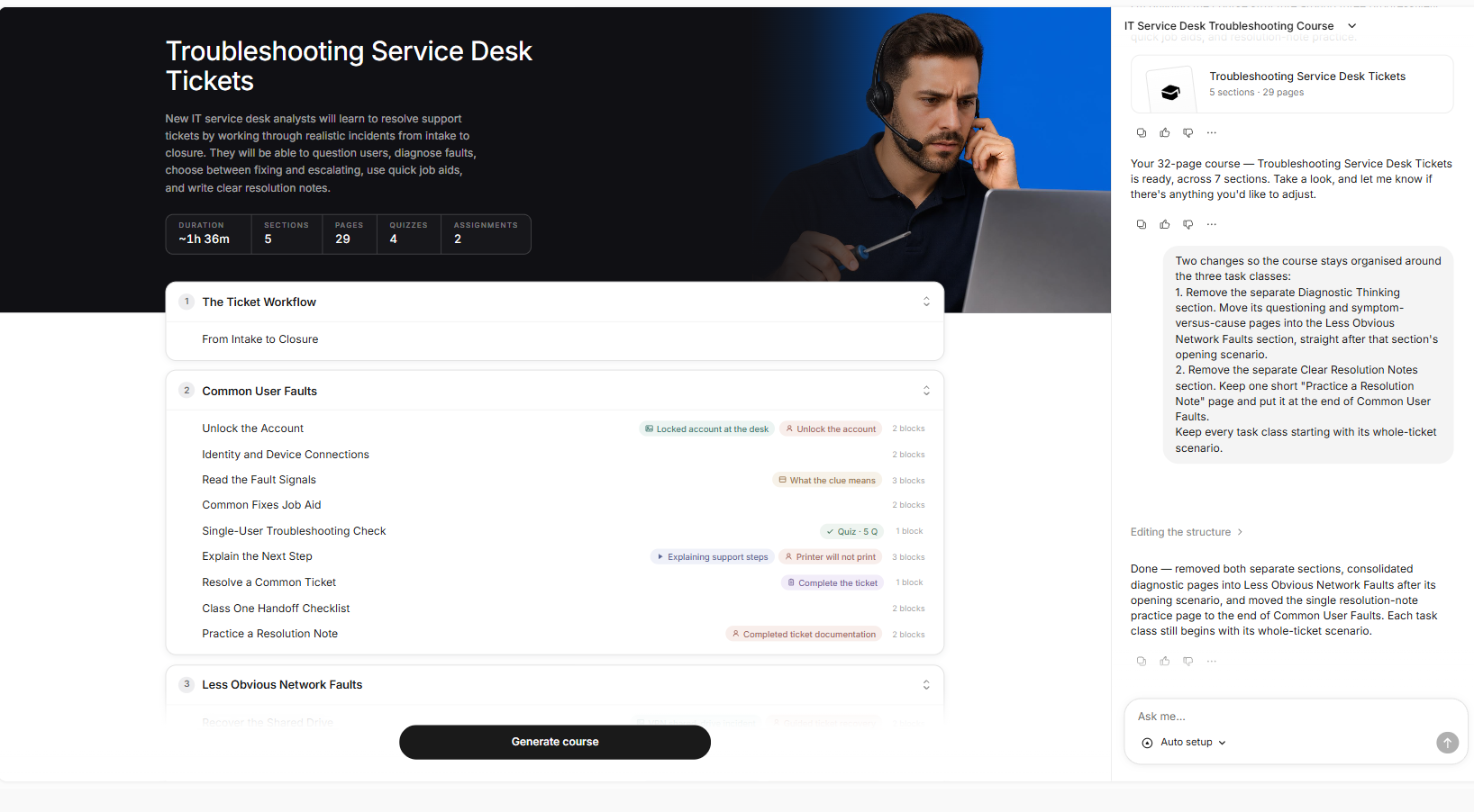
This was an outline test rather than an evaluation of a finished course or learner outcomes. The scenarios still need a subject-matter expert to check the fixes match your own systems. Our support inbox shows the same appetite for whole-task practice: an HR team rehearsing a conversation with a department head, a housing organisation practising interviews and feedback, and a risk trainer wanting "consequence-based simulations".
When 4C/ID is the wrong choice
- Short or simple training. The model is usually applied to substantial programmes lasting weeks to years. For a 20-minute procedure, a demonstration and a checklist will do.
- Tight design budgets. One team reported that designing a five-month professional development programme for primary teachers with the Ten Steps "spanned nearly two years" (Instructional Science, 2021).
- Designers trained on topic-based courses. In a 2019 paper on three 4C/ID redesigns, the authors note it "requires task-centred thinking", which takes practice for people used to writing a module per topic.
- When transfer is assumed. In a teacher education course, gains in information problem solving "disappeared after completing the course" (European Journal of Education, 2019). Whole tasks help transfer, but people still need chances to use the skill afterwards.

Case study: A vehicle-painting VR simulator in Germany
A vehicle-painting simulator study involved 47 apprentices and used the Ten Steps to design training. Delivering supportive information inside VR proved difficult.
Participants maintained the required spray distance and angle for less than half the recorded time. Without a control group, this does not establish superiority to conventional training.
Practical lesson: test whether the chosen medium can deliver explanations and feedback as well as practice. A sound blueprint does not guarantee that every component survives implementation.
4C/ID vs other instructional design models
| Model | What it organises | Best for |
|---|---|---|
| 4C/ID | Whole tasks, from simple to complex, with fading support | Complex skills over weeks or months |
| ADDIE | The project: analysis, design, development, implementation, evaluation | Managing any training project |
| Merrill's First Principles | Principles for good instruction around real problems | Checking any course design |
| Gagné's Nine Events | The order of events inside one lesson | Planning a single lesson |
4C/ID sits comfortably inside an ADDIE project, and it shares the task-centred idea behind Merrill's principles of instruction. If you plan single lessons, Gagné's nine events are still useful for structuring each one.
Build the first whole task before the topic list
4C/ID is a strong planning choice for work that requires people to coordinate several skills and make decisions in changing situations. Its central commitment is to whole learning tasks, supported by the right explanations, timely procedural help and selective extra practice. Renaming topic modules as task classes does not make that change.
Choose a representative job task and design a manageable first version that learners can attempt with support. Add a variation, decide which guidance should fade and check whether learners can handle the task rather than only answer questions about its parts. Use the first task-class plan to test the design before extending the programme. After training, people still need opportunities and support to apply the skill at work.
Frequently Asked Questions
Four-component instructional design. The four components are learning tasks, supportive information, procedural information and part-task practice.
Jeroen van Merriënboer, with colleagues, first described it in 1992 and published the full model in 1997. He died in 2023, and 4cid.org, the reference site for the model, is maintained by Jimmy Frèrejean and Iwan Wopereis in the Netherlands.
Supportive information helps with the non-routine parts of a task that need reasoning and decisions, and is given before and during a task class. Procedural information is step-by-step help for routine parts that are always done the same way, given at the moment it is needed.
Groups of whole learning tasks of the same difficulty. Learners work through task classes from simple to complex, with support fading inside each one.
No. It is used in vocational and workplace training, including policing, nursing, IT and vehicle painting apprenticeships, but it is designed for programmes long enough to teach a complex skill.
Carolina Martin
Carolina is a highly experienced learning designer with tech start-up experience. She is based in Sydney and previously designed courses alongside Coursebox founder Travis in a previous job. She is passionate about delivering engaging learning experiences and brings the same perspective to customer experience too. She manages our customer support documentation and product testing processes.

