

Adult Learning Theory: Knowles' 6 Assumptions Explained
Adult learning theory from Knowles' own books: the six assumptions, when each was added, his design process, real cases, the evidence and two templates.

Adult learning theory is the set of ideas about how adults learn, best known through Malcolm Knowles' andragogy, which assumes adults need to know why they are learning, direct themselves, use their experience and learn from real problems they face now.
- Knowles listed four assumptions until 1980, added motivation in 1984 and need to know by 1990, which is why sources give four, five or six.
- Knowles came to see andragogy and pedagogy as two ends of a spectrum, so an expert technician can be a beginner on a new app.
- Knowles' seven-phase design process and his learning contract turn the assumptions into a plan for a real course.
- Of 104 course requests typed into Coursebox in 90 days, about 6 were classified as describing experienced learners and only 1 asked to use their experience.
- The outcome evidence for andragogy is thin, so judge an adult learning redesign with a realistic task rather than a satisfaction form.
Five questions, about a minute. Answer for a course you are planning for people who already know their jobs, such as the rollout of a new system or process. This is a planning checklist, not a validated measure of learning or course effectiveness.

Go from storyboard to an interactive course in minutes
Picture a maintenance technician with twenty years on the packaging lines, who can hear a bearing failing before the sensor flags it. His plant is moving from paper work orders to an app on shared tablets, and the training opens with a slide titled "What is a work order?". By the second slide he has stopped listening, and the one thing he does need, how to record a job when the floor has no signal, comes twenty minutes later.
I'm an instructional designer at Coursebox, where we make instructional design software that turns a brief into a course outline, and I test what it builds from people's briefs. When a course is meant for people who already know the job, Malcolm Knowles' adult learning theory is the framework I reach for first. In this guide I cover what Knowles actually wrote, one hypothetical maintenance course worked through his assumptions and design process, the evidence, a test in our own product and two free templates.
What is adult learning theory?
Adult learning theory is the set of ideas about how adults learn, best known through Malcolm Knowles' andragogy, which assumes adults need to know why they are learning, direct themselves, use their experience and learn from real problems they face now.
The word andragogy comes from the Greek stem andr-, which Knowles glossed as "man, not boy" or adult. In the 1980 edition of The Modern Practice of Adult Education he wrote that he "originally" defined it as "the art and science of helping adults learn", in contrast to pedagogy, the teaching of children. Knowles' version is the best known, but the term covers more than one theory:
- Andragogy (Knowles). Six assumptions about adult learners, plus a separate seven-phase process for planning learning.
- Self-directed learning (Allen Tough, Knowles and others). How adults plan and run their own learning projects, mostly outside formal courses.
- Perspective transformation (Jack Mezirow). How adults come to change the way they see themselves and their situation, not only what they can do.
- Experiential learning (David Kolb and others). How people learn by moving between doing something, reflecting on it, drawing conclusions and trying again.
For a training designer, all four are practical lenses for deciding what to put in a course for adults and how to run it. None of them is a law of learning. Two qualifications apply throughout: Knowles' assumptions describe a spectrum, not a line drawn at age 18, and the research behind them is thinner than their popularity suggests.
Here are Knowles' six assumptions at a glance, in the order and wording of The Adult Learner (6th edition, 2005), with the year each joined his list.
| Assumption | Wording in The Adult Learner, shortened | In his list since | The question it asks of your course | What it can look like at work |
|---|---|---|---|---|
| Need to know | Adults need to know why they need to learn something before undertaking to learn it | By 1989 to 1990 | Have we said why this is worth their time? | Opening a new procedure with the incident that prompted it |
| Self-concept | Responsible for their own decisions, for their own lives | The original four | Where can learners choose, plan or skip? | Letting staff test out of a module they already know |
| Experience | A greater volume and a different quality of experience | The original four | How will the course use what they already know? | Asking staff to bring cases from their own work |
| Readiness to learn | Ready to learn what they need to cope with real-life situations | The original four | What change in their job makes this needed now? | Timing training to a promotion or a system change |
| Orientation to learning | Life-centred, task-centred or problem-centred | The original four | Is the course built around tasks or around topics? | Practising on a real case instead of reading chapters |
| Motivation | The most potent motivators are internal pressures | 1984 | What does the learner get out of it, beyond compliance? | Linking a skill to less rework or more control over the job |
Knowles described assumptions about learners and, separately, a seven-phase process for designing learning. Holton and Swanson, who continued The Adult Learner after Knowles died, call the six assumptions "core adult learning principles", which is why the two words get mixed up.
Andragogy is a spectrum, not an adults-only rule
Knowles' 1970 book was subtitled Andragogy versus Pedagogy, and his co-authors later wrote that it presented the two models as if "pedagogy is for children and andragogy is for adults". By the 1980 revision the subtitle had become From Pedagogy to Andragogy. Schoolteachers were using his ideas with children, and Knowles now saw the two models as most useful "not as dichotomous but rather as two ends of a spectrum". His example was "a forty-year-old may be very dependent in learning to program a computer but completely self-directing in learning to repair a piece of furniture".
He drew a practical rule from it: "whenever a pedagogical assumption is the realistic one, then pedagogical strategies are appropriate, regardless of the age of the learner". In 1979 he applied the same test to himself. He had meant the assumptions "to be tested (not to be presumed)", and "if I were now, at age 66, to undertake to learn a body of totally strange content (for example, the higher mathematics of nuclear physics), I would be a totally dependent learner." A standard textbook on adult learning by Sharan Merriam and colleagues reaches the same view: andragogy "now appears to be situation-specific and not unique to adults".
Our pedagogy vs andragogy comparison sets the two terms side by side. For a course designer, Knowles' later view is the useful one: ask how dependent or self-directing these learners are on this particular content, not how old they are.

Case study: Police recruit training in New Jersey
Two state-certified regional police academies in northern New Jersey ran basic training of about 23 weeks. One already ran on an adult learning philosophy, on a community college campus. The other was, in the researcher's words, "traditional, quasi-military, and pedagogical". The question was which approach better prepared recruits for the judgement that community policing asks of them.
- What they did: The andragogical academy built its training around a supportive climate, self-direction, experiential learning and an integrated curriculum, and it handled stress and discipline differently from drill-based training. Vodde compared the two academies for a PhD at the University of Leicester. He did not design either programme, and recruits were not randomly assigned.
- Evidence and result: In the last two weeks before graduation, recruits answered four timed written scenarios on domestic violence, use of force, a vehicle search and misconduct, each scored from 0 to 3 by two raters. In Vodde's 2008 thesis, the andragogical academy scored higher on all four, for example 2.14 against 1.38 on the first scenario, with 120 andragogical and 164 traditional recruits analysed. Yet recruits in both academies rated the quality of their training about the same, 8.5 against 8.3 out of 10.
- Limitation: The study compared two whole academies, so the campus, instructors, director and community-policing emphasis all differed along with the teaching approach. There was no pre-test on the scenarios, a panel that included the author wrote them, the thesis does not say whether raters knew which academy each recruit came from, and written answers are not street performance. One results table prints the group sizes swapped; the figures here come from the thesis's statistical appendix.
- Lesson: The recruits' own ratings missed a difference that a realistic scenario test picked up. If you redesign training around adult learners, judge it with a task like the job, and do not credit the adult learning approach alone for what you find.
Where adult learning theory came from
Knowles did not invent the word. Its first known use is by a German schoolteacher, Alexander Kapp, in 1833, in a book on Plato's educational ideas. As Loeng's 2017 study of Kapp puts it, "This is not a theory of adult learning." Eugen Rosenstock revived the word in the 1920s while teaching at the Academy of Labour in Frankfurt.
The ideas reached Knowles through Eduard Lindeman. Lindeman's 1926 book The Meaning of Adult Education never uses the word andragogy, but it states much of what Knowles later built on: "the approach to adult education will be via the route of situations, not subjects", and "Experience is the adult learner's living textbook." Lindeman did use the word in 1927, in a book written with Martha Anderson, but he did not develop it.
Knowles learned the label in the mid-1960s from a Yugoslav adult educator, Dušan Savićević, and used it in Adult Leadership in April 1968, printed with the misspelling "Androgogy". His books The Modern Practice of Adult Education (1970, revised 1980) and The Adult Learner (first edition 1973) followed. Knowles died in 1997. Elwood Holton III and Richard Swanson continued The Adult Learner from the 1998 fifth edition, and the ninth edition (Routledge, 2020) adds Robinson as a fourth author, so cite the later editions with all their authors.
If you read one thing by Knowles, make it chapter 4 of the 1980 revision of The Modern Practice of Adult Education. In 20 pages it gives the four original assumptions, the spectrum passage and the seven-phase design process. The six assumptions quoted in this guide are from the 6th edition of The Adult Learner (2005).
Why sources list 4, 5, 6 or 12 principles
Knowles' co-authors explain the count themselves: "the number of assumptions has grown from 4 to 6 over the years". The four original assumptions, which appear in the 1980 edition, were self-concept, experience, readiness to learn and orientation to learning. Motivation was added in 1984, which gives five, and need to know in Knowles' work of 1989 and 1990, which gives the six in current editions.
Other lists are not Knowles' at all:
- Four "principles of andragogy" (involve learners in planning, use experience, make it relevant now, centre it on problems) are a widely copied later summary, usually traced to Greg Kearsley's Theory Into Practice, and often credited to Knowles.
- Six "adult learning principles" (autonomous, experienced, goal-oriented, relevancy-oriented, practical, needing respect) come from a 1991 list associated with Stephen Lieb. They overlap with Knowles' six but are a different list, and they are not research findings.
- Twelve principles are Jane Vella's principles of dialogue education, from her 1994 book Learning to Listen, Learning to Teach.
Seven- and ten-point lists also circulate, and none of them is Knowles' own. In a design document, cite Knowles' six with the edition you used, and name the author of any other list.
Knowles' six assumptions, worked through one course
To show each assumption, I'll carry one hypothetical example through the rest of this guide. A food-packaging plant has 24 maintenance technicians on rotating shifts. Most have 10 or more years on the job and know the machines better than the people who designed the new software. They have always written up jobs on paper work orders.
From 3 March, paper work orders stop and every job is closed in a mobile maintenance app on shared tablets. A work order in the app needs the asset ID (scanned from the machine's QR tag), a fault code, time on and off the job, parts used and a free-text note, plus a photo when downtime passes 30 minutes. The plant is changing for three reasons: spare parts have to be traceable for its food-safety audit, paper slips get lost, and the app shows each machine's maintenance history at the machine. Some technicians use tablets every day; others do not, and nobody should assume app skills from the job title.
The course gives technicians what they need to make and judge decisions: a sample paper work order for a conveyor belt jam, the matching app screens, the fault-code list and the cut-over plan. The intended outcome is that every technician can close a real work order correctly in the app from 3 March, knows what to do with the awkward cases (no signal on the floor, a part not in the list, a long stoppage) and knows who to ask.
The example suits Knowles because every assumption applies, from "why does paper have to go?" to a fixed deadline. It also shows the spectrum: experts on the machines, and possibly dependent learners on the tablet.
1. Need to know
The newest assumption sits first in current editions: "Adults need to know why they need to learn something before undertaking to learn it." A reason that only management finds convincing does not meet it.
- What it asks of the course: Say why the change is happening, in terms of the learners' own work, before any content.
- In the technicians' course: The first page gives the three plant reasons (parts traceability for the audit, no more lost slips, history at the machine) and says what stays the same: the jobs, the machines and who does them. It takes under a minute.
- Check: Could a technician repeat the reasons in their own words, without saying "it's mandatory"?
2. Self-concept
The Adult Learner puts it as "Adults have a self-concept of being responsible for their own decisions, for their own lives." In 1980 Knowles described the same assumption as a move from "a dependent personality toward being a self-directed human being". Remember his spectrum, though: self-direction depends on the content.
- What it asks of the course: Let learners decide what they already know and where to spend their time, and give structure to those who want it.
- In the technicians' course: A short self-check asks how confident each technician is with tablets, QR scanning and typing notes, and tells them which parts they can skim. Technicians who rarely use a tablet get a step-by-step walk-through of the first screen.
- Check: Does any technician have to sit through content they already know? Does any technician get left without enough help to start?
3. Experience
"Adults come into an educational activity with both a greater volume and a different quality of experience from that of youths." In 1980 Knowles described experience as "an increasingly rich resource for learning", which echoes Lindeman's "living textbook". It cuts both ways: experience is what learners build on, and it carries habits the new process has to replace. Activating what learners already know is also one of Merrill's principles of instruction.
- What it asks of the course: Start from what learners already do, and ask them to bring their own cases.
- In the technicians' course: A mapping page takes each box on the paper work order they have filled in for years and shows where it goes in the app. An open-text question asks each technician to describe one job from their last week that would be awkward to record in the app, and what they would do. Their paper shortcuts, such as writing "see previous" in the parts box, are named so they can be dropped.
- Check: Is there at least one activity where the technicians' own jobs, not the examples we supplied, are the material?

Case study: New-hire training at a US electric utility
American Electric Power had about 600 telephone customer service representatives across six US states and trained about 200 new hires a year. Its end-of-training evaluations showed the training "did not properly prepare new-hires to perform effectively on the job".
- What they did: A senior trainer rebuilt the new-hire programme on Knowles' assumptions, together with other adult learning ideas. Trainees got daily self-directed time to work on what they felt they needed most. A mentor programme had them watch and then do the job beside experienced representatives, then reflect on it. Each section's objectives said why it was needed, and target behaviours were set on the first day with continuous feedback.
- Evidence and result: In Woodard's 2007 account in the MPAEA Journal of Adult Education, the share of new hires who agreed or strongly agreed that "My initial training provided the skills required to do my job effectively" rose from 71% under the old programme to 90% under the new one. The share who disagreed fell from 11% to 0%.
- Limitation: That is one self-report item from different cohorts, with no control group, and the number of respondents is not reported. The trainer who designed the programme also evaluated it, the mentor programme and other theories were part of the change, and no call-handling, quality or staff-turnover figures were published.
- Lesson: The programme is a clear model of turning each assumption into a design choice: protected time to self-direct, shadowing so new hires have experience to reflect on, and a stated reason for every section. The evidence only shows that new hires felt better prepared, so pair a redesign like this with a measure from the job itself.
4. Readiness to learn
"Adults become ready to learn those things they need to know and be able to do in order to cope effectively with their real-life situations." Readiness comes from a change in what life or work demands. The Adult Learner gives a workplace example: "Bench workers are not ready for a course in supervisory training until they have mastered doing the work they will supervise and have decided that they are ready for more responsibility."
- What it asks of the course: Tie the course to the event that makes it needed, and time it close to that event.
- In the technicians' course: Everything points to 3 March. The course runs in the fortnight before cut-over, uses the actual cut-over plan, and says what happens to paper work orders already open on the day.
- Check: Is the course close enough to cut-over that technicians will remember it on the day?
5. Orientation to learning
The Adult Learner describes adults as "life-centered (or task-centered or problem-centered) in their orientation to learning". A course built around topics ("Introduction to the app", "App features") asks learners to translate everything back into their job. A course built around tasks does that work for them, which is what scenario-based learning is designed to do.
- What it asks of the course: Organise the course around the tasks learners will do, and practise on those tasks.
- In the technicians' course: Practice is closing the conveyor jam work order in the app, using the sample paper order and the fault-code list. The assessment is a second work order, a motor that overheated with 45 minutes of downtime, judged on the right asset, fault code, times, parts and an attached photo.
- Check: Is any question in the course a recall question about the reasons for the change or the names of app fields? Keep any factual checks that support the task, and add decisions about work orders so recall is not the only thing assessed.
6. Motivation
"Adults are responsive to some external motivators (better jobs, promotions, higher salaries, and the like), but the most potent motivators are internal pressures (the desire for increased job satisfaction, self-esteem, quality of life, and the like)." Note that promotions and pay sit on the external side.
- What it asks of the course: Connect the learning to what learners care about in their own work, and use compliance as the floor rather than the pitch.
- In the technicians' course: The course shows the history screen at a machine with a repeat fault, so a technician can see the last three jobs on it before starting. It also says what the app ends: chasing lost slips and rewriting jobs at the end of a shift.
- Check: Take out the words "must" and "mandatory". Does the course still give technicians a reason to use the app well?
How the six assumptions fit together
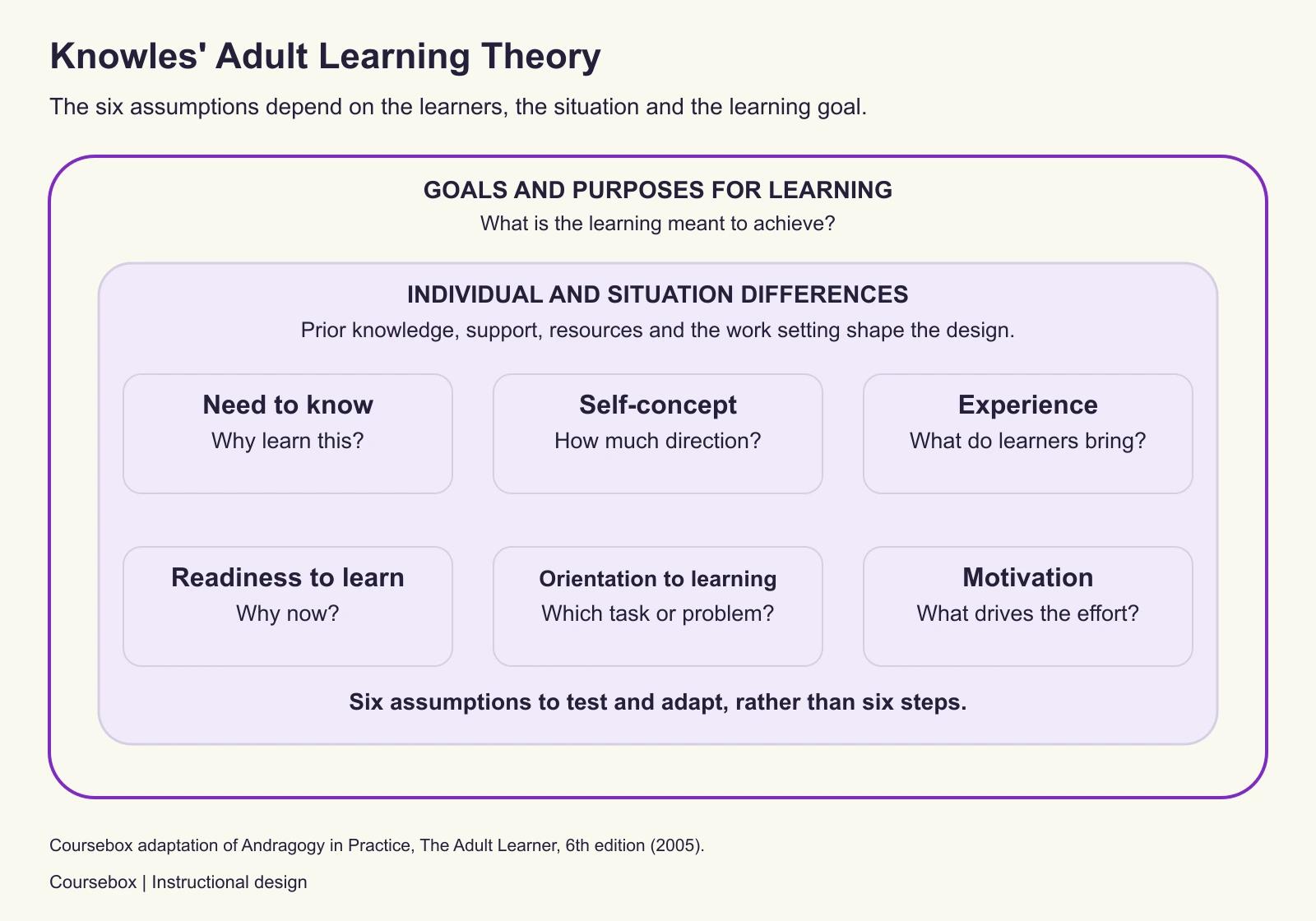
The six assumptions are not steps, and a course does not have to satisfy each one to the same degree. In the conclusion to his 1984 casebook of 36 applications, including a national accounting firm, a manufacturer and a bank, Knowles called the model "a system of elements that can be adopted or adapted in whole or in part" and added: "It is not an ideology that must be applied totally and without modification."
Holton and Swanson's Andragogy in Practice model places the six assumptions inside two outer rings, "goals and purposes for learning" and "individual and situation differences": the goal and the learners' situation decide how far each assumption applies.
In the technicians' course, the goal is traceable work orders from 3 March. The situation includes shift work, shared tablets and mixed tablet skills. So the course leans hard on what the technicians already know, the 3 March deadline and practice on real work orders. For the first app screens it uses plain demonstration for anyone who needs it, because on that content some technicians are, in Knowles' terms, dependent learners.
"Minimal direct instruction" is sometimes listed as an adult learning principle. Knowles never said that. His rule was that pedagogical strategies are appropriate whenever the pedagogical assumption is the realistic one, at any age. Adults who are new to the content, such as a technician who has never used a tablet, need clear demonstration and practice before they are handed control.
How to use adult learning theory to design a course
Knowles kept his assumptions about learners separate from what the designer does. In the 1980 edition he set out seven phases, for whole programmes and for single learning activities. Here they are in his words, applied to the technicians' course.
- "The establishment of a climate conducive to adult learning." The maintenance supervisor and two respected technicians introduce the change together and invite questions about the app.
- "The creation of an organizational structure for participative planning." A 20-minute session on each shift collects the jobs technicians expect to be awkward to record. Those become the exceptions practice.
- "The diagnosis of needs for learning." The self-check on tablets, QR scanning and typing notes, plus a look at which paper fields are most often left blank. A training needs analysis does the same job at a larger scale.
- "The formulation of directions of learning (objectives)." Close a work order correctly in the app from 3 March; handle no signal, an unlisted part and a stoppage over 30 minutes; know who to ask.
- "The development of a design of activities." The paper-to-app mapping, conveyor jam practice, the awkward cases, the question about the technician's own week and the second work order.
- "The operation of the activities." A self-paced course in the fortnight before cut-over, then buddy pairs on every shift in the first week.
- "The rediagnosis of needs for learning (evaluation)." Two weeks after cut-over, the planner reviews app records for missing parts and fault codes, and the gaps become a short follow-up. That is the behaviour level of Kirkpatrick's evaluation model, which a course quiz cannot reach.
I found no study testing whether following these phases improves results. Treat them as a planning sequence, not a guarantee, and remember that they depend on the people running them. Farmer field schools show why.

Case study: Farmer field schools in 90 countries
Farmer field schools began with the UN Food and Agriculture Organization in Indonesia in the 1980s, to teach rice farmers integrated pest management in place of heavy pesticide use. By 2014 they had been run in 90 countries, reaching an estimated 10 to 15 million farmers.
- What they did: Groups of farmers meet in a field over a growing season with a facilitator instead of a lecturer. They observe, run small experiments and decide together, using what the review describes as "participatory 'discovery-based' learning based on adult education principles".
- Evidence and result: Waddington and colleagues' 2014 Campbell systematic review pooled the 15 of 92 evaluations it rated at medium risk of bias (none was rated low). Participants used 23% less pesticide (8 studies) and had 13% higher yields (11 studies) than comparison farmers. In programmes scaled up nationwide, though, the review found "no evidence of effects on outcomes over the longer term".
- Limitation: No study had a low risk of bias, most gains came from short pilot programmes, and the schools follow adult education principles in general, not Knowles by name. The authors trace the scale-up failure partly to "problems in recruiting and training appropriate facilitators at scale".
- Lesson: Pilot programmes reported measurable gains, but national-scale evaluations did not show the same sustained benefits. Facilitator recruitment and training were reported barriers, rather than a demonstrated sole cause of the difference. An adult learning design is only as good as the people who run it, so budget for facilitation as well as content.
The technicians' course plan
The session lengths and the two-week review are choices for this hypothetical plant, not rules from Knowles.
| Knowles' phase | What it means | In the technicians' course | Evidence it happened |
|---|---|---|---|
| Climate | Learners feel respected and free to ask questions | Supervisor and two senior technicians introduce the change together | Questions from the briefing are logged and answered |
| Participative planning | Learners help shape the programme | Technicians list jobs they expect to be awkward to record | The exceptions practice uses their list |
| Diagnosis | Learners and designer find the gaps | Self-check on tablets, scanning and typing notes | Each technician knows which parts to skim |
| Objectives | Directions agreed from the diagnosis | Close a work order correctly in the app from 3 March | The objective is stated on the first page |
| Design of activities | Activities chosen to meet the objectives | Field mapping, conveyor jam practice, awkward cases, a second work order | Every activity uses the supplied work orders or the technicians' own jobs |
| Operation | Running the activities | Self-paced course before cut-over, then buddy pairs on shift | Every shift has a buddy pair in the first week |
| Rediagnosis | Checking what was learned and what is still needed | Review two weeks of app records for missing parts and fault codes | Gaps feed a short follow-up |
Plan a course for experienced staff with Knowles' six assumptions as questions and his seven design phases as a plan, with the maintenance technicians' course filled in and blank pages for your own. An adaptation, with no scores. Editable Word file, no email required.
The learning contract
Knowles' best-known practical tool is the learning contract, from Self-Directed Learning (1975). It puts one person's plan on a page in four columns: "1. Learning Objectives; 2. Learning Resources and Strategies; 3. Evidence of Accomplishment; and 4. Criteria and Means of Validating".
A course covers what everyone needs. A contract covers what one person still needs, in their own words. Here is one technician's contract for the first two weeks after cut-over.
| Learning objective | Resources and strategies | Evidence of accomplishment | Criteria and means of validating |
|---|---|---|---|
| Close a work order in the app with asset, fault code, times, parts and note | The course practice orders and a buddy shift with a technician confident on the tablet | Three real work orders closed in the app in the first week | The supervisor checks the three records against the plant's work-order fields |
| Record a part that is not in the app's list | The awkward-cases page and a call to the storeroom | One order with an unlisted part recorded | The storeroom confirms the part can be traced from the record |
| Close a job with more than 30 minutes of downtime | The motor overheating practice order and the tablet camera | One long-downtime order with a photo attached | The planner confirms the photo and the times on the record |
What course briefs leave out
To see whether people brief courses with these assumptions in mind, I looked at course requests typed into Coursebox in the 90 days to 7 October 2026: one per person, from English-language browsers, with no uploaded file. Of 266 prompts, 104 were course requests. Two independent passes with an AI model classified each request against written definitions of Knowles' assumptions, and every positive call was then re-read against the request's own words. Borderline calls were included, so these figures are classification estimates. Checking positive calls does not establish an upper bound or find every missed request. Many prompts are also cut off at 1,500 characters in the export, so a long brief may have asked for more than we could see.
About 6 of the 104 requests described learners who already knew the job, such as senior managers or practising clinicians, and only one asked the course to use that experience. Only 2 asked the course to explain why learners needed it. Nine tied the course to a change in the learner's work, and 6 of those were new-hire onboarding. None was about existing staff moving to a new system or process, which is the situation in the technicians' example.
The sample is small, it covers requests rather than finished courses, and people may value experience without writing it into a prompt. A clear brief gives the designer or course builder a better starting point, alongside supplied resources, questions and review. If a course is for experienced staff, say so in the brief, say why the change is happening, and ask for activities that use their own jobs.
The other adult learning theories, and when to use each
Sharan Merriam called andragogy and self-directed learning the two "pillars" of adult learning theory, and Mezirow's learning through perspective transformation is usually named alongside them. Experiential learning is the common fourth.
Self-directed learning
Allen Tough's interviews with adults in Ontario in the early 1970s found that most of their learning happened outside courses, in projects they planned themselves.
Tough's The Adult's Learning Projects counted a project as learning episodes adding up to at least seven hours. Knowles' 1975 definition of self-directed learning added that it "usually takes place in association with various kinds of helpers", such as teachers, mentors and peers. It does not mean learning alone.
Stephen Brookfield, in a 1985 critical review of the research, questioned "the methodological rigor of the studies" and their reliance on middle-class samples. Self-direction also needs time and resources that not every employee has. For the technicians, self-direction fits the period after cut-over, when each person knows their own gaps, and a learning contract gives that period a structure.
Perspective transformation
Jack Mezirow, a professor of adult education, described perspective transformation in a 1978 article based on women returning to education through US community college programmes. The core idea is "becoming aware that one is caught in one's own history and is reliving it", followed by a change in how a person sees themselves and their relationships. In 1991 he described ten phases that transformation tends to follow in some variation, starting with "A disorienting dilemma" and ending in a reintegration into one's life. Treat them as a description of what often happens, not a fixed sequence.
Critics such as Tennant have argued that Mezirow's examples sometimes describe ordinary, socially expected development rather than real transformation. For a course designer, the theory is useful when the training asks people to change a role or a belief, such as a technician becoming a supervisor of former peers. The app course is mostly a skill change, so it needs less.
Experiential learning
David Kolb's 1984 cycle describes learning as moving between concrete experience, reflective observation, abstract conceptualisation and active experimentation. It is a practical shape for any course built on practice and review. Our guide to Kolb's experiential learning theory covers the cycle in detail. In the technicians' course, the cycle is the practice order, the feedback on what was missed, the rule it teaches and the second order.
Learning styles and the learning pyramid often travel with adult learning theory, and neither holds up. A 2008 review by Pashler and colleagues found "no adequate evidence base to justify incorporating learning-styles assessments into general educational practice", adults included, so do not sort staff into visual or hands-on learners. The pyramid's figures, such as remembering 10% of what you read and 90% of what you teach, have no research behind them: a review in Education found "No specific credible research was uncovered to support the pyramid".
The Pashler review and Lalley and Miller's learning pyramid review give the detail. The table compares the four theories as design lenses; it is my synthesis, not a ranking.
| Theory | Best for | Weak spot | Use it when |
|---|---|---|---|
| Andragogy (Knowles) | Courses for staff who bring experience and a clear job need | Assumptions rather than tested findings, with thin outcome evidence | Learners know the job and the course serves a change in it |
| Self-directed learning (Tough, Knowles) | Learning that people plan and drive themselves, with helpers | Assumes time, resources and readiness to plan | Learners can set their own goals and you can supply resources and check-ins |
| Perspective transformation (Mezirow) | Changes of role, belief or perspective | Slow and personal, and hard to schedule or assess | The course asks people to rethink how they see their work or role |
| Experiential learning (Kolb) | Designing cycles of doing, reflecting, concluding and trying again | Describes how learning happens, not who the learners are | The skill is learned through practice and review |
Criticisms and evidence: does andragogy work?
Knowles rejected the question of universal superiority. Asked what research showed that andragogy was better than the pedagogical model, his reply in the 1980 edition begins "That is not the question". He saw the assumptions as something to test for different learners in different situations. His critics have mostly agreed that they have not been tested well:
- No tested theory yet. Pratt wrote in 1993, as quoted in Taylor and Kroth's 2009 review, that "We cannot say, with any confidence, that andragogy has been tested and found to be, as so many have hoped, either the basis for a theory of adult learning or a unifying concept for adult education".
- Inconclusive studies. Rachal's 2002 review of the empirical research called it "both inconclusive and beset by considerable variability in definition", and proposed seven criteria for a fair test, including performance-based assessment.
- Mixed early trials. In the studies Davenport summarised in his 1987 paper on the "andragogy morass", Rosenblum and Darkenwald found in 1983 that involving learners in planning their course "did not result in meaningful differences in either learning or satisfaction". Conti found in 1985 that teacher-centred teaching did better in exam-preparation classes and learner-centred teaching did better in basic skills classes, which turned the question into "when is each style most appropriate".
- A randomised null result. In a 2010 dissertation, 52 nonprofit staff were randomly assigned to andragogical or pedagogical online modules on grant writing. With at least partial data on 33 of them, there were no significant differences in reaction, achievement, grant-writing performance or completion. Only the abstract was available to me.
- Self-direction as a hope. Hartree argued in 1984 that the self-directing adult is "often more a pious hope than a description of his or her learning", which makes that assumption a prescription rather than a description.
- The social context is missing. Merriam's 2001 review notes that andragogy and self-directed learning have both been criticised for focusing on the individual learner and ignoring the social and historical setting. At work, that setting includes who gets time to learn and who does not.
I could not find a randomised test of andragogy at work, outside health care, that measured performance on the job. The strongest workplace comparison I found is the New Jersey police study, which compared two whole academies.
The balanced current view is that andragogy is a useful design lens rather than a proven method. A 2024 review by St. Clair concludes that "andragogy is a useful model for designing instruction in numerous fields of practice". That is how I use it: to ask better questions about who the learners are and what they need.
Using adult learning theory with an AI course builder
On 8 October 2026 I briefed Coursebox to build the technicians' course. Coursebox is our product, so weigh my account with that in mind. The brief described the learners as experienced technicians, told the builder not to explain maintenance or open with definitions, and gave it the plant's facts: the reasons for the change, the work-order fields, the photo rule, the conveyor jam work order, the fault-code list and the cut-over plan. It asked for a self-check with skim advice, a paper-to-app mapping, practice on the conveyor jam order, awkward cases, an open-text question about an awkward job from the technician's own last week, a wrap-up on who to ask and a final assessment on a second work order.
Most of the outline followed my brief based on Knowles. It opened with the changeover reasons in a "Before You Start" section, with no definitions. A "Check Your Starting Point" page came next, then "Match Each Work-Order Field", which mapped each paper field to the app. Practice used the supplied conveyor jam work order, a page on awkward cases covered the exceptions, and the course ended with an assessment on a second work order, the overheating motor.
The main gap was the open-text question asking technicians about an awkward job from their own last week. That question is the only part where the technicians' own jobs are the material, which is what the third assumption asks for.
One follow-up message fixed it. I asked for that reflection, and for the wrap-up from my brief. The revised outline showed "An awkward job from your week" as an open-text reflection after the awkward-cases page, and a "Who to ask in the first two weeks" page. It came to about 45 minutes across 5 sections and 9 pages.
I checked the outline only, not the rendered pages. Whether the self-check really tells technicians what they can skim, and whether the generated questions are decisions about work orders rather than recall, still needs checking in the generated course. Only real work orders after a cut-over would show whether technicians close them correctly. For what each technician still needs after the course, a learning contract does the planning.
Plan what one person still needs to learn in Knowles' four columns: objectives, resources and strategies, evidence and how it will be checked, with a maintenance technician's contract filled in and a blank contract with review dates. An adaptation, with no scores. Editable Word file, no email required.
Putting adult learning theory to work
Use adult learning theory when you build for people who already know their jobs and face a change in them, such as a new system, a new process or a promotion. Treat the assumptions as questions to check for each group and each piece of content, not as a rule about age.
Before you build your next course for experienced staff, write one paragraph for the brief that answers four questions: why the change is happening in the learners' own terms, what they already know, what real task they must do and by when, and how you will check real work afterwards, with a date and an owner. That check shows whether technicians apply the new procedure. Comparing it with a baseline and noting other changes gives you a better basis for judging the course's contribution.
Frequently Asked Questions
Adult learning theory is the set of ideas about how adults learn, best known through Malcolm Knowles' andragogy, which assumes adults need to know why they are learning, direct themselves, use their experience and learn from real problems they face now. The term also covers self-directed learning, learning through perspective transformation and experiential learning.
Knowles' six assumptions are the need to know, self-concept, experience, readiness to learn, orientation to learning and motivation. Four date from his original model, motivation was added in 1984 and the need to know by 1990. Later co-authors of The Adult Learner call them "core adult learning principles".
Andragogy, self-directed learning and learning through perspective transformation are the three most often grouped as the core of adult learning theory, following Sharan Merriam's description of andragogy and self-directed learning as its pillars. Experiential learning, best known through David Kolb, is a common fourth.
Five is Knowles' list between 1984 and 1990, before the need to know was added. Other counts come from later lists by other writers, such as a four-point summary usually traced to Kearsley, Lieb's six and Jane Vella's 12 principles of dialogue education. None of these other lists is Knowles' own.
Critics say andragogy is a set of assumptions rather than a tested theory, that research on its effects is inconclusive and defines it inconsistently, that it treats self-direction as a fact when it is often a hope, and that it ignores social context.
Carolina Martin
Carolina is a highly experienced learning designer with tech start-up experience. She is based in Sydney and previously designed courses alongside Coursebox founder Travis in a previous job. She is passionate about delivering engaging learning experiences and brings the same perspective to customer experience too. She manages our customer support documentation and product testing processes.

