

Mastery Learning: Bloom's Method and How to Use It at Work
Mastery learning explained for workplace training: Bloom's loop of check, corrective and second check, real cases, costs and two free Word templates.

Mastery learning is a way of teaching in which each unit has a standard set in advance, and anyone who misses it gets a different explanation and a second check with new questions before moving on to the next unit.
- Bloom's 1968 paper treats the time each person needs as the thing that varies, while the standard everyone reaches stays fixed.
- A pass mark plus a retake of the same quiz is not mastery learning, because nobody is taught differently after the miss.
- Thomas Guskey puts the cost of that extra teaching at about 10 to 20% more time on the first units of a course.
- Mastery learning pays back where a mistake is costly and a fixed amount of practice would leave many people below the standard, such as safety-critical steps in onboarding.
Five questions, about a minute. Answer for one course where people must reach a standard before they work alone, such as onboarding for a safety-critical task. This is an unvalidated planning aid. The total organises suggestions; it does not assess competence or prove that the method will work. Review each answer.

Go from storyboard to an interactive course in minutes
Picture a new dispatcher at a road freight depot in their first month. They fail the dangerous goods quiz on which loads can travel together, retake the same eight questions ten minutes later and pass, because they now remember the answers. Their record says trained. Nobody has shown them why the pairing they got wrong is a problem, and the next mixed load is theirs to plan.
I'm Alex, cofounder and COO of Coursebox. I manage most of our Perth team, and I hire with simulation-style interviews where a colleague and I play a customer while the candidate handles the call, because hiring for a small team teaches you to test for the behaviour rather than believe the label. Mastery learning is that idea applied to a course. Coursebox makes AI software for employee training, including quizzes with pass grades, so I have a commercial interest in how teams set standards. This guide explains what Benjamin Bloom proposed, walks one hypothetical dispatcher course through each element, looks at real studies of what it achieved and what it cost, and includes two editable Word templates.
What is mastery learning?
Mastery learning is a way of teaching in which each unit has a standard set in advance, and anyone who misses it gets a different explanation and a second check with new questions before moving on to the next unit.
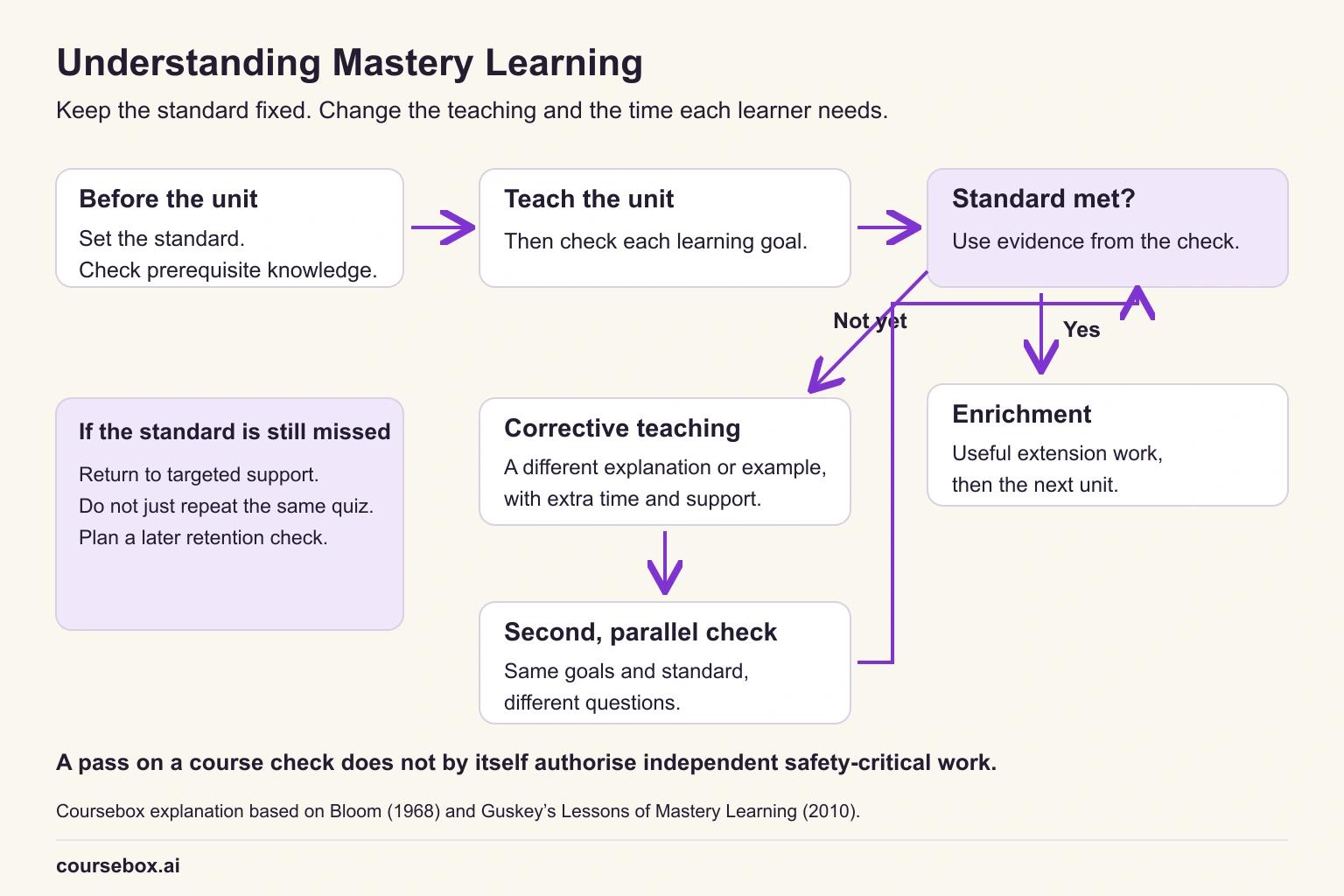
View the full-size mastery learning diagram
Benjamin Bloom set out the approach in a 1968 paper called Learning for Mastery. He started from an objection to grading on a curve: "There is nothing sacred about the normal curve. It is the distribution most appropriate to chance and random activity." If the course is designed well, he argued, most people can reach a high standard, and what differs between them is the time and kind of help they need. He also named the two conditions without which none of it works: "We must be able to define what we mean by mastery and we must be able to collect the necessary evidence to establish whether or not a student has achieved it."
The approach was written for schools and universities, and most later research comes from colleges and the health professions. It applies to any course where a skill can be broken into units, each unit can be checked, and someone has time to help those who miss. Thomas Guskey, professor emeritus at the University of Kentucky, who has written on mastery learning for decades, lists the parts in his 2010 article Lessons of Mastery Learning: a diagnostic pre-assessment, high-quality first instruction, regular formative checks, corrective instruction, a second parallel check and enrichment for those who pass first time. Here the pre-assessment sits inside the first element, which leaves five rows in the table.
| Element | What Bloom and Guskey describe | The question it asks of your course | What it looks like at work |
|---|---|---|---|
| Units and a standard | Short units, each with a level of performance set before teaching | What must someone be able to do, and how well, before moving on? | Every load-mixing decision right before a dispatcher plans loads alone |
| First teaching and a formative check | A diagnostic progress check at the end of each unit, used to find what was missed | Which part did each person get wrong? | A short check scored item by item, not a single percentage |
| Correctives | Help that is different from the first teaching, with extra time | What will someone who missed it get that they did not get the first time? | A worked example of the exact error and a few minutes with a supervisor |
| A second, parallel check | The same goals tested with different questions | Will the second attempt show learning or remembered answers? | New consignments that test the same rules |
| Enrichment | Useful extension work for those who passed first time | What do people who already meet the standard do meanwhile? | Building a hard case for the next intake |
Mastery learning is not Bloom's taxonomy. The taxonomy classifies the kind of thinking a learning objective asks for; mastery learning is a teaching and checking loop that can be used with objectives at any level. For writing the objectives themselves, use Bloom's taxonomy in course design.
What is the purpose of mastery learning?
The purpose is to make the standard fixed and the time flexible. A conventional course does the reverse: everyone gets the same hours, and the result spreads out across the grade range. Bloom built on John Carroll's 1963 model of school learning, which treated aptitude as the time a person needs to learn a task rather than a ceiling on what they can learn. Bloom made the time allowed for learning the main variable a course can change.
For a workplace course, that changes what a completion record means. A pass should say that this person met the stated standard on these course checks. A decision to let them work independently also needs suitable evidence of performance at work. The price is that some people take longer, and someone has to plan for that time.
Every measured case of mastery learning with employees that I could find comes from health care; I found no measured case from an office, retail, manufacturing or technology team, so the cases below are hospital and care staff.
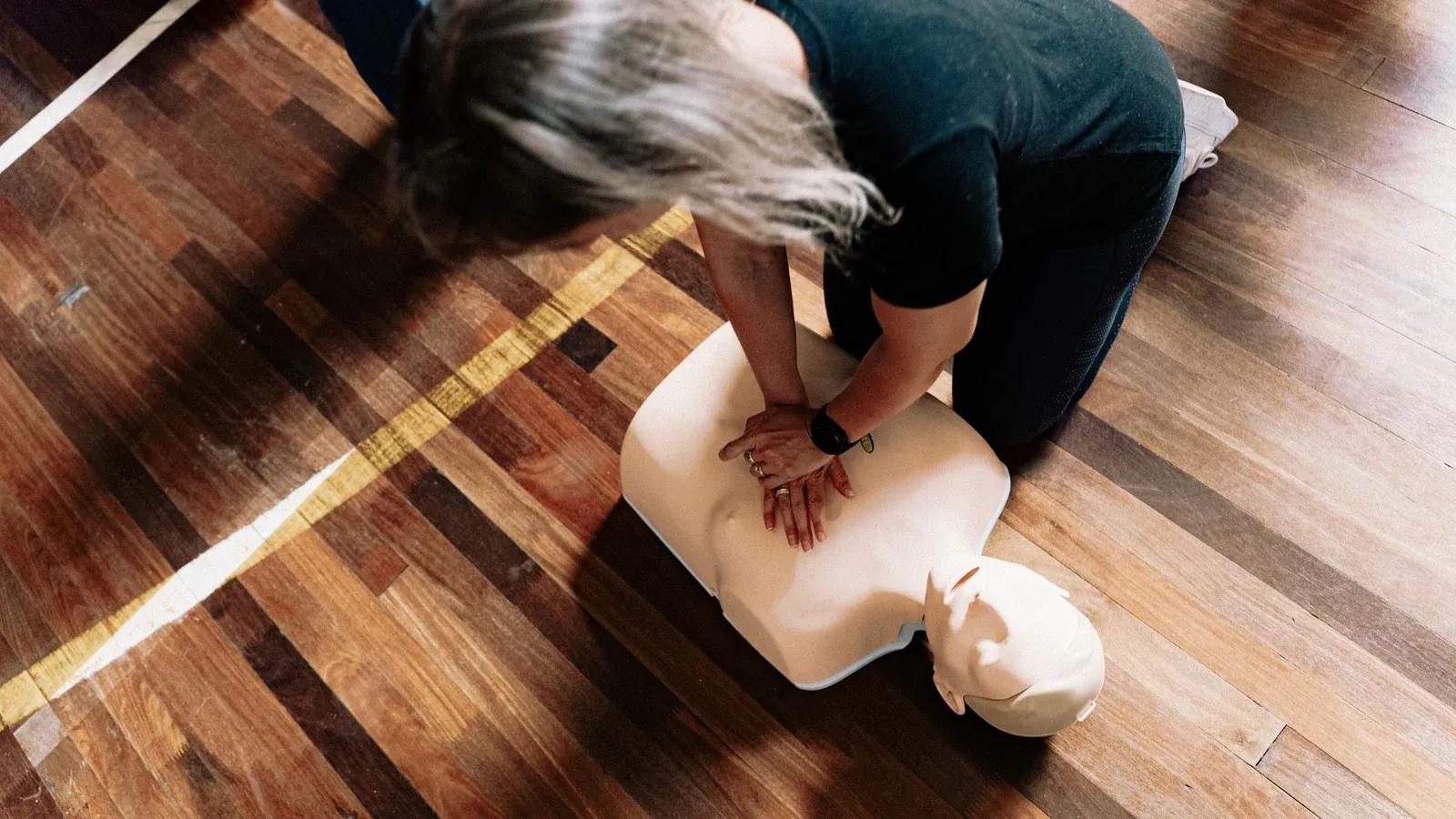
Case study: Hospital office staff learning CPR in Thailand
Thammasat University Hospital wanted to know whether its non-clinical staff, such as accounting officers, inventory clerks and procurement officers, kept CPR skills better if they practised to a mastery threshold.
- What they did: after an 8-minute video, one group practised on feedback manikins for up to five 1-minute sessions; the mastery group practised until they scored more than 90%. They needed a mean of 2.9 attempts, and 4 of 81 reached the threshold first time.
- Evidence and result: of 163 staff randomised, 71 per group were tested at 6 months. There was no significant difference in CPR skill or knowledge, the team reported in BMJ Open. Both groups had already exceeded the benchmark straight after training.
- Limitation: one hospital, a manikin test rather than a real arrest, a small difference in practice time between groups and a per-protocol analysis.
- Lesson: a mastery threshold adds something only when a fixed practice would leave people short of it. When a short, well-designed practice already brings the group above the benchmark, the extra loop can cost time without a measurable gain.
Bloom's paper and Guskey's guide: which to read
Carroll's 1963 model came first, Bloom's paper turned it into a teaching method in 1968, and Fred Keller published his own self-paced approach, the Personalized System of Instruction, the same year. Three sources are worth your time today:
- 1968: Bloom's Learning for Mastery, the original paper, free from ERIC. It gives the reasoning, the role of formative tests and his own course results.
- 2010: Guskey's Lessons of Mastery Learning in Educational Leadership, the clearest current statement of the elements.
- 2022: A Practical Review of Mastery Learning by Winget and Persky, which adds advice on standard setting, feedback and workload for professional courses.
If you only read one, read Guskey's article. It is short, and it is the source for the corrective and parallel-check rules.
How mastery learning works, step by step through one course
Here is the hypothetical course: a Perth road freight company onboards new depot dispatchers, and in their first month they learn to accept dangerous goods consignments. The course has three units that build on each other:
- Unit 1: read the class, UN number and packing group from the shipper's paperwork.
- Unit 2: decide which items can and cannot travel together on a mixed load.
- Unit 3: choose the placards and complete the transport document.
In this hypothetical depot, a supervisor verifies the load plan, paperwork and placards before dispatch. The course focuses on unit 2 because later decisions depend on getting the load plan right. The checks below support training; they do not replace that operational verification. The rules themselves come from the Australian Dangerous Goods Code and the company's own procedure, which the procedure owner supplies; this example states none of them.
1. Units and a standard set in advance
Bloom suggested breaking a course into "smaller units of learning", each of about "a week or two of learning activity" in a school course, and setting the standard before any teaching starts. In a workplace course the units are usually much shorter, but the decision is the same: what level of performance counts as done? Winget and Persky recommend a standard no lower than 80% and no higher than 90% "unless the task is so critical that it needs to be demonstrated at a high level", such as patient safety. Guskey also recommends a diagnostic pre-assessment, so that gaps in prerequisite knowledge are found before the unit starts.
- Sample goal: given a list of consignments for one truck, the dispatcher decides which items can travel together, with every decision right.
- How to assess it: a set of consignment lists marked against the segregation chart in the depot procedure. The sample requires every assessed segregation decision to be correct. The procedure owner must approve the tasks and criteria; a quiz percentage alone does not establish safe performance.
- In the course: units 1 and 3 also require every safety-critical criterion to be met. A second checker is an additional control, not a reason to accept an unsafe error. A short check on reading a dangerous goods label opens unit 1, so a supervisor can see who needs the basics first.
2. First teaching and a formative check
Bloom borrowed the term formative evaluation from Michael Scriven for what he called "diagnostic-progress tests" at the end of each unit. Their job is to show each person, and the trainer, which part they missed. They do not count toward a final grade; their job is to decide who gets a corrective and who moves on. A formative check used this way is a tool for deciding what to teach next, not a hurdle.
- Sample goal: the dispatcher applies the segregation chart to eight pairs of products from real shippers' paperwork.
- How to assess it: each pair is scored separately, so the result names the pairings missed rather than giving a single percentage.
- In the course: a short explainer using photos of the labels dispatchers will see, a worked example of the chart in use, then the check.
3. Correctives that differ from the first teaching
Corrective teaching is what separates mastery learning from a plain retake. Guskey writes that corrective instruction is not reteaching, which often means restating the original explanations "louder and more slowly". Instead, it "must be qualitatively different from the initial instruction, offering students an alternative approach and additional time to learn." Winget and Persky make the same point from the learner's side: if someone first learned a topic by reading, "asking them to correct their knowledge with rereading is pointless."
- Sample goal: a dispatcher who missed a pairing can explain why those two products are kept apart and find the rule in the chart.
- How to assess it: the depot supervisor asks them to talk through the missed pairing at the loading bay.
- In the course: a worked example of the exact pairing they got wrong, a different one for each type of error, and a two-minute walkthrough with the supervisor. The original explainer is not shown again.

Case study: An online course with a mastery-style loop for nurse aides in the United States
Nurse aides in long-term care are the staff most exposed to aggression from residents, and they get little effective training on it. Researchers built a self-paced online course to teach them a three-step approach to these situations.
- What they did: aides watched modelled video scenes, then answered questions about new scenes. Wrong answers came with an explanation of why they were wrong, and aides were retested on those scenes until they answered correctly.
- Evidence and result: 62 of 72 randomised aides completed both assessments. The trained group improved on knowledge, attitudes, self-efficacy and intention the next working day compared with the control group, the team reported in JAMDA. The lowest-rated part of the course was its locked, linear "tunnel design".
- Limitation: the retest repeated the same scenes, so it shows the corrective step, not a parallel check. Everything was measured the next day by questionnaire and video questions, and nobody observed the aides at work.
- Lesson: an explanation of the wrong answer fits an online course for frontline staff, but learners disliked being locked in. Lock only the units that are true prerequisites.
4. A second, parallel check
After the corrective, people take a second check that, in Guskey's words, "addresses the same learning goals of the unit but includes somewhat different problems, questions, or prompts." It shows whether the corrective worked, and it gives the learner a success to point to. The time this takes cannot be fixed in advance. In a Mayo Clinic trial, surgical residents trained on a simulator until they reached expert performance needed a median of 16 simulated repairs, with a range of 7 to 27.
- Sample goal: the same segregation decisions as the first check.
- How to assess it: new consignment lists with different products that raise the same pairings, at the same 100% standard.
- In the course: at least three versions of the unit 2 check, drawn from a parallel item bank. A dispatcher who misses twice sits with the supervisor before a third attempt.
If the second attempt repeats the first attempt's questions, a pass can mean the person remembered which options were right. Write the second check with different cases that test the same rule, and keep the standard the same.
5. Enrichment for those who pass first time
While some people work through correctives, others have already met the standard. Guskey says that leaving them to bide their time or do busywork would be "highly inappropriate"; they need extension work that is useful in its own right.
- Sample goal: the dispatcher builds one hard consignment, such as a mixed load where two items look compatible but are not.
- How to assess it: the supervisor checks the case and its answer against the chart before it goes into the item bank.
- In the course: an optional page inviting first-time passers to add a case for the next intake, credited to them.
In this course, unit 3 stays locked until unit 2 is passed, because placards depend on the load. A learning path can hold the few locks the content needs.
How the elements relate
The elements form a loop that repeats for each unit, not five stages that a whole course passes through once. Everyone gets the first teaching and the formative check. Only those who miss go through the corrective and the second check, and only those who pass first time do the enrichment. Bloom tied the frequency of checks to the structure of the content: "Where some of the learning units are basic and prerequisite for other units of the course, the tests should be frequent enough to insure thorough mastery of such learning material." In the dispatcher course, unit 2 gets the tightest loop because unit 3 depends on it.
Grading follows the same logic. Winget and Persky, drawing on Guskey, describe formative checks as ungraded and grading as based on the final check against a predetermined standard, not on comparison with other learners. Each person is to be "given all the help they need to learn."
Reaching the standard once is not the end. Winget and Persky point to evidence that courses wanting long-term retention "should avoid spending time and effort on learning to a high initial criterion (greater than 90%) but should instead devote those resources to subsequent relearning sessions." For the dispatchers, that means an 8-week re-check on unit 2 with new consignments, planned with the same care as the first check. Plan those later sessions around the forgetting curve.

Case study: Second-year hospital nurses in Akita, Japan
At one Japanese hospital, almost half of nurses in their second year reported struggling to care for patients with acute chest pain. The education team built a blended mastery course for them.
- What they did: nurses completed asynchronous e-learning, then hands-on simulation with assessment and feedback until they reached the standard.
- Evidence and result: 37 second-year nurses scored higher on performance and self-efficacy after the course and again 5 months later than before it, according to the study abstract in the Japan Journal of Nursing Science.
- Limitation: one cohort with no control group, so the gain cannot be credited to the method, and the patients were simulated.
- Lesson: online teaching first, then an in-person check to the standard, is a realistic shape for workplace mastery learning, and the 5-month re-test shows whether the standard held.
How to use mastery learning to design a workplace course
The workflow follows Guskey's elements, adapted for a course with employees:
- Split the course into units and mark which ones are prerequisites for later units.
- Set a standard for each unit before writing any content, and write down why: the cost of a mistake and whether anything later in the work catches it.
- Write the first check, scored item by item so it names what each person missed.
- Write a corrective for each likely error that teaches it a different way from the first teaching.
- Write a second check with different questions on the same goals, at the same standard.
- Plan the extension work for people who pass first time.
- Decide who helps someone who misses the second check, and when.
- Book a later re-check on the units where a mistake is costly.
The mastery unit planner, filled in for the dispatchers
The planner puts each unit on one row. The standards, checks and correctives here belong to the hypothetical depot course; the procedure owner sets the real ones from the current rules.
| Unit | Standard and why | First check | If missed | Second check | Extension |
|---|---|---|---|---|---|
| 1. Read class, UN number and packing group | Every safety-critical criterion met; supervisor verifies the paperwork before dispatch | Six shippers' documents, each field scored | Annotated example of the field misread | Six different documents | None needed |
| 2. Decide what can travel together | Every assessed segregation decision correct; supervisor verifies the load plan before dispatch | Eight product pairs from real paperwork | Worked example of the missed pairing and a supervisor walkthrough | Eight new pairs raising the same rules | Build a hard case for the next intake |
| 3. Choose placards and complete the transport document | Every safety-critical criterion met; supervisor verifies placards and documents before dispatch | Two completed loads to placard and document | Side-by-side of a correct and an incorrect document | Two different loads | Review a colleague's document |
A Word planner for setting each unit's standard and the reason for it, writing the first check, the corrective, the second check and the extension work. Includes the filled depot dispatcher example and a blank version.
Feedback that tells someone what to fix
A score alone does not start a corrective. Winget and Persky put it plainly: "General feedback, for example, a score in percentage, is not helpful in diagnosing individual learning difficulties or prescribing remediation procedures." Three habits make the feedback usable:
- Score each item or decision separately, and show the learner which ones they missed.
- Attach the corrective to the error, so a missed pairing leads to the worked example for that pairing.
- Use peers where it helps. Bloom found that small groups of two or three meeting to review their formative results and "help each other overcome the difficulties" worked well in his courses. In a depot, that can be two new dispatchers going through their missed pairings together before the supervisor's walkthrough.
What are the benefits of mastery learning?
The evidence is strongest on test performance and simulated skills, and weaker on long-term results at work.
- Bloom's own course. In his University of Chicago course on test theory, about 20% of students earned an A in 1965. In 1966, after the strategy was used, 80% reached the same level on a parallel examination. That is one course compared across two years with no control group.
- Controlled studies in schools and colleges. A 1990 meta-analysis by Kulik and colleagues found positive effects on examination performance, stronger for the weaker students in a class, and the programmes may increase time spent on the work.
- Health professions training. Cook and colleagues' 2013 meta-analysis of 82 studies of mastery learning with simulation found large skill gains compared with no training. Compared with simulation training without a mastery standard, the 3 studies that tested it found better skills, but the mastery version took more time.
For an employer, the practical benefit is a record that means something. When a pass requires the standard on every unit, a manager knows the person met it on the checks that matter for that decision, such as letting a dispatcher plan loads alone. The first live loads still need watching.
What workplace course requests leave out
I looked at first requests typed into the Coursebox course generator between 20 May and 15 November 2026, one per person, to see how often people building workplace training ask for the corrective half of the loop. An AI model classified a sample of 450 prompts, and 251 were course requests. After I removed duplicates and the prefilled example prompts that many people send unchanged, 205 independent requests were left. I read every hit by hand. Of those, 24 were workplace course requests that asked for a quiz or check.
Three of those requests set a pass standard or blocked progress until it was met, such as a policy course requiring 100% to move to the next section. One asked for a randomised question bank for the final assessment, which comes close to a second, different check. None said what someone who missed should get before trying again. The pool is small, and a request describes the course to be built, not the settings someone may add later in an LMS. Even so, it suggests that the corrective is the part a course designer has to add, and often the second check too.
Support threads point the same way. A search of Coursebox support threads for pass marks, retakes and mastery returned 155 threads. 27 were about this part of course design: 12 about retakes and 15 about pass grades and locking progress. One customer asked for approved explanations to appear after a pass or fail and before a retry, which is a corrective in all but name. Another had set a pass mark of 1% when they meant 100%, which shows why the standard deserves a second look before launch.
Mastery learning vs competency-based training and adaptive learning
The three are related and often confused. Mastery learning is a teaching loop inside one course. Competency-based training assesses whether someone can perform the units of a whole qualification or role to an industry standard. Adaptive learning routes different learners to different content based on evidence of what they know.
| Question | Mastery learning | Competency-based training | Adaptive learning |
|---|---|---|---|
| What it is | A loop of check, corrective and second check for each unit | Assessment of whole units of competency against an industry or role standard | Routing each learner to content based on what they already show they know |
| Best for | Units where a mistake is costly and a fixed amount of practice would leave many people below the standard | Qualifications, licences and role readiness | Mixed groups where some people already know part of the course |
| Weak spot | Takes extra time and needs correctives and second checks written in advance | Says little about how each unit is taught | Needs reliable checks to route people; weak checks send people the wrong way |
| Use it when | You can define the standard per unit and someone has time to help those who miss | An external standard defines what competent means | Experience varies widely and skipping known content saves real time |
The mastery loop sits comfortably inside the other two. A competency-based programme can use it to teach each unit, and an adaptive course can use its corrective step for learners who miss a check. If you are still writing the objectives and the tests that measure them, start with criterion-referenced instruction.
Limitations of mastery learning
- It costs time. Guskey reports that corrective activities typically add about 10 to 20 percent more time to the first learning units, citing work by Block, Efthim and Burns. Cook's review found the same trade-off in simulation training.
- Effects shrink on broader measures. Robert Slavin's 1987 review found essentially no evidence that group-based mastery learning improved standardised achievement tests, while effects on tests written by the researchers were positive but moderate, with little evidence they lasted.
- Busy staff may not finish. In a Danish simulation-based mastery course in flexible bronchoscopy, trainees who answered a survey named being too busy as the main reason for not completing it.
- It may add little when a short practice already works. In the Thai CPR trial, both groups were above the benchmark straight after training, and there was no measurable difference at 6 months.
- It creates work. Winget and Persky note that the model needs feedback, multiple versions of assessments and tracking, "and with this comes the issue of workload."
A figure of 0.59 from "36 mastery learning studies" circulates in summaries of the research and is attributed to Kulik and colleagues' 1990 meta-analysis. That paper's own abstract reports a larger set of controlled evaluations and gives no 0.59 figure. Until the figure is traced, treat it as unverified and cite the 1990 abstract for what it says.
The cost is easiest to see in a study that counted it. In a Danish ultrasound course, Post and colleagues trained 24 participants on a simulator to a level set by experts, and 21 reached it.
The range is the useful part: individual trainees needed from 1 hour 20 minutes to 4 hours 30 minutes. Counting the development cost and spreading it over only one trainee raised the figure to USD 4,541 per trainee, falling to USD 719 at 50 trainees. Budget for the slowest learners, not the median, and expect the first intake to carry most of the build cost.
Using mastery learning with an AI course tool
I built the dispatcher course in Coursebox as an unpublished test. I asked for the three units, a 100% standard on unit 2 that locked unit 3, a corrective aimed at each learner's mistake, a second check with different questions and harder cases for first-time passers, and asked it to list what it could not build.
Up front, the builder said it could not enforce a lock between units or set completion rules from the chat, and it changed the outline so the learner, not the course, picks the route after a miss. It built 20 pages, 3 units and 4 quizzes. Unit 2 had a first check, a remediation page, a retry check with different questions and harder cases for first-time passers, so the content side of Bloom's loop was there. What it could not do was the machinery: lock unit 3, detect the specific mistake and send the learner to the matching explanation. Its workaround was honest: after a failed check, the learner picks the error they made and follows the explanation and worked example mapped to it.
In the unit 2 quiz, the page told learners to answer all 8 questions correctly, but the pass grade was 80%. The standard was in the words, not the setting. I changed the pass grade to 100%, saved it and reopened the quiz to confirm it held. Neither the quiz nor the course settings could lock one unit behind another. Prerequisites in Coursebox run from course to course, so the way to lock unit 3 is to make it a course of its own with unit 2's course as the prerequisite. I have not tested that end to end. The original test brief used 80% for units 1 and 3. That was a design error: a second checker does not justify accepting a missed safety-critical criterion. The planner here uses the corrected criteria and retains supervisor verification.
After any AI build, open each quiz's settings and compare the pass grade with what the page tells learners.
A Word sheet for writing two different questions for each goal, the error each one targets and the corrective it leads to, using the depot dispatcher course as the example. Includes a blank version.
Putting mastery learning to work
Mastery learning is worth its extra time where a missed step is costly and a fixed amount of practice would leave many people below the standard. It may add little where a short, well-designed practice already brings people above the benchmark. Pick the one unit in your course where a mistake would reach a customer, a vehicle or a patient. Set its standard and write down why, then write the corrective and the second check before you build anything else. A pass mark and a retake of the same quiz leave out the corrective, which is the step that gives someone who missed a different way to learn it.
Frequently Asked Questions
Mastery learning is a way of teaching in which each unit has a standard set in advance, and anyone who misses it gets a different explanation and a second check with new questions before moving on to the next unit. The time each person takes varies; the standard does not.
A freight company training new dispatchers on dangerous goods could require every load-mixing decision to be right before they plan loads alone. Anyone who misses a pairing gets a worked example of that pairing and a short walkthrough from a supervisor, then a new check with different consignments. People who pass first time build a hard case for the next intake.
The five levels usually listed are novice, advanced beginner, competent, proficient and expert, from the Dreyfus model of skill acquisition. That model describes how expertise develops over years of practice. It is a different idea from mastery learning, which is a teaching method for reaching a set standard on each unit of a course.
The theory, set out by Benjamin Bloom in 1968 from John Carroll's model of school learning, holds that most learners can reach a high standard if they get enough time and the right kind of help. Differences in aptitude show up mainly as differences in the time needed, not in the level that can be reached.
The method breaks a course into units with a standard for each. Learners take a formative check after each unit; those who miss get corrective teaching that differs from the first explanation, then a second check with different questions on the same goals. Those who pass first time do extension work.
Alex Hey
Alex Hey is a technical marketer with 10 years of hands-on growth and digital marketing experience. He cofounded Coursebox together with Travis Clapp who he met online when looking for a cofounder to build a globally impactful software product. He works in the Perth, Western Australia office as the COO. He built the world's first automated funnel for patient recruitment before building Coursebox. After launching Coursebox in mid 2023, he drove +400k organic sign ups for Coursebox. Alex leads the marketing and digital growth of Coursebox and works with the product development team bringing a passion for data-driven product decision and exceptional user experience. Alex is determined to build the world's easiest way to build the perfect course.

