

Microlearning Examples: 9 Worked Lessons and How to Choose
Nine microlearning examples written out end to end, plus how to choose the format from the job the learner has to do and set a follow-up schedule.

A microlearning example is a single short lesson built around one moment at work. Name the moment first. The format comes last.
- Sort by the job: recall, procedure, judgement, noticing, or changing a habit. Each one rules some formats out.
- For a procedure the job aid is the real deliverable, and the video is how you get it read. For a habit the prompt has to arrive at the moment, not in the learning system.
- The follow-up does more work than the lesson. The longer the knowledge has to last, the wider the gaps between repeats should be, and the wording or the example should change each time.
- Short lessons usually help, though often not by a measurable amount. They are the wrong shape for supervised practice, for material where the connections are the point, and for anything that must be right first time.

Create bite-sized, high-retention training modules in minutes
A microlearning example is a single short lesson built around one moment at work. Here is a complete one. An email lands that looks like it came from your own finance team. The lesson is two emails side by side, one real and one fake, both using your company's branding. The check is a third pair with no answer given. It comes back three months later, with a different clue giving the fake away.
That example never mentions a format. Video, quiz, flashcard and infographic are containers, and picking one is the last decision you make, not the first. Start with the moment, name the one thing that has to change, and the format follows from there.
I am Carolina, an instructional designer at Coursebox, and I have watched plenty of short lessons fail the same way: someone picks a format they like, fills four minutes with it, and nobody works differently on Monday. Below are nine microlearning examples written out end to end, how to choose between them, and the follow-up schedule that decides whether any of them survive the week.
What counts as a microlearning example
A microlearning example is a single short lesson built around one moment at work. A 2026 systematic review of microlearning in hospitals defines it as focused lessons of under 15 minutes, which is roughly where the research draws the line. Most of mine run between 60 seconds and four minutes. Length is the least interesting part. What separates a microlesson from a slide is the single moment, not the running time.
Every example below has the same five parts. Reuse it as your own microlearning template:
- The moment. Where they are when they need it. At the till, on the machine, straight after a call.
- The behaviour. The one thing they do differently afterwards.
- The lesson. One to three minutes showing that behaviour.
- The check. One question they answer from memory.
- The follow-up. The date it comes back, with the example changed.
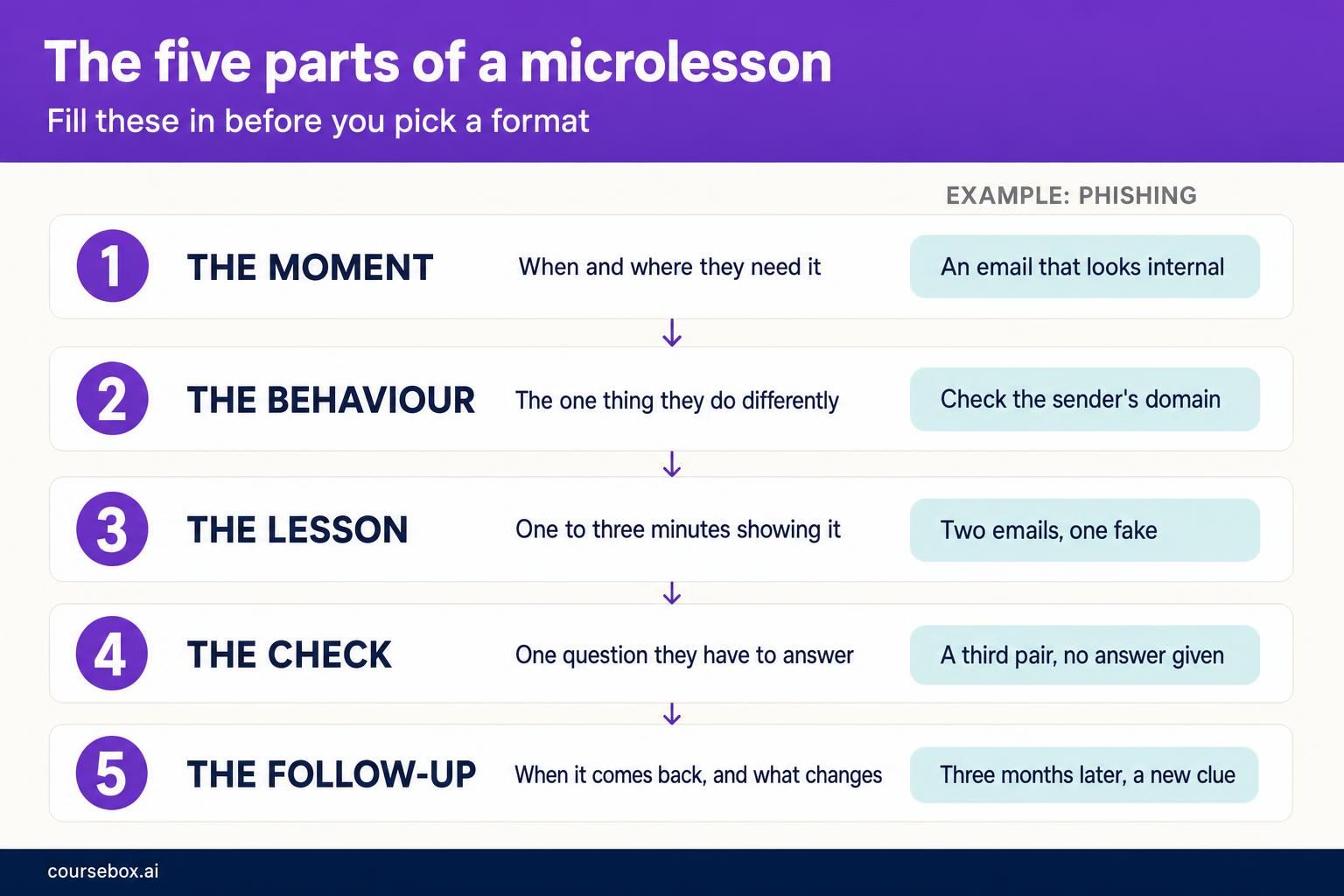
The behaviour is the line people get wrong. Write it as something they do, not something they know.
Can I name the exact moment this person needs this, and the one thing they will do differently afterwards? If not, it is a topic, and topics belong in a course.
Which format fits which job
Start with what the learner has to do. Almost everything I am asked for is one of five jobs, and each job rules some formats out.
| The job the learner has to do | What the example has to show | Formats that fit | Formats that cannot do it |
|---|---|---|---|
| Recall a fact under pressure | The fact produced from the situation, not picked off a list | Card sets, one question a day, retrieval quizzes | Long video, wall-chart infographics |
| Follow a procedure in order | The sequence performed, including the step people miss | Short screen or hands-on video plus a job aid | Written policy, narrated slides |
| Make a judgement call | The decision and what it costs | One-decision scenarios, paired recordings of the same moment | Quizzes with one defensible answer |
| Notice a condition before acting | The difference between a safe case and an unsafe one | Paired examples, annotated photos, spot the fake | Definitions and checklists on their own |
| Change a habit they already understand | A better version of what they already do | Before and after side by side, a prompt at the moment | Any lesson delivered away from the moment |
The one selection rule I would retire is matching the format to the learner, where the visual learner gets the infographic and the auditory learner gets the podcast. Reviewing the evidence for that idea, Pashler and colleagues reported that they found virtually no evidence for the interaction it depends on, and concluded there is no adequate evidence base for building teaching around learning-styles assessments. Formats differ by what they can show, not by who is watching. A checklist suits a sequence because a sequence has an order. A scenario suits a judgement call because judgement needs consequences.
The other constraint is physical. The moment of need mostly happens away from a desk, and the device in someone's hand sets the limits of what you can build.
That rules out anything needing a keyboard, a two-column layout or a steady connection, and it is why most of the examples below are a short video, a photograph, or a single question.
Nine microlearning examples, written out
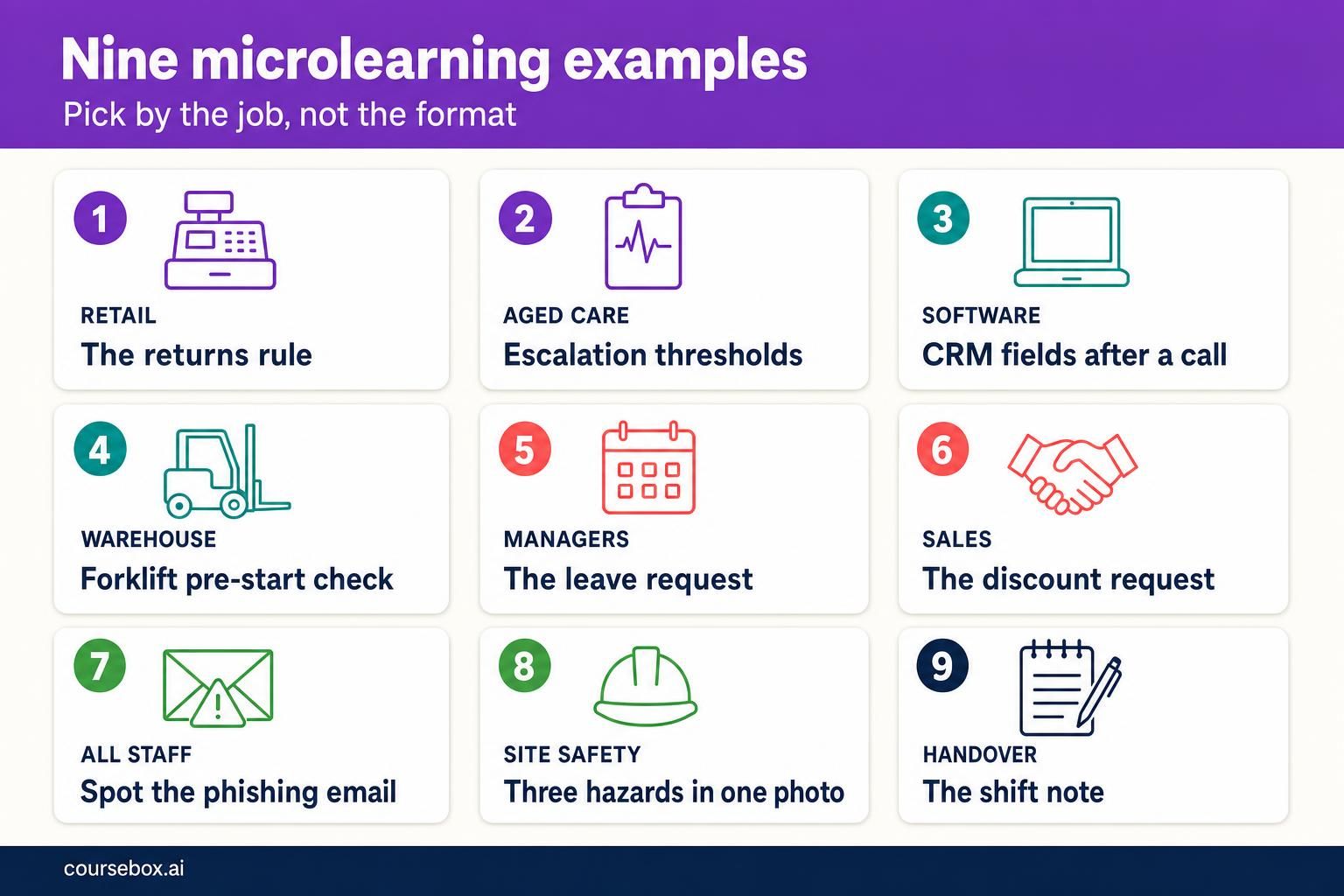
Each one uses the same five parts. Lift the shape and change the content.
1. Retail: the returns rule (recall)
A shop's returns policy is a handful of rules about what can come back, by when, and with what proof. Assistants are expected to know them cold, because reading them off a screen while someone waits at the counter is not really an option.
- The moment: A customer wants to refund a jacket bought 40 days ago. There is a queue.
- The behaviour: Say the returns rule from memory, without checking.
- The lesson: One card per rule, in the words you would say to a customer. "Thirty days with a receipt."
- The check: "Bought 40 days ago, has the receipt. What do you say?"
- The follow-up: One question a week in the team chat, taken from a real return.
2. Aged care: the escalation thresholds (recall)
Care staff take routine observations: blood pressure, pulse, temperature. Each one has a cut-off that means stop and call the registered nurse. Those cut-offs are what an escalation threshold is, and they differ between employers, so a worker with years of experience can still be carrying the wrong numbers.
- The moment: A support worker takes a resident's observations and one reading looks wrong.
- The behaviour: Call the nurse at the right threshold.
- The lesson: One card per vital sign, threshold and phone number together.
- The check: Four readings, one out of range. "What do you do now?"
- The follow-up: Monthly, with a different reading out of range.
That is why this one repeats every month rather than being covered once at induction.
3. Software: updating the CRM after a call (procedure)
After every sales call a rep is meant to update the deal record, so the sales forecast reflects what actually happened. Almost everyone knows this and almost everyone puts it off. A forecast built on week-old records is worse than no forecast at all.
- The moment: The ninety seconds after a sales call ends.
- The behaviour: Update the record now, not later.
- The lesson: A 70-second screen recording of one real deal, showing three fields change: stage, next step, close date.
- The check: A record where the stage moved but the close date did not. "What is missing?"
- The follow-up: The same three fields, pinned as a three-line checklist in the CRM.
People skip the close date because it is the only field that commits them to something. Say that out loud in the recording. For a procedure the checklist is the real deliverable, and the video is how you get it read.
4. Warehouse: the forklift pre-start check (procedure)
Before starting a forklift, the operator walks around it and checks a set list: tyres, forks, brakes, horn, fluid leaks. It is a legal duty and it takes about two minutes. The risk is not that people skip it. It is that they tick it off without knowing what a problem would actually look like.
- The moment: The start of a shift, standing at the machine.
- The behaviour: Finish the pre-start check before starting the engine.
- The lesson: A phone video shot on your own forklift, by whoever does the check best.
- The check: A photo of a machine with one item missed. "Tap what they skipped."
- The follow-up: None. The daily check is the repetition.
The daily check produces the compliance, not the lesson. Build that check from your duties under Safe Work Australia's model code of practice for managing risks of plant. The lesson is there to make the check make sense to a new operator.
5. Managers: the leave request you have to decline (judgement)
Sometimes a team member asks for something the company cannot give, and no policy covers it cleanly. The manager has to say no, in their own words, on the spot. Whatever they say becomes the version the rest of the team hears about afterwards.
- The moment: A team member asks for leave they have not accrued, three days before Christmas.
- The behaviour: Decline it clearly, without inventing a rule.
- The lesson: One situation, three replies, each written out in full.
- The check: Pick a reply. The feedback gives the reasoning, not the policy number.
- The follow-up: The same decision six weeks later, facts changed.
Ask three of your own managers what they would say, then use their words. The wrong answers have to be the ones people actually give.
6. Sales: the discount request (judgement)
Late in a good sales call, the buyer asks for money off. The rep can agree, or they can offer the discount in exchange for something: a longer contract, more seats, a reference call. Agreeing takes a second. Asking for something back takes nerve.
- The moment: A good call is ending and the prospect asks for twenty per cent off.
- The behaviour: Ask for something in return before conceding.
- The lesson: Two 40-second recordings. One rep concedes on the spot. The other trades the discount for a two-year term.
- The check: "Which rep kept the price, and what did they ask for?"
- The follow-up: The weekly pipeline review, against a live deal.
Use recordings of your own team. A scripted actor does not sound like your market.
7. Everyone: spot the phishing email (noticing)
A phishing email is one built to look like it came from someone you trust, so that you click a link or hand over a password. Most training explains what phishing is. What protects people is a two-second habit of checking who really sent it, and that is a different thing to train.
- The moment: An email arrives that looks like it came from inside the company.
- The behaviour: Check the sender's domain before clicking anything.
- The lesson: Two emails side by side, one real and one fake, both on your branding.
- The check: A third pair, no answer given.
- The follow-up: Every three months, with a different clue giving the fake away.
Withholding the answer feels wrong. It is the point. Noticing only counts when the person is unsure. And if the clue never changes, staff learn your fake instead of the habit.
8. Site safety: three hazards in one photo (noticing)
The first thing anyone should do on a work site is look around and register what is unsafe: a trailing lead, a missing guard rail, a load stacked too high. That is a skill of noticing, and handing people a list of hazards to memorise does not build it.
- The moment: Walking onto a work area at the start of a job.
- The behaviour: Spot what is wrong before starting.
- The lesson: One photo of a real area on your own site, with three things wrong in it.
- The check: "Tap the three hazards."
- The follow-up: A new photo every month.
Choose a photo where one hazard is obvious, one takes a second look, and one is arguable. The arguable one is what opens the conversation at the toolbox meeting. The supervisor who takes the photo usually learns more than anyone who answers it.
9. Clinical handover: the shift note (habit)
At the end of a shift, staff write a note telling the incoming shift what happened and what to keep an eye on. When that note is vague, the next shift spends an hour piecing it together from other people, and sometimes misses something important.
- The moment: 6:55am, writing the note at the end of a shift.
- The behaviour: Write the same three things in the same order: what changed, what to watch, what is outstanding.
- The lesson: Forty seconds showing a real note beside the same note rewritten.
- The check: Rewrite a third note into the three parts.
- The follow-up: A prompt at handover time, in the tool where the note is written.
This is not a knowledge problem. Everyone already knows what a good note looks like. It is a habit problem, and training it as though it were a knowledge problem is why handover training keeps getting repeated.
The follow-up schedule that makes an example stick
One microlesson on its own teaches very little. What moves the outcome is the second and third contact. The largest review of the spacing effect pooled decades of experiments to work out how long to leave between them.
Read that as a working rule: the longer the knowledge has to last, the wider the gaps should be. For something needed next week, come back the following day and again three days later. For an annual requirement, spread the repeats across the year. Packing them into induction week is the most common mistake in compliance calendars. Change the wording or the example each time, because asking the identical question twice tests whether they remember the question. There is more on setting the intervals in what spaced repetition is and how to practise it.
When a short lesson is the wrong shape
Some jobs need something other than a short lesson. And it is worth being straight about how strong the evidence is.
Most of those studies were before-and-after implementations, not controlled trials. The honest reading is that short lessons usually help, and the help is often too small to measure. Treat them as a sensible default, and watch for three cases where the shape is wrong. Skills needing sustained practice under supervision do not compress. Material where the connections between parts are the whole point breaks when you slice it. And anything a person must get right first time, unsupervised, needs assessment rather than a card. The fuller argument sits in the pros and cons of microlearning.
Turning what you already have into examples
You do not need software for any of this. Every example above can be built with a phone, a shared drive and a recurring calendar entry. For a team of twenty that is usually the right call. At that size a platform costs more than it saves.
What changes at scale is the record and the repetition. Once you are assigning to hundreds of people across several sites, you need to know who did what and when. The follow-up has to fire without anyone remembering to send it. That is the point where a platform starts paying for itself. If you get there, the microlearning platforms worth comparing covers the main options. Coursebox's AI course creator turns a policy or an existing deck into short lessons with the check questions attached, which is the part that takes longest by hand.
Whatever you build it in, the sequence does not change: name the moment, name the one behaviour, make the shortest thing that shows it, and decide up front when it comes back.
Frequently Asked Questions
A microlearning example is a single short lesson built around one moment at work. In practice that is a two-minute card set a retail assistant uses to state the returns rule from memory, a 70-second screen recording of the three CRM fields to update after a call, or two emails side by side where one is a phishing attempt. A format such as video or quiz is the container, chosen last.
Research on workplace microlearning generally sets the ceiling at 15 minutes, but most working examples are far shorter, between 60 seconds and four minutes. Length is a symptom rather than a target: if you have written one moment and one behaviour, the lesson comes out short on its own. If it will not fit, you are probably covering two things.
Start where people already get stuck and someone can name the moment. Returns and refund rules, escalation thresholds, the fields nobody updates in your CRM, pre-start equipment checks, phishing recognition, hazard spotting, and the handover or shift notes everyone complains about. Skip anything that is really an overview, because overviews have no moment attached.
Yes, and it is five lines. The moment: where they are when they need it. The behaviour: the one thing they do differently. The lesson: one to three minutes showing it. The check: one question they answer from memory. The follow-up: the date it comes back. Fill in those five before you decide whether it is a video, a card or a scenario.
Match the interval to how long the knowledge has to survive. For something needed next week, repeat the next day and again three days later. For annual requirements, spread the repeats across months rather than stacking them into induction. Change the wording or the example each time, so you are testing the knowledge rather than the question.
The evidence is positive but not overwhelming. A 2026 systematic review of microlearning in hospital settings found 90% of the 40 measured outcomes moved in the right direction, while 30% reached statistical significance, and most of the underlying studies were before-and-after designs rather than controlled trials. It is a reasonable default for recall, procedures and noticing, and a poor fit for skills that need supervised practice.
Carolina Martin
Customer success lead and learning designer at Coursebox AI

