

5 Moments of Need: The Performance Support Model Explained
The 5 Moments of Need explained: Gottfredson and Mosher's New, More, Apply, Solve and Change, the support each needs, the evidence and free templates.

The 5 Moments of Need is Conrad Gottfredson and Bob Mosher's performance support model, which sorts the times people need help with their work into five moments (New, More, Apply, Solve and Change) so that each gets the right help, from a course to a job aid.
- Gottfredson and Mosher set the model out in their 2011 book, Innovative Performance Support, and in a series of free articles in 2012.
- The authors see courses as the main help for the first two moments, and help built into the work for the last three.
- No published controlled study of the five-moment model has been found, so its evidence comes from studies of help at the moment of work.
- In a randomised study of 78 employees, training plus on-screen help scored 80% on a task, against 69% for training alone.
- Of 104 Coursebox course requests, 31 were flagged as signalling a first-time learning need, and none asked for help people could reach while working.
Five questions, about a minute. Answer for one job you train people to do, such as handling a customer complaint, fixing a fault or using a new system.

Go from storyboard to an interactive course in minutes
Picture a lift technician on their third night on the breakdown roster. It is 2 am, a lift in an apartment building is stuck between floors with nobody inside, and the controller shows fault 41: landing door lock not made. The technician did the breakdown course three weeks ago and passed the quiz. They remember there were four checks for this fault. They cannot remember the third, and the senior technician is asleep. The course was not wrong. It was the wrong kind of help for the moment the technician was in.
I'm an instructional designer at Coursebox, where we make AI software for employee training that turns a brief into a staff course, so I'll mention our product where I tested it. That gap is the problem Conrad Gottfredson and Bob Mosher's 5 Moments of Need was built to solve. In this guide I set out the five moments in the authors' own words, what performance support is, how the authors use the model today and what the evidence does and does not show. Then I carry one lift company's breakdown callout roster through all five moments, with two real cases, a product test and two free templates.
What are the 5 Moments of Need?
The 5 Moments of Need is Conrad Gottfredson and Bob Mosher's performance support model, which sorts the times people need help with their work into five moments (New, More, Apply, Solve and Change) so that each gets the right help, from a course to a job aid.
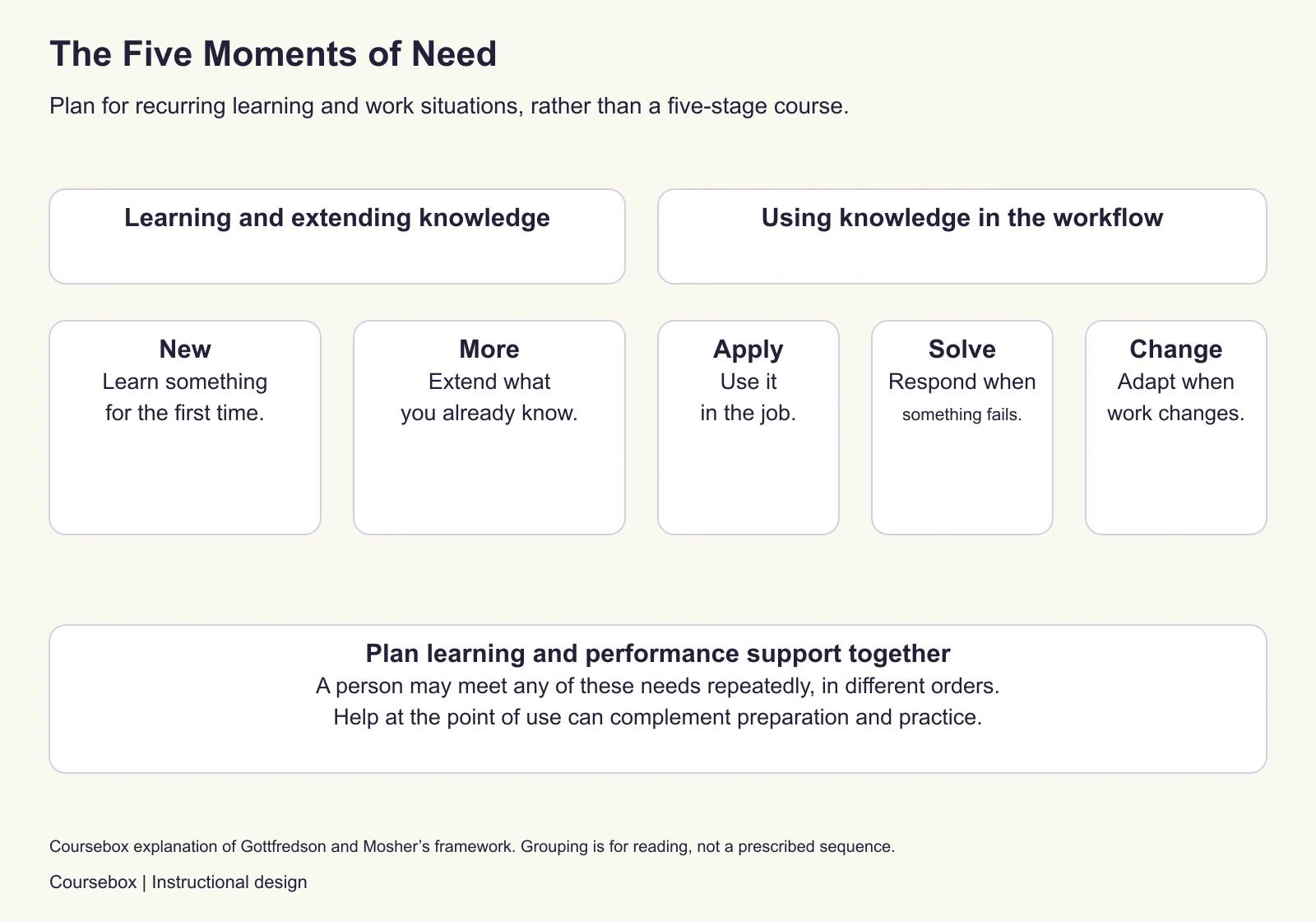
Gottfredson and Mosher set out the five moments in their 2012 article "Are You Meeting All Five Moments of Learning Need?" in Learning Solutions Magazine. In their words, the five moments "provide an overarching framework for helping learners become and remain competent in their individual and collective work." Here they are at a glance, with the authors' 2012 description of each and what it looks like for a lift technician on the breakdown roster.
| Moment | The authors' description (2012) | The question it asks of your training | What it looks like at work |
|---|---|---|---|
| New | "When people are learning how to do something for the first time" | What must people learn before they first do the job? | A technician's first callouts, shadowing a senior technician |
| More | "When people are expanding the breadth and depth of what they have learned" | What will they need to learn once the basics are in place? | A second controller family, and reading a controller's fault history |
| Apply | When they need to act on what they learned, "which includes planning what they will do, remembering what they may have forgotten, or adapting their performance to a unique situation" | What help do people need while they do the job? | A one-screen callout card, used at fixed points in the callout |
| Solve | "When problems arise, or things break or don't work the way they were intended" | What will people do when something goes wrong? | A yes or no troubleshooting guide for fault 41, used at the controller |
| Change | When people must learn a new way of doing something, "which requires them to change skills that are deeply ingrained in their performance practices" | What do people who already do the job need when the way they do it changes? | A two-minute update on what changed on 1 March, with the updated card |
The model's purpose is performance at work, not knowledge for its own sake. It applies to any job, from surgery to software support, and it is not only a framework for software rollouts, which is one common use.
The five moments split into two groups. The first two are about learning to do the job, and the last three are about doing it. The authors write that "the first two moments of need (learn new and learn more) are initially satisfied by the development and delivery of formal learning solutions", and add straight away that "these two can also occur at the moment of apply." So the split is a starting point, not a wall: a technician can meet something new in the middle of a callout, and help in the work can carry a small piece of new learning.
The model is not an argument against courses. The same article says it "isn't a proposal to overthrow formal learning, or to diminish the vital role that trainers play." The authors' complaint is narrower: an organisation whose only answer is courses leaves people without help at the three moments when the work actually happens.
The model has changed its vocabulary since 2012, though not its five moments. The authors' company now writes it as the 5 Moments of Need®, lists the moments starting with Apply, and calls the discipline "Workflow learning" on the 5 Moments of Need site. In a 2024 post, Mosher describes it as "Workflow Learning (what used to be Performance Support)". I use "performance support" because it is still the term most designers use, and the authors' own 2012 articles use it.
The World Health Organization's "My 5 Moments for Hand Hygiene" is a different model with a similar name: five points in patient care when health workers should clean their hands. It has nothing to do with Gottfredson and Mosher's model of learning and performance support, and the similar names make the two easy to confuse.
What is performance support?
Performance support is help that people use while they do their work, at the moment they need it, such as a checklist, a quick reference card, a step-by-step guide or help built into a software screen. Training prepares people before the work. Performance support helps during it.
The idea is older than the 5 Moments. Gloria Gery was writing about electronic performance support systems (EPSS) by 1989, when her article in Performance Improvement Quarterly argued that "Throwing in more traditional training events, regardless of whether they are interactive or not, will not solve it." Her 1991 book, Electronic Performance Support Systems, made the term widely known. Gottfredson quotes her definition of an EPSS in a 2013 article: "An orchestrated set of technology-enabled services that provide on-demand access to integrated information, guidance, advice, assistance, training, and tools to enable high-level job performance with a minimum of support from other people." Gottfredson and Mosher credit her directly: "Gloria Gery pioneered the initial ideas and practices of performance support."
Job aids are older still. US military researchers were testing step-by-step job performance aids for equipment maintenance in the 1960s, and a 1979 review by Harold Booher summed up "Over 20 years of research data" on them.
What the 5 Moments added was a way to decide where performance support belongs. Instead of asking "do we need a course or a job aid?", you ask which moment a need sits in. Gottfredson also borrowed Allison Rossett's word for help used during the work. In his 2011 article he describes help before, during and after the Apply moment: a "planner" before, and during it "something Allison Rossett calls 'Sidekicks.' A sidekick is anything we create that supports performance right at the moment of performance." After it come "Quick Checks", short self-checks on the work just done.
Gery also sorted support by how close it sits to the work. In her terms, intrinsic support is built into the task itself, extrinsic support sits inside the same system but outside the main workspace, and external support is separate, such as a manual or a help desk. One of the randomised studies of on-screen help compared exactly these three kinds of support.
One of the clearest real examples of help at the Apply moment is a checklist for surgical teams. It does not teach surgery. It makes sure steps the team already knows get done at the moment they count.

Case study: Surgical teams in eight hospitals across eight countries
In 2007 and 2008, eight hospitals in Toronto, New Delhi, Amman, Auckland, Manila, Ifakara, London and Seattle took part in the World Health Organization's Safe Surgery Saves Lives programme. Basic safety steps, such as confirming the patient and site and giving antibiotics on time, were done inconsistently. The teams knew the steps. The failure was doing all of them, every time, at the right moment.
- What they did: Each hospital adopted a 19-item checklist that the team read aloud at three pauses: before anaesthesia, immediately before the incision and before the patient left the operating room. Each hospital adjusted it to its own workflow and introduced it "using lectures, written materials, or direct guidance" over one week to one month.
- Evidence and result: Haynes and colleagues reported in 2009 on 3,733 consecutive patients before the checklist and 3,955 after. "The rate of death was 1.5% before the checklist was introduced and declined to 0.8% afterward." Inpatient complications fell from 11.0% to 7.0%, and the share of patients for whom all six observed safety steps were done rose from 34.2% to 56.7%.
- Limitation: It was a before and after comparison with no control group, so other changes over time cannot be ruled out, and the authors note a Hawthorne effect they found "difficult to disentangle". The checklist came with site visits, feedback on local gaps and, at three hospitals, a change in where antibiotics were given, so the result belongs to a programme, not to a sheet of paper. When Ontario later required a checklist in 101 hospitals, a study of the first three months found no significant change in deaths or complications. It is a health outcome, not a test of the 5 Moments, which the study never mentions.
- Lesson: Help at the Apply moment works when it sits at the exact pause where the action happens and the team uses it out loud. Handing out the tool is not the intervention, so plan how it gets used and check use, not distribution.
Where the 5 Moments of Need came from, and which source to read
The company the authors run today dates the framework to 1985, to Gottfredson's work at "a multinational oil company" after his doctorate, according to its history page. I found no publication of the five moments from the 1980s or 1990s. The earliest public text I could read is Gottfredson's April 2011 article, which already lists the five moments with the same definitions.
Three facts about the sources:
- The book is from 2011. Innovative Performance Support: Strategies and Practices for Learning in the Workflow was published by McGraw-Hill with a 2011 date, though its catalogue release date is December 2010 and the company's own timeline says 2010.
- There are two authors. The book and the 2012 articles are by Gottfredson and Mosher together. The company's history credits Gottfredson with identifying the five moments and Mosher with taking the approach to organisations around the world, so it is not "Bob Mosher's model", and neither is it Gottfredson's alone.
- The vocabulary moved on, the moments did not. The 2012 articles use "performance support" and "EPSS". The company now uses workflow learning and its own product names for the same ideas.
Which to read
- Read this one first: Are You Meeting All Five Moments of Learning Need? (2012). It is free, short and gives the authors' five definitions.
- For the design method: Ten Seconds: Performance Support in Two Clicks (2012), which explains the workflow, task and step structure and the two clicks rule of thumb.
- For the full treatment: the book, Innovative Performance Support (McGraw-Hill, 2011). Clark Quinn's review of the book is a fair, friendly summary of what it offers and where it simplifies.
How Gottfredson and Mosher use the model today
Today the authors design for the Apply moment first, then decide what still needs a course. Their current method, as their company describes it, has these parts:
- Map the work, not the content. Their 2012 article on performance support in two clicks describes a workflow that "consists of tasks that they need to perform. These tasks have steps." Help is organised around those tasks and steps, in layers, with the shortest help on top. They call this layered structure the performance support pyramid. Their company now sells the analysis step as a Rapid Workflow Analysis.
- Use failure impact to decide what must be practised before independent work. The authors call this Targeted Training. Their claim that other skills can be learned with a digital coach is a design position, not a substitute for checking prerequisites, task authority and the consequences of error.
- Put the rest into the work. In Mosher's 2024 post, the two deliverables are Targeted Training for New and More, and a "Digital Coach" for Apply, Solve and Change. The digital coach is their name for an EPSS.
- Make help fast to reach. "Performers need to get to contextual help within two clicks or ten seconds."
- Run it as a project. Their EnABLE methodology covers aligning the work, analysing and designing, building and implementing, sustaining the solution, and evaluation. These are paraphrases of the phase names; the linked source gives the authors’ labels.
The two clicks and ten seconds figures come from the authors' design advice, not from a study that measured them. Treat them as a target that keeps help short and close to the work: if a technician has to open a course, search it and scroll for the step, the help is too far away.
Mosher's 2024 post also makes a point about microlearning: breaking a course into short lessons is not the same as doing the 5 Moments. Short lessons are still lessons. A three-minute video on fault 41 is better than a forty-minute module, but it is still something to watch, not a list to follow at the controller. Our microlearning examples show where short lessons help, which is mainly at the New and More moments.
The company's pages also make outcome claims, such as faster time to productive performance, without published figures, and some quoted results are from anonymous clients. I have left those out of this guide.
A worked example: a lift company's breakdown callout roster
Here is the hypothetical example I'll use from here on. A lift maintenance company in an Australian city has about 120 field technicians who maintain about 4,000 lifts in office and apartment buildings. By day they do routine service visits. At night and on weekends, a roster of technicians attends breakdowns.
The learners are technicians joining the after-hours breakdown roster for the first time. They have done routine maintenance for at least a year, mostly alongside a senior technician. They know the company's lift models and its job app, but they have never attended a breakdown on their own at night. Their licence and years of service do not show that they can. Readiness requires supervised evidence against the approved procedure and the company’s task authorisation, not course completion alone.
The job is one callout, from arrival to close: confirm whether anyone is trapped, follow the company's isolation and lock-out procedure before any work, diagnose the fault from the code on the controller, fix it or make it safe, test-run the lift before returning it to service, complete the job card and tell the building manager. Four people are involved: the technician, a senior technician who mentors and signs off their first callouts, the control room operator who dispatches and logs callouts, and the building manager.
A few more facts carry through the example:
- Two controller families: an older relay controller on most office lifts and a newer microprocessor controller on most apartment lifts.
- One fault code: on the newer controller, fault 41 means "landing door lock not made". The code is illustrative, not a real manufacturer's code.
- One change: from 1 March, technicians must phone the control room before starting any passenger release (until then, the call came after the release), and the paper job card moves into the phone app, which needs a photo of the isolation lock before the job can be closed.
The old approach was a course with a quiz before the first night on the roster. The intended outcome is that a technician can complete an authorised callout, retain every required release and isolation check, find the approved fault-code guidance and close the job correctly. The fault code, procedure and dates are invented teaching details, not operating instructions. Real work requires the current manufacturer and site procedures, task authorisation and an approved escalation route.
This example shows the model well for three reasons. One job produces a clear need at every moment. Field technicians work alone, at night, in places where a course cannot reach them, so most of their help has to live in the work. And the difference between a costly mistake and a slow one is easy to see: a trapped passenger is not the same as a fault code.
The five moments, worked through one job
Each moment gets the same three parts: what the technician needs at that moment, the support that fits it, and how to check the support works.
1. New
New is the moment "When people are learning how to do something for the first time". This is where a course does its main job, because the technician has no way to act yet and no experience to adapt.
- What the technician needs: before the first solo callout, what a callout involves, the company's priorities when someone is trapped, and why isolation comes before any diagnosis.
- The support that fits: a short course for the explanation, then supervised practice on the training tower and shadowed callouts until readiness is demonstrated to the senior technician, who signs off the passenger release and isolation steps. The course can do the first part; the practice and sign-off happen on the job.
- How to check it works: the senior technician watches the release and isolation steps on the training tower and on the shadowed callouts. A quiz score cannot show that the technician isolated a lift correctly.
2. More
More is the moment "When people are expanding the breadth and depth of what they have learned". It comes after the basics, when people are ready for the next layer.
- What the technician needs: when readiness and assigned work justify it, the second controller family if they have only worked on one, and how to read a controller's fault history to spot repeat faults.
- The support that fits: a short module for technicians who need it, timed for when they have done enough callouts to use it. It does not belong in the course before the first night, where it would crowd out what has to be learned first.
- How to check it works: the senior technician reviews a fault history with the technician on a real callout and asks what the repeat faults suggest.
3. Apply
Apply is the moment people act on what they learned, which in the authors' words "includes planning what they will do, remembering what they may have forgotten, or adapting their performance to a unique situation". The authors put it at the centre of the model: "This help must be immediate and tailored to the role and situation of the performer."
- What the technician needs: to follow every callout step in order, at night, alone, without relying on memory.
- The support that fits: a one-screen callout card on the phone, used at four fixed points. On arrival: is anyone trapped, and phone the control room. Before work: isolate and lock out, and photograph the lock. Before returning the lift to service: test runs, doors, floor levelling and the alarm. At close: the job card in the app, and the building manager told. Steps only, no explanations and no quiz.
- How to check it works: on the first callouts, the senior technician checks that the card was used at each point, not that it was downloaded. The surgical checklist case is the reason: a tool that is handed out but not used does nothing.
4. Solve
Solve is the moment "When problems arise, or things break or don't work the way they were intended". The authors write that "these moments of solve require diagnostic skills coupled with performance support."
- What the technician needs: a way through a fault they have not met before, and a clear point at which to stop.
- The support that fits: an approved troubleshooting guide indexed by fault code, with the required prerequisites and authorisation, checks in the approved order, and clear escalation conditions. In this fictional example it has four checks. Damage, uncertainty or work outside the technician’s authorisation requires stopping and calling the senior technician. A generic guide cannot prescribe how to inspect or repair a real door-lock circuit.
- How to check it works: have an authorised technician and the senior technician try the guide in a controlled training setting first. Check prerequisites, task limits and escalation, then observe its use in appropriate approved work. Do not use a live safety-critical fault as a first usability trial.
Good troubleshooting knowledge usually sits with the best people in the job. Xerox's Eureka project collected repair tips written by its field technicians and checked by expert colleagues, starting in France in 1995, and MIT Technology Review reported in 1998 that a company study "showed a 5 to 10 percent savings in parts and labor". That is a press report of the company's own figures, but the design point holds: the people who fix the faults are the best authors of the guide, as long as someone checks it.
A modern version of the same idea puts that knowledge inside the work screen, and one firm measured what happened.

Case study: Chat support agents at a US software company
A Fortune 500 company selling business software to small businesses in the US ran chat-based technical support, where most chats were about diagnosing why a customer's software was not working. Most agents worked outside the US, mainly in the Philippines. Turnover was high, and new agents resolved fewer problems per hour than experienced ones.
- What they did: From late 2020, the firm gave agents an AI assistant that watched each live chat and offered "real-time suggestions for how to respond", with links to the firm's internal technical documentation. Agents could ignore it. It was rolled out to agents in stages, after a seven-week randomised pilot with 50 agents.
- Evidence and result: In the published 2025 study by Brynjolfsson, Li and Raymond, data from 5,172 support agents and about 3 million chats showed an estimated 15% increase in issues resolved per hour after access to the assistant. Less experienced and lower-skilled workers gained about 30%; the most skilled saw small speed gains and some decline in conversation quality. Shorter chats during tool outages were consistent with learning, although they do not isolate learning as the only cause.
- Limitation: The main analysis used staggered adoption rather than a fully randomised rollout. The authors adjusted for worker and tenure differences and examined alternative estimates, but selection and outage conditions still require care. This is one firm and job, uses generative AI rather than a classic job aid, and does not test the 5 Moments framework.
- Lesson: Help inside the work screen was associated with larger gains among less experienced and lower-skilled agents. The outage evidence is consistent with some learning rather than dependence alone. Check the job measure and response quality, not course completions.
5. Change
Change is the moment "When people need to learn a new way of doing something, which requires them to change skills that are deeply ingrained in their performance practices". The authors call it the one that "has been the least attended to, and yet is the most challenging", and say that people in it "absolutely need job aids that will guide them through the new way each time they are called upon by their job to perform."
- What the technician needs: to stop doing the release call in the old order, and to close jobs in the app with a lock photo, without relearning the whole job.
- The support that fits: a two-minute update on what changed on 1 March, the old and new steps, the reasons and the marked-up card. The lock photo records one visible part of the procedure; it does not prove that isolation was completed or verified.
- How to check it works: after 1 March, the control room checks that release calls arrive before releases start, and the app shows whether jobs close with a lock photo.
Every Solve guide needs a step that says when to stop and who to call, and it is easy to leave out. Write it before the troubleshooting steps. For fault 41 it is "make safe, leave the lift out of service and call the senior technician", and it is the line that keeps a guide from encouraging a technician to go further than they should alone.
How the five moments relate
The five moments are not a sequence that every learner walks through once. They describe kinds of need, and the same person can be in several of them in one shift.
- Apply is the centre. Most work happens at Apply, and Solve and Change interrupt it. The authors' current method starts there.
- New and More can turn up inside Apply. The authors say so directly, so a job aid can carry a small piece of new learning, such as a note on the newer controller's fault display.
- The moments recur. Every change sends experienced people back to a kind of New, and the Change moment is where that happens.
- Sorting a need into a moment is a judgement. The model gives you categories and questions, not a rule that decides for you.
In the lift example, one callout at 2 am can touch three moments in ten minutes: the technician follows the card (Apply), meets fault 41 (Solve) and, in their first week after 1 March, has to remember to phone the control room before a release (Change). The course they did before their first night (New) sits behind all of it.
How to use the 5 Moments of Need to design training
The authors sell their own analysis as a paid service, so this workflow is my adaptation of the ideas in their articles, not their method. It follows the lift company's breakdown roster.
- Check the problem is a skill problem. If people already know how to do the job and are not doing it, a moments plan will not fix a missing tool or a bad process. A performance gap analysis answers that first, and action mapping asks the same question from a business goal.
- Map one job as tasks and steps. List what the person does from start to finish, in the order they do it, with the people involved. For the roster, that is the callout from arrival to close.
- Rate what a mistake would cost for each task. High means someone could be hurt, or the damage is hard to undo. Low means the mistake costs time. The authors call this the critical impact of failure.
- Train and sign off the high tasks. Give them a course, practice and a sign-off before people do them alone. Practice in a realistic setting, such as the training tower, or in a scenario for decisions, belongs here.
- Build the Apply help next. Turn the job's steps into a job aid people use while they work, reachable in seconds. Keep steps as actions, and leave explanations to the course.
- Add a Solve guide for each common fault or problem. Yes or no steps in a fixed order, ending with when to stop and who to call.
- Plan the Change updates. Decide who will write the update when a step changes, and how the job aid gets updated the same day.
- Use courses primarily for New and More, with practice and updates where the risk and learning need require them. What is left in the course is what people must know before their first go, and what they will need once the basics are in place.
- Check use, not distribution, and measure on the job. Watch the first few uses of each job aid, and judge the plan by job measures, such as callouts closed correctly, not by course completions. Our guide to the Kirkpatrick model covers measuring behaviour on the job.
The moments plan for the breakdown roster
Step 3 sorts the callout's tasks. The rating column is the deciding one.
| Task | Critical impact of failure | Where it goes |
|---|---|---|
| Check whether anyone is trapped and phone the control room | High: a missed passenger or a late call puts people at risk | Course and sign-off, then on the callout card |
| Passenger release | High: a mistake can injure or kill | Practised on the training tower and signed off by the senior technician; the course does not teach it alone |
| Isolation and lock-out before any work | High: a mistake can injure or kill | Practised and signed off, then on the callout card with the lock photo |
| Reading a fault code and working through fault 41 | Assess against the approved procedure. Reading a code differs from intervening in a door or safety circuit; a stop line alone does not make diagnosis low-risk | Fault 41 troubleshooting guide at the controller |
| Closing the job card in the app | Assess the consequences of missing records and release controls, not just the time needed to correct them | Callout card and the 1 March update |
Then each moment gets its support, where it lives and a check.
| Moment | What the technician is doing | The support | Where it lives | How to check it |
|---|---|---|---|---|
| New | Learning callouts before the first night | Short course, training tower practice, two shadowed callouts | Course, then on the job with the senior technician | Senior technician signs off release and isolation |
| More | Taking on the second controller family when ready and required | Short module on that controller and on fault history | Course, opened when the technician needs it | Fault history review on a real callout |
| Apply | Attending a callout | One-screen callout card in four groups | The phone, used at each of the four points | Senior technician checks it was used on the first callouts |
| Solve | Facing fault 41 at the controller | Yes or no guide that ends with when to stop | The phone, one tap from the card | A technician new to fault 41 uses it at a controller |
| Change | Working the new way after 1 March | Two-minute update and the marked card | Sent before 1 March, then the card itself | Control room and app records after 1 March |
A planning sheet for one job: a task list where you rate what a mistake would cost for each task and decide whether it goes to training or to help in the work, then one row per moment with what the person is doing, where they are, the support and how you will check it. Filled in for the lift company's breakdown callout roster, with blank pages for your own job. A Coursebox adaptation of Gottfredson and Mosher's model, not their worksheet. Editable Word file, no email required.
Gottfredson's "Quick Checks" give the plan its feedback loop. After a callout, a short self-check on the phone asks the technician whether they phoned the control room, isolated before work and closed the job with the lock photo. It is not a test. It is a prompt to notice a missed step while the job is still fresh, and the answers show the senior technician where the card or the course needs work.
What Coursebox course requests leave out
To see which moments people brief for, I looked at course requests typed into Coursebox in the 90 days to 7 October 2026: one per person, from English-language browsers, with no uploaded file. Of 266 prompts, 104 were course requests. Two independent AI readers each classified all 104 against written definitions built from the five moments and the support each needs, and I re-read every positive call in full. Counts combine requests flagged by either reader. They are classification estimates, not statistical upper bounds.
The requests were almost entirely about the two learning moments. People asked for onboarding, beginner courses and "the basics". Almost nobody asked for help with the moments when the work happens.
Troubleshooting was flagged in 6 requests, and every time as a lesson inside the course, not a guide to use on the job. The only workplace request for a real job aid came from a new quality manager preparing a division for an ISO 9001 audit, who wanted "a crash course, guide pack, checklist etc.", so even there the job aid sat beside a course for someone new.
The sample is small, under a third of it was workplace training, and it covers what people typed, not the courses they finished. People may build job aids outside the builder or upload ones they already have. A course builder also attracts course requests by design, which is the honest reason the zero is not surprising. It is still useful: a builder briefed with a topic, whether a person or an AI, is likely to produce lessons and quizzes, because nobody asked for anything else. If you want a job aid, a troubleshooting guide or a change update, name it in the brief and say it is a tool for the job, not content to test.
5 Moments of Need and learning in the flow of work
"Learning in the flow of work" is Josh Bersin's phrase for learning and help that people get inside their daily work, without leaving it for a course. In the 5 Moments it maps mostly to the Apply moment, with Solve and Change close behind.
Bersin introduced the phrase in a June 2018 post, writing that "a new paradigm has arrived", which he called learning in the flow of work, and he later registered it as a trademark. His point was about time: "In the corporate learning world we want them to spend less." He gives job aids and performance support tools as examples. The phrase is his, and he does not cite Gottfredson, Mosher or Gery.
The idea underneath is older. Gery was writing about performance support systems in 1989, and Gottfredson and Mosher's 2011 book already has "Learning in the Workflow" in its subtitle. Their company now describes the Apply moment as "learning while in the flow of work", in Bersin's wording.
The two fit together. Bersin's phrase names a goal and covers more than job aids. The 5 Moments add the design decision underneath: which moment a need belongs to, and therefore whether it needs a course, a job aid, a troubleshooting guide or a change update. For the lift technicians, learning in the flow of work is the callout card at 2 am and the fault 41 guide at the controller. The course before the first night is not.
One thing the phrase is not is flow theory. Mihaly Csikszentmihalyi's flow theory is about the state of deep absorption in a task. Learning in the flow of work borrows the word, not the theory.
Does the 5 Moments of Need work? What the evidence shows
I found no controlled study of the five-moment model itself. The evidence that exists is for its parts, mainly help at the moment of work, and it is encouraging but narrow.
Studies that use the model are rare. A 2019 analysis by Daniel and Wolbrink in Pediatric Investigation sorted 138 health professionals' survey answers about why they used an online paediatrics learning platform into the five moments, and the authors note that "to date it has not been a widely applied framework within medical educational research." It measured motivation, not performance. A 2021 account of immunisation training in Ghana used the model to help trainers decide what to teach formally and what could be learned "using job aids or coaching", which is a design use, not a test.
The closest experimental evidence compares training with on-screen help. Two randomised studies with employees are the clearest I found.
In Nguyen and Klein's 2008 study, 78 employees from several companies were randomly assigned to training only, on-screen help only, or both, then completed a web tax form with 58 inputs. Both groups with on-screen help scored significantly higher than the group with training alone. The task was new to them, short and simulated, and the test came straight after, so it says nothing about long-term or on-the-job effects.
An earlier study shows where the help has to sit. In Nguyen, Klein and Sullivan's 2005 study, 72 employees at a semiconductor manufacturer completed a 12-step software task with help built into the task (84%), help in the same system (90%), a separate external aid (80%) or no help at all (71%). The two kinds of built-in help beat no help. The comparison did not detect a significant benefit for the separate aid over no help; it did not establish equivalence. The authors also noted that "very few studies have been conducted to measure its effectiveness", and the task was, in their words, "fairly simplistic".
Together with the surgical and chat support cases, the evidence supports a few modest claims. Help at the moment of work can beat training alone on a procedural task. Help that sits away from the work, like a manual on a shelf, may do little. And requiring a tool may not be enough: when Ontario required a surgical checklist, deaths and complications did not change significantly in the first three months. None of it shows that sorting needs into five moments improves performance, and I found no measured study of the Change moment at all.
5 Moments of Need vs action mapping, 70-20-10 and microlearning
The 5 Moments answers a different question from its neighbours. Action mapping asks whether training is the answer at all. The 5 Moments asks, once people need help with their work, which moment the need sits in and which help fits it. The table is my synthesis, not a ranking.
| Approach | Best for | Weak spot | Use it when |
|---|---|---|---|
| 5 Moments of Need | Deciding which help to build for a job: a course, a job aid, a troubleshooting guide or a change update | No controlled test of the model; sorting a need into a moment is a judgement | You know people need help with a job and must decide what kind, and where it lives |
| Action mapping | Starting from a business goal and finding what people must do, and whether training is the answer | Can identify job aids and other non-training changes; the moments add a view of when help is used | A course has been requested and nobody has asked what should change at work |
| 70-20-10 | Reminding planners that most development happens on the job and through other people | The ratio is not a prescribed allocation or a general measured law, and it says little about the immediate moment of work | You are planning development for a role over months, not one task |
| Microlearning | Short lessons people can fit around work | Short lessons are still lessons, not help at the moment of work | People need to learn something small, at the New or More moment |
In practice, action mapping and the 5 Moments work well in that order. Action mapping can show that part of a problem needs a job aid or a process fix rather than training, and the 5 Moments then helps design that job aid and decide where it lives. The 70-20-10 model is a reminder, not a ratio, and it does not prove the 5 Moments right: the two share only the view that a course is one part of how people learn a job. For where the 5 Moments sits among the wider set of design models, see our guide to instructional design models.
One slip to watch for when you adopt the 5 Moments is turning the help for Apply, Solve and Change into lessons: a card with a quiz on it, or a troubleshooting guide that has to be replayed as practice. If a technician cannot use it at the controller in seconds, it is a lesson, whatever it is called.
Limitations of the 5 Moments of Need
The model is a useful way to sort needs, but it has real limits, and a friendly reviewer of the authors' book names several of them.
- The model itself is untested. I found no controlled study comparing courses designed with the 5 Moments against courses designed without them. The evidence is for its parts.
- It comes from a business that sells it. The authors run a company that sells the method, a software product and certification, under a registered name. Clark Quinn's otherwise positive review of their book notes that "Owing to their current employment situation, they've naturally promoted performance support (PS)".
- It is a heuristic, not a procedure. Quinn calls the book "more heuristic than algorithmic" and adds that "there are some oversimplifications of the initial concepts". Which moment a need sits in is a judgement, and New and More can turn up inside Apply.
- Workflow maps go out of date. Quinn warns that the book "doesn't quite address the situation where business processes are changing faster", because a detailed map can be outdated by the time it is finished.
- The experiments are small and short. The randomised studies of on-screen help used simple tasks, 72 and 78 people and tests taken straight away.
- Requiring a tool is not the same as using it well. The Ontario checklist study found no significant change after a required rollout, and a requirement does not show that people use the tool at the moment of work.
- The Change moment has no evidence. The authors call it "the least attended to", and I found no measured study of help at that moment.
Using the 5 Moments of Need with an AI course builder
In the Coursebox course requests I looked at, people briefed a course builder for the New moment and stopped there. So I tested what a builder does when the brief asks for help at every moment.
On 12 October 2026 I briefed Coursebox to build the lift company's course, which I called "Breakdown callouts: your first month on the roster". Coursebox is our product, so weigh my account with that in mind. The brief supplied the fictional example’s facts and told the builder not to invent additional ones: the technicians, the senior technician, the control room, the two controller families, the callout steps, fault 41 and its four checks, and the 1 March change. It asked for one part per moment: short learning for New and More, a one-screen callout card for Apply, a yes or no guide for Solve and a two-minute update for Change, in seven sections in order, with no quizzes on the three tools.
The first outline did not shorten the tools. It padded them into lessons: the callout card took two pages, the fault 41 guide took three, and a new section on support roles appeared before the wrap-up, for 18 pages and about an hour. I sent one revision asking for exactly seven sections, one page each for the card and the guide, and no quizzes, because these were tools to use on the job, not lessons. The second outline had the seven sections in my order, 10 pages and about 35 minutes.
Most of it then came back as briefed. The callout card was one page with the four groups in order (On arrival, Before work, Before returning to service, At close), steps only, with no quiz. The 1 March update was a short table of the old way and the new way, with the reason for each change.
The issue was the Solve page. The fault 41 guide came back as a four-turn AI scenario and nothing else: "Make decisions across 4 turns to follow the Fault 41 yes/no check in the correct order". As practice before a shift, that is reasonable. As help at the controller, it fails, because a technician who has forgotten the third check would have to replay the scenario from the start to find it. The one tool meant for the moment something goes wrong had become a lesson again.
I checked the outline and four rendered pages, and I did not run the course with technicians or test the card on a phone. A guide on a page is not proof anyone opens it at the controller, and whether a technician can reach it in two clicks depends on how the company shares the page, which my test did not cover.
To fix the Solve page, I added the guide itself as a text block on the same page in the page editor: "Use this at the controller. Work down the list and stop at the first YES", the four checks in the briefed order, and the stop line, "make safe, leave the lift out of service and call the senior technician". I labelled the scenario as optional practice. Then I reloaded the learner view and checked that the four checks, "stop at the first YES" and the call to the senior technician were all on the page. With the guide added, the same page now holds both: a list to follow at the controller, and a scenario to practise with before a shift.
Layouts for the help people use while they work: a one-screen job aid in stages, a yes or no troubleshooting guide that ends with when to stop and who to call, a short change update, and a five-question check to run before you release any job aid. Filled in for the lift company's callout card, fault 41 guide and 1 March update, with blank versions for your own job. A Coursebox adaptation of Gottfredson and Mosher's model, with no scores. Editable Word file, no email required.
Putting the 5 Moments of Need to work
The 5 Moments of Need sorts the times people need help with their work into five moments, and its practical value is the question it makes you ask: what moment will this person be in when they need this? For the first two moments, a course, practice and sign-off are usually right. For Apply, Solve and Change, the help has to be in the work, short enough to use in seconds, and checked by watching people use it.
Use the model when you already know people need help with a job and must decide what kind. Train and sign off the tasks where a mistake would be costly, and move the rest into job aids, troubleshooting guides and change updates. Do not expect the model to prove itself: I found no controlled test of it, so judge your plan by job measures and by whether people use the help at the moment it was built for.
Your next step: pick one job, list its tasks and examine the consequences of error, prerequisites and authorisation with a job expert. Choose a suitable task for a draft job aid, test it in a controlled setting, then observe its use in approved work.
Frequently Asked Questions
The 5 Moments of Need is Conrad Gottfredson and Bob Mosher's performance support model, which sorts the times people need help with their work into five moments (New, More, Apply, Solve and Change) so that each gets the right help, from a course to a job aid. New and More are about learning, and courses usually serve them. Apply, Solve and Change happen while people work, and need help in the work itself.
Conrad Gottfredson and Bob Mosher. They set out the model in their 2011 book, Innovative Performance Support (McGraw-Hill), and in a 2012 series of articles in Learning Solutions Magazine. Their company credits Gottfredson with identifying the five moments and Mosher with promoting the approach, and the book and articles are written by both. They built on Gloria Gery's earlier work on performance support.
Performance support is help that people use while they do their work, at the moment they need it, such as a checklist, a quick reference card, a step-by-step troubleshooting guide or help built into a software screen. Training prepares people before the work, and performance support helps during it. An electronic performance support system (EPSS) is a digital version, a term Gloria Gery made widely known in her 1991 book.
Not quite. "Learning in the flow of work" is Josh Bersin's 2018 phrase for learning and help inside daily work, and it maps mostly to the Apply moment of the 5 Moments, with Solve and Change close behind. The 5 Moments model is older, from 2011, and adds a way to decide which help each need requires, including the courses that serve the New and More moments. Bersin's phrase is also unrelated to Csikszentmihalyi's flow theory.
No published controlled study of the five-moment model itself has been found. The evidence is for its parts: in a randomised study of 78 employees, training plus on-screen help scored 80% on a tax-form task against 69% for training alone, and help kept separate from the work was not significantly better than no help in another study. A surgical safety checklist in eight hospitals was followed by fewer deaths and complications in a before and after study with no control group, but a later required checklist in 101 Ontario hospitals showed no significant change in its first three months.
Carolina Martin
Carolina is a highly experienced learning designer with tech start-up experience. She is based in Sydney and previously designed courses alongside Coursebox founder Travis in a previous job. She is passionate about delivering engaging learning experiences and brings the same perspective to customer experience too. She manages our customer support documentation and product testing processes.

