

40 Employee Strengths and Weaknesses, With a Fix for Each
20 employee strengths and 20 weaknesses, each with the behaviour that reveals it, a review-ready phrase, and a specific fix that closes the gap.

Employee strengths are behaviours that show up in results, like reliability. Weaknesses are behaviours that get in the way, like weak prioritisation. Assess both from behaviour over a review period, and close each with one specific fix plus short training.
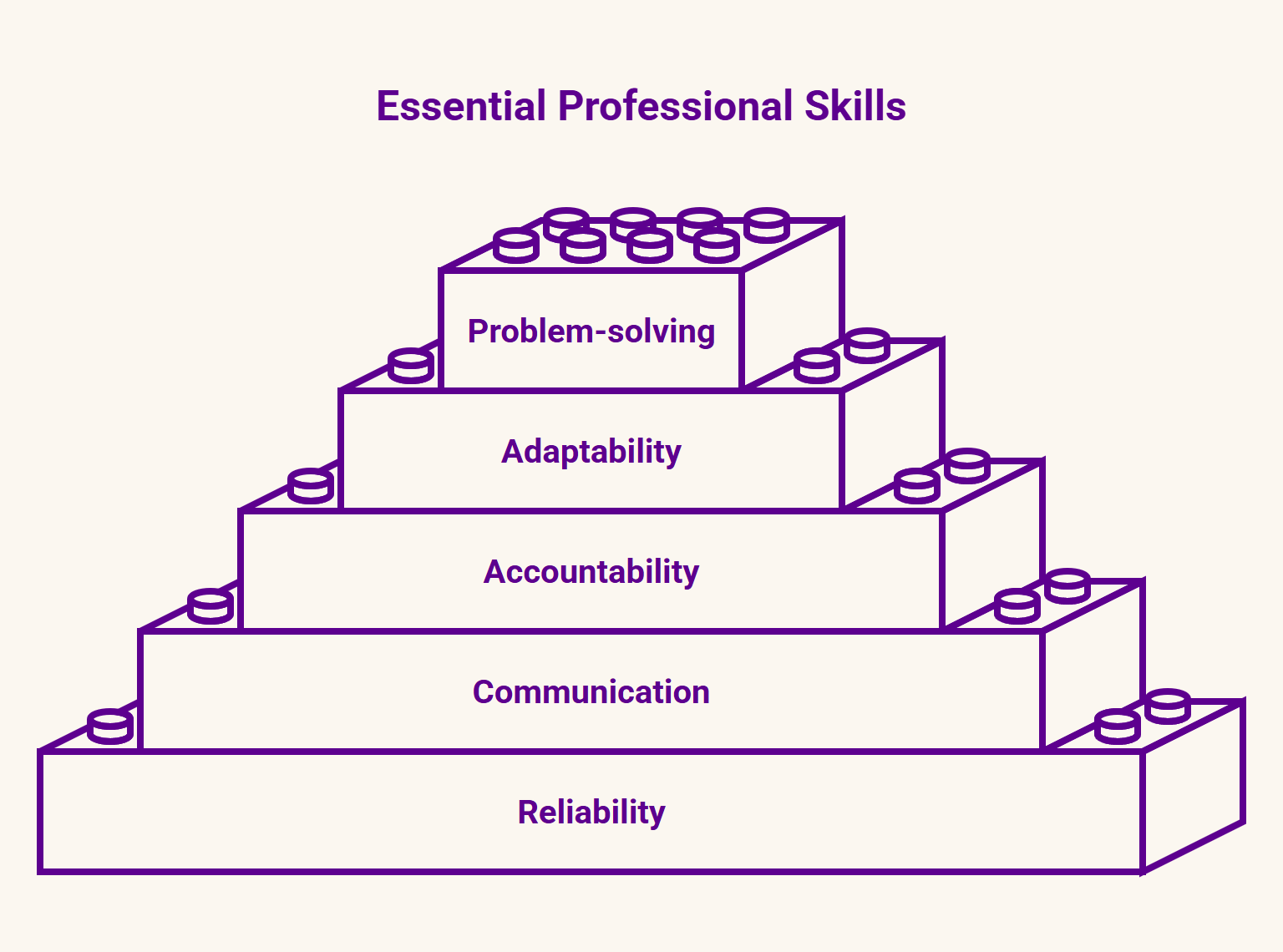
- The 5 strengths that travel across any role: reliability, communication, accountability, adaptability and problem-solving.
- The 5 weaknesses named most often: disorganisation, poor time management, procrastination, avoiding difficult conversations, perfectionism.
- A weakness is safe to admit when it is skill-based, specific, and already being worked on.
- Close a weakness by naming the behaviour, agreeing one first step, then checking it moved.
Four questions, about a minute. You get a straight read on whether your reviews run on evidence or on impression, and one specific thing to change before you write the next one.

Train teams faster and more effectively with AI
An employee strength is a behaviour that shows up in results, like flagging a risk early instead of letting it land as a surprise. A weakness is one that gets in the way, like leaving the hard task until the deadline forces it. Both are only useful once you can describe them as something the person actually does. "Strong communicator" is a label. "Sends the update before anyone has to ask for it" is evidence you can point at.
I cofounded a software company and manage most of our team out of the Perth office, so I write the performance reviews myself. There's no HR department between me and the conversation. The mistake I made for years was writing something like "needs to improve time management" and leaving it there. A year later I'd read the same sentence back, having watched nothing change, because a weakness with no fix attached is just a complaint.
So below you get 20 strengths, each with the behaviour that reveals it and a sentence you can adapt for a review. Then 20 weaknesses, each with a first step and the kind of training that closes it. After that, ready-made review sentences sorted by whether someone is exceeding, meeting or falling short. And the part I got wrong for longest: what happens when a strength is overused and starts reading as a fault.
What are employee strengths?
Employee strengths are the skills, habits and traits a person brings to the work, visible in what they produce. Communication, problem-solving, reliability, technical skill, time management and leadership are the common ones.
The test I apply now is whether I can point at a result. Staying calm is a personality trait. Holding a team together through a broken release is a strength, because something happened and something followed.
Someone can be excellent at one kind of strength and ordinary at the rest. That's normal, and it's worth saying out loud in a review, because the alternative is a person who reads their own assessment as a list of things they're failing to be.
Disengagement on that scale, measured in Gallup's State of the Global Workplace, isn't fixed by recognition alone. The cheapest thing available to a manager is noticing what someone is already good at and giving them more of it.
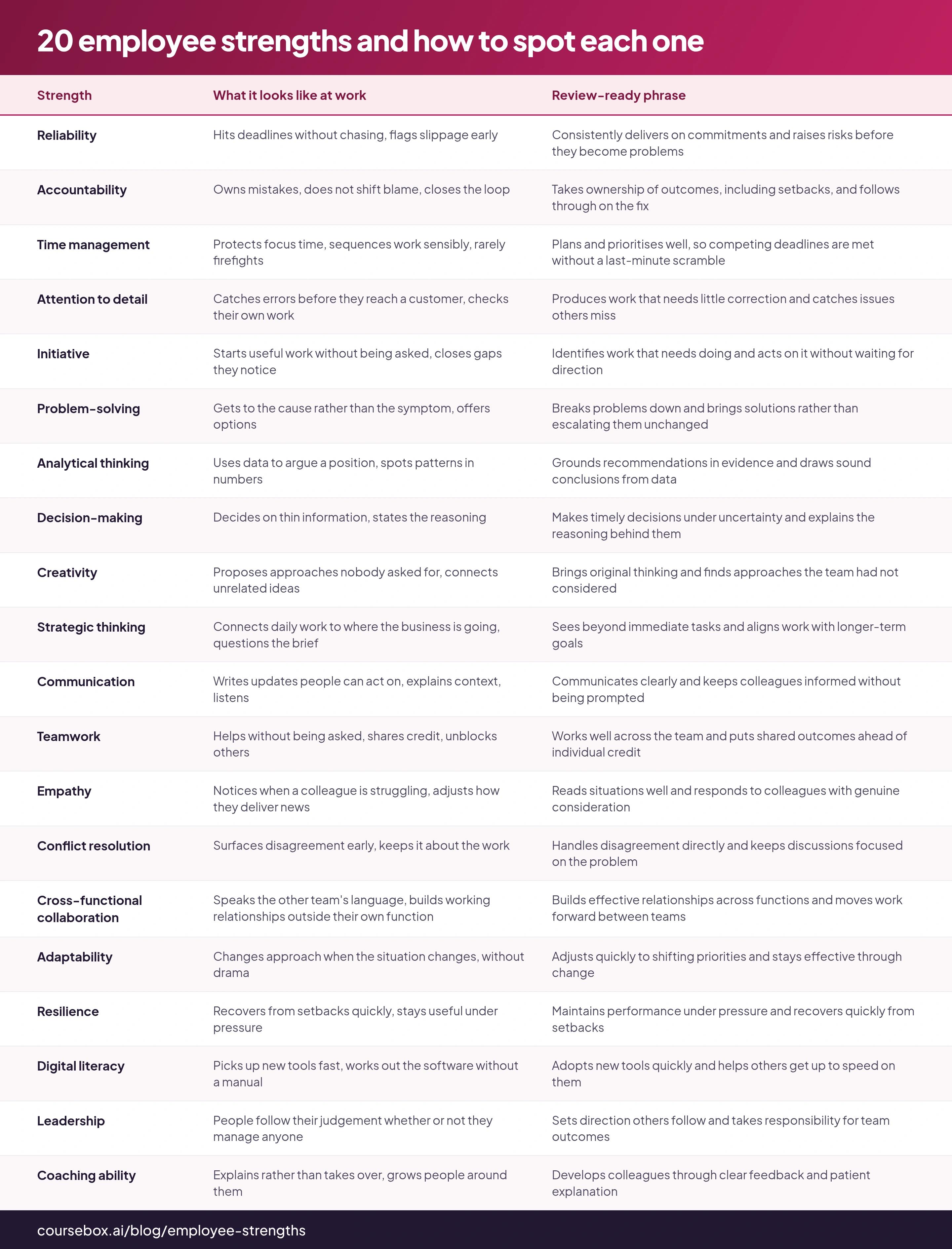
20 employee strengths and how to spot each one
These run in four groups of five: how someone handles their own work, how they think, how they work with other people, and how they handle change and bring others through it. The middle column is the tell, the behaviour you can cite. The last column is a sentence you can lift into a review and adjust with your own example.
| Strength | What it looks like at work | Review-ready phrase |
|---|---|---|
| Reliability | Hits deadlines without chasing, flags slippage early | Consistently delivers on commitments and raises risks before they become problems |
| Accountability | Owns mistakes, does not shift blame, closes the loop | Takes ownership of outcomes, including setbacks, and follows through on the fix |
| Time management | Protects focus time, sequences work sensibly, rarely firefights | Plans and prioritises well, so competing deadlines are met without a last-minute scramble |
| Attention to detail | Catches errors before they reach a customer, checks their own work | Produces work that needs little correction and catches issues others miss |
| Initiative | Starts useful work without being asked, closes gaps they notice | Identifies work that needs doing and acts on it without waiting for direction |
| Problem-solving | Gets to the cause rather than the symptom, offers options | Breaks problems down and brings solutions rather than escalating them unchanged |
| Analytical thinking | Uses data to argue a position, spots patterns in numbers | Grounds recommendations in evidence and draws sound conclusions from data |
| Decision-making | Decides on thin information, states the reasoning | Makes timely decisions under uncertainty and explains the reasoning behind them |
| Creativity | Proposes approaches nobody asked for, connects unrelated ideas | Brings original thinking and finds approaches the team had not considered |
| Strategic thinking | Connects daily work to where the business is going, questions the brief | Sees beyond immediate tasks and aligns work with longer-term goals |
| Communication | Writes updates people can act on, explains context, listens | Communicates clearly and keeps colleagues informed without being prompted |
| Teamwork | Helps without being asked, shares credit, unblocks others | Works well across the team and puts shared outcomes ahead of individual credit |
| Empathy | Notices when a colleague is struggling, adjusts how they deliver news | Reads situations well and responds to colleagues with genuine consideration |
| Conflict resolution | Surfaces disagreement early, keeps it about the work | Handles disagreement directly and keeps discussions focused on the problem |
| Cross-functional collaboration | Speaks the other team's language, builds working relationships outside their own function | Builds effective relationships across functions and moves work forward between teams |
| Adaptability | Changes approach when the situation changes, without drama | Adjusts quickly to shifting priorities and stays effective through change |
| Resilience | Recovers from setbacks quickly, stays useful under pressure | Maintains performance under pressure and recovers quickly from setbacks |
| Digital literacy | Picks up new tools fast, works out the software without a manual | Adopts new tools quickly and helps others get up to speed on them |
| Leadership | People follow their judgement whether or not they manage anyone | Sets direction others follow and takes responsibility for team outcomes |
| Coaching ability | Explains rather than takes over, grows people around them | Develops colleagues through clear feedback and patient explanation |
You won't find all 20 in one person, and you shouldn't expect to. I've never written a review that needed more than three, and the ones that read as thorough because they list eight are the weakest reviews I've written.
Below, what each one actually means when you sit down to write about it, including the ones that get confused with each other.
1. Reliability
The most undervalued strength on the list, because it only becomes visible when it stops. Nobody notices the person who never misses a handover until the week they do. When you write this one up, cite the thing that didn't happen: no escalations, no chasing, no missed dependency.
2. Accountability
Often confused with reliability, and they're different. Reliability is delivering. Accountability is what happens when delivery fails. The tell is the first sentence out of someone's mouth when something breaks, and whether it's about the cause or about who is responsible.
3. Time management
Not the same as working long hours, and it's usually the opposite. Someone with real time management finishes earlier and looks less busy, which is why it gets under-credited in reviews. Look at what they protect rather than what they complete.
4. Attention to detail
The one most likely to become a weakness if it isn't bounded, so pair it with an outcome when you write it. "Catches errors before customers do" is a strength. "Reviews everything twice regardless of stakes" is the same trait costing you a week.
5. Initiative
The gap between doing the job and owning it. Initiative shows up as work you didn't ask for that obviously needed doing. Its absence is not laziness. It is usually someone who has learned that unrequested work gets ignored, which is a management problem rather than a personal one.
6. Problem-solving
Everyone claims this, so the evidence has to be specific. The distinction is whether someone fixes the instance or the cause. A person who resolves the same ticket forty times is hard-working. A person who makes it stop arriving is a problem-solver.
7. Analytical thinking
Shows up as someone changing their mind when the numbers say so, which is rarer than producing a chart. The strength is not comfort with data. It is willingness to let data overrule an opinion they had already stated publicly.
8. Decision-making
Judge this on decisions made with incomplete information, because with complete information anyone can decide. The people who look strongest here are usually the ones who state the reasoning at the time, so a wrong call still leaves something the team can learn from.
9. Creativity
The most misattributed strength in reviews. It rarely looks like a new idea in a meeting. It looks like someone connecting two things nobody had put together, often quietly, often in a solution that ends up seeming obvious afterwards.
10. Strategic thinking
The tell is someone questioning the brief rather than executing it faster. This is uncomfortable to manage and easy to mistake for resistance, which is why it gets punished in reviews more often than it gets rewarded.
11. Communication
The strength with the widest gap between how it's judged and what matters. Confident speakers get credit; clear writers get overlooked. In distributed teams the written half carries more weight, so weight it accordingly when you write the review.
12. Teamwork
Hard to evidence because good teamwork is invisible by design. The practical test is to ask who unblocks other people, then check whether their own output looks slightly lower as a result. That dip is usually the evidence.
13. Empathy
Not agreeableness. Empathy is reading a situation accurately and adjusting, which sometimes means delivering hard news better rather than avoiding it. Someone who never says anything difficult is not demonstrating empathy, they're avoiding conflict.
14. Conflict resolution
The rare strength that costs the person something to use. Surfacing a disagreement early is unpleasant and makes you briefly unpopular, so people who do it consistently are worth naming explicitly, because the alternative is a team where problems arrive late and fully formed.
15. Cross-functional collaboration
Speaking another team's language well enough that work moves without a meeting. Undervalued because the benefit lands on somebody else's numbers, which is exactly why it needs writing down where their own manager can see it.
16. Adaptability
Judge it on the second and third change, not the first. Almost everyone absorbs one reorganisation well. The strength is staying effective through repeated change, and the people who have it tend to ask what stays the same rather than what's moving.
17. Resilience
Distinct from tolerance for pressure. Resilience is the speed of recovery, not the ability to keep absorbing indefinitely, and treating the second as a strength is how you burn out your most reliable people while praising them for it.
18. Digital literacy
The compounding one. Someone who works out new software without a manual will absorb every tool you introduce for the rest of their time with you. It is also the easiest to test for in hiring and the one most often assumed rather than checked. The Future of Jobs Report 2025 puts technological literacy in the top three fastest-growing skills to 2030, alongside AI and big data, and networks and cybersecurity.
19. Leadership
Not a job title. The evidence is whether people bring them problems before they're required to, which happens well below the management line and is the single best predictor of who to promote.
20. Coaching ability
The strength that multiplies. A person who explains rather than takes over is slower this month and compounding by next quarter. It is also the one strong individual contributors most often lack, which is why promoting on output alone goes wrong so reliably. Gallup's estimate is that about one in ten people have the talent to manage well, so treat this as something to test for rather than assume.
What are employee weaknesses?
Employee weaknesses are gaps between what the role needs and what the person currently does. Naming one is not criticism. It is what makes a plan possible, and an unnamed weakness never gets addressed.
The split I use before writing anything down is skill or character, because the two need completely different responses. Skill-based and habit-based weaknesses, things like weak prioritisation, disorganisation or shaky presenting, respond to training and structure and usually close fast. Character-based weaknesses, the ones about honesty or how someone treats people, are rare and much harder to coach. Deciding which one I'm looking at is what tells me whether I'm booking a course or having a much harder conversation.
That's deliberate. Dishonesty and treating colleagues badly aren't on the list, because they aren't a training problem and a course won't touch them. If what you're looking at is one of those, you need a conversation and possibly a formal process, not a development plan.
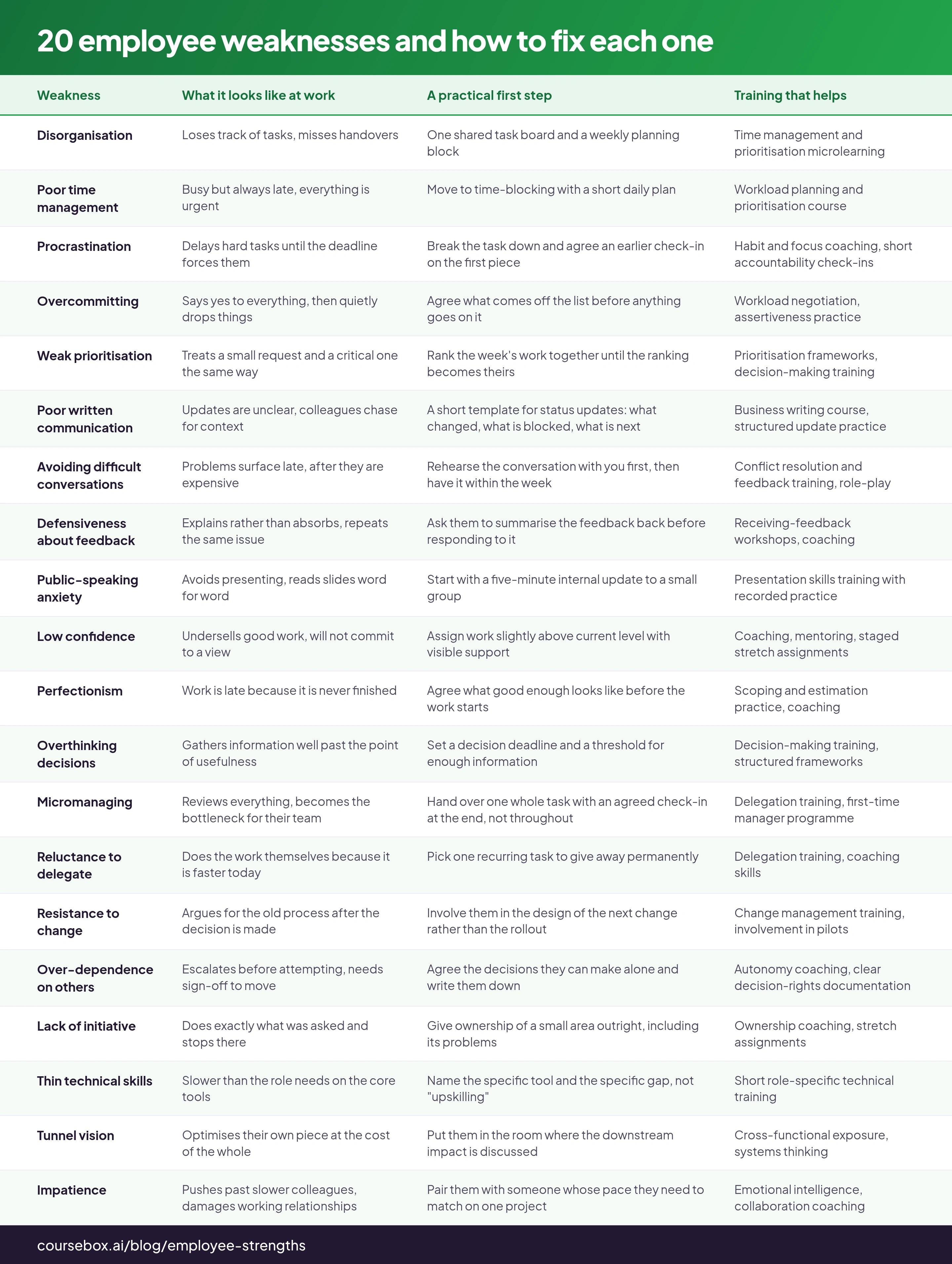
20 employee weaknesses and how to fix each one
The practical first step is the column that matters. A weakness with no path attached reads as criticism, and you already know your employee procrastinates. What I needed, the first few times I did this badly, was the sentence that comes after naming it.
| Weakness | What it looks like at work | A practical first step | Training that helps |
|---|---|---|---|
| Disorganisation | Loses track of tasks, misses handovers | One shared task board and a weekly planning block | Time management and prioritisation microlearning |
| Poor time management | Busy but always late, everything is urgent | Move to time-blocking with a short daily plan | Workload planning and prioritisation course |
| Procrastination | Delays hard tasks until the deadline forces them | Break the task down and agree an earlier check-in on the first piece | Habit and focus coaching, short accountability check-ins |
| Overcommitting | Says yes to everything, then quietly drops things | Agree what comes off the list before anything goes on it | Workload negotiation, assertiveness practice |
| Weak prioritisation | Treats a small request and a critical one the same way | Rank the week's work together until the ranking becomes theirs | Prioritisation frameworks, decision-making training |
| Poor written communication | Updates are unclear, colleagues chase for context | A short template for status updates: what changed, what is blocked, what is next | Business writing course, structured update practice |
| Avoiding difficult conversations | Problems surface late, after they are expensive | Rehearse the conversation with you first, then have it within the week | Conflict resolution and feedback training, role-play |
| Defensiveness about feedback | Explains rather than absorbs, repeats the same issue | Ask them to summarise the feedback back before responding to it | Receiving-feedback workshops, coaching |
| Public-speaking anxiety | Avoids presenting, reads slides word for word | Start with a five-minute internal update to a small group | Presentation skills training with recorded practice |
| Low confidence | Undersells good work, will not commit to a view | Assign work slightly above current level with visible support | Coaching, mentoring, staged stretch assignments |
| Perfectionism | Work is late because it is never finished | Agree what good enough looks like before the work starts | Scoping and estimation practice, coaching |
| Overthinking decisions | Gathers information well past the point of usefulness | Set a decision deadline and a threshold for enough information | Decision-making training, structured frameworks |
| Micromanaging | Reviews everything, becomes the bottleneck for their team | Hand over one whole task with an agreed check-in at the end, not throughout | Delegation training, first-time manager programme |
| Reluctance to delegate | Does the work themselves because it is faster today | Pick one recurring task to give away permanently | Delegation training, coaching skills |
| Resistance to change | Argues for the old process after the decision is made | Involve them in the design of the next change rather than the rollout | Change management training, involvement in pilots |
| Over-dependence on others | Escalates before attempting, needs sign-off to move | Agree the decisions they can make alone and write them down | Autonomy coaching, clear decision-rights documentation |
| Lack of initiative | Does exactly what was asked and stops there | Give ownership of a small area outright, including its problems | Ownership coaching, stretch assignments |
| Thin technical skills | Slower than the role needs on the core tools | Name the specific tool and the specific gap, not "upskilling" | Short role-specific technical training |
| Tunnel vision | Optimises their own piece at the cost of the whole | Put them in the room where the downstream impact is discussed | Cross-functional exposure, systems thinking |
| Impatience | Pushes past slower colleagues, damages working relationships | Pair them with someone whose pace they need to match on one project | Emotional intelligence, collaboration coaching |
The training column stays specific on purpose. A weakness closes faster with short practice tied to the exact behaviour than with a broad course booked once and forgotten. Mapping the real gaps first, with something like a skills gap analysis, keeps the training attached to the behaviour instead of to a budget line.
Notice how many of the fixes are behavioural rather than technical. Communication, conflict and delegation are the gaps that show up most in reviews, and they respond to practice and role-play, not to content. That's a different thing to run, and it's why teaching soft skills gets handled badly so often.
Below, what's usually underneath each one. Most of these have a cause that isn't the obvious one, and naming the wrong cause is how a development plan fails politely.
1. Disorganisation
Almost never a character trait. It is a system that worked at a smaller scale and stopped, usually when the person's remit grew and nobody revisited how they track things. Ask when it started rather than why they're like this.
2. Poor time management
The word "busy" is the diagnostic. Someone who is actually overloaded and someone who is poorly organised both look busy, and they need opposite responses. Count the work before you coach the habit, because coaching an overloaded person on planning is insulting and it does not work.
3. Procrastination
Usually avoidance of one specific feeling, not of work generally. The task being delayed is normally ambiguous, high-stakes or requires asking someone for something. Find which, and the fix follows from it rather than from discipline.
4. Overcommitting
The most common weakness in your best people, and the one managers cause. If saying yes has always been rewarded and saying no never modelled, this is learned behaviour. Fix your own signals before you put it in their review.
5. Weak prioritisation
Often an information problem rather than a judgement problem. Someone who doesn't know what matters to the business will rank by whoever asked most recently, which is rational given what they know. Check they have the context before you conclude they can't prioritise.
6. Poor written communication
Highly trainable, and it does more damage than its reputation suggests, because unclear writing costs every reader time rather than only the writer. A single template for status updates fixes more of this than a course does, and it works within a week.
7. Avoiding difficult conversations
Costs more than any other item on this list, because the problems it hides compound quietly. The person usually knows they're avoiding it. Rehearsing the conversation once with you is more effective than any amount of encouragement.
8. Defensiveness about feedback
Look at the delivery before the reaction. Defensiveness is sometimes a person, and sometimes feedback arriving as a surprise in a formal setting. If your reviews contain news, you have built the defensiveness yourself.
9. Public-speaking anxiety
Extremely common, rarely role-critical, and often over-weighted in reviews because it's visible. Fixable with graduated exposure, but first check the role actually requires it rather than assuming seniority means presenting.
10. Low confidence
Frequently mistaken for low competence, and the two produce different work. A person who undersells accurate work needs different handling from one who oversells weak work. Assign slightly beyond current level with visible backing, then let the evidence do it.
11. Perfectionism
Not a humble-brag when it is real, and it is expensive. The fix is agreeing what good enough looks like before the work starts, because after it starts the standard is already personal and arguing about it feels like an attack.
12. Overthinking decisions
Almost always a consequence-of-being-wrong problem rather than an information problem. If wrong calls have been punished, gathering more data is a rational defence. Change the safety, then set a decision deadline.
13. Micromanaging
Usually a first-time manager who was promoted for personal output and has had no training in anything else. Treat it as a skills gap in a new role rather than a personality fault, because that is what it almost always is. It is also the weakness with the widest blast radius: Gallup estimates managers account for at least 70% of the variance in team engagement, so one untrained manager moves a whole team's numbers.
14. Reluctance to delegate
The honest version of this is that delegating is slower today and faster in a month, and the person is optimising for today under real pressure. Reduce this month's pressure or the behaviour won't move.
15. Resistance to change
Worth listening to before correcting. The people who resist hardest often understand the current process best, and sometimes they are right. Involve them in designing the next change rather than only in absorbing it.
16. Over-dependence on others
Frequently an authority problem, not a confidence one. If nobody has said which decisions they may make alone, checking first is correct behaviour. Write the decision rights down and most of this disappears.
17. Lack of initiative
Before you write this, check whether previous initiative was welcomed. This is the weakness most likely to be caused by the environment rather than the person, and the most damaging to name wrongly.
18. Thin technical skills
The only item here that is purely a knowledge gap, which makes it the easiest to fix and the most often described vaguely. "Needs to upskill" is useless. Name the tool, name the task they can't yet do, and the training picks itself.
19. Tunnel vision
A structural symptom as much as a personal one. People optimise what they are measured on, so someone protecting their own numbers at the expense of the whole is usually responding correctly to your incentives. Check those first.
20. Impatience
Often the shadow of drive, so handle it as an overshoot rather than a fault. The damage is to relationships and it is real, but the underlying urgency is something you want. Name the behaviour with colleagues, keep the standard.
Which weaknesses are safe to admit
Two people need this answer. Someone about to name their own weakness in a review or an interview, and the manager hearing it who has to decide what it tells them.
The safe ones share three things. They are skill-based rather than character-based, so there is a route out. They are specific enough to be checked, which signals the person has actually looked at their own work. And they arrive with something already being done about them. A weakness admitted with a first step attached reads as self-awareness. The same weakness admitted alone reads as a warning.
The unsafe ones are the mirror image: anything about honesty or how someone treats people, and anything central to the job you are asking them to do. Presenting nerves are fine in an analyst and a serious problem in a sales lead. Context decides, not the weakness.
| What gets said | What it actually tells you |
|---|---|
| I put things off until the deadline | Usually avoidance of one specific kind of task. Ask which, and you learn where they need support |
| I take on too much and drop things | Often caused by a workplace that rewarded saying yes. Says more about their last manager than about them |
| I am slow to make decisions without full information | Cautious under uncertainty. A real cost in fast roles, an asset in risky ones |
| I struggle to speak up in large meetings | Very common, very trainable, and rarely relevant to the actual job |
| I am not confident presenting | Fixable with graduated practice. Check the role needs it before treating it as a problem |
| I get impatient with slower colleagues | Honest and uncomfortable to say. Usually the shadow of drive, and worth taking seriously for its effect on others |
| I am a perfectionist | The answer everyone gives. Treat it as a non-answer and ask for a real one |
That last row is the one I would push back on. Perfectionism has become the reflex answer, so it now tells you almost nothing except that the person is managing the conversation. When I hear it I ask what they missed a deadline for, and the real answer usually arrives straight after.
Performance review phrases for each level
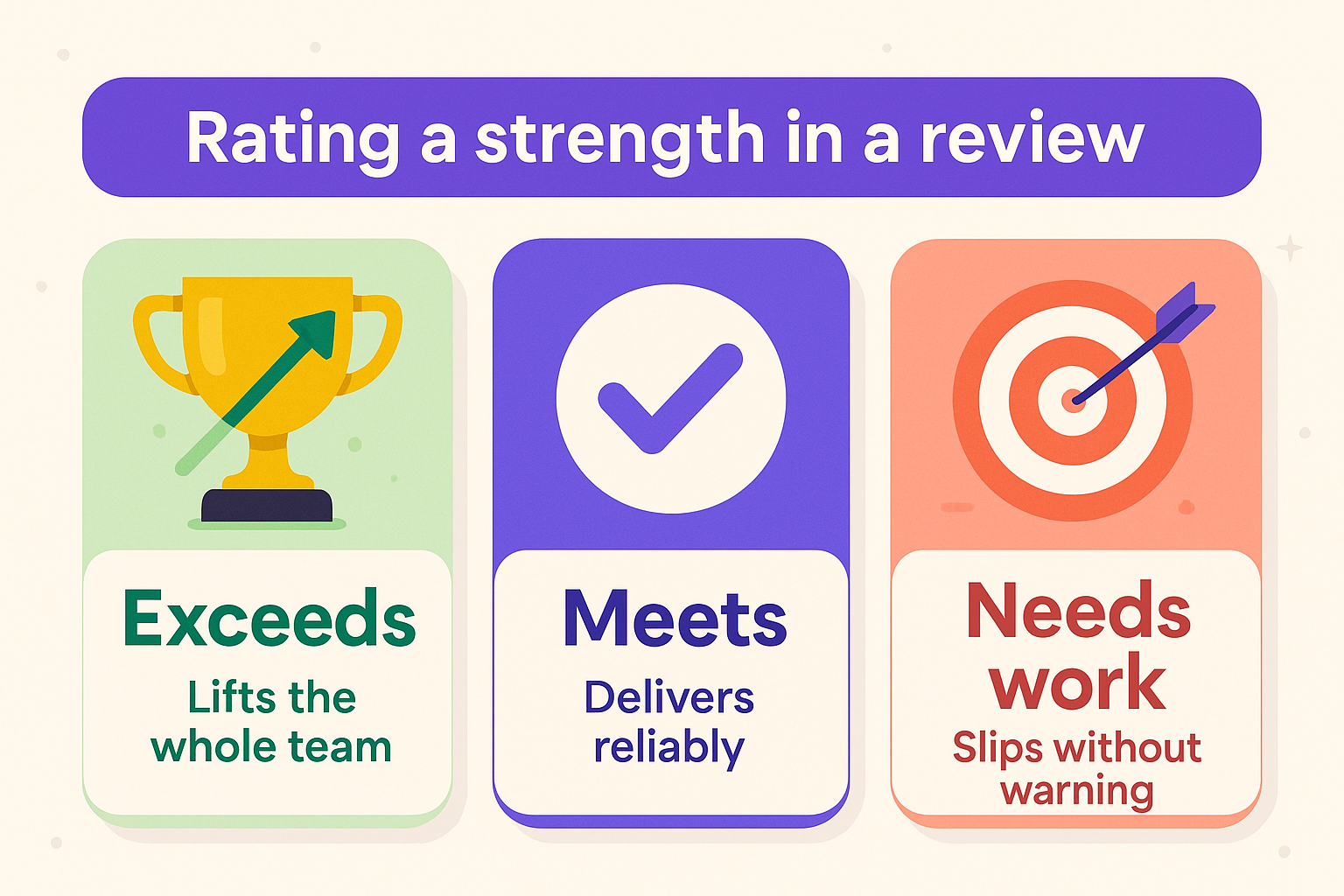
Sorted by performance level, because that's the axis a review form actually works along and the one I was always translating back to in my head. Adapt the wording and add your evidence. The sentence is the frame, the specific example is what makes it land.
| Trait | Exceeds expectations | Meets expectations | Needs improvement |
|---|---|---|---|
| Communication | Sets the standard for clear updates and unblocks others by explaining context well | Communicates clearly and keeps the team informed | Updates are late or unclear, and colleagues have to chase for context |
| Reliability | Delivers ahead of commitments and is the person others plan around | Meets commitments and flags risks in good time | Deadlines slip without early warning, which forces others to replan |
| Accountability | Owns team outcomes, not only their own, and drives the fix | Takes ownership of their work and their mistakes | Tends to explain problems rather than own them |
| Time management | Protects focus time and still absorbs urgent work without disruption | Plans well and meets competing deadlines | Work is reactive, and priorities are set by whoever asked most recently |
| Problem-solving | Solves problems at the cause and prevents the next one | Works problems through and brings options | Escalates problems unchanged, without an attempted solution |
| Teamwork | Lifts the people around them and shares credit deliberately | Works well with the team and helps when asked | Works in isolation, and hand-offs need chasing |
| Adaptability | Absorbs change and helps others through it | Adjusts to new priorities without losing pace | Change causes a visible drop in output or morale |
| Initiative | Finds and closes gaps nobody had noticed | Acts on obvious gaps without being asked | Waits for instruction, including on work clearly in their area |
Two rules keep these honest. Never write a line you can't back with an example from the review period, and treat the Needs improvement column as the opening of a plan rather than a verdict.
When a strength turns into a weakness
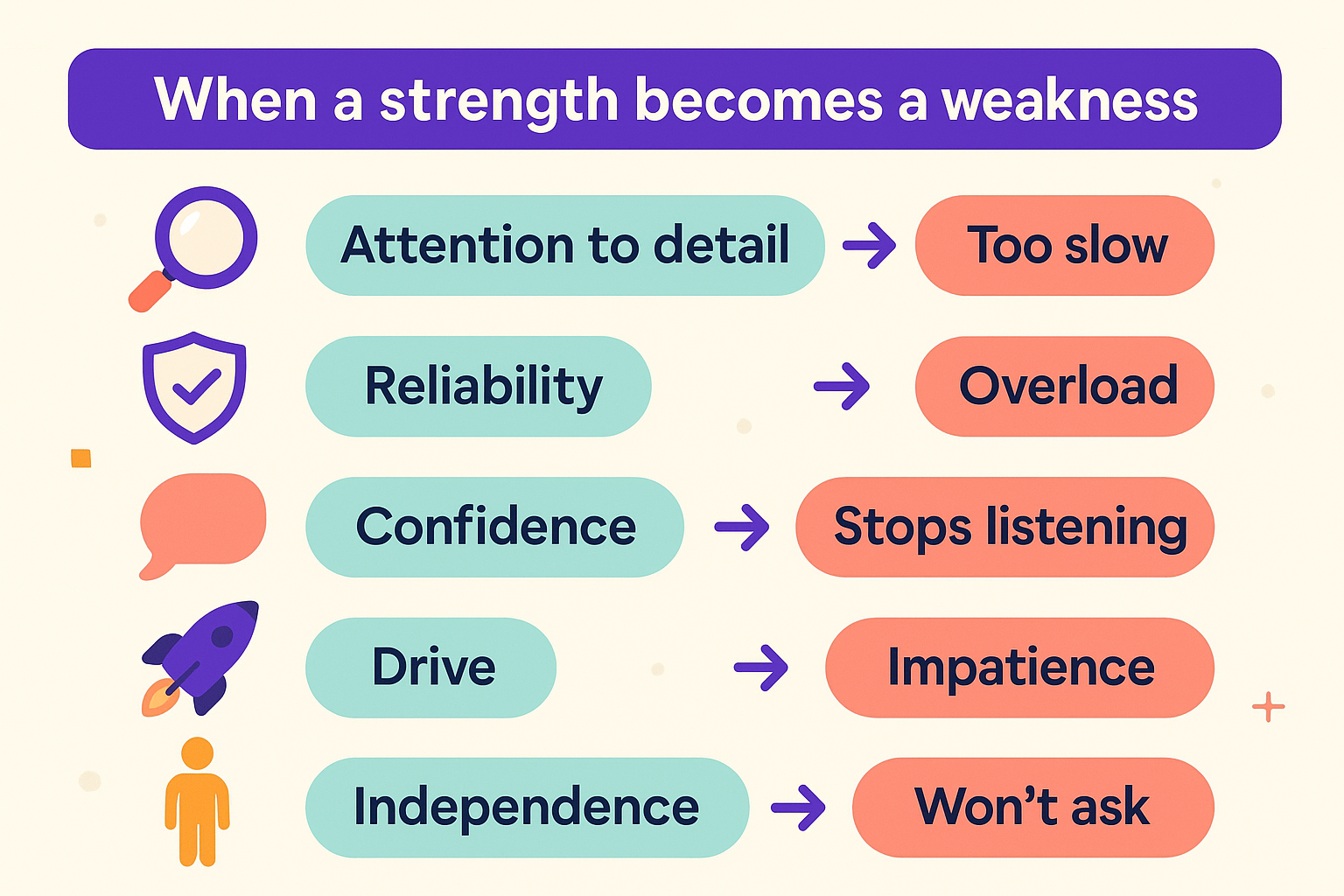
I've had the conversation where someone's best quality was also the thing burning them out, and I did not recognise it the first time. Most strengths have an overused version, and in a review it presents as a fault even though the root is a quality worth keeping. Robert Kaplan and Rob Kaiser made this case in Harvard Business Review in 2009, Stop Overdoing Your Strengths. Their example still lands: the highly supportive boss who cuts people too much slack.
Attention to detail becomes work that never ships. Reliability becomes an inability to say no, until the person is carrying more than anyone realises. Confidence becomes a habit of not listening. Drive becomes impatience with anyone slower. Independence becomes a refusal to ask for help until the problem is expensive.
The reviews I've written and later regretted are the ones where I logged an overused strength as a plain fault. The response isn't to blunt the strength. Name the one behaviour that has gone too far, and say plainly that the quality underneath it stays. A reviewer who writes "too much attention to detail" as a weakness and leaves it there has told the person their best quality is a problem. That's both wrong and the fastest way to lose them.
How to identify employee strengths and weaknesses
Most of what you need is already in front of you. In a small team everything is visible, which I assumed for a long time was the same as knowing it, and it's not. The discipline is looking at behaviour across a period rather than at one good or bad week.
- Watch the work directly. Note where someone speeds up and where they stall, and what kind of task each pattern attaches to.
- Read the results, not the effort. Outcomes, rework rates and how much chasing a person needs tell you more than how busy they look.
- Ask the people around them. Asking three colleagues who work with someone daily, which is what a 360-degree review does formally, surfaces patterns a manager one level up can't see.
- Let people assess themselves. Ask where they think they're strong and where they get stuck, then compare it with what you've observed. The gap between the two answers is usually the most useful conversation available, and a set of self-evaluation questions gives it structure.
Structured assessments help when you want shared language rather than a verdict. CliftonStrengths and the free VIA survey, which ranks 24 character strengths, both map what someone is naturally drawn to. DISC-style profiles describe working and communication styles. A full 360-degree review collects feedback from everyone around a person rather than only their manager.
For a whole team rather than one person, a skills matrix puts who can do what in a single grid. Any of these works as a prompt for a conversation, and none should be filed as a label. Watch for the known failure too: assessments reward confidence, and they can misread people who work or communicate differently from the norm.
How to turn a weakness into a strength
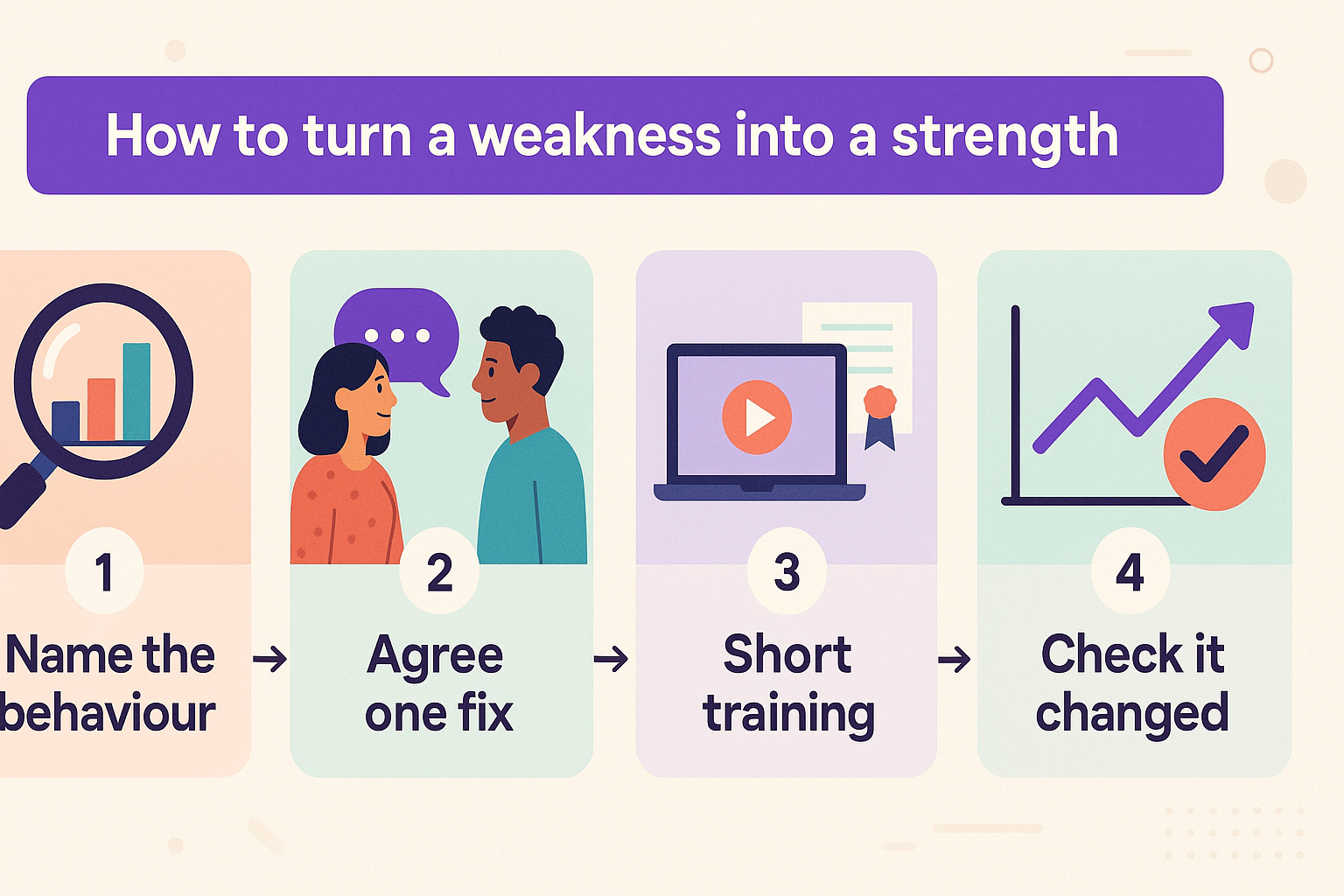
Start with the strengths. It's easier to take someone from good to excellent in an area they already care about than to drag a weakness from poor to average, and the return is usually larger. Gallup puts people who get to apply their strengths at six times as likely to be engaged at work. Give your strong people harder problems, room to mentor, and some say in how they work.
For the weaknesses, the sequence I use needs no software at all. Name the behaviour, not the trait. Agree one first step, small enough to start this week. Attach short practice to that exact behaviour. Then set an early check-in, well before the next review, to see whether it moved. The check-in is the step I skipped for years, and skipping it is what turns a review into an annual ritual. Write the four down as a development plan so the person can see the whole thing rather than remembering half a conversation.
That figure comes from the 2025 Workplace Learning Report. It's the argument for treating development as retention work rather than a perk, and keeping people is where the money actually is.
Most of the 20 weaknesses listed earlier close with one of four training methods. Short role-specific technical training covers tool gaps. Structured practice and role-play cover communication and conflict. Planning sessions cover prioritisation and time management. Regular short refreshers cover anything that carries real risk if it slips. Keep each one short: the microlearning format, meaning a single focused session rather than a full course, is what suits a gap this specific.
Then check it moved. Completion isn't evidence, so decide up front what you would see in the work if the behaviour had actually changed, which is the same discipline as measuring training effectiveness anywhere else.
Where a platform helps is at scale. Once you're tracking development for more than a handful of people, the matching is what falls apart in spreadsheets. Pairing a specific short course to a specific named gap, then checking whether the behaviour actually changed, is the job AI-built employee training exists to do. It turns material you already have into short assigned courses, without building each one from scratch.
I don't run our own team through a platform for this, and for a team this size I wouldn't recommend it. For five or ten people, a named behaviour, an agreed first step and a check-in in your calendar beats any system, and the manager's attention is doing the work either way. Tooling starts to be worth paying for when you can no longer hold the picture in your head, and you'll know when you cross that line.
So the next action, and the one I'd take first: pick one person, name one behaviour from the tables above, and agree one first step with them this week. A single specific fix that actually happens is worth more than a review document that names five.
Frequently Asked Questions
For strengths, the five that travel across almost any role are reliability, communication, accountability, adaptability and problem-solving. For weaknesses, the five most commonly named are disorganisation, weak time management, procrastination, avoiding difficult conversations and perfectionism. All five weaknesses are the fixable kind, which is why they're safe to name openly.
Reliability, communication, accountability, adaptability and problem-solving. They show up in results rather than in personality, they're visible in day-to-day behaviour, and they hold their value whether someone is an individual contributor or a manager.
A strength is something like initiative, visible when a person starts useful work without being asked. A weakness is something like weak prioritisation, visible when a small request and a critical one get the same treatment. The 40 examples above pair each one with the behaviour that reveals it, so you can cite evidence rather than a label.
Disorganisation, poor time management, procrastination, overcommitting, weak prioritisation, poor written communication, avoiding difficult conversations, defensiveness about feedback, perfectionism and micromanaging. Every one is skill-based or habit-based, and every one closes with short targeted practice tied to the specific behaviour.
One that is skill-based rather than about character, specific enough to be checked, and already has a first step attached. Putting things off, taking on too much, and nerves about presenting all qualify, because each has a route out. Avoid anything touching honesty, and anything central to the job itself. Perfectionism is now the reflex answer and reads as managing the conversation rather than answering it.
Name the behaviour, agree one specific first step, attach short practice to that exact behaviour, and set an early check-in to see whether it moved. Overthinking becomes a decision deadline and a good-enough threshold. Disorganisation becomes a shared task board and a weekly plan. The change comes from something small and repeated, not from one conversation.
Alex Hey
Digital marketing manager and growth expert

