

Cross-Training Employees: Definition, Benefits and How to Plan It
Learn what cross-training employees means, which tasks to cross-train first, and how to prove a backup can cover them before anyone is away.

Cross-training teaches employees the tasks of another role, so work continues when a colleague is absent or overloaded.
- The first tasks to cross-train are the ones only one person can do, where an absence would stop work or put customers or safety at risk.
- A backup counts as cover only after doing the task alone to the required standard, not after watching it done.
- Cross-training adds a second skill while the person keeps their own job, whereas job rotation moves the person into another job for a set period.
- Moving between tasks within a day can slow people down, so backups learn best in blocks of practice and need regular use to keep the skill.

Train teams faster and more effectively with AI
What Is Employee Cross-Training?
Cross-training teaches employees the tasks of another role, so work continues when a colleague is absent or overloaded. The employee keeps their own job and learns a defined second task, such as a receptionist learning the end-of-day cash reconciliation or a warehouse picker learning to receive deliveries.
Organisations use it to protect work that depends on one person, to absorb busy periods without hiring, and to give staff a wider view of how the business runs. It is one of the common types of employee training, but it is defined by its purpose, cover, rather than by its topic.
Because the term also has a fitness meaning, business writing often says "employee cross-training" or "cross-skilling", and "multiskilling" when one person holds several trained skills.
Cover exists only for tasks a backup has already performed alone. Someone who has watched a task a few times is an observer, and will need help on the day the owner is away.
What Are the Benefits of Cross-Training Employees?
The benefits fall into three groups: what the organisation gains, what the employee gains and what changes between colleagues.
1. Organisational Flexibility and Agility
A cross-trained team can absorb sick leave, holidays, resignations and peaks without stopping work or paying for temporary staff. The gain is largest where one person holds a task nobody else can do, because that person's absence would otherwise halt the work behind them.
What it protects: continuity of a named task, such as payroll on pay day or the morning stock delivery.
2. Employee Engagement and Development
Learning a second task gives employees variety and a broader picture of the business, and it can prepare them for a later move. In the bank study described below, workers who had spread their experience across more tasks were less likely to leave.
What it protects: retention, and a pool of people ready to step into an internal vacancy.
3. Team Collaboration and Communication
People who have done a colleague's task understand what that colleague needs from them, such as which details a handover note must contain. Shared skills also reduce the queue that forms when everyone waits for the one person who knows.
What it protects: smoother handovers and fewer errors at the points where work passes between people.
How to Plan a Cross-Training Program
A cross-training program starts from the tasks at risk, not from a list of courses. The steps below use an illustrative small inn as the running example (roles, counts and dates are invented): about a dozen staff covering reception, the restaurant, the kitchen and housekeeping.
1. List the Tasks Only One Person Can Do
The manager sits with each team member for half an hour and lists the tasks they do in a normal week and month, then marks any task nobody else can perform.
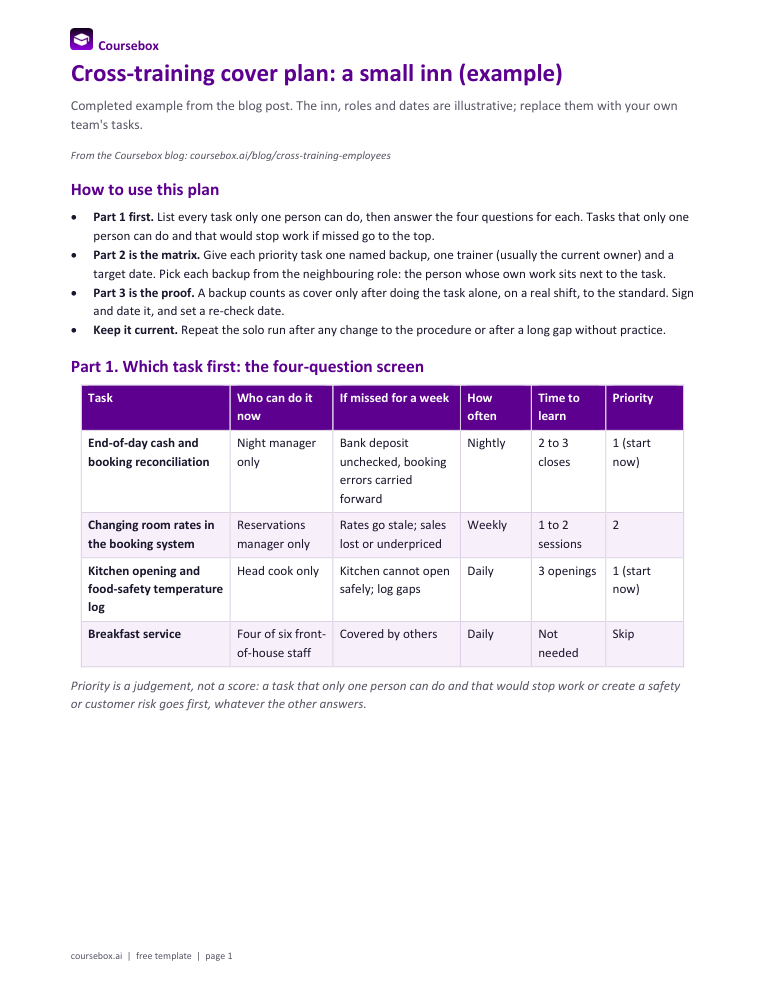
At the inn, that list includes the end-of-day cash and booking reconciliation, changing room rates in the booking system, and opening the kitchen with its food-safety temperature log.
Done when: every single-person task is written down, with the name of the person who holds it.
2. Rank Them With Four Questions
The manager scores each task on four questions: how many people can do it today, what happens if it is missed for a week, how often it occurs, and how long a capable person needs to learn it. Tasks that only one person can do and that would stop work if missed go first.
At the inn, the cash reconciliation ranks first because it runs every night and a missed close leaves the bank deposit unchecked. Breakfast service ranks last, because four of six front-of-house staff can already run it. A skills matrix helps here if the team already keeps one.
Done when: the list is in priority order and the top three have a start date.
3. Choose the Backup From the Neighbouring Role
The manager picks a backup for each priority task, starting with the person whose own work sits next to it.
This is a light version of "skill chaining", where each person learns the task next to their own so that skills overlap. A 2004 study in Management Science by Hopp, Tekin and Van Oyen concluded that chaining can be an efficient way to build workforce flexibility, based on models of production lines.
At the inn, the front desk lead backs up the night manager's reconciliation, the reservations clerk backs up rate changes, and the kitchen assistant backs up the kitchen opening. Nobody learns every task.
Done when: each priority task has one named backup and one named trainer, usually the current owner.
Aim first for two people on every critical task, then widen. A third person on a task that is already covered adds less protection than a second person on one that is not.
4. Train From the Written Procedure
The task owner writes down how they do the task as a step-by-step standard operating procedure, including the checks they make without thinking. The backup reads it, then does the task with the owner beside them.
Where no procedure exists, writing one is the first deliverable, and a course-authoring tool can turn that procedure into a short lesson with a quiz the backup can revisit later.
At the inn, the night manager writes the reconciliation steps, and the front desk lead runs three closes with the night manager watching.
Done when: the procedure is saved where the team can find it, and the backup has completed the task with help.
5. Prove the Cover With a Solo Run
The trainer watches the backup do the task alone, on a real shift, without stepping in, and signs the matrix only if the result meets the standard.
A short knowledge check, such as a quiz built from the same procedure, confirms the steps are understood, but the solo run is the proof. An observation checklist keeps the sign-off consistent.
Done when: the matrix shows a signed, dated solo run. Repeat it after any change to the procedure or after a long gap, because unused skills fade.
The finished plan fits on one page. Here is the inn's coverage matrix, with each backup's target and the check that will prove it.
| Task | Who can do it now | Backup and target | Verified by |
|---|---|---|---|
| End-of-day cash and booking reconciliation | Night manager only | Front desk lead, by week 6 | Two unaided closes, checked against the deposit |
| Changing room rates in the booking system | Reservations manager only | Reservations clerk, by week 4 | One solo change, checked next morning |
| Kitchen opening and temperature log | Head cook only | Kitchen assistant, by week 8 | Three solo openings, log reviewed by the head cook |
| Breakfast service | Four of six front-of-house staff | None needed | Already covered |
A Word plan for one team: screen each task with the four questions, record backups and target dates in the coverage matrix, and sign each solo run. Includes the completed inn example.
Hoshino Resorts: One Team Across Four Duties
Hoshino Resorts, a Japanese family hotel business with more than 100 years of history, trains its employees to work across all duties rather than specialising in reception, housekeeping or the kitchen, CNBC reported in 2017. Chief executive Yoshiharu Hoshino said the practice lets staff deliver "the ultimate experience" for guests.
The company's recruitment pages name the four duties it treats as fundamental skills: restaurant service at breakfast and dinner, front service at check-in and check-out, cooking assistance such as plating and washing up, and guest-room cleaning. The stated aim is more contact points with each guest.
Hoshino answers the first three steps of the plan in the widest way possible: every duty is on the list, and everyone backs up everyone. That suits duties that peak at different hours, because staff trained in all four can be placed wherever the shift is busiest.
A team with one or two single-person tasks can get the cover it needs from the targeted plan above instead. The published sources do not describe how Hoshino checks that someone is ready to work a duty alone, which is the job of the solo run.
What Are the Disadvantages of Cross-Training Employees?
Every hour a task owner spends training is an hour away from their own work. The plan above is built to limit five costs in particular.
- Lost output while training: the task owner trains instead of working, and the backup works more slowly at first.
- Switching cost: moving between tasks within a day slows people down, as the bank study below measured.
- Skill fade: a backup who rarely performs the task forgets it, so cover on paper may fail in practice.
- Spread too thin: training everyone on everything takes time from the core job and can lower quality in both roles.
- Pay and fairness questions: staff asked to cover extra roles may expect recognition, and rosters must not turn cover into a permanent second job without saying so.
In a team our size, one absence shows up across the whole company within a week. So I check the roster as well as the training: a backup who works the owner's days is not cover.
One field study measured the switching cost directly, on a busy home loan processing line in Japan.

Case study: Task variety on Shinsei Bank's home loan line
Shinsei Bank, a mid-sized Japanese bank, processed home loan applications on an internal line of 17 human stages, such as data capture and credit checks. A system assigned each worker the next task as they finished the last, and workers were not trained as specialists in one stage.
- What was studied: Researchers Bradley Staats and Francesca Gino analysed every application from June 2007 to December 2009: 598,393 completed stages by 111 workers, after excluding short-stay temporary staff and managers.
- Within a day: each extra repetition of the same stage cut a worker's completion time more than work on other stages did, about 5.7 seconds against 2.0 seconds on an average transaction.
- Across days: over many tasks, the pattern reversed. Workers with more varied experience eventually overtook the specialists, which the authors link to experience on one stage helping on others, and higher variety was linked to a lower chance of leaving the bank.
- Lesson: keep a backup on one task for a block of time, and vary their tasks across days rather than within them.
The same working paper estimates the opposite effect within a single day: a worker kept on one stage would finish their 100th task about 3.8% faster than average, against 2.3% for one splitting the day across four stages. For a cross-training plan, that means scheduling practice in whole shifts or half-days, not in scattered half-hours.
Examples of Cross-Training in the Workplace
Each pairing below names the task, the backup and the check that proves the cover. The pattern is the same in every sector:
- Hotel front desk: a receptionist learns the night audit checked by two unaided closes.
- Payroll: an accounts payable officer learns the pay run, checked by running one cycle while the payroll officer reviews.
- Warehouse: a picker learns goods receiving, checked by booking in one delivery against the purchase order.
- Retail: shelf staff learn the checkout and the cash-up, checked by closing one register alone.
How Cross-Training Differs From Job Rotation and Upskilling
Several workplace practices widen what people can do. They differ in what moves: the task, the person or the level of skill.
A cross-trained employee keeps their job and can step into one more task when needed. A rotated employee leaves their job for a set period and does a different one full time.
| Practice | Main goal | What changes for the person | Typical length |
|---|---|---|---|
| Cross-training | Cover for named tasks | Learns a second task, keeps own job | Weeks per task |
| Job rotation | Broad experience and development | Moves into another job for a period | Months |
| Upskilling | Better performance in the current role | Deepens skills in own job | Ongoing |
| Job enlargement | More variety in one job | Takes on extra tasks permanently | Permanent change |
1. Cross-Training vs. Job Rotation
Job rotation moves a person through several jobs in turn, usually for development, such as a graduate rotating through finance, sales and operations. It is one form of internal movement between roles, and its aim is the person's growth rather than cover for a task.
2. Cross-Training vs. Upskilling and Reskilling
Upskilling deepens a person's skills in their current role, and reskilling prepares them for a different role. Cross-training sits between the two: it adds a neighbour's task without changing the person's role.
3. Cross-Training vs. Job Enlargement
Job enlargement permanently adds tasks to a job description. Cross-training keeps the extra task as standby cover, used when the owner is away or the workload peaks. If a backup ends up doing the task every day, the job has been enlarged and the pay and description should follow.
Explain It Like I'm Five
Cross-training is when two friends each learn how to feed the other's pet. If one friend goes away, the pet still gets fed, because the other friend has already done it once by themselves.
The Bottom Line
Cross-training teaches employees the tasks of another role so work continues through absences and peaks. Start with the tasks only one person can do, and count a backup only after a solo run.
Sources
- Staats, B. R. and Gino, F. Specialization and Variety in Repetitive Tasks: Evidence from a Japanese Bank. Harvard Business School Working Paper 11-015, 2011. Published in Management Science 58(6), 2012.
- Hopp, W. J., Tekin, E. and Van Oyen, M. P. Benefits of Skill Chaining in Serial Production Lines with Cross-Trained Workers. Management Science 50(1), 2004.
- CNBC. Interest in Japanese hospitality is growing, and this term may help explain it. 29 May 2017.
- Hoshino Resorts. Kai Alps inn management staff, job description. Recruitment page, read 19 November 2026.
Frequently Asked Questions
Cross-training teaches employees the tasks of another role, so work continues when a colleague is absent or overloaded. Each employee keeps their own job and learns one or more defined tasks they can cover when needed.
The main costs are lost output while the task owner trains the backup, slower work when people switch tasks within a day, skills that fade if rarely used, and staff spread too thin. Training in blocks and repeating a solo run after long gaps reduces them.
Cross-training adds a second task to a person's current job so they can cover it. Job rotation moves the person out of their job into a different one for a set period, usually for development.
Cross-training keeps work running when someone is sick, on leave or leaves the organisation, and it handles busy periods without extra hires. It also gives employees variety and prepares them for future roles.
Alex Hey
Alex Hey is a technical marketer with 10 years of hands-on growth and digital marketing experience. He cofounded Coursebox together with Travis Clapp who he met online when looking for a cofounder to build a globally impactful software product. He works in the Perth, Western Australia office as the COO. He built the world's first automated funnel for patient recruitment before building Coursebox. After launching Coursebox in mid 2023, he drove +400k organic sign ups for Coursebox. Alex leads the marketing and digital growth of Coursebox and works with the product development team bringing a passion for data-driven product decision and exceptional user experience. Alex is determined to build the world's easiest way to build the perfect course.

