

Coursera vs edX: I Compared Courses and Certificates (2026)
I enrolled in digital marketing on both Coursera and edX, compared the course styles first-hand, checked what each certificate gets you, and priced both.

Coursera suits career upskillers who want a brand-name certificate from Google, IBM or Meta; edX suits anyone who wants university teaching from Harvard, MIT or Maryland.
- Neither Coursera nor edX certificates outweigh the projects behind them: reviewers who asked recruiters directly heard they signal initiative and little more.
- Depends what you are buying: Coursera and edX build different courses, Google's certificate being job training around tools like Google Ads while my Maryland course on edX taught frameworks like a degree module.
- edX wins on one-course cost, $199 once for my test course; Coursera wins if you take several, with Plus covering 10,000+ courses at $399 a year.
- edX wins free sampling: I was inside a University of Maryland course in one click with no card, while every Coursera marketing course sent me to a 7-day card trial.
- Depends where you sit: Coursera quoted my account A$566 for the Plus year its US pages sell at $399, while edX priced everything in USD.
Answer 4 quick questions to figure out in seconds

Learn faster with AI powered courses, quizzes, and flashcards
I made new accounts on Coursera and edX one September morning and enrolled in a digital marketing course on each, Google's career certificate on one side and the University of Maryland's university course on the other. The two are different species. Google's page reads like a job description, all Google Ads and paid media, while Maryland's is a professor teaching marketing theory, and I watched those lectures myself.
The bigger question is whether these certificates actually help you get a job, so I dug into that too. The honest answer I kept finding: the certificate alone impresses nobody, and the projects you build during the course are what convince an employer.
In this article, I share my testing experience on both the platforms.
The short version
Pick Coursera if:
- You want a certificate employers recognise by brand. The Google, IBM and Meta Professional Certificates live here; the Google Digital Marketing certificate alone shows 1.5 million enrolments.
- You want one subscription for everything. Coursera Plus covers 10,000+ courses at $59 a month or $399 a year. edX sells course by course.
- You want job-shaped, practical courses. The career certificates are built by the companies whose tools you will use, with projects along the way.
Pick edX if:
- You want university teaching. Harvard, MIT, Edinburgh and Maryland courses taught by professors. My test course was real lectures with full transcripts.
- You would rather pay once than subscribe. A verified certificate is a one-time purchase, $199 on my test course.
- You want to sample the real course before paying. Audit is edX's free way in: you sit in the course and watch the lessons, with no certificate and no graded work. It is printed on the course page and enrols in one click, no card. I found no audit option anywhere in Coursera's marketing catalogue.
How I compared Coursera and edX
- what each certificate is worth to employers
- what the lessons are actually like to study
- what kind of course each platform builds, job training or university teaching
- what the same study costs on each
- what free really gets you before something stops you
I ran the same test on both, on my own new accounts, on 7 September 2026. The job on each was to find a digital marketing course, get in, and study until something stopped me.
We build in this space as well. Coursebox is an AI-powered learning management system that builds and delivers a team's own training courses. It is not one of the two platforms here and it is not what I recommend below, so treat that as a disclosure rather than a pitch.
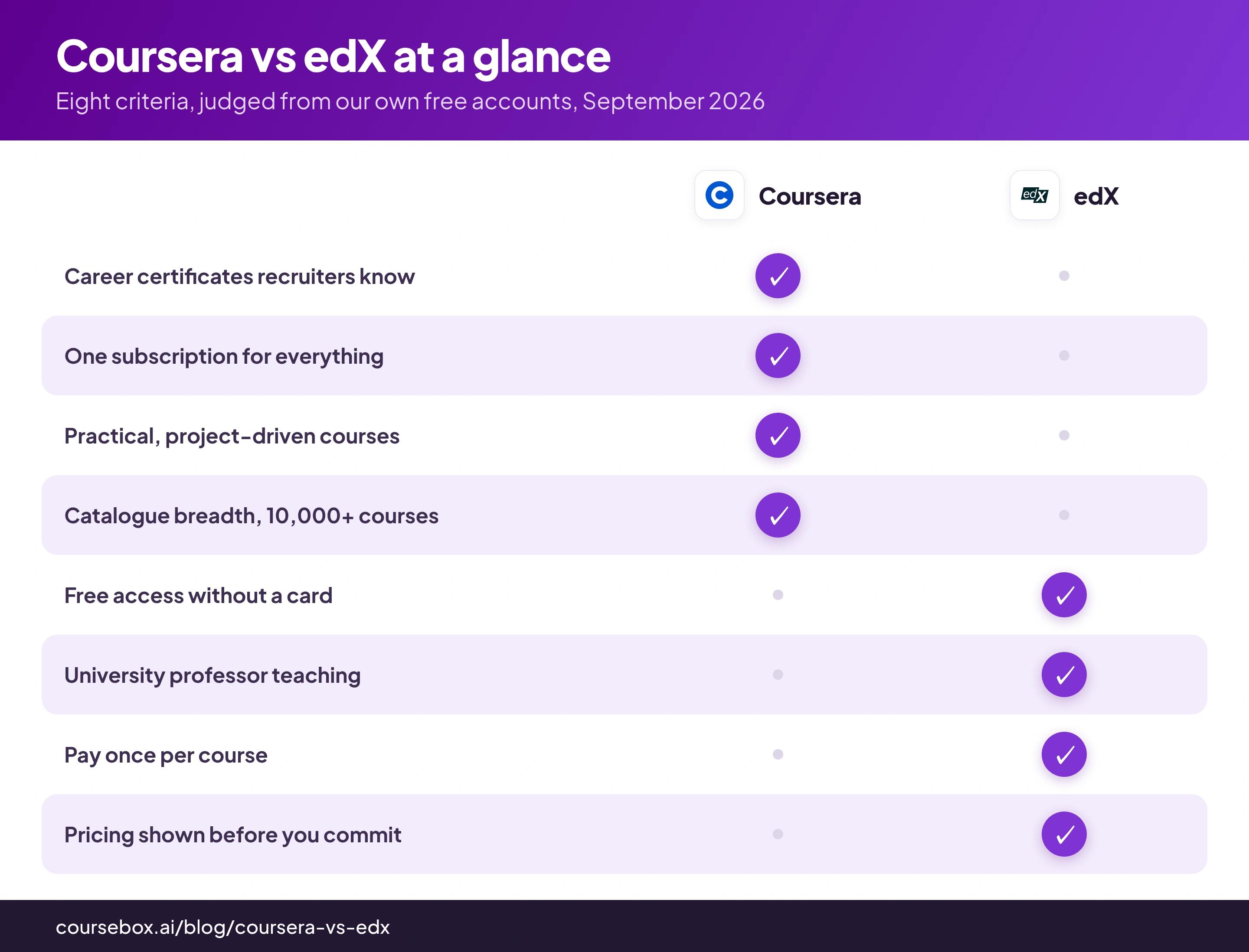
Coursera vs edX at a glance
| Coursera | edX | |
|---|---|---|
| Certificates | Company-built career certificates (Google, IBM, Meta) recruiters recognise by name | University-issued verified certificates (Harvard, MIT, Maryland) |
| Course style | Job-shaped and project-driven, built by the companies whose tools you learn | Professor-taught lectures with transcripts, structured like degree modules |
| Starting price | Google cert $49/mo after a 7-day card trial; Coursera Plus $59/mo or $399/yr | Verified certificate one-off, $199 on my test course; audit $0 for 7 days |
| AI features (2026) | AI Chat assistant that remembers your goals; some assignments AI-graded | Xpert, an AI tutor inside every course |
| Best for | Career certificates a recruiter recognises, on subscription | University teaching, paid per course, free to sample |
What you get on Coursera: job-shaped career certificates
Here is how the test ran on each platform: a brand-new free account, a search for digital marketing, and an enrolment in the top result to see what the course and its certificate actually are.
Coursera's search put Google's own certificate on top: the Google Digital Marketing & E-commerce Professional Certificate, an eight-course series rated 4.8. That is Coursera's whole pitch in a single screen, and it impressed me before I had clicked anything. These courses are built by the companies whose tools you will use.
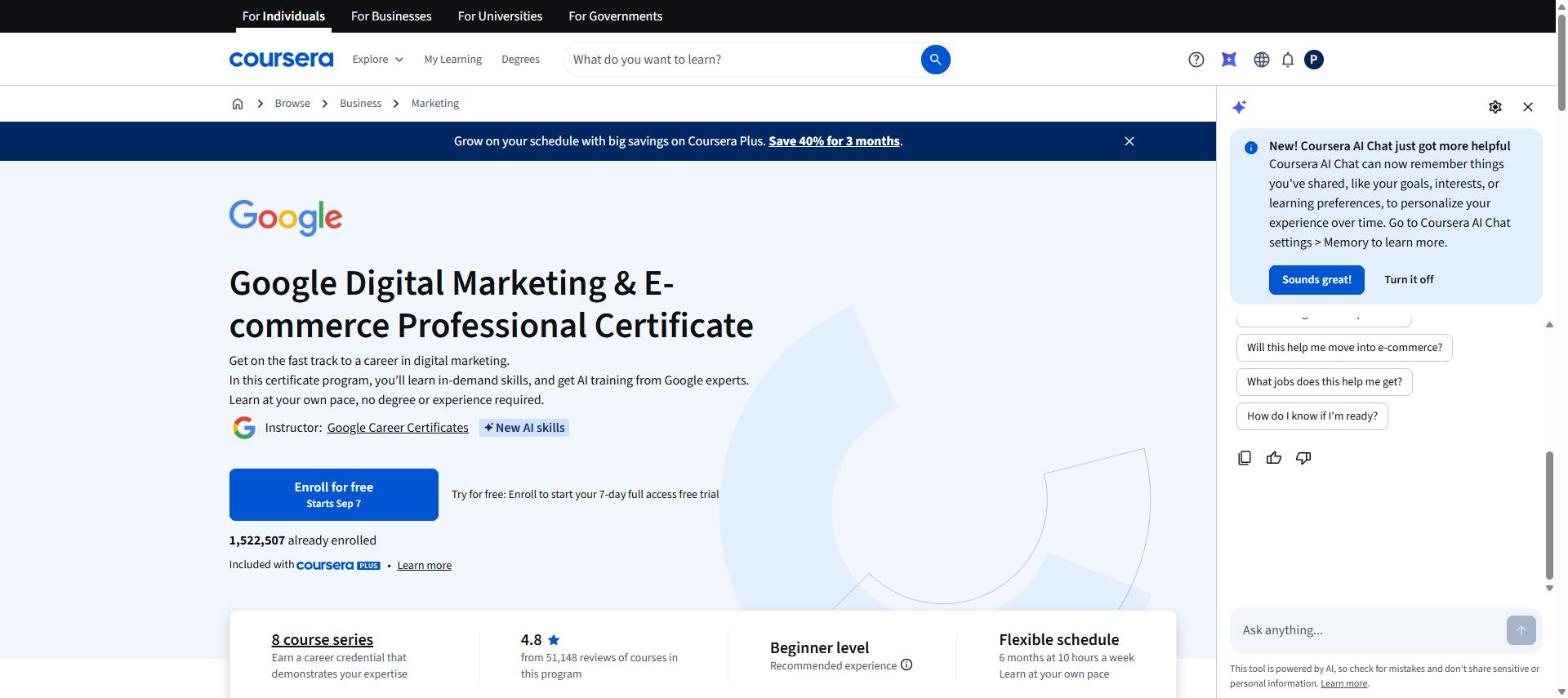
The Google certificate page, with Coursera's AI Chat opening itself alongside.
The course itself is job training rather than education in the university sense. Its page reads like a job description: the skills list runs Email Marketing, Paid Media, Search Engine Optimization and Social Media Strategy, the one tool named is Google Ads, and some assignments are graded by AI. It seemed very practical to me, resembling things I would actually do at work.
Coursera's new AI Chat opened itself beside the certificate page to announce it now remembers my goals and preferences, which felt a little eager.
Watching a lesson has one precondition: the card. The only way into course 1 is "Try free for 7 days", and the checkout behind it wanted my card number for the free trial, "Today's Total: A$0" printed right above the card form, refunds stopping at the first charge. I did not hand it a card. So on Coursera I can tell you what the course teaches, and on edX I can tell you what it is like.
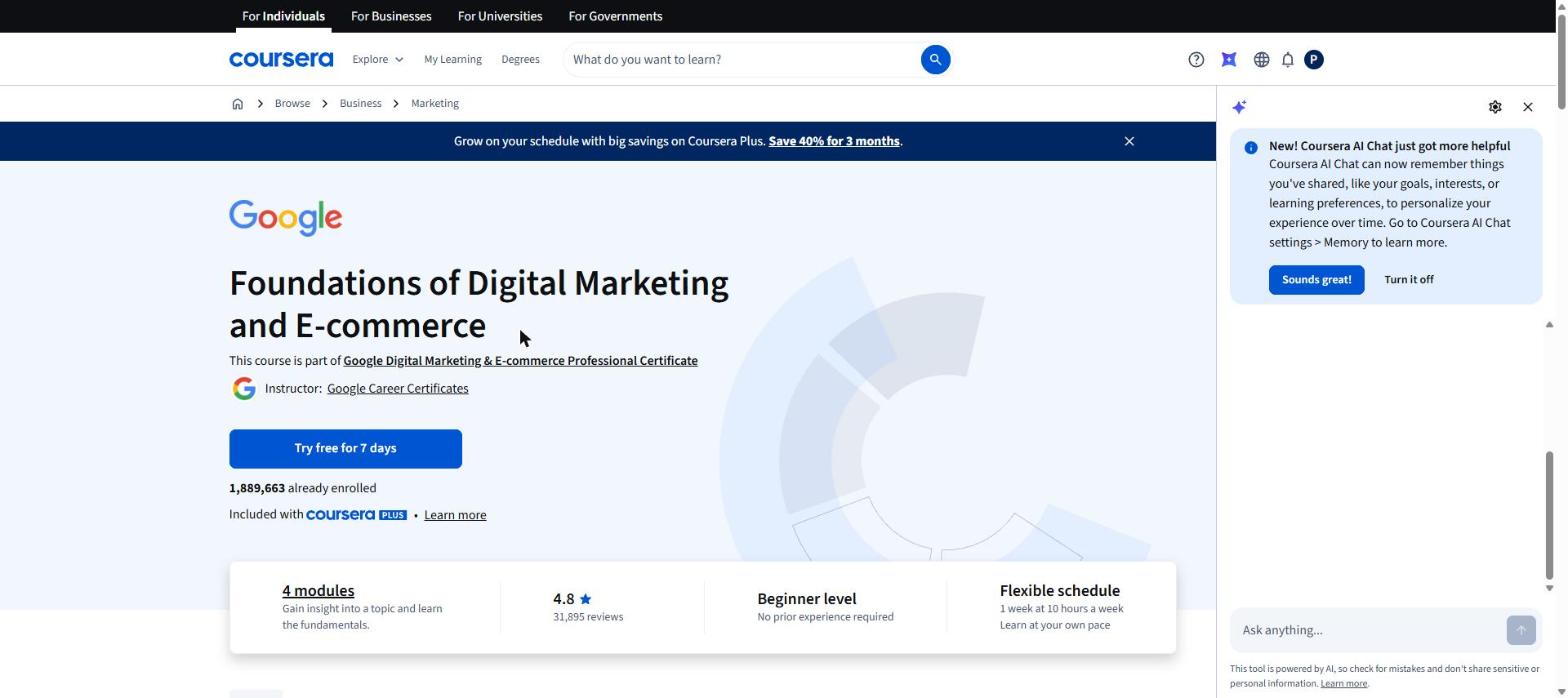
Course 1 of the Google certificate: one button, and it is a trial.
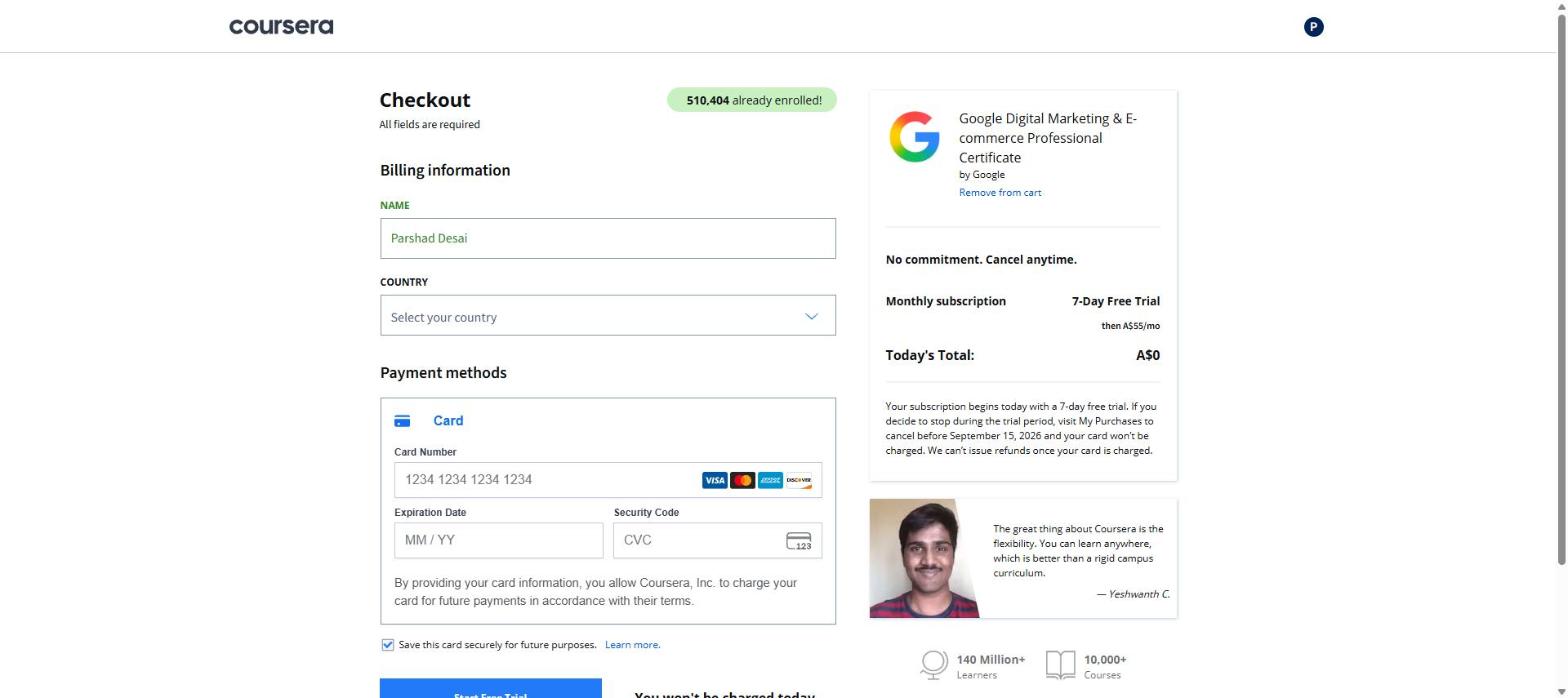
A free trial that starts with a card form. Total today: A$0.
That was no Google-certificate quirk either. Wharton's famous Introduction to Marketing showed me the same single trial button. Auditing, the free sit-in-and-watch access these platforms were once famous for, is gone from every Coursera marketing course I opened, which honestly surprised me. The nearest thing left is financial aid, a discount after a fortnight's wait, and exactly one plain "Free" badge in my whole results page, Goldman Sachs' 10,000 Women.
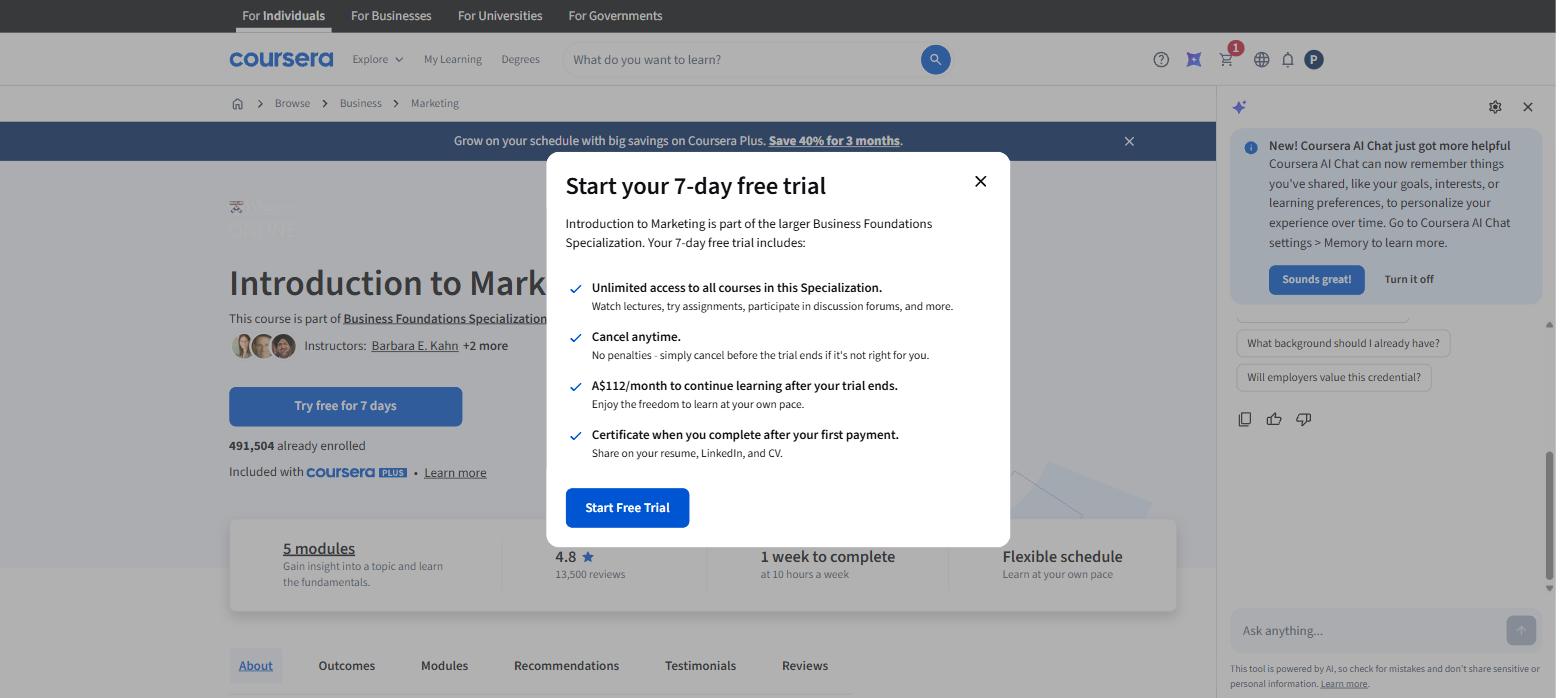
Wharton's classic course behind the same trial, at A$112 a month.
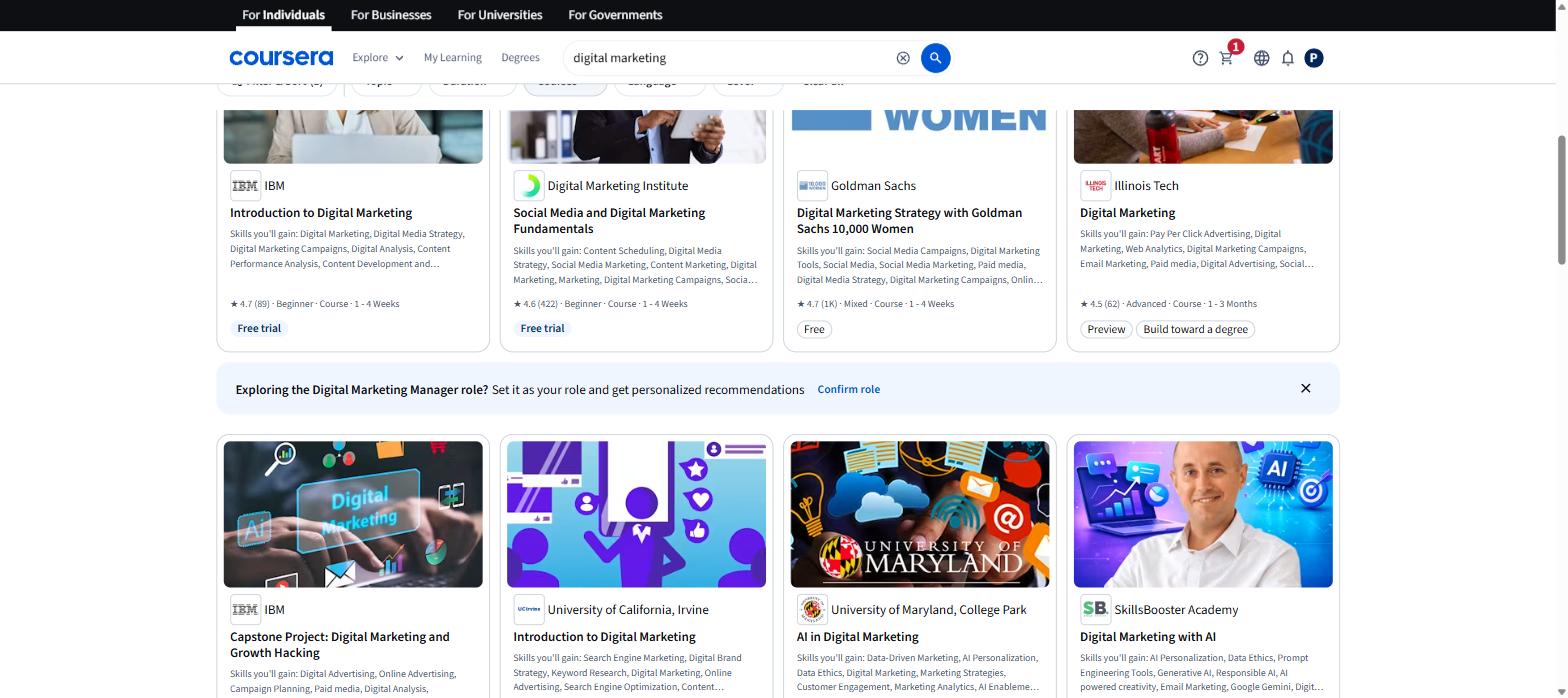
Goldman Sachs 10,000 Women: the one plain Free badge on the page.
Where Coursera is better
- Certificates recruiters recognise by name. Google, IBM, Meta and Adobe build the career certificates themselves; edX's are issued by universities.
- The subscription maths. If you plan more than one certificate a year, the annual Plus plan is the only way the numbers work out cheap.
- Job-shaped practicality. The career certificates run on projects and tool practice; reviewers who asked recruiters heard the projects are what convince an employer.
- Catalogue breadth. 10,000+ courses across business, tech and everything between, against edX's deep but narrower university list.
What you get on edX: university teaching you can actually sit in
edX's search returned 92 digital marketing results, led by certificate programs from Edinburgh, Maryland and IIM Bangalore. I picked Maryland's Fundamentals of Digital Marketing as the closest twin to Google's course, clicked the "Audit course" link printed right on its page, and was inside in under a minute, no card, no checkout.
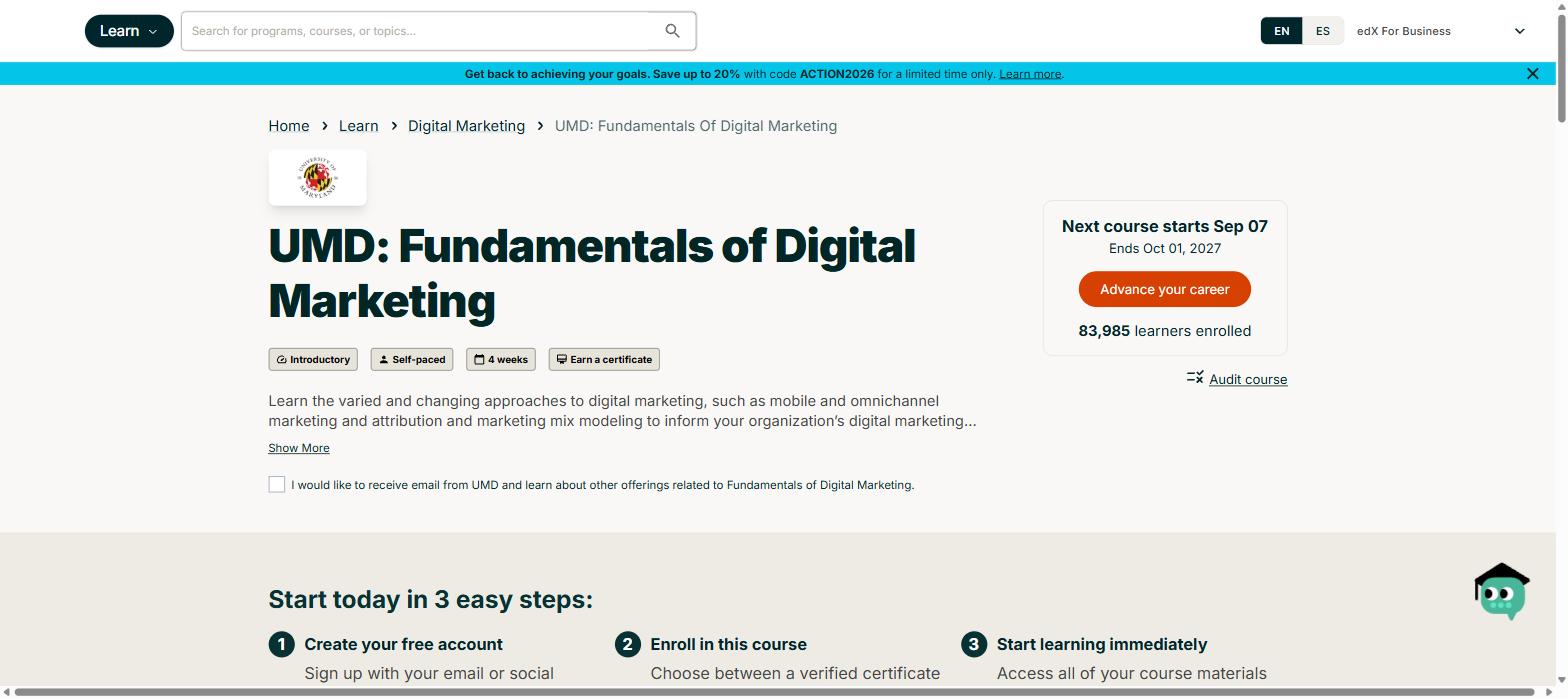
The Maryland course page. Audit course, printed right there.
The lessons are real university teaching. Mine were short Maryland Smith lectures, four minutes and two minutes in the first lesson, each with a full transcript beside the player and a link to just read instead. I watched them, and they felt theoretical and academic to me, thorough on frameworks and light on the practical how-to a working marketer would use tomorrow.
The course is built like a degree module, and that is the choice you are really making on edX. Module 1 walked the marketing strategy formation process before touching anything digital, and Module 2 studies social media through a scenario about Facebook's cloud gaming platform. I could feel the frameworks stacking up; what I kept waiting for was someone showing me how to run a campaign.
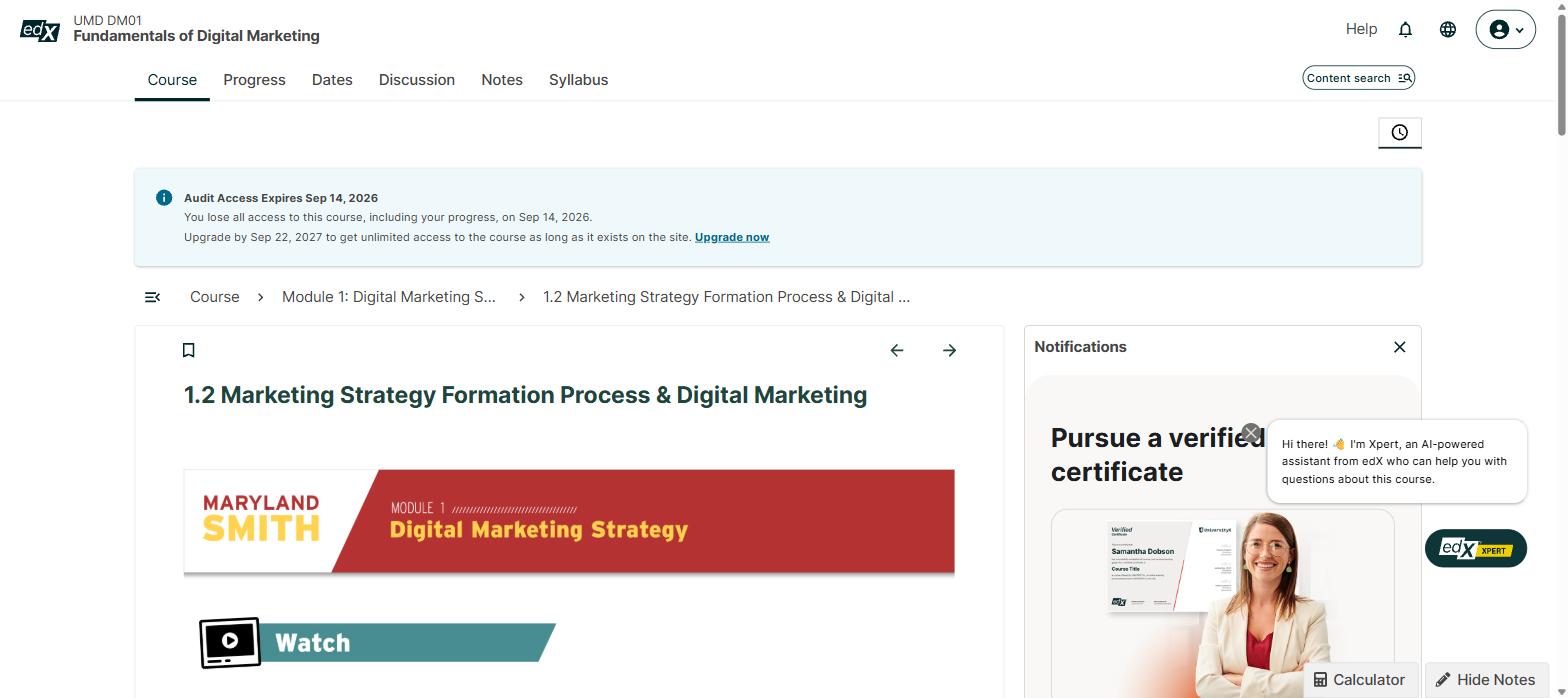
A free lesson: professor lecture, transcript, and a read-instead link.
The buying side is unusually honest. Before enrolling, a track-select screen priced everything side by side, certificate, program bundle and free audit, limits spelled out in plain text, which I did not expect from either platform.
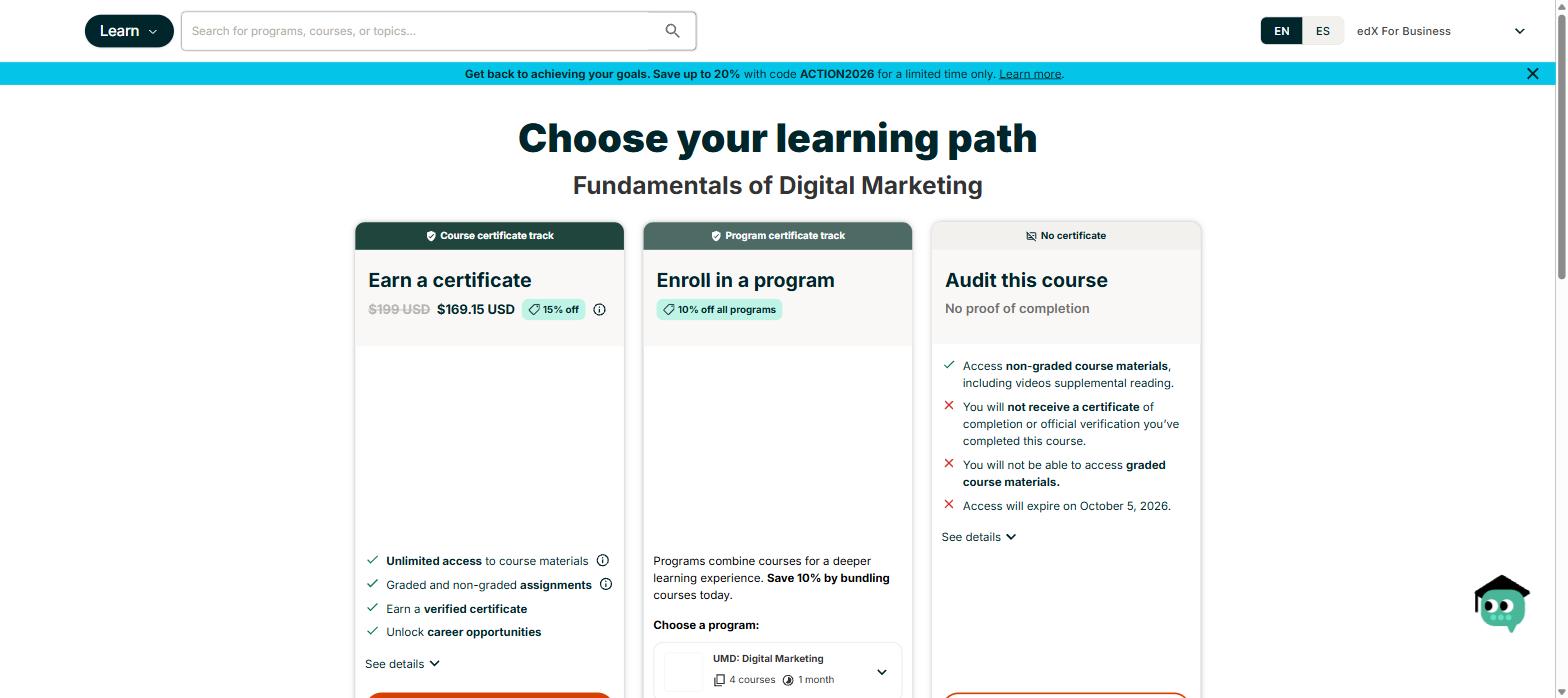
Three tracks, three prices, restrictions in plain text.
The free window has hard limits though. The enrol screen said my access ran to 5 October; the in-course banner said 14 September, which annoyed me. And the outline showed what audit buys. Every lecture and reading was open, while every Practice & Apply exercise, the end-of-module scenarios, and even one full lesson on influencer marketing carried a padlock. The theory is free, and the hands-on work is what costs $199. A locked page says it in edX's own words: "The next pages of content, are only available to those on the verified track."
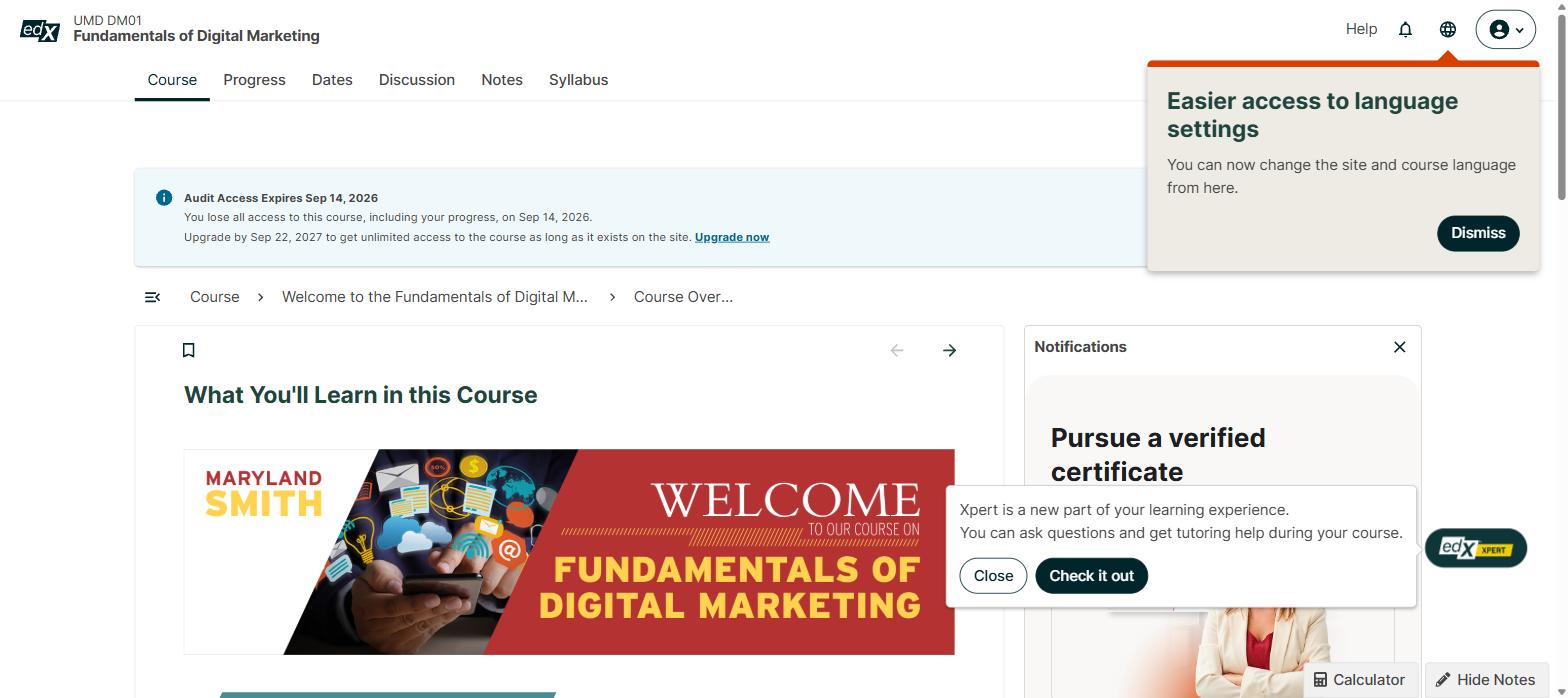
Seven days, then everything goes, progress included.
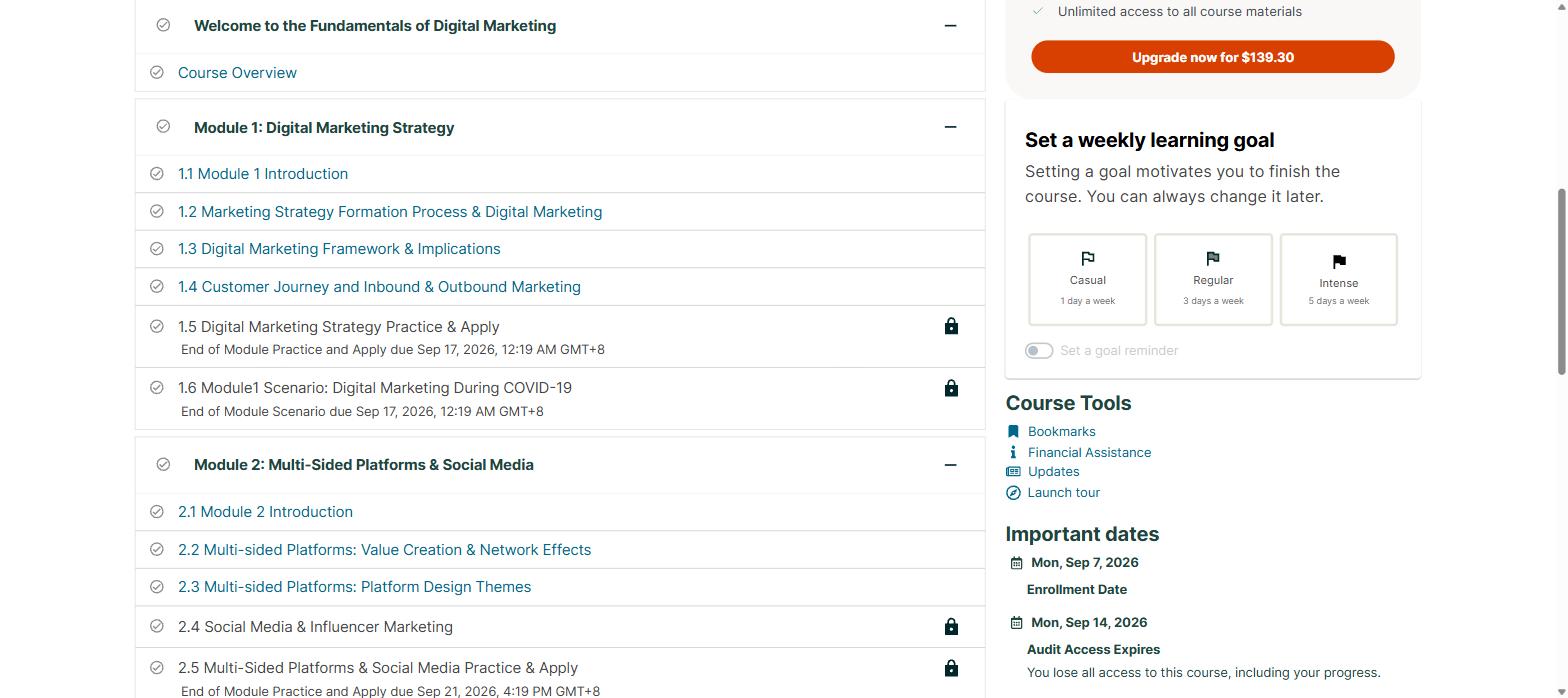
What I get for free: the lectures. What it locks: everything graded.
The upgrade price followed me around the course and kept dropping the deeper I went, three prices in ten minutes. If you plan to buy the certificate, wait for the in-course modal, which is a strange sentence to have to write. The platform's own AI turned up too, an assistant called Xpert offering tutoring help in the corner, and I left it alone, the same way I left Coursera's chat.
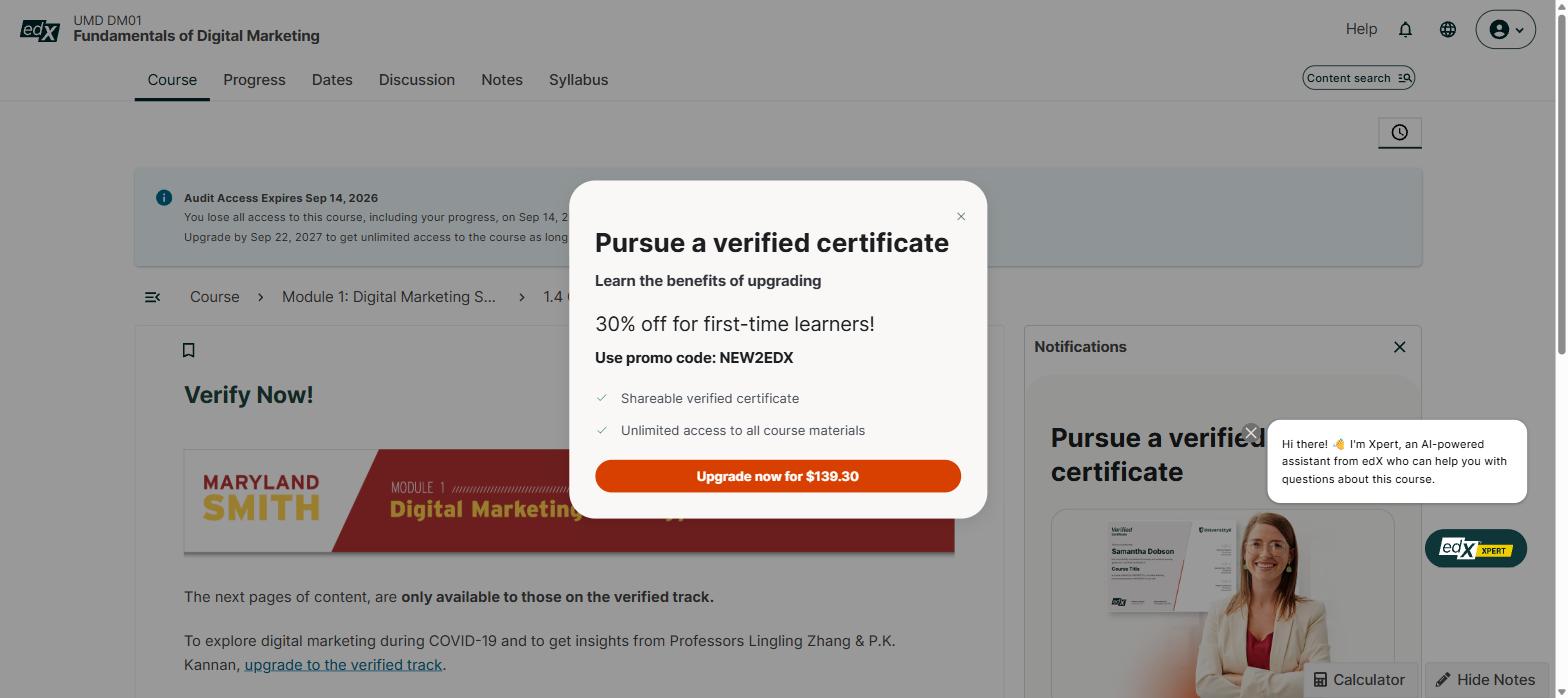
The third certificate price in ten minutes: $139.30 with the first-timer code.
Where edX is better
- Free without a card. One-click audit with the terms in writing; Coursera's free tier starts at a card form.
- University teaching. Professor-taught lectures with transcripts from Harvard, MIT, Edinburgh and Maryland; if academic depth is what you want, edX simply has more of it.
- Pay once and be done. A verified certificate is a one-off purchase with no subscription running behind it.
- Pricing honesty. The track-select screen shows every option and its limits before you commit; nothing on Coursera's side compares.
Are the certificates worth anything?
Here is where I landed after testing Coursera and edX: a certificate alone gets nobody hired.
What it tells an employer is that you cared enough to finish something, and what convinces them is the work you can show from it. A verified certificate proves who paid and submitted; it cannot prove who did the coursework, and employers know that too.
The evidence backs the instinct. Reviewers who asked recruiters directly heard the same thing, one recruiter bluntly saying certificates had counted for nothing in his hiring, with senior partners at established firms the most dismissive, and only a generational shift ahead as younger managers rise.
My split is simple. If you need job skills and a certificate name people know, go Coursera, because the projects inside its certificates are the part you can show. If you want to properly learn the subject from a professor, go edX, and you can start free today.
What they cost
- Studying free: edX audit is $0 for a 7-day window, no card. Coursera's 7-day trial takes a card up front and bills A$55/mo unless you cancel in time.
- One certificate: $199 one-off for my Maryland course on edX (offered at $169.15, then $139.30 with a code). The Google certificate runs $49/mo, about $294 if it takes the typical six months.
- Everything for a year: Coursera Plus, $399. edX has no consumer subscription.
Coursera pricing
| What | Price | The catch |
|---|---|---|
| Professional Certificates (Google, IBM, Meta) | $49/mo after 7-day trial | Card required for the trial; certificate only after first payment |
| Specializations (Wharton and similar) | A$112/mo quoted to my account, varies by program and region | Same card-first trial |
| Coursera Plus | $59/mo or $399/yr (promo $35/mo running to 23 Sep 2026) | 14-day money-back on annual |
| Financial aid | Up to 75% off | Application reviewed in up to 16 days |
edX pricing
| What | Price | The catch |
|---|---|---|
| Audit | $0 | 7-day window on my course, no certificate, graded work locked |
| Verified certificate | $199 on my test course | Promos stack it down: 15% site-wide, 30% first-timer code |
| Certificate programs | 4-course bundles, 10% off vs buying singly | Prices vary by university |
| Executive Education | Premium short courses (Oxford, Cape Town) | Separate lane, separate prices |
Coursera prices by region without telling you. My account was quoted A$566 a year for the Plus plan that Coursera's US pages sell at $399, and A$55 a month for the $49 Google certificate. edX quoted USD throughout. Before comparing prices, check whose currency is on your screen.
What I wish I'd known before starting
- Coursera and edX build different kinds of course, and the names tell you. A certificate built by Google trains you for a job; a course taught by Maryland teaches you a subject. Decide which one you are actually buying before comparing prices.
- The free theory will not teach you the hands-on work. On my edX course every practical exercise was locked; if you learn by doing rather than listening, audit alone will frustrate you.
- edX's certificate price is a moving target. Three prices in ten minutes; the first-timer modal is the cheapest.
- Coursera and edX both give you seven free days, differently. Coursera's is a card trial that bills unless you cancel, refunds stopping at the first charge; edX's audit needs no card but deletes your progress when the window shuts, and my expiry date moved between two screens.
- Financial aid exists on both. Coursera's is up to 75% off after a review of up to 16 days; edX keeps a Financial Assistance link inside the course tools.
Where both platforms stop, and what Coursebox is for
Coursera and edX teach public courses. Training your own team, onboarding, product knowledge, compliance, needs a different kind of tool. That lane belongs to Coursebox, our AI course creator: it generates courses from a company's own documents, builds the quizzes and assessments around them, and grades the answers that need marking.
Certificates are a live argument on the public platforms, but inside companies people simply keep issuing them, and our own numbers show it.
Both platforms beat us at what they do. We have no Harvard, and no $49 certificate a recruiter might recognise on sight. An individual learner belongs on one of the two platforms above; Coursebox is for the team whose training is its own.
The verdict, split by who is asking
Career upskiller who needs a recognisable certificate
Coursera. The Google, IBM and Meta certificates are the ones hiring managers have actually heard of, and the project work inside them is the part you can actually show in an interview.
Building real foundations, or just prefer a professor
edX. The Maryland lectures were proper university teaching, and you can sit in most of a course free before deciding to pay $199 once.
Studying free this month
edX, eyes open. Audit costs nothing and needs no card, but treat it as a one-week window and read fast. On Coursera, hunt the rare plain-Free badges instead of the trial.
Training a team rather than yourself
Neither of these is that tool. Both sell business tiers for licensing their catalogues; building and tracking your own training is a different job.
The mistake to avoid is paying list price on edX, or forgetting a Coursera trial you signed up for with your card. Both platforms make money on exactly those two moments.
If neither one fits
Beyond Coursera and edX, Udemy is usually the next place people look: one-off courses sold cheaply and perpetually on sale, with quality that swings course by course. Udacity sells fewer, mentored programs at much higher prices for career-changers who want structure. The wider field is ranked in our list of the best online learning platforms. And if what you actually need is to build training rather than take it, that is the lane we covered in the section above.
Last updated 7 September 2026. Both platforms were tested on new free accounts that day, with every price read in-product and from the live pages. USD figures were confirmed against Coursera's own US-facing pages, and the audit windows quoted are the ones shown to my account.
Frequently Asked Questions
Coursera certificates are worth the most when a company name is on them. Reviewers and the recruiters they spoke to agree the certificate itself signals initiative, while the skills and projects behind it convince the employer. The Google, IBM and Meta Professional Certificates carry the most recognition, and their project work doubles as portfolio material.
edX certificates are university-issued and respected as evidence of study, but no reviewer I found treats one as a job qualification on its own. Take an edX course for the teaching, and treat the certificate as a bonus.
Mostly no: Coursera's marketing catalogue offered me no audit option, just 7-day trials with a card form, and exactly one fully free course in a whole page of results. Financial aid can cut up to 75% off after an application reviewed in up to 16 days.
For one course, edX is cheaper, a $199 one-off (less on promo) against Google-certificate months at $49 each. For steady, broad learning, Coursera wins, with Plus at $399 a year covering 10,000+ courses; edX has no comparable consumer subscription.
Harvard and MIT founded edX in 2012 and sold it to the education company 2U in 2021 for about $800 million. 2U filed for Chapter 11 bankruptcy in July 2024 and emerged that September as a privately held company. The platform kept running throughout, and it is where my one-click free audit happened this week.
Coursera, for most working marketers. The Google Digital Marketing & E-commerce certificate is practical, project-driven and recognised, with 1.5 million enrolments. Choose edX's Maryland or Edinburgh programs if you want university-style teaching of strategy and frameworks; having watched the Maryland lectures, that is exactly what they deliver.
Parshad Desai
Parshad is a full stack technical marketer based in our Perth office. He began his Coursebox career as a marketing intern. After impressing the founders with his incredible work, he later transitioned into a full time position coordinating digital marketing. His focus lies in managing our website, product analytics, and email marketing. Recently he has taken a keen interest in applying AI to digital marketing and growth.

