

8 AI Lesson Plan Generators in 2026: What I’d Use Each For
I tested 8 AI lesson plan generators as a learning designer: which produce a plan you can actually teach from, what each free tier really covers, and where the editing still falls to you.

The best AI lesson plan generators in 2026 include MagicSchool and Brisk for classroom planning, Coursebox for a plan that becomes a delivered course, and Curipod for interactive lessons. Eduaide, Khanmigo, Diffit and Auto Classmate cover other planning and materials workflows.
- For a free, full plan: MagicSchool is the strongest dedicated teacher tool and Brisk writes the plan straight into your Google Doc. Khanmigo is 100 percent free and standards-aligned if you teach a Khan-covered subject.
- Coursebox connects an editable outline with lessons, quizzes, tutoring and delivery. Choose the output you need: a classroom plan, differentiated materials, interactive slides or a self-paced course.
- For the materials around the lesson, Eduaide generates 100-plus resource types for $5.99 a month and Diffit gives you one reading at several levels (check the leveling, it reads high). For interactive slides, Curipod builds a lesson students answer live.
- Almost every tool here has a real free tier, so you rarely pay to generate a plan. Whichever you pick, rewrite the low-order activities and check any facts or standard codes before you teach it.
Compare MagicSchool AI, Brisk Teaching, Curipod, Coursebox through three training preferences. Check required features and plan conditions in the entries before choosing.

Set up your branded LMS and deliver training with AI
Type a grade and a topic into an AI lesson plan generator and you get a full plan, objectives, activities, an assessment, in about thirty seconds. The first time it feels like a cheat code. Then you read the activities: a word search, a “discuss with your partner,” a fill-in-the-blank. It is a plan, and almost none of it is worth teaching.
The first draft is only useful if its activities teach the objective. I look for a plan I can adapt to the class: a clear sequence, suitable reading and language, time for practice and an assessment that shows what pupils understood. A tidy page can still need work on all four.
I am Carolina, a learning designer. I write lessons and the assessments that go with them, so a plan that looks finished but teaches nothing is exactly the thing I spend my days fixing. I ran the same brief through eight tools and judged each on what it actually produces, how much editing it takes to be classroom-ready, and the one thing to fix before you teach it.
I work at Coursebox, whose AI lesson plan generator is included here. Its outline-to-course workflow is different from a teacher tool that produces tomorrow’s printable plan, so I have compared the output and delivery choices as well as the planning step.
What an AI lesson plan generator actually makes (and what it leaves to you)
These tools do not all make the same thing, and picking the wrong kind is why teachers end up let down. They fall into three types.
- Full-plan and outline generators (MagicSchool, Brisk, Khanmigo, Coursebox, AutoClassmate). Give a grade and topic, get a structured plan or an editable outline, objectives, activities, assessment. The output is a first draft you edit.
- Materials and differentiation (Eduaide, Diffit). Less the plan, more the pieces inside it: worksheets, leveled readings, questions. Diffit’s whole job is the same text at several reading levels.
- Interactive lessons (Curipod). A live lesson students respond to, the closest thing here to lesson-plan slides.
Treat the result as a draft to review against your objective and class. Standards codes, activity difficulty and assessment questions need checking before you teach.
How I tested these eight tools
I compared the tools using a 45-minute lesson brief and, where supported, a curriculum standard. I checked the output type, activity quality, editing workflow and free-plan limits. The important question was whether the draft could become a teachable lesson, rather than how quickly text appeared.
- Output: A plan document, editable outline, differentiated materials or interactive slides.
- Teaching quality: Activities and assessment that match the objective, with space to adapt for your class.
- Revision: Whether you can improve the plan and create its supporting resources without starting again.
- Access and cost: The free limits, individual upgrade route and any school-level purchase.
The 8 AI lesson plan generators at a glance
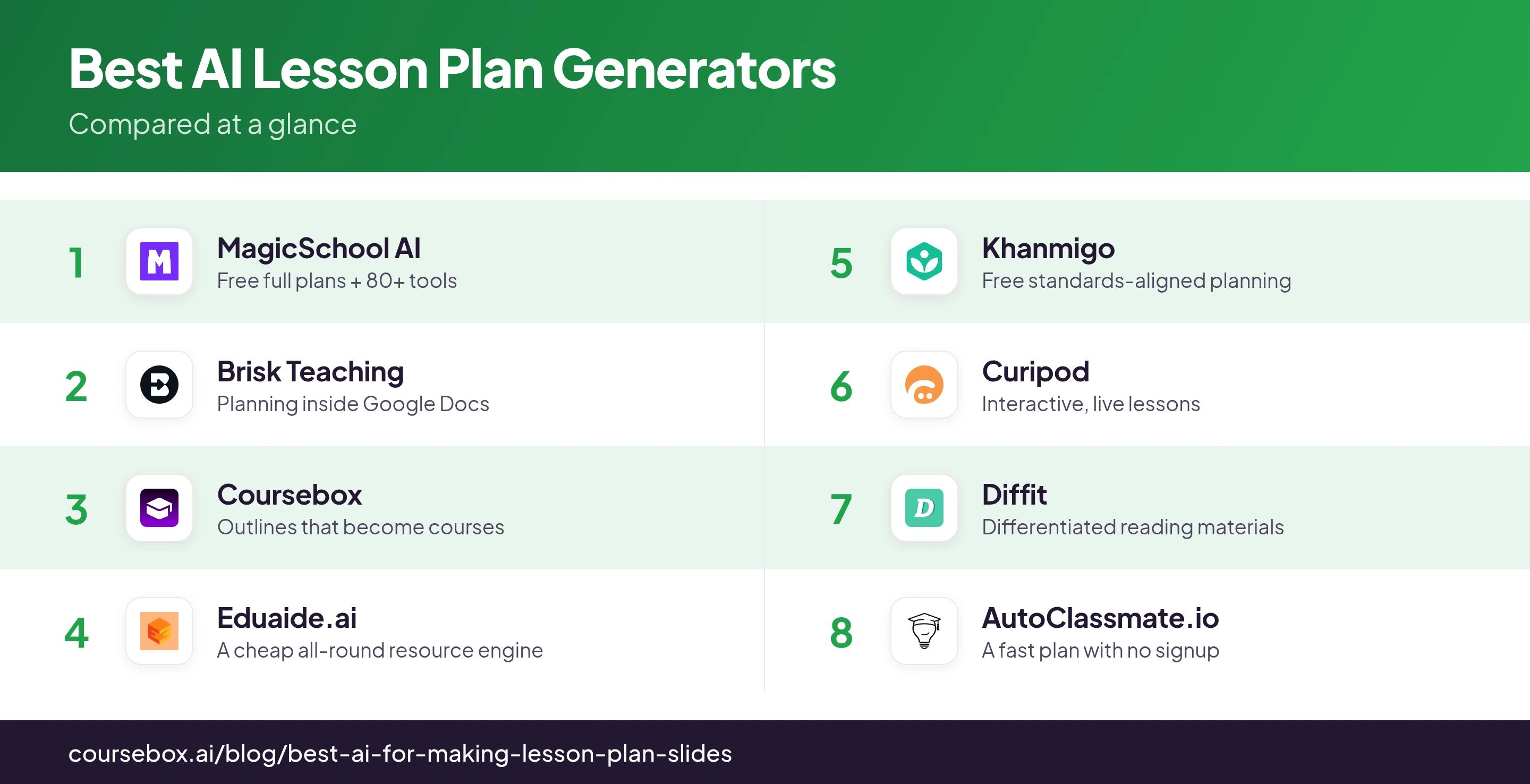
| Tool | Best for | Free tier | What it makes | Watch out for |
|---|---|---|---|---|
| MagicSchool AI | Free full plans + 80+ tools | Free forever | A standards-aligned plan in ~30s | US standards; a first draft |
| Brisk Teaching | Planning inside Google Docs | Completely free | The plan written into your doc | Paid tier is institutional-only |
| Coursebox | Outlines that become courses | Free (capped, watermarked) | An editable outline, then a course | Course-oriented, not single lessons |
| Eduaide.ai | A cheap all-round resource engine | Free (generation limits) | Plans + 100+ resource types | First draft; iterate to improve |
| Khanmigo | Free standards-aligned planning | 100% free for teachers | A plan tied to Khan content | Best in Khan subjects |
| Curipod | Interactive, live lessons | Free plan | A lesson deck students answer live | Check the AI feedback; build in pieces |
| Diffit | Differentiated reading materials | Free (PDF only) | Leveled passages + questions | Leveling can read high |
| AutoClassmate.io | A fast plan with no signup | Free (no account) | A standards-aligned plan skeleton | Thin; nothing saved on free |
Prices and free-tier limits are from each tool’s own page as of October 2026. Every tool here has a real free tier, so the free column is where it stops, not whether there is one.
The 8 best AI lesson plan generators
1. MagicSchool AI
MagicSchool AI is the tool most teachers reach for, and for lesson plans it is the strongest here. Give its Lesson Plan Generator a grade, subject, topic and, if you have them, your standards, and it returns a full standards-aligned plan, objectives, activities, materials and assessments, in about thirty seconds. It sits inside a suite of 80-plus teacher tools, so the matching handouts, exit tickets and scaffolded versions are one click away.
The catch is the one this whole list shares: what you get is a solid first draft, not a finished lesson. One reviewer put the edit at five to ten minutes a plan, which matches mine, and the activities lean generic and low-order until you push them. Standards alignment is built around US frameworks, so it is weaker outside the US.
In practice: I had a full plan, objectives through assessment, in under a minute, then spent ten minutes rewriting two activities that were busywork and adding the higher-order questions it had skipped. That ten-minute edit is the real cost, and on this tool it pays off.
Pricing: Free forever, with all 80-plus tools on the free tier. Plus is $8.33 a month billed annually for higher limits.
2. Brisk Teaching
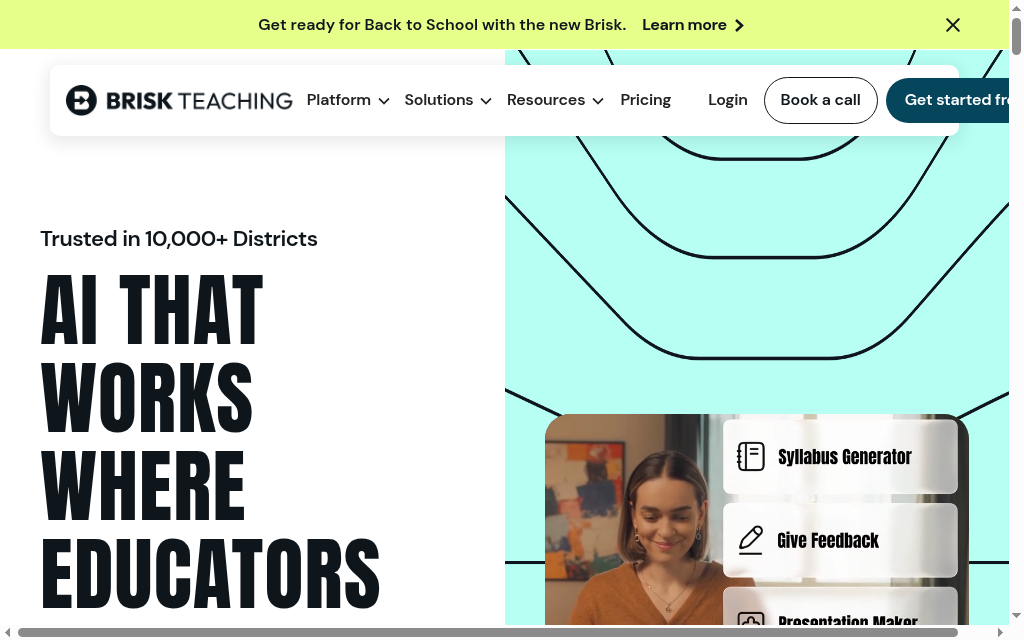
Brisk Teaching does its planning where you already work. It is a free Chrome and Edge extension that adds an AI layer to Google Docs, Slides and Classroom: open a doc, click the Brisk icon, choose Create then Lesson Plan, give it the grade, subject and topic, and it writes the plan straight into the document.
Brisk writes into supported browser apps, so the benefit depends on where you already plan and teach. Its free educator tools have usage limits. Brisk’s FAQ also lists an individual Educator Pro upgrade, while school and district packages add shared controls and alignment. Check the current account offer rather than assuming every paid feature requires a school contract.
Where it fits: Having the plan appear in the Google Doc I already had open, instead of copy-pasting from another tab, is what I actually wanted. The draft still needed the usual edit, but the friction of getting it into my workflow was gone.
Pricing: Free educator access includes 20-plus tools with usage limits. An individual Educator Pro option is listed in Brisk’s FAQ; check its account pricing and availability. Schools and districts use custom pricing for broader alignment and administration.
3. Coursebox
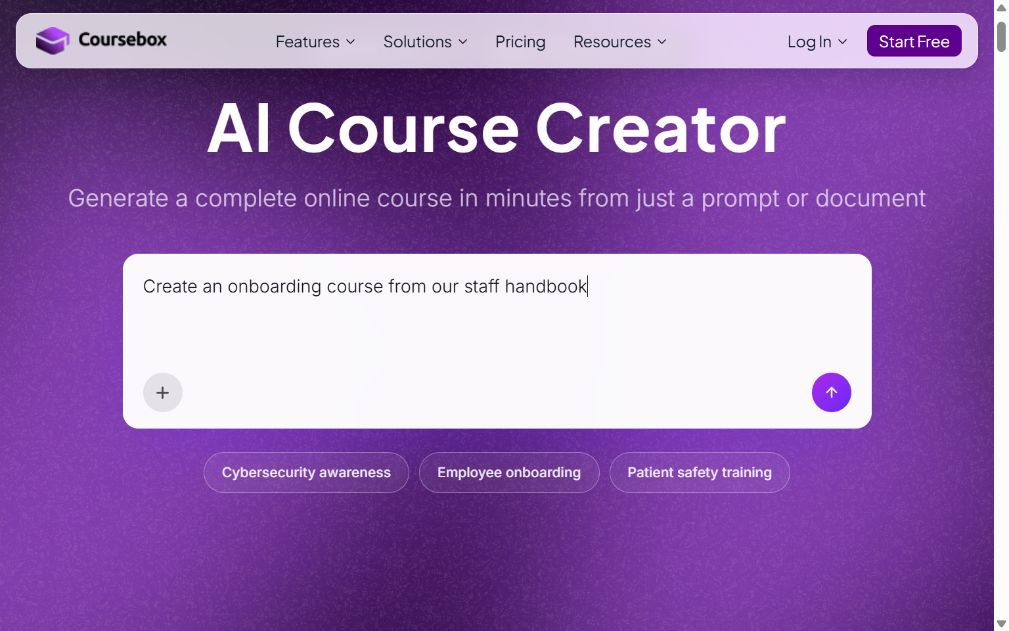
Coursebox, which is ours, so weigh that, plans outline-first. Give it a prompt or upload a document and it generates a structured, editable lesson outline, objectives and activities, that you shape and then turn into real lessons, and, if you want, a full course with quizzes, video and an AI tutor.
The useful choice is what should happen after planning. For a one-off classroom handout, a teacher-focused planner may be a shorter route. Coursebox lets the outline become lessons learners take online, with quizzes, an AI tutor and progress records. The free plan limits the course size and generation allowance and displays a Coursebox watermark.
My take: I reach for it when a plan has to become more than a printable page. Editing the generated outline into shape was faster than building the structure from a blank page, and turning it into a delivered course with quizzes is the part the teacher tools do not do.
Pricing: Free includes three mini-courses of up to five pages each, unlimited learners and defined AI allowances. Paid plans expand capacity and remove the watermark; Pro + LMS adds a fully branded platform.
4. Eduaide.ai
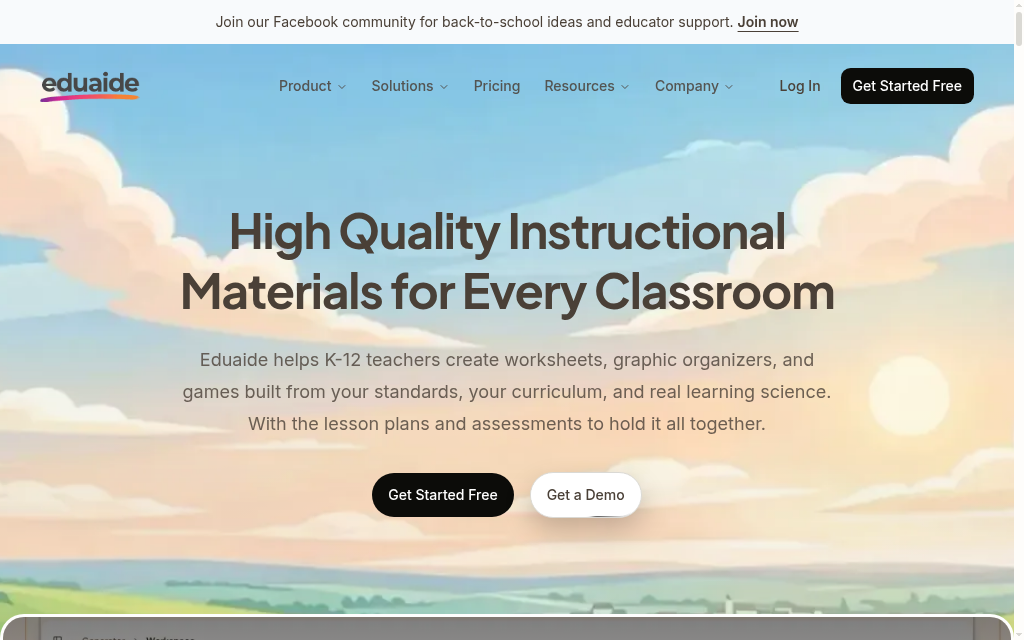
Eduaide.ai goes wider than a plan. Start from an objective, a topic or a source and it generates a standards-aligned lesson plan plus more than 100 other resource types, worksheets, graphic organizers, classroom games, assessments, that you refine in its editor. It is the cheapest paid option here.
The value is the refine loop, not the first output, which, like everywhere, is a draft you improve. The free plan caps how much you can generate (the exact number is not published, so check it), and no single output is as polished as a dedicated tool’s. Breadth is the trade-off.
What stood out: I generated a plan, then kept iterating in the editor, tightening objectives and swapping an activity, which is where it pays off rather than in the first result. Spinning up the worksheet and the assessment from the same place saved me hopping between tools.
Pricing: Free with generation limits; Pro is $5.99 a month, the lowest paid tier on this list.
5. Khanmigo
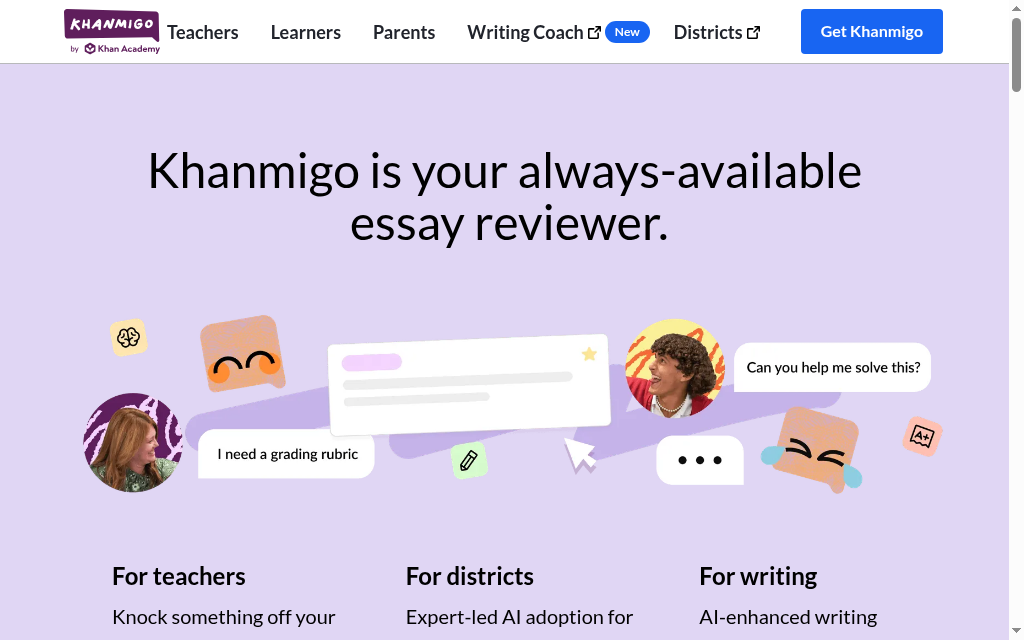
Khanmigo, Khan Academy’s AI assistant, is the free one. Its teacher tools generate standards-aligned, differentiated lesson plans tied to Khan Academy’s content library, plus objectives, rubrics and exit tickets, from a topic and a standard.
The useful fit is the connection between planning and Khan Academy resources. For a topic with suitable videos and practice, the teacher can assemble a lesson around existing material rather than generate every resource. Review the linked content against your syllabus and class. Teacher tools are now available in more than 180 countries and territories, with eligibility and language coverage set out by Khan Academy.
My read: Picking a standard and getting a hook-to-assessment plan with Khan videos and practice already attached is properly useful for a maths topic, the linked content is the edge. For a subject Khan covers thinly, I got a more generic plan.
Pricing: 100 percent free for teachers. The $4-a-month tier is for parents and learners, not teachers.
6. Curipod
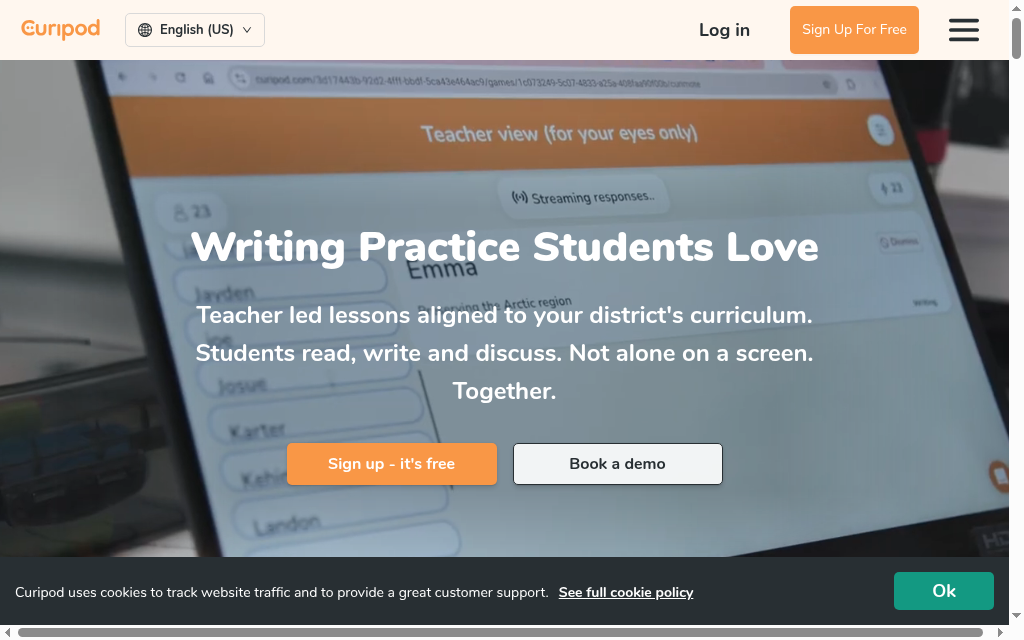
Curipod turns a prompt into an interactive lesson, not a printable plan. Describe a topic and grade and it builds a slide deck with polls, word clouds, drawings and open-response activities students answer live. It is the closest tool here to the lesson-plan slides idea.
Two catches: the AI output needs checking (one teacher found the auto-feedback can be quite random), and it rewards building one activity at a time rather than one-shotting a whole lesson. It makes a live experience, not a document you file, so it is a different job from the planners above.
The trade-off: Turning a topic into a deck the whole class responds to live, polls, a quick write, peer voting, is something a plain lesson plan cannot do, and it took minutes. Building it activity by activity worked far better than asking for a whole lesson at once, which came out uneven.
Pricing: Free plan for individual teachers; school and district plans are custom-priced.
7. Diffit
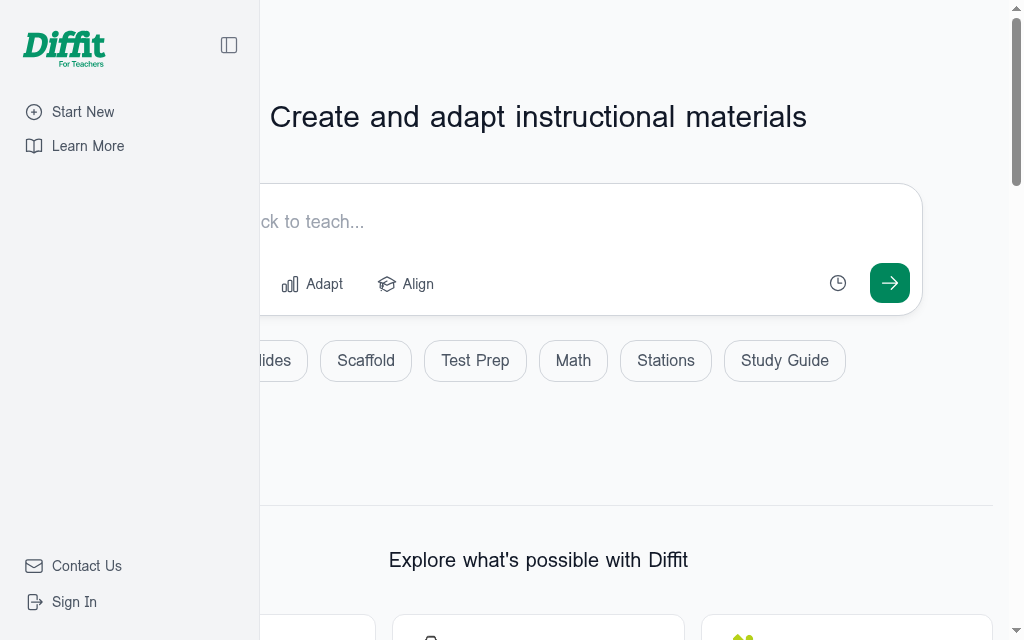
Diffit solves a different part of the lesson: differentiation. Give it a topic, an article URL, a YouTube video or your own text and it returns a leveled reading passage with a summary, vocabulary and ready-made questions, and it regenerates the same content at different reading levels or in another language. One topic becomes tiered materials for a mixed-ability class in about a minute.
Leveling is the weak spot: independent testing found the passages read above their labeled grade, a second-grade passage that tested at fourth-grade readability, so treat the level as a strong start and check it before class. The free tier exports to PDF only and keeps your content for 90 days.
My call: I typed in a topic and had a multi-paragraph leveled passage with questions in seconds, then generated it two grades lower for the students who needed it, which by hand is an afternoon. I ran the levels past a readability check and they skewed high, so I nudged the lower one down.
Pricing: Free (PDF export, 90-day retention); the Individual Teacher plan is $14.99 a month for Google Docs export and a permanent library.
8. AutoClassmate.io

AutoClassmate.io is the no-friction option: a freemium lesson plan generator you can use without creating an account. Add your content area, any specific instructions and your state standards, and it returns a structured, standards-aligned plan in under five minutes.
It trades depth for speed. The output is a clean skeleton, objectives and a sequence, rather than the richer plans the top tools produce, and because there is no account on the free generator, there is nothing saved to come back to. For a fast, standards-aligned starting point it does the job; for a library of plans you revisit, it is thin.
In my testing: Going from a topic to a usable plan skeleton without a signup was quick, and the standards slot made the alignment automatic. I still rewrote the activities, which were the generic recall kind, before it was ready to teach.
Pricing: Free to use, with no account needed for the core generator; paid upgrades add saved plans and extras.
Before teaching from a generated plan, check that an activity asks students to use the idea, not just repeat it. Replace a recall question with a relevant explanation, comparison or application where the objective calls for that level of thinking. Then check the assessment against the same objective.
Judge the time saved after the editing
The Education Endowment Foundation’s trial with 259 teachers in 68 English schools found that teachers using ChatGPT with a planning guide spent 31% less time preparing Year 7 and 8 science lessons. Lesson quality did not appear to decline in the assessed sample. That is evidence for a supported planning workflow, rather than a result promised by every tool here.
In the 2025 Gallup and Walton Family Foundation survey, US teachers using AI at least weekly estimated saving 5.9 hours a week across their work. I would measure the whole task: drafting, checking and adapting the materials, because a quick output is only part of the saving.
If you are a trainer, not a classroom teacher
Most of these tools stop at a document you print. In corporate training and L&D the plan is usually step one: you need it to become something people take, with modules, a quiz and a record of who finished. That is the job Coursebox’s AI lesson plan generator is built for, turning the outline into a delivered course with assessments and an AI tutor rather than a PDF you file.
Which AI lesson plan generator should you choose?
Match the tool to the job you actually have:
| If your priority is | Go with |
|---|---|
| A free, full classroom plan fast | MagicSchool AI |
| Planning inside Google Docs | Brisk Teaching |
| A plan that becomes a full course | Coursebox |
| Plans plus the materials around them, cheaply | Eduaide.ai |
| A free, standards-aligned plan in maths or science | Khanmigo |
| An interactive, slides-based lesson | Curipod |
| The same reading at several levels | Diffit |
| A quick plan with no signup | AutoClassmate.io |
If you want the wider teacher toolkit beyond planning, my guide to the best AI tools for teachers covers grading, feedback and more.
And if you are mapping a whole unit rather than a single lesson, I compare the best AI curriculum generators separately, since curriculum and lesson planning are different jobs.
Start with the format you will teach from, then compare how much useful control the tool gives you during revision.
Disclosure: I work at Coursebox, which is included above. Pricing and access conditions were checked in October 2026. The Coursebox usage figure is first-party product analytics for its stated historical period.
Frequently Asked Questions
For most teachers, MagicSchool: a free Lesson Plan Generator that produces a standards-aligned plan in about thirty seconds inside 80-plus teacher tools. Brisk plans inside Google Docs, Khanmigo is 100 percent free for Khan-covered subjects, and Coursebox is the pick if you want the plan to become a full course. The right one depends on your subject and workflow.
Yes, several. MagicSchool has a real forever-free tier, Brisk is a free Chrome extension, Khanmigo is 100 percent free for teachers, and AutoClassmate runs without an account. Eduaide, Diffit, Curipod and Coursebox all have free tiers with limits, so you rarely need to pay to generate a plan.
They can provide a useful starting structure, but the teacher still needs to check facts, standards, activity difficulty and assessment. Evaluate a tool with a real lesson objective and compare the changes you need to make before teaching, rather than judging the first draft by its length or appearance.
Curipod creates interactive lesson decks with activities students answer live. Brisk also works with supported slide workflows, while Coursebox can develop a lesson outline into delivered course lessons. If you need a standalone presentation file, check the tool’s actual export format before choosing.
Plan for five to ten minutes even on the best tools. The structure and objectives usually hold up; the activities are where the work is, because AI defaults to low-order busywork. Rewrite the weak activities, check any facts or standard codes, and adjust for your actual class before you teach it.
Carolina Martin
Carolina is a highly experienced learning designer with tech start-up experience. She is based in Sydney and previously designed courses alongside Coursebox founder Travis in a previous job. She is passionate about delivering engaging learning experiences and brings the same perspective to customer experience too. She manages our customer support documentation and product testing processes.

