

25 Customer Service Role Play Scenarios + Free Script Pack
25 customer service role play scenarios, four dialogue scripts and a free pack with role briefs, an observer sheet and a 60-minute session plan.

A customer service role play is a practice conversation between a customer and an agent. An observer records specific actions and helps the agent decide what to practise next.
- Choose a situation staff handle at work, give the customer and agent separate briefs, and replace the sample policies before using them.
- Rate actions you can see or hear. A missed identity check still needs practice even if the rest of the conversation went well.
- The pack has 25 scenarios and four full dialogue scripts. Its completed example shows one agent practising four conversations in a 60-minute session.
- Use the observer result to plan coaching. Decide readiness for live work through your organisation's supervised practice and approval process.

Train teams faster and more effectively with AI
A customer service role play is a practice conversation where one person plays the customer, one plays the agent, and a third person observes. Below are 25 scenarios for phone, chat, email and in-person service, plus four full sample conversations. The free pack adds separate briefs, an observer sheet and a session plan.
I'm an instructional designer at Coursebox, and I also work in support. Coursebox makes branching scenario software for building AI role plays.
The examples cover conversations where knowing the policy is only part of the job: explaining a refund, helping someone who has called twice already, or refusing an account change. Each scenario gives the customer a reason to push back and the agent enough information to respond.
The free pack includes all 25 scenarios with customer and agent briefs, plus a blank observer sheet and session plan. The completed example adds four full dialogue scripts. All people, policies and session results in the examples are fictional.
Get all 25 scenarios with separate role briefs. The blank Excel pack has an empty observer sheet and session plan; the completed Excel and PDF versions add four full dialogue scripts and a fictional 60-minute session.
The 25 scenarios
Here are all 25. The pack adds the customer brief, the agent brief, what good looks like and the common miss for each one.
| # | Situation | Level | Channel | The customer opens with | What to practise |
|---|---|---|---|---|---|
| 1 | Complaint | Starter | In person | "I bought this kettle last week and it's already stopped working." | Apologises, asks for the receipt, offers an exchange or refund, checks stock. |
| 2 | Angry customer | Hard | Phone | "This is the third time I've called about this. Nobody has fixed it." | Reads the notes, sums up the history, takes ownership, gives a date and a direct follow-up. |
| 3 | Manager demand | Standard | In person | "I want to speak to the manager. Now." | Asks what happened, offers to help now, offers the manager if still wanted. |
| 4 | Late order | Starter | Chat | "My order was meant to arrive Tuesday. Where is it?" | Gives the tracking status, the new date and what happens if Friday is missed. |
| 5 | Long wait | Standard | In person | "I've been waiting 50 minutes. My appointment was at 10." | Apologises, gives an honest estimate, offers to rebook or keep waiting. |
| 6 | Price objection | Standard | Phone | "The gym down the road is 10 dollars a month cheaper. Why should I stay?" | Asks what they use, explains the value, makes the allowed offer. |
| 7 | Saying no | Hard | In person | "I want a cash refund. I don't have the receipt. It was a gift." | Says no clearly, explains why, offers store credit. |
| 8 | Refund | Starter | Phone | "You've charged me twice for the same payment." | Verifies identity, confirms the duplicate, reverses it, gives a reference and the timeframe. |
| 9 | Cancellation | Standard | Phone | "I want to cancel. I'm moving overseas." | Accepts the cancellation, explains the fee waiver and proof, confirms the end date. |
| 10 | Upsell | Starter | In person | "Just the sunscreen, thanks." | Asks one relevant question, makes one suggestion, accepts a no. |
| 11 | Technical fault | Standard | Chat | "The app keeps logging me out every few minutes." | Asks the app version, gives the update steps, checks it worked, raises a ticket if not. |
| 12 | Vulnerable customer | Hard | Phone | "I can't pay this bill. I've just lost my job." | Slows down, shows empathy, explains the hardship options without judgement, confirms the plan. |
| 13 | Booking problem | Standard | In person | "I booked a double room and you've given me twin beds." | Apologises, checks the system, offers both options, confirms the choice. |
| 14 | Abusive customer | Hard | Phone | "[Swearing] You people are useless. Fix it or else." | Gives a calm warning, offers help, ends the call if it continues, logs it. |
| 15 | Language barrier | Standard | In person | "Sorry, my English is not good. I need something for my child. Fever." | Uses short sentences, checks understanding, brings in the pharmacist. |
| 16 | Wrong order | Starter | In person | "I ordered the vegetarian burger. This has bacon on it." | Takes the plate away, apologises, has it remade, offers a drink, checks back. |
| 17 | Billing error | Standard | "I cancelled last month but you charged me again." | Confirms the record, refunds, apologises, confirms in writing. | |
| 18 | Identity check | Hard | Phone | "I'm calling about my partner's account. Just change the email address." | Explains why, explains how to add an authorised person, doesn't change anything. |
| 19 | Compensation demand | Standard | Chat | "My order was late. I want a full refund and a discount." | Apologises, applies the allowed refund, explains the policy plainly. |
| 20 | Complaint about staff | Standard | In person | "The man at the other till was really rude to me." | Listens, apologises, logs it, explains the follow-up. |
| 21 | Missing items | Starter | Phone | "Half my groceries are missing." | Lists the missing items, offers the choice, confirms. |
| 22 | Out of stock | Starter | In person | "Your website said you had this in stock." | Checks, offers the other store or an order, holds one if wanted. |
| 23 | Callback request | Standard | Phone | "I don't have time for this now. Call me back." | Books a time, confirms the number, says what will happen on the call. |
| 24 | Public complaint | Hard | Social media | "Posting this everywhere: worst service ever." | Replies once in public, moves to a private message, resolves it. |
| 25 | Formal complaint | Standard | "I want to make a formal complaint." | Explains the process, logs it, gives a reference and the timeframe. |
What a customer service role play is
In a customer service role play, staff rehearse a conversation and then discuss how they handled it. The customer has a problem to resolve; the agent works within the information and authority in their brief. An observer notes specific actions so the discussion can go beyond whether the conversation felt good or bad.
The three roles
| Role | What they get | What they do |
|---|---|---|
| Customer actor | The opening line and a customer brief | Starts with the supplied line, then responds using the customer brief |
| Agent | An agent brief with the policy facts they'd have on the job | Handles the conversation as they would at work |
| Observer | The observer sheet and what good looks like | Rates 10 behaviours, then runs the debrief |
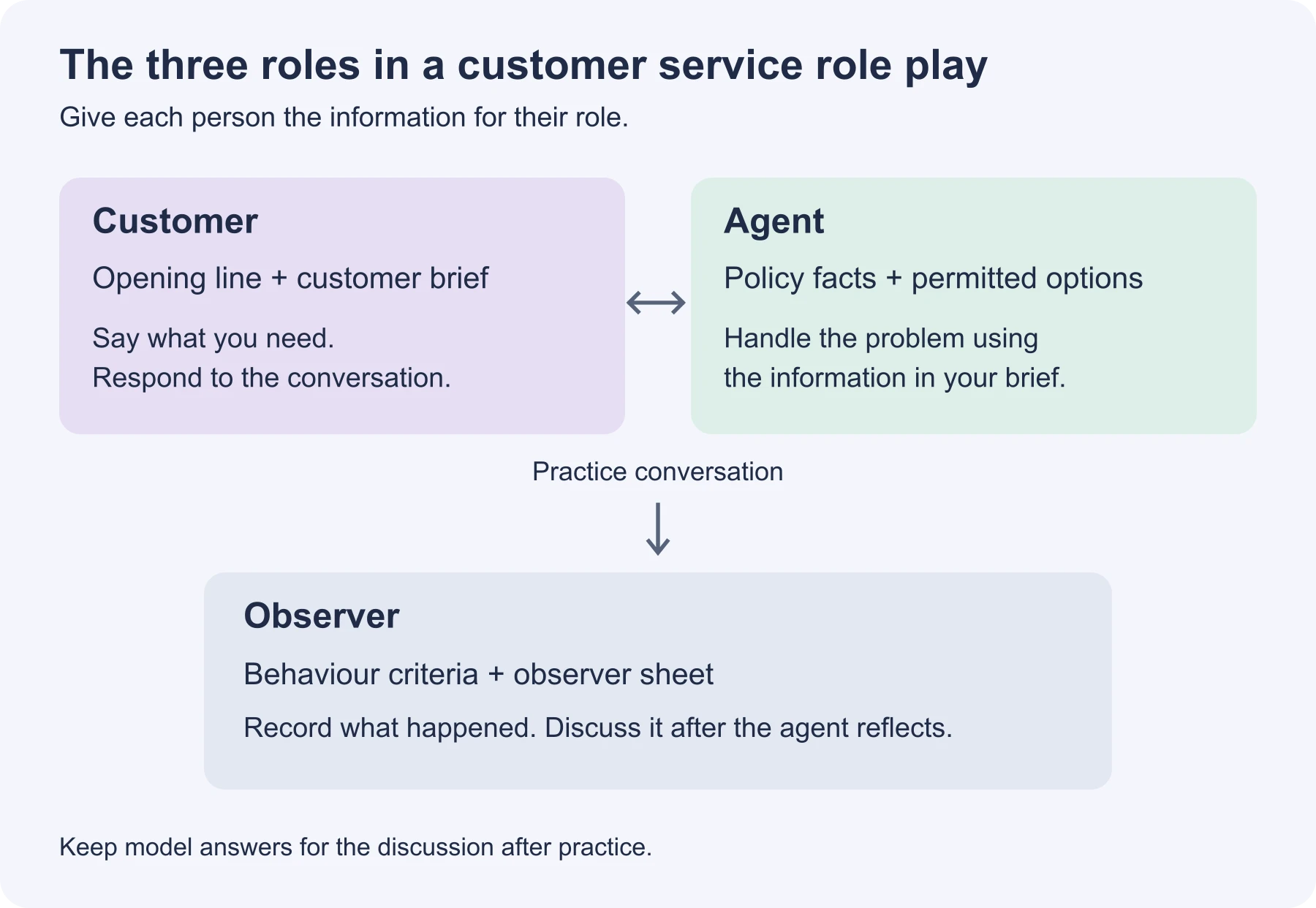
Open the three-roles diagram at full size
Rotate roles when everyone needs a turn as the agent. Keep a separate observer sheet for each person. If you want to record one agent across four scenarios, keep that person in the agent role and change the customer or observer instead.
Role play, branching scenario, AI role play or simulation?
| Format | How it works | Best for |
|---|---|---|
| Live role play | Two people talk; a third observes | Tone, listening and handling pushback |
| Branching scenario | The learner picks a reply and sees what happens next | Practising decisions alone, at scale |
| AI role play | The learner chats with an AI playing the customer | Extra practice between live sessions |
| Simulation | A realistic copy of the job, often with the real system | Process steps, such as finding an order |
For more on simulations, see these role play simulation examples. This guide is about live role play, with scripts you can also turn into a branching scenario.
Difficulty levels
| Level | What it tests | Example |
|---|---|---|
| Starter | A clear problem with a clear fix | A late order with a new delivery date |
| Standard | A fix with a choice or a limit | A booking problem with two options to offer |
| Hard | Saying no, high emotion or a risk | A caller wanting to change someone else's account |
Use the levels as planning labels, not a test of ability. Start with a familiar problem and the policy beside the agent. Practise identity checks from the beginning whenever the job involves accounts. Introduce harder pushback once the agent can follow the relevant process.
What makes a scenario work
- A specific opening line, such as "This is the third time I've called about this." A vague brief ("the customer is annoyed") gives the actor nothing to say.
- A reason for the customer to keep asking, and a description of what would help them accept an answer. The actor can respond to the agent rather than simply repeat the complaint.
- Policy facts and limits for the agent, such as the refund timeframe and whether they may offer credit. Give them the reference material they would have at work.
- Observable good behaviour, written so the observer can tick it.
Why showing a poor reply helps
A meta-analysis of 117 studies of behaviour modelling training found stronger transfer to work when training included good and poor examples, learner-generated scenarios and goal setting, among other conditions. It studied this wider training approach, not this pack.
Use the pack's common misses as discussion examples: show a poor reply, ask what it leaves unresolved, and try a better one. Invite staff to adapt a scenario from an anonymised customer problem, then finish with one action to practise again.
When role play is the wrong tool
- Teaching the policy itself: teach it first in a short course or briefing, then practise it.
- Learning a system: use a simulation or the real system, with practice data.
- Agents who freeze in front of colleagues: start with a branching scenario or an AI role play, which they can do alone.
How to run a customer service role play
The completed workbook follows a fictional contact centre session. One new agent practises four phone conversations while a colleague plays the customer and a team leader observes. This lets you see that agent's progress across four situations. For a group session, run several trios in parallel and use one observer sheet per agent.
Step 1: Pick three or four scenarios at the right level
The example uses a repeat caller (2), a double charge (8), an abusive caller (14) and a caller asking to change their partner's account (18). Choose situations your staff actually handle. Before the session, replace the sample policies with your organisation's approved answers and confirm what the agent may promise.
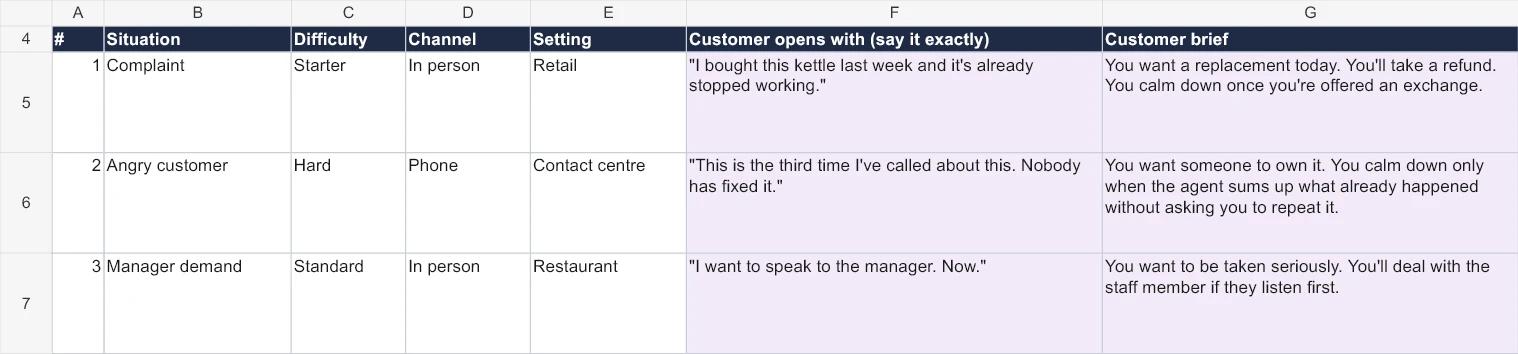
The first three scenarios
Example: Fictional scenarios for retail, phone support and a restaurant.
- 1. Filter: choose a channel, setting or difficulty in the header to see only those scenarios.
- 2. Opening line: start with the supplied line, then respond to the agent using the customer brief.
- 3. Customer brief: tells the actor what they want and what calms them down, so they know when to ease off.
Open this workbook preview at full size
Step 2: Brief each role separately
Give the customer actor only the opening line and the customer brief. Give the agent only the agent brief. The observer gets "what good looks like" and the observer sheet.
Before practising an abusive caller, agree the words and a pause signal. Nobody needs to direct personal insults at a colleague. In pharmacy or other specialist settings, practise getting the qualified person involved rather than improvising advice.
Share the customer opening and brief with the customer, the policy brief with the agent, and the criteria with the observer. Hiding columns in a workbook is a presentation choice, not access control. Copy the required columns into separate files or print only those columns.
Step 3: Run it once, straight through
Let the conversation run without coaching, then discuss it afterwards. Agree a signal anyone can use to pause. For the fictional phone script below, identity has already been checked and the conversation takes place on Tuesday. The agent has two previous call notes and an available Thursday technician visit. Read the script together as a demonstration, then practise from the separate briefs.
| Speaker | Line |
|---|---|
| Customer | This is the third time I've called about this. Nobody has fixed it. |
| Agent | I'm sorry you've had to call three times. I'm Sam. I can see notes from your calls on the 4th and the 9th about the internet dropping out every evening. Is that right? |
| Customer | Yes. And every time someone says they'll call back, and nobody does. |
| Agent | That's not good enough, and I'm going to own this one myself. The earlier calls reset the modem, which hasn't fixed it, so the next step is a technician. |
| Customer | How long will that take? |
| Agent | I can book one for Thursday between 8 and 12. Does that work for you? |
| Customer | Thursday's fine. But what if it still doesn't work? |
| Agent | Then you call me directly, not the main line. My direct number is in the text I'm sending now, with the booking reference. I'll also call you on Thursday afternoon to check. |
| Customer | Okay. Thank you. |
| Agent | Is there anything else I can help with today? |
The useful detail here is the call history. Sam checks the earlier attempts before suggesting another step, then gives a booking window and a follow-up time. The observer can check each of those actions; the customer does not have to become cheerful for the agent to have handled the call well.
Step 4: Score what you saw, not what you think they meant
Rate the 10 behaviours on what you saw or heard. Shown means completed without help; Partly means attempted but incomplete or prompted; Not shown means missed or incorrect. Use N/A only when the conversation gave no opportunity to show that behaviour. Six behaviours are marked essential in the example. Change these must-have choices to suit your task before running the session.
An identity-check gap in the completed example
Example: Fictional agent A, observed in scenarios 2, 8, 14 and 18.

- 1. Identity check: marked Not shown because the agent began the account change before confirming the caller had authority.
- 2. N/A: excluded from the shown-in count. In scenario 2, identity was checked before this practice conversation began.
- 3. Follow-up: the full sheet flags three essential behaviours to practise: listening, identity checks and giving the next-step timeframe.
Open this workbook preview at full size
Step 5: Debrief, with the agent speaking first
Ask the agent to describe their own decisions before adding the observer's notes. Use an exact moment from the conversation: "You offered the refund but did not say when it would arrive." Then replay that part with a clearer answer.
Ask these straight after each scenario, before the observer gives feedback.
1. What went well?
2. What would you change?
3. What will you do next time?
Step 6: Record the next action and continue
The sample plan runs from 2 pm to 3 pm: 5 minutes to brief the group, four rounds of 6 minutes of practice and 6 minutes of discussion, and 7 minutes to finish. The 6-minute discussion includes recording feedback and preparing the next round. Four rounds give one agent four attempts, or several agents fewer attempts if you rotate. Add more time when everyone needs four turns.
For an account change, follow the organisation's process for confirming both who the caller is and whether they may act on the account. A caller knowing the account holder's name is not enough. Use the sample scenario to practise explaining the next permitted step.
In Coursebox, a branching scenario lets the learner choose a reply and see what happens next. An AI interactive scenario lets the learner exchange text messages with an AI character and receive feedback on replies. Check the current plan and AI-credit requirements before setting up repeated practice.
Role play scripts for other settings
In the 180 days to 19 October 2026, at least 47 people asked our AI course builder for customer service training with role plays, scenarios or scripts, most often for retail and pharmacy counters, contact centres, venues and hotels. These scripts cover those settings.
Each script is a tab in the example file.
A retail counter: refund with no receipt
Scenario 7, in person. The customer wants cash; the agent may offer store credit under the sample change-of-mind policy.
| Speaker | Line |
|---|---|
| Customer | I want a cash refund. I don't have the receipt. It was a gift. |
| Agent | Thanks for bringing it in. For a change-of-mind return without proof of purchase, this store offers credit rather than cash. I can offer 45 dollars in store credit. |
| Customer | That's ridiculous. It's obviously from here. |
| Agent | I can see it's ours. Under this return policy, the credit is based on our lowest recent selling price, which is 45 dollars. You can use it in store or online. |
| Customer | Fine. Can I use it today? |
| Agent | Yes, straight away. I'll put it on a card now. |
This example is a change-of-mind return of an unused, non-faulty gift. The fictional policy allows 45 dollars in credit without proof of purchase. Replace it with your own approved policy; a faulty item needs a different conversation.
A hotel front desk: the wrong room
Scenario 13, in person. A suite is available tonight, a double is confirmed tomorrow, and the agent may offer a 20% discount if the guest keeps the twin room. Those facts belong in the agent brief before practice starts.
| Speaker | Line |
|---|---|
| Customer | I booked a double room and you've given me twin beds. |
| Agent | I'm sorry about that. Let me check your booking. You're right, you booked a double, and we have no doubles left tonight. |
| Customer | So what are you going to do about it? |
| Agent | I can offer you two things. A suite tonight at no extra cost, and a double from tomorrow. Or you keep the twin room and I take 20% off your whole stay. |
| Customer | The suite, please. |
| Agent | Done. Here's the new key. I've noted it so you move to a double tomorrow. If anything else isn't right, call me on extension 9. |
The guest can choose an upgrade with a room move tomorrow, or stay in the twin room at a lower price. Check both availability and your authority to offer a discount before using this script.
Live chat: the same angry customer, in writing
Scenario 2 adapted for chat. As in the phone version, identity has been checked and a technician is available on Thursday.
| Speaker | Line |
|---|---|
| Customer | 3rd time contacting you about this. Nobody has fixed it. |
| Agent | I'm sorry you've had to come back three times. I'm Sam. I can see your contacts on the 4th and 9th about the internet dropping every evening. I'm going to own this one. |
| Customer | Last time someone said they'd call back. They didn't. |
| Agent | The modem resets haven't fixed it. A technician is available Thursday between 8 and 12. Would you like me to book that? |
| Customer | Yes. |
| Agent | Booked. Your reference is TK-4471. I'll message you here on Thursday afternoon to check it's fixed. Anything else today? |
The chat version keeps the history and proposed next step visible in short messages. It also asks permission before booking the visit. In a practice chat, let the observer review the written exchange before giving feedback.
What to do after the session
- Choose the next practice task. If an essential behaviour was missed, repeat the relevant conversation after feedback. If essential behaviours were shown, plan a harder variation or supervised workplace practice. The sheet does not authorise someone to work with customers independently.
- Follow each recorded gap. Agent A needs another turn at listening in scenario 2, identity checks in scenario 18 and explaining the refund timeframe in scenario 8. Use a fresh sheet so the next attempt remains separate.
- Keep the sheets. Keep the scenario and observer notes with each record so you can compare later attempts. These observation checklists show how to build one for other skills.
- Look for a shared problem. If several agents miss the same step, check whether the policy, training or available tools explain it. The guide to customer service training covers planning the wider programme.
When the pack is not enough
- To build a whole customer service programme, start with customer service training and compare customer service training software.
- For retail floor exercises beyond role play, see these customer experience training exercises.
- To let staff practise decisions alone, learn how scenario-based learning works.
The pack is version 1.1 (20 October 2026). The Excel files have been checked in Microsoft Excel on Windows. The PDF is a printable example; it does not calculate scores or times. Other spreadsheet apps have not been tested.
Running your next role play session
Pick three or four scenarios at the right level, and keep the customer's brief away from the agent. Score what the observer actually saw, and let the agent speak first in every debrief. Between sessions, staff can practise the same scenarios alone as branching scenarios or AI role plays built with Coursebox's branching scenario software.
Frequently Asked Questions
A practice conversation where one person plays the customer, one plays the agent, and an observer scores what the agent did. It lets staff practise hard conversations, such as angry customers or refusals, before they happen for real.
Choose a workplace situation, give each role a separate brief, and agree a pause signal. Let the conversation run, then ask the agent to reflect before the observer shares specific feedback. Repeat the difficult part or move to the next scenario; use one observer sheet per agent.
Start with a familiar problem and an approved answer, such as a late order or missing delivery item. Include identity checks whenever the task involves an account. Add stronger pushback after the agent can follow the basic process.
The example allows 6 minutes of conversation and 6 minutes of discussion per round. Four rounds plus a 5-minute briefing and 7-minute wrap-up take 60 minutes. One agent can complete all four rounds; rotating agents gives each person fewer attempts.
Rate behaviours you can see or hear, such as letting the customer finish, saying the problem back and confirming the next step. Mark some as essential, and don't let a high overall score hide a missed essential.
Carolina Martin
Carolina is a highly experienced learning designer with tech start-up experience. She is based in Sydney and previously designed courses alongside Coursebox founder Travis in a previous job. She is passionate about delivering engaging learning experiences and brings the same perspective to customer experience too. She manages our customer support documentation and product testing processes.

