

10 Best LMS for Nonprofits in 2026 (Free, Discounted & Paid)
The 10 best LMS for nonprofits, ranked on real cost, free tiers, verified nonprofit discounts, and the per-user billing trap that makes volunteers expensive. Plus how to claim each discount.

For nonprofits, the billing model counts for more than the price. Per-registered-user pricing makes volunteers expensive (15 staff + 200 volunteers is billed like 215 people); flat or unlimited-learner pricing takes that ceiling off. Check it first.
- The truly free options are Moodle and Chamilo (open-source), Google Classroom (if you are on Google Workspace) and Docebo OWL (free ready-made courses for registered charities under 300 users). With Moodle and Chamilo, though, "free to license" is not free to run: you host and maintain them, which means managed hosting from roughly $100 to $500 a year for a small site, or a volunteer who really knows servers.
- For a nonprofit training a big or growing volunteer base, Coursebox keeps the bill flat: a real free plan, unlimited learners and no per-learner fee, plus AI that builds courses from your own docs. TalentLMS is the other easy no-IT pick and publishes a 20% nonprofit discount, but its per-user pricing climbs as volunteers grow.
- Most nonprofit software deals are claimed through TechSoup, a nonprofit that verifies your charitable status so vendors can give you a discount. Set up a TechSoup account before you shop; some vendors (Absorb, LearnUpon, Cornerstone) publish no discount and price by quote instead.
- Start with the cheapest tool that proves completions clearly, then upgrade only when reporting, separate portals, or volunteer volume force it. And if a full LMS is overkill, a free plan or a shared checklist may be enough to start.
Answer three quick questions and I will point you to the right platform for your budget and team.

Run your own branded LMS with unlimited learners
Picture a small charity: 15 paid staff and 200 volunteers who cycle in and out every season. Most LMS pricing punishes exactly that shape. You are billed for all 215 people, and every new volunteer pushes the bill higher. The billing model catches nonprofits far more often than the sticker price does, so it is the first thing to check.
Two more walls come with it. You are training different groups at once: staff who need compliance records, volunteers who turn over constantly, sometimes the community you serve. That is really three training jobs under one roof. And you probably have no IT team, so a platform that is "free" to license but needs a server admin is not free at all. The real question on every tool below is simple: how are you billed (per registered user, per active user, or a flat rate), and can one non-technical person keep it running?
Below, I have ranked ten platforms on that reality, and flagged every verified nonprofit discount with how to claim it.
One disclosure before the list: we build Coursebox, an AI LMS built for nonprofits, so we have kept it to an honest number three below and named its limits. With that on the table, here is how the ten compare.
What decides it for a nonprofit (it is rarely the feature list)
Six things decide whether an LMS works for a nonprofit, and none of them show up in a feature comparison.
- The billing model, not the price. Per-registered-user pricing punishes you for having volunteers: 15 staff plus 200 volunteers is billed like a 215-person org, and it climbs every time someone new signs up. Per-active-user is kinder; flat or unlimited-learner pricing takes the ceiling off. Check this before the sticker price.
- Free is not always free. Open-source (Moodle, Chamilo) has no license fee, but you host it, patch it and keep it online, which is real cost measured in staff or volunteer hours. Weigh the total cost of running it, not just the zero on the invoice.
- Three audiences, one platform. Training paid staff on compliance is a different job from orienting churning volunteers, which is different again from educating the community you serve. The tools that fit run separate, branded spaces for each rather than forcing everyone into one.
- TechSoup is the main channel, but several vendors handle it directly. TechSoup verifies your charitable status and is how you claim a lot of nonprofit software deals, so set up an account early. Several vendors here run their own nonprofit offer instead (TalentLMS, Docebo OWL, Coursebox), so check each one.
- Reporting your board and funders will accept. Grants and audits need proof, exportable completion records tied to real people, not just a dashboard. If you report to funders, check what the platform lets you export before you commit.
- Accessibility your learners and funders expect. If you serve people with disabilities, or run any federally funded program, accessibility is not optional: look for WCAG 2.1 AA support and, in the US, Section 508 compliance. Check it before you commit, because retrofitting an inaccessible platform is far harder than choosing an accessible one.
If volunteer turnover is the real problem, the fix is as much program as platform. Our guide to training volunteers covers the onboarding side no LMS solves on its own.
How I compared these
I ranked these on the things that decide it for a nonprofit, not generic LMS features: the real cost (free tiers, published nonprofit discounts, and whether billing is per-user or flat), how well each handles a mixed staff-and-volunteer audience, and whether a small team can run it without IT. I checked pricing and every nonprofit-discount claim on each vendor’s own site, and pulled user ratings from G2 and Capterra. Where a tool is free to license but costly to run, or where a "discount" is quote-only rather than published, I have said so.
The 10 platforms at a glance
| Platform | Best for | Free / nonprofit price | Billing | User rating |
|---|---|---|---|---|
| Moodle | Free open-source flexibility | Free to license (you host it) | Free / self-host | 4.1 (448) |
| TalentLMS | Easy and cheap, no IT | 20% off annual for nonprofits | Per-user tiers (small free plan) | 4.6 (806) |
| Coursebox | Staff + volunteers, flat cost | Real free plan; paid from ~$25/mo | Flat; unlimited learners | 4.7 (99)* |
| Docebo OWL | Free ready-made courses, small charities | Free under 300 active users | Free (curated library) | Not listed |
| Google Classroom | Lightweight training on Google | Free with Workspace | Free | 4.5 (1,568) |
| Absorb LMS | Larger, funded nonprofits | No published discount (quote) | Quote; per user | 4.6 (973) |
| LearnUpon | Separate staff/volunteer/member portals | No published discount (quote) | Quote; from ~100 users | 4.5 (254) |
| Blackbaud | Orgs on Blackbaud fundraising | Nonprofit-native (quote) | Quote | 3.8 (31) |
| Chamilo | Free, simpler than Moodle | Free to license (you host it) | Free / self-host | 4.9 (18) |
| Connecteam | Frontline/deskless volunteers | Free plan (small teams) | Per-user tiers | 4.6 (3,505) |
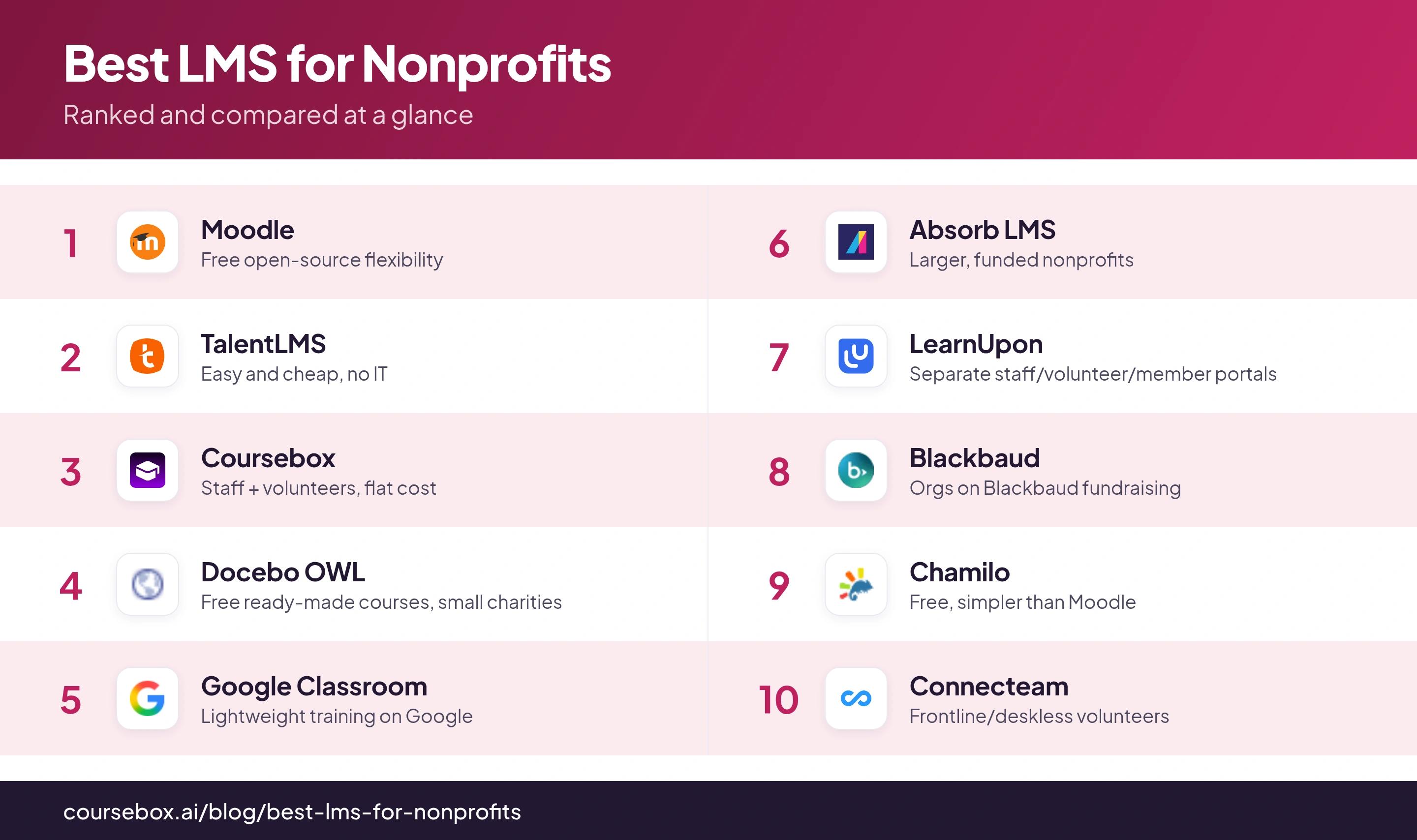
User ratings are out of 5 with review counts in brackets, from G2 as of September 2026, except * which is from Capterra (Coursebox is not yet rated on G2). Free / open-source tools and Docebo OWL are rated where a listing exists.
The 10 best LMS platforms for nonprofits
1. Moodle
Moodle is where a huge share of nonprofits start, because the software is free: it is the open-source LMS that runs a large part of the education and nonprofit world, endlessly flexible, with a plugin for almost anything. You can build courses, track completions, issue certificates and shape it to a program that is truly yours, at no license cost.
Best for a nonprofit with a bit of technical help, or a volunteer who is comfortable with servers. The honest catch is the one this whole list warns about: free to license is not free to run. You host it, patch it, manage plugins and updates, and it needs someone technical to keep it online, which is real cost in a place that measures cost in staff hours. MoodleCloud is a paid hosted option if you want the software without the server.
My testing experience: poking at a test site, the "free" is real and so is the upkeep. The default admin screen barely reads as an LMS, and people who run it warn that every core upgrade means cloning the site and re-testing each plugin, since an update can clobber a plugin back a version and break it. Site-wide reporting is thin enough that teams build custom tools for it. Budget managed hosting (roughly $100 to $500 a year for a small site) or a volunteer who really knows servers.
Verdict: The free, flexible pick when you have technical help to run it. If nobody on your team can manage a server, the real cost lands on you later.
2. TalentLMS
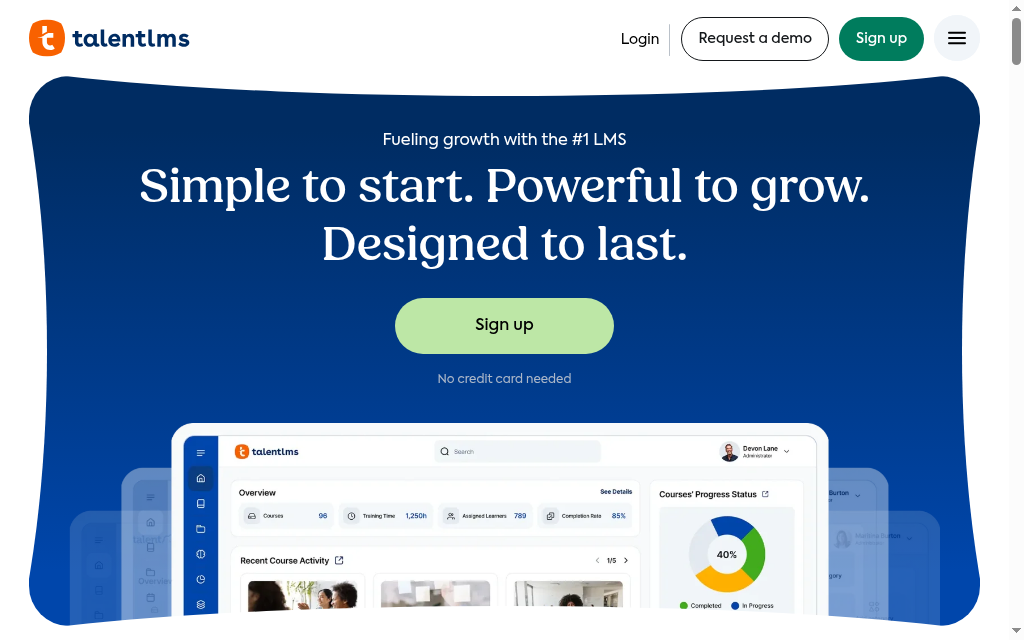
TalentLMS is the easiest paid option here for a nonprofit with no IT: a simple cloud LMS you can brand and launch in days, with a small free plan to start and, importantly, a published nonprofit discount of 20% off the annual plan. You get clean course delivery, certificates and reporting without touching a server, in a tool a single admin can run.
Best for a small or mid-size nonprofit that wants something live fast, cheap and low-maintenance. The 20% nonprofit discount and the free starter plan keep the entry cost down. The catch is the model: pricing is per-user in tiers. As a large volunteer base signs up, the cost climbs, so watch it if you are training hundreds of volunteers, not just staff.
My testing experience: a branded academy was live in under an hour, one admin can run it. The limits show up later: the free plan hard-caps at 5 users and 10 courses, so paid staff plus volunteers blow past it almost at once, the authoring is basic (fine for slides, weak for scenario design), and reporting cannot roll courses into a curriculum or show a manager their team. Removing the TalentLMS branding is a Pro-tier feature, and the 20% nonprofit discount is claimed after you sign up for the free plan.
Verdict: The simplest cheap pick for a small nonprofit with no IT, and it publishes a real 20% discount. Per-user pricing is the thing to watch as volunteers scale.
3. Coursebox
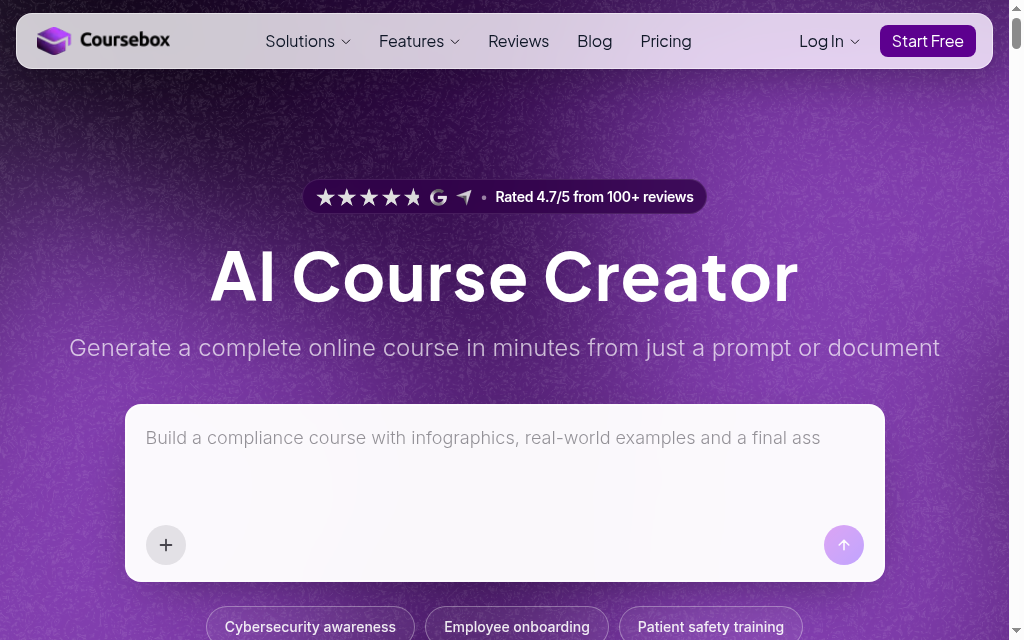
Coursebox, which is ours, is built around the two things that pinch a nonprofit: cost and a large, changing audience. It has a real free plan and it is white-label, so learners see your organization, not us. Its AI drafts a full course (lessons, quizzes, an AI tutor) from a document, a link or a prompt, so a tiny team can build training without an instructional designer. Its billing is what suits a nonprofit: unlimited learners with no per-learner fee, so training 20 staff or 2,000 volunteers does not change the price the way per-user platforms do.
Best for a nonprofit training both staff and a big or churning volunteer or member base, that wants to keep costs flat and build courses fast. You get a free plan to start, white-label branding, and unlimited learners on paid plans. Honest placement: it is newer than Moodle or the enterprise names, the quiz engine is still basic, and it is not tied into fundraising CRMs the way a Blackbaud is. For flat-cost, branded training at volunteer scale, it is a strong fit.
My testing experience: feeding in a handbook, a full course drafted in minutes and opened straight in the editor, which is the real draw for a small team. Plan to edit, not skim: the AI draft can read generic on specialised topics and reviewers have caught real slips, so budget five to ten minutes a page, and note the quiz builder locks a question type once you create it. Coursebox is ours, so weigh that, and the flat, unlimited-learner pricing is the reason it fits volunteer scale.
Verdict: Go here for flat-cost, white-label training that does not get more expensive as your volunteer base grows, built fast with AI. Newer, with a basic quiz engine and no fundraising-CRM tie-in.
4. Docebo OWL
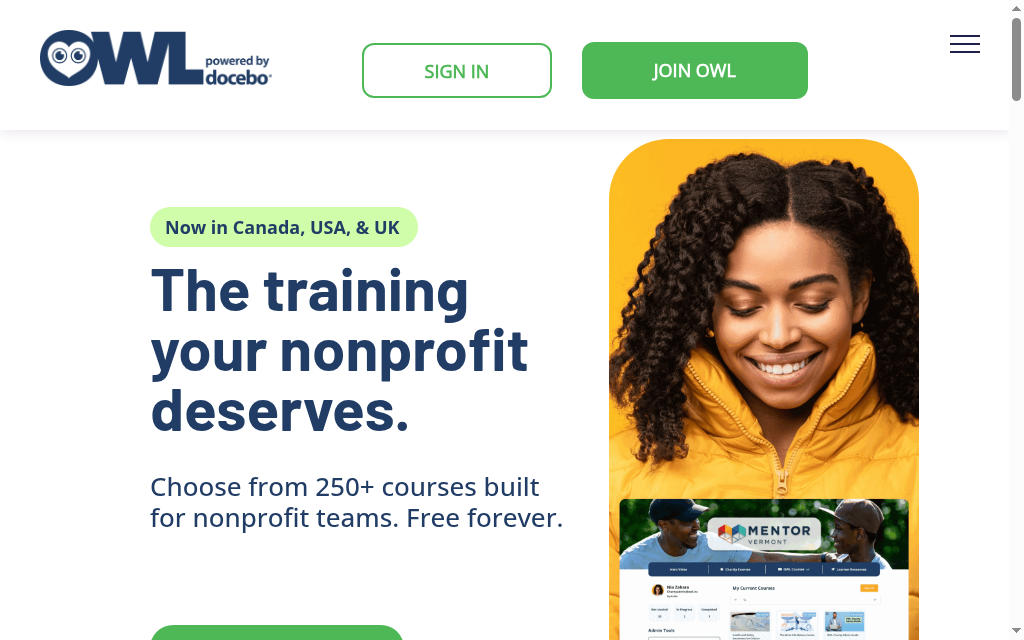
Docebo OWL is the most interesting free option here: a program from Docebo that gives registered charities free access for organizations under 300 active users a month (in the US, Canada and the UK). Instead of an empty platform you have to fill, it comes with a curated library of professionally made courses, funded through an impact program, so a small charity gets real training content at no cost.
Best for a small registered charity that wants ready-made, good-quality courses without paying or building them. The important limits: it is a curated content library, not a system you upload your own material into, and the free tier caps at under 300 active users a month. If you need to host your own courses or you are larger than that, you are into paid Docebo, which is powerful but enterprise-priced.
My testing experience: it is a curated course library, not free Docebo. You get pre-built courses (HR compliance, board governance, DEI, fundraising), each ending in a shareable certificate, but to load your own material you apply separately for a branded charity account. Onboarding runs through one "charity lead" who grants access by uploading a CSV of users, so there is no self-serve signup for a churning volunteer base, and the free tier caps at under 300 active users a month for registered charities in the US, Canada and UK.
Verdict: A truly free, content-included option for small registered charities under 300 active users a month. Not a build-your-own LMS, and you outgrow the free tier as you scale.
5. Google Classroom
Google Classroom is the free, lightweight option for a nonprofit already living in Google: a teacher-style tool where you set up a class, hand out materials and assignments, collect work and give feedback, all inside Google Workspace. It turns on the same day, costs nothing with a qualifying account, and there is nothing to host.
Best for simple, low-stakes training or community education when you already use Google and do not need a real LMS. Be clear on the limits: no SCORM, no proper course-authoring, and thin certification and reporting, so it complements structured training more than it replaces it. Nonprofits can also get Google Workspace itself free or heavily discounted through Google for Nonprofits, which is worth claiming regardless.
My testing experience: if everyone is already on Google Workspace it turns on the same day. The limits come fast: no SCORM, no role-based enrolment (you add people by hand), and no concept of a recurring or expiring course, so annual compliance recertification falls back to spreadsheets. The one that bites a nonprofit hardest is access: anyone without a Google account cannot join, and a Workspace for Education setup can lock a class to your own domain, so volunteers on outside email may be shut out depending on your settings. There are also no native certificates or clean audit records to export.
Verdict: Right for free, simple coursework if you already use Google Workspace. Too light to be a real LMS for compliance or grant-ready reporting.
6. Absorb LMS
Absorb LMS is a polished, managed cloud LMS that scales well, which suits larger, funded organizations more than shoestring ones. It gives you branded portals, AI-assisted admin, e-commerce if you sell training, and clean completion and score reporting you can export for a board or funder, without you running any infrastructure.
Best for a bigger or well-funded nonprofit that wants a dependable, professional platform and can afford it. The honest catch for the sector: Absorb does not publish a nonprofit discount, and pricing is quote-based and per-user, so it is out of reach for a small volunteer-run org, but comfortable for a national charity with a training budget.
My testing experience: it is polished for learners, but the admin side is click-heavy, common tasks take more clicks than they should and the menus take a while to learn. The catch for a nonprofit is cost and reporting: one admin needed about a dozen separate reports and merged them by hand in a spreadsheet, real ad-hoc reporting is a paid add-on, and pricing is quote-only with a setup fee and several features charged on top. Go in expecting to negotiate and to ask exactly what is extra.
Verdict: Built for a larger funded nonprofit that needs scale and funder-grade reporting. No published nonprofit discount, and quote-based pricing prices out a small org.
7. LearnUpon
LearnUpon is built around multi-portal delivery, which maps neatly onto how nonprofits train: separate, branded spaces for staff, volunteers and members, each with its own courses and reporting, all from one account. It is well supported, cloud-hosted and comes with real onboarding help, so several audiences can be run without stitching tools together.
Best for a mid-size nonprofit training a few distinct audiences that wants them cleanly separated but centrally managed. Two catches: LearnUpon states a minimum (around 100 users) and prices by quote, with no published nonprofit discount, so a small volunteer-run org is below its floor, but for an established nonprofit with staff plus a large volunteer or member base, the multi-portal model is worth it.
My testing experience: multi-portal is the real reason to look at it, staff, volunteers and members each get a branded space from one admin. But it is built for scale: minimums start around 100 users and it is quote-only, so a small org is looking at roughly $10k to $15k a year plus implementation. A nonprofit admin also hit the permission model, only learner, manager and admin roles exist, and once a course is published you cannot add a module without creating a new version.
Verdict: A strong multi-audience pick for an established nonprofit running staff, volunteer and member training separately. The 100-user minimum and quote pricing rule out small orgs.
8. Blackbaud
Blackbaud is the name most nonprofits already know for fundraising and donor management, so it is natural to wonder whether it runs training too. Be clear on what it is: its learning tools are an add-on to that ecosystem rather than a strong standalone LMS, and the product actually branded as its LMS leans toward K-12 schools. The pull, such as it is, is staying inside one vendor, not training that plugs into your donor data.
Best for an organization already committed to Blackbaud’s stack that wants everything under one roof, or a K-12 school its LMS is really built for. For a typical nonprofit training staff and volunteers, it is quote-based, reporting is weak and tedious, and a focused LMS will deliver courses better. The donor-data-linked training you might imagine is not really something you can buy.
My testing experience: this is the one to be honest about. Blackbaud is the name nonprofits know for fundraising, so it feels like the place to run training too, but its learning tools are really an add-on that only makes sense if you already live in the ecosystem, and its actual LMS product leans toward K-12 schools rather than staff and volunteer training. Reviewers say reporting is weak and tedious (columns and rows, many steps to pull anything), and the donor-data-linked training you might picture is not really something you can buy. For staff or volunteer training, a focused LMS will serve you far better.
Verdict: Only worth it if you already live in Blackbaud and want one vendor, or you are a school on its student system. For standalone staff or volunteer training, pick a focused LMS instead.
9. Chamilo
Chamilo is a free, open-source LMS like Moodle but lighter and simpler, with a focus on being easy to use out of the box. For a nonprofit that wants the zero-license-cost of open-source without Moodle’s complexity, it is a real alternative: course delivery, tracking and certificates, with a gentler learning curve.
Best for a small nonprofit that wants free and open-source but finds Moodle heavy. The same honest caveat applies, it is self-hosted, so you (or a volunteer) run the server, and its community and plugin ecosystem are smaller than Moodle’s, so there is less to fall back on. Simpler to use, but still your responsibility to host and maintain.
My testing experience: it is noticeably lighter than Moodle, reviewers report needing about a third of the training time, and it runs on modest hardware, which suits a nonprofit with weak IT. It is still a real server you install and maintain, though, one educator called it "complicated to install and configure," and the plugin and integration ecosystem is much smaller than Moodle’s, so there is less to fall back on and the look feels dated.
Verdict: A simpler free, open-source alternative to Moodle for a small org that wants zero license cost. Still self-hosted, with a smaller community behind it.
10. Connecteam
Connecteam comes at nonprofit training from a different angle: it is built for deskless, frontline teams, so its training lives in a mobile app your volunteers already have in their pocket. Rather than a full course platform, it pairs bite-size mobile training and quizzes with the operational tools frontline volunteers need (scheduling, chat, checklists), and it has a free plan for small teams.
Best for a nonprofit whose people work in the field rather than at desks: event volunteers, community health workers, drivers. For them, short phone-first training beats a formal LMS. The trade-off is depth: it is more an operations app with training inside it than a full LMS, so for rich assessment, branching or serious certification it is thinner than the dedicated platforms. For getting a churning frontline volunteer team trained on their phones, it fits.
My testing experience: training lives in the phone app your frontline volunteers already carry, right alongside their scheduling and chat. Two things to know: it does take SCORM uploads (correcting a common assumption, though a zip can take minutes to load), but the built-in quizzes are multiple-choice only, and there is no ready-made content, so you build every course yourself. Watch the free plan too, the 10-user cap counts people who have left, and there is no offline mode for a dead-signal site.
Verdict: The mobile-first option for training deskless, frontline volunteers, with a free plan for small teams. Thin as a full LMS if you need structured courses and certification.
The nonprofit discounts, and how to claim them
Here is who offers a nonprofit deal, what it is, and how you get it, covering the platforms above plus a couple of others nonprofits often ask about. Confirm the current terms on the vendor’s own page before you sign, and note that "no published discount" usually means the price is negotiable by quote, not that none exists.
| Vendor | Nonprofit offer | How to claim it |
|---|---|---|
| Moodle / Chamilo | Free and open-source (no license fee) | Download and self-host, or pay for managed hosting |
| TalentLMS | 20% off the annual plan for registered nonprofits | Sign up for the free plan, then request the nonprofit discount |
| Docebo OWL | Free for registered charities under 300 active users/month (US, Canada, UK) | Apply at join.owl.inc; it is a curated course library, not custom hosting |
| Google Workspace | Free and heavily discounted plans (Google Classroom is free) | Verify via Google for Nonprofits, usually through TechSoup |
| Litmos | Nonprofit discount for verified 501(c)(3) organizations | Through TechSoup (the discount size is not published) |
| LearnWorlds | 15% lifetime discount for registered nonprofits (Pro Training and higher) | Contact LearnWorlds with proof of charitable status; not available on the Starter plan |
| Coursebox | A real free plan, open to everyone | Just sign up; no nonprofit verification needed |
| Connecteam | Free plan for small teams | Sign up for the free plan; no nonprofit verification needed |
| Absorb, LearnUpon, Cornerstone, Blackbaud | No published nonprofit discount | Quote-based; negotiate directly (LearnUpon has a ~100-user minimum) |
Do you need a TechSoup account? For many of these discounts, yes. TechSoup is a nonprofit that verifies your charitable status (your 501(c)(3) in the US, or the equivalent) and acts as the channel vendors trust to confirm you qualify. Setting up an account once gets you discounted and donated software across a lot of vendors, not just LMSs. The catch: fiscally-sponsored projects and organizations with a pending status often do not qualify, so check your eligibility before you count on a specific deal.
Funding the LMS: one-time cost versus a monthly subscription
There is a funding wrinkle most vendors will not raise. Grant budgets and funders tend to favour a one-time capital line item over an open-ended monthly subscription, so a per-user SaaS licence can be harder to get funded than a one-off purchase, even when it is cheaper overall. Plan around it before you sign.
A few ways to work with that: self-hosted Moodle or Chamilo can be booked as a one-time setup cost that a capacity or technology grant covers cleanly; ask a subscription vendor for an annual prepaid invoice that maps to your grant period rather than a rolling monthly charge; and write the platform into a capacity-building or technology grant as a named deliverable. The staffing case is easy to make: in the National Council of Nonprofits’ 2023 workforce survey of more than 1,600 organizations, 74.6% reported current job vacancies, so most nonprofits are onboarding new people constantly, which is exactly the load a reusable LMS is there to carry.
When a full LMS is overkill
Not every nonprofit needs an LMS.
The honest answer is sometimes the cheapest one.
If all you need is to make sure ten staff have read a policy and signed off, a shared document with a checklist, or the training features already inside your HR or scheduling software, may do the job for nothing. An LMS is worth it when you are running structured courses, certifying people, onboarding a steady stream of volunteers, or reporting completions to a funder or auditor.
If none of that is true yet, start with a free plan (Coursebox, TalentLMS, Google Classroom, or self-hosted Moodle) and only pay when you actually outgrow it.
Before the features, before the price, ask how a platform counts your people. Per-registered-user pricing makes volunteers expensive, an org with a handful of staff and hundreds of volunteers pays like a large company. If your volunteer or member base is big or growing, a flat or unlimited-learner model can save more than a percentage discount. Check the billing model first, then compare everything else.
Which should you use
If you want one answer: most nonprofits with no IT should start with TalentLMS and claim its 20% discount, and anyone training a big or churning volunteer base that needs costs to stay flat should look hard at Coursebox. If you have technical help and no budget, Moodle is hard to beat on control. And a small charity that just needs good courses handed to it should grab Docebo OWL’s free tier before paying for anything.
Most nonprofits are really weighing "free but I run it" against "paid but someone else does". If that open-source-versus-managed question is the one you are stuck on, our Moodle alternatives guide walks through it in detail. Before you commit, check the billing model, claim any discount through TechSoup, and make sure you can export the records your funders will ask for.
Frequently Asked Questions
It depends on your budget and who you train. Moodle and Chamilo are free and open-source if you can host them; TalentLMS is the easiest cheap paid pick and publishes a 20% nonprofit discount; Coursebox is the flat-cost option with a real free plan and no per-learner fee; Docebo OWL gives small charities free ready-made courses. For larger funded orgs, Absorb or LearnUpon.
Yes, several. Moodle and Chamilo are free and open-source (you host them yourself). Google Classroom is free with a Google Workspace account. Docebo OWL is free for registered charities under 300 active users a month, with courses included. Coursebox and TalentLMS have real free plans to start. Just remember that "free to license" open-source still costs you the time to host and maintain it.
Many do, but you usually claim them through TechSoup, which verifies your charitable status. TalentLMS publishes 20% off its annual plan; Google offers free and heavily discounted Workspace; Litmos discounts for verified 501(c)(3) organizations via TechSoup; Docebo runs the free OWL program for small charities. Others, like Absorb, LearnUpon and Cornerstone, do not publish a nonprofit price and negotiate by quote.
TechSoup is a nonprofit that verifies your organization’s charitable status and acts as the trusted channel through which many software vendors deliver nonprofit discounts and donations. For a lot of the deals above, you need a TechSoup account to claim them. Setting one up once gets you discounted software across many vendors. Note that fiscally-sponsored projects and orgs with pending status often do not qualify.
It can be nothing. Free and open-source (Moodle, Chamilo), free tiers (Coursebox, TalentLMS, Google Classroom) and free programs (Docebo OWL for small charities) mean a small nonprofit can start at $0. Paid plans for small orgs typically run from around $25 to a few hundred dollars a month. The total cost depends heavily on the billing model. Per-user pricing rises with your volunteer count, while flat pricing does not.
Alex Hey
Digital marketing manager and growth expert

