

Best White Label LMS Platforms, Ranked by How Hard They Are to Brand
Most white label LMS purchases turn on one number that never shows up on a feature comparison. How many days pass between signing up and showing a paying


Run your own branded LMS with unlimited learners
I have sat through hundreds of demo calls with training companies and L&D teams, and I keep watching the same thing happen. I see someone fall for a feature grid, sign, and then discover that white label on that platform means a DNS ticket, an SSL certificate, an SSO project and sometimes a developer.
I run the commercial side of Coursebox, so I am not a neutral party here. I have not put our own platform at number one, and I will get to where it actually sits further down. I want to grade these tools on the part of the decision that vendors bury in the fine print. Almost all of them can be branded, so that is not the question I find interesting. I care about how much work, money and technical help it takes to go live under your brand, and I find that lens reorders the ranking a lot. Some of the most capable white label LMS software in this list is also the slowest and most expensive to stand up.
I am looking at all of this through the eyes of a training company, an L&D team or a course business that wants to resell learning under its own name. If you are one of those, setup friction is a real cost, and it is the one nobody quotes you.
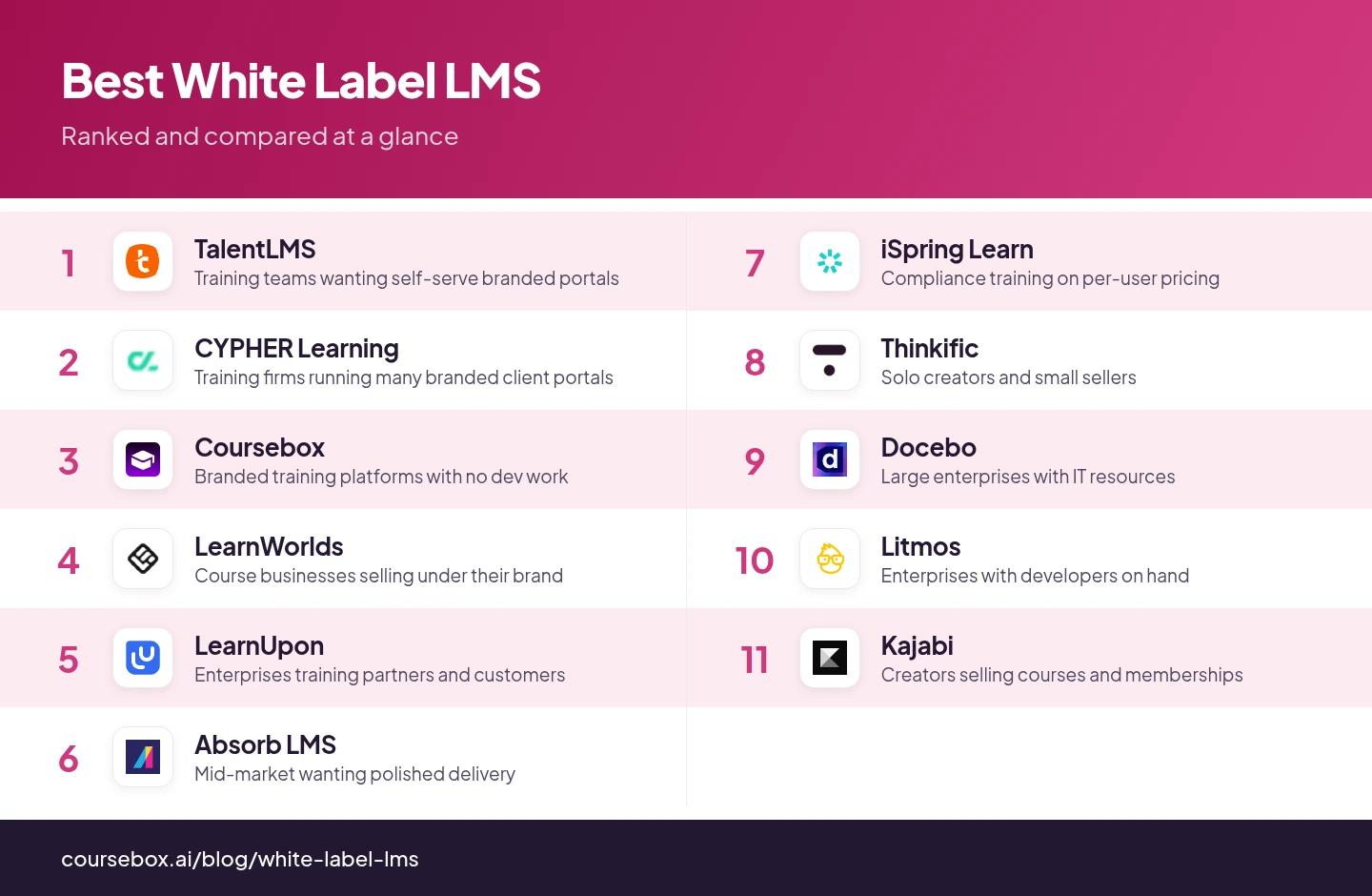
White label LMS platforms compared at a glance
| Tool | Best for | White-label setup | Pricing |
|---|---|---|---|
| TalentLMS | Training teams wanting self-serve branded portals | Self-serve from the entry paid plan | From $119/mo (annual $95) |
| CYPHER Learning | Training firms running many branded client portals | Full multi-tenant, vendor-led onboarding | Custom quote |
| Coursebox | Branded training platforms with no dev work | Logo, domain and colours, no code | Free plan; paid from $25/mo annual |
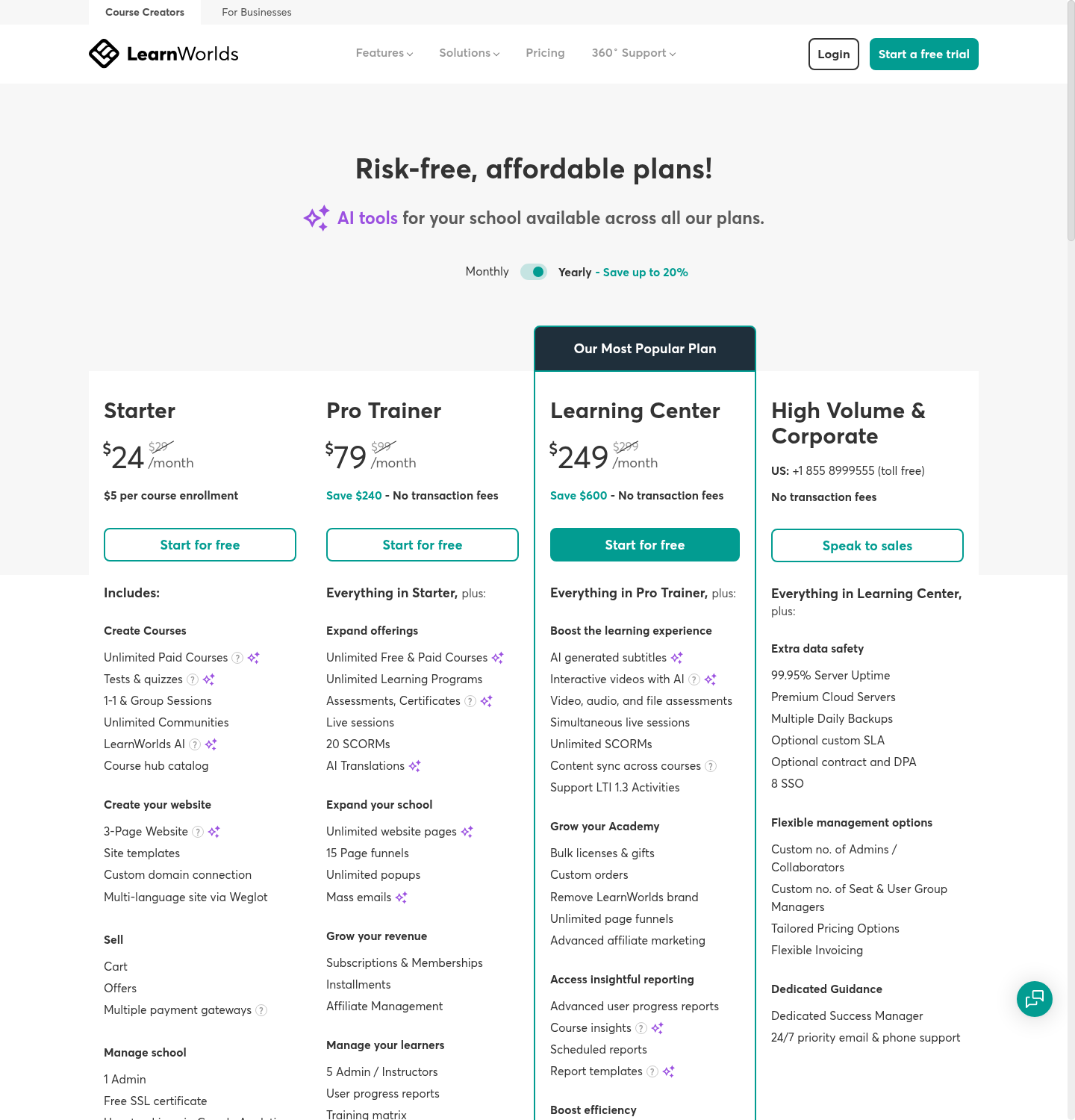
| LearnWorlds | Course businesses selling under their brand | Full removal on the Learning Center plan | From $29/mo; full removal $299/mo |
| LearnUpon | Enterprises training partners and customers | Branded portals, guided implementation | Quote, roughly $6 to $9 per user |
| Absorb LMS | Mid-market wanting polished delivery | Full white-label, paid setup fee | Custom quote; setup fee applies |
| iSpring Learn | Compliance training on per-user pricing | Branding easy, own domain costs extra | From $3.97 per user/mo annual |
| Thinkific | Solo creators and small sellers | Domain on all plans, removal at Grow | From $40/mo annual; removal at $164/mo |
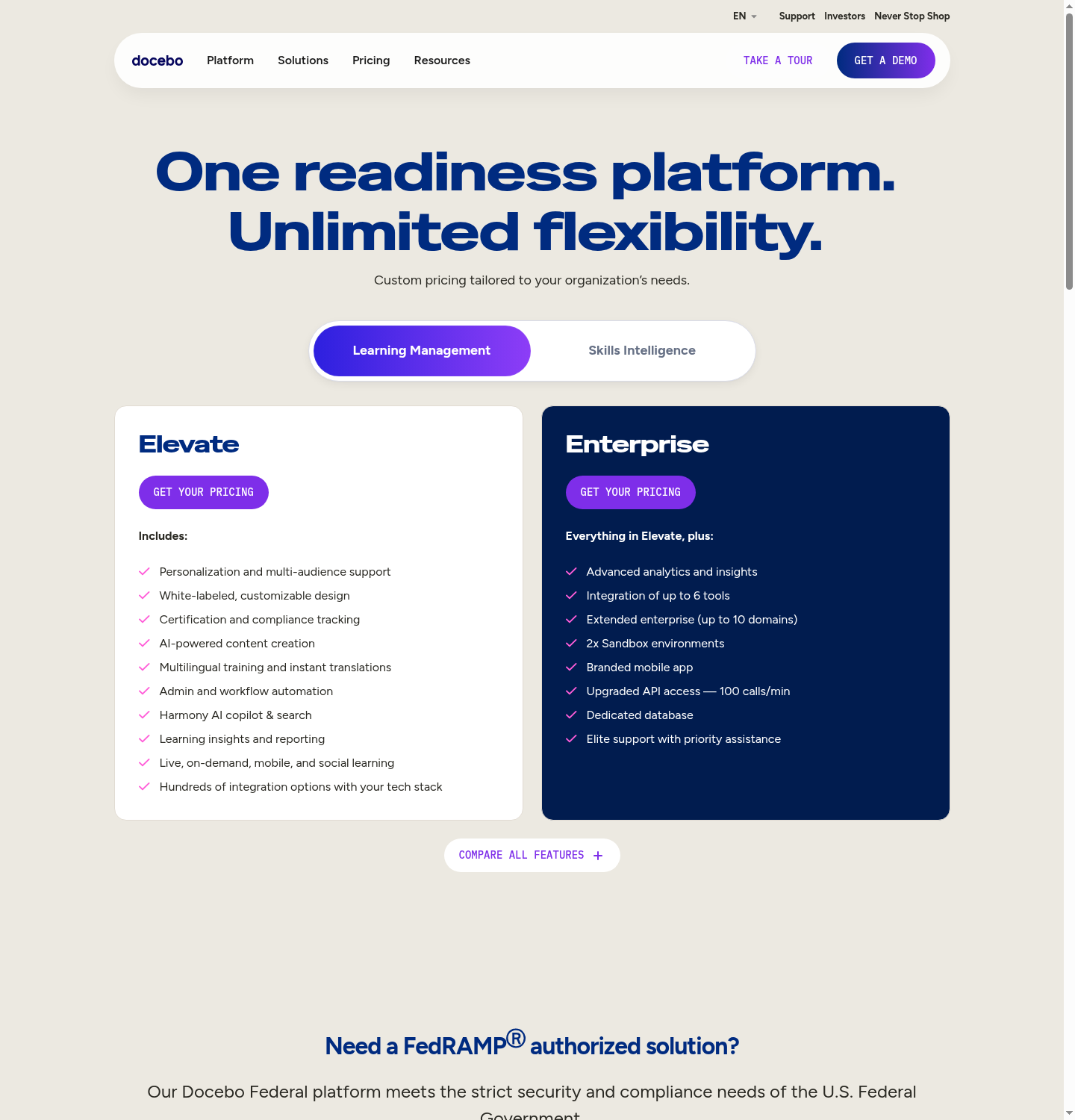
| Docebo | Large enterprises with IT resources | Own domain needs DNS and SSL work | Custom quote; 250-learner minimum |
| Litmos | Enterprises with developers on hand | Full removal needs API and dev work | Custom quote |
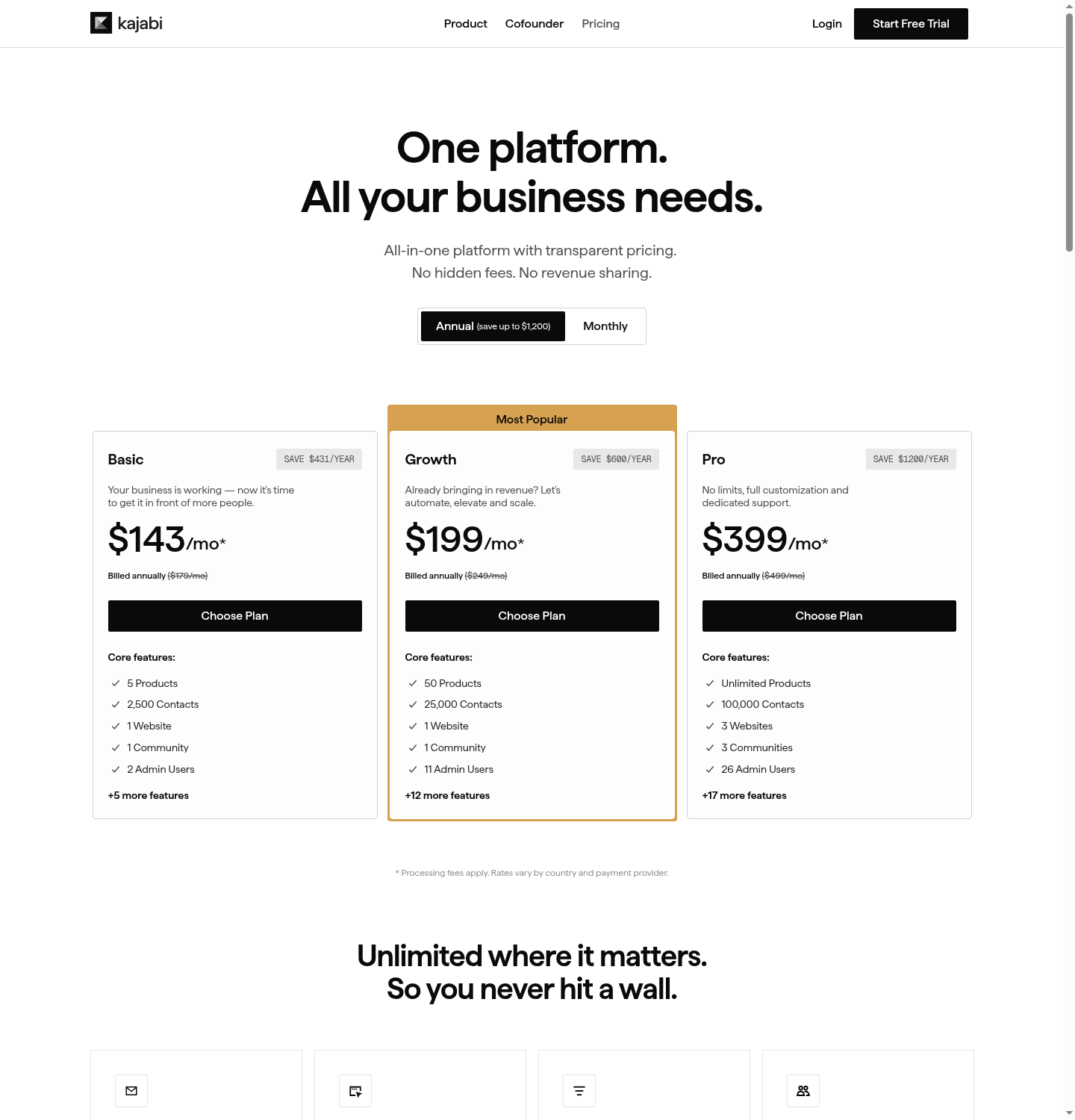
| Kajabi | Creators selling courses and memberships | Custom domain, no true multi-tenant | From $89/mo |
1. TalentLMS
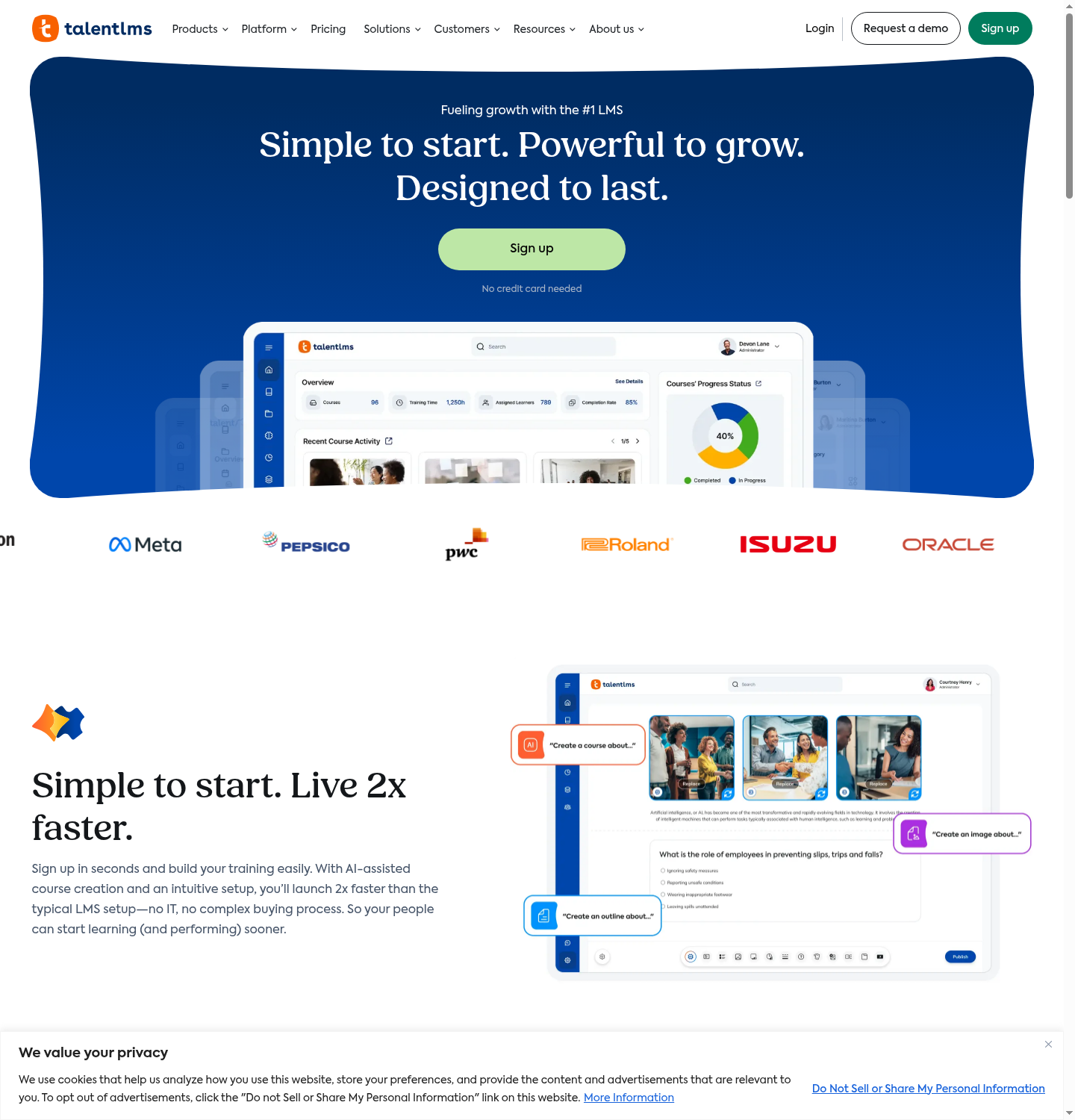
I point training teams to TalentLMS first when they want branded portals without a project plan attached. It sits at the top of most vendor lists, and I find it holds up when you test the setup rather than the brochure.
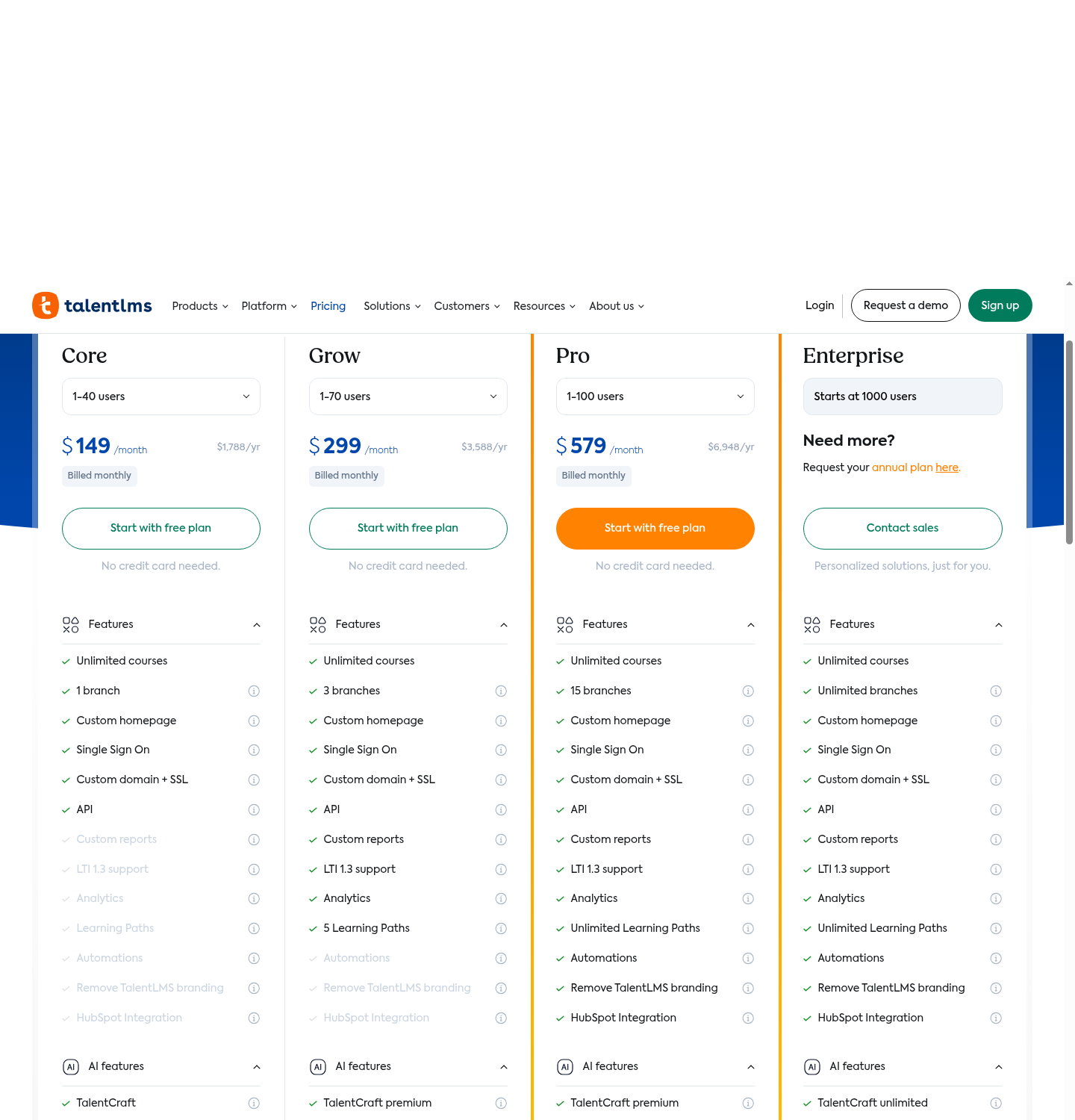
Here is what I like from the friction angle. Custom domain, SSL and hiding the TalentLMS branding are all available from the entry paid plan, and you switch them on inside the settings rather than raising a ticket. I have watched an admin with no technical background put their logo, colours and domain in place in an afternoon. I would flag the multi-portal side, because that is where the tiers bite. You get one branch on Core, three on Grow and fifteen on Pro, so a training company reselling to many clients climbs the plans quickly.
I respect that the pricing is public. Core is $119 a month, or $95 billed annually, and it runs up to Pro at $449. I would read one line before committing: the AI course builder, TalentCraft, gives Core only a one-time credit pool while the higher plans get monthly credits. If you want the most honest self-serve branded LMS in this category at a price you can see, I would start here.
2. CYPHER Learning
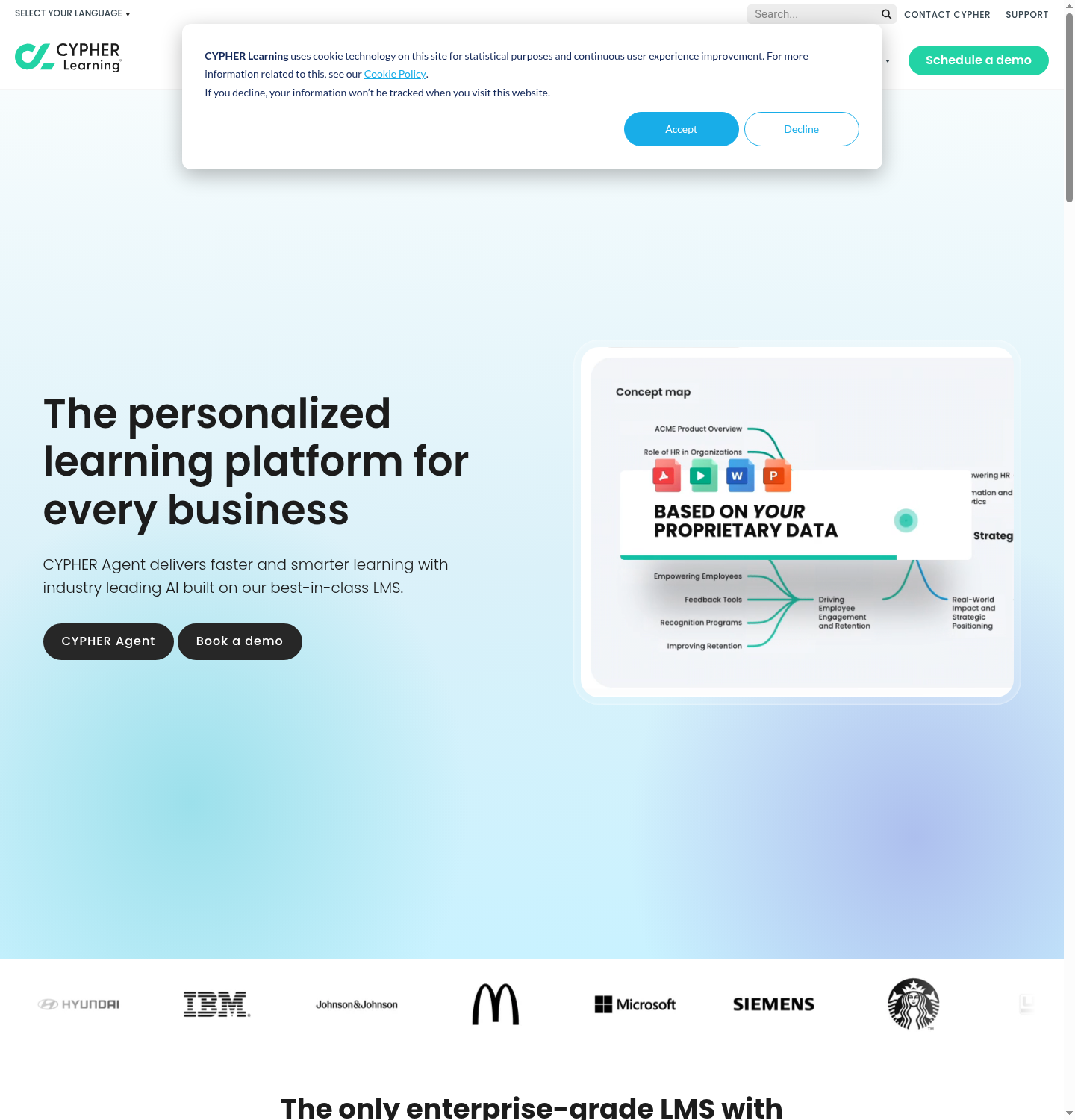
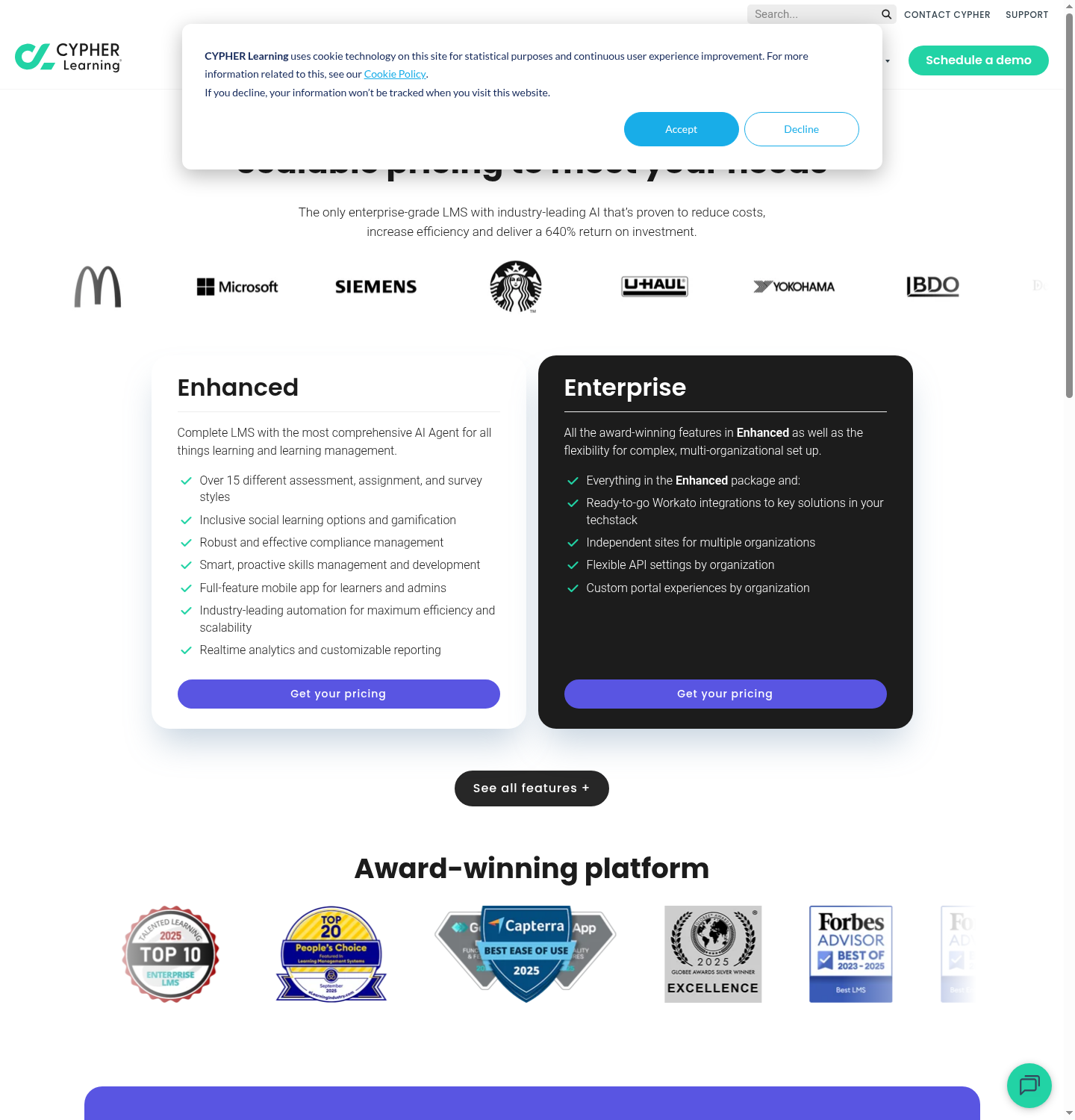
I rate CYPHER Learning as the strongest true white label multi tenant LMS on this list, and I do not say that lightly. If your business model is running a dozen client academies, each with its own domain, logo, emails and mobile app, this was built for exactly that shape.
The multi-tenant architecture lets you spin up separate portals from one admin environment, each partitioned from the others but visible to you as the operator. I find the branding runs unusually deep. Domain, colours, fonts, email templates and the mobile interface are all customisable, and the CYPHER name does not appear to learners or admins anywhere. For a franchise model or a training company with many partners, I have not seen many platforms match that completeness.
I would be honest about where the friction lives, which is the buying motion. Pricing is quote-only, there is no self-serve trial, and you are into a sales conversation and an onboarding process before anything goes live. I would not call the setup technically hard, because the vendor does the heavy lifting, but you are buying an implementation. For a serious multi-brand operator I think that trade-off is fine. For a two-person training shop, I would call it overkill you will feel in the invoice.
3. Coursebox
I promised I would be straight about where we sit, so here it is. I know Coursebox best of anything on this list, and I am comfortable putting it third rather than first because the two tools above beat it on multi-portal depth and market track record. Where I think Coursebox wins is the exact thing this article is about, which is how little it takes to go live under your brand.
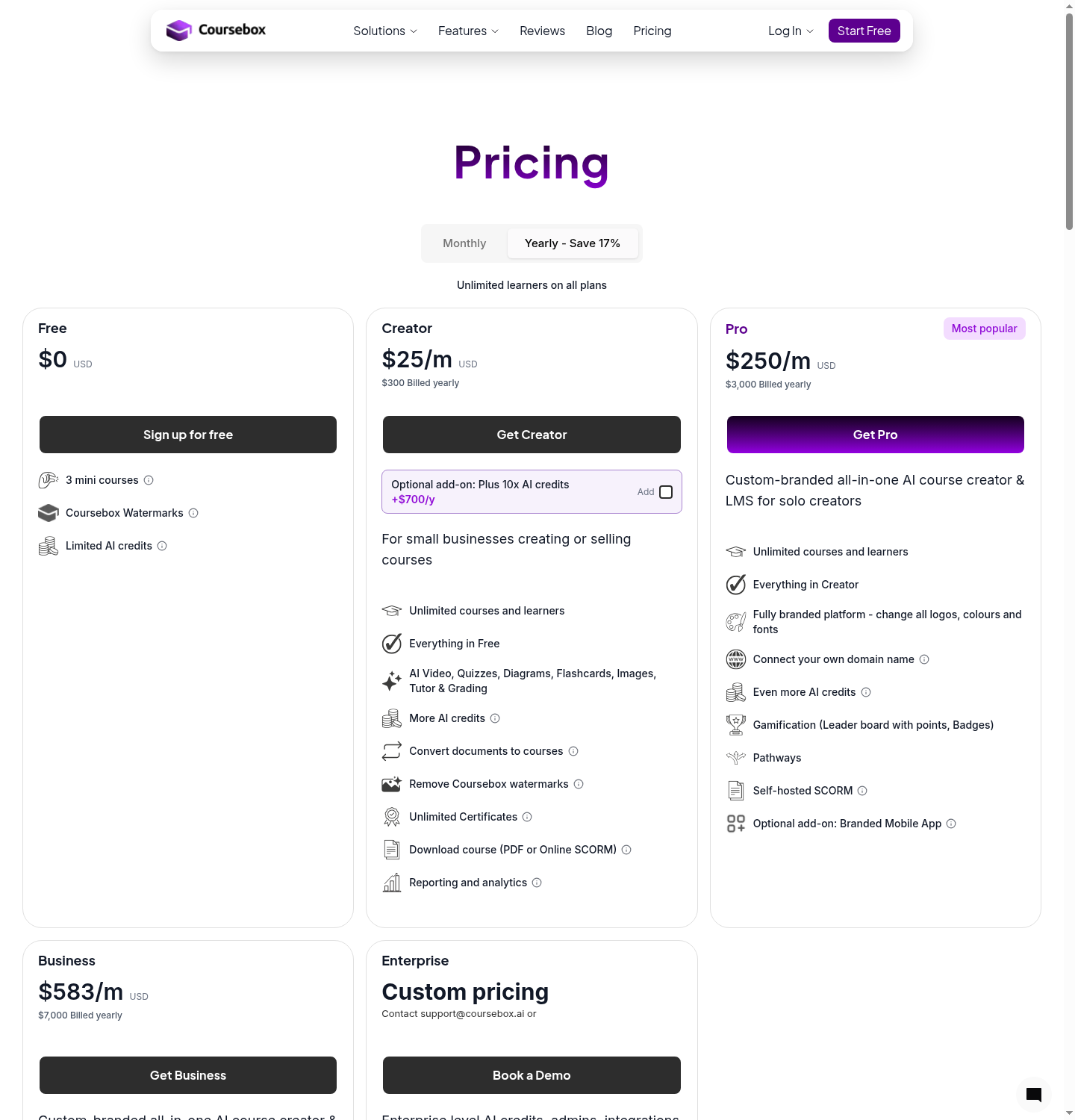
I can white-label a Coursebox AI LMS with three inputs. A logo, a domain name and your brand colours in minutes, literally. No code, no developers, no DNS project handed to someone technical. The branded login page, the course pages and the certificates all carry your identity, and the learner never sees the word Coursebox. I built branded demo portals myself in a few minutes, and the reason I got into no-code tools in the first place is that this is how branding should feel.
I will name the honest limitation, and it is tiering. The free plan carries a Coursebox watermark, paid plans open at $25 a month on annual billing, and the full white-label experience with your own domain lives on the higher tiers. So I stand by the three-input promise, but the plan that unlocks all of it is not the cheapest one. If you want a branded platform live this week without pulling in a developer, I think Coursebox is the least painful path in this comparison. As an added bonus, Coursebox offers unlimited learners on all plans.
4. LearnWorlds
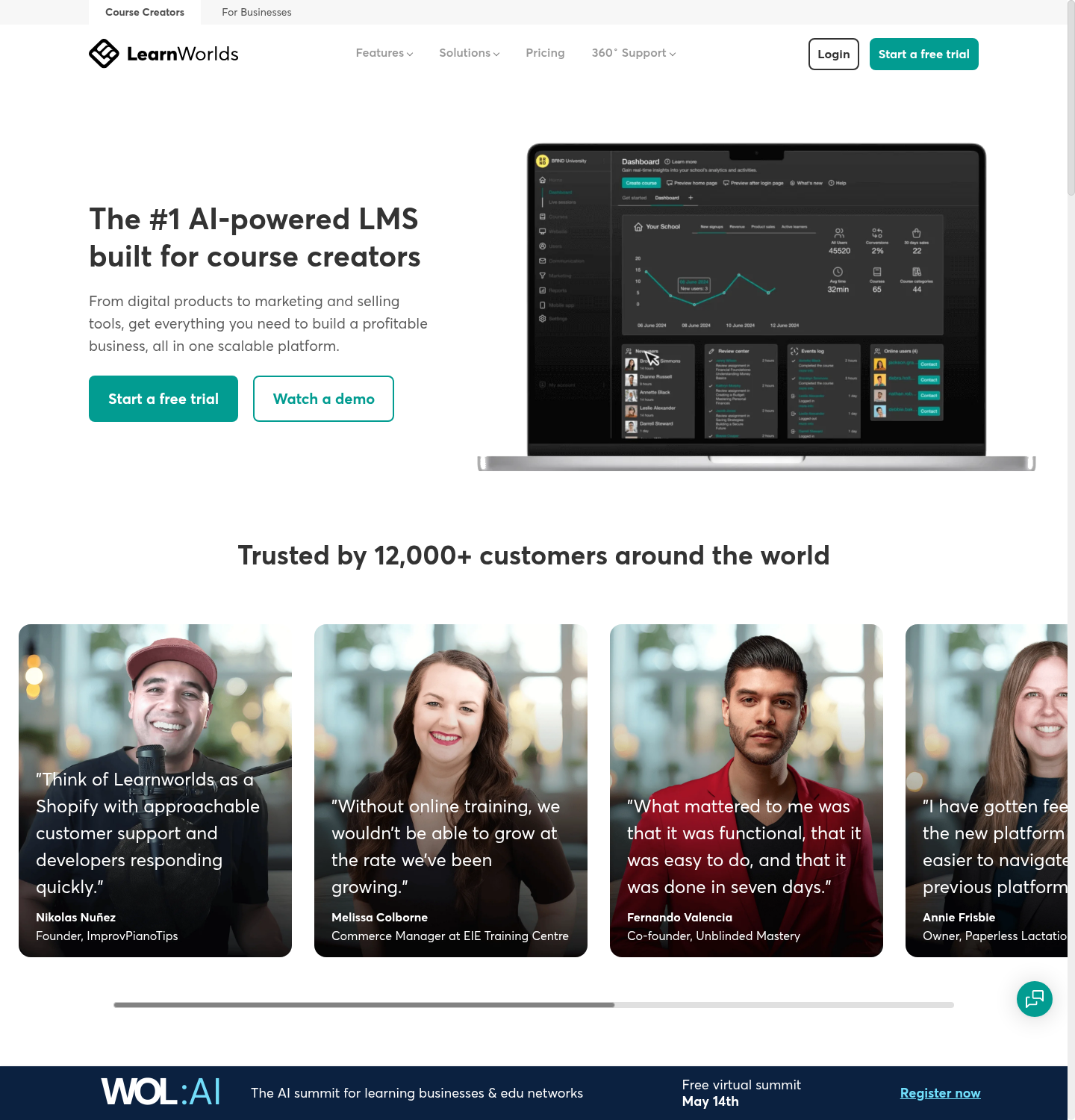
I send course businesses to LearnWorlds when they care as much about the storefront as the classroom. I rate the interactive video, the site templates and the assessment builder, and the 100% white-label mobile app builder needs no coding for iOS or Android.
I would map the branding story to your budget carefully, because it has a catch. Your own domain, logo and colours are available on the monthly plans, but full removal of the LearnWorlds branding only arrives on the Learning Center plan at $299 a month. I found the Pro Trainer plan at $99 gets you branded email from your domain and little more of the full treatment. So the entry price of $29 is not the price of a truly unbranded school.
I find the setup itself self-serve and pleasant once you are on the right plan. I would recommend LearnWorlds to a course seller who wants polish, as long as you budget for the tier that strips the vendor name out.
5. LearnUpon
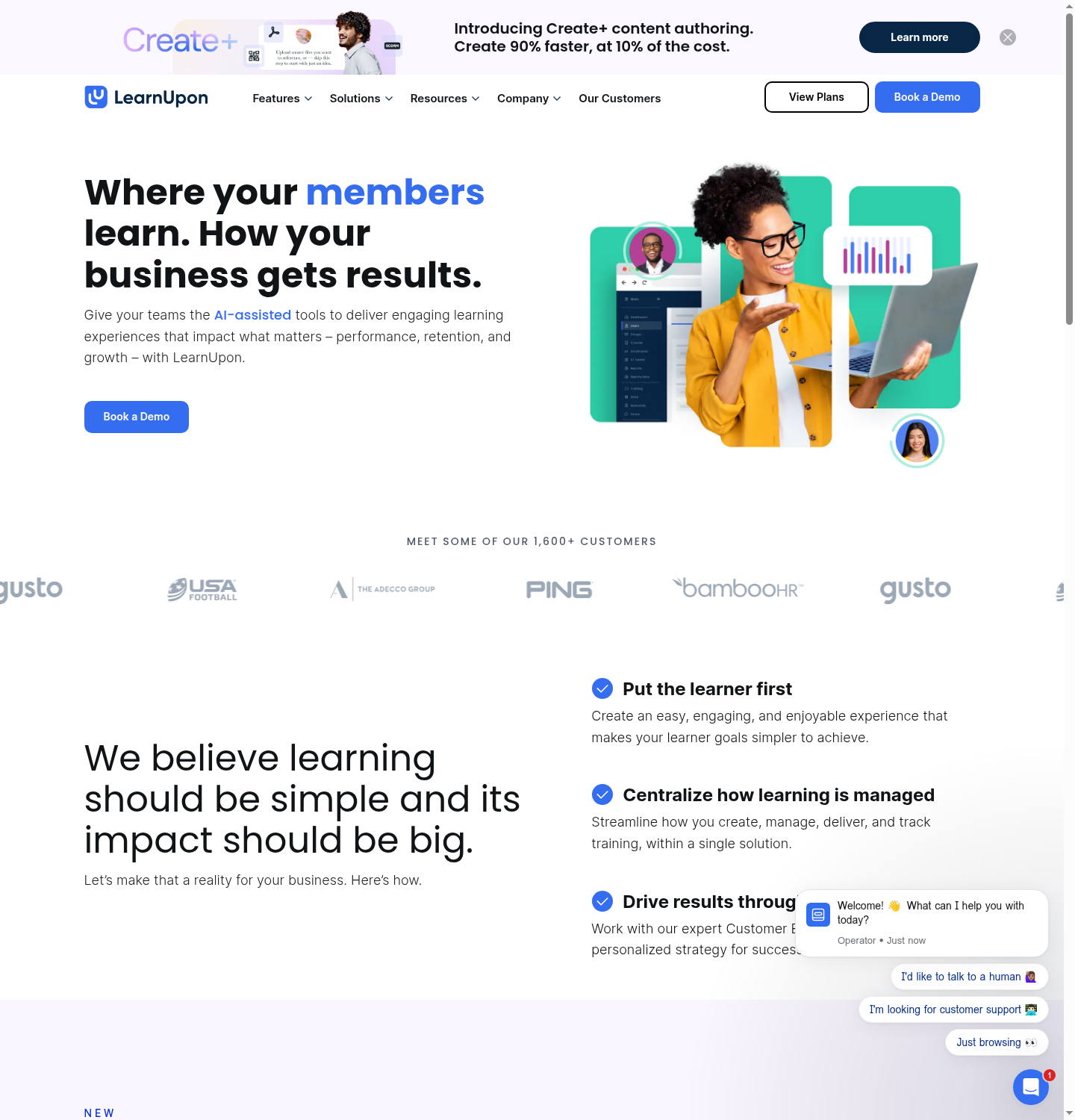
I think LearnUpon is a strong fit for the classic extended-enterprise problem, where you are training employees, customers, partners and resellers as separate audiences at once. Its multi-portal model gives each audience its own branding, learners and access rules from one system.
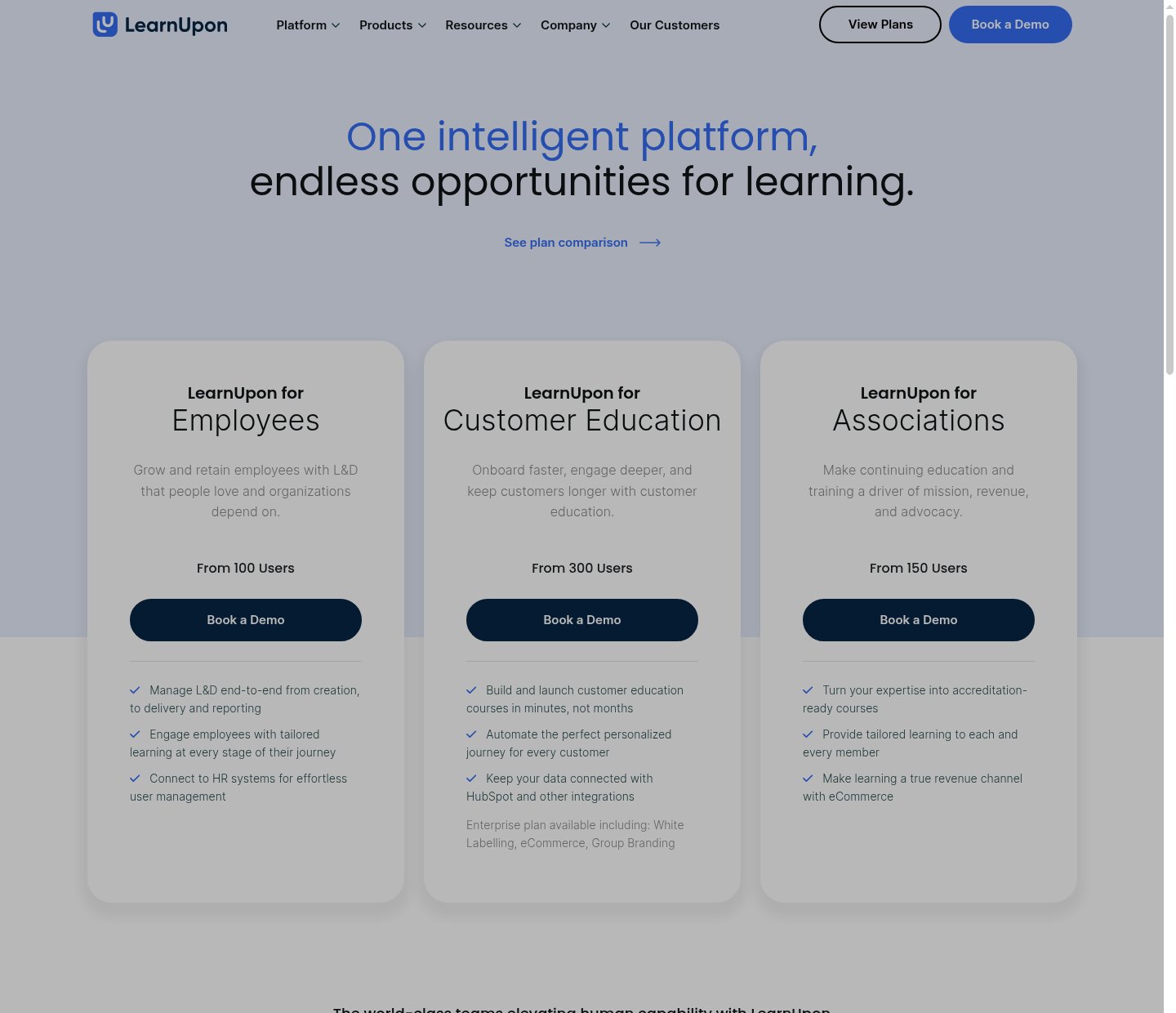
The vendor describes the white-label customisation, custom domain, custom sender addresses and logo removal as achievable without technical expertise, and I believe that for the branding surface itself. I would point to everything around it as where the friction lands. Pricing is quote-based, typically in the region of $6 to $9 per user per month, and the company cites implementation consulting as part of the deal. I have seen extra portals beyond the baseline cost more, and several integrations want professional services. I would deploy this platform with help, not switch it on over a weekend. For a mid-size to large organisation with distinct partner audiences and a budget for onboarding, I think LearnUpon is a safe, capable pick.
6. Absorb LMS
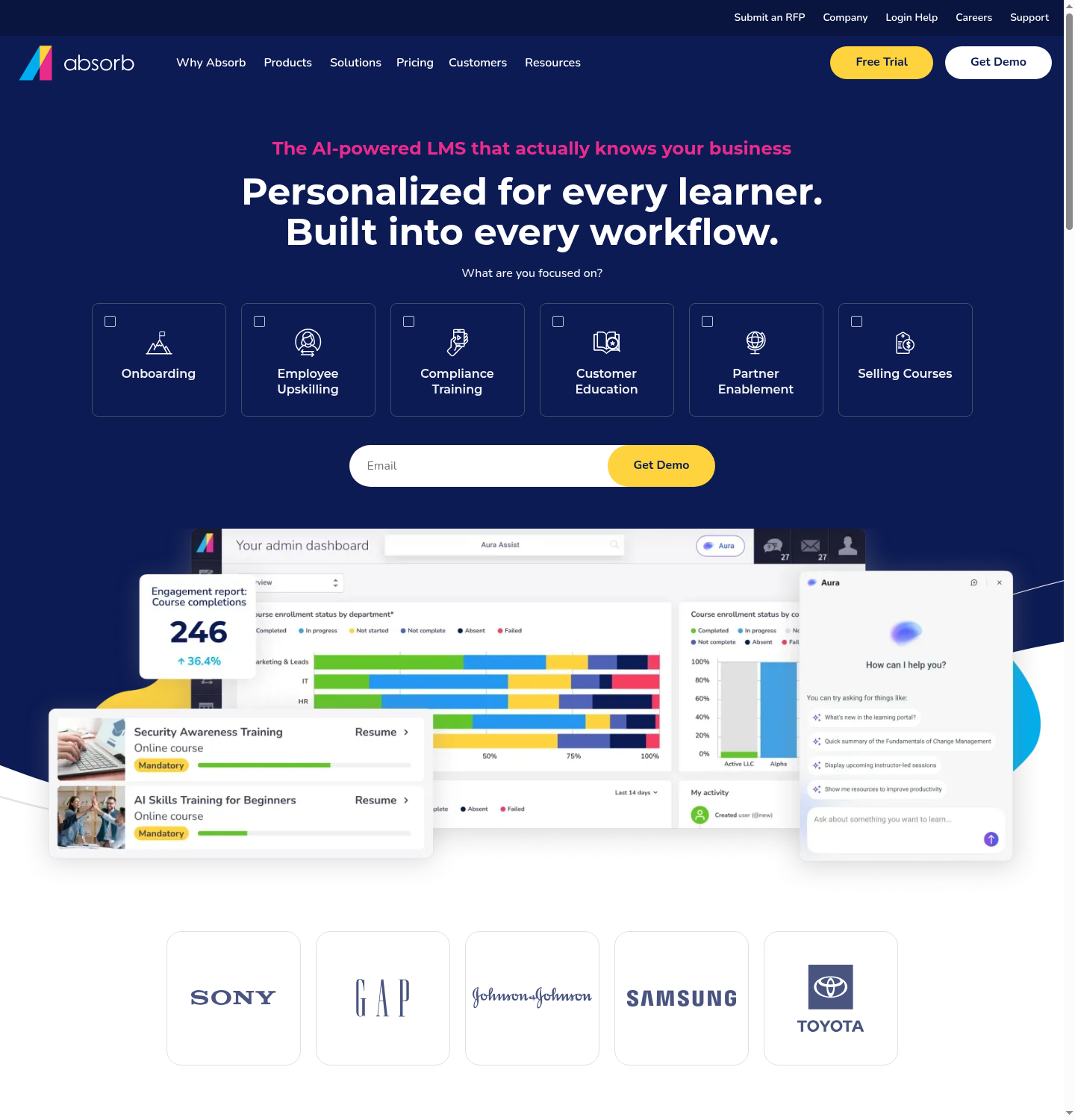
I see a lot of loyalty for Absorb LMS from mid-market L&D teams, and the branded delivery is polished. Absorb LMS lets you customise login screens, colours, logos and domain so learners see your brand at every step, and I rate the eCommerce and automation around it.
I am ranking it here purely on setup friction. Pricing is quote-only, and I find the money side of implementation is what catches training companies off guard. Third-party accounts put the one-time setup fee at roughly $3,200, with single sign-on integration adding around $3,500 on top. I do not treat those as small numbers when you are pricing a branded academy, and they are the sort of cost that never appears until you are already in the sales cycle. You can start simpler if you do not need SSO on day one, but I would plan for the setup spend. I would still call Absorb a strong platform for a buyer who expects a proper onboarding and has budgeted for it.
7. iSpring Learn
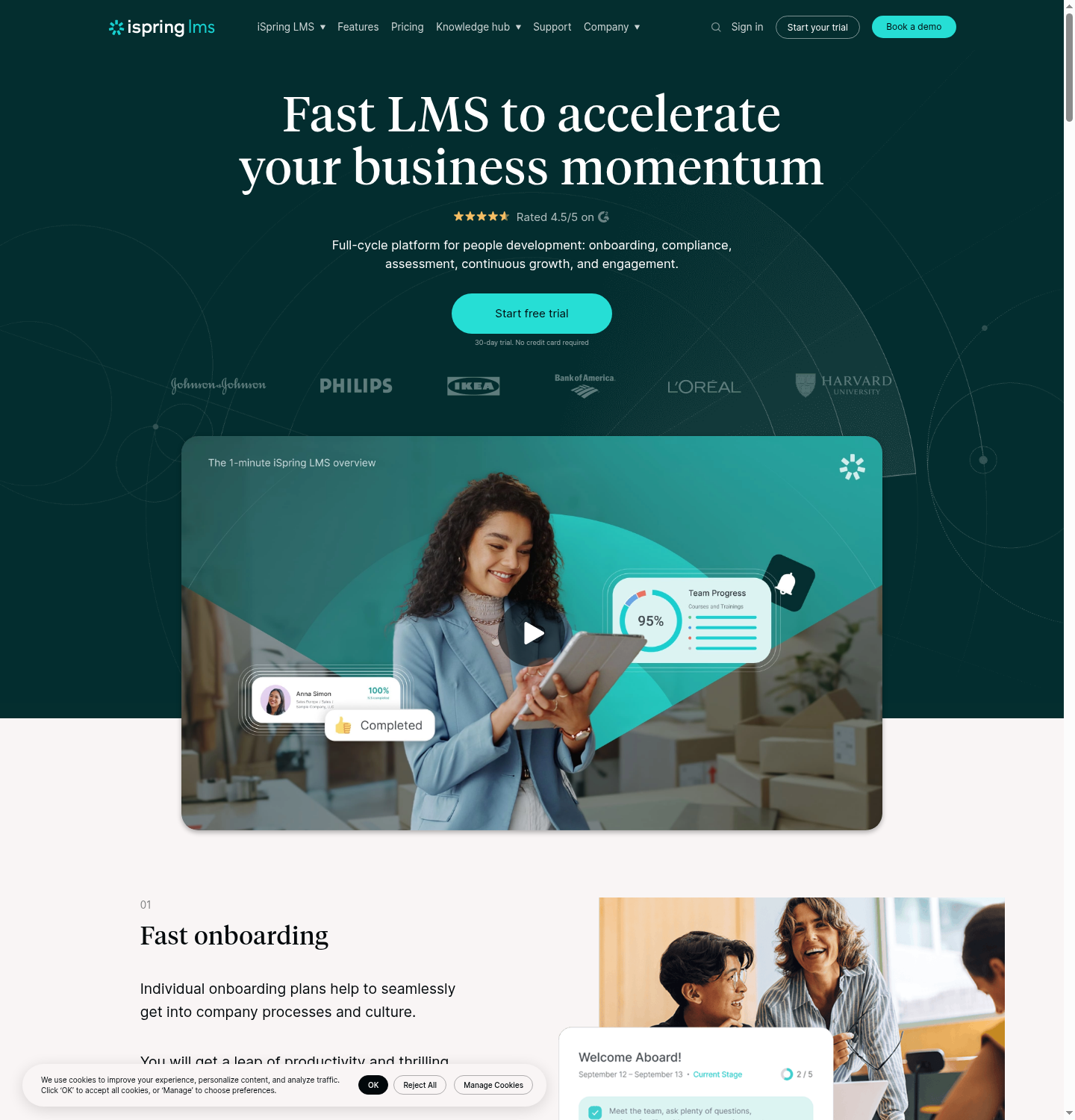
I reach for iSpring Learn when the buyer's real job is compliance training and certification tracking, and I like the way it prices for that. The pay-per-active-user model runs from $6.91 per user per month at 100 users down to $3.97 at 500 users on annual billing, so you pay for people who actually log in.
On branding, I find the basics easy and self-serve. You add your logo, change the interface colours and put your brand name on the login page inside the portal settings. I would flag one specific line item as the friction. Every iSpring Learn account lives on an ispringlearn.com subdomain by default, and hiding that behind your own domain is a paid feature called a domain alias, not something included as standard. I would not call it hard to set up, but it is an extra cost that surprises people. If your priority is compliance rigour on a per-user budget and you can absorb the domain add-on, I think iSpring is a sensible, honest choice.
8. Thinkific

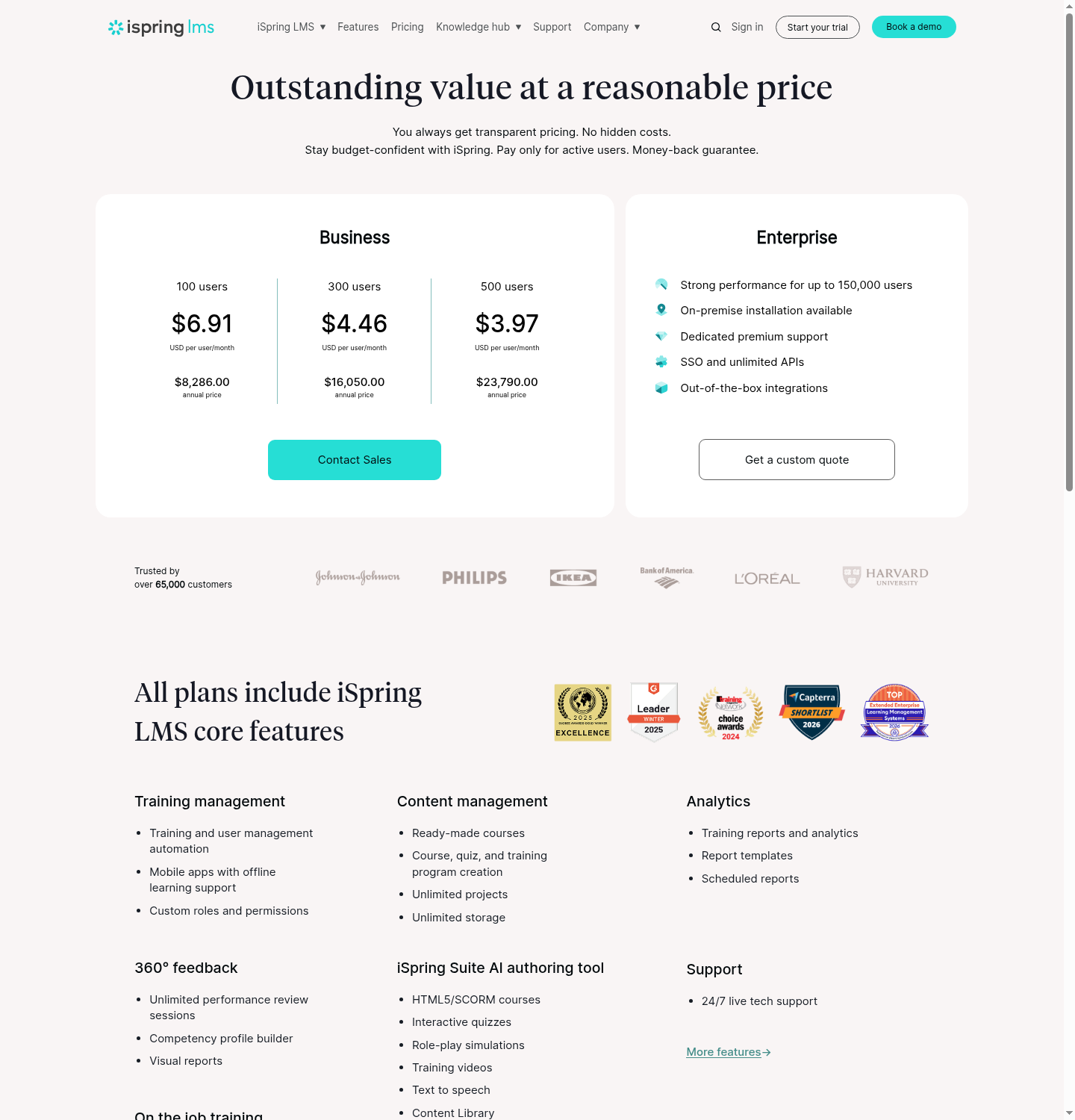
I judge Thinkific against the job it is built for, which is the solo creator and the small course seller, and I will say where a training company hits the ceiling. Thinkific gives you a custom domain on every paid plan, which I count as a good start.
Removing the Thinkific branding is where the plan ladder shows up. I found it is a one-click toggle in settings, but the toggle only works from the Grow plan, which runs $164 a month billed annually. The entry Basic plan at $40 a month still shows "Powered by Thinkific". I would also note there is no real multi-tenant model here, so reselling many separate branded client portals is not what this tool does. Watch the transaction fees too, because a 5% surcharge applies if you take payments outside Thinkific Payments. For an individual creator selling their own courses under a light brand, I find Thinkific easy and quick. For a reseller running client academies, I would look higher up this list.
9. Docebo
I treat Docebo as enterprise learning infrastructure, and the branding is as deep as you would expect, with a White Label app, a Custom Domain app and an Extended Enterprise module for running separate client platforms. Docebo can produce fully branded, fully separated learner portals that leave no trace of the vendor.
I am putting it low on the friction ranking for reasons that have nothing to do with capability. Setting up a custom domain here means work outside the platform first. You register the domain, configure its DNS records and procure an SSL certificate before you finish the job inside Docebo. I file that under a task for someone technical, which is fine for a large enterprise with IT on hand and wrong for a lean training company. I would add the commercial reality: pricing is quote-only, there is a 250-learner minimum, and contracts commonly run three to five years. I think Docebo is the right answer for a big organisation with resources and a long horizon. I would call it the wrong answer if you want to be live under your brand this month.
10. Litmos
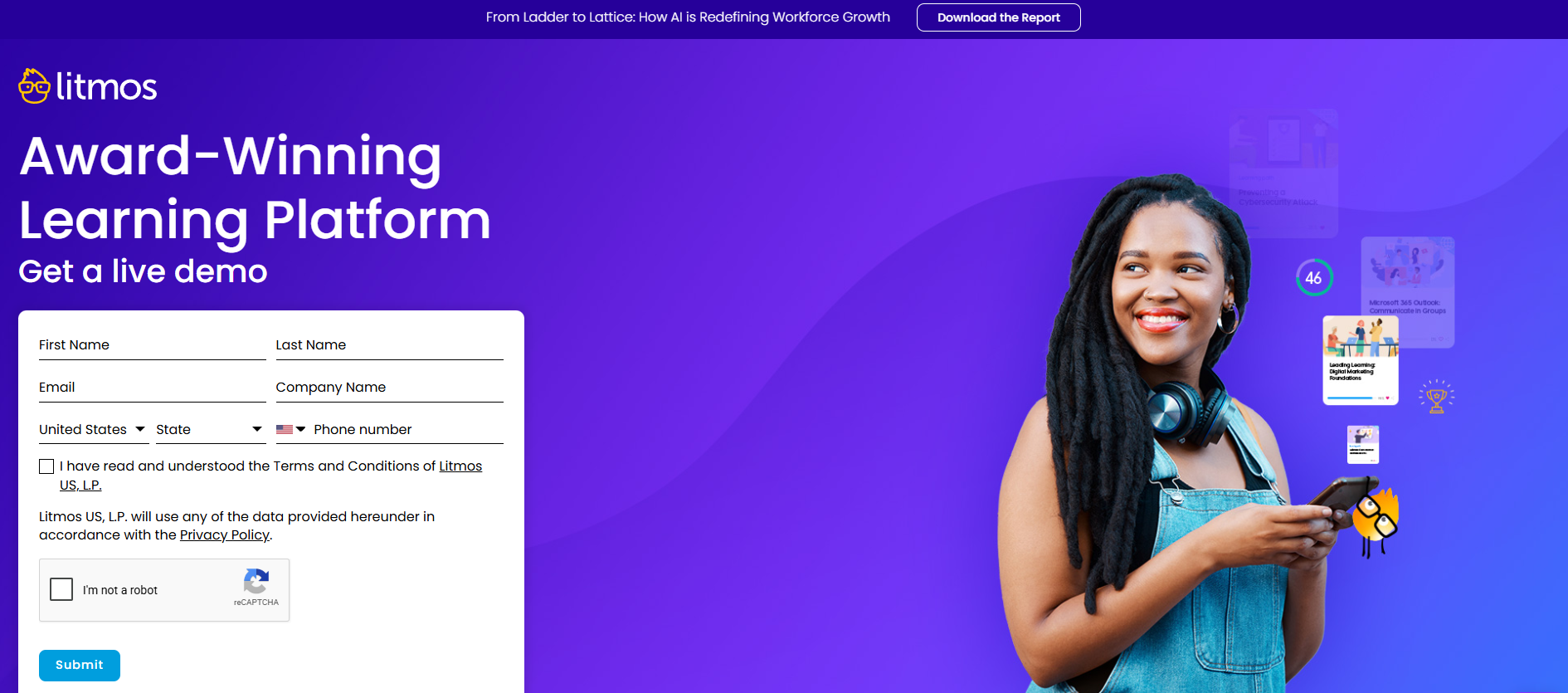
I use Litmos as the clearest illustration of why I grade this category on setup rather than features. On paper the branding tools are there, with a Brands feature covering logos, colour schemes, email templates and custom domains that mask the litmos.com URL.
Then I read the fine print. To fully remove every reference to Litmos, the vendor's own documentation says you need to use the API to build a single sign-on page and customise your mail settings using your own developers and servers. I read that as a developer requirement stated in black and white, and it is exactly the hidden cost this article exists to surface. I would add that the Brands feature is not even switched on for every account, so you may be emailing an account manager just to unlock multi-branding. Pricing is quote-only across Foundation, Platinum and Platinum AI. I still count Litmos a capable enterprise LMS, but if you do not have engineering time to spend, its white-label ceiling is higher than the marketing suggests. I would only choose it if a developer is already on your team.
11. Kajabi

I want to be direct about why Kajabi keeps turning up in white-label searches and does not really belong in this one. It is a creator commerce platform built around memberships, coaching, podcasts and sales funnels, and course delivery is a side of it.
You do get a custom domain and a branded mobile app, so at the individual-creator level it looks white-label enough. What I do not find is a true multi-tenant model for running separate branded client portals, and there is no real LMS depth for compliance or structured corporate training. Starter is $89 a month. I would happily use Kajabi as a creator selling my own programme under my own name. As a white label LMS for training providers reselling to clients, I think it is the wrong tool, and I would skip it here.
Mistakes I watch training companies make
I will close on the traps, because in this category the traps cost more than the wrong feature choice ever will.
I would never sign before clicking through the white-label setup myself. The demo shows you the finished branded portal and never the DNS records, the SSL certificate or the API work standing between you and that screenshot. I ask the vendor to walk the exact steps, and I ask who on my side has to do them.
I would also check the branded experience on a phone before anything gets signed. In our own delivery data at Coursebox, 28% of course starts over the past year happened on a mobile device, and a white-label portal that looks perfect on a laptop and carries broken branding on a phone is a complaint your clients will send you, not the vendor.
I would not read "white label" as one price either. On several tools here, your own domain, removal of the vendor name and branded email each live on a different plan or a different add-on. I always get the total for the fully unbranded result, not the entry number.
And I would not pay for onboarding I do not need. Litmos can demand developer time for full removal, and Docebo hands you a DNS and SSL job before you start, so if you are a lean training team I think those two will cost you weeks you did not budget. I would not underrate the boring stuff, because the platform that goes live under your brand fastest is usually the one a non-technical admin can set up alone.
Disclosure: Coursebox is the AI training platform we build, so we compete in this category. I have ranked it at number three where I believe it honestly sits rather than at the top, and I graded every tool here on published product information, vendor documentation and captured user sentiment, plus my own hands-on time inside the products where we have had it. Competitor comparison lists are almost always vendor-published, so read all of them, including this one, with that in mind.
Frequently Asked Questions
For a nonprofit I would let budget and staffing decide, since paying thousands in setup fees is rarely an option. I would start with tools that are self-serve and have a genuine free or low entry plan. TalentLMS has a permanent free plan for small teams, and Coursebox has a free tier plus low monthly paid plans, though full branding sits higher up. I keep a fuller list of LMS options for nonprofits if you want to compare on cost first. I would avoid the quote-only enterprise platforms unless a funder is covering implementation.
At minimum I expect it to replace the vendor's branding with your own logo, colours and a custom domain, so learners see your organisation and not the software company. A fuller white label LMS service also covers branded email notifications, branded certificates and, for training companies, a mobile app under your own name in the app stores. I find the gap between platforms is less about whether these exist and more about which plan tier unlocks them and how much setup work each one takes. I would always confirm the custom domain and the removal of "powered by" text specifically, because those two are the most commonly gated.
Yes, and I think this is where the multi-tenant question matters most. A white label LMS reseller needs separate, fully branded portals for each client, each with its own domain, users and access rules, managed from one admin account. I would look at Coursebox and LearnUpon first, since both are built around this multi-portal model, and TalentLMS supports it through branches, with the number rising on higher plans. Coursebox lets you resell under your own product name as well. I would not start with single-creator tools like Thinkific and Kajabi, because they do not offer true multi-tenant reselling.
Most white label platforms separate roles into administrators, instructors or course creators, and learners, with admins controlling branding, enrolment and reporting. In a multi-tenant setup for customer training or partner training, I also expect portal-level permissions, so a client admin can manage their own branded portal without touching yours. I find LearnUpon and CYPHER give you granular control partitioned per portal. If you run accredited training or compliance programmes, I would check that the platform lets you lock down who can edit assessments and issue certificates, because that permission detail is where audits get won or lost.
Alex Hey
Digital marketing manager and growth expert

