

Merrill's Principles of Instruction: The 5 First Principles
Merrill's principles of instruction explained: the 5 First Principles with a worked example, the Pebble-in-the-Pond design process and two templates.

Merrill's First Principles of Instruction place real-world problems at the centre of learning, supported by activation, demonstration, application and integration. These phases recur as learners tackle progressively harder tasks.
- Merrill's design process, Pebble-in-the-Pond, starts from one whole task and a progression of harder ones, with only the goal and the learners defined beforehand.
- Merrill checks consistency before anything else: the demonstration and the practice have to match the kind of skill, such as a procedure or a concept.
- Activation was the rarest principle in course requests typed into Coursebox, with at most 13 of 99 asking for it.
- The studies reviewed here include small and vendor-funded evaluations. They support testing the approach, with limits on claims about workplace transfer.
Five planning prompts for one course. This is an unvalidated checklist. Review each answer separately; the total cannot establish alignment, readiness or effectiveness.

Go from storyboard to an interactive course in minutes
Picture a home insurer (a hypothetical example) onboarding six new claims assessors before the storm season. Their training is forty slides of policy wording on water damage and a twenty-question quiz at the end. All six pass. A week later, one of them stands in a bathroom with swollen floorboards and a customer who says the leak started yesterday, and has no idea how to tell a sudden leak from one that has been running for months.
M. David Merrill's First Principles of Instruction are built for that gap between knowing the policy and handling the claim. I'm an instructional designer at Coursebox, where we make instructional design software that training teams use to build courses from their own plans. I use Merrill's principles to check whether a course gives people real problems to work on, and the claims course runs through all five here.
What are Merrill's principles of instruction?
Merrill's principles of instruction, also called the First Principles of Instruction, describe five conditions that support learning. Real-world problems sit at the centre, supported by activation, demonstration, application and integration. These four phases can recur as tasks become more difficult; the model does not require an identical cycle for every problem.
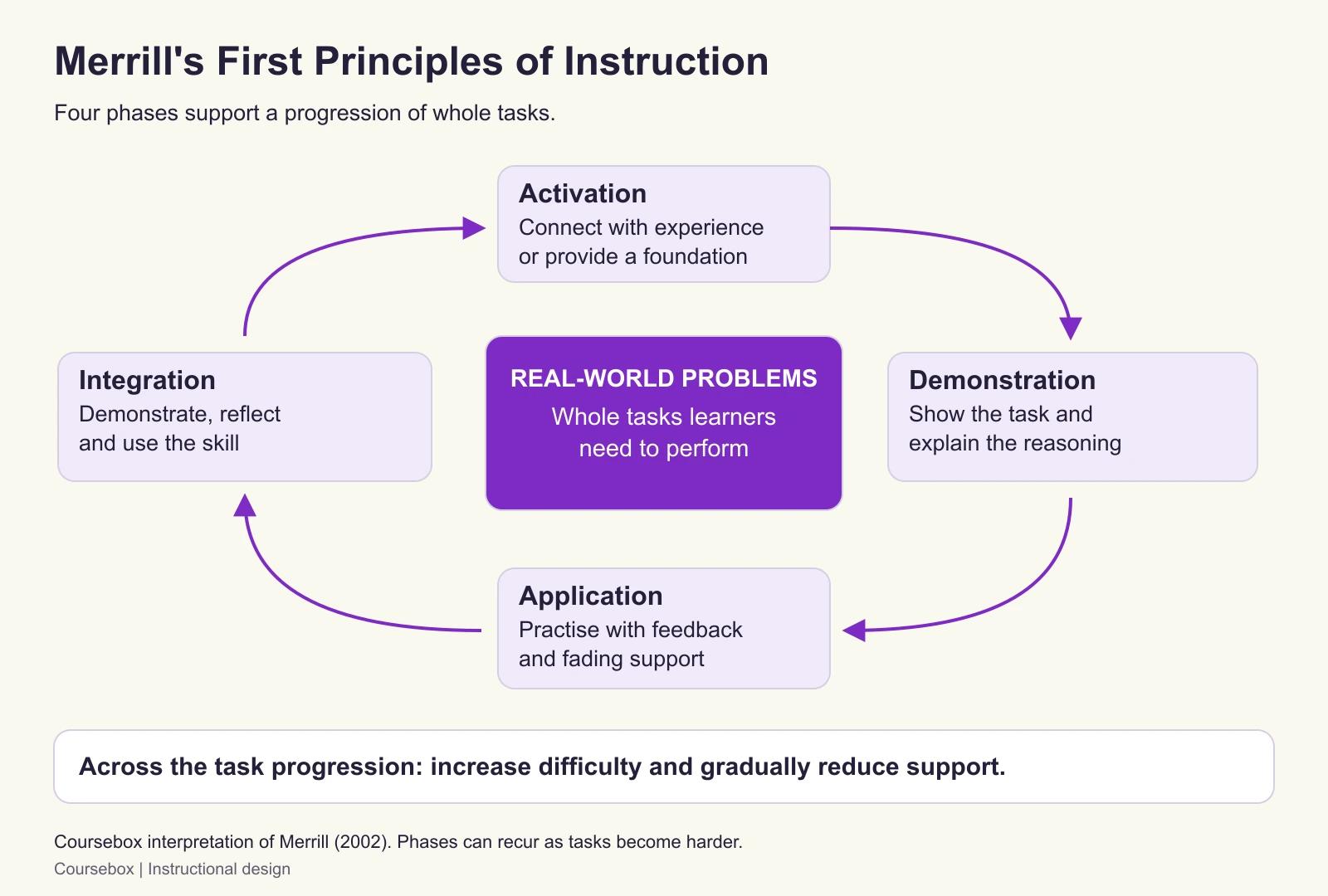
Merrill set them out in 2002 after reviewing instructional design theories and models and identifying the principles they have in common. His paper puts it this way: "The first principle relates to problem-centered instruction. Four more principles are stated for each of the four phases for effective instruction" (Merrill, 2002, p. 44). So the model has five principles, and four of them cover the four phases.
The example below is a hypothetical onboarding course for new home-insurance claims assessors. Its three water-damage claims use a sample policy, so the decisions illustrate course design rather than rules that apply to every insurer.
| Principle | Merrill's words (2002) | The question it asks of your course | In the claims course |
|---|---|---|---|
| Problem-centred | Learning is promoted when learners are engaged in solving real-world problems | Is the course built around whole tasks from the job? | Three water-damage claims, from easiest to hardest |
| Activation | Learning is promoted when existing knowledge is activated as a foundation for new knowledge | Do learners connect with relevant experience, supplied when needed? | Before each claim, assessors recall a leak they have seen |
| Demonstration | Learning is promoted when new knowledge is demonstrated to the learner | Do learners see the skill done, beyond being told about it? | A senior assessor thinks aloud through the first claim |
| Application | Learning is promoted when new knowledge is applied by the learner | Do learners do the task themselves, with feedback? | Scenarios with feedback on the second and third claims |
| Integration | Learning is promoted when new knowledge is integrated into the learner's world | Do learners use the skill in their own work and reflect on it? | Role-play the conversation, reflect, then apply the skill in supervised work |
Merrill proposes that the principles can guide instruction across delivery systems, from eLearning to workshops and workplace coaching. His 2002 paper presents these as design propositions drawn from existing models, rather than an experimental demonstration of a numerical relationship between checklist scores and learning. Use the principles to inspect concrete examples, practice and transfer opportunities.

Case study: Thomson NETg's Excel course
Thomson NETg, an eLearning company, rebuilt its Microsoft Excel course around whole spreadsheet tasks in a progression, pulling in each command lesson when a task needed it and fading the help from fully worked to "on-your-own".
- Setting: 128 participants from client organisations, including Lockheed-Martin and the University of Limerick in Ireland, around 2001 to 2002.
- Measured: scores and completion times on three authentic Excel tasks, for a scenario group (49), a guided demonstration group on the existing eLearning course (49) and a control group with no instruction (30).
- Result: In Merrill's account of the Excel evaluation, scenario learners averaged 89%, guided-demonstration learners 68%, and the uninstructed control group 34%. Scenario learners took 29 minutes, compared with 49 for the guided-demonstration group. NETg funded part of the paper, and the groups differed in more than the principles, so this vendor evaluation cannot isolate their effect.
Who created the First Principles, and what to read
M. David Merrill earned his PhD at the University of Illinois in 1964 and was a professor at Utah State University from 1987 to 2004, where he is now professor emeritus. Before the First Principles he developed Component Display Theory and Instructional Transaction Theory. He has revised the principles since 2002, so the details depend on which version you read.
- Start with the 2002 paper, "First principles of instruction" in Educational Technology Research and Development, which Merrill hosts as a free 17-page PDF. It has all five principles and their fifteen corollaries.
- Read the book when you design a full course. First Principles of Instruction came out from Pfeiffer (Wiley) in late 2012, dated 2013, and the publisher's record lists his course critique checklist and the Pebble-in-the-Pond design model inside. A revised edition followed from AECT in 2020.
- For his current wording, read his open chapter (EdTech Books, CC BY). It lists activation first and redefines integration as learners who "share, reflect on, and defend their work by peer-collaboration and peer-critique".
In 2002 Merrill wrote that he was "not yet convinced that collaboration is a first principle" (p. 57). His later wording builds collaboration into integration. His Springer handbook chapter, "First Principles of Instruction Revisited" (online 2021), brings together the principles, levels of instructional strategy, the Pebble-in-the-Pond model and a summary of the research.
The five principles, worked through one course
For the worked example, new home-insurance claims assessors must use a sample policy to investigate water damage and explain a defensible decision to a customer. The old course gives them policy slides and a recall quiz. We will redesign it around three increasingly difficult claims, with support fading as their judgement develops. The four phases recur across that progression; the plan need not give every claim an identical four-part lesson.
1. Problem-centred
Merrill wants the learning activity to be "some whole task rather than only components of a task", and representative of the tasks learners will meet after the course. He also argues against opening with objectives, because "Objectives of this form are abstract and often only understood following the instruction" (p. 46).
- Merrill's corollaries: show the task learners will be able to do; engage them at the task level as well as the step level; give them a progression of problems that are explicitly compared.
- In the claims course: three claims in order of difficulty. A burst washing-machine hose is the clear case. A slow shower leak raises the question of gradual or sudden damage. Storm water through a damaged roof, with a mould claim from a frustrated customer, adds a cover decision on the storm damage, a separate one on the mould and a hard conversation.
- How to check it: list your course's sections. If every title is a topic, such as "Policy definitions", add the task that topic serves.
2. Activation
Activation means getting learners to call up relevant experience before the new content arrives. Merrill warns that "A simple recall of information is seldom effective as an activating experience" (p. 47).
- Merrill's corollaries: direct learners to recall relevant past experience; provide a relevant experience if they have none; give them a structure to organise the new knowledge.
- In the claims course: before each claim, assessors describe a leak they have seen at home or at work and what told them how long it had been going. The course then gives them a structure for every claim: cause, timeline, cover, then the conversation.
- How to check it: before introducing unfamiliar material, identify the relevant experience or mental structure learners can draw on. Ask them to recall it, or provide an experience when they have none. A pre-test can help establish entry knowledge, but testing unfamiliar facts does not itself activate a useful foundation.
3. Demonstration
Merrill separates two levels of knowledge: information, which is general, and portrayal, which is one specific case. Demonstration is the portrayal, and he notes that "tell-and-ask instruction by itself is seldom effective instruction" (p. 48).
- Merrill's corollaries: keep the demonstration consistent with the goal; guide learners to what to look at, with multiple representations or compared demonstrations; use media only where it plays an instructional role.
- In the claims course: a senior assessor thinks aloud through the burst-hose claim, from the first call to the decision, naming what she checks in the room and why. For the shower leak, learners compare photos of sudden and gradual damage side by side.
- How to check it: when Merrill reviews a course, he opens Module 3 and looks for examples first, so do the same. In his words, "What do I look for first? Examples." (open chapter).
4. Application
Application means learners use the new skill to solve problems. Merrill's harshest line is about practice that is only recall: "so much instruction merely includes a few multiple-choice questions that are labeled practice" (p. 49).
- Merrill's corollaries: keep practice consistent with the goal; coach with feedback and withdraw the coaching gradually; give a sequence of varied problems.
- In the claims course: learners work the shower-leak claim as a scenario, choose gradual or sudden from the evidence and get feedback on the reasoning. The storm claim gives them less help and more evidence to sort.
- How to check it: for each practice item, ask whether a learner could answer it by remembering a slide. If so, it only checks memory, and the course still needs a task where the learner does the work, such as deciding a claim from the evidence.

Case study: Nutrition counselling in Damghan
The Damghan County health network ran a four-session course on adolescent nutrition counselling built on all five principles, with a problem-based pre-test, video demonstrations of counselling, role plays and personal action plans.
- Setting: community health workers employed in Damghan's health centres, 2024; 90 analysed, 40 in the intervention group and 50 in a control group given standard training.
- Measured: a 12-item knowledge test before, after and two weeks later.
- Result: The nutrition-counselling study reported a rise from 7.52 to 10.71 in the intervention group, a 42% increase, compared with 25% in the control group; the reported effect size was d = 0.9. Two weeks later, the intervention mean was 8.27, still above baseline. Allocation was not fully randomised, and the test measured knowledge rather than counselling behaviour.
5. Integration
Integration is where learners carry the skill into their own work. In 2002 Merrill gave it three corollaries. He also wrote that "The real motivation for learners is learning" (p. 50).
- Merrill's corollaries: Watch me, where learners publicly demonstrate the new skill; Reflection, where they reflect on, discuss and defend it; Creation, where they find new and personal ways to use it.
- In the claims course: assessors explain the storm-and-mould decision in a recorded role play and reflect on their reasoning. Follow this with a supervised workplace claim and a discussion of what changed when they used the skill with a real customer.
- How to check it: look for opportunities to demonstrate, reflect on and adapt the skill, then plan evidence of its use beyond the course. A role play can support integration without proving workplace transfer. The Damghan study measured knowledge retention, so its two-week decline cannot tell us whether staff changed their counselling practice.
Write down the relevant experience or structure learners need before each task. If they are new to the work, supply an accessible example first. A recap is useful only when it connects with the knowledge the new task requires.
How do the five principles fit together?
The problem is the frame, and the four phases form a cycle inside it. Merrill's Figure 1 draws activation, demonstration, application and integration around a problem at the centre, and he writes that "Much instructional practice concentrates primarily on the demonstration phase and ignores the other phases in this cycle of learning" (p. 44).
The three claims below form a task progression. Demonstration and coaching are strongest at the start, while later claims ask learners to make more decisions independently:
- Burst hose: activation, then a full think-aloud demonstration, then a short decision check.
- Shower leak: activation, compared examples of sudden and gradual damage, then a scenario with feedback.
- Storm and mould: activation, then a scenario with less guidance, then integration through the customer conversation and the reflection.
That fade is Merrill's "diminishing coaching" corollary, and it is the same pattern NETg used: fully worked, then prompted, then on your own.
What is Merrill's consistency rule?
The consistency rule asks whether the demonstration and practice match the kind of skill being taught. Merrill puts that check before guidance and media: a polished demonstration of the wrong performance still does not prepare learners for the intended outcome.
Merrill sorts what a course teaches into five kinds of knowledge, and each kind needs its own demonstration and practice. Where Bloom's taxonomy sorts objectives by thinking level, Merrill's categories sort the content itself, which tells you what a fair example and a fair practice item look like.
| Kind of knowledge | Merrill's practice | Merrill's demonstration | In the claims course |
|---|---|---|---|
| Information about | Recall or recognise the information | No separate form given | The policy's definition of storm |
| Parts of | Locate, and name or describe, each part | No separate form given | The parts of a roof where storm water gets in |
| Kinds of | Identify new examples of each kind | Examples and non-examples | Sudden versus gradual water damage |
| How to | Do the procedure | A demonstration of the procedure | Taking moisture readings and photos on site |
| What happens | Predict a consequence, or find the faulted conditions behind an unexpected one | A visualisation of the process | How a slow leak spreads under tiles |
The rows come from Merrill's demonstration and practice corollaries (pp. 47 to 49). For behaviour, such as the conversation with a frustrated customer, his demonstration corollary adds modelling.
His later work adds a ladder for whole courses, the levels of instructional strategy: Level 0 is information only, Level 1 adds demonstration, Level 2 adds application, and Level 3 is task-centred integration of all three (Jabar and Albion, 2016, citing Merrill). The old forty-slide claims course sat at Level 0 with a quiz on top.
To find the gaps, Merrill uses four learning events: Tell, Ask, Show and Do. He calls Tell and Ask on their own "the least effective instructional strategy", and his revision method is a matrix: list the module's topics down the side, put Tell, Ask, Show and Do across the top, then add examples and practice wherever a topic only has Tell and Ask (open chapter).
"Which of these is the first step in a moisture inspection?" checks memory of the procedure. The Do version gives the learner the room, the readings and the photos, and asks for the next action. Merrill calls practice that only asks learners to remember "the most common but usually inadequate form of practice" (Pebble paper, p. 42).
List each topic, name its kind of knowledge, mark where the course tells, asks, shows and has learners do, and plan the missing examples and practice. The claims course is filled in, with a blank version. Editable Word file, no email required.
How to use Merrill's Pebble-in-the-Pond model to design a course
Pebble-in-the-Pond is Merrill's design process for First Principles. It assumes you already have an instructional goal and know your learners, then designs outwards from one whole task, like ripples from a pebble (Merrill, Performance Improvement, 2002). Merrill calls it "a version of the 4C/ID model proposed by van Merriënboer (1997)".
- Cast the pebble: specify one whole task of the kind learners will do after the course, including the information they start with, the result, and the task worked through.
- Design a progression: identify a sequence of tasks of increasing difficulty, so that learners who can do them all have mastered the skill.
- Analyse the components: list the knowledge and skill each task needs, using the five kinds of knowledge.
- Choose the instructional strategy: combine tell, ask, show and do with each component.
- Design the interface: decide how learners will see and work through it.
- Produce it: build the materials.
Merrill specifies the content early. He prefers the word "production" to ADDIE's "development", because in the traditional model the content often gets specified late, during development: "In the Pebble-in-the-Pond model the content to be learned is specified first". If your team works in the ADDIE model, the pebble sits inside the design phase, and you still need the analysis before it and the evaluation after it.
The claims course, planned with the pebble
| Ripple | What Merrill asks for | The claims course |
|---|---|---|
| 1. Pebble | One whole task, specified and worked | The burst-hose claim: photos, the customer's account and the policy wording in; a decision and a call to the customer out |
| 2. Progression | Tasks of increasing difficulty | Burst hose, then the slow shower leak, then storm water with a mould claim |
| 3. Components | The knowledge each task needs | Policy definitions, signs of sudden and gradual damage, the inspection steps, how water spreads |
| 4. Strategy | Tell, ask, show and do per component | Think-aloud demonstration on claim 1, compared examples and a scenario on claim 2, a scenario with less help on claim 3 |
| 5. Interface | How learners see and work through it | Self-paced online course, damage photos, scenario practice with feedback, about 80 minutes |
| 6. Production | Build the materials | Built in an AI course builder from the plan, then checked against it |
Score an existing course against Merrill's own questions for each principle, then plan the redesign with the six Pebble-in-the-Pond ripples. The claims course is filled in, with blank versions to use. Editable Word file, no email required.
How to audit a course you already have
Merrill's Pebble paper turns the principles into questions: "IF there is an affirmative answer to each of these questions THEN learning is incrementally promoted". There is one main question per principle, such as "Is the courseware presented in the context of real-world problems?" and "Do learners have an opportunity to apply their newly acquired knowledge or skill?", each with follow-up questions on the corollaries. The audit worksheet uses them, with a score of 0, 1 or 2 per principle and space for the evidence and the fix.
A team at Glasgow Caledonian University used a survey instrument based on the principles to rate 76 randomly selected massive open online courses, or MOOCs (Margaryan, Bianco and Littlejohn, 2015).
The same audit found activities focused on integration in only 5 of the 76 courses, while most courses "scored highly on organisation and presentation of course material". A course can look well made and still give learners no real task to work on.

Case study: Auditing clinical simulation training
Researchers in Recife, Brazil, and at Maastricht University in the Netherlands built a 24-item rating scale on Merrill's principles and used it to audit published simulation training for clinicians managing postpartum haemorrhage.
- Setting: 40 raters assessing the training described in 32 published articles, with subscales for authenticity, activation, demonstration, application and integration.
- Measured: mean adherence on a 5-point scale per subscale, based on what each article described.
- Result: In the published simulation audit, every subscale had a mean below 3 out of 5. The raters assessed what the articles described, so missing reporting cannot establish that a practice was absent from the training itself.
Which principles do course requests ask for?
To see which principles people building courses ask for on their own, we classified a sample of course requests typed into Coursebox. The sample came from the 90 days to 7 October 2026: requests from English-language browsers, one per person, with no uploaded file, and template duplicates removed. That left 99 free-written course requests, classified by a language model and spot-checked by hand.
These are upper bounds, because the classifier counted generously. Practice came up in up to 4 in 10 requests and demonstration in up to 3 in 10, and at most 2 of the 99 asked for all five principles. If you brief a course builder, human or AI, activation is the principle to spell out.
Support questions show demand for practice. We reviewed our support inbox on 7 October 2026, and most of the threads we found dated from May to October 2026. The most common question in this area, from 8 customers in 8 threads, was how to add or edit an AI scenario or role play, or base one on their own material. Five customers asked how to get worked examples and practice tasks into generated courses, and 3 asked how to capture learner reflections, an opportunity consistent with the reflection part of integration, without establishing that customers used the full model.
Building a Merrill course in Coursebox
On 7 October 2026 I gave Coursebox a Merrill plan for the claims course. The plan listed the three claims in order of difficulty: the burst washing-machine hose; the slow shower leak, where the question is gradual or sudden damage; and storm water through a damaged roof plus a mould claim from a frustrated customer. It asked for activation before each claim, a think-aloud demonstration on claim 1 and scenarios with feedback on claims 2 and 3. Integration came through explaining the claim 3 decision to the customer and reflecting on it, and each section was to be named after its claim. Coursebox is our product, so weigh my read with that in mind.
The first outline included pages for the three claims, activation, demonstrations, practice with feedback and the customer conversation. Those labels reflected the requested design. I still needed to inspect the structure, and the outline alone could not establish the quality of the examples or feedback.
The structural issue was that the sections did not follow the plan's three claims. Claim 1 was split over two sections, a fifth section held a single page, and the storm pages were out of order with an extra quiz.
One correction message fixed it, and in the same message I asked for Australian spelling, since the outline had spelt mould the American way. The revised outline had three sections, one per claim, starting with "The Burst Hose Assessment" and "Slow Shower Leak". The storm pages followed the order I gave and ended on explaining the decision to the customer and a next-time reflection, with the extra quiz removed. The final outline came to about 1 hour 19 minutes, 26 pages and 4 quizzes, with pages such as What You Already Know, Inspecting the Room and Sudden or Gradual matching the plan. I checked the outline's structure and labels; the finished activities, feedback and workplace transfer still require review.

Merrill's principles vs 4C/ID and Gagné's nine events
Merrill's principles are criteria a whole course should meet, with the Pebble model to plan it. 4C/ID is the fuller whole-task model (Merrill calls Pebble "a version of" it), and Gagné's nine events sequence a single lesson. Merrill's 2002 paper draws on both: it lists van Merriënboer's 4C/ID among the problem-centred models it reviewed, and it cites Gagné on matching instruction to the kind of outcome and on eliciting performance with feedback.
| Feature | Merrill's First Principles | 4C/ID | Gagné's nine events |
|---|---|---|---|
| What it is | Five principles plus the Pebble design process | A whole-task model with four components | A sequence of nine events for one lesson |
| Unit it designs | A course built on a task progression | A programme for complex skills, with duration set by the learning needs | A single lesson |
| Best for | Auditing and redesigning workplace courses | Coordinating interdependent skills through whole-task practice | Teaching a new skill step by step |
| Weak spot | Light on front-end analysis and evaluation | Requires careful task analysis and support design | Easy to run without a real task |
| Use it when | A course is all slides and quizzes | Learners must coordinate many skills at once | You are building one lesson from scratch |
The problem-centred principle provides the frame for the other four. Merrill's papers list the principles in different orders. The phases recur around real tasks, with their emphasis and support adapted to the learner; they are not five topic sections to complete once.
Limitations of Merrill's principles
- Merrill's own caveat. The 2002 paper states, "There is no attempt in this paper to identify the empirical support for these principles", and assumes "perhaps without sufficient justification" that principles shared across theories are valid (p. 44). In 2007 he added, "Anecdotal data lacks the careful control that I would like to see."
- A small evidence base, often with a stake in the result. I did not identify a relevant meta-analysis in the research for this guide. The NETg study was vendor-funded, and a 2022 randomised study of 65 novice programming students that favoured the whole-task approach on transfer had Merrill as a co-author (Rosenberg-Kima et al., 2022).
- Not universal. A 2019 study of instructional designers' judgements questioned their universality on the basis of designers' judgements, rather than a controlled comparison of learner outcomes and proposed an extra principle for the affective domain (Honebein, 2019).
- Gaps for work-based learning. Shell's exploration and production division redesigned its technical courses on the principles and found they "need to be expanded to reflect the particular needs of the Shell EP context". It added criteria for collaboration and knowledge sharing and used them to evaluate more than 60 courses (Collis and Margaryan, 2005).
- A design model only. Merrill says Pebble-in-the-Pond is "primarily a design model" that leaves out front-end analysis, implementation and evaluation, so pair it with a needs analysis and an evaluation plan such as the Kirkpatrick model.
A widely cited study is a correlational one from a US university (Frick et al., 2010).
The figure is a ratio of two probabilities from 12 university courses, based on students' ratings of their courses and instructors' ratings of mastery. It supports the principles without isolating them, and it says nothing direct about workplace training.
Putting the model to work
Open one module and look for a complete task, a worked example and practice that asks learners to do the same kind of work. Fix the largest gap before rebuilding the whole course. Then arrange a chance to use the skill at work and collect evidence against the intended outcome. Merrill gives you a way to inspect the instructional design; the checklist and a generated outline cannot establish that learning or transfer has occurred.
Frequently Asked Questions
Merrill's First Principles of Instruction place real-world problems at the centre of learning, supported by activation, demonstration, application and integration. These phases recur as learners tackle progressively harder tasks.
There are five. Merrill's 2002 paper names a problem-centred principle as the frame, then four principles for the four phases of learning: activation, demonstration, application and integration.
Gagné's nine events are a sequence for a single lesson. Merrill's principles are conditions a whole course should meet, built around a progression of real tasks, and they can include Gagné-style lessons inside them.
No. Barak Rosenshine's Principles of Instruction is a separate list of ten classroom teaching principles, published in 2012. M. David Merrill's First Principles are five design principles from 2002.
Merrill's 2002 paper, "First principles of instruction", appeared in Educational Technology Research and Development 50(3), pages 43 to 59. Merrill hosts a free PDF copy on his own website.
Carolina Martin
Carolina is a highly experienced learning designer with tech start-up experience. She is based in Sydney and previously designed courses alongside Coursebox founder Travis in a previous job. She is passionate about delivering engaging learning experiences and brings the same perspective to customer experience too. She manages our customer support documentation and product testing processes.

