

8 Best LMS for Government in 2026: My Procurement Review
My review of eight government LMS platforms: named cloud-service status, accessibility, course delivery, administration and buying fit.

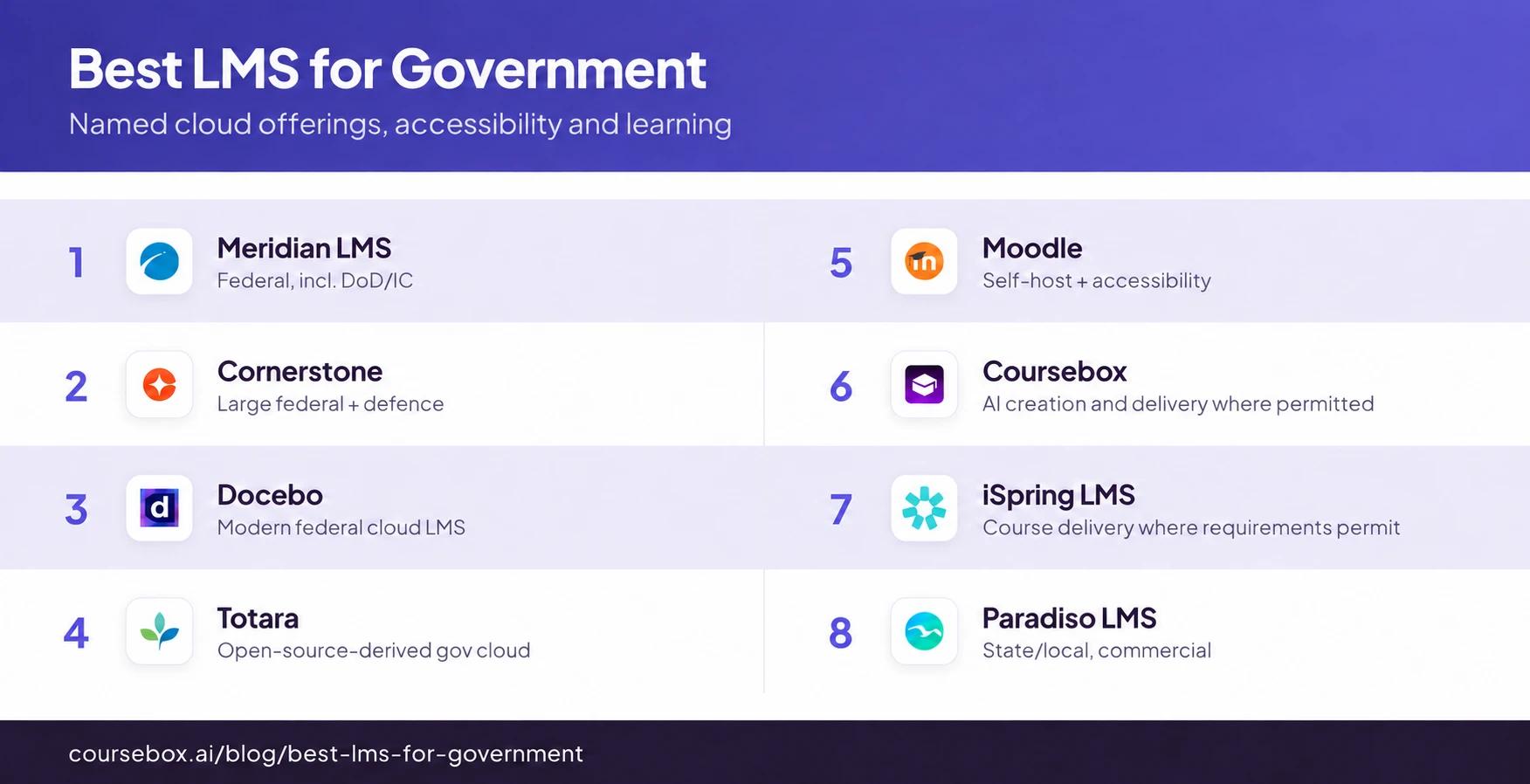
The best LMS for government in 2026 include Meridian, Cornerstone Galaxy, Docebo for Government, TotaraGov, Moodle, Coursebox, iSpring LMS and Paradiso. Match the named deployment to the agency’s requirements before comparing the learning workflow.
- The marketplace currently lists Meridian, Cornerstone Galaxy, DCBO-GOV and TotaraGov as FedRAMP Certified at Moderate. Their certification applies to those services, not every product or installation from the vendor.
- Moodle for Government is listed as Legacy FedRAMP Ready, not Certified. Self-hosted Moodle and MoodleCloud are separate deployment decisions.
- Coursebox combines AI authoring, assessment, tutor support and delivery. It has no verified FedRAMP listing and fits only where the organisation’s requirements permit its deployment.
- Assess accessibility for the platform and the uploaded courses, and keep a current product report alongside practical learner-task checks.
Compare learning priorities across four options. This quiz does not check agency deployment approval; confirm the exact service and required approvals in the entries before shortlisting.

Run your own branded LMS with unlimited learners
A government training team needs a platform it can use within the agency’s deployment, security and accessibility requirements. It also needs to get courses built, assigned and kept current. This comparison covers named US federal cloud offerings alongside options for other public-sector programmes.
As a CTO, I want to see the exact service behind a security claim. The vendor’s name or badge alone does not tell me which deployment has been assessed. I’d settle that part of the purchase before comparing the learning tools the team will use each day.
I’m Toni from Coursebox. Our AI LMS is included for authoring, assessment, learner support and delivery, but it has no verified FedRAMP listing. Exporting a course does not make the authoring environment inherit another LMS’s approval.
How I picked these government LMS platforms
Compliance set the order, then fit. I judged each on:
- Named service status: The exact cloud offering, current marketplace status and required level, separate from vendor-wide or infrastructure claims.
- Accessibility: Section 508 and WCAG with a published VPAT for the actual product, not just the vendor’s authoring tool.
- Security posture: SOC 2 (and its type), ISO 27001, and data-handling, since these come up in procurement even below the federal bar.
- Tier fit: Federal versus state/local versus commercial, because that decides whether authorisation is even required.
FedRAMP status applies to a named cloud service. The current marketplace uses Certified for the four certified offerings in this comparison and Legacy FedRAMP Ready for Moodle for Government. Ready is not Certified. An agency approval, a DoD impact-level decision and accessible course content still require their own evidence.
The best LMS platforms for government compared
| Platform | Verified cloud status | Useful fit | Cost basis |
|---|---|---|---|
| Meridian LMS | Named service: Certified, Moderate | Federal workforce learning | Quote-only |
| Cornerstone | Named service: Certified, Moderate | Large federal + defence | Quote-only |
| Docebo | Named service: Certified, Moderate | Modern federal cloud LMS | Quote-only |
| Totara | Named service: Certified, Moderate | Open-source-derived gov cloud | Quote-only |
| Moodle | Moodle for Government: Legacy Ready | Core self-hosting or distinct government service | Core software free; government service quoted |
| Coursebox | No verified FedRAMP listing | AI creation, assessment and delivery where permitted | Free; branded Pro LMS from US$3,000/year |
| iSpring LMS | No verified FedRAMP listing | State/local, PowerPoint authoring | US$8,286/year at 100 users; authoring separate |
| Paradiso LMS | No verified FedRAMP listing | State/local, commercial | Quote-only |
The 8 best LMS platforms for government
1. Meridian LMS
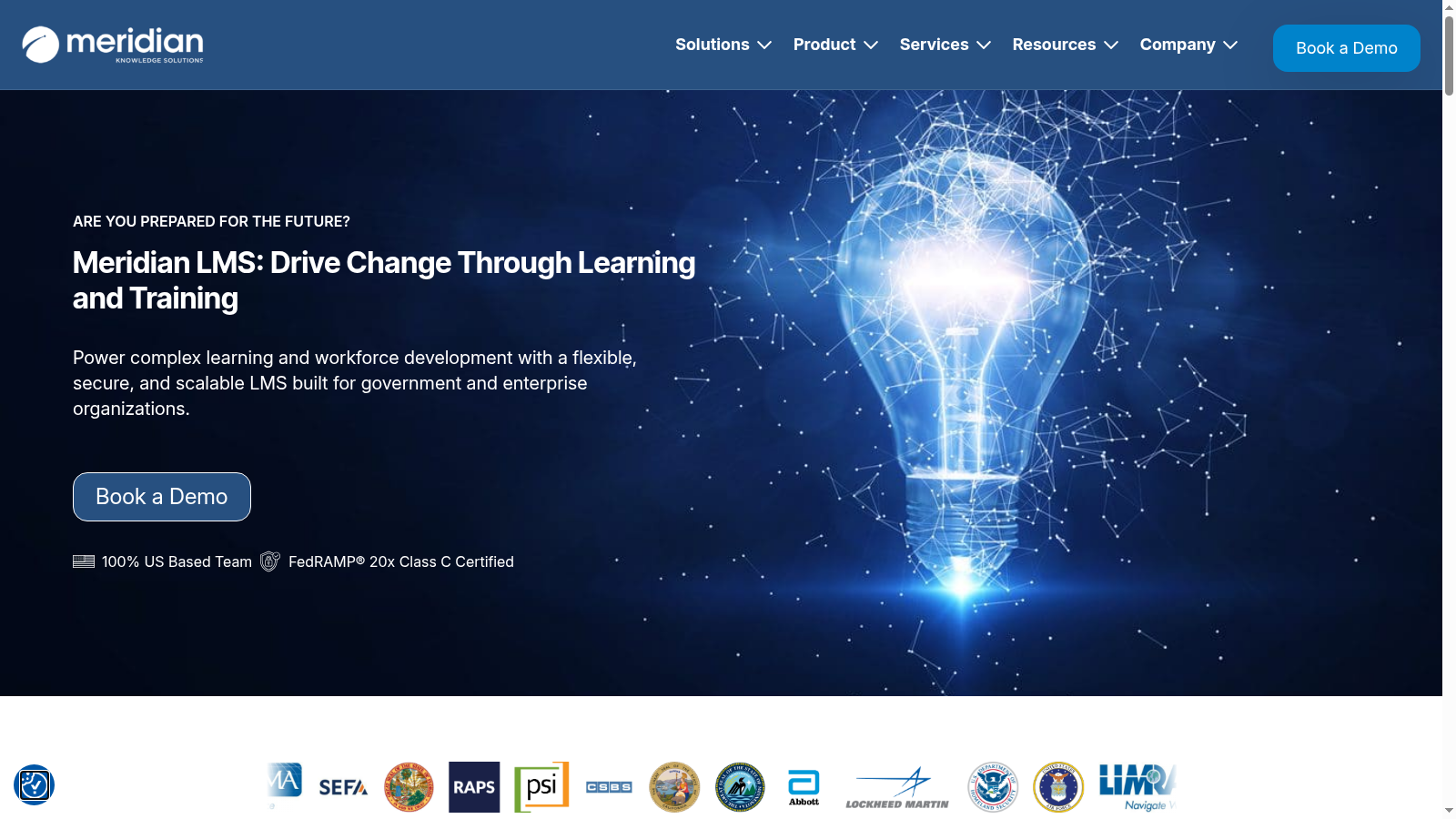
Meridian LMS is a workforce-learning platform whose named cloud service is currently FedRAMP Certified under the 20x Program path at Class C (Moderate). The marketplace lists certification from 6 March 2026.
It is a federal-grade LMS for workforce training, compliance and certification tracking, available in a FedRAMP cloud or on-prem/private cloud, and used by agencies including the DoD and the intelligence community. It is built for federal procurement, not a quick self-serve start.
My procurement notes: I would compare the certified Meridian cloud for a programme whose required level is Moderate. The 20x path does not make it a higher impact level than another Moderate platform. Verify the offered deployment and current accessibility report in the procurement package.
The product supports workforce learning and certification administration across online and instructor-led training. For an agency rollout, I would separate the learner’s task, the supervisor’s follow-up and the administrator’s recordkeeping. The cloud service offering is the object of the FedRAMP listing; an on-premises or private-cloud purchase is a different deployment. A 20x certification path is not a higher impact level than another Moderate service, so I would choose on workflow and procurement fit after the required level is met.
What it costs: Quote-only.
2. Cornerstone
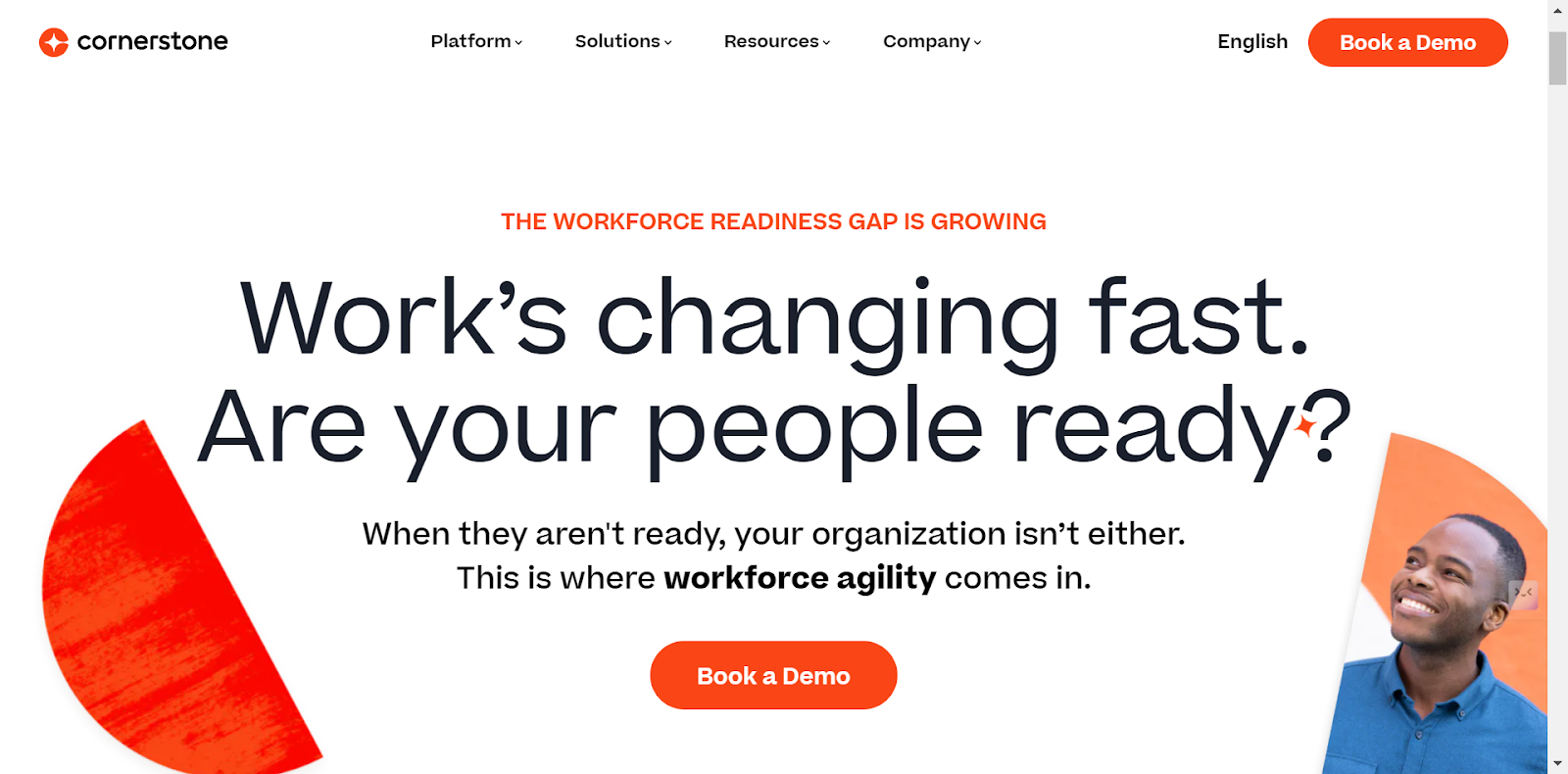
Cornerstone combines learning and talent management and has a named government cloud service, Cornerstone Galaxy, listed as FedRAMP Certified at Moderate.
It pairs learning with talent management across a large public-sector suite, delivered from a FedRAMP-authorised environment, and is aimed at the largest agencies and at defence.
My procurement notes: I would shortlist Galaxy when the programme needs learning connected to broader workforce development. Its separate DoD provisional approval must be checked against the application and required level; request the current product accessibility report and review its exceptions.
Its learning and talent scope can help a large agency keep development activity connected to the wider workforce programme. That breadth also requires clear ownership of the learning configuration and employee data. I would start by mapping agency units, administrator permissions and reporting responsibilities, then test the actual learner path with keyboard and screen-reader users. A product accessibility report describes conformance and exceptions; it does not establish that every uploaded course will be accessible.
What it costs: Quote-only.
3. Docebo
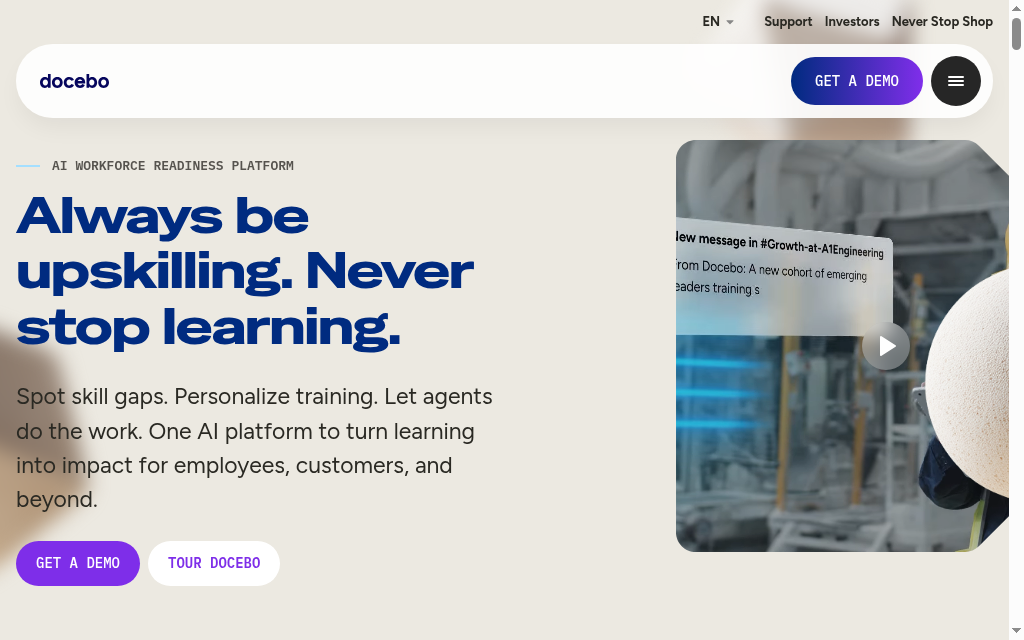
Docebo’s named government offering, DCBO-GOV, is FedRAMP Certified at Class C (Moderate) under the Rev5 Agency path. The marketplace lists certification from 21 May 2025.
It is a configurable cloud LMS with AI content tagging and a skills engine, offered in a government cloud for agencies that want a current platform rather than a legacy one.
My procurement notes: I would compare the government offering for delegated administration and learning programmes across agency units. Verify the features and integrations available in that service; GovCloud infrastructure is not proof of an application-level DoD approval.
The government offering must be assessed as its own cloud service, including the features and integrations available there. I would use the audience, learning-plan and delegated-administration workflow to compare how an agency assigns training across units and how managers follow it up. AWS GovCloud hosting does not by itself confer a DoD impact-level approval on every hosted application. Keep the application’s procurement evidence separate from the infrastructure provider’s credentials.
What it costs: Quote-only.
4. Totara
Totara’s government cloud service is a FedRAMP Certified Class C (Moderate) offering. The marketplace record applies to TotaraGov rather than every Totara installation.
It is a flexible talent-development platform (learn, perform, engage) built on an open-source core, configured and hosted by certified partners as "TotaraGov".
My procurement notes: I would compare TotaraGov when configurable learning programmes and recurring certifications are useful. Agree the partner’s responsibilities and the exact deployment, and review the current accessibility evidence for that service.
TotaraGov is the listed government cloud service; an arbitrary Totara installation does not inherit that status. Totara’s programmes and certifications support assigned learning and recurring requirements, with a partner shaping the deployment. My preference is to agree who maintains configuration, integrations and upgrades before signing the hosting contract. The open-source-derived platform provides flexibility, while the Core and proprietary Extensions have different licensing terms and the government service has its own scope.
What it costs: Quote-only, via partners.
5. Moodle
Moodle offers open-source software and several managed deployment choices. Its specific Moodle for Government service is currently listed as Legacy FedRAMP Ready, with zero authorizations; it is not listed as FedRAMP Certified.
It is a fully customisable open-source LMS you self-host or run via MoodleCloud or a partner, with "Moodle for Government" options and the deepest configurability here.
My procurement notes: I would compare the selected Moodle deployment for courses, assessment, access and accessibility. Ready status is not Certified, and the status of Moodle for Government does not apply to arbitrary self-hosted Moodle or MoodleCloud installations.
The marketplace record applies to Moodle for Government, a specific Moodle Workplace service from Moodle US. It does not describe every self-hosted Moodle site or MoodleCloud subscription. Core Moodle provides courses and assessment, and a managed deployment adds its own service obligations. I would choose the deployment first, then evaluate accessibility, completion records and operational support within it. Self-hosting gives control but also assigns responsibility for security, updates and recovery to your team or partner.
What it costs: Core Moodle is free and open-source to self-host; Workplace and managed hosting are quote-only via a partner.
6. Coursebox
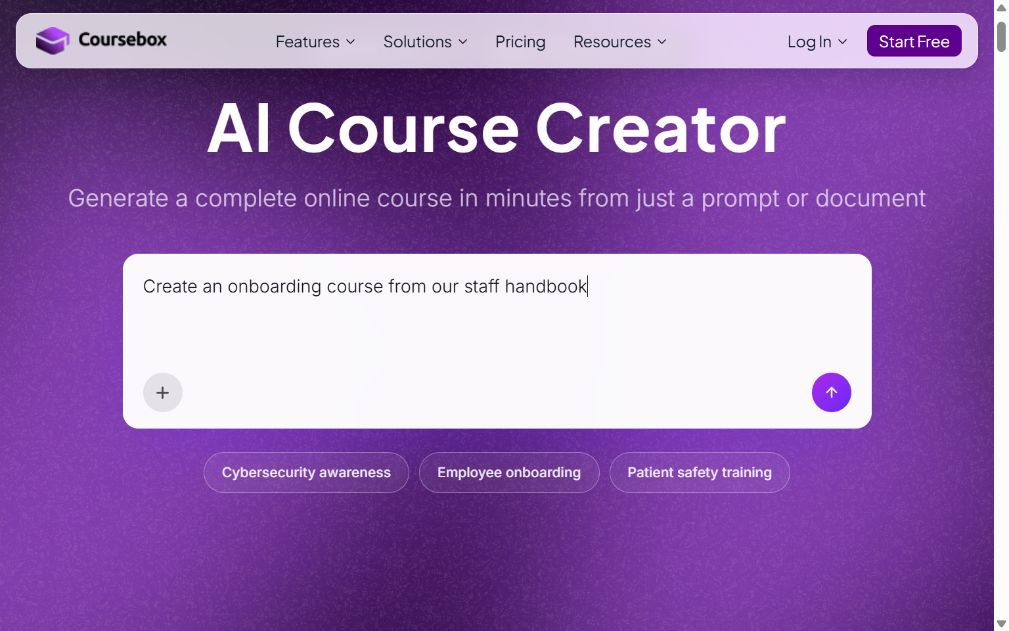
Coursebox combines AI course creation, assessment, tutor support and delivery. It has no verified FedRAMP listing, so I would shortlist it only where the organisation’s requirements allow that deployment.
It turns your policies and documents into courses fast, delivers on your own domain, exports SCORM to load into another system, and tracks completion, with unlimited learners.
A public-sector content owner can review a course generated from approved material and deliver it in Coursebox or export SCORM. Sensitive source documents still pass through the authoring service; exporting to a certified LMS does not transfer that service’s approval back to Coursebox.
My procurement notes: My preference is this workflow where creating and maintaining training is part of the job and the required processing terms can be met. A state or local label alone does not settle eligibility. If federal cloud approval is required, the current verified listing does not establish it.
The workflow continues after the first draft. A subject expert reviews the generated lessons and questions, learners work through the course with AI tutor support, and the administrator follows progress and assessment records. You can deliver in Coursebox or export a SCORM package to an existing LMS. That is useful when course production, learner support and delivery all need an owner; an AI draft still needs your subject expert’s approval.
Pricing and plans: Free to start with unlimited learners. A branded Pro LMS starts at US$3,000/year; Enterprise starts at US$30,000/year with a two-year minimum. AI credits, administrators and portal requirements affect the plan. Enterprise SAML for administrators is a US$3,000/year add-on; learner SSO is scoped separately.
7. iSpring LMS
iSpring LMS is the turnkey SaaS option with public pricing, a fit for state and local teams that do not need federal authorisation.
It pairs a cloud LMS with PowerPoint-based authoring and strong standards support, delivering quizzes and completion tracking with a mobile app.
My procurement notes: I would compare iSpring LMS for a programme whose requirements match the offered SaaS deployment. Review security evidence and accessibility for the LMS itself; an accessibility report for iSpring Suite does not cover the learner platform. There is no verified FedRAMP listing in this review.
The LMS and the authoring product are separate buying decisions. iSpring Suite converts PowerPoint material into courses and is licensed per author; iSpring LMS handles assignment, delivery and progress. The Windows and PowerPoint dependency applies to Suite, not to every way of creating or importing LMS content. I would keep this route when existing slides contain useful approved material, then budget for both the course producer and the learner platform.
Pricing and plans: The published US plan at 100 users is US$8,286/year (US$6.91 per user/month). Larger bands have lower unit rates. iSpring Suite is a separate author licence, published at US$970/year; compare the selected LMS and authoring configuration. Enterprise is quoted.
8. Paradiso LMS
Paradiso LMS is a commercial, integration-heavy LMS that markets to government, but be precise about what it is certified for.
It is a SaaS or self-hosted LMS with broad integrations and AI features, pitched at public-sector and commercial buyers.
My procurement notes: I would assess the quoted deployment against the agency’s requirements. The public information inspected does not establish a FedRAMP listing; security certification claims need their entity, scope and period checked in the supplied evidence. Do not substitute vendor wording such as compliant for a named listed service.
A broad integration catalogue is useful only if the connection supports the agency’s actual records and responsibilities. I would compare the relevant identity connection, course delivery and reporting output within the quoted deployment. SOC 2 and ISO evidence should be checked for its entity, scope and period, without treating it as an application-level FedRAMP listing. Its potential fit is a programme whose requirements match the supplied deployment, rather than all state and local organisations automatically.
What it costs: Quote-only.
Check the service, the course and the agency workflow
CDC reports that 28.7% of US adults reported a functional disability in its 2022 BRFSS data. Accessibility should be part of the learner workflow from login through assessment and records, with the agency’s required standard documented.
WebAIM’s 2026 automated study detected WCAG failures on 95.9% of one million home pages. That is broad web context, not a rating of these LMS products. I would review the current accessibility report and test the actual learner tasks and uploaded content.
| Layer | Check before approval |
|---|---|
| Named cloud service | Marketplace package, required level and agency process |
| Integration | Identity, external content and data connections in scope |
| Platform accessibility | Current accessibility report and documented exceptions |
| Course accessibility | Keyboard flow, captions, documents and assessments |
| Learning operation | Assignments, delegated permissions and retained records |
Which government LMS should you choose?
Eight platforms, sorted by the one question that gates the rest, what you are actually allowed to run:
| If your priority is | Go with |
|---|---|
| Federal, the 20x Moderate cloud offering | Meridian LMS |
| Large federal or defence, talent + learning | Cornerstone |
| A modern, AI-forward authorised cloud LMS | Docebo |
| An open-source-derived authorised platform | Totara |
| Self-hosting and the deployment and accessibility control | Moodle |
| State or local, fast AI course building | Coursebox |
| State or local, PowerPoint authoring + public pricing | iSpring LMS |
| State/local or commercial, a SOC 2 vendor | Paradiso LMS |
For related programme guidance, see our compliance training software.
Frequently Asked Questions
For a US federal cloud requirement, compare the named certified services: Meridian, Cornerstone Galaxy, DCBO-GOV and TotaraGov. For other public-sector programmes, check the organisation’s requirements before including additional deployments.
The current marketplace uses FedRAMP Certified for a certified cloud service. Meridian, Cornerstone Galaxy, DCBO-GOV and TotaraGov are listed at Moderate; Moodle for Government is Legacy FedRAMP Ready, not Certified.
The agency’s data, cloud-service use and applicable policy determine the requirement. State and local organisations can have different requirements, so their status alone is not an exemption or an approval.
Request the current accessibility report for the exact LMS and review the exceptions, then test the required learner tasks and course content. This review does not establish one platform as universally the most accessible.
Coursebox can support a government training programme where its deployment and processing terms meet the organisation’s requirements. It has no verified FedRAMP listing. Exporting SCORM to a certified LMS does not make the authoring service part of that listing.
Toni Arrebola
Toni joined Coursebox in 2024 as a software engineer and later moved into a CTO position with us after having a quick positive impact. He has 25 years of experience building SaaS platforms and managing high performance development teams. He transitioned from UI/UX design into product-minded software engineering. He previously founded and built a SaaS platform from scratch, scaling the business to 1,000+ paying customers. Toni is located in our Perth, Western Australia office and is originally from Spain. He is responsible for delivering an incredible user experience within the product, something he cares deeply about.

