

10 Best Gamification Tools in 2026: The Ones With Real Wow Factor
The best gamification tools in 2026, judged on real wow factor: which create live leaderboards, celebrations and missions that actually move a metric, and which are just badges.

The best gamification tool depends on what you are gamifying. Spinify and SalesScreen lead for sales with live, celebration-driven leaderboards; Smartico for customer loyalty; Coursebox for gamified training. The wow factor only counts when the game moves a metric you can measure.
- Sales gamification has the biggest wow factor: Spinify, SalesScreen and Ambition put live leaderboards and on-screen celebrations in front of the whole team.
- For customers, Smartico gamifies loyalty at scale and Influitive turns them into advocates; Triggerbee gamifies the on-site marketing experience.
- Most business gamification software is quote-only. Coursebox (free to start), Triggerbee (public pricing) and Zelos (free tier) are the transparent-pricing exceptions.
- Wow without behavior change is decoration. Judge every tool on whether the game is wired to a real metric, deals, completions, purchases, not on how many badges it hands out.
Answer three quick questions and we will point you to the right fit from this list.

Turn boring content into gamified learning instantly
I have watched gamification go two ways throughout my career. In one office a live leaderboard went up on the wall and the room's energy changed: reps started calling out their own numbers, the last hour of the day got loud, and the board moved output more than any pep talk. In another we switched on points and badges in a tool nobody had asked for, and within a week not one person had looked at them. Same idea, but very opposite result.
I run a software company, so what I care about is whether a tool creates that moment of motivation and magic, or just hands out badges nobody notices. This list is judged on that.
One thing up front: this is about gamifying your sales, engagement, loyalty and marketing. If what you want to gamify is training and courses, that is a different category, start with our guide to gamified learning platforms instead.
How I judged these
I did not rank these by mere feature count. Gamification only works when the game changes behavior, so I judged every tool on the wow it creates and whether that wow is tied to something you can measure. I check all four, in the same order.
What it gamifies: sales, engagement, loyalty, marketing or training. Buy for your lane. A sales leaderboard tool will not gamify a training course, and a training tool will not run your sales floor.
The wow factor: does it create moments people actually feel, a live leaderboard on the screen, a celebration when a deal lands, spin-to-win, a mission worth chasing, or is it a quiet badge nobody notices?
Mechanics that move a metric: the wow has to be wired to a behavior you can measure, calls made, deals closed, courses finished, repeat purchases. Points for their own sake change nothing.
Access: public pricing or a free tier versus a sales call to find out. Most of this category hides pricing, so I have flagged the exceptions.
Comparison at a glance
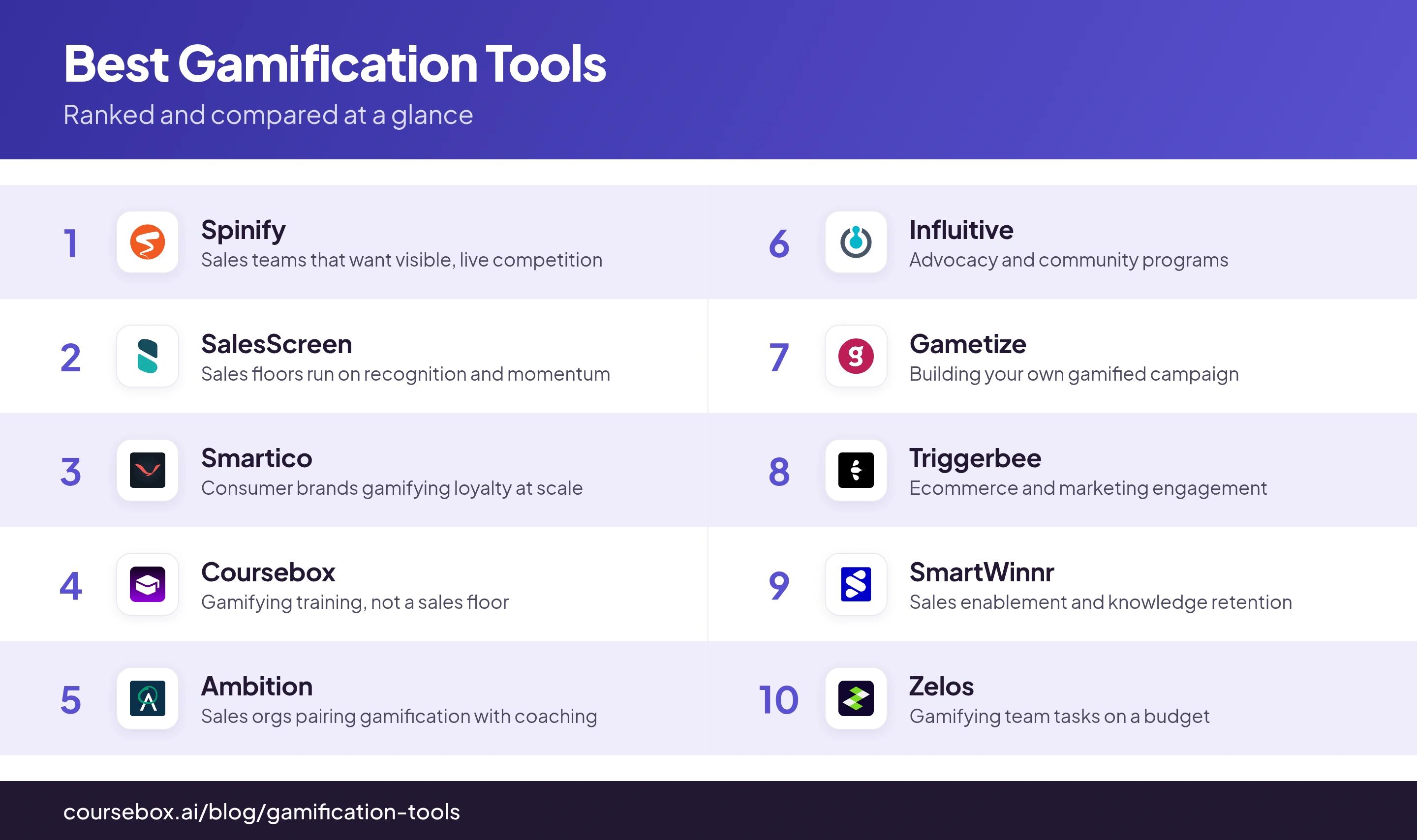
| Tool | What it gamifies | Wow factor | Access | Best for |
|---|---|---|---|---|
| Spinify | Sales | Live TV leaderboards + AI, confetti when a deal closes | Demo/quote | Sales teams that want visible, live competition |
| SalesScreen | Sales | Celebration videos + competitions on the office screen | Quote only | Sales floors run on recognition and momentum |
| Smartico | Customer loyalty + engagement | Missions, tournaments, spin-the-wheel at consumer scale | Quote only | Consumer brands gamifying loyalty at scale |
| Coursebox | Training + courses | Leaderboards, badges and AI role-play inside the course | Public, free to start | Gamifying training, not a sales floor |
| Ambition | Sales | TV leaderboards tied to live coaching | Quote only | Sales orgs pairing gamification with coaching |
| Influitive | Customer advocacy + community | Challenges and rewards that turn customers into advocates | Quote only | Advocacy and community programs |
| Gametize | Anything (DIY engine) | No-code missions, quizzes and challenges you design | Tiered + quote | Building your own gamified campaign |
| Triggerbee | Marketing + ecommerce | Spin-to-win and gamified on-site campaigns | Public pricing | Ecommerce and marketing engagement |
| SmartWinnr | Sales knowledge | Gamified quizzes and contests that reinforce knowledge | Quote only | Sales enablement and knowledge retention |
| Zelos | Team + volunteer tasks | Points and challenges on real work, free tier | Freemium | Gamifying team tasks on a budget |
1. Spinify
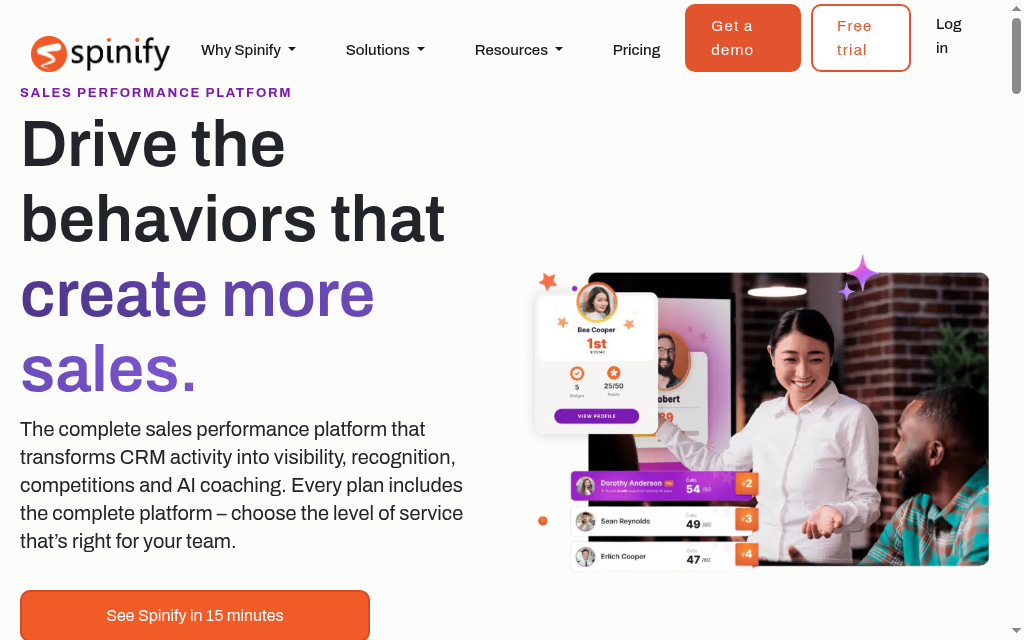
Best for: sales teams that want competition everyone can see, in real time.
Spinify is sales gamification at its most visible: live leaderboards on the screens around your office, wired straight to Salesforce or HubSpot.
What it gamifies: sales activity and results, calls, demos and closed deals, pulled from your CRM as they happen.
The wow factor: the leaderboards update the second a deal lands, then fire an on-screen celebration the whole floor watches, and AI-driven challenges keep the contest fresh so it never fades into wallpaper. This is the category at its most visible.
The catch: the wow depends on clean CRM data. A messy pipeline makes the leaderboard lie, so fix that before you mount the TV.
Access: demo-led, pricing on request.
My take: Spinify's real surprise is how many leaderboard and competition types it ships with, and how few obvious defaults, so budget a week of trial and error before it clicks. Once it is set up, it is the one you can point at across the floor.
2. SalesScreen
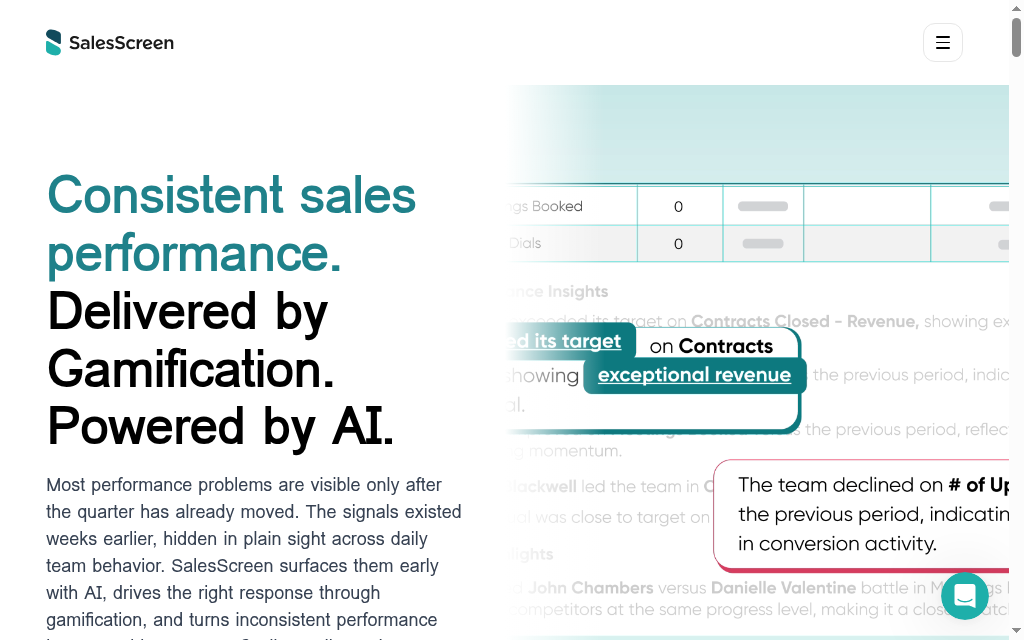
Best for: sales floors that run on recognition and momentum.
SalesScreen turns recognition into a live event rather than a line in a monthly email.
What it gamifies: sales activity and milestones, with competitions and personal goals tied to your numbers.
The wow factor: when a rep hits a milestone, a custom celebration video or animation plays on the office screen for the whole team to see, right then, not a week later.
The catch: it leans harder on motivation than on the coaching and analytics you get from Ambition, so pair the two if you need both.
Access: quote only.
My take: The competition templates are what save you. Teams running dozens of contests a year found setup drop from an hour of brainstorming to minutes. Get it if the problem is floor energy and you launch contests often.
3. Smartico
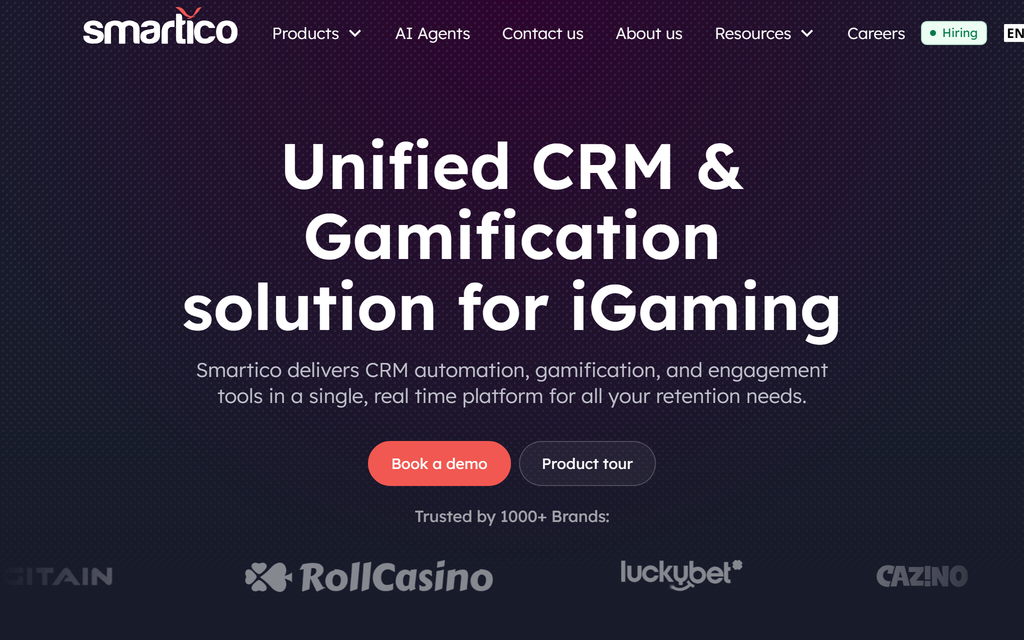
Best for: consumer brands gamifying loyalty and engagement at scale.
Smartico brings the flashiest mechanics on this list and wires them straight into loyalty and CRM automation.
What it gamifies: customer behavior, missions, tournaments, levels, spin-the-wheel and badges, built to run for millions of users at once.
The wow factor: its iGaming and retail roots show: real-time missions and prize wheels that feel like a game a customer wants to keep playing, not a corporate points scheme.
The catch: it is built for consumer scale, so it is overkill and over budget for gamifying a team of twenty.
Access: quote only, enterprise.
My take: Built for gamifying customers, not staff, and for maximum spectacle. Fair warning: almost every Smartico video online is its own marketing, so there is little independent footage to judge from, which fits its niche iGaming and fintech roots. Get a live demo on your own data first.
4. Coursebox
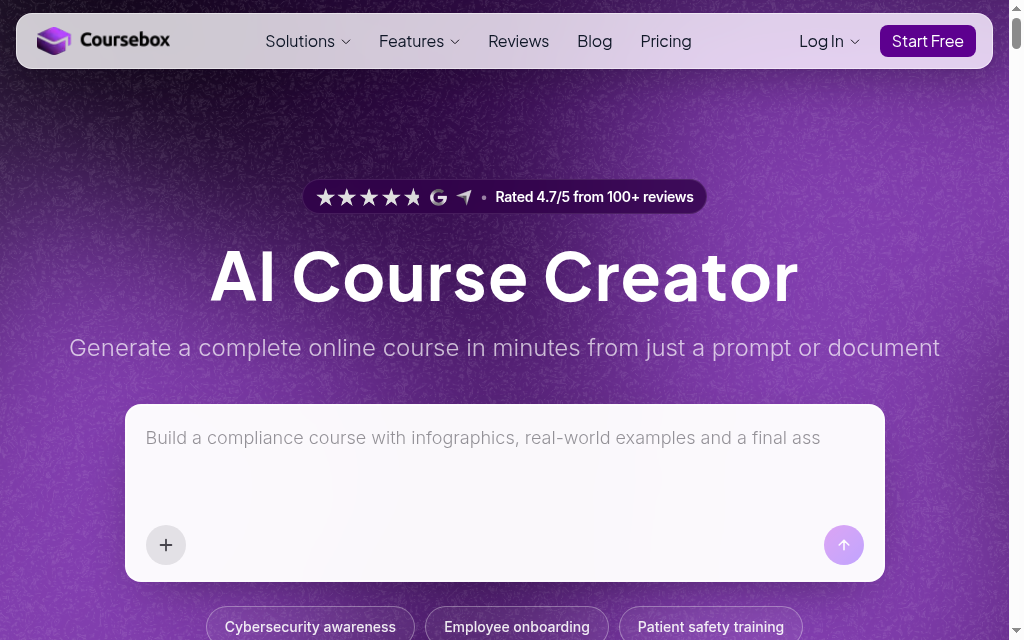
Best for: gamifying training and courses, not a sales floor.
Coursebox is ours, so weigh this accordingly. It gamifies the learning itself, inside a branded course you generate from your own material.
What it gamifies: learning, with points, badges, leaderboards and progress that sit inside the course, not bolted on beside it.
The wow factor: the AI Scenario role-play, where learners practise a real conversation with an AI character and get scored, backed by an AI Tutor that answers their questions in context.
The catch: it gamifies learning, not sales or customer loyalty. For those, the tools above fit better.
Access: public. Free to start, full white-label on higher tiers.
My take: Straight talk since it is ours: the AI Scenario role-play is the part to try first, and it is the moment in a demo that lands. It fits when the behaviour you want to change is skills and knowledge and you want the game inside the course. For staff performance or customer loyalty, the tools above fit better.
5. Ambition
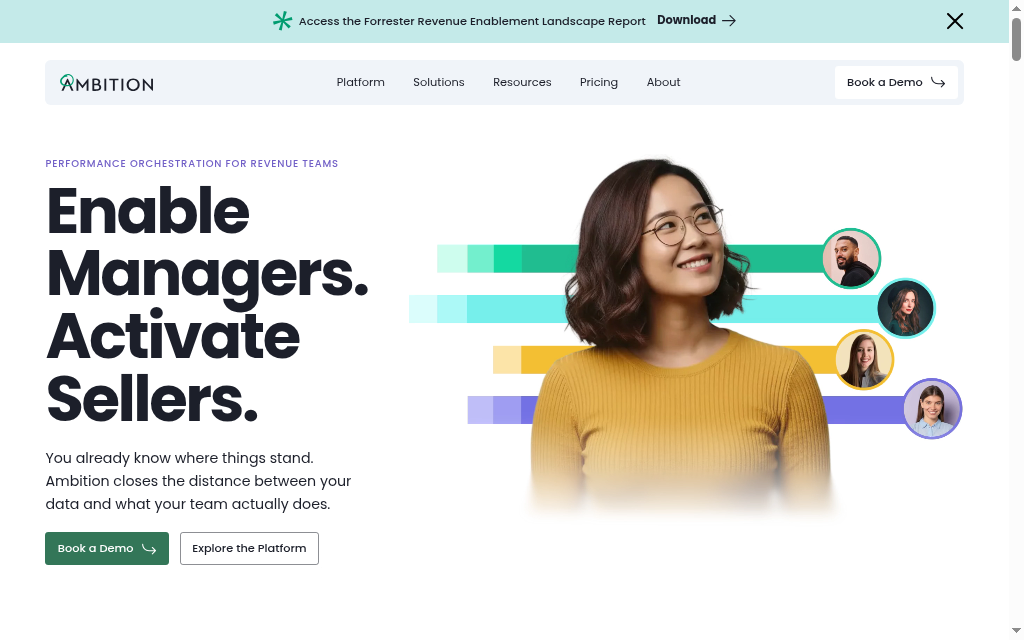
Best for: sales orgs that want gamification and coaching in one place.
Ambition pairs the leaderboards and competitions you would expect with a structured coaching layer underneath.
What it gamifies: sales activity and performance, with competitions plus 1:1 coaching workflows in the same tool.
The wow factor: the TV leaderboards do not just rank people. A slipping number triggers a coaching conversation, so the game and the fix live together.
The catch: you are buying a sales performance platform as much as a game, so weigh the coaching depth in the price.
Access: quote only.
My take: A second-line sales leader in one review made the point that stuck: Ambition gave them visibility they normally never get, because teams tell you what you want to hear and the dashboards showed the real picture. Right for when a leaderboard is not enough and managers need coaching and honest numbers in one place.
6. Influitive
Best for: turning customers and community members into active advocates.
Influitive gamifies advocacy, pointing its mechanics at your customers and community rather than your staff.
What it gamifies: advocate behavior, a feed of challenges, writing a review, making a referral, sharing content, with points and rewards.
The wow factor: the challenge feed makes advocacy feel like a game members work through and climb, and the best programs run genuinely addictive campaigns.
The catch: it is a community and advocacy platform, not for a sales team or a training program.
Access: quote only.
My take: Best when the metric is advocacy, referrals and reviews, not internal productivity. One caveat: the footage online is all Influitive's own walkthroughs, so trial the challenge feed with your real advocates before leaning on it.
7. Gametize
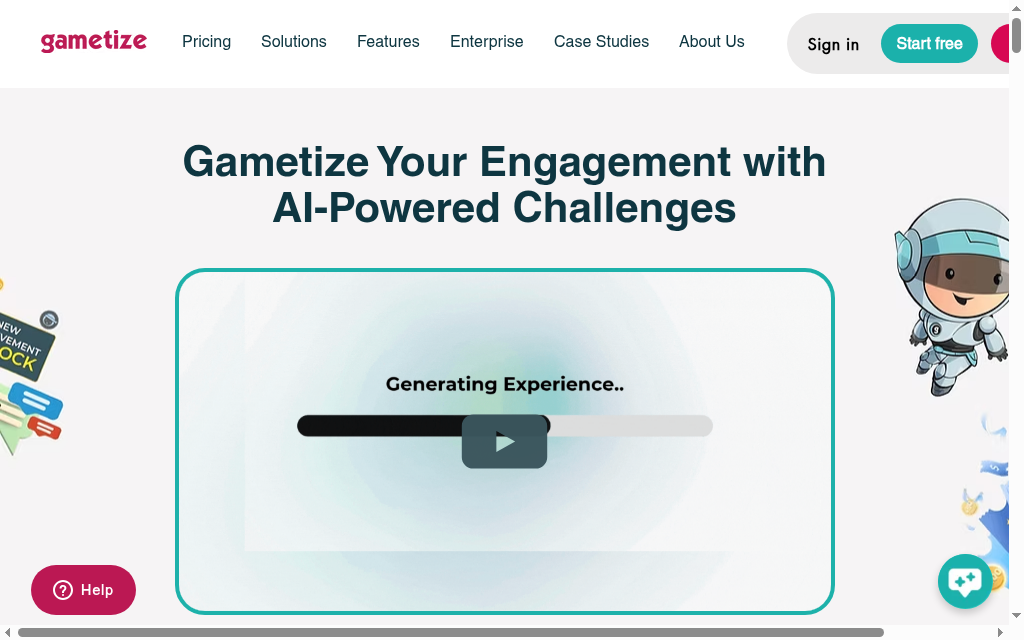
Best for: teams that want to design their own gamified campaign without engineers.
Gametize is a no-code gamification engine rather than a fixed use case.
What it gamifies: anything you point it at, missions, quizzes, challenges and rewards you build and theme yourself.
The wow factor: the wow is whatever you design in, from onboarding to an event to an engagement drive, launched without waiting on developers.
The catch: it is a toolkit, not a turnkey program, so you get out what you put in.
Access: tiered plans plus enterprise quotes.
My take: The trap people hit is building content on day one. Decide the single number you want to prove first, then build to generate it, or you end up with vanity metrics. A flexible option when your use case does not fit the sales or loyalty boxes, provided you come in with that metric chosen.
8. Triggerbee
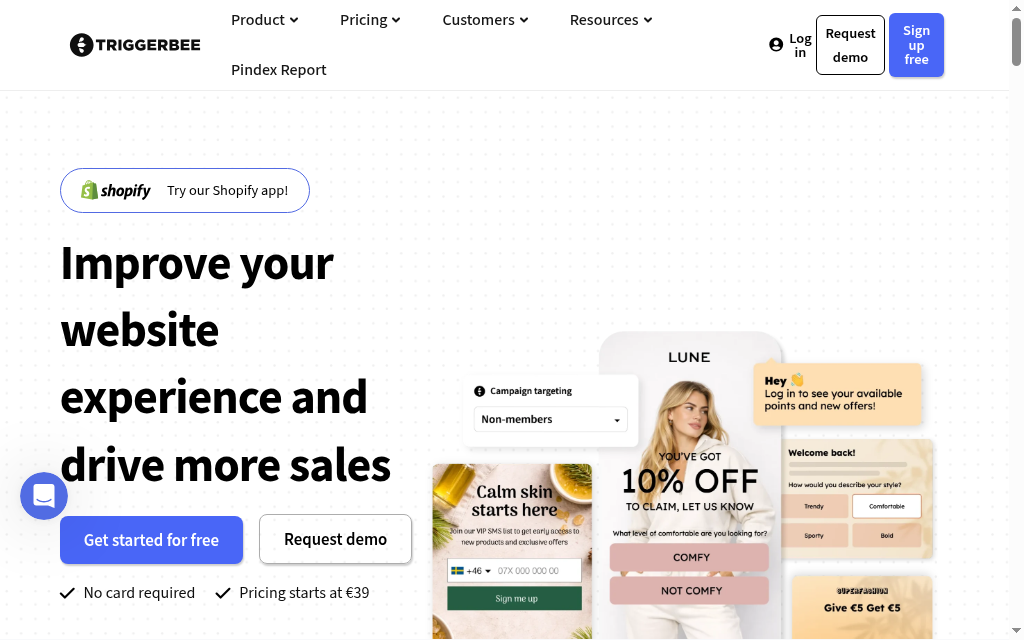
Best for: ecommerce and marketing teams gamifying the on-site experience.
Triggerbee gamifies the website itself, and unusually for this category, it publishes its pricing.
What it gamifies: visitor behavior, spin-to-win wheels, interactive pop-ups and campaigns tied to email capture and offers.
The wow factor: the spin-to-win wheels and campaigns noticeably lift opt-ins and conversions, one of the few gamification tools with a direct line to revenue.
The catch: it is a marketing and on-site personalization tool, not for team or learning gamification.
Access: public pricing.
My take: Reach for it when the metric is signups, conversions and repeat visits on your site. The demos online are vendor-made, so lean on the public pricing and a free trial to see the spin-to-win lift on your own traffic.
9. SmartWinnr
Best for: sales enablement teams that need reps to retain what they learn.
SmartWinnr aims its gamification at knowledge rather than raw activity.
What it gamifies: sales knowledge, gamified quizzes, contests and reinforcement wrapped in coaching.
The wow factor: daily gamified quiz nudges and contests keep product and pitch knowledge sharp, competition aimed at what reps know, not just how hard they are dialing.
The catch: it overlaps with training, so if learning is your whole problem a course tool may serve you better.
Access: quote only.
My take: Worth it only if the gap is what your sales team knows, not how motivated they are. There is no real independent demo footage, only vendor pitches aimed at pharma sales, so trial the daily quiz nudges on your own content before buying.
10. Zelos
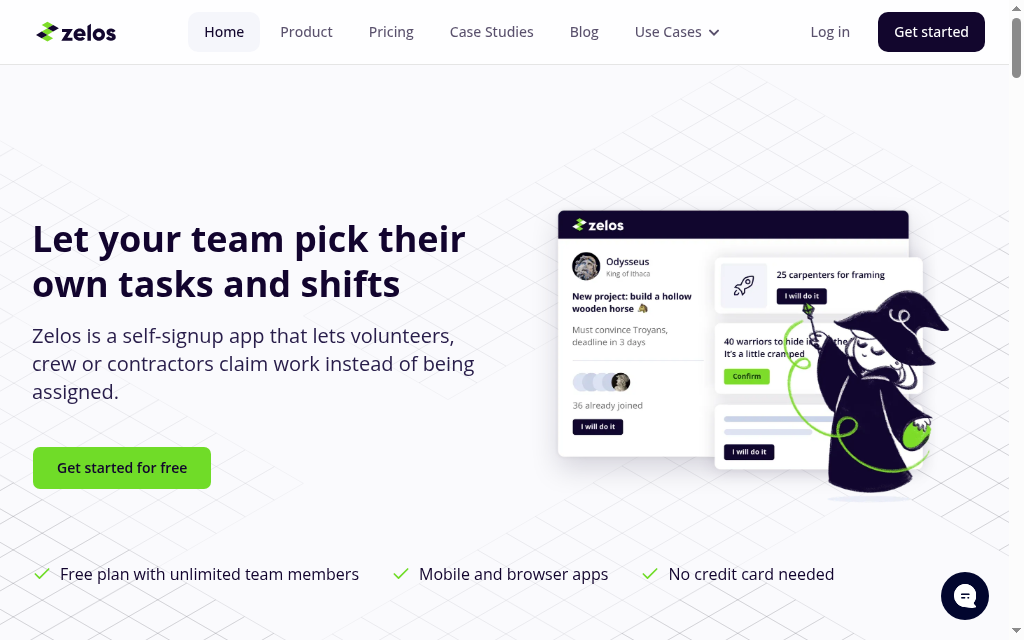
Best for: small teams and volunteer groups that want gamification without an enterprise bill.
Zelos puts a working points-and-challenge layer on real work, on a genuinely usable free tier.
What it gamifies: tasks, shifts and to-dos, with points and challenges on the actual work.
The wow factor: the wow here is accessibility rather than spectacle: a small org, nonprofit or volunteer group can run real gamified task management for nothing.
The catch: it is lightweight by design, so do not expect the on-screen spectacle of Spinify or Smartico.
Access: freemium, with a real free plan.
My take: One practical catch: agree a points scale before you assign values, because one task worth 1 and another worth 100 breaks the competition fast. The pick for tight budgets that still want real game mechanics on everyday work, with a genuinely usable free plan.
What counts as a gamification tool, and what is just a points sticker
A gamification tool should change what people do. The test is simple: strip out the points and badges, and does anything about the behavior change? If not, the gamification was decoration.
Three things separate a real tool from a sticker. It is wired to a live metric (deals, completions, purchases), not a vanity counter. It creates visible moments people react to, a leaderboard on the screen, a celebration, a challenge, rather than a silent tally. And it targets one clear behavior, not "engagement" in the abstract. A tool that does those three has earned the label.
How to choose a gamification tool
Start from the behavior, not the badges. Name the single metric you want to move, calls, deals, course completions, repeat purchases, and pick the tool built for that lane. A sales leaderboard will not fix training, and vice versa.
Demand real wow, then check it is wired to the metric. A live leaderboard or a celebration is only worth paying for if it fires on the behavior you care about. Ask to see the trigger, not just the animation.
Check what it plugs into. Sales tools live and die on the CRM connection; marketing tools on your site and email; training tools on your content. A gamification layer with bad data underneath just makes a prettier wrong number.
Treat quote-only pricing as a signal. Most of this category hides pricing behind a sales call. Public pricing or a free tier (Coursebox, Triggerbee, Zelos) usually means faster procurement and fewer surprises.
What I would actually pick
Decide what you are gamifying first. For a sales floor, Spinify and SalesScreen bring the most visible wow, with Ambition when you need coaching alongside it. For customers, Smartico for loyalty at scale and Influitive for advocacy. For marketing, Triggerbee. For a build-your-own campaign, Gametize; on a budget, Zelos. And if the behavior you actually want to change is skills and knowledge, that is training, so gamify it inside the course with Coursebox, or start from our gamified learning platforms guide. Whatever you choose, make the game fire on a real metric, because wow without behavior change is just a more expensive badge.
Frequently Asked Questions
A gamification tool adds game mechanics, points, badges, leaderboards, challenges, missions, to a non-game activity such as selling, learning or shopping, to change behavior. The good ones wire those mechanics to a real metric; the weak ones just display a counter.
If you are gamifying sales, customer loyalty or marketing, you want a gamification tool from this list. If you are gamifying training and courses, you want a gamified learning platform instead, that is a different category built around delivering learning.
They work when the game is tied to a behavior you can measure and creates visible moments people react to. A live leaderboard that updates when a deal closes changes behavior; a silent badge in a menu does not. Strip out the points, and if nothing about the behavior would change, the tool is decoration.
Spinify and SalesScreen lead on visible, live sales gamification (leaderboards and celebrations on the office screen). Ambition is the pick when you want gamification plus a coaching workflow, and SmartWinnr when the gap is sales knowledge rather than activity.
Yes. Zelos has a genuine free tier for team and volunteer task gamification, Coursebox is free to start for gamified training, and Triggerbee publishes its pricing. Most of the rest (Spinify, SalesScreen, Smartico, Ambition, Influitive) are quote-only.
Travis Clapp
Travis Clapp is the original founder and CEO of Coursebox. As an experienced instructional designer, he has lived through the process of building high quality courses. These experiences brought about his idea to upload all your documents and ideas into a virtual box that could convert those magically into a course. Prior to Coursebox, he successfully founded and built a social based LMS. Travis has 15+ years of experience designing courses and EdTech platforms from university MOOCs to enterprise LMS. Travis has built training for reputable companies like Johnson & Johnson, Electrolux, Michael Hill and SA Health. One of his courses reached 20,000+ learners which was a flagship edX course. He is based in the Adelaide, South Australia office and passionately works on customer support, sales and bringing the original product vision to life every day.

