

Dick and Carey Model: The 10 Steps, Examples and Template
The Dick and Carey model explained: all 10 steps with a worked example, how to run formative evaluation, real results and two free templates.

The Dick and Carey model is a ten-step systems approach to designing instruction, where analysis of the goal, the skills, the learners and the workplace drives objectives, assessments and materials, and the draft is tried out with learners and revised before release.
- Formative evaluation is what makes the model work, so keep at least one round of tryouts with real learners.
- Formative evaluation runs in three rounds, one-to-one, small group and field trial, and each round feeds the revision step.
- Dick and Carey suits stable, high-stakes skills like safety procedures, where a mistake in the course becomes a mistake on the job.
- Scale analysis, assessments and tryouts to the task and its risks, rather than treating ten numbered components as a one-way sequence.
Five planning prompts for one instructional design project. This is an unvalidated checklist. Review each answer; the total does not establish suitability or effectiveness.

Go from storyboard to an interactive course in minutes
Picture a utility contractor (a hypothetical example) that hires twelve licensed electricians as field technicians to replace smart meters in people's homes. The first draft spends an hour on electrical theory and five minutes on spotting an unsafe installation. Nobody checked which skills the technicians already had, or tried the course with one of them before release. Their licences establish an entry requirement, but the designer still needs evidence that each person can perform this particular job.
The Dick and Carey model is built to stop that. I'm an instructional designer at Coursebox, where we make instructional design software that teams use to build courses from their own analysis and source material. I've used the model on workplace courses, and below I take the smart-meter course through all ten steps.
What is the Dick and Carey model?
The Dick and Carey model is a ten-step systems approach to designing instruction, where analysis of the goal, the skills, the learners and the workplace drives objectives, assessments and materials, and the draft is tried out with learners and revised before release.
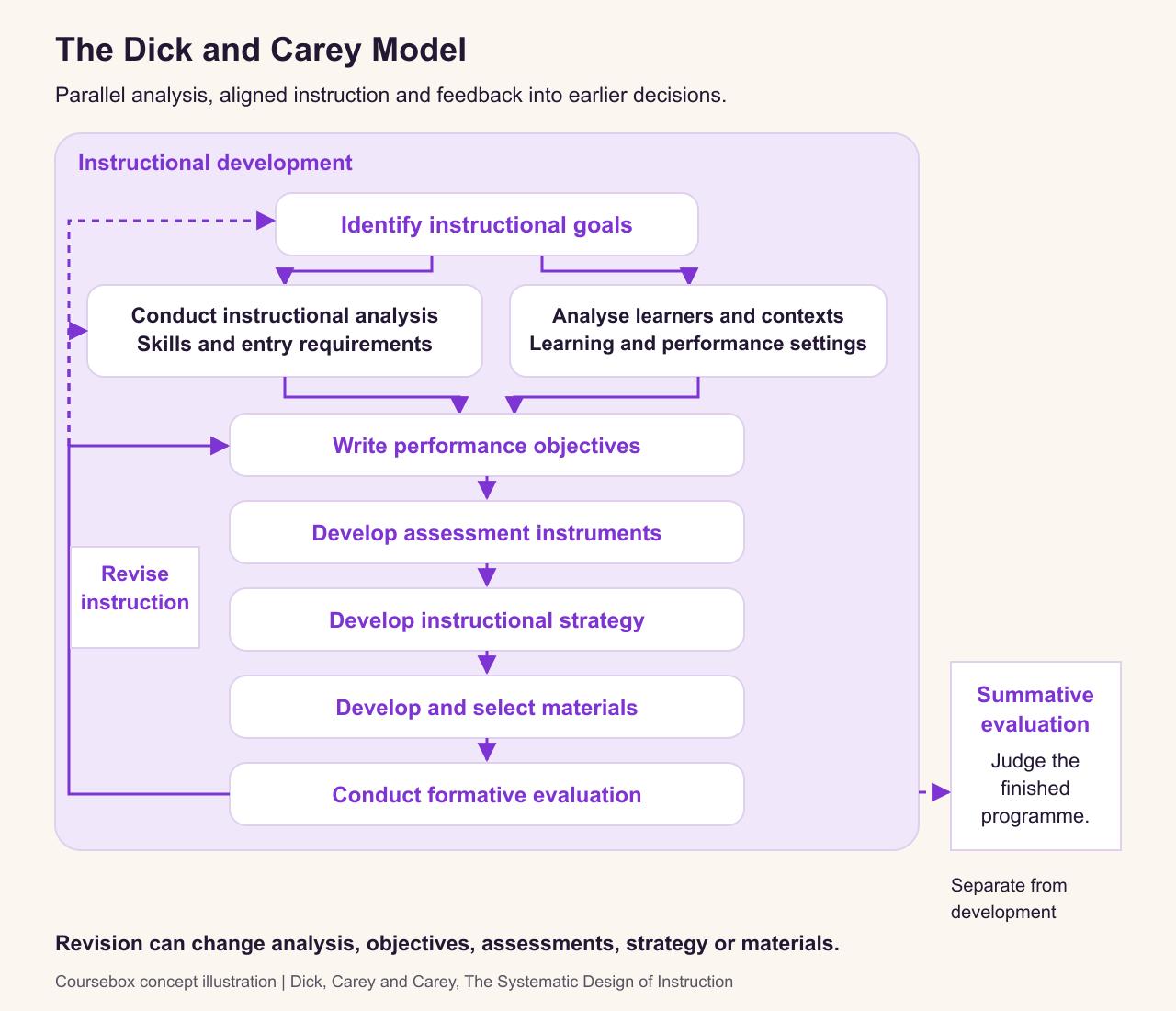
The model comes from The Systematic Design of Instruction by Walter Dick, Lou Carey and James O. Carey. Its ninth edition was published in 2021. A systems approach connects analysis, objectives, assessments and materials, then uses learner evidence to revise those decisions. Instructional analysis and learner/context analysis run in parallel. See Pearson's edition information.
The example column below follows that contractor's smart-meter course. It prepares twelve new field technicians to replace residential electricity meters under the employer's approved procedures, recognise when to stop and escalate, and record the completed job. This is a hypothetical design example, not an installation guide.
| Step | What you do | The question it answers | In the smart-meter course |
|---|---|---|---|
| 1. Identify instructional goals | Name the job outcome the training must produce | What should people be able to do at work? | Replace a residential meter safely, restore supply and record the job |
| 2. Conduct instructional analysis | Break the goal into steps, subordinate skills and entry skills | What does doing it involve, and what must they know first? | An expert maps the approved procedure, prerequisite skills and use of approved equipment |
| 3. Analyse learners and contexts | Describe the learners, where they learn and where they perform | Who are they, and what will the job site be like? | Licensed electricians, new to meters, working alone in customers' homes |
| 4. Write performance objectives | State the condition, the behaviour and the criteria | What exactly will they do, and how well? | Use an approved de-energised rig and meet every safety-critical item under a qualified assessor |
| 5. Develop assessment instruments | Build the checks that match each objective | How will we know they can do it? | Scenario decisions plus an observed practical assessment |
| 6. Develop instructional strategy | Decide how each objective is taught and practised | How will they learn it? | Demonstration, scenario practice and supervised practical work |
| 7. Develop and select instructional materials | Build or source the materials | What will they use? | Short lessons, videos, scenarios and a job aid |
| 8. Design and conduct formative evaluation | Try the draft with learners in three rounds | Does it work before we release it? | An expert review, learner trials and supervised practice on an approved training rig |
| 9. Revise instruction | Fix what the tryouts found, at whichever step caused it | What needs to change, and where did it start? | Move the unsafe-installation check to the start |
| 10. Design and conduct summative evaluation | Decide whether the finished training is worth keeping | Should we keep, adopt or replace it? | Review practical-assessment and job-audit evidence, recording other changes |

Case study: Breastfeeding education in Italy
A regional breastfeeding programme used Dick and Carey alongside problem-based learning. Its designers surveyed 343 professionals about needs, developed a 29-hour course and field-tested it before wider delivery. Across the programme, 562 professionals and 32 tutors received training. Follow-up knowledge, attitudes and self-reported practice were available for 105 of 137 participants in the follow-up sample. The practical lesson is to use needs analysis and field testing to shape a programme before scaling it. These measures do not isolate the design model or establish improved breastfeeding outcomes. Read the Italian programme evaluation.
In the Italian programme, 105 of 137 participants in the follow-up sample provided all measurements. Knowledge, attitudes and self-reported practice gains remained at four to six months. Reported practice is useful follow-up evidence, but it is different from independently observed behaviour or patient outcomes.
Who created the Dick and Carey model, and which edition to read
Walter Dick, now Professor Emeritus at Florida State University, and Lou Carey published the first edition in 1978. James O. Carey joined as an author in later editions. The book has run to nine editions, and Walter Dick wrote in 1996 that "many instructional designers and numerous organizations have adapted the Dick and Carey model for use in their training functions" (Educational Technology Research and Development).
- Read the 9th edition (2021). It adds new formative evaluation suggestions and process flowcharts, and its chapters treat instructional analysis as two jobs: goal analysis, then subordinate and entry skills.
- Older editions are fine for the core ideas, but the step names differ slightly, and many summaries still quote the 2005 or 2009 versions.
This guide counts revision as a component and summative evaluation as the tenth step. Instructional analysis and learner/context analysis run in parallel, and revision feeds back into earlier components. Summative evaluation sits outside the development cycle. The numbering explains the components; it is not a ten-box sequence to complete once.
The ten steps, worked through one course
Here is the course we are designing: training for twelve licensed electricians who are new to a utility contractor's residential smart-meter replacement work. They need to follow the approved procedure, recognise unsafe conditions and document the job. The course combines screen-based decisions with supervised practice on a training rig and a qualified assessor's check. This hypothetical example shows why analysing the task, checking entry skills and testing actual performance must stay connected.
1. Identify instructional goals
Start from what people must do at work, after a front-end analysis confirms training is the right fix. If the incidents come from a missing tester in the van, a course will not help. A training needs analysis is the usual way to find out.
- What you do: write one goal statement in terms of job performance.
- Smart-meter course: given a work order and a meter at a customer's home, the technician replaces the meter safely, restores supply and records the job.
2. Conduct instructional analysis
Break the goal into the steps a competent person follows, then the skills each step depends on.
- What you do: list the main steps, the subordinate skills under each, and the entry skills learners must already have.
- For the smart-meter example, a qualified subject expert would map the approved work procedure and the skills it requires. Verify entry skills rather than treating a licence as proof of every prerequisite. Include the use of approved test equipment, hazard recognition and job documentation in that analysis. The example here is a course-design plan; technical procedures and competency criteria must come from the employer and the applicable local requirements.
3. Analyse learners and contexts
Describe the learners and the two settings that shape the training: where they learn and where they perform.
- What you do: record prior knowledge, attitudes, the learning setting and the performance setting.
- Smart-meter course: experienced electricians who dislike being taught basics, learning between jobs on a tablet, and performing alone in someone's home with the customer watching.
4. Write performance objectives
Each objective has three parts: the conditions, the behaviour and the criteria. Criterion-referenced instruction uses the same three parts, and each one should be measurable. The criteria part is the one I see left out most.
- What you do: write one objective per step and per key subordinate skill.
- Example objective: given a de-energised training rig, approved procedure and required equipment, the learner completes the specified isolation and verification sequence under a qualified assessor, meeting every safety-critical item on the approved checklist. The assessor defines the criteria before the trial. A scenario quiz can support this preparation, but it cannot replace an observed practical check.
5. Develop assessment instruments
Write the assessments before the content, straight from the objectives, so each check measures the behaviour in the objective and nothing else.
- What you do: build an entry-skills check, practice checks and a final assessment.
- For the smart-meter course, use scenarios to check decisions and an observed practical assessment to check the physical work. A qualified assessor uses the approved checklist on a de-energised training rig. Passing online questions alone does not establish competence to undertake electrical work.

Case study: Web-based technology lessons in Nigeria
A Nigerian courseware study used Dick and Carey to develop web-based basic-technology lessons for junior secondary students. Content, computing and educational-technology experts reviewed the courseware, and 83 students from two schools in Minna took part in field validation.
The reviewers judged the courseware suitable for learning the subject. The study's reported validation does not establish improved achievement, retention or workplace performance. Students came from non-randomised groups, so the findings should not be treated as a controlled test of the model.
The design lesson is to test different questions with different reviewers: experts check the subject and technical design, while target learners help reveal whether the materials work for them. That evidence can guide revision before wider delivery.
6. Develop instructional strategy
Decide how each objective will be taught: the sequence, the examples, the practice and the feedback. The 9th edition gives the logistics of delivery a chapter of its own.
- What you do: plan pre-instruction, content, practice with feedback, assessment and follow-through for each objective.
- Smart-meter course: use short demonstrations and decision scenarios to prepare for supervised practical work on an approved de-energised training rig. Plan practice with the equipment as well as the online lessons, and assess each using the relevant objective.
7. Develop and select instructional materials
Build or reuse the materials the strategy calls for. Reusing an existing manufacturer video is often better than filming a new one.
- What you do: produce the lessons, media, practice activities and job aids.
- Smart-meter course: six short lessons, demonstration videos, a scenario per step and a one-page job aid for the van.
8. Design and conduct formative evaluation
Try the draft with real learners before release, in three rounds that each catch different problems.
- What you do: one-to-one tryouts, then a small group, then a field trial.
- For the smart-meter course, begin with an experienced technician reviewing the draft, then a small group of target learners using it without design-team coaching. Trial practical activities on an approved de-energised training rig under qualified supervision. Any later workplace trial involves authorised, competent personnel following approved procedures; it is not a test of whether an unqualified learner can work on a live installation.
9. Revise instruction
Use the tryout data to fix the course, and trace each problem back to the step where it started. A confusing lesson might be a materials problem; a skill nobody can do might be a missed subordinate skill in step 2.
- What you do: change the materials, the strategy or the analysis, whichever caused the problem.
- Smart-meter course: the unsafe-installation check moves from the removal step to the start of the job.
10. Design and conduct summative evaluation
Summative evaluation answers a different question from the rest of the model: should the organisation keep, adopt or replace this training? It usually happens after the design team's work is done.
- What you do: compare the training's results against the need that started the project.
- For the smart-meter course, compare practical-assessment records and job-audit findings against the intended outcomes. Record changes in equipment, supervision and procedures alongside the training. A before-and-after improvement can support a decision about continuing the programme, but it does not by itself prove that the course caused the change.
When I write the checks first, every lesson has to justify itself against a check, and content that no check needs gets cut early.
Plan all ten steps with a guiding question for each, a performance objective builder, and the smart-meter example filled in. Editable Word file, no email required.
How to run formative evaluation in the Dick and Carey model
Formative evaluation is the step that separates Dick and Carey from a plan on paper. You try the draft with learners, find what fails, and revise before anyone depends on it. The three rounds each catch a different kind of problem.
| Round | Who takes part | What it catches | Smart-meter course |
|---|---|---|---|
| One-to-one | One learner at a time, with you watching and asking questions | Confusing wording, missing steps, wrong assumptions about prior knowledge | An experienced technician works through the draft on a tablet and talks aloud |
| Small group | A small group of target learners working on their own | Timing, sequencing and whether learners can succeed without you | A new cohort of technicians completes the course; you collect scores and comments |
| Field trial | Learners in the real setting, with the real constraints | Whether it works on the job, with real equipment and real time pressure | Trial under qualified supervision on an approved training rig; workplace use follows authorised procedures |
Each round feeds step 9. When the tryout shows a problem, ask which earlier step caused it before you rewrite a lesson. In my experience, an "unclear lesson" often turns out to be a subordinate skill nobody listed in step 2.
A restricted Coursebox course lets you control who can access the draft. Arrange access for the trial group and confirm their permissions before the session. A link alone does not grant permission to a restricted course. After the trial, collect the feedback and revise before changing the publishing settings.
In our records, 260 English courses changed from restricted access to public or paid access between 9 July and 6 October 2026. Those transitions show a publishing pattern; they do not establish that creators ran learner tryouts or used Dick and Carey. For your own trial, keep access limited to the intended reviewers, collect their feedback, revise, and then decide when to release.
Plan the one-to-one, small group and field trial rounds, then log each problem, the step it traces back to and the change you made. Editable Word file, no email required.
Building a Dick and Carey course in Coursebox
On 7 October 2026 I gave Coursebox, the course builder we make, the analysis for the smart-meter course: the instructional goal, the six main steps, the subordinate and entry skills, the objectives and assessments, and the strategy. Coursebox is our product, so weigh my read with that in mind.
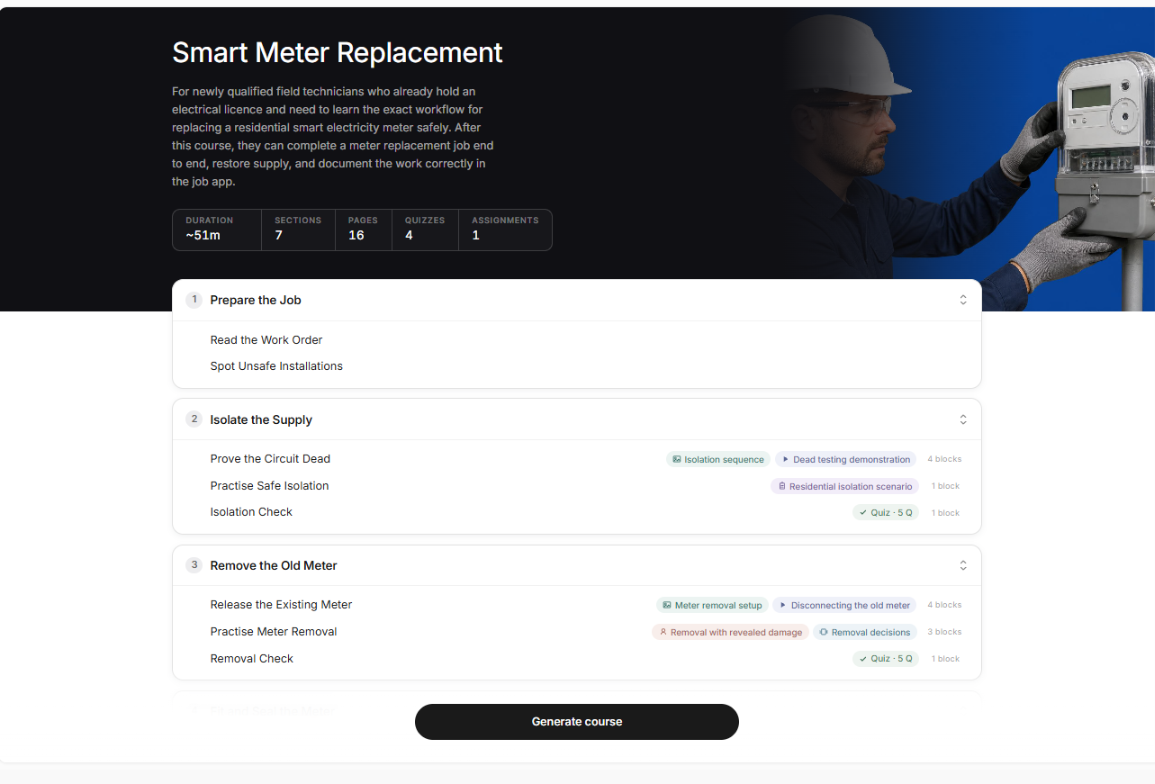
The first outline followed the analysis closely. It had six sections, one for each main step from Prepare the Job to Complete the Record, and each step had a demonstration, a practice scenario and a short check. The entry skills stayed out, as I had asked, and the removal step included a scenario where damage is found halfway through.
The analysis stayed with me as the designer and shaped the first outline. I then supplied simulated reviewer feedback: hazard recognition needed to come before isolation, and the full-job assessment was missing. Coursebox added an unsafe-installation page to Prepare the Job and a Final Job Assessment section. The revised outline had seven sections and about 51 minutes of learning. That was a revision to an outline, not a learner tryout or a competency check. The next step is expert review against approved procedures, followed by supervised practical trials with the intended learners.
Dick and Carey vs ADDIE
Dick and Carey and ADDIE cover many of the same design functions. Dick and Carey specifies relationships between goals, skills, objectives, assessments and learner tryouts. ADDIE offers a broader vocabulary for analysis, design, development, implementation and evaluation. You can use ADDIE to organise the project and Dick and Carey to work through the instructional decisions.
| Feature | Dick and Carey | ADDIE |
|---|---|---|
| What it is | A specific ten-step model from one textbook | A general five-phase pattern with many versions |
| Analysis | Goal, subordinate skills, entry skills, learners and contexts, in detail | Depends on the version used |
| Testing before release | Three defined rounds of formative evaluation | Usually present, less prescribed |
| Best for | Stable, high-stakes skills where errors are costly | A shared structure for any training project |
| Use it when | You need aligned instructional decisions and evidence from learner tryouts | You need a common language for the project phases |
If your requirements are unclear and you need to show stakeholders something early, the Successive Approximation Model or rapid prototyping suit better.
Limitations of the Dick and Carey model
- Rigid for some projects. One critique calls it "a rectilinear ID model which suggests a lockstep approach" and says the process "is rigid and cumbersome for the real-life instructional design situations" (Akbulut, 2007). In practice the revision step loops back into every earlier step, but the model is drawn as a sequence and is often run that way.
- The analysis, aligned assessments and learner tryouts require time and access to participants. Budget that work in proportion to the risk of the task and the decisions you need to make. A short course can use the model without producing a large set of documents.
- Built before AI-assisted production. A 2026 review says the Dick and Carey tradition is "pedagogically rich but predate[s] the way artificial intelligence (AI) now reshapes content production", groups it with ADDIE as options that "struggle to flex", and notes that it emphasises "systemic alignment among objectives, assessment, and instruction" (BMC Medical Education, 2026).
- Formative evaluation gets cut. When deadlines tighten, the tryout rounds are easy to drop. An Iranian residents' course built with the model reported that "formative evaluation in the true sense of the word was not possible" (BMC Medical Education, 2025).

Case study: Quality improvement in US community pharmacies
A randomised study across 21 community pharmacies evaluated a quality-improvement programme developed with Dick and Carey. Sixty-nine staff responses represented a 43.9% response rate. The intervention group reported improvements in several patient-safety culture domains, but recorded quality-related events did not differ between groups. That mixed result is useful: a course can improve reported attitudes without showing a change in the operational measure you hoped to affect. Keep both kinds of evidence in your evaluation. Read the community-pharmacy study.
Keep the goal, assessment and learner evidence connected
Use the model to make the course traceable: the goal explains the objectives, the objectives explain the assessments, and learner tryouts show what needs revision. Analyse the task and the people in parallel, and return to those decisions when feedback exposes a problem. For the smart-meter example, an AI-generated outline is a development aid. Approved procedures, qualified assessors and observed practical performance determine whether the training is ready for use.
Frequently Asked Questions
The Dick and Carey model is a ten-step systems approach to designing instruction, where analysis of the goal, the skills, the learners and the workplace drives objectives, assessments and materials, and the draft is tried out with learners and revised before release.
Identify instructional goals, conduct instructional analysis, analyse learners and contexts, write performance objectives, develop assessment instruments, develop instructional strategy, develop and select instructional materials, design and conduct formative evaluation, revise instruction, and design and conduct summative evaluation.
ADDIE is a broad five-phase pattern for organising training projects. Dick and Carey specifies relationships between analysis, objectives, assessments, materials and formative evaluation. They share design functions, but Dick and Carey is not simply a later version of ADDIE.
No. Instructional analysis and learner/context analysis run in parallel, and revision returns to earlier decisions. The components can be explained in order without treating the model as a single pass.
Walter Dick and Lou Carey first published it in 1978 in The Systematic Design of Instruction. The current 9th edition, with James O. Carey, was published by Pearson in 2021.
Carolina Martin
Carolina is a highly experienced learning designer with tech start-up experience. She is based in Sydney and previously designed courses alongside Coursebox founder Travis in a previous job. She is passionate about delivering engaging learning experiences and brings the same perspective to customer experience too. She manages our customer support documentation and product testing processes.

