

Online Education Marketing Strategies for Course Creators and Educators
Wondering how to attract more students to your online courses? Discover effective online education marketing strategies that help course creators and educators.


Set up your branded LMS and deliver training with AI
Many course creators and educators invest weeks or even months building valuable content, designing lessons, and preparing learning materials. However, once the course is ready, another challenge quickly appears, which is to reach the right learners.
This is where online education marketing strategies become essential. They help course creators connect with the right audience, communicate the value of their courses, and build trust with potential learners. Thinking of it as different layers in a pyramid can help strategise better.
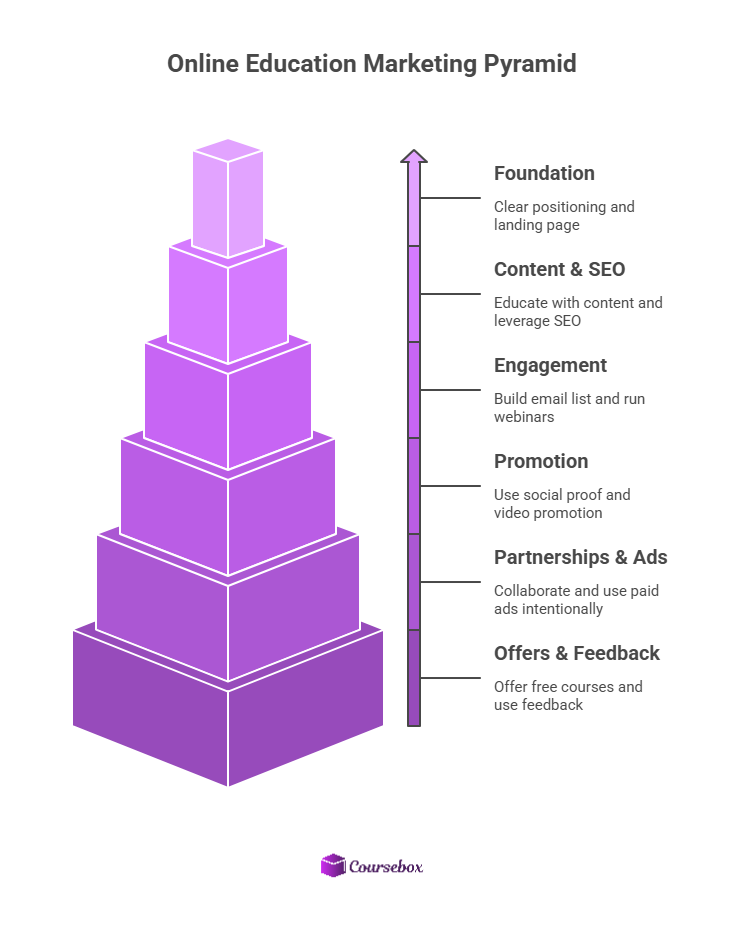
In this guide, we will explore 15 practical online education marketing strategies for course creators and educators to promote their courses.
15 Online Education Marketing Strategies
Marketing an online course requires more than simply posting announcements or sharing links on social media. Successful course creators treat marketing as a structured process that builds awareness and long-term relationships with learners.
The online education marketing strategies below focus on practical actions educators take to attract learners and increase enrollments.
1. Build a Clear Course Positioning Statement
Before promoting your course, clearly define what your course offers and who it is designed for. A positioning statement explains the specific problems your course solves, the audience it targets, and the outcome learners can expect.
Learners are simply less likely to enroll in your course if they don’t understand what the course will help them achieve.
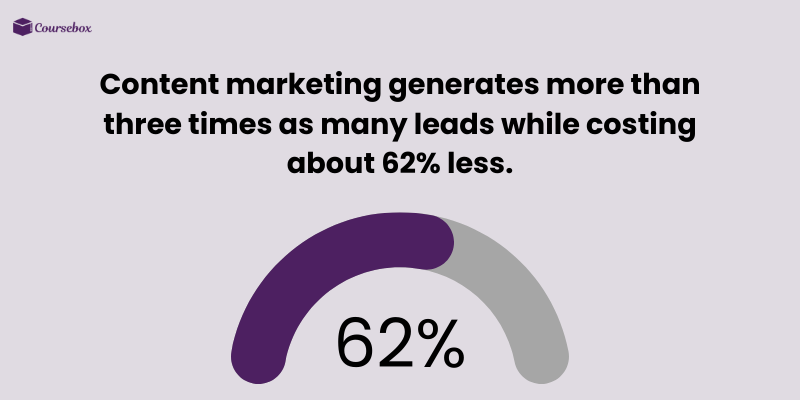
Clear positioning becomes even more powerful when supported by educational content marketing. Research shows that content marketing generates more than three times as many leads while costing about 62% less.
Source: NYT Licensing
2. Create a High-Converting Course Landing Page
A landing page is often the first place potential students evaluate whether a course is worth their time and money. A well-designed page guides visitors through a clear journey of understanding the problem and feeling confident enough to enroll.
Strong landing pages typically include a clear headline, a short explanation of the course outcome, instructor credibility, and a testimonial.
You can also add visual elements, such as screenshots, lesson previews, or short videos, to help visitors understand what's inside the course. Remember, even a small improvement in landing page clarity can significantly affect enrollment rates.
3. Use Content Marketing to Educate Before Selling
Content marketing is one of the most effective strategies for course creators. Instead of directly selling a course, instructors first provide useful insights, tutorials, and guidance related to the course topic.
Examples include writing educational blog posts, creating YouTube tutorials, publishing short lessons on social media, or sharing case studies. These pieces of content help potential learners understand the knowledge and teaching style.
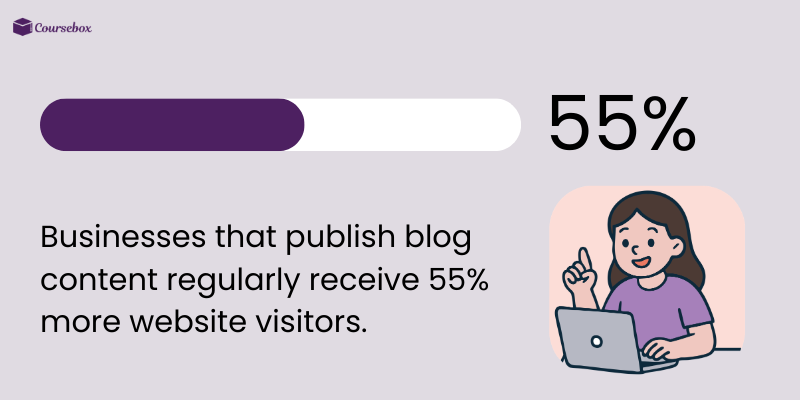
Additionally, consistent educational content increases visibility. That’s why studies show that businesses that publish blog content regularly receive 55% more website visitors compared to those that do not.
Source: Go Giant
4. Leverage SEO for Long-Term Course Discovery
Search engine optimization (SEO) helps potential learners discover your course when they search for answers online. Many people look for tutorials, guides, or learning resources before enrolling in a course.
If your educational content appears in those results, you can attract learners who are already interested in your topic.
Course creators can leverage SEO by publishing helpful blog posts, answering common questions, or creating detailed guides. For instance, if you teach photography, you can write articles about camera settings or beginner photography tips to attract learners.
Keyword research plays an important role here. Identifying what learners search for allows you to create content that directly addresses those questions.
5. Build an Email List Early
Email remains one of the most reliable ways to communicate directly with potential learners. Unlike social media platforms, where algorithms control visibility, an email list allows course creators to reach their audience whenever they need to.
This can be done by offering valuable resources such as downloadable guides, checklists, short lessons, or early access to course updates.
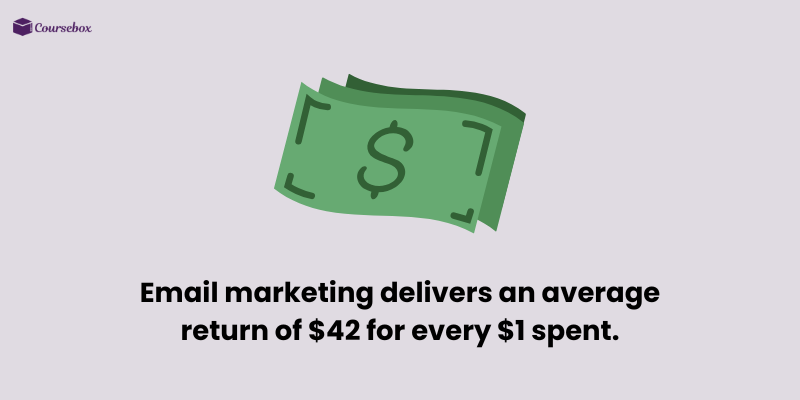
Email marketing also has strong performance results. Research shows that email marketing delivers an average return of $42 for every $1 spent. This makes it one of the most effective marketing channels for educators and course creators.
Source: Financial Post
6. Run Live Webinars or Workshops
Live webinars and workshops are powerful ways to connect with potential learners before they enroll in a course. These events allow educators to demonstrate their teaching style while providing real value to participants.
A webinar typically focuses on solving a specific problem related to the course topic. During the session, instructors can explain concepts, share practical insights, and answer questions from the audience.
At the end of the session, educators can introduce their course as a deeper learning opportunity for those who want to continue building their skills. This actually works like a charm, making it a proven online education marketing strategy.
7. Use Social Proof Strategically
Social proof helps potential learners feel confident about enrolling in a course. When people see that others have already benefited from a program, they are more likely to trust its value. Examples include testimonials, learner reviews, case studies, and success stories.
Instead of simply stating that a course is helpful, show real results from students who have completed it. A short testimonial explaining how someone improved their skills or solved a problem can go a long way.
However, placement also matters here. Testimonials should appear on landing pages, promotional emails, and course sales pages, as this is where learners make the final enrollment decision.
8. Promote Through Short-Form Video
Short-form video has become one of the fastest ways to reach new audiences online. Platforms such as TikTok, Instagram Reels, and YouTube Shorts allow educators to share quick lessons, tips, or insights related to their course topic.
Rather than promoting the course directly, short videos should focus on teaching something useful in under a minute. An example of it could be a language instructor might share a quick pronunciation tip, while a coding educator could explain a small programming trick.
This format is a winner as viewers can quickly consume and share the content. Consistent short educational videos help course creators build visibility and position themselves as knowledgeable instructors.
9. Partner with Other Educators or Creators
Collaborating with other educators or content creators can expand your reach significantly. Partnerships let you introduce your course to audiences who already trust another instructor or creator.
These collaborations can take several forms. Guest appearances in webinars, podcast interviews, joint workshops, or cross-promotions in newsletters are all effective ways to reach new learners.
Such partnerships are known to improve marketing results. You would be surprised to know that businesses (even educators) earn an average of $5.78 for every $1 spent on influencer marketing collaborations.
Source: Digital Marketing Institute
10. Use Paid Ads Intentionally
Paid advertising can help course creators reach learners faster, but it works best when used strategically. Platforms such as Google Ads, Facebook, Instagram, and LinkedIn allow educators to target specific audiences based on interests, profession, or search behavior.
But a common mistake many people make is running ads without testing messaging or landing pages first. Alternatively, start with a clear goal such as promoting a webinar, a free lesson, or a waitlist for your course.
This allows potential learners to experience your value before making a purchase decision. To improve performance, test different headlines, visuals, and audience segments.
11. Offer Free Mini-Courses
Free mini-courses are a powerful way to show the value of your teaching. Never ask learners to purchase a full course immediately. Provide a brief learning experience first to introduce learners to your teaching style and expertise.
A mini-course usually focuses on solving a small but meaningful problem. It might include a few lessons, a short video series, or a downloadable guide combined with exercises.
Once learners see the value of the material, they are more likely to enroll in the course. This approach also helps educators grow their audience and email list while providing genuine educational value.
12. Create a Launch Strategy
As a course creator, you shouldn’t launch a course without a clear plan. Having a launch strategy helps create momentum and anticipation before the course becomes available.
Many course creators begin promoting their course weeks before the official launch. This might include sharing behind-the-scenes content, publishing helpful articles related to the topic, and inviting people to join a waitlist for early access.
Research shows that product launches are up to 2.5 times more likely to succeed when companies plan structured pre-launch marketing activities. The same principle applies to online courses.
Source: TETR
To create a launch strategy, start by defining your launch timeline. Decide when you will begin promoting the course, when enrollment will open, and how long the launch period will last.
Plan the marketing activities you will use during this time, such as emails, webinars, social media posts, or live sessions.
Each activity should guide your audience closer to enrollment.
13. Optimize Pricing and Offers
Pricing plays an important role in how learners perceive the value of a course. If the price is too low, potential students may question the quality. Similarly, if it is too high without a clear justification, they may hesitate to enroll.
Finding the right balance requires understanding your audience and the transformation your course provides.
Don’t worry, many successful course creators test different pricing strategies before settling on the most effective one.
You can test different price points during the launch to find out which one attracts more students. For instance, offer an early-bird price first and track how many people enroll.
Later, introduce the regular price and compare the results. Some creators also test bundles or payment plans, so you can try that out too.
14. Repurpose Educational Content
It can be quite exhausting to create marketing content from scratch every time. This is where repurposing makes things much easier. It enables course creators to turn one piece of content into multiple formats.
For example, a detailed blog post can be transformed into a short video, several social media tips, or a short email newsletter. A webinar recording can be edited into smaller clips for social media.
Even course lessons themselves can inspire marketing content that educates and attracts new learners.
15. Use Learner Feedback Publicly
Learner feedback can be one of the best marketing assets for a course. When real students share their experiences, potential learners gain insight into the course’s impact and effectiveness.
Feedback can appear in several forms, including testimonials, success stories, course reviews, or short case studies. Simply sharing specific outcomes is particularly persuasive.
If you describe how the course helped them develop a skill or solve a professional problem, it can provide tangible proof of value.
Common Pitfalls in Educational Marketing You Must Avoid
If you’re looking to market an online course, you need more than posting announcements or running occasional promotions. Many course creators put effort into online education marketing strategies, but struggle to see results because they fall into common mistakes.
By knowing what those mistakes are, you can better use your resources.
1. Trying Every Platform at Once
One of the most common mistakes course creators make is trying to promote their courses on every available platform at the same time. Social media networks, blogs, podcasts, email marketing, and video platforms all seem valuable, so it becomes tempting to use them all.
However, spreading efforts across too many platforms usually leads to inconsistent results. Each platform requires time, content planning, and audience engagement.
2. Focusing on Features Instead of Outcomes
Many course creators describe their courses by listing features. They mention the number of modules, hours of content, downloadable worksheets, or videos included in the program. While these details are useful, they do not always persuade learners to enroll.
Prospective students are usually more interested in the outcome that the course can help them achieve. Rather than focusing only on what the course contains, marketing should explain what learners will gain.
3. Ignoring Trust-Building
Trust plays a major role in educational marketing. Students are investing their time and often their money into a course, so they want to feel confident that the instructor is credible and the content is valuable.
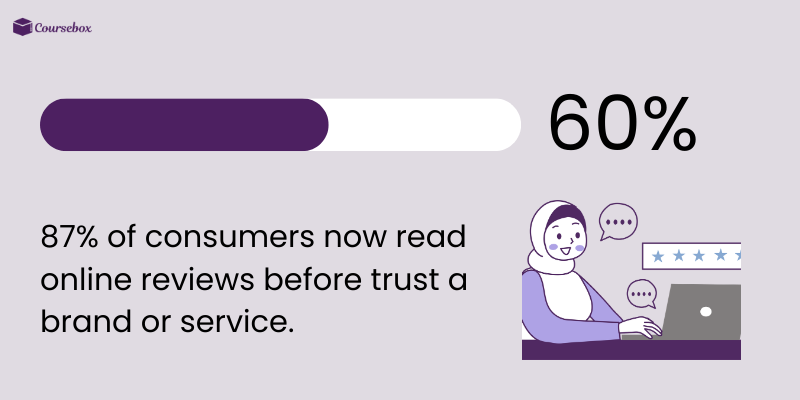
In fact, 87% of consumers now read online reviews before trusting a brand or service. This applies to online education as well, where potential learners often rely on reviews, ratings, and recommendations.
Source: TrustSmrt
4. Relying Only on Social Media
Social media is one of the first marketing tools educators consider. Platforms like Instagram, LinkedIn, YouTube, and TikTok can attract attention and build an audience.
But if you only rely on social media, it can be risky. Make sure your marketing strategies don’t depend only on social media platforms, or you may lose access to your audience.
Turn Your Expertise Into a Course with Ease
Creating a valuable online course is a huge achievement, but to reach the right learners, you require thoughtful online education marketing strategies. However, one issue that course creators usually face is turning their knowledge into engaging learning content.
The best way to do so is using Coursebox.
This AI-powered platform allows educators to transform documents or resources into complete AI-generated training videos. Moreover, with tools like AI course design and an integrated LMS, creators can focus more on promoting their courses.
Sign up for Coursebox today to grow your online course!
FAQs
Frequently Asked Questions
Start by focusing on a specific problem your course solves. Share helpful tips, short lessons, or insights through blogs, videos, or social posts to show expertise. Engage in communities where your learners already gather. Over time, consistent educational content builds trust and gradually attracts an interested audience.
The best marketing channel depends on your target learners. Professionals often respond well to LinkedIn and email newsletters, while visual topics may perform better on YouTube or Instagram. Many successful course creators combine content marketing, email lists, and social platforms to reach learners.
Focus on teaching rather than promoting. Share useful insights, practical tips, and real examples that help your audience solve small problems. When learners gain value from your content, they naturally become curious about your course. You can also use storytelling to make marketing feel helpful.
Personal branding is best for building trust faster because learners connect with the instructor’s expertise and personality. Meanwhile, course branding becomes useful only when you are offering multiple programs or building a larger learning platform. Many educators combine both approaches by sharing personal insights.
Travis Clapp
Educational technologist and instructional designer

