

10 Gamified Learning Platforms You Must Know in 2026
Gamified learning platforms keep learners engaged and motivated throughout the whole experience. Explore free and paid gamified platforms to choose the right one for your needs.

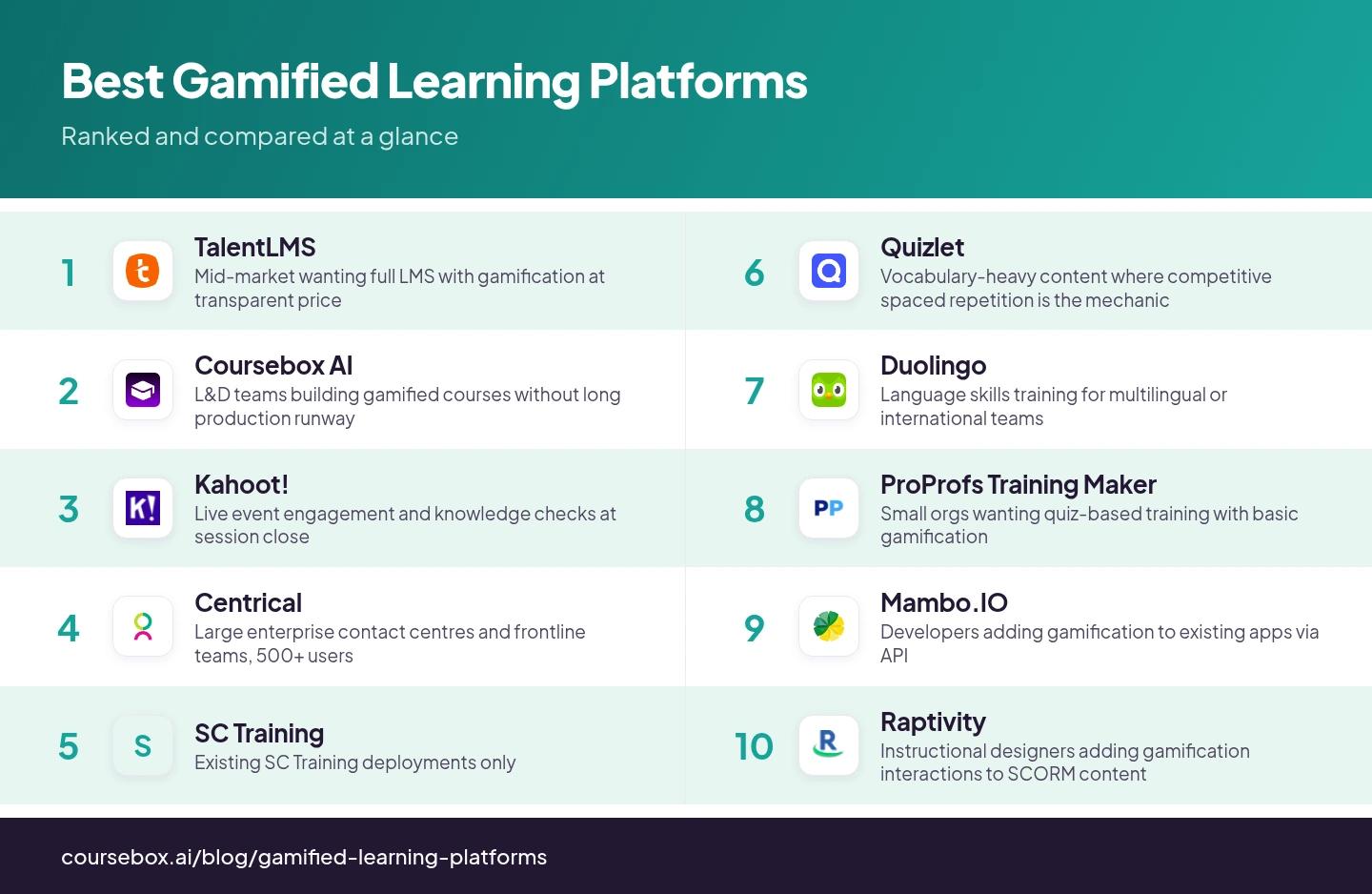
The best gamified learning platforms in 2026 are TalentLMS for most SMB and mid-market teams (badges, points and leaderboards at a published price), Centrical for large frontline and contact-centre teams (deep, KPI-tied gamification), Kahoot! for live session energy, and Coursebox if you want AI to build the gamified course for you. We judged 10 platforms on genuine gamification depth, corporate fit, honest pricing and whether the product is still live.
- TalentLMS is the easiest overall pick: badges, points and leaderboards sit in its base paid tier at a published price from $119 a month, with no discovery call needed to see a number.
- Centrical is the deep end, built for large frontline and contact-centre teams that tie games to real performance; it is overkill and priced out of reach for a 50-person team.
- Kahoot!, Quizlet and Duolingo come from the classroom or consumer world; strong for live energy or recall, but check the scope reaches workplace training before you commit.
- Beware decorative or gated gamification: several tools here limit games to puzzles, cap free sessions, or lock the mechanics behind an upgrade, and SC Training (EdApp) was retired in March 2026.
Answer three quick questions and we'll point you to the best fit from this list.

Turn boring content into gamified learning instantly.
I started my career in Adelaide building e-learning for SA Government agencies and training organisations that had almost no budget for anything interactive. This was deep in the SCORM era, when "engaging learning" usually meant a progress bar that forced you to wait before clicking Next, and adding a leaderboard to a compliance module required a developer, a feature request, and about three weeks of patience nobody had.
I cared about learning quality. I'd done enough instructional design work to know that flat information delivery doesn't stick, that recall fades within 48 hours without reinforcement, and that bored learners don't absorb content regardless of how important the material is.
Gamification kept appearing as the way out of flat slide-decks and basic SCORM packages. But every time I tried to implement it, the tooling blocked me. Platforms that supported real game mechanics required weeks of custom configuration. Platforms that were quick to set up had gamification bolted on as a cosmetic layer, changing the appearance of the learning experience without changing how it worked.
That gap between what I wanted to build and what the tools actually allowed is why this list looks the way it does. I'm not going to tell you which platforms have a gamification checkbox. I'm going to tell you which ones let you build something that changes learner behaviour, and at what cost and complexity level.
This list is written for L&D professionals and training managers building programmes for employees. Some of the platforms here started in K-12: Kahoot!, Quizlet, and Duolingo all have their roots in classroom or consumer education. I've included them where they have genuine corporate applications and flagged where the scope doesn't extend to workplace training.
SC Training (formerly EdApp) appears in almost every comparable article on gamified learning platforms. It was a strong mobile microlearning platform with solid gamification. SafetyCulture retired the product effective March 2026. None of the other articles currently ranking for this search mention it, but recommending SC Training for a new build would be a disservice, so it stays here with that caveat.
Comparison at a glance
| Tool | Gamification mechanics | Best for | Watch out for |
|---|---|---|---|
| TalentLMS | Points, badges, levels, leaderboards, rewards | Mid-market wanting full LMS with gamification at transparent price | No curriculum-level reporting across grouped courses |
| Coursebox AI | Points, badges, leaderboards, AI quizzes, AI tutor, AI scenarios (branching role-play) | L&D teams building gamified courses without long production runway | AI content needs a human accuracy review pass |
| Kahoot! | Live leaderboard, points, streaks, timed questions, team mode | Live event engagement and knowledge checks at session close | Fatigue: single-format live quiz loses novelty over time |
| Centrical | Points, coins, badges, levels, leaderboards, KPI-linked missions | Large enterprise contact centres and frontline teams, 500+ users | No published pricing; significant implementation complexity |
| SC Training | Points, stars, leaderboards, badges, real rewards (product retired) | Existing SC Training deployments only | Retired March 2026; not viable for new implementations |
| Quizlet | Match and Blast games, mastery-based Learn mode, streaks | Vocabulary-heavy content where competitive spaced repetition is the mechanic | Only memorisation and recall; no branching or learning paths |
| Duolingo | Streaks, XP, leagues, hearts, gems, daily quests | Language skills training for multilingual or international teams | Language only; not compliance, sales, or technical training |
| ProProfs Training Maker | Points, leaderboards, badges; in-course games limited to word search and crossword | Small orgs wanting quiz-based training with basic gamification | Not for enterprise scale or complex learning paths |
| Mambo.IO | Points, badges, levels, missions, leaderboards via API | Developers adding gamification to existing apps via API | Not a standalone learning platform; requires developer resource |
| Raptivity | Game-style interaction templates; no native points or leaderboards | Instructional designers adding gamification interactions to SCORM content | Not a standalone LMS or complete learning platform |
What gamification actually looks like in the field
Before the platform list, some concrete examples of what works and what doesn't in corporate gamification. I've seen these mechanics deployed across government agencies, training organisations, and corporate L&D programmes, and the patterns are consistent.
In compliance training, progress bars tied to module milestones reliably lift completion rates where flat lists of required modules fail. The mechanic is simple: a learner can see they're at 60% and that visibility pulls them forward in a way that a checklist doesn't. Add a cohort leaderboard on top, and the social pressure works well for onboarding groups, less well for individuals working through mandatory safety modules on their own timeline.
In onboarding programmes, points competitions for first-week task completion (configuring tools, submitting a first project, attending orientation sessions) work because the tasks are comparable across the cohort and the stakes feel low enough to be playful. New-hire cohorts I've watched complete onboarding tasks faster when there's a visible ranking than when there's just a deadline and a checklist.
In sales enablement, gamification gets both more interesting and harder to do well. Scenario-based scoring, where learners work through a simulated customer call and receive immediate feedback on their choices, ties the reward signal directly to the quality of a decision rather than its completion. This is the distinction between surface gamification and the mechanics that actually change behaviour. A badge for finishing a module is surface. A branching scenario where a wrong choice leads to a different path, with a score that reflects decision quality: that changes how someone approaches the real conversation.
The platforms worth building on support this second category. Leaderboards and badges are table stakes. Spaced repetition, branching scenarios, and real-time coaching signals are where the retention gains come from.
How I chose these platforms
Genuine gamification depth. At minimum: configurable leaderboards, progress-based mechanics, and some pathway to scenario-based or branching content. Platforms where gamification is decorative (badge skin on a static slide-deck, call it gamified) didn't make the cut.
Corporate L&D fit. Workplace training is increasingly delivered on mobile for frontline and field teams, so platforms needed to work on mobile without significant degradation.
Honest pricing. Several platforms in this category advertise "gamification included" on plans that lock it behind an upgrade tier. I've noted where pricing is gated behind a sales call and where free tiers are functional for real use.
Current product status. The SC Training situation is the reason this criterion exists. If a platform has been retired, significantly changed, or is in a sunset state, I've said so.
I spent the most time on the tools where my evidence was strongest: Coursebox (I built it), Kahoot! (I've run it across dozens of training sessions), Centrical and TalentLMS (researched in detail for this piece). For the rest, and to keep every entry honest, I also went through hands-on demos and independent reviews of each platform's gamification and pulled out what actually happens when you use it. Those observations appear under 'Thoughts after trying it out' in each entry.
1. TalentLMS
Website: talentlms.com
TalentLMS is the easiest platform here to recommend to a mid-sized team that wants a full LMS with gamification and no discovery calls to see a price. Badges, points, leaderboards and certificates sit in the base paid tier, and the pricing is published: Core is $119 a month for 100 users, Grow $229, Pro $449. Several rivals gate gamification behind an undisclosed upgrade; TalentLMS does not.
You would pick it for ease of use and mid-market pricing, with the gamification coming along rather than being the whole identity. If deep, KPI-driven gamification at 500-plus agents is the main need, that is Centrical. The one limitation that keeps coming up is no curriculum-level reporting across grouped courses, which matters for compliance audit trails but rarely for straightforward training.
Best for: SMBs and mid-market organisations wanting a full LMS with gamification at a transparent, published price.
Pricing: Free (up to 5 users, 10 courses); Core at $119/month (100 users); Grow at $229/month (500 users); Pro at $449/month. Annual billing with 20% discount.
Not for: Enterprise compliance programmes requiring advanced analytics, or organisations needing deep platform customisation.
Thoughts after trying it out: I tested TalentLMS gamification with a mixed learner group. Turning it on partway meant earlier course completions didn't retroactively earn points. Learners also found ways around it, muting videos or clicking through just to rack up leaderboard position. Rewards need tying to actual KPIs, not just points.
2. Coursebox AI
Website: coursebox.ai
Full disclosure: I built this one, so read the entry with that in mind. Coursebox turns documents, videos or a web page into a structured course, then layers on genuine gamification (points, badges and leaderboards), an AI tutor that answers learners in context, and AI scenarios, branching role-play simulations where people practise decisions without real-world risk. The game mechanics and the interactive practice are both there, not bolted on.
Its other edge is authoring speed: 88% of creators use the AI generation path, and the median time from first generation to a published course is 23 minutes. That means you can build a gamified, scenario-based module, watch how learners respond, and rebuild it the same afternoon. The honest limitation is that AI content is a starting point, so subject-specific accuracy still needs a human review pass, which is non-negotiable for complex compliance or technical material.
Best for: L&D teams and small-to-mid organisations that want to build gamified courses without a long content production runway. Strong for rapid iteration on gamification mechanics.
Pricing: Free plan (3 mini-courses, unlimited learners, Coursebox watermark). Pro tier includes gamification, custom domain, and 300 courses. Current tier pricing at coursebox.ai/pricing.
What I'd change: The reporting dashboard. Analytics are functional but won't satisfy teams expecting curriculum-level reporting or cohort comparison views out of the box.
Thoughts after trying it out: I will be honest since we built it. The gamification (points, badges, leaderboards) is genuinely there, and what stood out in testing was pairing it with an AI tutor and AI scenarios, so learners get branching role-play and in-context help, not just a leaderboard bolted onto a static course. The bigger unlock was speed: spinning up a gamified, scenario-based course in minutes rather than weeks.
3. Kahoot!
Website: kahoot.com
Kahoot!'s live leaderboard produces genuine energy in a room, and it is used across much of the Fortune 500 for training and events. The caveat other lists skip is Kahoot fatigue: the single-format live quiz loses novelty fast in recurring programmes and rewards fast clicking over recall. It shines in an end-of-onboarding knowledge check; in a monthly safety refresher across a year, you will hear grumbling by month three.
Position it accurately: it is a live-session engagement tool, not a self-paced LMS. There are no learning paths, no adaptive content and no answer explanations, and LMS integration, SSO and provisioning are Enterprise-only on a custom contract. The free tier works for small groups; Pro Start is $19 a month for up to 50 participants, Pro Standard $25, and Pro Plus $49.
Best for: Live event engagement, knowledge checks at session close, onboarding-day activities, and annual kickoffs where energy matters more than depth.
Pricing: Free (basic functionality, limited participants); Pro Start at $19/month (50 participants); Pro Standard at $25/month (200 participants, certificates); Pro Plus at $49/month (1,000 participants, team missions). Enterprise pricing undisclosed.
Not for: Self-paced training programmes, adaptive learning paths, or organisations expecting LMS-native integration below Enterprise cost.
Thoughts after trying it out: I tested Kahoot in team settings and found the live leaderboard creates real psychological pressure. Being in the lead means racing to stay ahead with mounting anxiety; participants stuck at the bottom just checked out. Brilliant for initial engagement, but the public ranking can flip into stress if you're not actively reframing it as playful.
4. Centrical
Website: centrical.com
Centrical is a different category: no published pricing, no self-serve trial, and real value only after vendor-led implementation. For its actual context, large frontline teams in contact centres, retail or enterprise sales, it does what nothing else here can, tying gamification directly to real-time performance data at the job level. Its AI role-play simulations let staff practise realistic scenarios with instant feedback, with Centrical claiming a 30% faster time to proficiency.
That power comes with genuine implementation complexity: teams report needing significant configuration and ongoing vendor support to get full value, the trade-off for enterprise-scale gamification rather than a criticism. Client names like Microsoft, Coca-Cola and BT signal the scale it is built for. If you are under a few hundred users or have no implementation resource, this is not your platform.
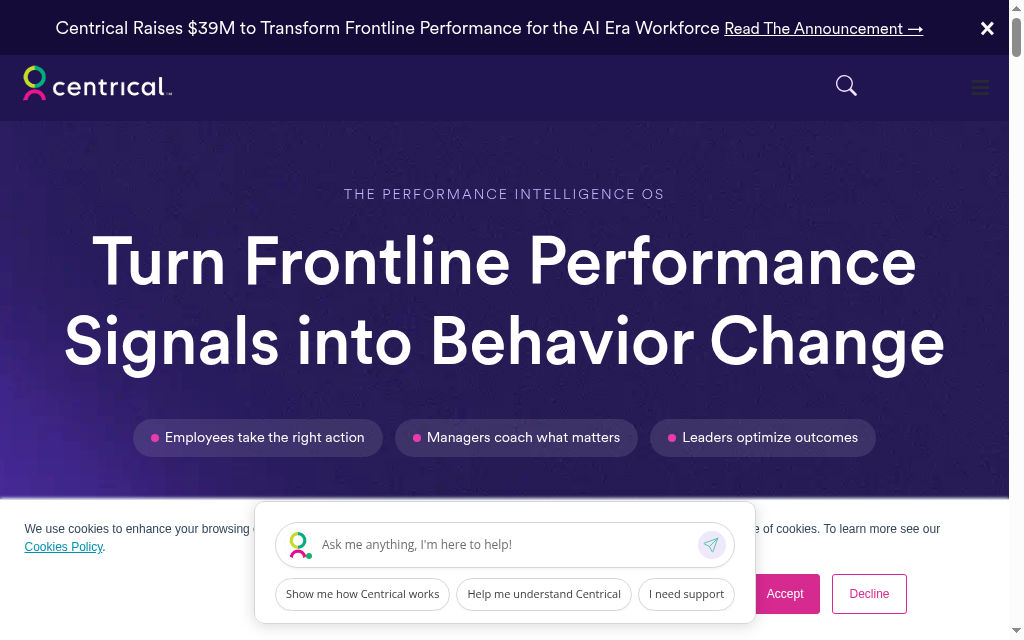
Best for: Large enterprise contact centres, frontline sales teams, and organisations with 500+ users and dedicated L&D implementation resource.
Pricing: Not disclosed. Enterprise contract model. Contact centrical.com/get-pricing.
Not for: SMBs, teams without dedicated implementation support, or organisations evaluating without budget for enterprise-level spend.
Thoughts after trying it out: I found that Centrical's value hinges on using it as designed. Teams initially treating it like a standard LMS, without configuring AI-driven performance matching, struggle to hit proficiency marks. But once you enable data-driven content delivery based on actual performance gaps, the platform becomes genuinely effective.
5. SC Training (formerly EdApp)
Website: training.safetyculture.com
SafetyCulture retired SC Training in March 2026, so it is not viable for a new build, and no other article ranking for this search says so. I am keeping the entry only to flag that: if it is on a shortlist you built from older articles, cross it off.
For existing users the free plan (up to 10 learners) still runs and your content is not deleted, but there is no new development and support timelines are uncertain, so plan a migration. Its strong mobile microlearning and PDF-to-lesson AI are covered below by TalentLMS and Coursebox for small-to-mid teams, and by Centrical at enterprise scale.
Current status: Retired March 2026. Not viable for new implementations.
Thoughts after trying it out: I tested SC Training's gamification features across different devices. Leaderboards and badge achievements are well-designed and drive engagement on modern phones, but older Android devices experience noticeable lag when loading real-time rankings. This performance gap undermines the competitive momentum that makes the gamification effective for on-shift training.
6. Quizlet
Website: quizlet.com
Quizlet is a flashcard and study-set tool from the K-12 and higher-ed world, with a real corporate use for vocabulary-heavy content: product knowledge, compliance terminology, regulatory definitions or language practice for multilingual teams. Its gamification is competitive recall through timed exercises, head-to-head races and matching games, which work well for memorising terms.
It does not stretch to branching scenarios, coaching or learning-path management with any depth. The free tier covers basic study sets; paid plans add class and team management, admin controls and advanced modes. Pricing in this category moves often, so check quizlet.com for current figures.
Best for: Product training, compliance terminology, vocabulary-heavy content where competitive spaced repetition is the primary mechanic needed.
Pricing: Free tier available. Paid plans for advanced features and team management.
Not for: Full L&D programmes, skill-based training, onboarding workflows, or any training requiring mechanics beyond memorisation and recall.
Thoughts after trying it out: I tested the free version on a 20-item training set: Learn mode cut me off after two seven-question rounds, forcing me to stop mid-session even though I had momentum. The paid version has no such limits. For workplace training with larger knowledge sets, those session caps can derail motivation before you've reviewed all the material.
7. Duolingo
Website: duolingo.com
Duolingo is the most recognised gamified learning product in the world, and also a consumer language app rather than a corporate training platform. The gamification design is genuinely excellent: streaks, XP, badge progressions, adaptive difficulty and social comparison that drive daily habits, the streak in particular producing return behaviour most corporate tools would love to replicate.
The scope is narrow, though: it does language, not compliance, sales enablement or technical skills. For onboarding multilingual teams or maintaining language requirements there is a case for Duolingo for Business, but for most L&D teams it is a supplementary tool for a specific need, not a platform to build a programme on.
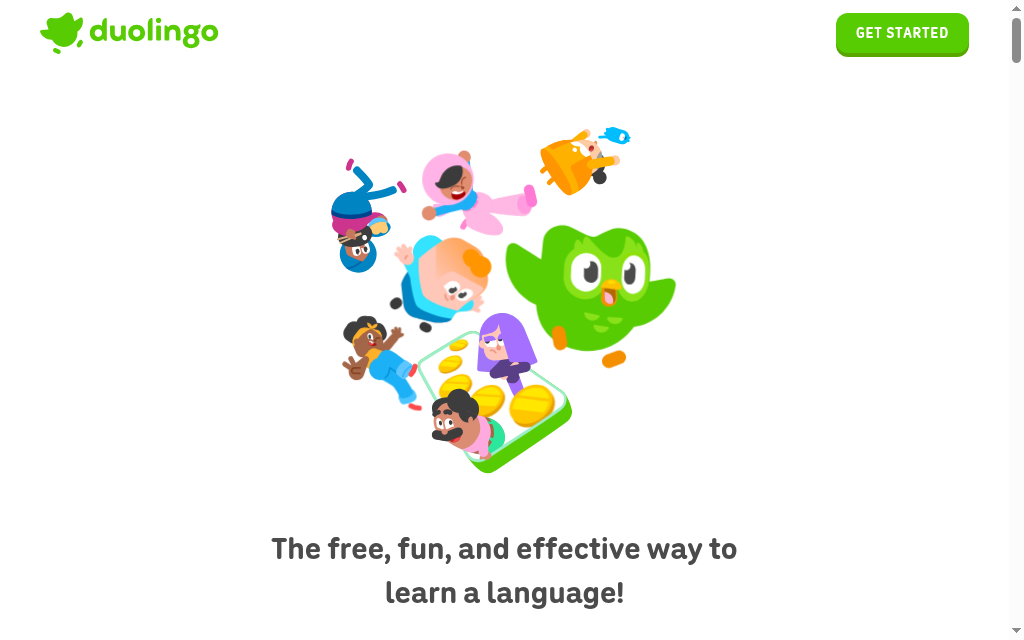
Best for: Language skills training for multilingual or internationally-deployed teams.
Pricing: Free consumer tier available. Duolingo for Business provides team management and progress tracking.
Not for: Non-language corporate training, LMS functionality, or compliance-heavy programmes.
Thoughts after trying it out: I tested Duolingo and found the streak system created a trap. Rather than learning, I was doing the bare minimum each day just to keep my streak alive. The psychological pressure to not lose invested days meant I stopped actually learning the language.
8. ProProfs Training Maker
Website: proprofstraining.com
ProProfs spans quizzes, courses, knowledge bases and surveys. For L&D the relevant piece is quick, self-paced quiz-based training with light gamification and certificates, at an accessible price and without full-LMS overhead. It is not as sharp as Kahoot! for live energy or as deep as TalentLMS for LMS functionality, but it fills a useful middle ground for small teams that mainly want quizzes.
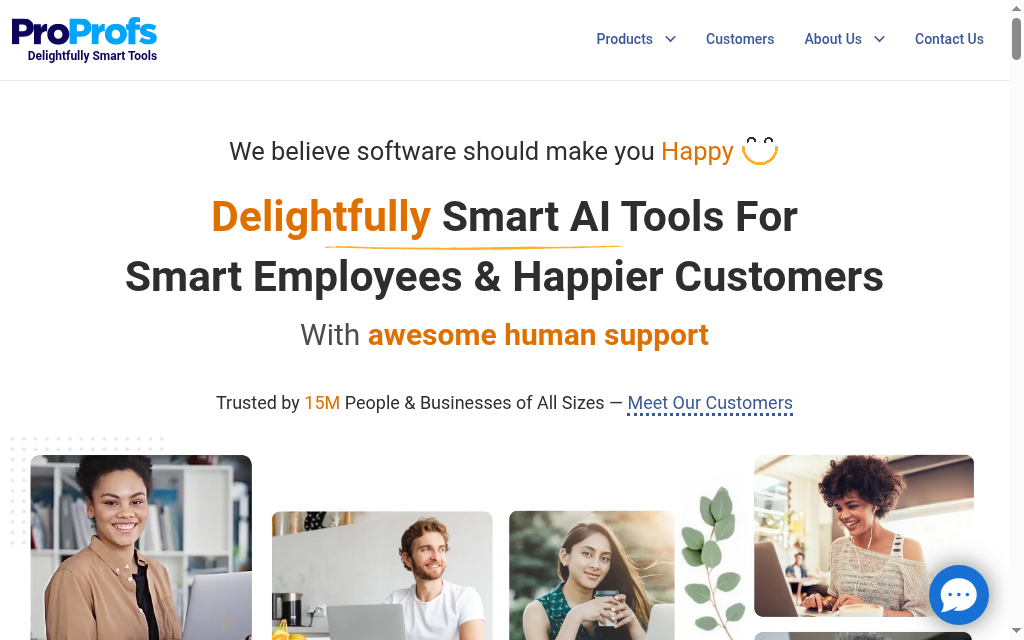
Best for: Small organisations wanting quiz-based training with basic gamification and certificate generation without full LMS overhead.
Not for: Enterprise scale, complex learning path management, or advanced analytics requirements.
Thoughts after trying it out: I tested ProProfs Training Maker's gamification and found it limited to word search and crossword puzzles embedded in courses. No leaderboards, badges, or points system, just simple games to make content more engaging than plain text. Good for variety, but if you're after full gamification mechanics, you'll need to look elsewhere.
9. Mambo.IO
Website: mambo.io
Mambo.IO is not an LMS, which is the key thing to know before comparing it here. It is a gamification API and rules engine that adds points, badges, leaderboards, challenges and levels to an existing app via integration. If you have an LMS or internal system without gamification and want to add it rather than replace the platform, it is one of the few tools built for exactly that.
Implementation needs developer resource, there is no no-code layer, so it suits technical teams injecting mechanics surgically. For most L&D teams evaluating standalone gamified platforms it is the wrong category; for those with a custom system and dev resource, it can save a migration.
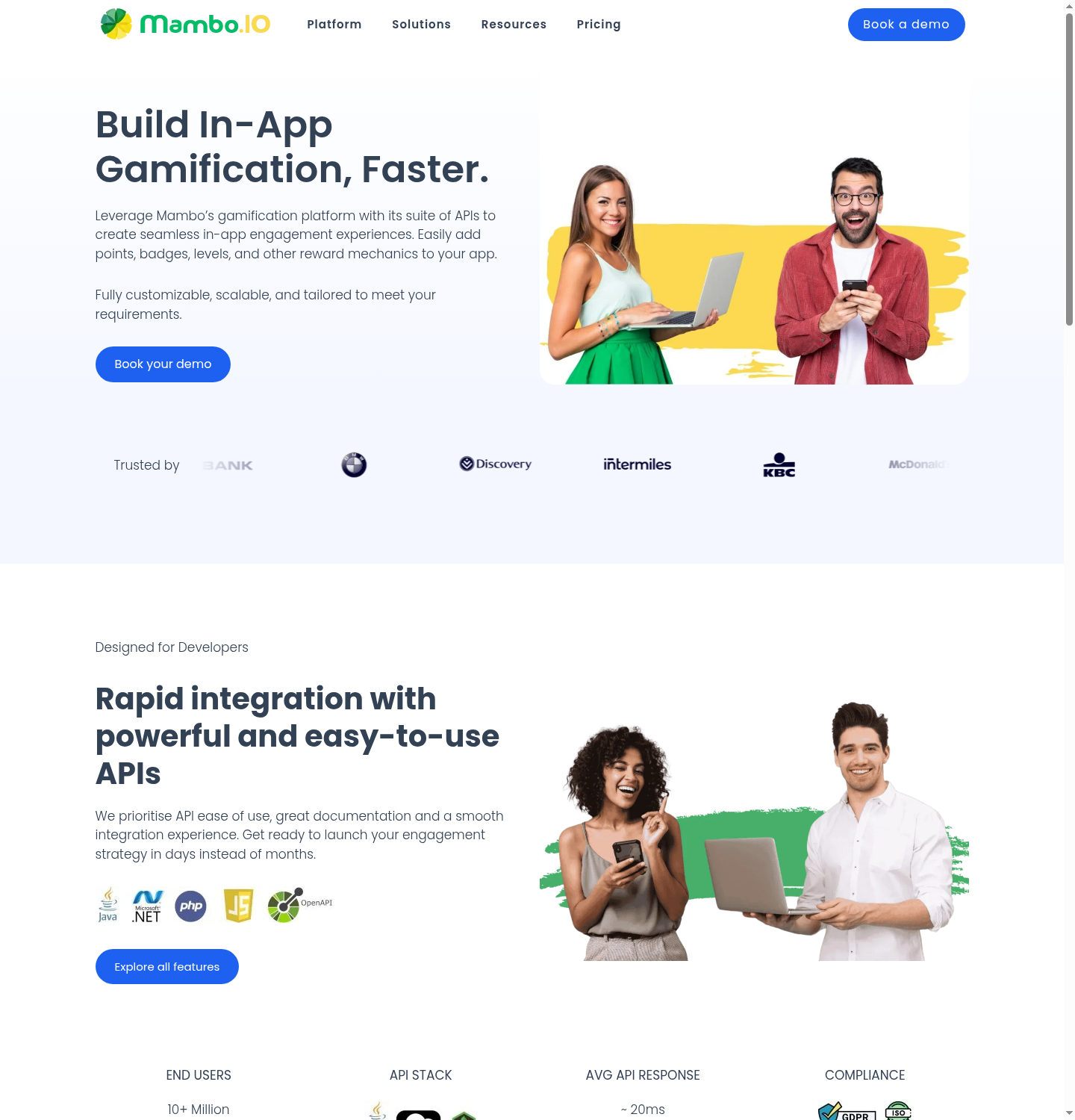
Best for: Developers and technical L&D teams adding gamification mechanics to existing applications via API.
Not for: Organisations wanting a ready-to-use training environment. This is not a standalone learning platform.
10. Raptivity
Website: raptivity.com
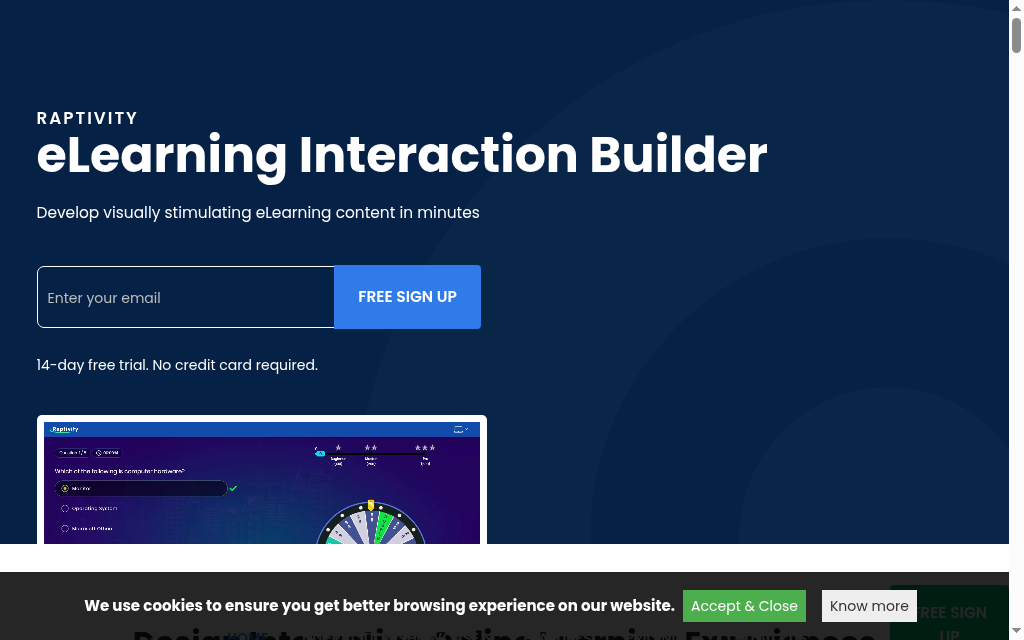
Raptivity is an interactive-content authoring tool, not an LMS. It builds gamified interactions such as branching scenarios, knowledge checks and simulations that export to SCORM and embed in your LMS. The use case is narrow: if your current authoring tool (Storyline, iSpring, Lectora) cannot produce the interaction you need, Raptivity complements it rather than replacing it.
If you have no established authoring workflow, Coursebox and TalentLMS both handle authoring and gamification without adding a second specialist tool. Raptivity is for instructional designers who already have a workflow and need to extend it. Check raptivity.com for current pricing.
Best for: Instructional designers adding gamification interaction types to SCORM-based content deliverables.
Not for: Organisations looking for a standalone LMS, a live engagement tool, or an end-to-end training platform.
Thoughts after trying it out: The game templates are visually different but mechanically identical. Mountain climb, bowling rush, and cheese quest all use the same quiz-answer-progress model under the skin. If you need varied game mechanics beyond multiple choice, you'll hit the template ceiling pretty quickly.
What I would actually pick
For a small or mid-sized organisation (under 200 employees) that wants to build and deliver gamified training without a lengthy implementation runway: Coursebox (honestly). The AI authoring speed changes what's actually achievable with a typical L&D team's available hours. You can iterate on gamification mechanics quickly instead of committing months to a single course build, which is the practical requirement for doing gamified learning properly rather than just checking the box.
For a mid-market organisation (100-500 employees) that wants a full LMS with gamification and transparent pricing: TalentLMS. Core at $119/month for 100 users handles the majority of mid-market training needs, gamification is in the plan, and the implementation doesn't require vendor hand-holding to get started.
For large enterprise contact centres or frontline sales teams at scale: Centrical. It's the only platform on this list that applies game mechanics at the performance-data level rather than the course-completion level. The implementation effort is significant. So is the outcome difference when the deployment is right-sized.
Kahoot! I'd keep as an event-day and knowledge-check supplement, not a foundation for a training programme. The fatigue problem is documented enough that I've watched L&D teams build quarterly training calendars around it and regret it by the third quarter.
Frequently Asked Questions
A gamified learning platform adds game mechanics like points, badges, leaderboards, levels and challenges to training, so learners stay engaged and keep coming back. The strongest ones use those mechanics to change behaviour and improve recall, not just to decorate a course.
It can, when the mechanics reward real progress rather than clicks. Points, streaks and leaderboards drive engagement and repeat practice, but if they are tied to activity alone, learners will find ways to game them. The platforms that work tie rewards to genuine performance.
For zero cost, Kahoot! and Quizlet have functional free tiers for quiz and recall games, and TalentLMS has a free plan for up to five users. Coursebox has a free tier if you want AI to build the course itself. Check the limits, as several cap sessions or lock gamification behind a paid tier.
TalentLMS, Centrical, SC Training and Coursebox are aimed at workplace L&D. Kahoot!, Quizlet and Duolingo come from the classroom or consumer world and work best for live energy or recall rather than full compliance or role-based training.
It ranges widely. TalentLMS publishes plans from $119 a month, enterprise tools like Centrical quote on request, and Kahoot!, Quizlet and Coursebox have free tiers. Watch for gamification locked behind an upgrade, which is common in this category.
Travis Clapp
Educational technologist and instructional designer

