

8 Law Enforcement LMS Platforms for US Agencies in 2026
The best law enforcement LMS options in 2026 include Vector Solutions, Lexipol Training (formerly PoliceOne Academy), Axon Academy, Meridian LMS, Coursebox, Relias, PowerDMS, SC Training. Compare the learning or business workflow you need.

The best law enforcement LMS options in 2026 include Vector Solutions, Lexipol Training (formerly PoliceOne Academy), Axon Academy, Meridian LMS, Coursebox, Relias, PowerDMS, SC Training. Compare the learning or business workflow you need.
- Accepted courses, credited hours and the actual state process.
- Required hosting, security boundary and purchased modules.
Answer three questions to compare the four tools below. The result balances your preferences; the entries explain the features, limits and costs to check.

Run your own branded LMS with unlimited learners
For a US law-enforcement agency, the LMS decision starts with the records it needs to retain: accepted training hours, assessment results, policy acknowledgments and observed field performance. Those are different records, and a course-completion report cannot replace all of them.
I’m Alex, Coursebox’s COO, and my perspective is on learning software and its buying requirements. I’d ask the agency’s training lead which records they need to retrieve and which courses they can accept. That helps separate a specialist training library, a records system and a tool for creating the agency’s own learning.
Coursebox’s compliance training software is included for creating and delivering agency-specific courses, assessments and learner support. The specialist options below cover other parts of the training and records job.
How I ranked these law enforcement LMS platforms
I used these criteria:
- Training credit: Accepted courses, credited hours and the actual state process.
- Evidence: Completion, policy version and signed field observations.
- Administration: Role permissions, exports, amendments and retained records.
- Procurement: Required hosting, security boundary and purchased modules.
The US Bureau of Justice Statistics reported an average of 806 basic-training hours at state and local law-enforcement academies in 2022. That scale makes an accurate record of completed activities and accepted hours a useful selection test.
The tools compared
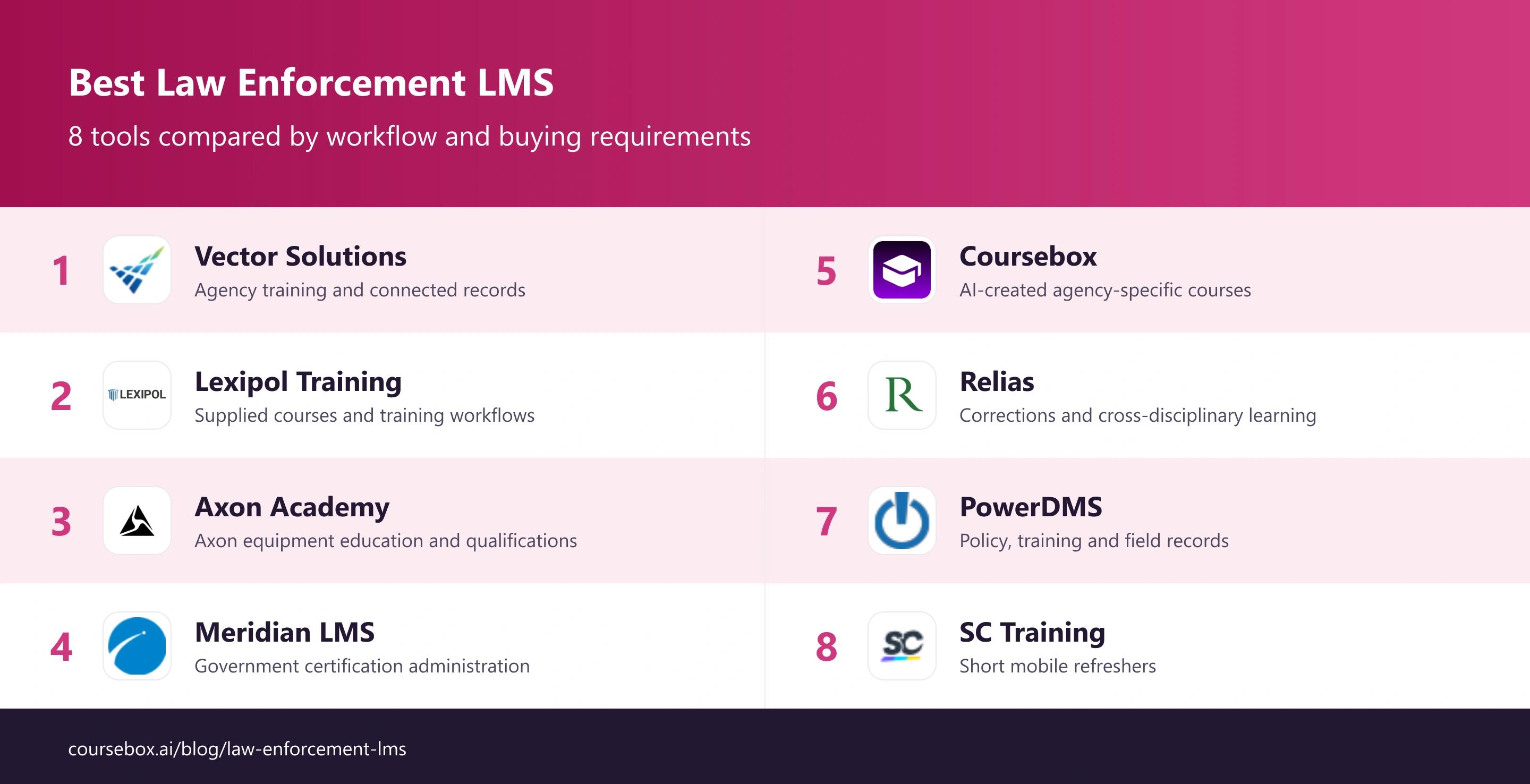
| Tool | Useful starting job | Starting cost |
|---|---|---|
| Vector Solutions | Agency training and connected records | Quote; modules scoped separately |
| Lexipol Training (formerly PoliceOne Academy) | Supplied courses and training workflows | Agency quote; single-user access differs |
| Axon Academy | Axon equipment education and qualifications | Course and agency arrangement |
| Meridian LMS | Government certification administration | Quote for required deployment |
| Coursebox | AI-created agency-specific courses | Free; Creator AU$500/year; LMS tier costs more |
| Relias | Corrections and cross-disciplinary learning | Organisational quote |
| PowerDMS | Policy, training and field records | Quote; products scoped separately |
| SC Training | Short mobile refreshers | Free small-team tier; paid learner plans |
Prices and plan scope checked in October 2026. Currency, billing term and included features are stated in the entry pricing notes.
The 8 law enforcement LMS options
1. Vector Solutions
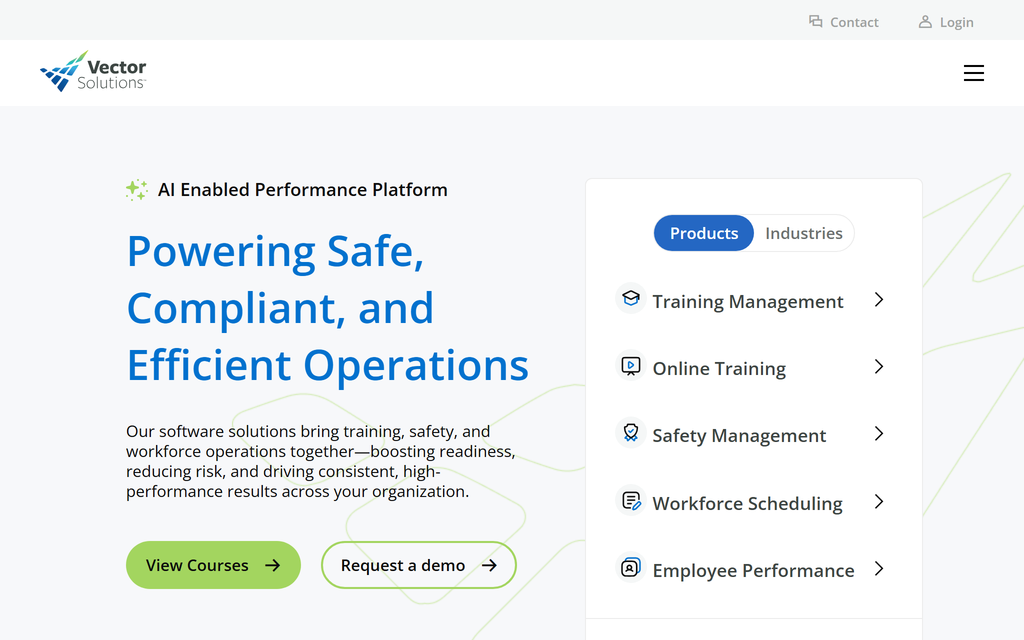
Vector Solutions combines law-enforcement course delivery and training records with separately scoped public-safety products. Its training library includes IADLEST National Certification Program courses, while Evaluations+ handles field-training observations and daily observation reports. That gives an agency a way to compare online learning and observed performance within one vendor portfolio.
AgencyConnect links participating local agencies with academies and state certifying organisations using Acadis. Confirm your own state’s connection and accepted courses. Guardian Tracking is an early-intervention and performance product; it should not be described as the same thing as the FTO evaluation application.
My review: My review centres on one officer’s record: online course, instructor-led attendance and a signed field evaluation. I would reconcile that record with the state submission and check who can correct an entry. The useful buying detail is which product owns each record.
My verdict: Shortlist it for agency training records and field evaluations, with the required modules named in the quote. A single subscription should not be assumed to include the entire public-safety portfolio.
Pricing: Pricing is by quote. Specify learners, course library, Evaluations+, any Acadis connection, migration and support. Acceptance of credit remains a state and course-level check.
2. Lexipol Training (formerly PoliceOne Academy)

PoliceOne Academy now directs buyers to Lexipol Training. The current offering combines public-safety online courses with options for field training, training tracking and roll-call lessons. It is useful for agencies that want supplied content as well as tools for documenting training.
Field Training includes editable daily observation reports and supervisor sign-off. Training Tracking covers blended plans and external training requests, while roll-call material includes discussion resources and attendance records. These are different workflows, so the quote needs to identify which are included. State credit acceptance should be checked for the specific course.
What stood out: What stood out in my comparison was the link between a lesson and the agency’s routine. I would assign a course, record a roll-call discussion and review a recruit’s signed observation report. That checks delivery and documentation without treating them as identical evidence.
My verdict: Choose it for supplied law-enforcement content and a broader training workflow. Confirm how policy assignments connect to the chosen training products rather than assuming all Lexipol services are bundled.
Pricing: Agency pricing is by enquiry. The vendor also offers single-user access; compare the required administration and reporting scope before using an individual subscription as an agency budget.
3. Axon Academy
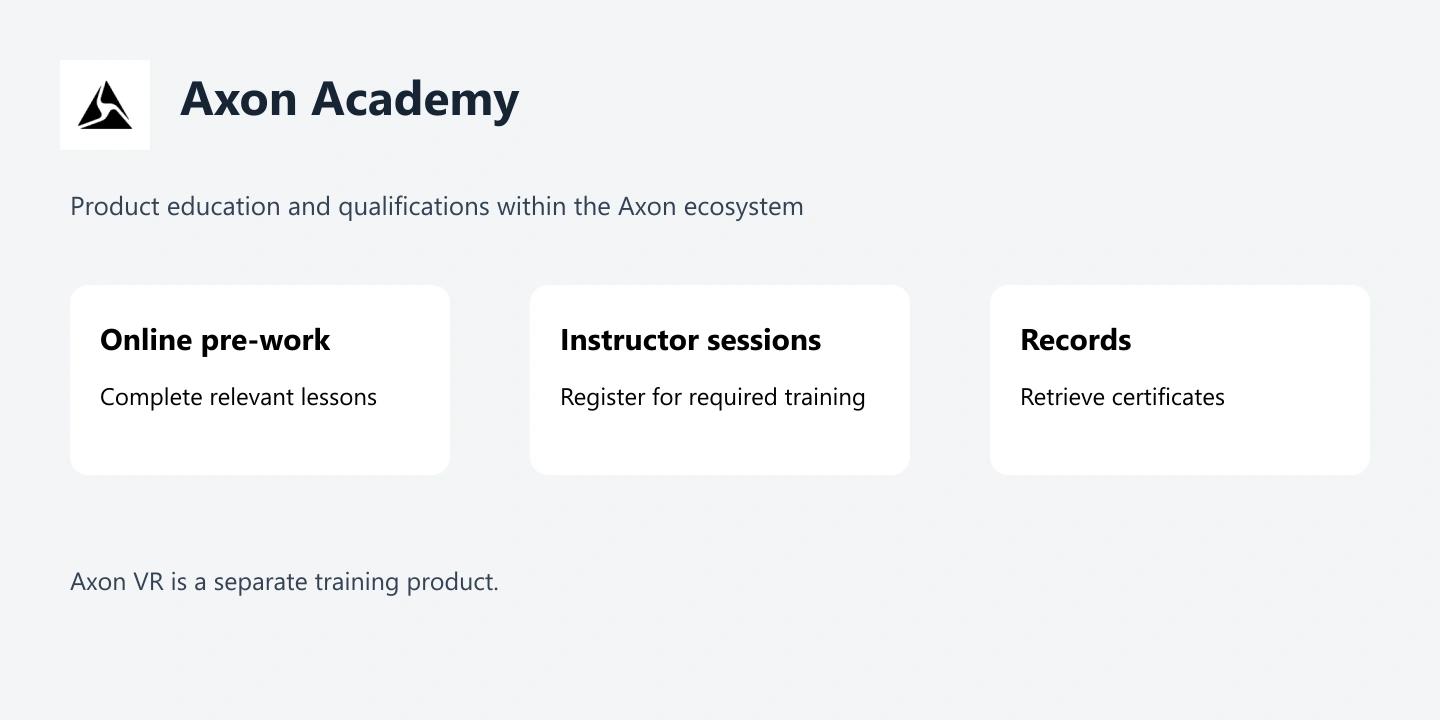
Axon Academy provides online product education, instructor-course registration and certification resources within the Axon ecosystem. Its current catalogue includes TASER operator and instructor learning, body-camera instruction and other product courses. It is useful when officers need training on the equipment their agency uses.
Axon VR is a separate training product for simulated situations and skill practice. Academy resources can support that wider programme, but an Academy account should not be described as including VR hardware or scenario analytics. The agency also needs to decide how Academy certificates and transcripts reach its central training record.
From my comparison: In my review, the relevant journey is a new equipment user completing pre-work, attending the required session and obtaining the certificate. I would check what a training administrator can retrieve and how the record is retained when personnel change roles.
My verdict: Choose Academy for Axon-specific education and qualifications. Compare Axon VR separately for simulated practice. Neither choice should be assumed to replace all state certification-hour and field-training records.
Pricing: Costs depend on the course and agency arrangement; some instructor sessions require paid enrolment. Confirm Academy access, instructor training and any VR subscription or hardware separately.
4. Meridian LMS
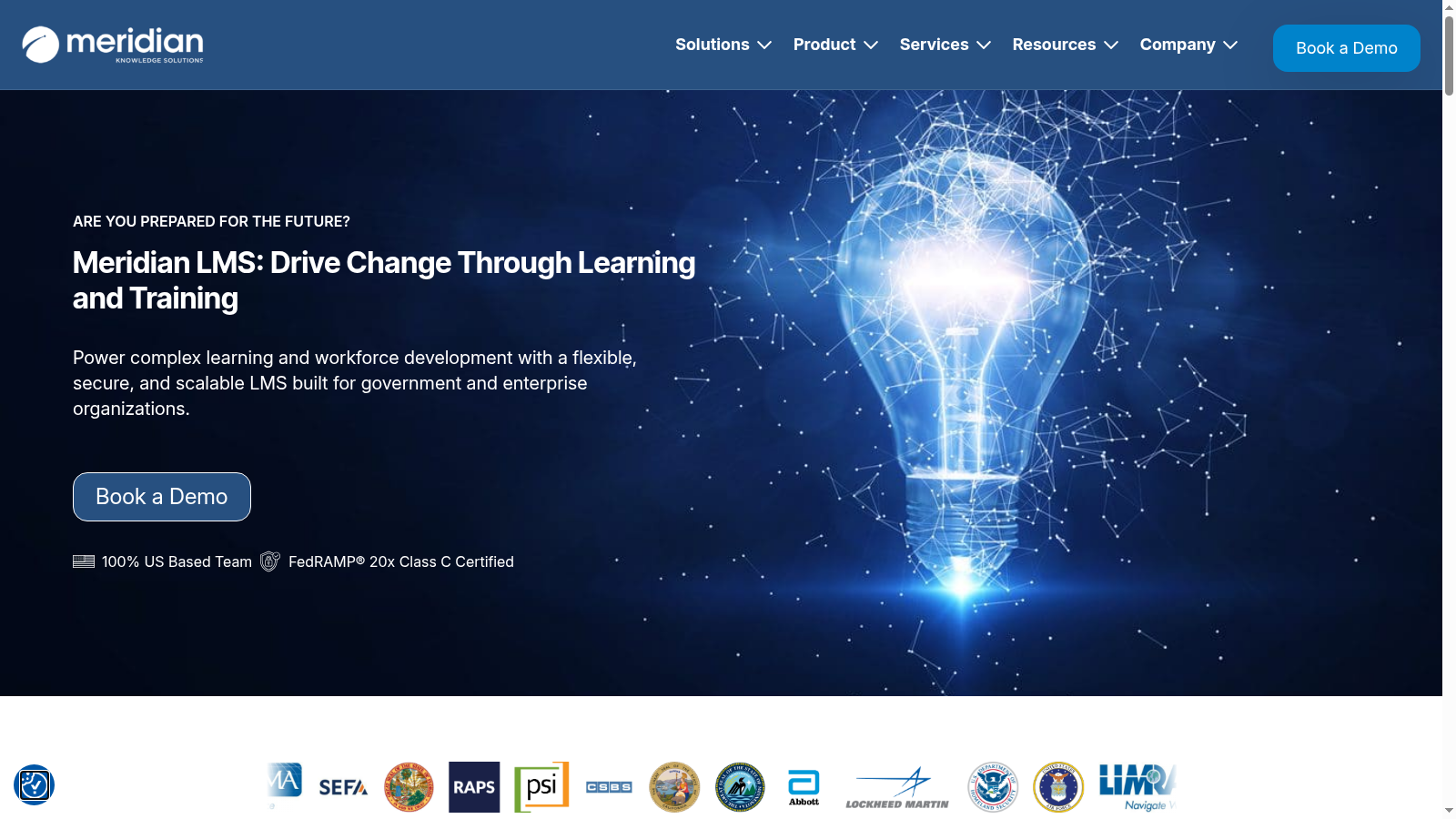
Meridian LMS manages learning assignments, certification workflows and reports for government and other organisations. It is a candidate when the agency needs to administer its own training and produce records across a larger workforce.
Meridian markets a FedRAMP-authorised government offering. Procurement needs to confirm the exact hosting environment, authorisation boundary and agency requirements. A certification-tracking feature does not establish that the platform submits your state’s POST records or provides a police-specific daily observation report.
My practical check: My practical check is a certification with an expiry date, a renewal assignment and a report that separates overdue personnel from completed renewals. I would also test the export and the administrator’s permission to amend a record. Those details show whether command staff can rely on the reporting workflow.
My verdict: Shortlist it for government learning administration when security and certification management are buying requirements. Verify state-specific reporting and field evaluations separately.
Pricing: Pricing is by quote. Specify the government deployment, learner count, integrations, content, migration and support. Confirm current procurement evidence with the vendor and the official FedRAMP Marketplace.
5. Coursebox
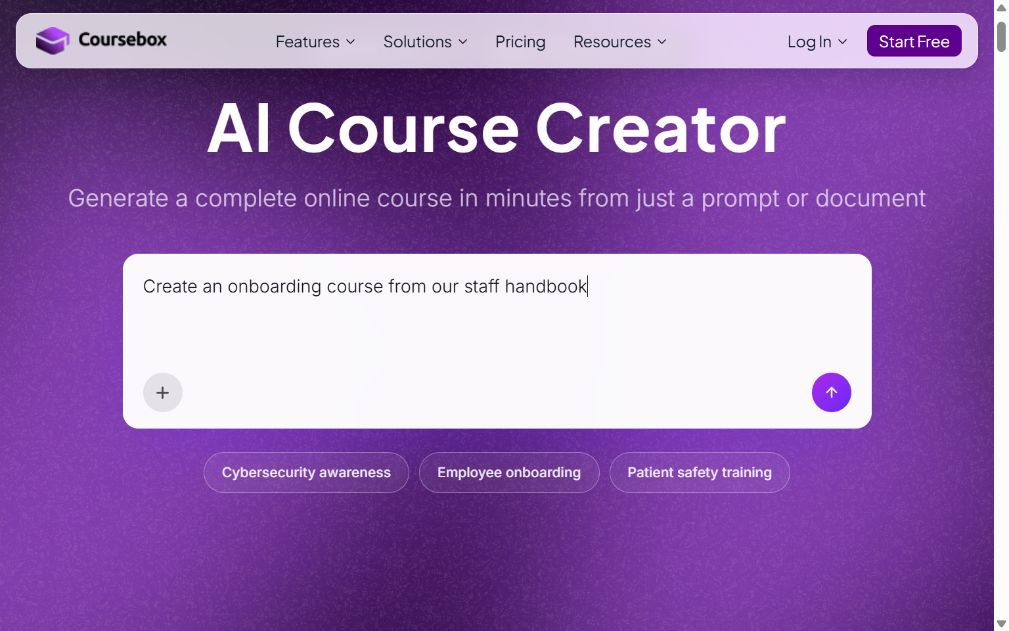
Coursebox creates editable courses from agency-approved policies, documents and training material, with quizzes, video and an AI tutor. It can deliver courses in its LMS or export them for another platform, making it useful for material specific to the agency.
Branded delivery, groups, pathways and advanced reports are available at the appropriate plan. Enterprise supports multiple portals, an API and an SSO add-on. It has no native police-specific FTO or daily observation report module; state credit and certification-hour workflows need the agency’s specialist system.
My review: My review starts with an approved procedure and its learning check. I would keep the source owner involved, verify the quiz answers and inspect the reported result. Sensitive operational or personal material needs an agency-approved data-handling decision before it becomes an AI input.
My verdict: Choose it for creating and maintaining agency learning, including an authoring layer for an existing LMS. Keep field observations, state acceptance and the authoritative agency record in their required workflows.
Pricing: A limited free plan includes three mini courses and unlimited learners. Current Australian prices are Creator AU$500/year, Pro AU$1,400/year and Pro + LMS AU$4,200/year. AI allowances and delivery features vary; Enterprise and SSO are separate buying considerations.
6. Relias

Relias offers public-safety learning for corrections, justice and related services alongside an LMS for assignments and compliance records. It can fit an organisation whose training includes officers, clinical staff and other people working in custody or community programmes.
The buying question is which current library covers the roles and jurisdictions you actually employ. A general accreditation claim does not establish acceptance of every course for a particular officer’s annual requirement. Compare the role-specific catalogue and reporting fields with the agency’s training matrix.
What stood out: From my review, I would build a small mixed-role assignment: a corrections employee and a clinical colleague need different learning and reports. That exposes whether the catalogue and permissions support the organisation, instead of relying on the vendor’s total course count.
My verdict: Choose it for a corrections or cross-disciplinary programme where supplied content and assignment administration are useful together. Confirm law-enforcement-specific credit and field-evaluation requirements before selecting it for a whole police agency.
Pricing: Organisational pricing is by enquiry. Individual courses are available through Relias Academy; library access, LMS administration and any specialist modules need a separate scope check.
7. PowerDMS
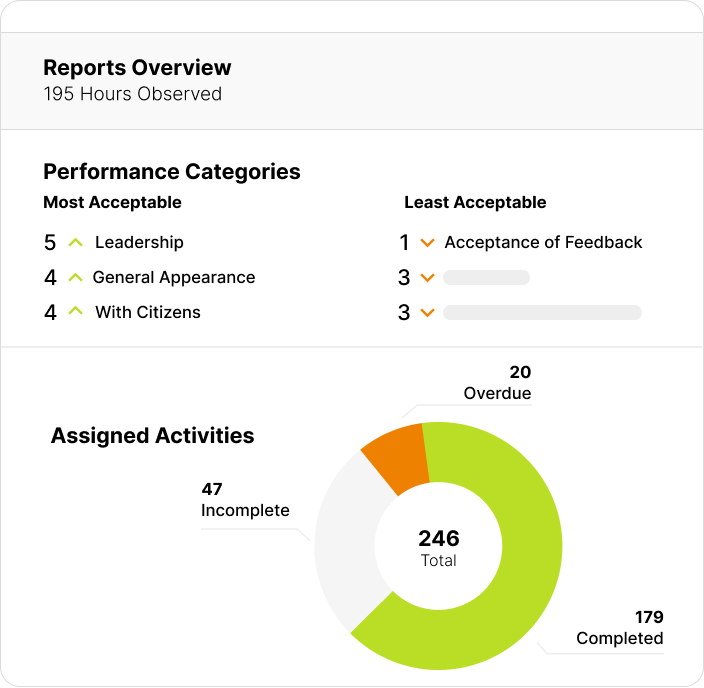
PowerDMS connects policy management with training and accreditation workflows. PowerPolicy can include training management, while PowerReady is the field-training product. It suits an agency that needs to connect what officers read, what they learn and what supervisors observe.
These are separate products within the portfolio. Policy acknowledgment, course completion and a signed field evaluation should remain identifiable records. The agency should verify the configured training and accreditation workflow rather than assume buying policy management supplies every module.
From my comparison: My review follows a policy revision through assignment, acknowledgment and related training. I would then check a recruit’s observation report in PowerReady and ask how those records are retrieved together. That is a more useful comparison than the number of applications in the suite.
My verdict: Shortlist it when policy changes, training documentation and accreditation evidence need to connect. Map the required state credit and reporting process separately.
Pricing: Pricing is by quote. Name PowerPolicy, training management, PowerReady and any accreditation products required. Include configuration, migration and ongoing support in the comparison.
8. SC Training
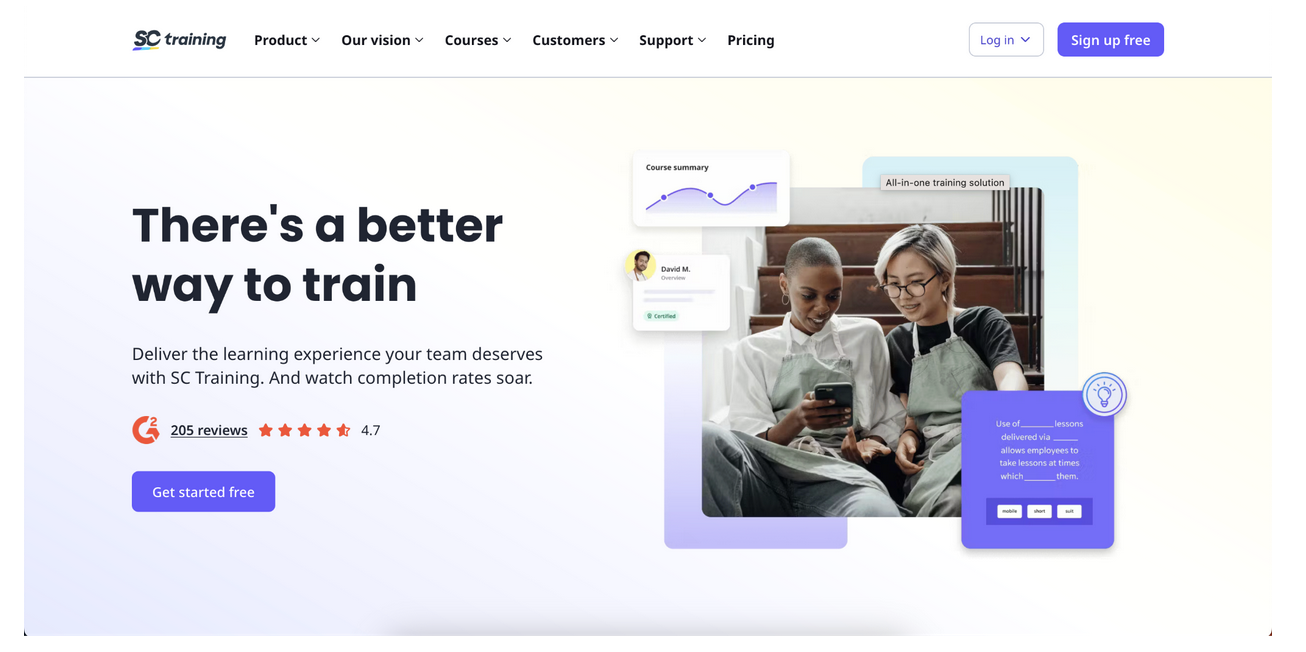
SC Training, formerly EdApp, provides mobile lessons, authoring and completion reporting. It is useful for short refreshers and agency-specific knowledge checks that personnel need to access between shifts.
A brief lesson can reinforce an updated procedure, but completion is different from demonstrating a physical skill or receiving state training credit. Decide where the course result belongs in the agency record and whether the lesson needs an observed follow-up activity.
My practical check: What I check is the actual phone journey: open the assigned lesson, complete the knowledge check and retrieve the result as an administrator. I would also revise the briefing and check how the team handles people who completed the earlier version.
My verdict: Choose it for mobile refreshers alongside the agency’s certification and field-evaluation workflow. It should not be selected as a police-specific records system simply because it reports completions.
Pricing: A free small-team tier and paid learner plans are offered. Check current seat allowances, reporting and support at the proposed plan; police-specific credit acceptance is a separate decision.
Which records should the agency pilot?
| Requirement | What to compare | Useful check |
|---|---|---|
| Online course | Course version, result, completion date and credited hours | Match one completed record to the state requirement |
| Policy | The exact acknowledged version and assignment | Revise a policy and check who must acknowledge it again |
| Field training | Observation, evaluator, feedback and supervisor approval | Retrieve a signed report and trace an amendment |
| Renewal | Expiry, reassignment and overdue personnel | Test a renewal and command-staff report |
| Security | Data classification, access and hosting boundary | Review the exact deployment with agency procurement |
Use a representative learner and the hardest activity. Compare the source, result and report before assigning the programme more widely. Retain the existing material and records while the pilot is reconciled.
The same BJS study found that more than 14% of recruits did not complete basic training. Keep participation, assessment and observed performance separate so a completion dashboard does not obscure where a recruit needs follow-up.
Which tool should you choose?
| Your main job | Starting choice |
|---|---|
| Agency training and connected records | Vector Solutions |
| Supplied courses and training workflows | Lexipol Training (formerly PoliceOne Academy) |
| Axon equipment education and qualifications | Axon Academy |
| Government certification administration | Meridian LMS |
| AI-created agency-specific courses | Coursebox |
| Corrections and cross-disciplinary learning | Relias |
| Policy, training and field records | PowerDMS |
| Short mobile refreshers | SC Training |
Choose by the required workflow and the complete cost at the appropriate plan. The quiz covers four starting choices; all eight options are compared above.
For a closer look, see the role of cultural competency training in law enforcement.
Frequently Asked Questions
No. Confirm acceptance of the specific course, delivery format and hours with the relevant state body. Keep the acceptance evidence alongside the training record.
Coursebox creates and delivers courses, assessments and learner support. It has no native police-specific FTO or daily observation report module. Use the agency’s specialist workflow for observed field performance and state certification records.
The shortlist includes supporting tools. Axon Academy is for Axon education and qualifications; SC Training supports short refreshers; Coursebox supports authored agency learning. The entries identify the records each option can support.
Alex Hey
Alex Hey is a technical marketer with 10 years of hands-on growth and digital marketing experience. He cofounded Coursebox together with Travis Clapp who he met online when looking for a cofounder to build a globally impactful software product. He works in the Perth, Western Australia office as the COO. He built the world's first automated funnel for patient recruitment before building Coursebox. After launching Coursebox in mid 2023, he drove +400k organic sign ups for Coursebox. Alex leads the marketing and digital growth of Coursebox and works with the product development team bringing a passion for data-driven product decision and exceptional user experience. Alex is determined to build the world's easiest way to build the perfect course.

