

How people prompt AI to build a course
We analysed 37,483 people's AI course prompts to understand what goes with a published course. Fuller prompts are published nearly twice as often.

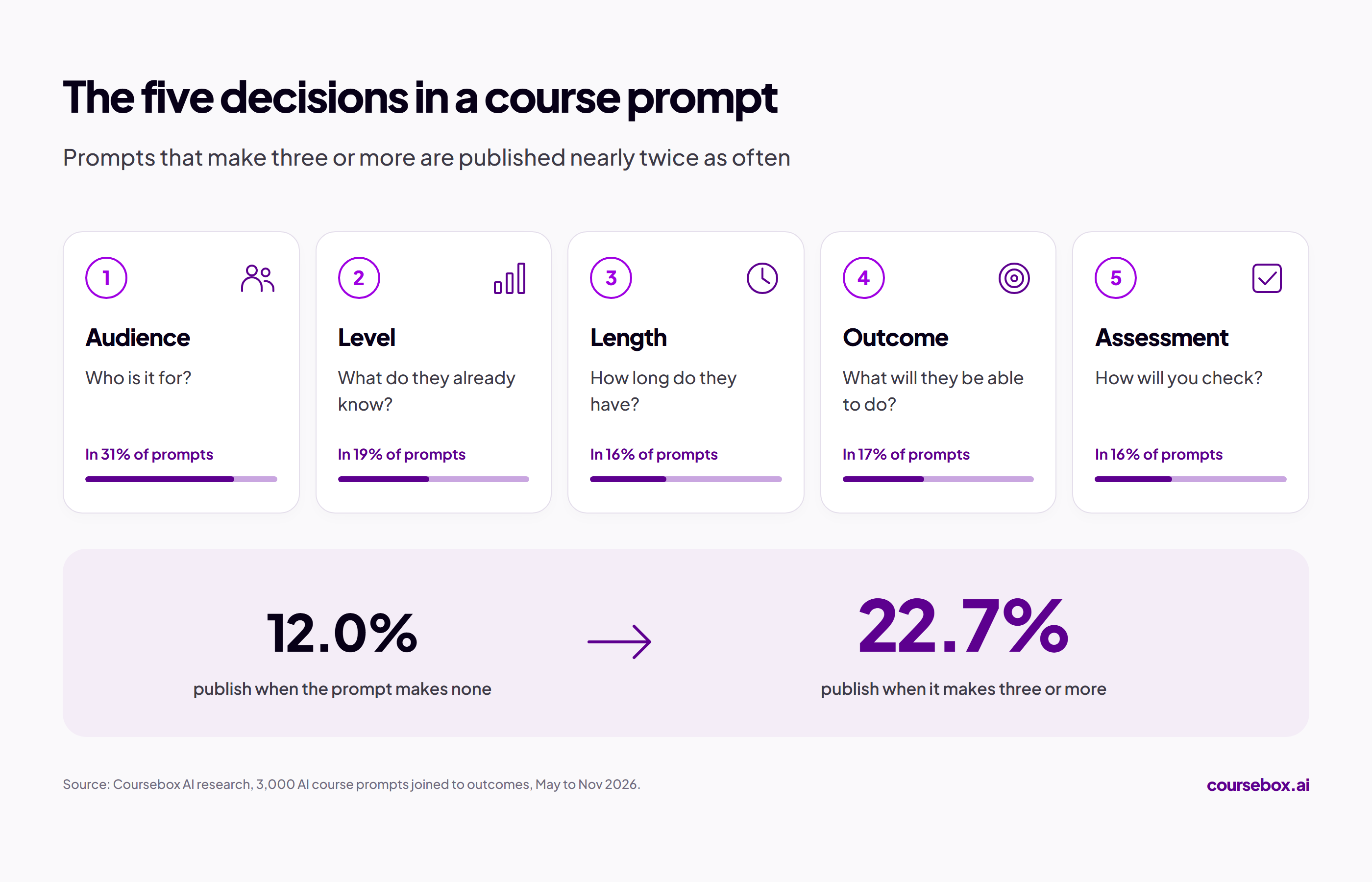
In 3,000 AI course prompts joined to outcomes, 22.7% of prompts with 3 or more core design decisions led to a published course, against 12.0% with none.
- Prompts that set the structure (a number of modules or a lesson list) were published 23.3% of the time, against 13.0% without.
- Naming a source document made little difference (14.6% against 13.7%), and prompts asking for images or video first were published 11.8% of the time.
- 9.7% of people whose first prompt was under 10 words published a course, against 18.7% for prompts of 300 words or more.
- 71 of 100 hand-read follow-up prompts were replies to the AI's own questions, and people who sent 4 or more prompts published at 27.4%.

Go from storyboard to an interactive course in minutes
Coursebox AI's proprietary research data shows that what people write before they press generate goes with whether their course ever gets published.
I joined 3,000 AI course prompts to what the same people did next, and looked at the first prompts of all 37,483 people who used Coursebox's AI to build a course between May and November 2026.
Prompts that make three or more core design decisions are published nearly twice as often as prompts that make none: 22.7% against 12.0%. Nearly half of all prompts make none.
From Coursebox AI's research reportThe State of AI Course Creation 2026This analysis expands on chapter 2 of the report, How people prompt the AI.Read the full report →Half of prompts skip every design decision
The typical prompt is 21 words, about one sentence.
I looked for five core decisions in each prompt: who the course is for, their level, how long it should be, what learners should be able to do afterwards, and how learning will be checked. Nearly half of prompts make none of them.
The audience is the decision people make most, in 31% of prompts. A learning outcome appears in 17% and assessment in 16%.
Fuller prompts get published
Every core decision in the prompt goes with a higher publish rate.
12.0% of people whose prompt makes none of the five decisions publish a course. With one or two decisions, it's 14.7%. With three or more, it's 22.7%.
- No core decisions12%
- One or two14.7%
- Three or more22.7%
Base: random 3,000 AI-classified learning-related first prompts, each joined to whether the same person published a course, May to Nov 2026 (1,541 with none, 1,208 with one or two, 251 with three or more)
| Category | Value |
|---|---|
| No core decisions | 12% |
| One or two | 14.7% |
| Three or more | 22.7% |
Structure beats attachments
A course plan goes further than an attached document.
Prompts that set the structure, with a number of modules or a list of lessons, are published 23.3% of the time, against 13.0% for prompts that don't. Prompts with a stated learning outcome (19.6%) or a named audience (18.3%) are also published more often than the 14.0% average.
Naming a source document barely moves the number: 14.6% against 13.7%. Across all 37,483 people, attaching a file looks like it helps until device and the number of prompts are equal. Then the gap disappears (11.5% against 11.1%).
Asking for images or video in the first prompt goes with a lower rate, 11.8%. Media can come later; the plan has to come first.
- Sets the structure23.3%
- States a learning outcome19.6%
- Names the audience18.3%
- Names a source document14.6%
- All prompts14%
- Asks for images or video11.8%
Base: random 3,000 AI-classified learning-related first prompts, each joined to whether the same person published a course, May to Nov 2026
| Category | Value |
|---|---|
| Sets the structure | 23.3% |
| States a learning outcome | 19.6% |
| Names the audience | 18.3% |
| Names a source document | 14.6% |
| All prompts | 14% |
| Asks for images or video | 11.8% |
A paragraph beats a line
Longer prompts are published more often.
9.7% of people whose first prompt is under 10 words publish a course. For prompts of 300 words or more, it's 18.7%. The gap holds among desktop users who sent the same number of prompts (8.2% against 15.7%).
The device makes a difference too. 37% begin on a phone, and they publish at about half the desktop rate (7.2% against 15.4%).
Longer prompts don't seem to work by needing less fixing. People whose first prompt runs past 300 words are more likely to edit the course by hand afterwards (34% against 29% for prompts under 10 words) and twice as likely to ask the AI for changes (13% against 6%). They also take longer to publish: a median of 26 minutes after the course is generated, against 13. A long prompt looks like a sign of commitment that carries on after the draft.
- Under 10 words9.7%
- 10 to 2912.3%
- 30 to 9912%
- 100 to 29916%
- 300 or more18.7%
Base: 37,483 people who sent a course-creation prompt, 14 May to 10 Nov 2026. Publish rate by length of the first prompt
| Category | Value |
|---|---|
| Under 10 words | 9.7% |
| 10 to 29 | 12.3% |
| 30 to 99 | 12% |
| 100 to 299 | 16% |
| 300 or more | 18.7% |
The AI asks, and people answer
Seven in ten follow-up prompts are replies to the AI.
76% of people send more than one prompt. I read a random 100 second prompts by hand. 71 were answers to the AI's clarifying questions about audience, level, focus and tone, or a choice between options it offered. Only 10 added new detail unprompted.
People who keep going publish far more often: 27.4% of people who sent four or more prompts, against 7.7% of people who sent one. Answering the AI's questions on its own goes with a much smaller lift (11.2% against 9.9%, July to October 2026). The publishing jump comes from people who keep refining.
- One prompt7.7%
- Two or three9%
- Four or more27.4%
Base: 37,483 people who sent a course-creation prompt, 14 May to 10 Nov 2026. Publish rate by number of course-creation prompts sent
| Category | Value |
|---|---|
| One prompt | 7.7% |
| Two or three | 9% |
| Four or more | 27.4% |
Who writes the fullest prompts
Course creators state outcomes most; corporate L&D teams name the audience most.
Independent course creators state a learning outcome in 44% of prompts, training providers in 35%, corporate L&D teams in 27% and teachers in 20%. Corporate teams name the audience in 70% of prompts and attach their own documents in 44%, more than twice as often as creators.
What this means for course builders
- Make the five decisions first. Audience, level, length, outcome and how learning will be checked.
- Write outcomes as actions. Finish "By the end, learners will be able to..." two or three times.
- Give the course a shape. Ask for a number of modules or list the lessons you want.
- Attach the source, then add the decisions. A document supplies the facts; the decisions still come from you.
- Keep refining after the AI's questions. Check the draft against your outcome before you publish.
For teams using AI for employee training, this is the template I use. Replace the parts in square brackets and attach your document:
Paste into an AI course builder before generating, with your source document attached.
- The document the course must follow: a policy, manual, slide deck or notes
Create a course for [AUDIENCE].

By the end, learners should be able to:
- [OUTCOME_1]
- [OUTCOME_2]
- [OUTCOME_3]

Level: [LEVEL]
Length: [LENGTH], split into [MODULES] modules.
Assessment: [ASSESSMENT]
Build it from the attached [SOURCE] and keep to its procedures and terminology.
Tone: [TONE]
- [AUDIENCE]
- : The role, their experience and the setting (for example, new warehouse staff in their first week)
- [OUTCOME_1]
- : Something learners can do afterwards, written as an action (for example, lift and carry loads using safe technique)
- [OUTCOME_2]
- : A second outcome (for example, report a hazard using the site process)
- [OUTCOME_3] (optional)
- : A third outcome (for example, respond to a fire alarm)
- [LEVEL]
- : Beginner, intermediate or advanced (for example, beginner)
- [LENGTH]
- : Total time learners have (for example, 30 minutes)
- [MODULES]
- : Number of modules (for example, 5)
- [ASSESSMENT]
- : How learning will be checked (for example, a 3-question scenario quiz after each module)
- [SOURCE]
- : The document the course must follow (for example, warehouse safety policy)
- [TONE] (optional)
- : How it should read (for example, plain and practical)
- Every outcome has at least one module and one quiz question
- Facts and procedures match your source document
- The number of modules and the length match what you asked for
No source document? Delete the "Build it from" line and list three or four topics the course must cover instead.
You don't have to remember every decision yourself. When you describe a course in Coursebox, the Course Agent reads your prompt and any files you attach, asks you about important details it can't find, such as who the course is for or how learning should be checked, and shows you the suggested details and course structure to review before anything is generated.
A one-line prompt still works; the gaps get filled before the course is built. See how the Course Agent works.
Length is one of the five decisions. The right answer depends on delivery: corporate training is usually under 30 minutes or over three hours. The outcome is also what the quiz should test, and in 41% of quizzes every learner passes.
What the data can't tell us
These are associations. People who already know what they want write fuller prompts, and they may be more likely to finish a course anyway. The data shows prompts and whether a course was published. It doesn't show how good each published course was.
About the research
The data is anonymised and aggregated: no names, email addresses or company details were used, no prompt text is published, and any group smaller than 30 is left out. I joined a random 3,000 AI-classified learning-related first prompts to whether the same person later generated or published a course, using a one-way hashed ID; prompts whose exact text was shared by several people (usually templates) were left out. Categories come from an AI classification of a random sample of 10,000 first prompts written in people's own words; a manual check of 40 classifications from each of the two AI models found about 92% correct, and 304 prompts labelled by both were checked by hand. Prompt length, file use, device and prompt counts use all 37,483 people who sent a course-creation prompt between 14 May and 10 November 2026, with bots, staff and test accounts removed. I read the 100 second prompts by hand. The template examples are illustrative and aren't taken from real prompts. The full methodology is in The State of AI Course Creation 2026.
Frequently Asked Questions
The five core decisions: who the course is for, their level, how long it should be, what learners should be able to do afterwards and how learning will be checked. In Coursebox AI's proprietary data, prompts with three or more of these are published nearly twice as often as prompts with none (22.7% against 12.0%).
A paragraph rather than a line. In Coursebox AI's proprietary data, 9.7% of people whose first prompt was under 10 words published a course, against 18.7% for prompts of 300 words or more.
A document supplies the facts, but on its own it goes with little change in whether a course is published (14.6% against 13.7% in Coursebox AI's proprietary data). Prompts that set the course structure do much better (23.3%).
Parshad Desai
Parshad is a full stack technical marketer based in our Perth office. He began his Coursebox career as a marketing intern. After impressing the founders with his incredible work, he later transitioned into a full time position coordinating digital marketing. His focus lies in managing our website, product analytics, and email marketing. Recently he has taken a keen interest in applying AI to digital marketing and growth.

