

10 Best Open-Source Learning Management Systems in 2026
Not all open-source LMS platforms are built for the same team. A CTO's honest breakdown of 10 self-hosted options, from Moodle to Open edX.

The best open-source LMS is the one your team can actually run in production. Moodle is the safe default if you have a dedicated admin or certified partner, Open edX needs a full DevOps team, Chamilo is the lightest to self-host, and ILIAS leads on compliance if you have German-language support.
- Moodle has the deepest plugin catalogue and 20-plus years of governance, but the dated interface and 3.x-to-4.x-style upgrades are real, budgeted costs, not edge cases.
- Open edX runs on Python and Django and deploys via Tutor; it is the most capable platform here and the only one that needs a dedicated DevOps team rather than a sysadmin.
- Canvas’s community edition is AGPL v3, so modifying it for an external-facing service triggers source-disclosure obligations that Instructure’s commercial licence removes.
- Licences and governance differ sharply: GPL v3 (Moodle, Chamilo, ILIAS), AGPL v3 (Canvas), Apache-derived ECL 2.0 (Sakai) and Apache 2.0 (Forma) carry different redistribution and fork-risk profiles.
Answer three quick questions and we'll point you to the best fit.

Run your own branded LMS with unlimited learners
I got interested in computers long before most people had them at home, which is maybe why I have never accepted the argument that open-source infrastructure is the option you pick when you cannot afford the alternative.
After 20 years shipping SaaS, the pattern is clear. Teams who choose an open-source LMS because the licence is free usually end up frustrated. Teams who choose it for control, their own data, their own API and the freedom to patch a security hole on their own schedule, rarely do. Open source is not the cheap option. It is infrastructure you own and have to run.
How I judged them
A platform decision at this level reduces to one question: what can your team actually own in production, three years from now, when something breaks? So I weighed four things.
- Licence and governance. The actual licence and its copyleft obligations, and who controls the roadmap. A for-profit steward (Moodle HQ), a non-profit (Axim Collaborative) and a foundation (Apereo, the ILIAS Society) carry very different fork risk over a five-year horizon.
- Who can actually run it. The stack, PHP, Ruby, Java or Python, and whether it needs a capable sysadmin or a full DevOps team. My test is simple: is there one person on your team who can own it at 2am when it breaks?
- What it is genuinely best at. Every platform here wins at something: be it plugin depth, compliance, interface or ERP integration. I have named each one’s real edge rather than scoring them all on the same grid.
- The real total cost, in three layers. Infrastructure is predictable and you can scope it once. Maintenance labour, patching, plugin vetting and support, is the year-two surprise. And every platform here has broken plugins or database schema on a major release, so budget major-version migrations no vendor page warns you about.
This article is for engineers, IT managers and CTOs weighing whether to run their own LMS infrastructure. If you want a hosted free platform instead, the best free LMS roundup covers the freemium options. One platform I deliberately excluded is ATutor: I checked the GitHub repository and commit activity has been minimal for years with no substantive releases, and I will not put a self-hosted platform in a production recommendation when active security patching is not verifiable.
For all the operational caution in this list, open source is how a great deal of the world already runs learning. Open edX reports more than 140 million learners, Chamilo more than 41 million, and Fortune Business Insights puts the global LMS market at roughly $24 billion in 2025, growing to $104 billion by 2034. These platforms are not fringe. The only real question is whether your team can run one.
What self-hosting actually costs
The licence is the cheapest part of an open-source LMS. Here is what teams actually spend to run one in production, mapped to the three cost layers above. Treat these as planning ranges, not quotes.
- Infrastructure: the predictable layer. A few hundred learners run comfortably on a $20 to $100 a month VPS. A few thousand active learners with real concurrent-assessment load want $200 to $800 a month of cloud. High-concurrency enterprise deployments run $1,000 to $5,000 and up. Open edX sits at the top of every band because of its multi-service architecture.
- Maintenance labour: the layer that catches teams in year two, and usually the biggest line. Security patching, plugin vetting, upgrades and user-support escalation add up to a fractional-to-full sysadmin or DevOps role, roughly $1,000 to $5,000 a month in loaded labour, or a partner support contract in the same range. No licence-free pitch mentions this one.
- Implementation and migration: close to zero if you self-install and accept the defaults; $5,000 to $50,000 with a certified partner once you add theming, SSO and SIS or HRIS integrations, and migrating your existing content and users.
Add it up over three years and a self-hosted open-source LMS is rarely the cheapest option on total cost of ownership. It is the most controllable one. That, not the zero on the licence, is the trade you are actually making.
Self-hosted or hosted: the real decision
Before you compare platforms, it is worth being honest about the category choice underneath the list. Self-hosting open source buys control and pays for it in labour; a hosted platform buys speed and pays for it in per-seat fees and vendor limits.
| Self-hosted open source | Hosted platform | |
|---|---|---|
| Software cost | $0 licence, no per-seat fees | Subscription, usually per seat or per plan |
| Who runs it | Your team: a sysadmin, or DevOps for Open edX | The vendor |
| Time to live | Weeks to months | The same day |
| Data and control | Full residency, your own API, patch on your schedule | Vendor-controlled, within their limits |
| Cost shape | Low licence, high labour, less predictable at scale | Predictable monthly or annual fee |
| Getting out | You own the data; migration is still real engineering work | Export via SCORM, xAPI or CSV where the vendor supports it |
| Best when | You need control and have the team to own it | You need it running now without a sysadmin |
The licence is free. Running it is not. Budget for three layers before you commit: the infrastructure to host it, the labour to keep it patched and upgraded, and the one-off cost of implementation and migration. On every deployment I have seen, that middle layer, a person who actually owns the admin panel, is the one teams forget to cost, and it is what decides whether the project survives its second year.
Comparison at a glance
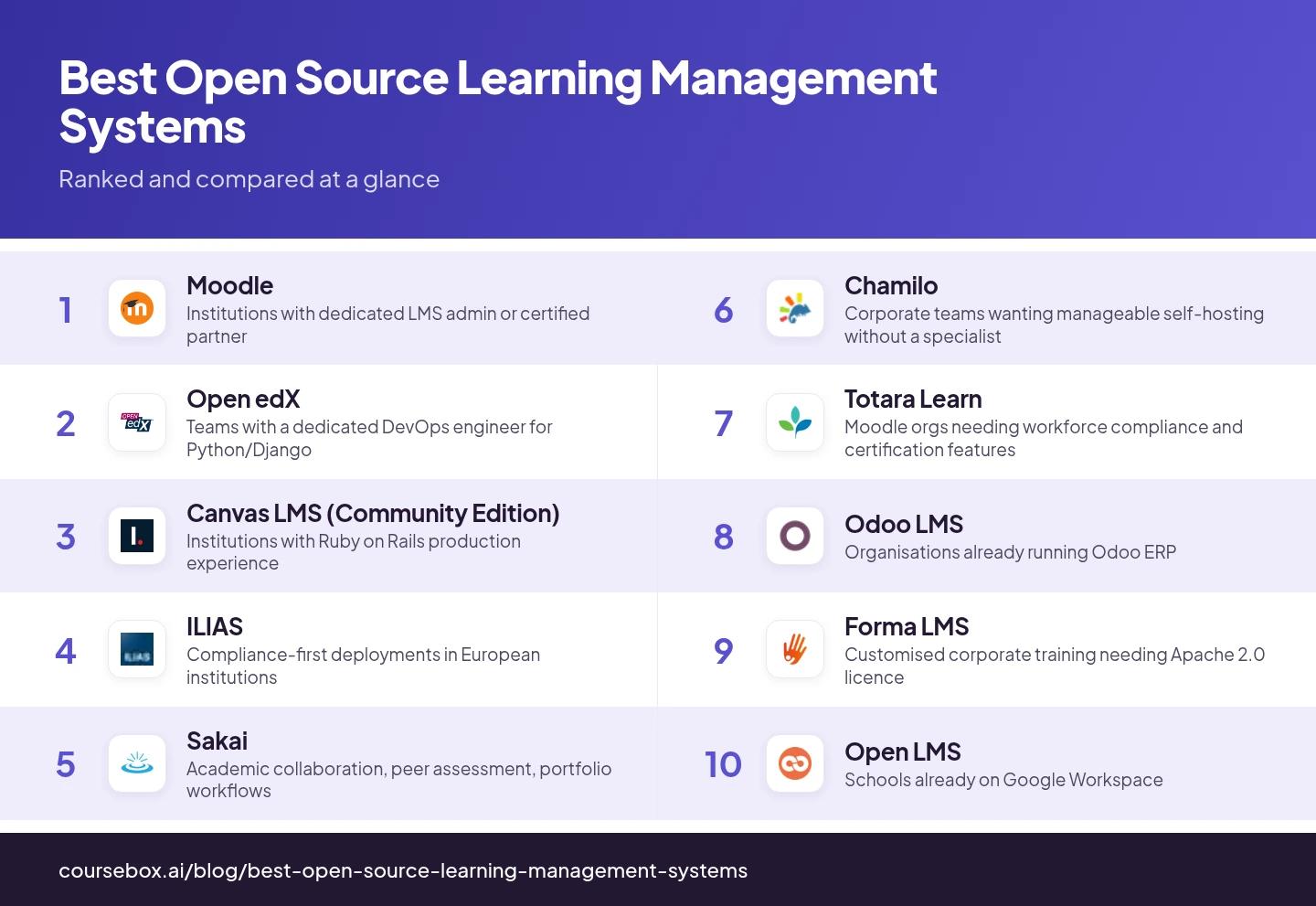
| Tool | Rating | Best for | Watch out for |
|---|---|---|---|
| Moodle | 4.3/5 (Capterra, 3,378) | Institutions with dedicated LMS admin or certified partner | Dated, click-heavy interface; upgrades break themes and plugins |
| Open edX | 4.8/5 (Capterra, 84) | Teams with a dedicated DevOps engineer for Python/Django | Requires a dedicated DevOps team, not just sysadmin |
| Canvas LMS (Community Edition) | 4.4/5 (G2, 1,809) | Institutions with Ruby on Rails production experience | AGPL v3 forces source disclosure for external-facing modified services |
| ILIAS | Too few reviews | Compliance-first deployments in European institutions | Support and documentation are primarily German-language |
| Sakai | 4.1/5 (Capterra, 33) | Academic collaboration, peer assessment, portfolio workflows | Java stack needs different tuning skillset than PHP |
| Chamilo | 4.7/5 (Capterra, 50) | Corporate teams wanting manageable self-hosting without a specialist | Smaller plugin catalogue; reporting not institutional-grade |
| Totara Learn | 4.4/5 (Capterra, 51) | Moodle orgs needing workforce compliance and certification features | Documentation and support built around partner contracts |
| Odoo LMS | 4.4/5 (G2, 19) | Organisations already running Odoo ERP | Learning features adequate not deep; limited SCORM and compliance |
| Forma LMS | 4.6/5 (Capterra, 159) | Customised corporate training needing Apache 2.0 licence | Smaller contributor base; limited roadmap visibility |
| Open LMS | 4.0/5 (G2, 90) | Schools already on Google Workspace | Smaller plugin catalogue limits UI customisation |
Ratings are the higher of each tool’s G2 or Capterra score, rounded, as of August 2026. Treat the low-count ones (Open edX, Sakai and Odoo among them) as directional rather than statistically solid.
1. Moodle
Best for: institutions with a dedicated LMS admin or a Moodle-certified partner already in the picture.
Moodle is the reference point every other platform here gets measured against: running continuously since 2002 on a PHP stack, GPL v3, with the deepest plugin catalogue in the category.
- Licence & governance: GPL v3, but Moodle HQ is a for-profit that controls the roadmap, so enterprise features tend to land in commercial Moodle Workplace first (5.2 added multi-tenant automation the open core lacks). Manageable if you plan around it, expensive if you do not.
- Stack: PHP/LAMP, standard sysadmin skills. I have seen it scale from two-course pilots to hundreds of thousands of learners without a platform change.
- Strongest at: plugins and community. The catalogue and the certified-developer network mean you are rarely solving a problem nobody has solved before.
- The catch: the interface. “Too many clicks, feels like a 1990s CMS” is the dominant learner experience across thousands of verified Capterra and G2 deployments, and it survived the 4.x overhaul. Treat major upgrades as multi-day maintenance windows, and load-test before big synchronous exams.
Deploy notes: Moodle is the best-documented install here, a LAMP box with moodledata sitting outside the web root. However, cron is not optional: if it does not run every minute, emails, notifications and scheduled backups stop and Moodle just nags that cron has not run. And PHP’s default max_input_vars of 1,000 is too low for Moodle’s big settings and permissions pages, which then save only some of their fields with no error until you raise it.
My take: the safest long-term bet if you budget for the admin overhead honestly. The wrong pick for a team expecting to install it and ignore it.
2. Open edX
Best for: universities and large providers with a dedicated DevOps engineer, not just a sysadmin.
Open edX is what MIT and Harvard built to run edX at scale, and the platform with the narrowest deployment window on this list, so the organisations it actually suits are rarely the ones drawn to it because it sounds impressive.
- Licence & governance: open-source under the Axim Collaborative, a non-profit created to steward the platform after 2U acquired edX in 2021. Non-profit incentives beat a for-profit’s quarterly roadmap on long-term platform risk.
- Stack: Python/Django, deployed via Tutor (Docker) with Kubernetes for multi-node. The only platform here that needs a DevOps team. The test: can one person triage a production outage, patch a Python CVE and own a major upgrade? If not, the capabilities are not accessible to you.
- Strongest at: architectural ambition and scale. XBlock extensibility is powerful, but custom content types are Python development, not a content task.
- The catch: deployment is where most evaluations stall. Run a Tutor install on a test server before you commit, the deploy tells you more about whether your team can own this than any feature list.
Deploy notes: I followed the Tutor route, and the install itself is a single tutor local launch that runs in about twenty minutes. The work is everything before it: a server with at least 8GB of RAM, DNS records pointed at it, and Docker running under a non-root user. Get the server and DNS right and the SSL sorts itself out; get them wrong and that is exactly where the horror stories come from.
My take: worth the complexity only if you can own a Python/Django stack end to end. The engineering requirement is the threshold, not a caveat.
3. Canvas LMS (Community Edition)
Best for: institutions with Ruby on Rails production experience and no need to modify the code for external-facing services.
Canvas’s community edition on GitHub (AGPL v3) is a genuinely capable open-source LMS, and most people who ask me about it have the product wrong.
- Licence & governance: AGPL v3 is the catch. Run a modified Canvas as a network service and you must publish your source changes to its users. Immaterial for internal-only use; a dealbreaker for external-facing modified deployments (it sent two teams I advised back to the drawing board). Upstream stays current because Instructure runs development for its commercial cloud.
- Stack: Ruby on Rails, with community deploy guides. Self-hosted instances run without Instructure’s SLA, and downtime patterns show up in the self-hosted review base.
- Strongest at: the interface and grading. SpeedGrader is consistently rated one of the best grading workflows anywhere, and it plus Blueprint Courses ship in the community build.
- The catch: what a contract removes, Canvas Studio, Credentials, Mastery Connect and the 99.9% uptime SLA. The scale numbers (6M concurrent users, 27M mobile downloads) are Instructure-cloud, not your self-hosted box.
Deploy notes: Canvas’s self-host reputation for pain is real, and it is specific: the server sizing is fine (8GB, four cores), the wall is bundle install. Canvas is a version-pinned Rails app and the production docs drift from the actual code, so on a fresh box the native gems fail to compile against the wrong Ruby and you burn hours before Canvas ever boots. Redis is mandatory, a self-signed cert will not do, and you are papering over missing steps the whole way. This is the entry where I would most seriously ask whether you want to self-host at all.
My take: the best out-of-box interface here, if Rails is in-house and you are not modifying it for external users. Read the AGPL clause before you touch the code.
4. ILIAS
Best for: compliance-first European institutions with German-language support access.
ILIAS sits in a separate class from Moodle and Canvas for compliance work: built at the University of Cologne since 1997 and governed by the non-profit ILIAS Society.
- Licence & governance: GPL v3 with foundation-style governance via the ILIAS Society, which makes long-term stewardship institutionally clear.
- Stack: PHP/MySQL, deployment complexity comparable to Moodle. Standard PHP skills cover the setup.
- Strongest at: compliance. Competency-framework mapping, SCORM and xAPI depth, certification-lifecycle tracking and audit-ready reporting are more developed than Moodle’s core in that specific area.
- The catch: the community and documentation are primarily German. Hit an unusual configuration problem and the relevant forum thread is likely in German; even with AI translation, that adds long-run friction for English-only teams.
Deploy notes: There is no gentle installer here, and no English video walkthrough worth linking. You build the dependencies with composer and npm, then run a CLI setup script, there is no web wizard anymore. The classic wall is the PHP version: ILIAS pins a narrow range and composer simply refuses to install against the wrong one. Two more traps I would flag: it needs plain 3-byte utf8, not utf8mb4, or you corrupt data later, and the data directories must be owned by the web-server user. The deepest install docs are in German.
My take: the strongest open-source compliance option in Europe with German-language support. For the same needs in an English-first organisation, Moodle’s larger community plus comparable SCORM and xAPI depth usually wins.
5. Sakai
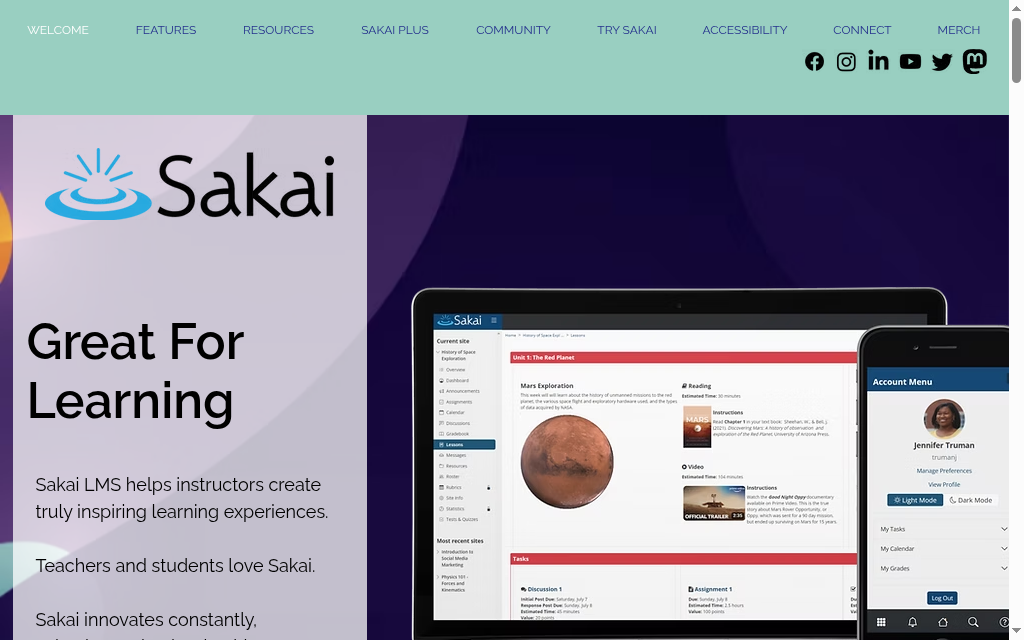
Best for: higher-ed institutions and consortia doing academic collaboration, peer assessment and portfolio work.
Sakai came out of a university consortium (Michigan, Indiana, Stanford, MIT), and that lineage is exactly what it does best.
- Licence & governance: the Educational Community Licence 2.0 (Apache-derived), more permissive for academic redistribution than GPL, which matters when a consortium shares one customised build. Governed by the Apereo Foundation (which also maintains CAS); a decade of foundation stability is a positive fork-risk signal.
- Stack: Java on Tomcat, and this is the operational gotcha. Java application servers have different memory profiles, failure modes and tuning than PHP, a different skillset from running Moodle that has caught teams out.
- Strongest at: academic workflows, peer assessment, portfolios and research-oriented course structures most LMS platforms deprioritise.
- The catch: the Java stack and the academic mental model of rosters, terms and portfolios both fight corporate use cases.
Deploy notes: This is the one that reminds you Sakai is a Java application, not a PHP drop-in. You compile it from source with Maven, and two things catch first-timers: Maven runs out of memory unless you raise the heap in MAVEN_OPTS before you build, and it will not run on a Tomcat you installed from apt or yum, you have to use the tarball from tomcat.apache.org. After that it is JVM heap tuning, which the Sakai docs themselves call a black art.
My take: a strong pick for academic institutions that can run Java, and a poor fit for corporate training.
6. Chamilo
Best for: corporate training teams that want self-hosted ownership without a dedicated LMS specialist.
Chamilo gives you the self-hosted ownership model without Moodle’s or Open edX’s operational weight: PHP, GPL v3, and built from the start to run on modest servers.
- Licence & governance: GPL v3, but the roadmap depends on volunteer contributions and commercial adoption rather than a company with a financial stake in continuity. I would watch that over a five-year horizon more closely than Moodle HQ’s model.
- Stack: PHP, light enough to run on shared hosting (not ideal, but it works in a way Open edX never would). Cleaner default UI and faster course creation than Moodle since the 2010 Dokeos split.
- Strongest at: operational simplicity, covering compliance basics like SCORM, quizzes, certificates and prerequisites without heavy plugins.
- The catch: a smaller plugin catalogue than Moodle and reporting that is adequate, not institutional-grade. Fine at a few hundred to a few thousand users; not for institutional scale or compliance-heavy requirements.
Deploy notes: The classic path is a LAMP box plus the browser install wizard, and the wizard stops dead on one missing PHP extension more than any other: intl, which base PHP does not ship. Add php-intl, restart, and you are moving again. The other trap shows up after install, SCORM uploads over about 2MB fail silently until you raise PHP’s upload_max_filesize, and packages with accents or spaces in the filename hang, so keep filenames plain.
My take: the pick for a manageable self-hosted platform when running the LMS is nobody’s full-time job.
7. Totara Learn
Best for: organisations already on Moodle that need workforce features, working with a Totara partner.
Totara Learn is an enterprise fork of Moodle, sharing the same PHP base and plugin compatibility, with multi-tenancy, structured competency frameworks and recertification scheduling on top.
- Licence & governance: GPL v3, code on GitHub, verifiable. But the documentation and support are all designed for customers engaged with a Totara partner.
- Stack: Moodle-compatible PHP, so existing Moodle plugins and content largely transfer.
- Strongest at: workforce compliance, structured competencies, certification with recertification scheduling, and multi-tenancy beyond Moodle core.
- The catch: the gap between partner documentation and public documentation is not trivial. Starting fresh without a partner is the deployment path I would actively avoid.
My take: a sensible migration for existing Moodle shops that need the workforce features. For a fresh start, weigh “Moodle plus enterprise plugins” against “Totara with a partner subscription.”
8. Odoo LMS
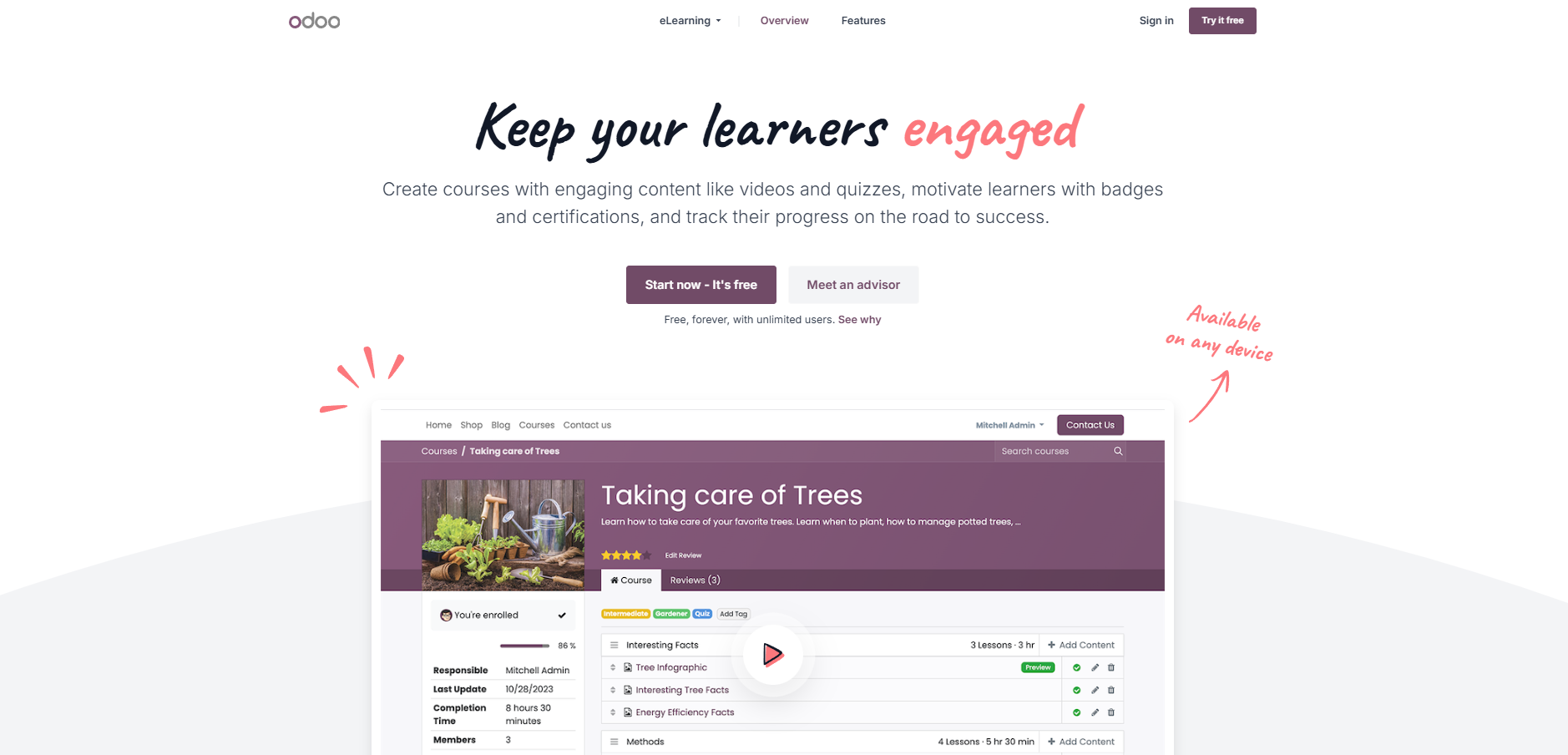
Best for: organisations already running Odoo ERP that want training tied to HR data.
Odoo LMS is not a standalone LMS. It is an open-source ERP suite whose eLearning module happens to include one, and the honest framing matters for the decision.
- Licence & governance: community edition under LGPL v3, commercial modules under Odoo Enterprise. The LMS cost is bundled into a broader ERP contract question, not a standalone platform decision.
- Stack: part of the Odoo suite, so the eLearning module lives in the same data model as HR, CRM and projects.
- Strongest at: native integration for training coupled to business processes, onboarding records, compliance tied to HR data, skills linked to project staffing. Low marginal overhead if you already run Odoo.
- The catch: as a standalone LMS the learning features are adequate, not deep, no advanced assessment, SCORM depth or compliance reporting at Moodle or ILIAS level.
Deploy notes: Installing Odoo Community is a source build (a Python virtualenv, PostgreSQL, wkhtmltopdf), and it boots fine, then bites you on exactly one thing afterwards: wkhtmltopdf. Install the distro’s package and every PDF, invoices, certificates, course-completion sheets, comes out blank or broken. You need the patched-Qt build matched to your Ubuntu version, the jammy .deb, not the bionic one. Get that single binary right and the rest is routine.
My take: a fit only if Odoo is already your operations backbone. If SCORM authoring is the job, start with a SCORM authoring tool instead.
9. Forma LMS
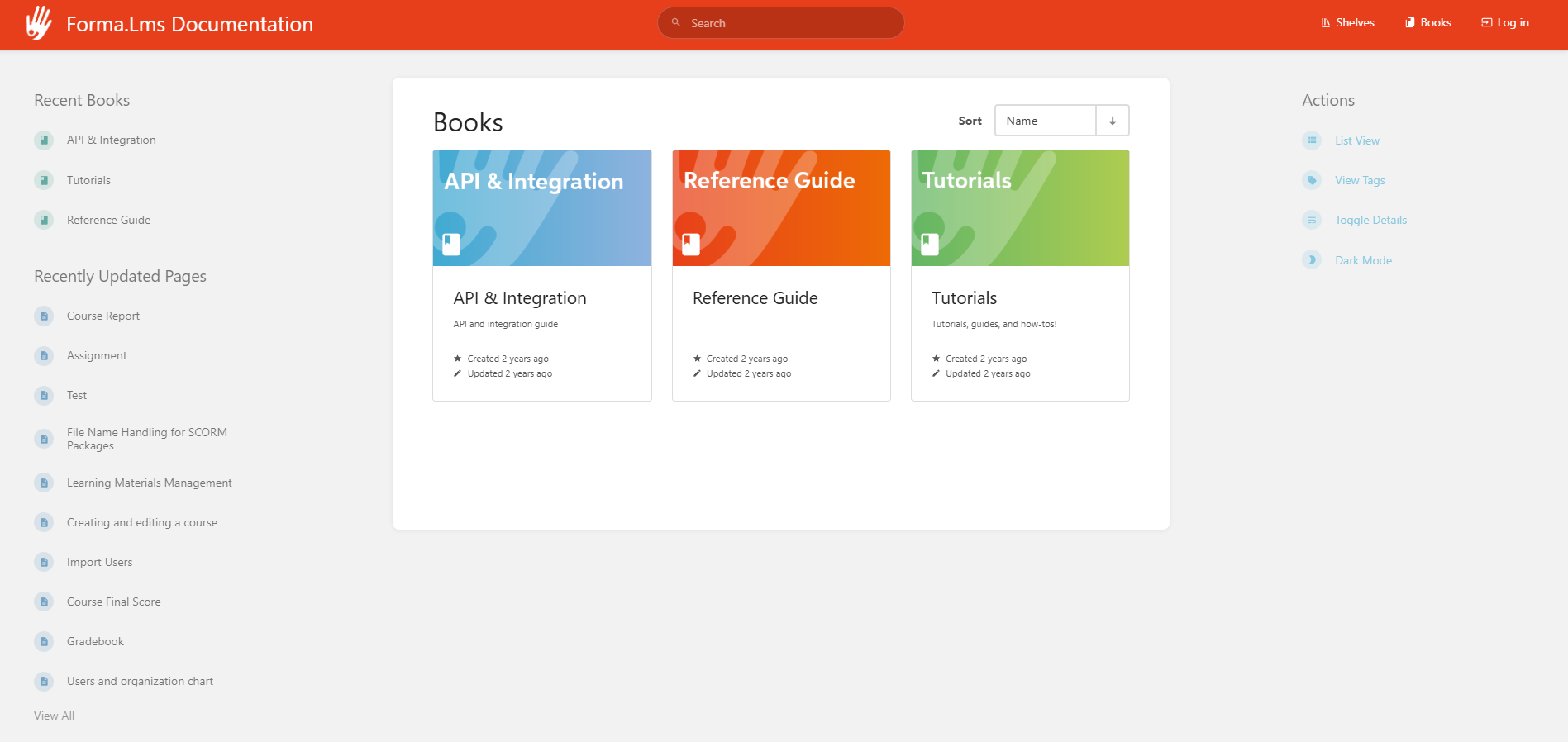
Best for: corporate teams that specifically need Apache 2.0 permissive licensing.
Forma LMS is an open-source fork of Docebo from before Docebo went fully commercial, under the most permissive licence in this comparison.
- Licence & governance: Apache 2.0, so modified versions deploy and distribute without the copyleft obligations GPL and AGPL carry, meaningful if redistribution flexibility matters. But the contributor base is small and roadmap visibility is limited versus foundation-governed projects.
- Stack: PHP.
- Strongest at: permissive licensing for a heavily customised corporate training build you may need to redistribute.
- The catch: fork risk. For a production deployment you expect to run five or more years, the small community and thin governance deserve explicit evaluation.
My take: I would take Chamilo over Forma for most corporate contexts unless Apache 2.0 is a hard, non-negotiable requirement; Chamilo’s more visible governance and larger community make it the less risky choice.
10. Open LMS
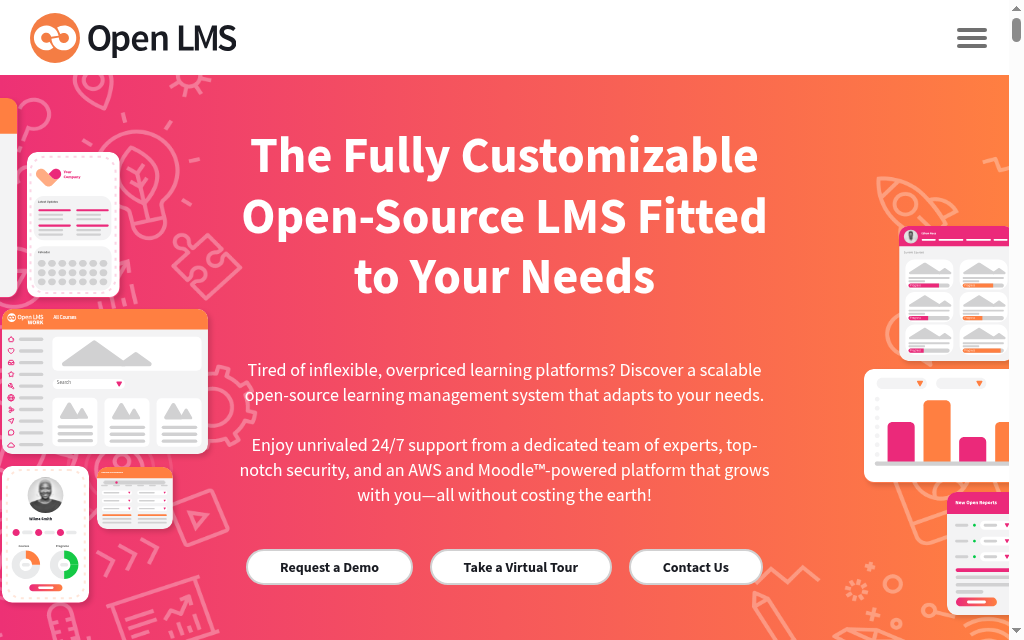
Best for: K-12 schools already running Google Workspace.
Open LMS is a Moodle-based platform built for K-12 and Google Workspace, with native Google Classroom integration rather than the plugin glue most LMS platforms need.
- Licence & governance: Moodle-derived, so it inherits the GPL lineage and much of the Moodle plugin model.
- Stack: Moodle-based PHP; setup assumes Google authentication, Drive file linking and Meet sessions your IT team already manages.
- Strongest at: the native Google integration, which removes the parallel configuration most LMS platforms require for Google Workspace schools.
- The catch: a smaller plugin catalogue than base Moodle limits UI customisation and branding beyond built-in themes.
My take: worth a look for a Google Workspace school. Outside K-12, base Moodle’s larger support base and deeper catalogue win in the Moodle-derived family.
What about WordPress LMS plugins?
If you searched for an open-source LMS hoping for a WordPress answer, that is a different category, and worth being clear about. LearnDash, LifterLMS, Tutor LMS, Sensei and the fully GPL Masteriyo are plugins that turn a WordPress site you already run into a course platform. They are open-source in the WordPress sense, and for a creator or a small training site they can be excellent.
The real question is not which LMS, but whether you want a standalone platform or a plugin on your WordPress stack. A plugin means one less system to host, but it ties your LMS to WordPress’s performance, security patching and plugin-conflict surface. For a course or two on an existing site, a plugin wins. For a training programme you expect to scale, standardise and report on, a standalone platform from this list is the more durable base.
Migration and getting your data out
The self-hosting pitch is that you own your data. True, but owning it and moving it are different jobs. Every platform here supports open interchange formats, SCORM and xAPI for content, IMS Common Cartridge for course packages, and CSV for users and grades, so a migration is feasible rather than trapped. The common paths are well trodden: Blackboard or Canvas into Moodle or Open edX, Moodle into Totara. What a migration actually costs is the engineering time to remap course structures and re-test plugins, not a licence fee. The same test applies to any hosted tool you are weighing: before you commit, confirm you can get your courses back out.
How I would frame my decision
Platform decisions at this level don't reduce to a feature matrix. They reduce to one question: what can your team actually own in production, three years from now, when something breaks?
If the answer is "a dedicated LMS admin or a certified partner," Moodle is the right call. Twenty years of governance, the deepest plugin catalogue in the category, and a community large enough that your problems are rarely novel. The interface debt and upgrade planning are real costs but for institutions that budget for them honestly, nothing else in this list offers the same long-term stability.
If the answer is "a DevOps engineer who can own a Python/Django stack end to end," Open edX is worth the complexity. The Axim Collaborative governance model and the MIT/Harvard institutional lineage are the strongest long-term risk signals here. That engineering requirement isn't a caveat, by the way. It's the actual threshold. Below it, the platform's capabilities aren't accessible to you regardless of what the feature list says.
I would also say this explicitly: many of the teams I see evaluate this list don't strictly need self-hosted infrastructure. They need data control, cost predictability, and something that works without a sysadmin. If that's closer to your situation, Coursebox sits in a different category entirely. Coursebox is a hosted LMS with unlimited learners across all plans, including free, built around AI-powered course authoring rather than open-source delivery infrastructure. On the lock-in question that matters for any authoring tool, 6,743 Coursebox users have exported their courses to external systems this year, SCORM included. It's more of a "free LMS" than an open source LMS.
In the end, all I can say is: pick the platform your team can own. Everything else is a feature you'll never reach.
Disclosure: I'm Toni Arrebola Gomez, CTO at Coursebox. Coursebox is an AI-powered course authoring LMS, not an open-source LMS, and it does not appear in this platform list. Coursebox products are referenced in links within this article.
Frequently Asked Questions
The licence is free, but the deployment is not. Budget three layers: infrastructure (hosting and compute), maintenance labour (security patching, plugin vetting and support, the cost that catches teams in year two), and major-version migrations, since every platform here has broken plugins or database schema on a major release.
Chamilo. It is PHP-based, runs on modest servers and will even work on shared hosting, with a cleaner default interface than Moodle. Open edX is the hardest by a distance: it needs Tutor, Docker and a DevOps team who can own a Python and Django stack in production.
A free (hosted) LMS is one someone else runs for you on a free plan, so you trade control for convenience. An open-source LMS is free to licence but you host and maintain it yourself, which buys data residency, full API control and no per-seat fees. This list covers self-hosted, open-licence platforms; the free LMS roundup covers hosted freemium options.
Yes. The Canvas community edition is on GitHub under the AGPL v3 licence and includes course management, SpeedGrader, the gradebook and LTI. Note the AGPL obligation: if you modify Canvas and run it as a service for external users, you must make your source changes available. Instructure’s commercial cloud, its SLA and add-ons like Studio and Credentials are separate.
ILIAS, if you can work with German-language community support. Its competency-framework mapping, SCORM and xAPI depth, certification tracking and audit-ready reporting are more developed than Moodle’s core. For an English-first organisation, Moodle offers comparable SCORM and xAPI depth with a far larger English-language community.
At minimum a capable sysadmin. Moodle, Chamilo and ILIAS are PHP/LAMP; Canvas is Ruby on Rails; Sakai is Java on Tomcat, a different tuning and failure profile; and Open edX needs a DevOps engineer for its Python, Django and Docker stack. The real test is whether one person can own the platform at 2am when it breaks.
Toni Arrebola
Software engineer and SaaS product builder

