

ASSURE Model: The 6 Steps, Lesson Plan Example and Template
The ASSURE model explained: the six steps, who created it, ABCD objectives, a vocational lesson plan example, ASSURE vs ADDIE and two free templates.

Robert Heinich, Michael Molenda and James Russell created ASSURE in their 1982 textbook on instructional media, and the current edition still teaches it to Pre-K to 12 teachers.
- ASSURE is mostly used to plan one lesson or unit, though its creators said it could plan a whole programme too. ADDIE is the usual choice for bigger builds.
- Write the objective in ABCD form (audience, behaviour, condition, degree) before you pick any video or slides.
- Some editions add learning styles to learner analysis, but there's no good evidence that matching teaching to a learning style helps.
- If you get AI to draft an ASSURE lesson, name the sections after the content, not the six steps.
Five prompts to guide a review of one project. This is an unvalidated editorial check, not a certification of model fit, completeness or learning effectiveness. Check each answer as well as the total.

Go from storyboard to an interactive course in minutes
Picture a cookery teacher at a vocational college (a made-up example) with a 90-minute lesson on knife safety. The slides are ready and the demonstration is rehearsed. Halfway through, it turns out two students cannot follow the fast-paced video, nobody has a cutting board at their station, and the end-of-lesson quiz asks about knife types when the real goal was a safe grip. Every part of the lesson existed. Nobody had planned it from the learners' side.
The ASSURE model is a six-step framework for planning a single lesson or unit around the learners, the objective and the media you use: Analyze learners; State standards and objectives; Select strategies, technology, media and materials; Utilize technology, media and materials; Require learner participation; Evaluate and revise. I'm an instructional designer at Coursebox, where we make instructional design software that teachers and trainers use to build lessons.
What is the ASSURE model?
The ASSURE model helps teachers and trainers plan how media, materials and learner activity will support a lesson objective. Its six steps provide a planning sequence, from understanding learners to evaluating the lesson. Evaluation can send you back to revise objectives, resources or practice; the plan need not be completed in a single pass.
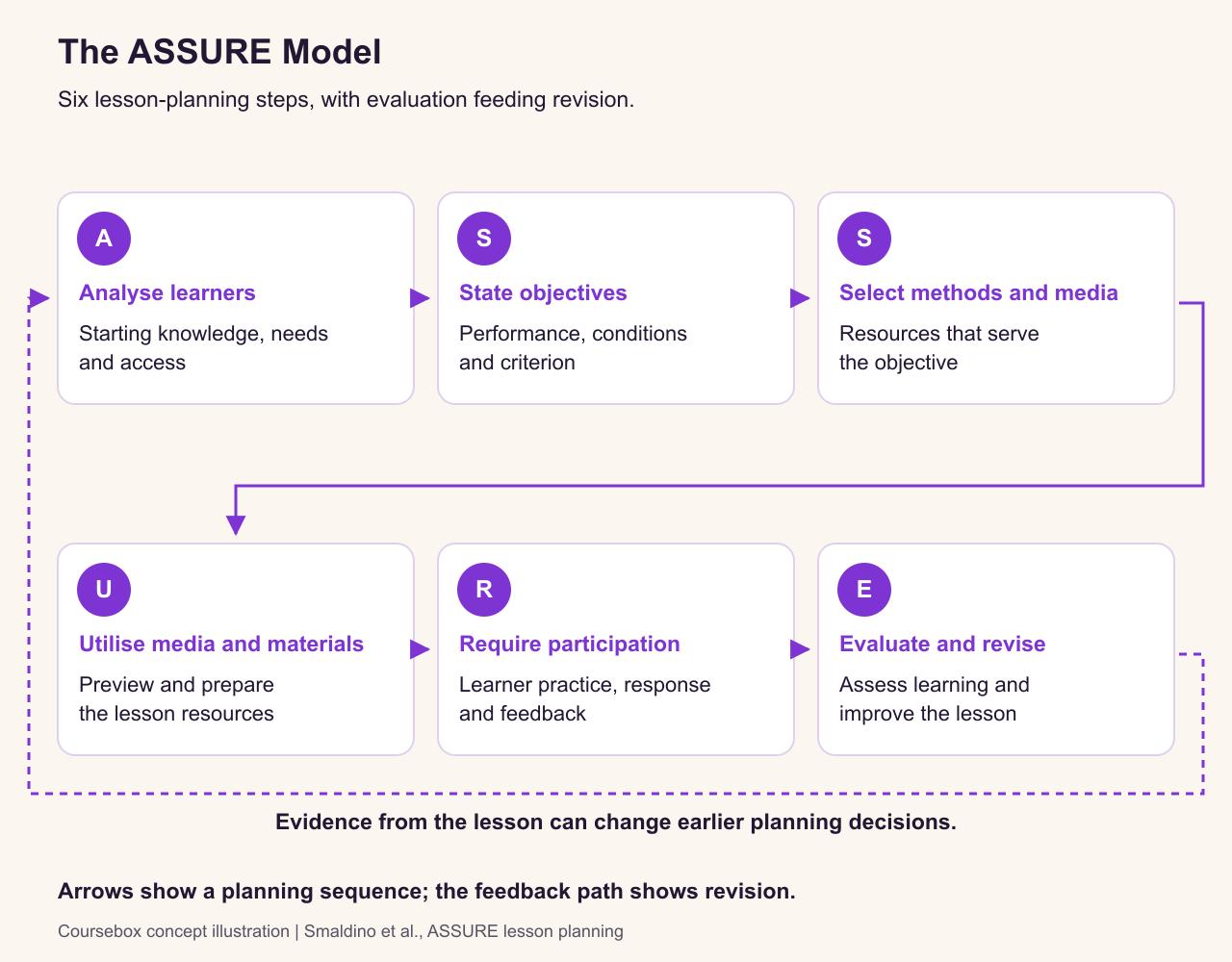
| Letter | Step | The question it answers |
|---|---|---|
| A | Analyze learners | Who are my learners, and what do they already know and need? |
| S | State standards and objectives | What will learners be able to do, to what standard? |
| S | Select strategies, technology, media and materials | Which methods and materials will help them get there? |
| U | Utilize technology, media and materials | How will I prepare and use them in the lesson? |
| R | Require learner participation | What will every learner do, and how will they get feedback? |
| E | Evaluate and revise | Did learners reach the objective, and what will I change? |

Case study: Biology lessons in Ghana
A Ghana genetics study compared two weeks of ASSURE-planned lessons for 50 senior high school students with conventional lessons for 54 students. The researchers used a pre-test and post-test, then adjusted the post-test comparison for prior scores.
Adjusted post-test means were 23.9 for ASSURE and 19.5 for the comparison group. These are ANCOVA-adjusted means, not raw class averages. The reported partial eta squared was 0.546.
Schools were assigned as whole groups and the researchers wrote the test. School and teacher differences limit causal interpretation. The practical lesson is to align the media, activities and assessment around the same genetics objective; this study does not establish that ASSURE always outperforms other planning approaches.
Plan one lesson with prompts for all six steps and the knife safety lesson filled in, plus an after-the-lesson review. Editable Word file, no email required.
Who created the ASSURE model?
Robert Heinich, Michael Molenda and James Russell introduced ASSURE in the first edition of Instructional Media and the New Technologies of Instruction, published by Wiley in 1982. The preface says it plainly: "This model is our own creation." The 1999 date you sometimes see is the sixth edition.
The book has been revised many times, which is why sources disagree on the wording of the steps:
| Edition | Selected wording in that edition |
|---|---|
| 1st edition, 1982 | Original six: Analyze learner characteristics; State objectives; Select, modify, or design materials; Utilize materials; Require learner response; Evaluate |
| 4th edition, 1993 | Analyze learners; Select media and materials; Utilize media and materials; Require learner participation; Evaluate and revise |
| 6th edition, 1999 | Select methods, media, and materials |
| 9th edition, 2008 | State standards and objectives; Select strategies, technology, media, and materials; Utilize technology, media, and materials |
The book is now called Instructional Technology and Media for Learning. Pearson’s 12th edition lists Sharon Smaldino, Deborah Lowther and Clif Mims as its authors and presents ASSURE as a lesson-planning approach for Pre-K to 12 classrooms. The audience explains its emphasis on classroom media, preparation and learner participation.
The six steps, worked through one lesson
This hypothetical lesson teaches 16 first-year commercial cookery students to cut vegetables safely in a training kitchen. It lasts 90 minutes and combines a demonstration with supervised practice and an observation of each learner's technique. Students have used knives at home, but have not learned the professional method. ASSURE helps us choose and prepare the demonstration, make time for everyone to practise, and check the skill the lesson promises.
A: Analyze learners
The book looks at learners' general characteristics (age, background, language) and their specific entry competencies: what they can already do that this lesson builds on. For the cookery class, most students have cut vegetables at home but none professionally, two need instructions in plain English, and one has a recent hand injury.
The 1993 and 1999 editions added learning styles to this step. Be careful here. A review in Psychological Science in the Public Interest found "there is no adequate evidence base to justify incorporating learning-styles assessments into general educational practice" (Pashler and colleagues, 2008). Keep the step, but analyse what does affect learning: prior knowledge, reading level, language, access needs and motivation.
S: State standards and objectives
ASSURE uses the ABCD format for objectives: the audience, the behaviour they will show, the condition under which they show it, and the degree of success required. For the cookery lesson: given a chef's knife and a cutting board, first-year commercial cookery students will dice an onion using the claw grip, with no unsafe hand position on the observation checklist.
The ABCD format grew out of Robert Mager's work on objectives, adding the audience to the performance, condition and criterion of his criterion-referenced instruction. ABCD objectives are one way to write measurable learning outcomes. The condition and degree are the easiest parts to leave out.

Case study: Primary teachers in Nigeria rated condition and degree weakest
A survey of 50 primary teachers in Oyo State, Nigeria, asked how fully they specify each part of their lesson objectives. The lowest-scoring part was stating "the acceptable standard of performance" (a mean of 2.02 on the study's scale), followed by the condition (2.42), while content was well specified (3.68) (Journal of Language Teaching and Research, 2021). The study was self-reported, and the sample was small.
The four parts of an ABCD objective, three weak-to-strong rewrites from vocational lessons, and a table for writing your own. Editable Word file, no email required.
S: Select strategies, technology, media and materials
Choose the methods and materials that fit the objective and the learners, then decide whether to use existing materials, modify them or make new ones. For the cookery lesson: a live demonstration, a slowed, captioned close-up video of the claw grip for the two students who need plain English, practice stations and a one-page safety card.
U: Utilize technology, media and materials
This step is about running the lesson well. The ninth edition sets it out as the five Ps: "Preview the technology, media, and materials; Prepare the technology, media, and materials; Prepare the environment; Prepare the learners; and Provide the learning experience." For the cookery lesson, that means checking the video plays on the kitchen screen, setting every station with a board and a guard, with a first-aid kit within reach, and briefing the class on the safety rules before anyone picks up a knife.
R: Require learner participation
Every learner should do something with the content and get feedback on it. For the cookery lesson, each student practises three cuts while the teacher and a partner check their grip against the safety card. A demonstration can help learners prepare, but watching alone does not show they can perform the cuts safely.
Media is easy to add; participation takes a deliberate decision. Every time you add a video or slides, plan the activity that goes with it.
E: Evaluate and revise
Check whether learners met the objective and whether the methods and materials worked. For the cookery lesson, observe each student against the checklist and record which cut caused unsafe grips. If errors cluster around the onion, revise that demonstration and retest the skill. The practical assessment provides Level 2 evidence in the Kirkpatrick Model; reviewing the lesson design is a separate part of ASSURE evaluation. Safe performance on work placement needs a later workplace check.
Turning an ASSURE plan into a lesson in Coursebox
ASSURE is a planning tool for the teacher, and each step's answers become the lesson. On 6 October 2026 I tested that hand-over in Coursebox, the course builder we make. I gave it my plan for the online part of the knife-handling lesson: the learner analysis (no professional experience, two students who need plain English, one recent hand injury), the ABCD objective, the captioned claw-grip video and safety card, the participation plan and the observation checklist.
Before it drafted anything, the builder asked me a question: how should the hand injury affect that student's knife practice? It recommended a teacher-approved adaptation with no forced knife use, which is the Analyze learners step doing its job. The first outline then followed the lesson rather than the model: safety rules before anyone touches a knife, a readiness check, station setup, claw-grip practice with a partner check, onion dicing, and a review of unsafe grips.
At about 1 hour 32 minutes, it was longer than the online part of a 90-minute practical should be, so I asked for about 30 minutes, keeping the safety rules, the readiness check, the slowed claw-grip demonstration and the review of unsafe cuts. When I asked it to cut the kitchen practice to one short page each, it asked how to combine the sections rather than guess, and I took its recommendation. The result was 4 sections, 10 pages and about 32 minutes: safety and readiness first, the slowed claw-grip demonstration, short station and onion-practice pages with a teacher or partner check, then a review of the unsafe cut with "stop, reset, report".
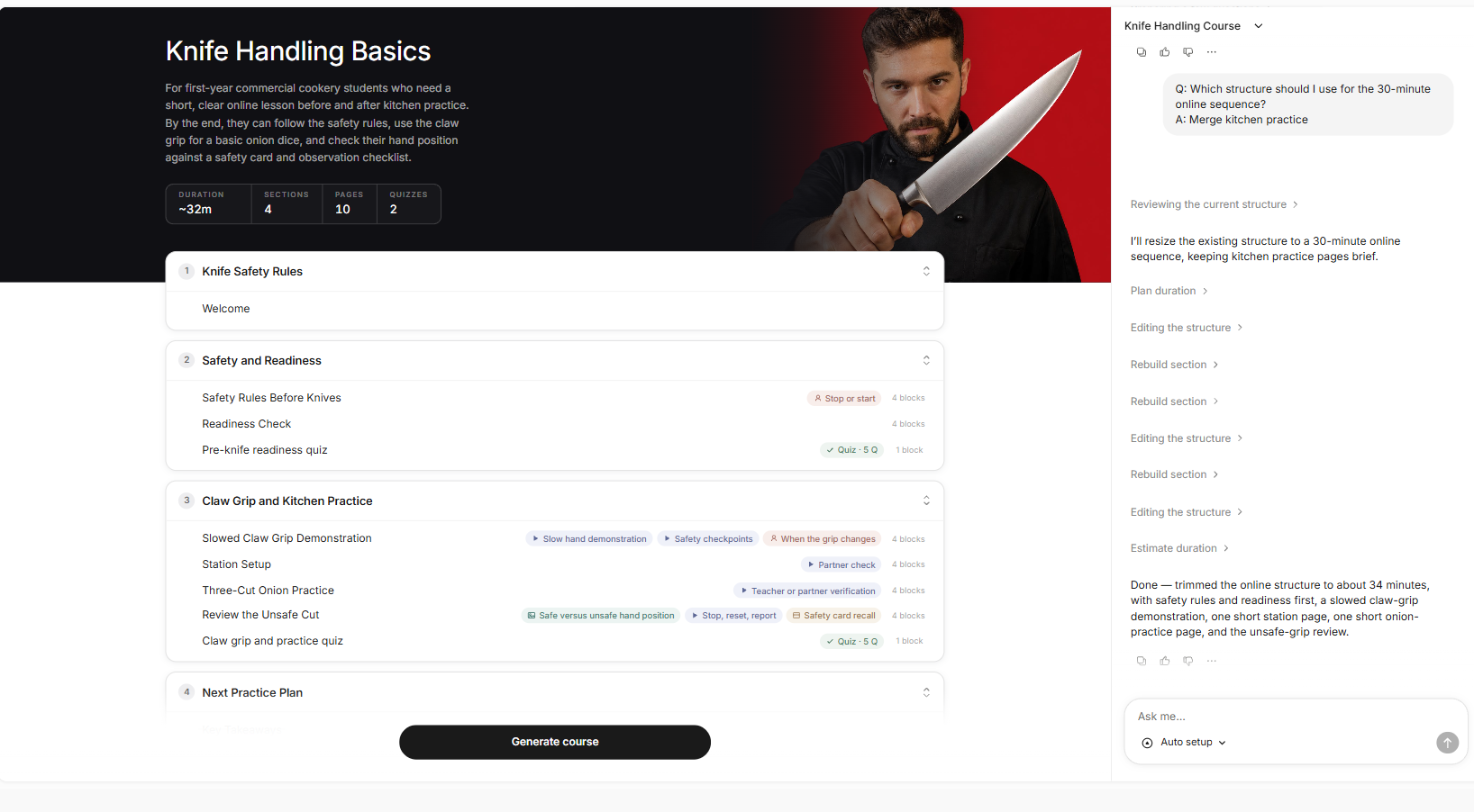
The builder handled the Select and Utilize steps quickly, and the teacher's decisions stayed in charge. The kitchen practice and the observation stay at the station with the teacher.
Our support inbox hears the same concern from teachers and trainers. A beginner adult English teacher asked us to shape each AI-built lesson like a 60-minute class: one goal, five to ten key phrases, exercises and scenarios. A UK trainer worried learners would flick through pages without reading. Forced page completion can prevent skipping, but it does not demonstrate attention or learning. Require a meaningful response instead: use the phrases in a short scenario, then give feedback against the lesson objective.
ASSURE vs ADDIE
The main difference is scope. Heinich and his co-authors said ASSURE could plan a complete programme, but in practice teachers use it for lessons and units. ADDIE is a general process for developing whole training programmes and products, often by a team. Plotnick's 1997 ERIC Digest, summarising Gustafson and Branch's survey of design models, describes classroom-oriented models as giving "a general road map" with "only a few functions" (ERIC Digest, 1997).
| Feature | ASSURE | ADDIE |
|---|---|---|
| Common scope | Often one lesson or unit; can inform larger work | Often course or programme development; can also guide a lesson |
| Typical user | A teacher or trainer | An instructional designer or team |
| Starting point | The learners in front of you | A needs analysis |
| Media and technology | A step of its own | Part of design and development |
| Objectives | ABCD format, built in | Objectives are part of Design; ABCD or another suitable format can be used |
| Best for | Planning a lesson that uses media well | Building larger training from scratch |
The two work together. A team might use ADDIE to build a commercial cookery course, and each teacher would use ASSURE to plan the individual lessons in it.
Does the ASSURE model work?
Two recent studies are useful, with caveats.

Case study: Training English teachers in Egypt to plan with ASSURE
A 12-week programme in Mansoura, Egypt trained 20 EFL teachers to plan lessons with ASSURE. The study measured teachers’ knowledge and observed instructional performance before and after the programme.
All 20 teachers improved on the study’s pre/post measures. There was no comparison group, and the author both delivered the programme and rated performance. These results concern the teachers’ measured performance, not proof of improved student attainment.
Limitations of the ASSURE model
- Lesson scale. It plans single lessons and units well, but it has little to say about needs analysis, programme structure or project management for larger training.
- Media-centred origins. It began as a model for planning the use of media in teaching, so it can pull attention towards tools and away from the task learners must perform.
- Little outcome evidence. A 2016 study in Computers in the Schools noted "there is very little empirical evidence examining the impact the model has on K-12 learning gains" (ERIC). The studies quoted here are small.
- Infrastructure. Testing the equipment and preparing resources belong within Utilise; they do not remove unreliable power or access constraints. Research on Nigerian schools identified electricity and missing materials as barriers. Prepare an offline or low-tech activity that still lets learners practise the objective.
Turn the ASSURE plan into a lesson learners can use
ASSURE helps when a lesson needs a clear connection between the learners, the objective, the resources and what everyone will do. Choosing an impressive video or requiring people to finish every page is not enough. The materials should help learners practise the intended performance, and the evaluation should tell you what to improve.
For your next lesson, write the ABCD objective before selecting the media. Prepare the resources and a workable fallback, give every learner an appropriate task with feedback, and collect evidence against the objective. In the cookery example, the assessment needs to establish safe cutting, rather than merely record that the video played smoothly. Use what learners actually do to revise the next lesson, including earlier planning decisions when necessary.
Frequently Asked Questions
Analyze learners; State standards and objectives; Select strategies, technology, media and materials; Utilize technology, media and materials; Require learner participation; Evaluate and revise.
ASSURE appeared in Heinich, Molenda and Russell’s 1982 Instructional Media and the New Technologies of Instruction. Later editions revised the wording. Pearson’s 12th edition of Instructional Technology and Media for Learning lists Smaldino, Lowther and Mims as its authors.
A lesson plan organised by the six ASSURE steps: who the learners are, an ABCD objective, the methods and materials chosen, how they will be prepared and used, what every learner will do, and how the lesson will be evaluated and improved.
ASSURE is mostly used to plan one lesson or unit with media. ADDIE is a broader process for developing whole training programmes. A team can use ADDIE for the programme and ASSURE for individual lessons.
Objectives that state the audience, the behaviour they will show, the condition under which they show it, and the degree of success required. For example: given a chef's knife and a board, first-year cookery students will dice an onion using the claw grip with no unsafe hand position.
Carolina Martin
Carolina is a highly experienced learning designer with tech start-up experience. She is based in Sydney and previously designed courses alongside Coursebox founder Travis in a previous job. She is passionate about delivering engaging learning experiences and brings the same perspective to customer experience too. She manages our customer support documentation and product testing processes.

