

10 Best SCORM Authoring Tools for e-Learning in 2026
Compare 10 SCORM authoring tools for interactive courses, PowerPoint, video and AI creation, including export behaviour, pricing and practical testing notes.

The best SCORM authoring tools in 2026 include Storyline for custom interactions, iSpring for PowerPoint, Rise for block-based courses and Coursebox for connected AI creation and delivery. Compare all ten by the content you need to build.
- SCORM 1.2 and 2004 both support scores and resume. Version 2004 adds richer interaction data, separate completion/success statuses and sequencing; test your LMS reports.
- A self-contained package is not automatically offline. Check external services, runtime support, subscription cancellation and access to editable source.
- Coursebox offers dynamic and self-hosted SCORM routes with different plan and live-feature conditions. Test the actual activity in the destination LMS.
- Accessibility, project maintenance, author seats and hosting dependencies affect the buying decision alongside the export format.
Compare four starting options using three preferences. Check the entries for required capabilities, integrations and plan conditions.

Run your own branded LMS with unlimited learners
The question I ask of a SCORM authoring tool is what happens after publishing. Can a learner leave halfway through, resume on another day and get the right score into the LMS? And when that fails, do I have enough information to diagnose it? That is where I would spend the trial.
Most instructional designers evaluating authoring tools already have an LMS. They are choosing the tool that sits between their subject matter experts and the LMS intake process, not a new delivery platform. Our own usage data makes the point: so far in 2026, of the roughly 20,000 people who generated a course with AI on Coursebox, one in five (20.9%) exported it to an external system rather than keeping it on the platform. That is the job of an authoring tool. It is the manufacturing layer, and your content has to leave cleanly and land in whatever LMS you already run.
SCORM authoring tools diverge fast once you get past the compliance checkbox. The right question to ask here is which tool was built for the kind of content you are actually making.
The SCORM decision most buyers skip
Before comparing tools, settle the reporting standard and the type of package your LMS will receive. Both affect maintenance and the learner’s experience.
SCORM 1.2 and 2004 both support scores, completion and resume behaviour. Version 2004 separates completion from success, expands interaction data and adds sequencing. It also allows more suspend data in its later editions: 64,000 characters versus 4,096 in 1.2. Match the version to your LMS and test its actual reports; neither guarantees a separate gradebook column for every question.
A self-contained package includes the course’s local files; a connected or dynamic package loads some or all of the course from its provider. Self-contained does not automatically mean offline: external media, fonts, services and the LMS runtime can still require a connection. For either type, check what happens when you cancel the authoring subscription and who can maintain the source.
Coursebox offers dynamic and self-hosted SCORM routes with different plan and feature conditions. Dynamic delivery retains a live connection, while self-hosted output excludes some live services. I would export the activity I need and test it in the actual LMS before choosing between them.
Match the SCORM version to the LMS and its reports. Then test exit, resume, a failed quiz and a completed pass. For dynamic delivery, document the hosting dependency; for self-contained output, check external services and the rights and source files needed to maintain it.
Now, I'll give an honest assessment of how SCORM authoring tools line up today.
Comparison at a glance
| Tool | Best for | Watch out for |
|---|---|---|
| Articulate Storyline 360 | Custom branching, triggers and layered interactions | Windows authoring; manage source files and test LMS reporting |
| iSpring Suite | PowerPoint into a tracked course | Desktop Suite and browser Cloud AI are different editions |
| Articulate Rise 360 | Responsive block-based authoring | Prototype the layout and interaction you need |
| Coursebox | AI creation, assessment and delivery through SCORM | Dynamic and self-hosted routes have different feature coverage |
| Adobe Captivate | Software training and simulation | VR belongs to Classic; check project and editor compatibility |
| Lectora Online | Detailed author control and accessibility checks | Authors still need to remediate and test the output |
| Elucidat (Confirm Create) | Team templates, branding, review and localisation | Current quote and publishing conditions replace old tiers |
| Easygenerator | Subject-expert authoring and maintainable content | Plan limits and the required interaction depth |
| Camtasia | Screen-recorded video with LMS tracking | Use the correct Editor/Smart Player publishing route |
| Adapt Learning | Responsive open-source authoring with technical control | Installation, plugins and ongoing support need an owner |
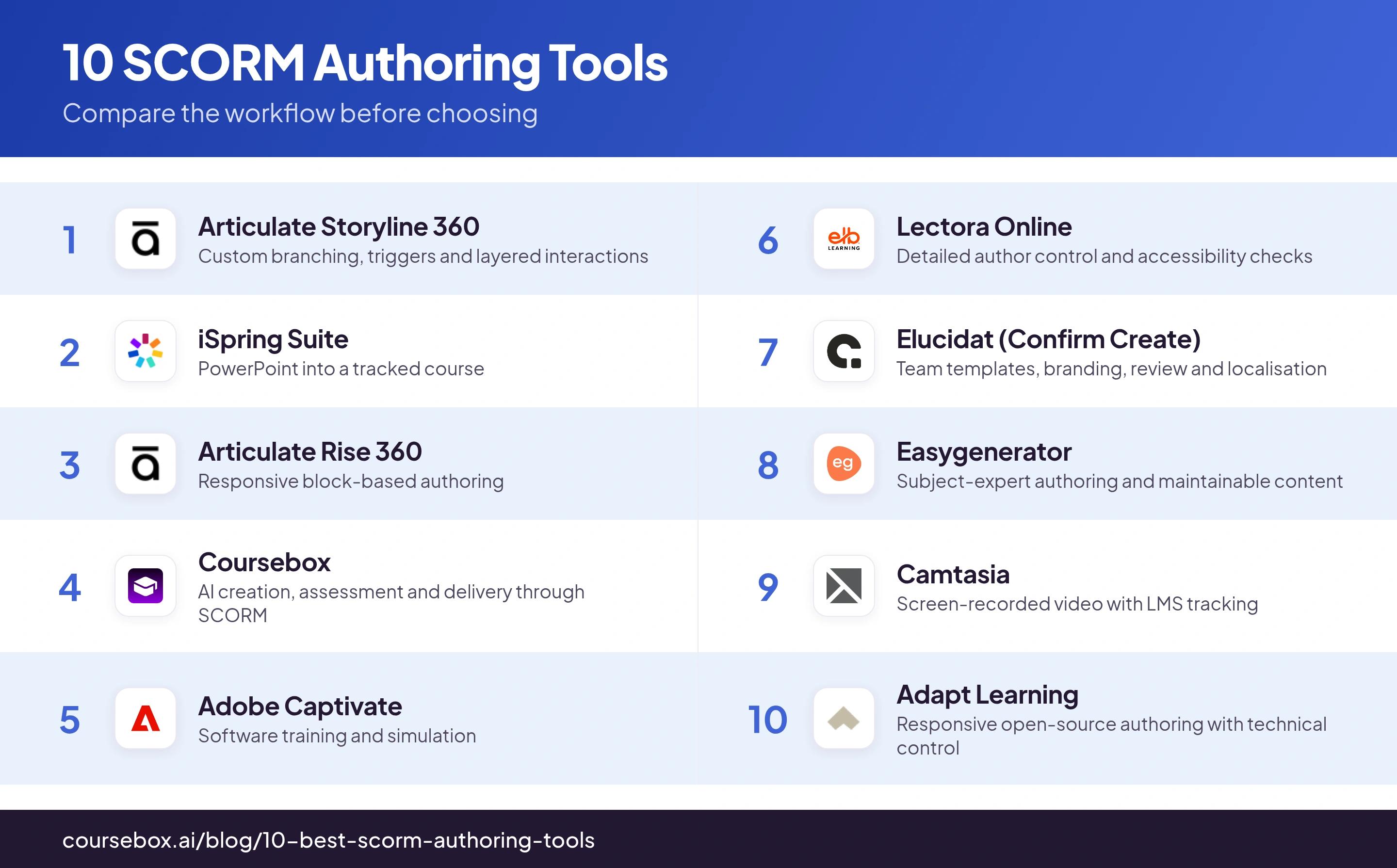
1. Articulate Storyline 360
Storyline is a familiar option for corporate L&D teams building custom interactions. Slides, layers, variables and triggers give designers control over what happens after a learner makes a choice, with a large pool of designers already used to the workflow.
Deep interaction design. 25 question types, trigger-based branching, question pools, layered slides and a 13M+ asset library. The April 2026 update added AI sync timelines and an accessible Likert component.
Publish to SCORM 1.2 or 2004 and test the actual score, status and resume behaviour in your LMS. Keep project files and dependencies backed up so a publishing fault does not leave the package as your only copy.
Windows-only (a hard blocker for Mac teams), no real-time co-authoring, and manual version control. If Storyline is too heavy or pricey, the main alternatives are covered separately.
My experience: The one thing that bit me hard: I opened a .story file straight off a network drive and it was corrupted. All the bundled media was wiped out. Storyline packs every asset into that single project file, so I now avoid editing directly on a network share. I keep projects on the local drive now and only copy the finished file across.
Pricing: Articulate 360 AI is displayed from US$1,449 per seat/year; compare Personal and Teams entitlements and any localisation purchase in the current selector.
2. iSpring Suite
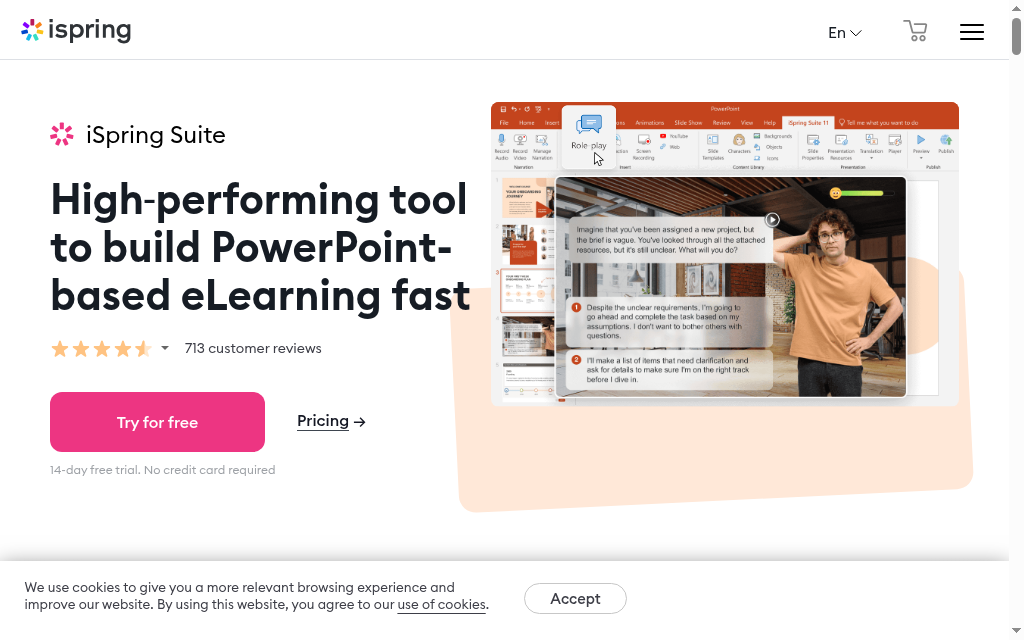
iSpring Suite installs as a PowerPoint ribbon tab. You build the course the way you always have, hit Publish, and the SCORM package comes out the other side, quizzes and narration included.
The fastest PowerPoint-to-SCORM path in the category, backed by a 134,400-item asset library, a 14-type quiz engine, and tested compatibility against 150+ LMS platforms.
iSpring supports SCORM 1.2 and 2004 and other reporting formats. A compatibility list is useful, but your own quiz settings and LMS still determine which score and completion records appear.
Suite uses the Windows and PowerPoint workflow. Check captions, narration and accessibility inside the specific quiz and interaction types you plan to use. The browser-based Cloud AI product is a separate edition, not the PowerPoint add-in running on a Mac.
My experience: On small modules, the PowerPoint workflow is instant, but the moment I loaded a course heavy with audio and video, publishing to HTML5 slowed to a crawl and noticeably stretched my build time. Also another gotcha I learned the annoying way: do not keep source files in OneDrive, iSpring does not play nicely with it.
Pricing: The inspected regional page lists Suite at EUR970/author/year and Suite AI at EUR1,290. Cloud AI is a separate EUR720 browser product. Check your currency, edition and trial offer.
3. Articulate Rise 360
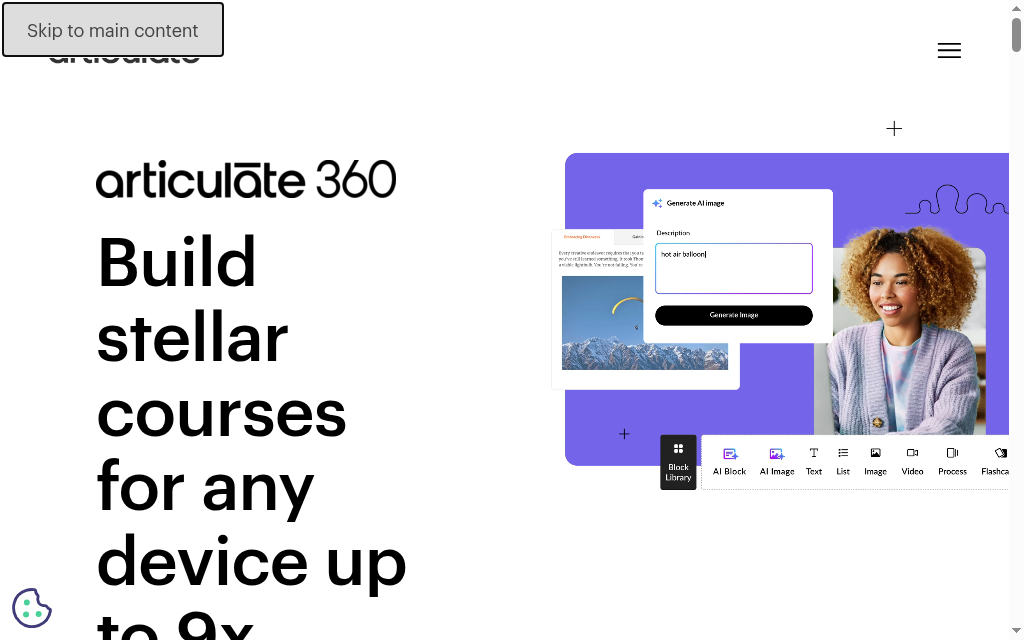
Rise 360 ships under the same Articulate 360 subscription as Storyline, so the choice between them is about workflow, not budget. Rise is the block-based, no-code path to a finished, mobile-first course.
Speed and simplicity. You assemble courses from content blocks (text, image, quiz, accordion, timeline, scenario), and the output is responsive by default. Recent AI additions estimate completion time and pull images from source docs on import.
SCORM 1.2, 2004 and xAPI. Clean, mobile-first packages.
The block system trades layout freedom for a consistent responsive course. I would build the most awkward page in the trial, checking alignment, media quality and editability before moving a large library.
My experience: Rise is one of the fastest way I have built a clean course, but the customisation is very, very limited. On one course, my text drifted out of alignment from block to block with simply no way to fix it. Images also come out softer than what I upload, Rise recompresses them on the way in and you cannot fully stop it.
Pricing: Included in the relevant Articulate 360 subscription alongside Storyline. The current page displays pricing from US$1,449/seat/year; team and localisation conditions vary.
4. Coursebox
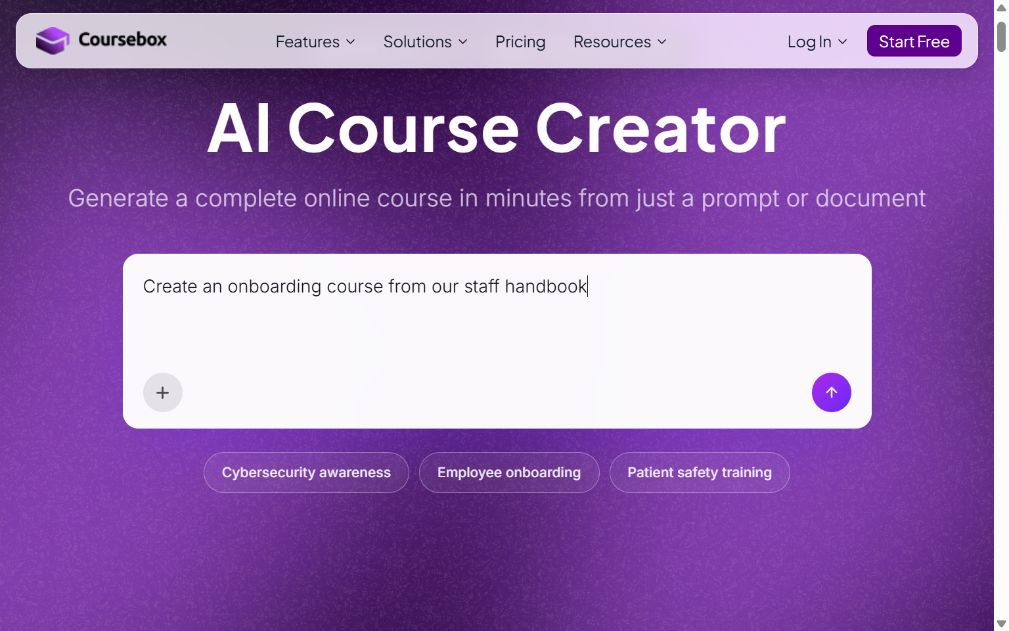
Coursebox combines AI course creation with editing, assessment, tutoring and delivery. Describe the course or provide source material, review the structure, refine the lessons and questions, then choose a supported SCORM route for the LMS you already use.
Speed from raw material to a trackable course. Median time from first AI generation to first publish is 27 minutes across 1,013 users in the last 90 days, with a quarter publishing in under 10. It offers both standalone and dynamic SCORM, so you choose per course.
SCORM 1.2 and 2004 are available through the appropriate export route. Demonstrate launch, score, completion and resume in your destination LMS, and compare the self-hosted output with live services such as the tutor.
For a complex simulation or a highly customised interaction, build a representative sample before comparing it with Storyline or Captivate. The useful difference is the amount of manual control and production work you need, rather than treating AI generation as a substitute for every kind of instructional design.
My experience: The dynamic export I tried was a small launcher that loaded the published Coursebox course. That made the hosting dependency visible immediately. For self-hosted output, I would check which live activities are omitted and test the final score and resume behaviour; SCORM 1.2 can report scores too, so 2004 is not a universal fix for a missing grade.
Pricing: Free includes three mini-courses of up to five pages each, unlimited learners, defined AI allowances and a Coursebox watermark. Paid plans expand capacity and remove the watermark; branded LMS, exports and integrations depend on the selected plan.
5. Adobe Captivate
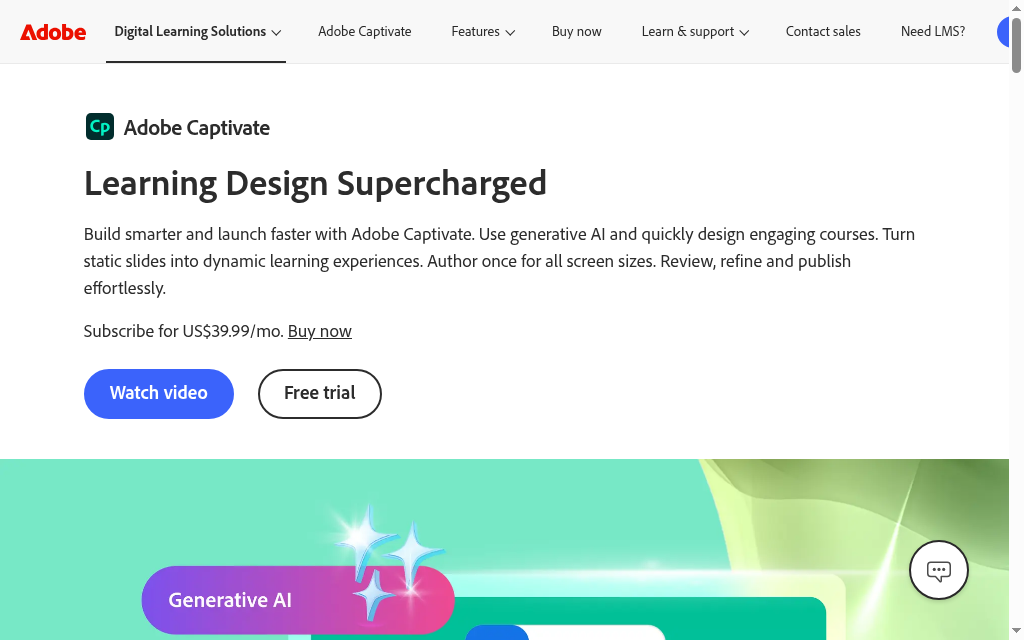
Captivate is useful for software training and interactive course design. Separate the current responsive authoring environment from Captivate Classic before evaluating an existing project or a VR workflow.
Software simulation is a reason I would compare it closely. VR and 360-degree projects are a Captivate Classic workflow; they should not be promised as identical features in the newer Captivate editor. The subscription currently includes both products.
Adobe documents SCORM 1.2, SCORM 2004, AICC and xAPI publishing. Select reporting in the project, publish the ZIP and test it in the LMS. Do not assume a format is supported just because another authoring suite includes it.
The edition and existing project format affect the learning curve. Check what imports from Classic into the current editor and what needs rebuilding, especially advanced interactions and VR content.
My experience: Captivate took me longer to feel comfortable with than Storyline. The reason I kept comparing it was software simulation. For a VR project, I would now begin by checking the Classic workflow and device support rather than assuming the newer editor has the same features.
Pricing: The current US buying guide lists US$39.99/month for an individual subscription including Captivate, Captivate Classic, storage and defined generative credits. Check the commitment and local taxes.
6. Lectora Online
Lectora gives authors detailed control over interactions and accessible course construction. Its accessibility checks can identify issues in the project, but the author still has to correct and test the output.
Reading order, keyboard operation, alternative text and focus behaviour are part of the authoring work. The built-in checker helps identify problems; publishing alone does not guarantee WCAG or Section 508 conformance.
SCORM 1.2, 2004, xAPI, cmi5, AICC and HTML5, with dedicated publish packs for SumTotal, PwC and HealthStream. Conditional branching via On Variable Change triggers.
Build the interaction and test it with keyboard and screen reader users in the trial. A percentage comparison of feature depth is not a useful substitute for checking the capabilities your course requires.
My experience: Lectora’s accessibility checker helped me find issues and work through corrections while authoring. I would still test the published package, including its media and interaction states, rather than treat a clean automated check as a full accessibility review.
Pricing: Subscription terms and authoring bundle vary. Confirm the current Lectora desktop/online, review and asset-library entitlements rather than relying on an older Studio Gold quote.
7. Elucidat
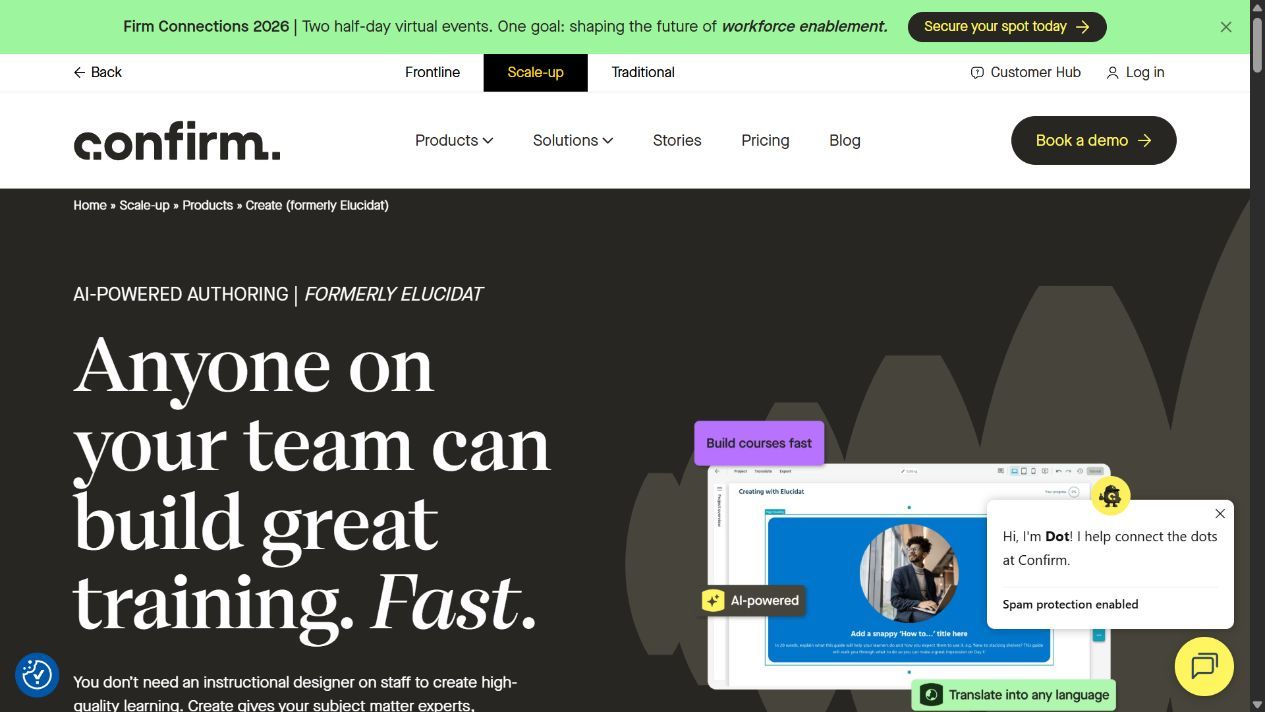
Elucidat is now offered as Create within Confirm. It remains a browser-based authoring option aimed at teams that want reusable templates, brand control, review and localisation across a large course library.
Multi-author consistency at scale: template governance, Auto-Translate across 75+ languages, and organisation-wide review access.
SCORM 1.2 and 2004 (3rd and 4th edition support added April 2025, closing an earlier sequencing gap).
The current offer is quote-based. Include authors, review access, branding, localisation and publishing rights in the proposal rather than assume an older Growth-tier price and watermark rule still apply.
My experience: Templates and review controls helped keep a group of authors consistent. I would price that shared workflow against the time spent repairing inconsistent courses, then check the current branding and publishing entitlements in the contract.
Pricing: Now sold as Create within Confirm. Current pricing is by quote; include authors, review, localisation, branding and publishing conditions.
8. Easygenerator
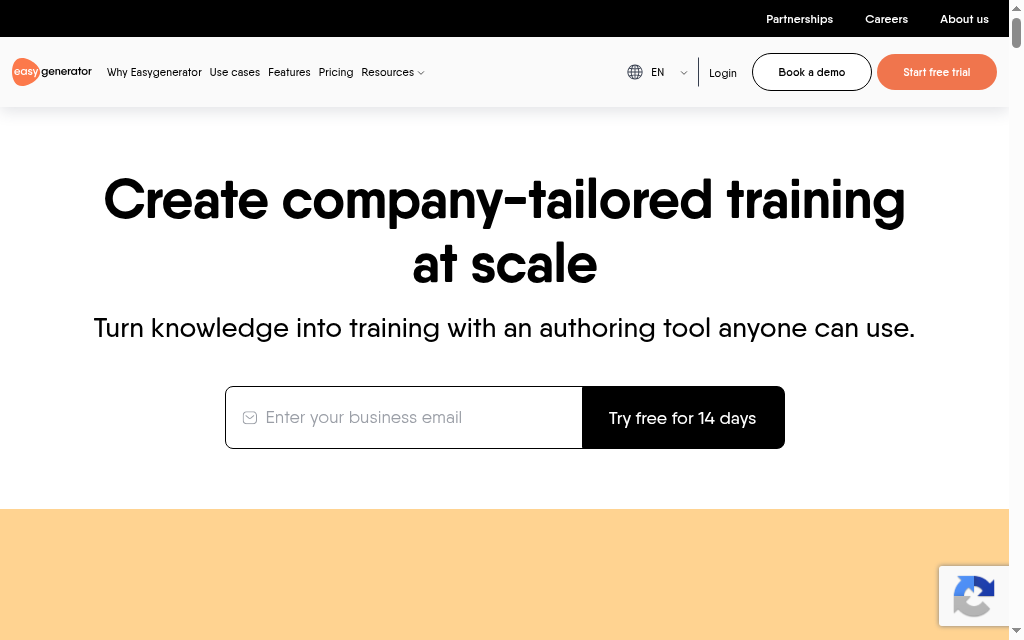
Easygenerator is built for SMEs to author without an instructional designer, and its standout is dynamic SCORM: fix a typo in the source and it propagates to learners already mid-course, no repackage-and-re-upload cycle.
Dynamic publishing can reduce repackaging work when source content changes. Several tools here offer connected delivery, so compare how updates affect an existing learner attempt and what depends on an active hosted account.
Compare the standard SCORM and connected publishing routes in the selected plan. Demonstrate an update while a learner has an unfinished attempt, and check how the LMS records the next visit.
The workflow favours subject experts creating focused learning content. If the course needs branching, screen simulation or complex question-bank behaviour, build that activity in the trial before committing.
My experience: Easygenerator got a subject expert into the editor quickly. I reached its limits when trying to build the more specialised interaction I had in mind. That would make me prototype the hardest activity first, rather than judge it only by a straightforward text lesson.
Pricing: Pro is US$1,499/year for one author, 10 courses and 100 learners. Team is US$7,495/year, starting at five authors with unlimited courses and learners. Taxes and plan-specific features apply.
9. Camtasia
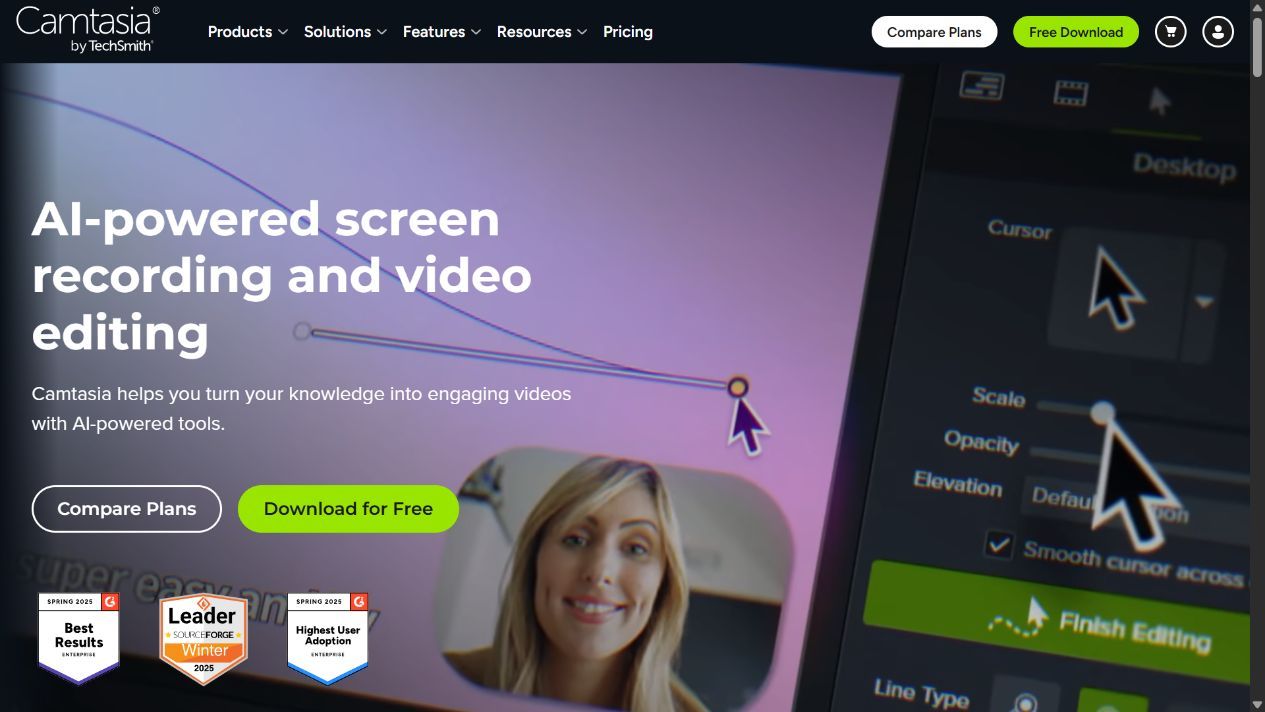
Camtasia is a screen-recorder and video editor that happens to export SCORM. The SCORM capability is real and works, but it is not the reason anyone buys it.
Screen-recorded video training. Where video is the primary medium and SCORM is just the LMS wrapper, it is a clean fit. Runs on both Windows and Mac, unlike Storyline and iSpring.
Bundles video, quizzes and completion tracking into a SCORM package most LMS platforms accept. Best kept to video-based content, not branching courses.
Keep the editable project and a tested export. For assessment, demonstrate the intended score and completion rules in the LMS rather than assuming a video view or an embedded question produces the record you need.
My experience: A package I tried recorded completion but did not show the quiz score where I expected it. I would investigate the publish settings and LMS report before treating that as a general limit. TechSmith retired its hosted Results Service, but still documents SCORM delivery for collecting results through an LMS.
Pricing: Paid Editor subscriptions and a separate free online recorder are different offers. Choose the desktop package with the required Smart Player/SCORM workflow and check current renewal terms.
10. Adapt Learning
Adapt is a free, open-source framework with a separate authoring tool and community plugins. It suits a team that can manage the technical setup and wants control over the resulting responsive learning content.
Clean, accessible, fully responsive HTML5 output, with a plugin ecosystem that covers interactions commercial tools charge extra for.
SCORM 1.2, 2004 and xAPI, standards-compliant and clean.
The self-hosted authoring tool needs installation, updates and support from your team or a provider. Hosted Adapt-based services also exist, so distinguish the open-source project from a commercial hosting agreement.
My experience: I liked the responsive output, but installation and plugin compatibility took technical work. I would budget for that development and test the finished interaction for accessibility, rather than assume HTML output makes every course accessible.
Pricing: No open-source licence fee. Budget developer time, hosting, upgrades and any commercial support or managed service.
How I would actually split this
Slide-first teams with existing PowerPoint content belong in iSpring Suite. The single-click publish from the authoring environment you already use is the fastest path to a SCORM package in this category, and the 150-plus LMS compatibility record means the output lands cleanly wherever it goes.
Storyline 360 is the right answer when the project requires complex branching, question pool randomisation, layered interaction design or software simulation. If the brief goes past a linear slide sequence into adaptive pathways or procedural training, nothing else in this list competes at that depth.
Coursebox is where I would start for knowledge-transfer content going into an existing LMS. The time from first AI generation to a published SCORM package is measurably shorter than any other workflow in this list. The limitation is interaction depth: when the brief involves complex branching or simulation, the tool is not the right fit.
Most teams do not need Captivate. It is the right tool for VR, 360-degree content and deep software simulation, and I would not start a new project there for anything outside those requirements. The mastery investment is steep and the use case is narrow in most L&D contexts.
Past publishing problems made me wary of judging a tool from a polished demo. Use the most complex project you actually need to build, keep the source backed up, and inspect the score, completion and resume records in the destination LMS. That trial tells you more than a long list of supported standards.
Disclosure: Coursebox is the AI course creation platform built by the team I work with. I have ranked it at #4, where I believe it honestly sits in this comparison, and I have covered its limitations directly in the entry above. All other tools in this list were evaluated through user testing, publicly available product information, pricing pages, vendor changelogs and practitioner sentiment from Capterra, G2 and eLearning Industry.
Frequently Asked Questions
It is software that builds e-learning content and packages it as a SCORM file (a zipped set of web files plus a manifest) that any SCORM-compliant LMS can import, play and track for completion and scores. The authoring tool is the manufacturing layer; your LMS is where the finished course runs.
Both support scores, completion and resume. Compare the LMS’s version support and reporting; 2004 adds separate completion/success states, richer interaction data and sequencing. Later 2004 editions also allow more suspend data. Test a real attempt, exit, resume and completed assessment.
Rise 360, iSpring Suite (if you already live in PowerPoint), or an AI-first tool like Coursebox. They get you to a publishable SCORM course fastest, with the trade-off of shallower interactivity than Storyline or Captivate.
Adapt is open-source with technical setup and operating costs. Other tools offer trials or limited free access; Coursebox Free includes mini-courses and AI allowances, while exports have plan conditions. Confirm that the free offer includes the actual publishing route you need.
No. An LMS can track its own lessons, quizzes and assignments without SCORM. SCORM is useful when you need to move an authored package between systems and exchange supported progress or assessment data. A plain video’s tracking depends on the LMS and player rather than its file extension alone.
Carolina Martin
Carolina is a highly experienced learning designer with tech start-up experience. She is based in Sydney and previously designed courses alongside Coursebox founder Travis in a previous job. She is passionate about delivering engaging learning experiences and brings the same perspective to customer experience too. She manages our customer support documentation and product testing processes.

