

How to Write Training Survey Questions That Work?
Learn the 4 types of effective training survey questions and proven steps to eliminate bias. Ensure your L&D evaluations deliver accurate data for improvement.


Set up your branded LMS and deliver training with AI
There is no doubt that employee training and development is the lifeline of talent retention and competitive advantage. However, no learning and development (L&D) program can meet its objectives without training surveys that measure its impact and identify crucial areas for refinement.
Training survey questions are the backbone of this strategic process that moves beyond simple attendance figures. They are an excellent first step to conduct corporate training evaluations, benchmark the impact of workplace training programs, and provide insights for improvement.
Remember that participant feedback requires careful handling and must be developed through intensive research and planning. If you are looking to design evaluations that deliver unbiased and actionable results, this is your definitive guide to writing training survey questions that work.
Key Takeaways: Tips to Write Training Survey Questions
- Prioritize Bias-Free Design: Always use simple, neutral language and avoid emotional or leading words to ensure honest participant feedback.
- Maintain Focused Structure: Structure questions to address only one idea at a time (avoid double-barrelled questions). The answer scales should be balanced and symmetrical around a neutral point.
- Evaluate Across Stages: Utilize different question types like pre-training, mid-pulse, post-training, and follow-up. It will help you measure learning progress at every stage, from knowledge gaps to on-the-job application.
- Keep it Concise: Protect against survey fatigue by keeping the questionnaire brief and relevant, ideally with fewer than 15 focused questions.
What are Training Survey Questions?
Training survey questions are a powerful tool for gathering participant feedback on a professional training program. They are usually a set of questions or inquiries used to measure the success, relevance, and overall impact of any learning event or course.
These questions aim to move beyond simple satisfaction and target more complex areas, such as instructional design, logistics adequacy, and the professional quality of delivery.
This feedback mechanism helps learning and development teams collect insights from participants to evaluate various critical aspects. These range from the immediate instruction quality and facility setup to the long-term application of knowledge and actual learning outcomes on the job.
How to Write Bias-Free Training Survey Questions
A bias is a tendency or prejudice toward or against something. Biased questions direct participants to respond how they think they should, rather than how they truly feel.
In the context of a training survey, biased questions can completely distort your results and undermine the integrity of the data.
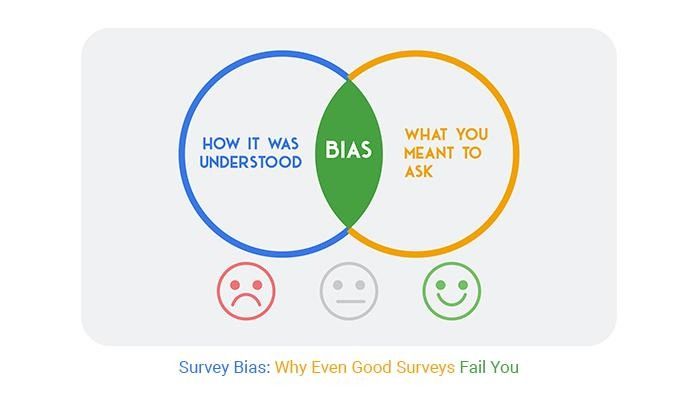
Creating a neutral and bias-free survey is the first crucial step. It helps design and delivers training programs truly aligned with learner needs and organizational goals. Here is a step-by-step guide on how to write training survey questions:
Step 1: Use Simple Language That Everyone Understands
The first step is to phrase your survey questions in a simple and accessible language. The meaning of the question should be easy to understand for every employee. Experts, like the University of Minnesota, suggest using everyday language and avoiding jargon that can confuse participants.
Always ensure questions are unambiguous, so respondents understand exactly what is being requested. For example, a clear and straightforward question is: “How relevant do you think this training will be to your current job duties?” This structure is a clear prompt that instantly delivers the request you are trying to ask.
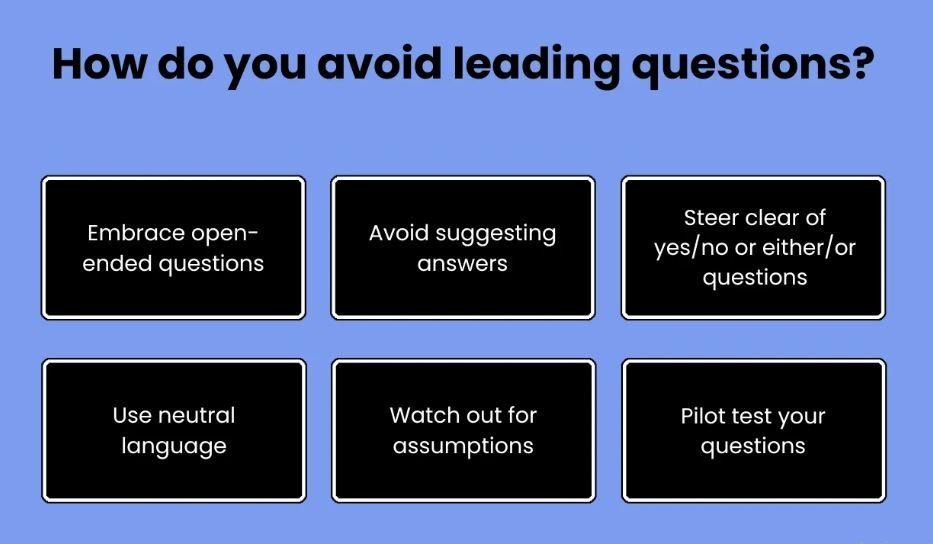
Step 2: Avoid Leading or Emotional Wording
Leading or emotional questions are statements that indirectly push people towards a particular answer. These questions carry a strong positive or negative connotation, as they can introduce bias into the responses. This includes emotional words like “love,” “disappointed,” “happy,” or “angry.”
Let's say “Did you find the instructor’s talk highly useful?” This question pressures the respondent for a positive rating. Instead, you can ask a neutral question: “How useful was the instructor's presentation?” Loaded questions can force respondents to accept a premise that may not be true before they can answer. Therefore, stick to neutral and objective language.
Step 3: Focus on One Idea Per Question
You might have heard of the term double-barrelled questions. These are single survey questions that ask about two or more different topics at once. When a question combines multiple topics, respondents, however, are only given space to provide one answer.
Such questions can put the respondent in a tight spot, create confusion, and result in unreliable data. One of the very common examples is “Do you find your work rewarding and stress-free?” Now, a job can be rewarding while still being stressful. This means these are two different concepts and should be asked separately.
Step 4: Give Neutral, Balanced Answer Choices
Just like the questions, the answer choices should be symmetrical and balanced around a neutral midpoint. You must have an equal number of positive options and negative options. This means two positive choices require two negative choices. Include a clear neutral option, such as “Neither Agree nor Disagree.” The scale should look like:
- Strongly Agree
- Agree
- Neither Agree nor Disagree
- Disagree
- Strongly Disagree
This balanced approach ensures that the data accurately reflects the distribution of opinions and provides a reliable measure of training effectiveness.
Why Training Surveys Fail
Research indicates that only 44% of employees are satisfied with learning and training initiatives. One major reason for this dissatisfaction is that organizations do not properly evaluate programs. While there are many factors, training surveys often fail due to poor design, unclear objectives, and a fundamental failure to act on the results.
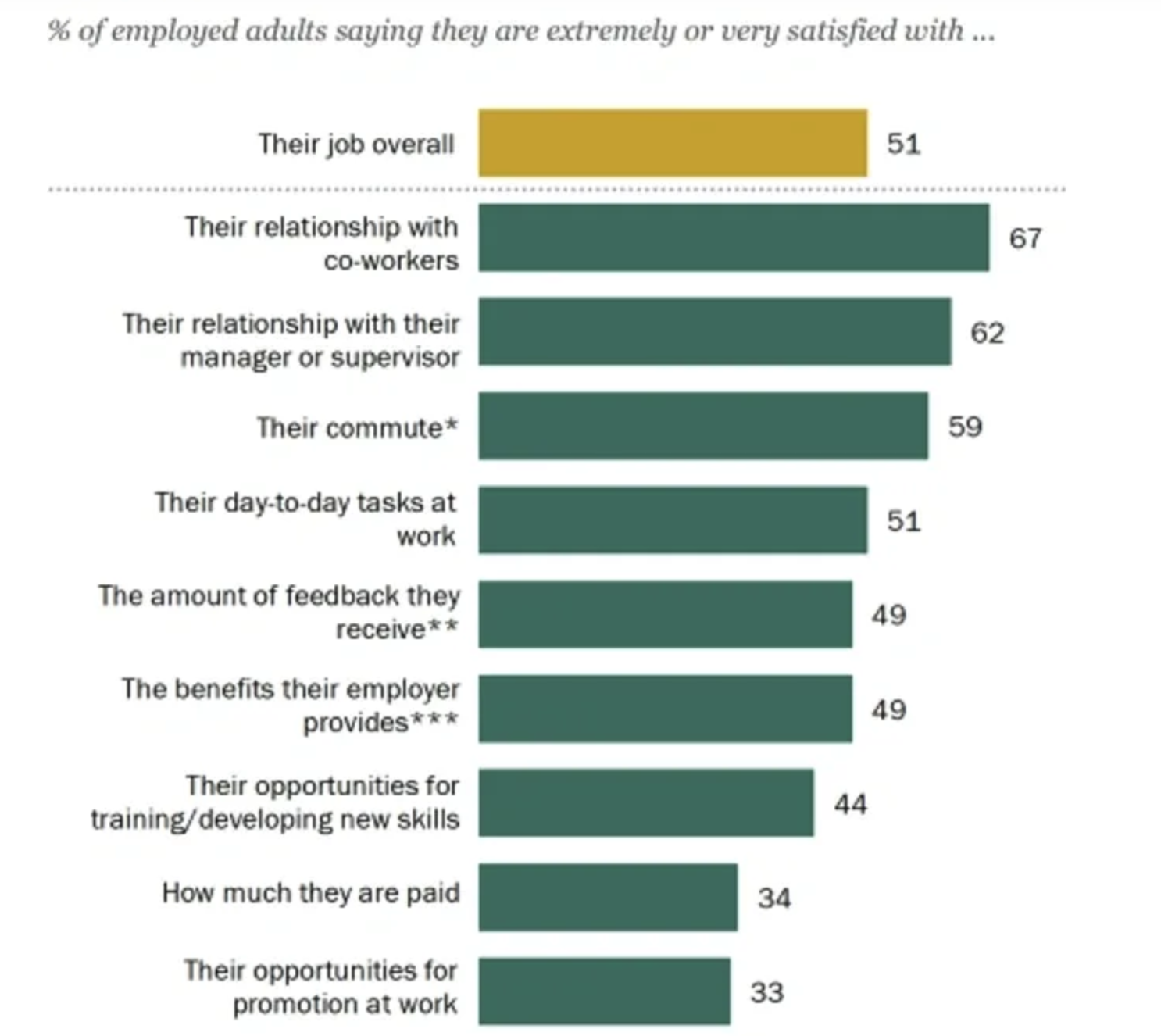
Here are the key reasons why training surveys underperform:
- Excessive Length: Surveys that are too long can cause respondent fatigue. This leads to dismissive, random, or incomplete answers, and ultimately invalidates the data.
- Lack of Pre-Testing: Failing to test the survey allows confusing or ambiguous questions to slip through. It compromises the integrity of the collected feedback and wastes organizational resources.
- Unclear Objectives: Surveys underperform when data is collected without a clear objective. Therefore, they must be explicitly tied to specific business goals or documented employee skill gaps.
- Inaction on Results: Employees lose their trust in the process when they don’t see any tangible changes on their feedback. This failure to demonstrate follow-through erodes make staff highly unlikely to participate honestly in any future evaluation efforts.
Types of Training Survey Questions You Should Use
Once you understand the importance of well-designed training surveys, the next step is to identify what questions to ask. These questions must be relevant for your employees and deliver actionable data.
We have broken the process into distinct evaluation stages. This structured approach helps create a training roadmap with measurable results.
1. Pre-Training Questions
A pre-training assessment is the most critical step in preparation. It helps you understand your employees’ skill gaps, current knowledge levels, and any special needs that may require assistive equipment. It also clarifies training delivery preferences, such as video for visual learners or lectures for auditory learners.
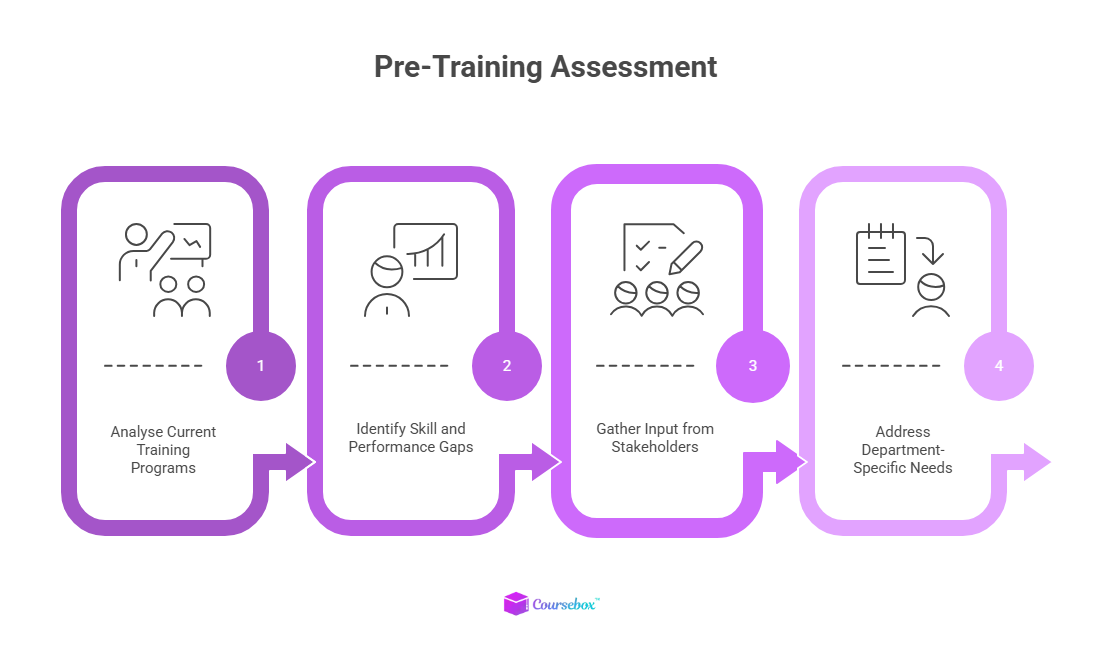
With this information, you can structure your training appropriately to meet the needs of your entire group effectively. Below are some good examples of pre-training survey questions:
- On a scale of 1 to 5 (1 = Not at all knowledgeable, 5 = Expert), how would you rate your current knowledge?
- What is the one thing you most hope to learn or take away from this course?
- How often do you currently perform tasks related to [Training Topic] in your job?
- Do you require any specific assistive technologies to fully participate in the training?
- Which delivery method do you generally find most engaging for technical content?
2. Mid-Training Pulse Check Questions
Mid-training surveys are an underrated but very valuable aspect of employee training. Global employee engagement is low, and organizations should not miss a chance to connect with staff.
Mid-training surveys allow for immediate adjustments to improve the learning experience and provide early insight into trainee comprehension. They also respect the learner's autonomy by involving them in the process. Some of the good mid-training questions could be:
- Do you feel the pace of the content covered so far is appropriate?
- How clearly do you understand the concepts covered in the last module?
- Can you identify one skill learned so far that you could immediately apply to your job?
- Did the instructor answer your questions clearly?
- How appropriate were the exercises and activities created to support the concepts?
3. Post-Training Evaluation Questions
Post-training evaluation measures the outcomes of your training sessions. You can determine whether the learning goals have been met or need further improvement. Gathering participant feedback on content, delivery, and relevance helps fine-tune future programs, boost engagement, and assess ROI for organizational goal achievement.
For a post-training survey, include questions that give you honest and unfiltered insights about the session's effectiveness and future improvements:
- On a scale of 1 to 10, how valuable was this training investment for your professional growth?
- Was the amount of time dedicated to interactive activities (e.g., Q&A, group exercises) appropriate?
- Which specific module or topic should be explored in greater detail in the future?
- List two specific tasks from your current job where you plan to use the knowledge gained from this training.
- How effective was the trainer at facilitating discussion and responding to participant questions?
4. Follow-Up Application Questions
The power of follow-through in employee training cannot be overstated. Follow-up application surveys are assessments conducted weeks or months after the initial training to determine if participants are actually applying the new skills and knowledge on the job.
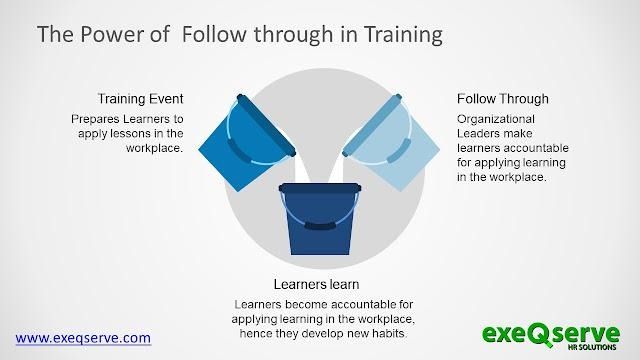
This crucial step embeds an accountability culture in the organization and provides hard data on the success of behavioral transfer. These questions are often directed at both the trainee and their manager to gather a 360-degree view of behavioral change:
- Describe a specific situation where you successfully applied a concept learned in the training.
- Since the training, how often have you used the (Specific Skill) in your work?
- To what extent have you shared or taught the content learned in the training to your colleagues?
- Do the new skills feel like a natural part of your daily workflow now?
- To what extent has your manager provided you with opportunities to use the new skills since the training concluded?
Question Formats That Improve Response Quality
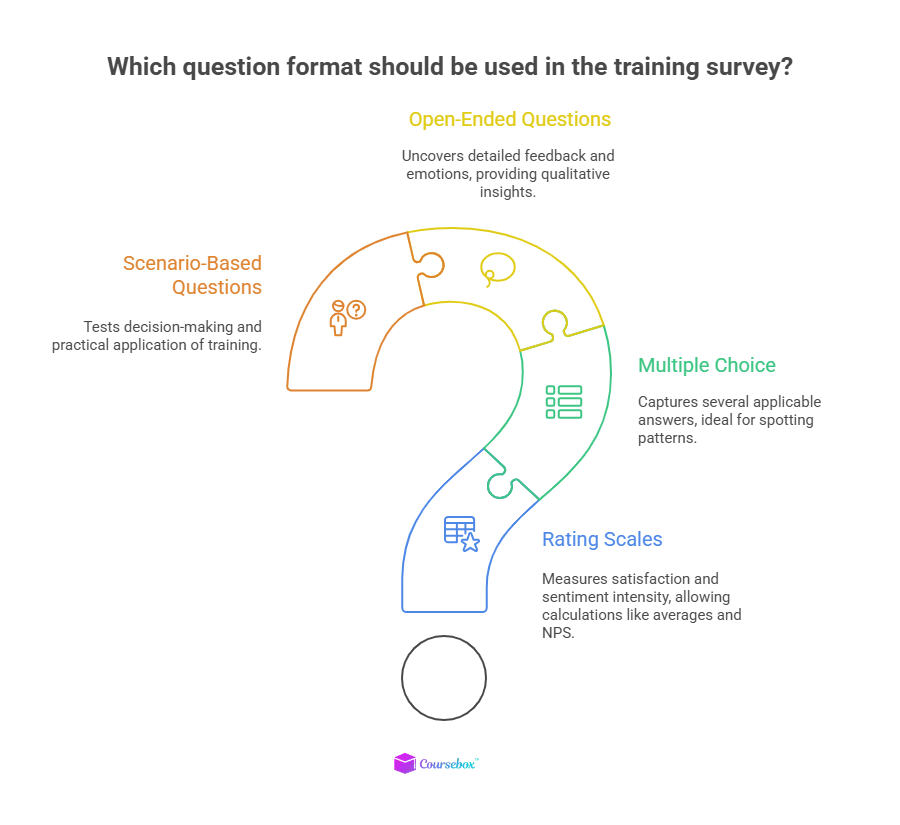
The way a training survey question is structured is extremely important. Use a variety of question formats to capture different perspectives and insights, and more reliable data than relying on a single style.
1. Rating Scales
Rating scales ask the respondent to select a numerical value or a point on a scale. For example:
How would you rate the clarity of the instructor's presentation?
Options: 1 (Poor) - 2 (Fair) - 3 (Good) - 4 (Very Good) - 5 (Excellent)
These questions are more useful when you want to measure the intensity of user sentiment or satisfaction levels. It allows you to perform certain calculations, such as averages, CSAT (customer satisfaction score), and net promoter score (NPS).
2. Multiple Choice and Single Choice
A multiple-answer question offers different answers and allows respondents to choose more than one option from a list. Let's say:
Which topics do you feel need further review? (Select all that apply)
- Advanced data analytics
- Project budgeting fundamentals
- Client communication scripts
- Time management techniques
3. Open-Ended Questions
An open-ended question allows respondents to provide written answers in their own words in a text box. For Example:
What specific barriers prevent you from applying the new budgeting procedure?
Option: [Text Box for written response]
Open-ended questions help respondents express their feelings, emotions, experiences, and in-depth knowledge related to a specific subject, scenario, or situation. They are best for gathering qualitative insights. However, reading the data is time-consuming, which can lead to negative or unstructured comments.
4. Scenario-Based Questions
Scenario-based questions present hypothetical or real-world work situations to assess a candidate's problem-solving, critical thinking, and decision-making skills. For instance:
A key stakeholder rejects your new project proposal. What is the immediate next step you would take?
- Rework the entire proposal immediately
- Schedule a follow-up meeting to understand their specific concerns
- Forward the rejection to your manager for them to handle
- Proceed with the original plan without stakeholder approval
Scenario-based questions are highly effective in competency-based training evaluation. They assess the practical application of learned skills rather than just theoretical recall.
Traps to Avoid When Writing Training Survey Questions
While detailed surveys may seem thorough, excessive length and complexity can be a trap that compromises data quality. We have listed some of the most common traps and pitfalls that you should intentionally avoid for collecting reliable, unbiased feedback.
1. Asking Too Many Questions
The ideal number of survey questions often sits between 10 and 15, though some research suggests up to 25 to 30 for complex training. Keep your training survey questions brief and focused.
Asking too many questions leads to survey fatigue and causes respondents to rush, answer randomly, or abandon the survey entirely. This dramatically lowers the completion rate and invalidates the integrity of the collected data.
2. Using Jargon or Technical Terms
A questionnaire should not be a test of vocabulary or an exercise in using a thesaurus. Avoid using overly technical or complicated terms that may confuse participants who are not specialists.
For instance, if you are conducting a survey on sales and customer support training, instead of asking about “client relationship management protocols,” you can use the more accessible phrase “how you handle customer follow-up after a sale.”
3. Forcing Answers to Sensitive Questions
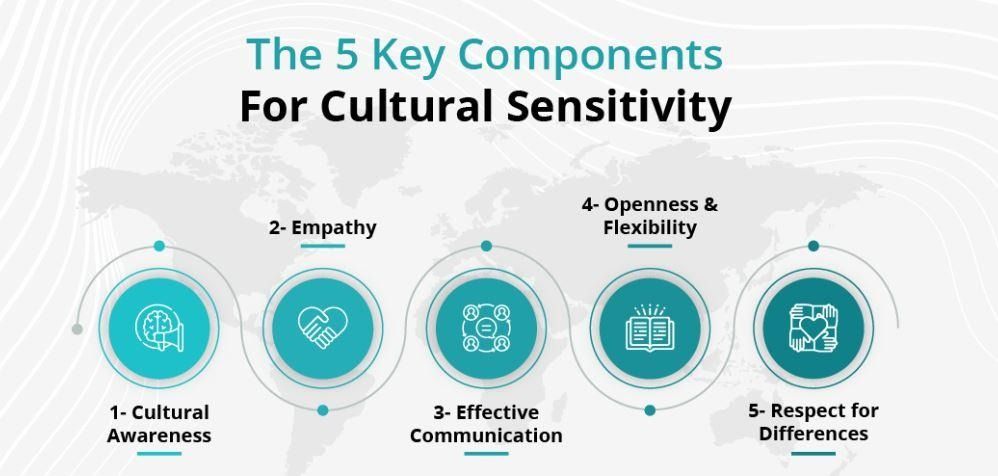
Cultural and ethnic sensitivity is not just a trend but a necessity in 2025. The focus of training evaluation should be on understanding cultural differences and promoting an inclusive environment.
Do not force the respondents to answer personal or demographic questions that can make them uncomfortable or violate their privacy. Always provide a “Prefer not to answer” or “Other” option for sensitive questions or remarks.
Transforming Feedback into Action with Coursebox

Training surveys are designed to drive continuous improvement and maximize your organization's investment in its people. Designing survey questions that are bias-free, focused, and tailored to the different stages of learning transforms subjective opinions into actionable strategic insights.
Remember, the most critical step is the follow-through: demonstrate that employee feedback leads to real change, builds trust, and guarantees high participation in future initiatives.
The power of training surveys needs a seamless platform for easy execution and robust analysis. Coursebox supports your learning and development journey like a dedicated assistant. As an AI-powered platform, it helps you rapidly create engaging training courses, generate quizzes, assessments, and interactive content.
Sign up for a free trial and see how we can instantly elevate your employee training programs.
FAQs
1. Which tools are best for creating training surveys?
The best tools for training surveys blend user-friendliness with robust analytics and integration capabilities. Platforms like SurveyMonkey, Qualtrics, and Google Forms are popular choices for general surveying needs. For a complete solution, Coursebox is highly recommended as an AI-powered platform that seamlessly integrates survey creation, course delivery, and assessment analytics in one place.
2. Should I mix open-ended and rating questions?
Yes, mixing open-ended and rating questions is essential for collecting rich, comprehensive data. Rating scales provide quantitative data needed for trend analysis and benchmarking, while open-ended questions provide qualitative context. Use an open-ended question after a rating question to understand the why behind a specific score or to gather unexpected insights.
3. Can I use the same survey questions for every training session?
You should avoid using the exact same questions for every session, as this often leads to generic data with little value. Core questions about logistics or instructor effectiveness can be standardized, but the majority must be tailored. Customize questions to reflect the unique content, learning objectives, and expected job application of each training program.
4. What’s the ideal number of questions for a training survey?
The ideal number of questions typically falls between 10 and 15 focused items. The priority is protecting against survey fatigue, which causes rushed answers and lowers data integrity. For highly complex or long-term training programs, you might extend this to 20–30 questions. Keeping it brief maximizes the completion rate and the reliability of your feedback.
Travis Clapp
Travis Clapp is the original founder and CEO of Coursebox. As an experienced instructional designer, he has lived through the process of building high quality courses. These experiences brought about his idea to upload all your documents and ideas into a virtual box that could convert those magically into a course. Prior to Coursebox, he successfully founded and built a social based LMS. Travis has 15+ years of experience designing courses and EdTech platforms from university MOOCs to enterprise LMS. Travis has built training for reputable companies like Johnson & Johnson, Electrolux, Michael Hill and SA Health. One of his courses reached 20,000+ learners which was a flagship edX course. He is based in the Adelaide, South Australia office and passionately works on customer support, sales and bringing the original product vision to life every day.

