

10 Best Podia Alternatives, Ranked by What They Cost Before You Sell Anything
Podia dropped its free plan and its entry tier is now $42 a month plus 5%. Ten alternatives ranked on what they cost before you have made a single sale.

The best Podia alternative depends on why you are leaving. If it was losing the free plan, Systeme.io and Coursebox both let you keep selling at zero with unlimited learners. If it was for its teaching capability, Coursebox and Teachable make the cut.
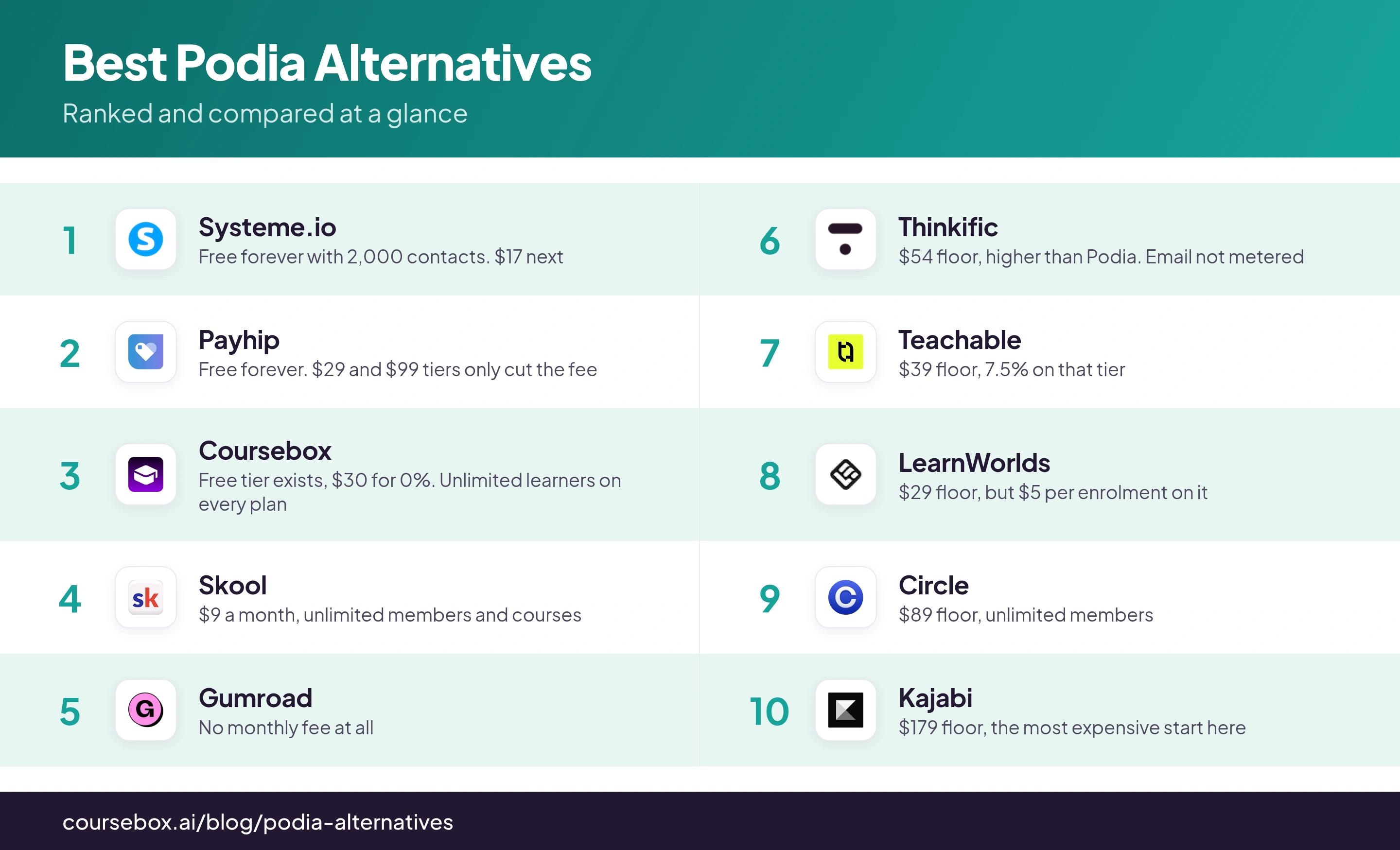
- Systeme.io: best if losing the free plan was your reason, with a genuine free tier of 2,000 contacts and one course.
- Coursebox: best if Podia could not teach, with AI-built quizzes and grading, unlimited learners and zero cut on paid plans.
- Payhip: best pay-as-you-sell option, no monthly fee, 5% on the free plan dropping to 0% at $99 a month.
- Skip Kajabi unless your problem is marketing, not price; it starts at $179 a month.
Answer three quick questions and we'll point you to the best fit from this list.

Build, launch and sell quality courses in minutes
Podia used to be the easy answer for a creator who had not sold anything yet: simple, good-looking and most importantly, free to start. That changed on 14 October 2024, when Podia removed its free plan. New creators now get a 30-day trial, and then a bill.
So the reason people leave Podia is not really features. It is money. You now pay from day one, $42 a month plus 5% of every sale, before you have proved anything works. Today, we will look at real Podia alternatives that are easy on the wallet.
One disclosure up front: Coursebox is ours. It sits at number three below, with its weaknesses written into the entry along with everything else.
The free plan that made Podia the easy place to start is gone, as of 14 October 2024. New creators now get a 30-day trial, then a bill. Here is what Podia charges today:
- Mover, $42 a month, 5% of every sale, 100 subscribers, 50 products, 500 videos.
- Shaker, $84 a month, no transaction fee, 500 subscribers, 150 products, 1,000 videos. PayPal, affiliates and upsells unlock here.
- Earthquaker, $150 a month, no fee, 1,000 subscribers, unlimited everything.
Stripe or PayPal take 2.9% + 30c on top. Most creators sit well under the entry cap, so the cap is not what bites; paying $42 a month and 5% before a single sale is.
How I graded these
- Cost as you grow. What you pay before your first sale, and what happens to that number as the audience and the catalogue get bigger. This is the reason people are leaving, so it carries the most weight here.
- Transaction fee. The slice the platform keeps out of each sale, before your card processor takes its own.
- Teaching and assessment. Whether you can actually assess anyone. Quizzes, assignments, completion tracking. Podia's most-cited functional gap.
- Portability. Whether your buyers, your list and your billing relationship come with you.
One note on method. Every price and fee here comes from each vendor’s own pricing page and terms, checked in July 2026. For the biggest tools, I also did some user testing to see how the platforms looked.
Podia alternatives compared
| Platform | Cost as you grow | Transaction fee | Teaching and assessment | Portability |
|---|---|---|---|---|
| Podia (what you are leaving) | $42 floor, no free plan. Subscribers capped 100 / 500 / 1,000 | 5% on Mover, 0% from $84 | No quizzes or assignments | Own Stripe. List export not published |
| 1. Systeme.io | Free forever with 2,000 contacts. $17 next | 0% on every plan, including free | Courses yes, assessment thin. 1 course on free | Your own gateway |
| 2. Payhip | Free forever. $29 and $99 tiers only cut the fee | 5% free, 2% at $29, 0% at $99 | Course hosting, light on assessment | Your own Stripe or PayPal |
| 3. Coursebox | Free tier exists, $30 for 0%. Unlimited learners on every plan | 30% on free, 0% on every paid plan | AI-built quizzes, assignments and marking | Own gateway, own domain from Pro |
| 4. Skool | $9 a month, unlimited members and courses | 10% on Hobby, 2.9% on the $99 Pro | Courses and community, no formal assessment | Members are yours, no published export |
| 5. Gumroad | No monthly fee at all | 10% + 50c per sale, 30% via their marketplace | Digital delivery, not really teaching | Your customers, your payouts |
| 6. Thinkific | $54 floor, higher than Podia. Email not metered | 0% on Thinkific Payments, 5% / 2% / 1% otherwise | Quizzes, assignments, surveys | CSV export, subscriptions do not migrate |
| 7. Teachable | $39 floor, 7.5% on that tier | 7.5% on Starter, 0% from $89 | Quizzes and graded assessment | Merchant of record, so buyers pay in their currency |
| 8. LearnWorlds | $29 floor, but $5 per enrolment on it | $5 an enrolment on Starter, 0% from $99 | The best here. Interactive video, real assessment | Full CSV and XLS export |
| 9. Circle | $89 floor, unlimited members | 2% on Professional, 1% at $199 | Courses inside a community product | Members and content are yours |
| 10. Kajabi | $179 floor, the most expensive start here | 0% on Kajabi Payments | Quizzes and assessments, marketing-led | Contacts export, capped by plan |
1. Systeme.io
Best for: anyone who left Podia because the free plan went and wants to keep selling for nothing.
Systeme.io is an all-in-one marketing platform that happens to host courses: funnels, email, a site builder and course delivery in one product. It is the closest thing here to Podia with the free version still switched on.
I went through that free plan feature by feature: the real limit is the single course you can build, not the 2,000 contacts people fixate on.
- Cost as you grow: a real free plan that does not expire, with 2,000 contacts, one course and unlimited emails. Podia's $42 plan gives you 100 subscribers. Paid tiers run $17, $47 and $97 as contacts rise.
- Transaction fee: zero, on every plan including free. You keep the sale minus your own card fees.
- Teaching and assessment: the weak spot. You can build and sell a course, but the free tier allows one and assessment is thin, so if you grade work this is not your platform.
- Portability: you connect your own gateway, and your contacts export.
My take: if price is why you left, start here. The free plan genuinely runs your funnels, email and checkout at zero cost, with room for a couple of thousand contacts. The course experience is basic and the interface is busy, but I would take that over paying $42 a month to sell nothing.
Thoughts after testing: When setting up courses in Systeme.io, you need to re-upload each video file individually rather than simply linking them from Google Drive like you can in some competitors. This creates extra work if you're managing videos across multiple platforms.
2. Payhip
Best for: sellers who want the bill to scale with sales, and refuse to be feature-gated.
Payhip sells digital products, courses, memberships and coaching, and it is deliberately plain: a storefront, a checkout, EU VAT handling and delivery, with no funnel builder in sight.
I read the pricing twice to be sure, and the features really are identical on all three tiers!
- Cost as you grow: free forever, then $29, then $99, with identical features on every tier. Nothing is capped by subscribers, products or revenue, so you are only ever buying down the transaction fee.
- Transaction fee: 5% on free, 2% on Plus at $29, zero on Pro at $99. Plus pays for itself at around $1,000 a month in sales.
- Teaching and assessment: course hosting with sections and lessons, no real assessment. Fine for information, thin for training.
- Portability: your own Stripe or PayPal, so the buyer relationship is direct.
My take: Podia gates PayPal, affiliates and upsells behind its $84 plan; Payhip gates nothing behind anything. I rate the model over the product, and if you sell simple digital things, the model is most of what you need.
Thoughts after testing: I tested Payhip's affiliate program and found there's no system for automatic payouts. You review the sales reports and then manually pay each affiliate via PayPal yourself. It works for a handful of partners, but becomes genuine admin overhead at scale.
3. Coursebox
Best for: people who left Podia because they could not actually assess anyone.
Coursebox builds the course for you: point it at documents, videos or a web page and it writes the lessons, quizzes and assignments, marks what learners submit and issues certificates, all inside an AI LMS. Payments are a setting you switch on afterwards.
I will be straight about our own weak spot: on the free tier we take 30% of a sale, which is exactly why we tell people not to pick us on the free plan alone.
- Cost as you grow: a free tier exists, and every plan carries unlimited learners, so your audience can grow to any size without changing your bill. Paid plans are $30 Creator, $300 Pro and $700 Business.
- Transaction fee: zero on every paid plan. The free tier is a different story, it takes 30% of any sale, so if you are choosing purely on a free plan we lose that comparison.
- Teaching and assessment: this is why we are third, not eighth. AI-generated quizzes and assignments, automated marking with feedback, completion tracking and certificates are all best in class here, and it is the gap Podia never filled.
- Portability: your own Stripe, PayPal or Paystack on every plan, your own domain and branding from Pro, and Shopify and WooCommerce plugins that enrol buyers automatically.
My take: We are strong at teaching and at letting an audience grow for free, and weak at helping you find that audience, with limited email and affiliate module. But we have the best course authoring on this list. What selling on Coursebox involves covers the rest.
Thoughts after testing: I will be honest since it is ours. Coursebox is strongest at the part Podia leaves manual, turning your material into a finished, branded course with AI and hosting it in a built-in LMS. The honest trade-off is that it is a course platform first, not a full creator storefront, so if selling digital downloads, memberships and a community all in one place is your main need, weigh that up. Where it wins is making the actual course fast to build.
4. Skool
Best for: people whose Podia "spaces" were the bit that actually worked.
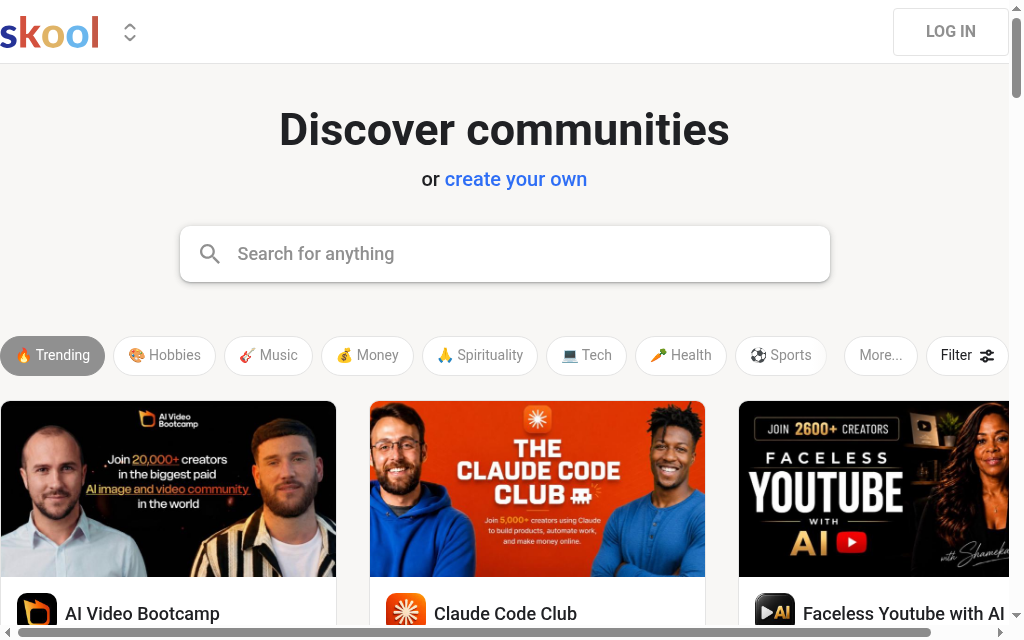
Skool is a community platform with courses attached: one feed, one classroom, a leaderboard and a calendar. It is opinionated and deliberately small, which is either the appeal or the problem.
I ran the maths at $2,000 a month of sales, and Hobby’s 10% quietly costs more than the $99 Pro plan, the opposite of how the tiers are meant to read.
- Cost as you grow: $9 a month on Hobby with nothing metered, unlimited members, courses and videos. Against Podia's $42 with a subscriber cap, that is a straightforward win.
- Transaction fee: 10% on Hobby, dropping to 2.9% on Pro at $99. The 10% is steep, so Hobby is a starting tier, not a home if you sell volume.
- Teaching and assessment: courses are simple with no formal assessment. Skool leans on community and gamification instead, which is genuinely more than Podia offers.
- Portability: members are yours to talk to inside the platform, but there is no published bulk export, which is the risk you accept.
My take: watch the 10%. On $2,000 of monthly sales, Hobby costs $209 all in versus $157 on Pro, so the cheap plan stops being cheap fast. I would pick Skool when the community features are really important for you. My Skool alternatives piece covers the rest of that field.
Thoughts after testing: I found Skool's monetisation tools surprisingly limited. You can't build a proper sales funnel or charge one-time payments; you'll need external tools like Thrivecart if you want anything beyond their bare product page. It's friction for anyone selling courses or memberships.
5. Gumroad
Best for: anyone who wants the monthly fee to be exactly zero, forever.
Gumroad sells digital products with the least setup of anything here: upload a file, set a price, share a link. Courses exist as content, not as a learning experience.
I checked the fee against a good month, not a slow one: 10% plus 50c on $2,000 of sales is about $200, so the zero monthly fee is only half the story.
- Cost as you grow: no monthly fee at all. Your bill is purely a function of what you sell, which is the purest version of the thing Podia stopped offering.
- Transaction fee: where it gets expensive, 10% plus 50c on your own sales and 30% on marketplace sales. On $2,000 a month that is about $200, where Payhip's $29 plan would cost $69 all in.
- Teaching and assessment: effectively none. Gumroad delivers a product, it does not teach, test or track anyone.
- Portability: customers and payouts are yours.
My take: Gumroad is the cheapest option in a slow month and the most expensive in a good one, so it suits irregular, low-volume sales. I treat the 10% as the price of never seeing a bill in a month when I sell nothing.
Thoughts after testing: I discovered that Gumroad's versions feature is actually a workaround for upsells since there's no proper sales funnel. You can add bundles or upgrades, but they appear as product variants at checkout, not as sequential offers. This limits how you can structure your customer journey.
6. Thinkific

Best for: Podia users who want a proper course platform and will pay more than Podia to get it.
Thinkific is the grown-up version of what Podia was trying to be: courses, memberships, bundles, coupons, order bumps and invoiced group orders, all first-party. It is a listed company and reports USD 4.23 billion earned by its 35,000 customers.
I lined Basic up against the Podia plan you are leaving, and at $54 it costs more; you are paying for the assessment Podia never had.
- Cost as you grow: Basic is $54 a month, more than the Podia plan you are leaving, but nothing is metered by audience size, so growth does not move you up a tier.
- Transaction fee: nothing if you use their in-house processor. Bring your own gateway and it reappears, 5% at Basic, 2% at Start, 1% at Grow.
- Teaching and assessment: real quizzes, assignments and surveys with completion tracking, a serious step up from Podia.
- Portability: people and orders export to CSV easily. The trap is recurring memberships billed through their processor, which have to be rebuilt by hand, one customer at a time.
My take: a straight upgrade that costs more. I would take it only if Podia’s thin assessment was the problem and budget never was. My Thinkific and Podia comparison runs them side by side.
Thoughts after testing: I set up a checkout after purchase and found you can't hide Thinkific's standard thank you and course-access buttons. The checkout sits underneath those locked elements instead, which really kills conversion compared to dedicated checkout tools. If you're planning to use Thinkific's native flow, prepare for a kneecapped experience.
7. Teachable
Best for: selling to buyers in several countries without doing the tax yourself.
Teachable is a hosted platform for courses, coaching and digital products, with a sales-page builder, checkout and affiliate payouts. Teachable says 150,000 creators use it across 180 countries.
Every time I check Teachable’s recent reviews, the same word leads the complaints: pricing, which squares with the 7.5% fee on the Starter plan below.
- Cost as you grow: Starter is $39 a month, marginally under Podia, and Builder at $89 removes the fee. Nothing is capped by subscribers.
- Transaction fee: 7.5% on Starter, higher than Podia's 5%, and zero from Builder. Card processing is separate.
- Teaching and assessment: quizzes, graded assessment and certificates. Better than Podia, behind LearnWorlds.
- Portability: Teachable is the merchant of record, so buyers pay in their own currency and Teachable files the tax, but the payment relationship is theirs, not yours.
My take: if you sell outside the US, the tax handling alone is worth the swap, and it is the one thing here you cannot replicate with a cheaper plan. But mind the 7.5% on Starter; you have swapped Podia’s 5% for a bigger cut, so the win only lands at the $89 Builder tier. My Teachable and Podia comparison has the detail.
Thoughts after testing: The Teachable mobile app lets you download lessons for offline viewing, which is useful. But you need to download each lesson one at a time, not by section. If your modules are large, that becomes tedious to set up.
8. LearnWorlds
Best for: anyone who left Podia because they actually need to assess and certify people.
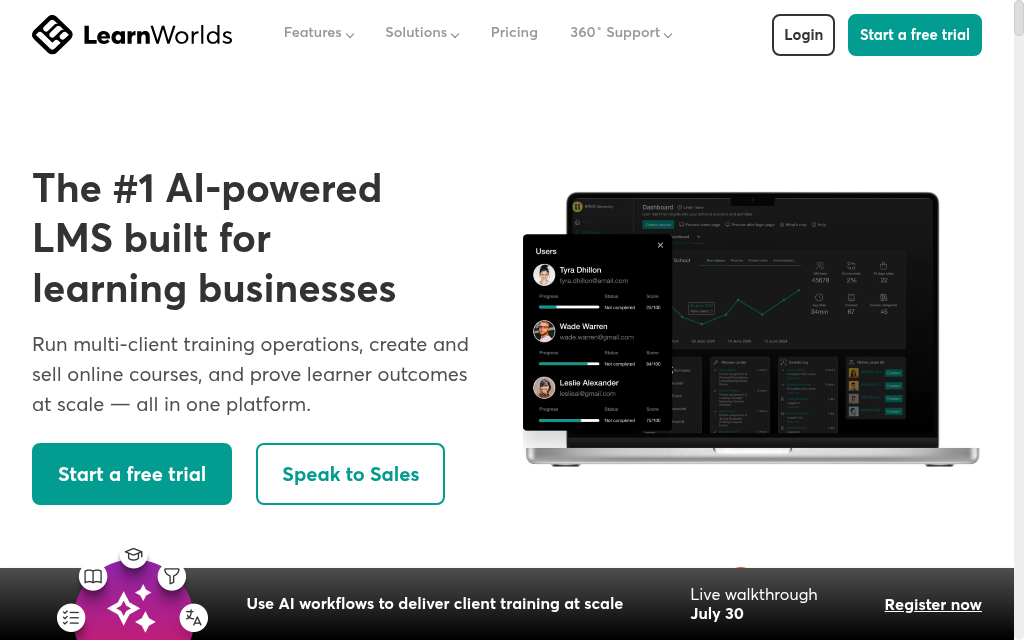
LearnWorlds is a course platform with an unusually strong storefront and some of the deepest teaching tools here: interactive video, question banks, certificates and a white-label mobile app builder. More than 13,000 learning businesses run on it.
I almost missed the catch myself: the $29 headline hides a $5 charge on every enrolment, which behaves like a large percentage on cheap courses.
- Cost as you grow: Starter is $29, the cheapest paid entry here, and that number is misleading. Nothing is metered by audience, but see the cut.
- Transaction fee: $5 for every course enrolment on Starter, zero from Pro Trainer at $99. On a $29 course that fee is about 17% of the sale, more than three times what Podia takes.
- Teaching and assessment: one of the best on this list, alongside Coursebox.
- Portability: users, sales records and affiliate commissions export to CSV or XLS, and your own Stripe is the merchant.
My take: the $5 enrolment fee is the whole decision. It reads like a small line item and behaves like a big percentage on cheap courses, so I would only pick it on premium prices or the $99 Pro tier. My LearnWorlds and Podia comparison goes deeper.
Thoughts after testing: I tested LearnWorlds and the interactive video feature really stands out. You can add buttons, transcripts, and clickable overlays directly to your course videos, something most competitor platforms don't offer. It's particularly useful for linking to resources and materials within the video itself, which can help boost engagement.
9. Circle
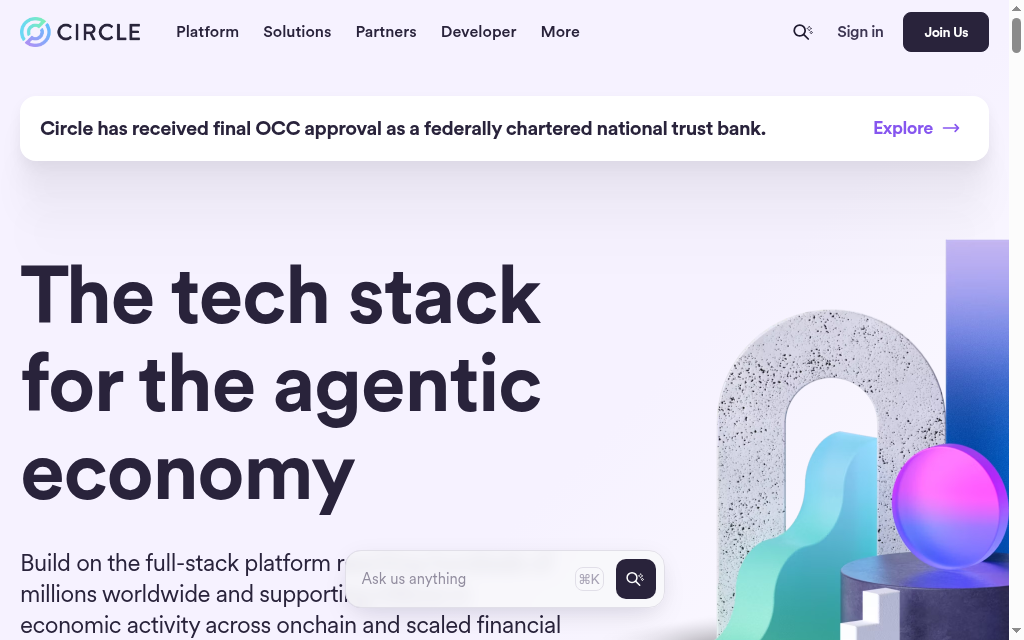
Best for: communities first, courses second, with a budget already in place.
Circle is a community platform with courses, events and paid memberships built in. It is where people go when the community is the product and the course is the bonus.
I went looking for a cheaper way in and there is not one: $89 a month is the floor, more than double Podia, before you add the Email Hub.
- Cost as you grow: Professional is $89 a month and Business is $199, with unlimited members on every plan. The floor is more than twice what you were paying Podia.
- Transaction fee: 2% on Professional, 1% on Business, 0.5% on Circle Plus. The Email Hub includes 10,000 contacts and charges $99 a month for each extra 10,000.
- Teaching and assessment: courses sit inside a community product. Adequate, not a real LMS.
- Portability: members and content are yours, and payment runs through your own processor.
My take: hard to justify if a price rise is what pushed you out. I would only choose Circle if you were already on Podia’s $150 tier for community and found it thin, in which case the jump is smaller than it looks.
Thoughts after testing: I tested Circle's native live streaming feature for webinars. While it works fine for community chats, the audio and video quality aren't quite broadcast-grade. It's notably behind Zoom if you're aiming for a polished, professional feel for your training sessions.
10. Kajabi
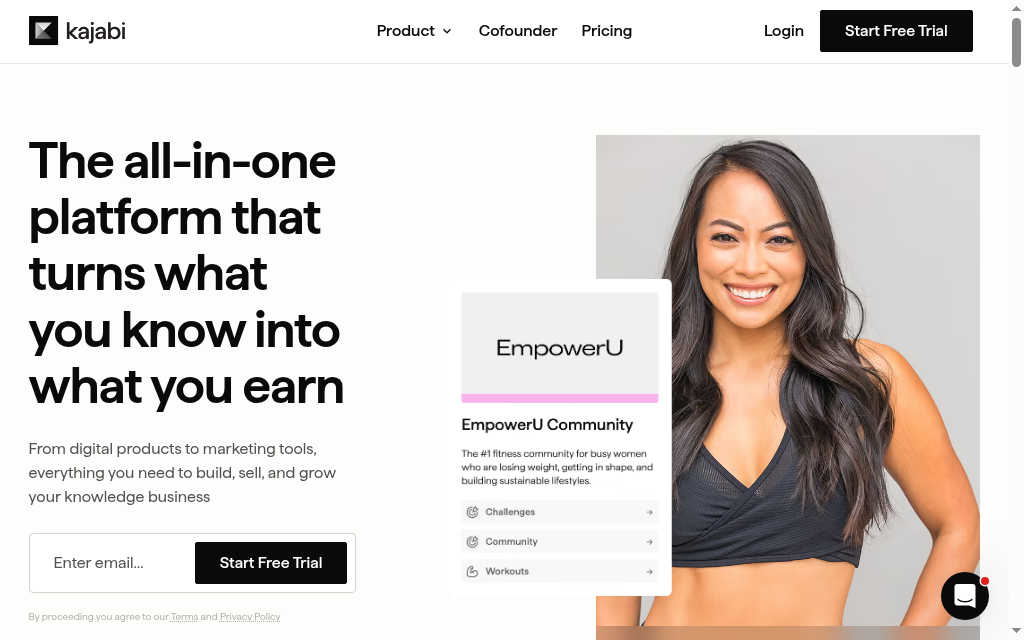
Best for: people whose real problem is that nobody is buying.
Kajabi is a marketing platform that also hosts courses: unlimited emails, landing pages, funnels, upsells and affiliates on every plan, with behaviour-based automation through all of it. Its case studies name creators who have earned USD 10 million and more.
The recurring trial complaint below squares with the pricing I found: verify your email and Kajabi asks for $167 before you have really seen the product.
- Cost as you grow: $179 a month before you sell anything, rising to $249 and $499. By a distance the most expensive way to leave Podia, with contacts capped at 2,500, 25,000 and 100,000.
- Transaction fee: zero on Kajabi Payments or PayPal, and 2% / 1% / 0.5% on any other processor. International-card, subscription and currency surcharges can stack to 5.1%.
- Teaching and assessment: quizzes and assessments exist, but they are not the point of the product.
- Portability: contacts export, capped by plan. Kajabi documents how to move Stripe subscriptions in, and publishes no route for taking them out.
My take: I would not send anyone here who left Podia over money. But if your courses were fine and your sales were not, this is the fix. My Kajabi and Podia comparison has the full picture.
Thoughts after testing: When I customised email templates to match my brand, I didn't realise the liquid objects in curly brackets connect your automations. I edited one by mistake and my follow-up sequences just stopped firing. Once I figured out the liquid tags were broken it was a quick fix, but there's no error to warn you.
What they really cost at $2,000 a month in sales
This is what each platform costs in a month you sell $2,000, on its cheapest paid plan, counting the platform’s own fees only. Your card processor’s cut (roughly 2.9% + 30c) sits on top and is the same everywhere. LearnWorlds is left out because it charges $5 per enrolment rather than a percentage, so its cost depends entirely on your price point.
| Platform | Cheapest paid plan | Fee on $2,000 | Total that month |
|---|---|---|---|
| Systeme.io | $17 | 0% | $17 |
| Coursebox | $30 | 0% | $30 |
| Thinkific | $54 | 0% in-house | $54 |
| Payhip | $29 | 2% ($40) | $69 |
| Circle | $89 | 2% ($40) | $129 |
| Kajabi | $179 | 0% | $179 |
| Teachable | $39 | 7.5% ($150) | $189 |
| Gumroad | $0 | 10% + 50c (about $200) | about $200 |
| Skool | $9 | 10% ($200) | $209 |
Pick by the reason you are leaving
If the free plan going is what pushed you out, take Systeme.io or Coursebox. They are the only option here that lets you carry on at zero with unlimited learners.
If you want a bill that only exists when you make sales, it is Payhip at 5% or Gumroad at 10%. Payhip wins on almost every volume, and Gumroad wins only if your sales are genuinely sporadic.
If you left because Podia could not teach, the answer is Coursebox. Coursebox builds the assessments for you and takes nothing on any paid plan. It is an AI-native platform, so it also makes course creation easy.
If you left because nothing was selling, none of the above will fix it, and Kajabi probably will. Budget $179 a month and treat it as a marketing spend rather than a hosting one.
Frequently Asked Questions
Yes, on 14 October 2024. New creators get a 30-day free trial instead. Podia published its reasoning, including that under 0.5% of platform sales volume came from free accounts.
Mover is $42 a month with a 5% transaction fee, Shaker is $84 with no fee, and Earthquaker is $150. Stripe or PayPal charge 2.9% + 30c on top. Several comparison articles still quote the older $39 and $89 prices.
Yes. Systeme.io's free plan does not expire and includes 2,000 contacts, one course and three funnels with no transaction fee. Payhip is also free forever and takes 5% per sale.
5% on the Mover plan. It drops to zero on Shaker at $84 a month and above, which means removing the fee costs $42 a month.
Your content and contacts can be exported, but the work is manual and any active subscriptions will not follow you automatically. Cancel at the end of a billing cycle and rebuild memberships on the new platform before you switch payment over.
It depends on volume. Below roughly $1,000 a month, a free plan with a per-sale fee costs less. Above it, a fixed monthly fee with no cut wins. Our guide to the best LMS for selling courses works through that arithmetic.
Alexandra Cserta
Manages influencer marketing, case studies, webinars and community and Coursebox AI

