

Kemp Model of Instructional Design: The 9 Elements Explained
The Kemp model of instructional design: the nine elements, the outer ring, where to start, Kemp vs ADDIE, real examples and two free templates.

The Kemp model, also called the Morrison, Ross and Kemp model, organises instructional design into nine connected elements rather than fixed steps.
- The nine elements are instructional problems, learner characteristics, task analysis, objectives, content sequencing, strategies, message design, development and evaluation instruments.
- The elements sit in an oval because there is no required order, so you start with whichever one your situation needs.
- Planning, revision and three kinds of evaluation (formative, summative and confirmative) run alongside the elements for the whole project.
- The first element asks whether training is the answer at all.
- The model's flexibility suits experienced designers; beginners often find a step-by-step model like ADDIE easier to follow.
Five prompts to guide a review of one project. This is an unvalidated editorial check, not a certification of model fit, completeness or learning effectiveness. Check each answer as well as the total.

Go from storyboard to an interactive course in minutes
Take a hypothetical chain of community pharmacies that hires new pharmacy assistants every month. Its induction course starts with company history, moves through a product catalogue and ends with a quiz. New assistants still answer clinical questions they should refer to the pharmacist, because nobody designed the training around that moment at the counter. Fixing it means going back to the problem at the counter, and the Kemp model lets you start there.
The Kemp model is an instructional design model of nine elements arranged in an oval, so designers can work on them in any order and return to them as they learn more. I'm an instructional designer at Coursebox, where we make instructional design software.
What is the Kemp model of instructional design?
The Kemp model is a systematic approach to designing instruction built around nine interdependent elements. Unlike models drawn as a sequence of boxes, it shows the elements as an oval. The current edition of the book that defines it says the elements "overlap and are presented in an oval shape … to indicate that there is no one specific sequence or order to completing the steps."
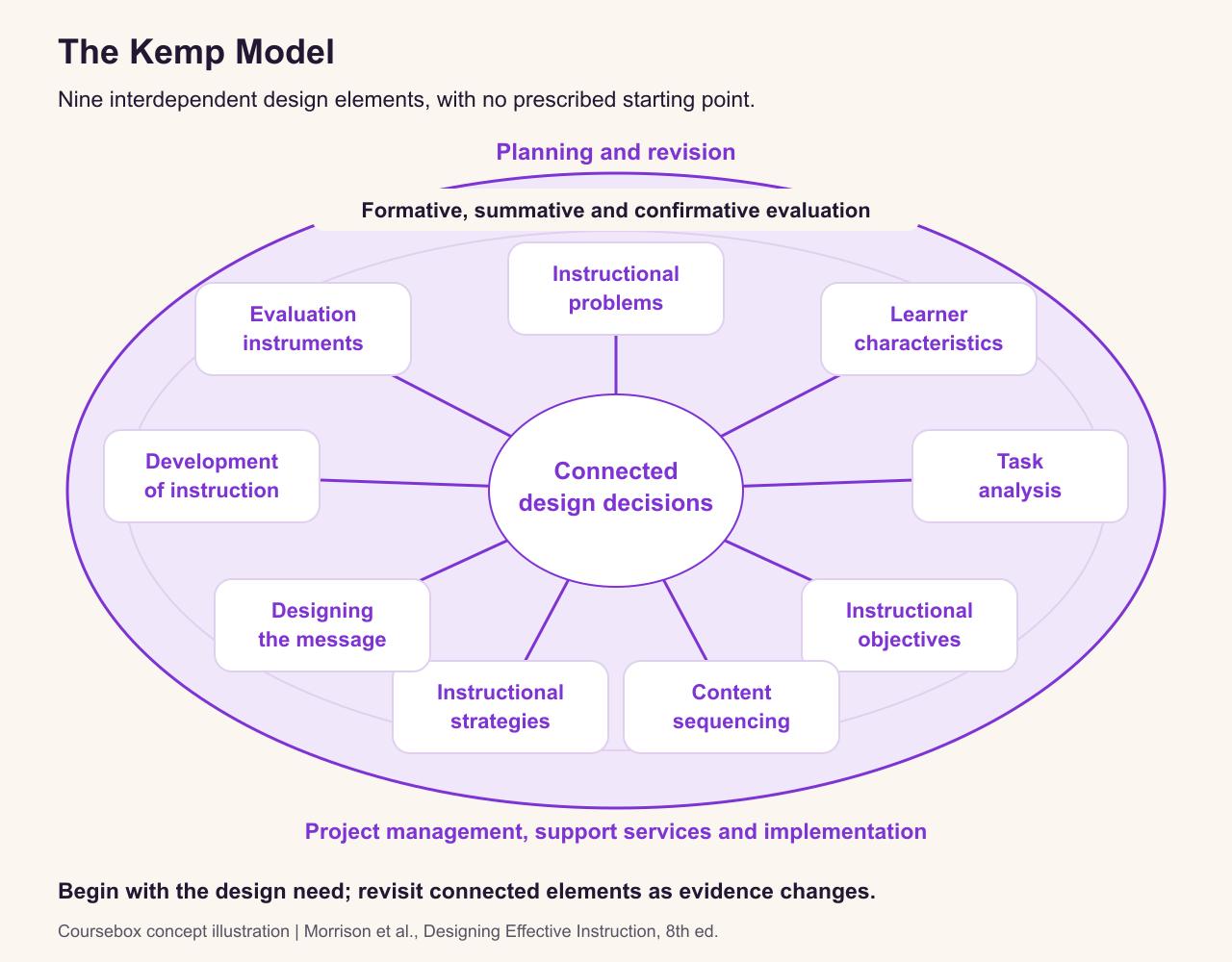
It rests on four fundamentals that the book says "form the framework for systematic instructional planning": learners, objectives, methods and evaluation. The current version is the 2019 eighth edition of Designing Effective Instruction, by Gary Morrison, Steven Ross, Jennifer Morrison and Howard Kalman.
The book also says something many design models leave out: instructional design "never assumes that instruction is the answer to all problems." The first element exists to check whether training is the right fix at all.
The nine elements, worked through one course
Our hypothetical pharmacy chain needs new assistants to recognise clinical questions and refer them to the pharmacist under local policy. Most are school leavers or career changers, learning on rostered shifts. The existing induction covers products, but does not give them enough practice at that counter decision. We will redesign it around realistic customer conversations, a referral aid and observed practice. The nine elements let us examine that problem from several starting points.
| Element | The question it answers | In the pharmacy induction |
|---|---|---|
| 1. Instructional problems | What performance problem are we solving, and is training the answer? | New assistants answer clinical questions they should refer to the pharmacist |
| 2. Learner characteristics | Who are the learners, and in what context will they learn? | School leavers and career changers, on shifts, learning at the counter |
| 3. Task analysis | What does competent performance involve? | Greeting, privacy at the counter, handing over medicines, and when to refer |
| 4. Instructional objectives | What must learners be able to do? | Refer every clinical question to the pharmacist, using the referral script |
| 5. Content sequencing | In what order should learners meet the content? | Counter routines, then privacy, then referrals |
| 6. Instructional strategies | How will learners practise? | Scenarios at a simulated counter, then supervised shifts |
| 7. Designing the message | How will the content be worded and presented? | Plain-language prompts and a one-page referral card |
| 8. Development of instruction | What will be built, and in what format? | Short online lessons plus a supervisor's checklist |
| 9. Evaluation instruments | How will we know learners can do it? | Pharmacist observes relevant referral scenarios, then follows up during workplace opportunities |

Case study: Training volunteer health workers in Indonesia
In Bekasi District, Indonesia, researchers used the Morrison, Ross and Kemp model to design nutrition training for volunteer community health workers. They revised a five-day draft to three days around workers’ availability, with 38% lecture and 62% practice, and revisited the design elements during development.
At follow-up, 52 of 70 trained workers were rated competent overall. The comparison group received only a half-day event, so this was not an equal-dose comparison that isolates the Kemp model. The source also prints an inconsistent count/percentage for the comparison group; an exact percentage contrast would be misleading.
The useful design lesson is how learner constraints changed the schedule and practice mix. Use observed task performance to refine those choices, rather than treating a published model as a guarantee of results.
Instructional problems
Start by defining the problem as something people do wrong on the job. "New assistants need to know our products" is a content wish. "New assistants answer clinical questions they should refer" is a performance problem, and it points to what the training has to change. If the real cause is that the pharmacist is hard to reach during busy periods, a course will not fix it. A training needs analysis is the usual way to work this out.
Learner characteristics
The current edition calls this element learner and context. It covers who the learners are, what they already know, and where and when they will learn. For the pharmacy, a career changer from retail already handles customers well but has never heard of a referral; a school leaver may need both. Shift work rules out long classroom sessions.
Task analysis
The book calls task analysis "one of the most, if not the most, important component of the process." In the pharmacy, an afternoon watching experienced assistants shows what competent work looks like: how they spot a clinical question, what they say to the customer, and how they hand over to the pharmacist.
The AT&T case is about task analysis in general rather than the Kemp model, but it shows why the book puts so much weight on this element.
Instructional objectives
Objectives "specify exactly what the learner must master." For the pharmacy: given a customer's question at the counter, the assistant recognises whether it is clinical and refers it to the pharmacist using the referral script, every time.
Content sequencing
Decide the order learners meet the content. For the pharmacy, counter routines come first because everything else happens inside them, then privacy, then referrals, which depend on both.
Instructional strategies
Choose how learners will practise. Assistants work through counter scenarios, each with a customer question to classify and respond to, then do supervised shifts where a senior assistant gives feedback.
Designing the message
This element covers how the content is worded and laid out: plain language, clear prompts and signalling of what is most important. For the pharmacy, it produces a one-page referral card with the three questions that always go to the pharmacist.
Development of instruction
Build the materials in the chosen formats. Short online lessons cover the routines; a supervisor's checklist structures the supervised shifts.
Evaluation instruments
Design how you will check that learners meet the objectives. For referrals, a quiz shows whether an assistant knows the rule; a pharmacist watching at the counter in week 2 shows whether they follow it. That observation is behaviour, Level 3 in the Kirkpatrick Model.
The nine elements with a guiding question and the pharmacy example for each, a checklist of the ongoing processes and a revision log. Editable Word file, no email required.

Case study: Reading-comprehension strategies for students in Türkiye
A Turkish reading-strategy study used the Morrison, Ross and Kemp approach to design digitally supported instruction for twelfth-grade students preparing for an English university-entrance test. Sixteen students received the six-week programme and sixteen continued with their usual lessons.
The researchers reported improved achievement and reading-strategy use in the programme group. This was a small quasi-experimental study at one school, with additional instruction in the programme group. It does not isolate the model from the teaching time, strategies or digital resources.
The practical lesson is to connect a specific learner problem with both instruction and assessment: here, how students approach reading questions, not simply how much English content they cover. The paper follows a fourteen-stage interpretation of Morrison, Ross and Kemp, so its procedure is not identical to the nine-element overview above.
Where the Kemp model came from
| Year | What happened |
|---|---|
| 1971 | Jerrold Kemp, a professor at San Jose State University, publishes Instructional Design: A Plan for Unit and Course Development |
| 1985 | Kemp publishes The Instructional Design Process |
| 1994 | First edition of Designing Effective Instruction, with Gary Morrison and Steven Ross |
| 2019 | Eighth edition (Wiley), by Gary Morrison, Steven Ross, Jennifer Morrison and Howard Kalman |
That history explains the model's three names: the Kemp model, the Morrison, Ross and Kemp (MRK) model, and the Morrison, Ross, Kalman and Kemp model. Kemp died in 2015, and he is no longer listed as an author of the eighth edition.
It also explains why you will find two different lists of nine elements online. Older summaries of the fourth edition end with "planning instructional delivery" and "selecting resources". The current edition ends with designing the message, development of instruction and evaluation instruments, and lists support services among the outer processes. This page uses the current names.
The outer ring: what runs throughout the project
The current edition surrounds the nine elements with two outer ovals of "processes that are ongoing throughout the life of an instructional design project": planning, revision, project management, support services, implementation, and formative, summative and confirmative evaluation.
Confirmative evaluation happens long after launch, so it is the easiest to forget. It checks "whether a course or instruction remains appropriate over time". For the pharmacy, that means asking a year later whether the referral rules or the products have changed enough to make the course wrong.
Where to start
The book says it "would seem logical to start with the instructional problem and then proceed clockwise", but it also calls designing the evaluation instruments straight after the objectives logical. In practice, the situation decides:
| Your situation | Start with | What can be reused or deferred, with a check |
|---|---|---|
| A new performance problem, cause unknown | Instructional problems | Designing the message, until the need is clear |
| A compliance course with a fixed standard | Instructional objectives, then evaluation instruments | The standard is fixed; still check learner gaps, context and whether training addresses them |
| The same audience as a recent course | Task analysis | Reuse prior learner analysis only after checking knowledge, access and circumstances remain current |
| An existing course that is not working | Evaluation instruments: what is failing? | Development, until the cause is found |
Learner characteristics is an element I often see revisited late. In our support inbox, a German training company told us its courses worked for newcomers but felt too shallow to experienced practitioners, and a prospect asked how to hide a module from everyone except advanced learners. Both are learner analysis arriving after the build, which is exactly the loop the oval allows for. Plans change even before anything is built:
Match your situation to a starting element, decide which elements you can do lightly, and record why. One-page editable Word file, no email required.
From Kemp plan to induction course in Coursebox
The Kemp elements are questions for you, the designer. The answers become the course: a counter scenario, a referral card, a supervised shift. So on 6 October 2026 I tested that hand-over in Coursebox, the course builder we make. I did the planning first, then gave it my answers for the pharmacy induction: who the learners are, the performance problem, the referral objective, the sequence (counter routines, then privacy, then referrals), the strategies and the week-two observation.
It built a learner-facing induction course, with sections named after the work: Counter Foundations, Privacy at Work, Recognize Clinical Questions, Refer With Confidence and Prove Safe Performance. That is five sections, 11 pages and about 47 minutes, split into short pages that fit into a shift. The sequence followed my plan, and the strategies turned into practice: a "Classify the question" scenario, a page for the three-question referral card, and four counter scenarios on symptoms, medicine use, side effects and safe responses. A short check closes each of the main sections, and the week-two pharmacist observation is the last step.
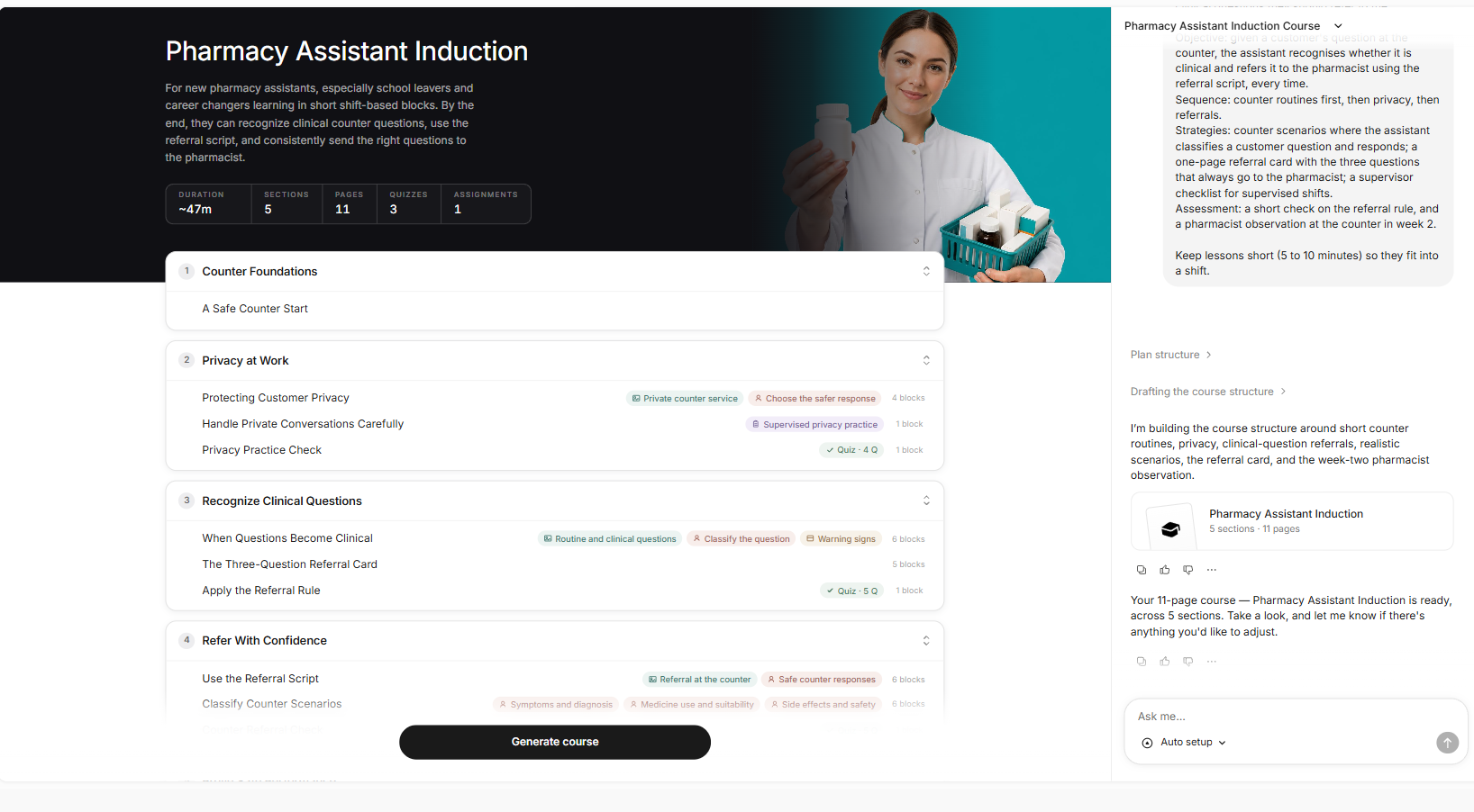
The planning answers did the work here. Each Kemp element I had decided became a specific part of the course, and I spent my time on the decisions rather than on building pages. The one thing I would add is a separate checklist for the pharmacist. The observation is a page in the learners' course, which is the right place to tell assistants it is coming, but the person doing the observing needs their own copy.
Kemp model vs ADDIE
Most new designers learn ADDIE first, so it is the natural comparison. The Kemp model is older: Kemp's plan dates from 1971, while ADDIE grew out of a model Florida State University built for the US armed forces in the mid-1970s. Michael Molenda, in a sidebar in the eighth edition, goes further and argues that ADDIE is "merely a colloquial label for a systematic approach to instructional development" rather than an authored model.
| Feature | Kemp model | ADDIE |
|---|---|---|
| Shape | Nine elements in an oval, any order | Five design functions; often sequenced, with iteration and feedback |
| Starting point | Wherever the problem is | Analysis |
| Evaluation | Formative, summative and confirmative, throughout | Formative evaluation in every phase, plus evaluation of delivered training |
| Attention to message design | An element of its own | Part of development |
| Useful when | Experienced designers and courses that change as you learn | Teams that need a simple shared sequence |
Limitations of the Kemp model
- Too open for beginners. The freedom to start anywhere can leave new designers unsure what to do next. Serhat Akbulut (2007) suggests novices "might favor" the more prescriptive Dick and Carey model, "whilst experienced designers might favor the MRK model" (Turkish Online Journal of Distance Education).
- Classroom scale. Gustafson and Branch classed it among classroom-oriented models, and Akbulut notes it suggests non-instructional solutions yet "leads to an output of one or few hours of instruction."
- Time and expertise. The Indonesian team reported the work "required adequate time, a good record-keeping system and a team with various experts."
- Thin evidence. The published applications I found, including the two on this page, are small studies without randomised comparisons.
Use Kemp’s flexibility with a clear reason to revise
The Kemp model is useful when a design problem does not arrive in a neat sequence. You might begin with an assessment failure, a changed task or a constraint on delivery. Its flexibility lets you work from that point while checking the connected elements. It does not remove the need to understand the performance problem, the learners and the evidence of success.
Use the planning template to record your starting point and which assumptions still need checking. In the pharmacy induction, a clearer referral card may solve one problem, but it must still fit the local policy, learner practice and observed performance. Reuse earlier analysis only when it remains current, and record why feedback sends you back to a particular element. That makes the open process easier for the whole team to follow.
Frequently Asked Questions
Instructional problems, learner characteristics, task analysis, instructional objectives, content sequencing, instructional strategies, designing the message, development of instruction, and evaluation instruments, as named in the 2019 eighth edition of Designing Effective Instruction.
Jerrold Kemp of San Jose State University, who first published his plan in 1971. Gary Morrison and Steven Ross joined him for Designing Effective Instruction in 1994, and later editions added Howard Kalman and Jennifer Morrison.
No. Its elements are drawn in an oval to show there is no required order. You can start with any element and revisit others as the design develops.
Kemp describes nine interdependent design elements and allows different starting points. ADDIE describes analysis, design, development, implementation and evaluation. Both can be iterative and both require formative evaluation; ADDIE does not reserve evaluation for the end.
Its advantages are flexibility, a strong focus on the learner and the real performance problem, and evaluation throughout. Its disadvantages are that beginners can find it too open, it is usually classed as a classroom-scale model, and published evidence of its results is limited to small studies.
Carolina Martin
Carolina is a highly experienced learning designer with tech start-up experience. She is based in Sydney and previously designed courses alongside Coursebox founder Travis in a previous job. She is passionate about delivering engaging learning experiences and brings the same perspective to customer experience too. She manages our customer support documentation and product testing processes.

