

10 Best AI LMS Platforms in 2026
Looking for the best AI LMS? Compare AI-powered LMS platforms and see how automation, AI tutors, and smart assessments transform training.

The best AI LMS in 2026 depends on how much real work the AI actually does. Sana is the most AI-native learner experience for an English-primary org (though there is no trial), Coursebox is the AI-native pick you can start using today, and the enterprise incumbents like Docebo and Cornerstone win on LMS depth with AI treated honestly as a bonus rather than the core.
- Only Sana and Coursebox are built AI-native from the ground up. On the rest, the AI is a genuine assist (TalentLMS, 360Learning) or still a work in progress (Absorb, LearnUpon, SAP Litmos).
- Ask every vendor not whether an AI feature exists, but how many users actually have it switched on. Adoption is often tiny, and that is the difference between an AI LMS and an LMS with an AI logo on the box.
- Skip SAP Litmos for a new multi-year deal: veteran users report a steady decline in stability and UX since the SAP acquisition. Worth revisiting in 2027.
- Most of these are enterprise-priced and quote-only. TalentLMS and Coursebox are the two you can price and start without a sales call.
Answer three quick questions and we'll point you to the best fit from this list.

Run your own branded LMS with unlimited learners
Most 'best AI LMS' roundups are written by a vendor that conveniently puts itself at number one. D2L crowns Brightspace, Absorb ranks Absorb, 360Learning leads with 360Learning. This one does not work that way: I have ranked by how much real work the AI actually does, put a competitor above our own product, and been specific about where each one falls short.
My position here is different, though not neutral. I cofounded Coursebox, which is an AI-native LMS. You will find it at number two on this list, not number one, and I will be specific about why it earns that spot and where it still falls short. T
One thing to flag up front: best AI LMS means different things to different buyers. Run L&D at a 20,000-person enterprise and you are really shopping for Docebo or Cornerstone. At a 200-person company it is TalentLMS or Absorb. And if you mostly need to build and deploy content fast with a solid LMS on top, something like Coursebox fits better. I have written this with all three in mind, and the closer gives a direct answer by buyer type.
I've tried to write this with all three cohorts in mind. The closer section will give you a direct answer by buyer type.
One more thing: the LMS category has a reporting problem. I mean that literally. Across 360Learning, Absorb, TalentLMS and SAP Litmos, the most consistent user complaint is analytics that don't deliver what they promise.
How I tested this: for each platform I worked through its AI features hands-on when possible, then noted what the AI actually did against what the marketing claims. Where I could not get hands-on, the entry says so.
How I ranked these
I did not rank these on how 'well known' or big the LMS is. I ranked them on how much real work the AI does and whether you can actually use it, and I check every platform below against the same four, in the same order:
AI approach: whether the AI was built in from the start (AI-native) or added on top of a legacy LMS.
What the AI does: the concrete job the AI performs, generating courses, tagging content, answering questions, and where it is just a logo.
Access: public pricing, a free tier or a trial, versus a sales call to find out.
The catch: the one honest limitation worth testing before you sign.
Comparison at a glance
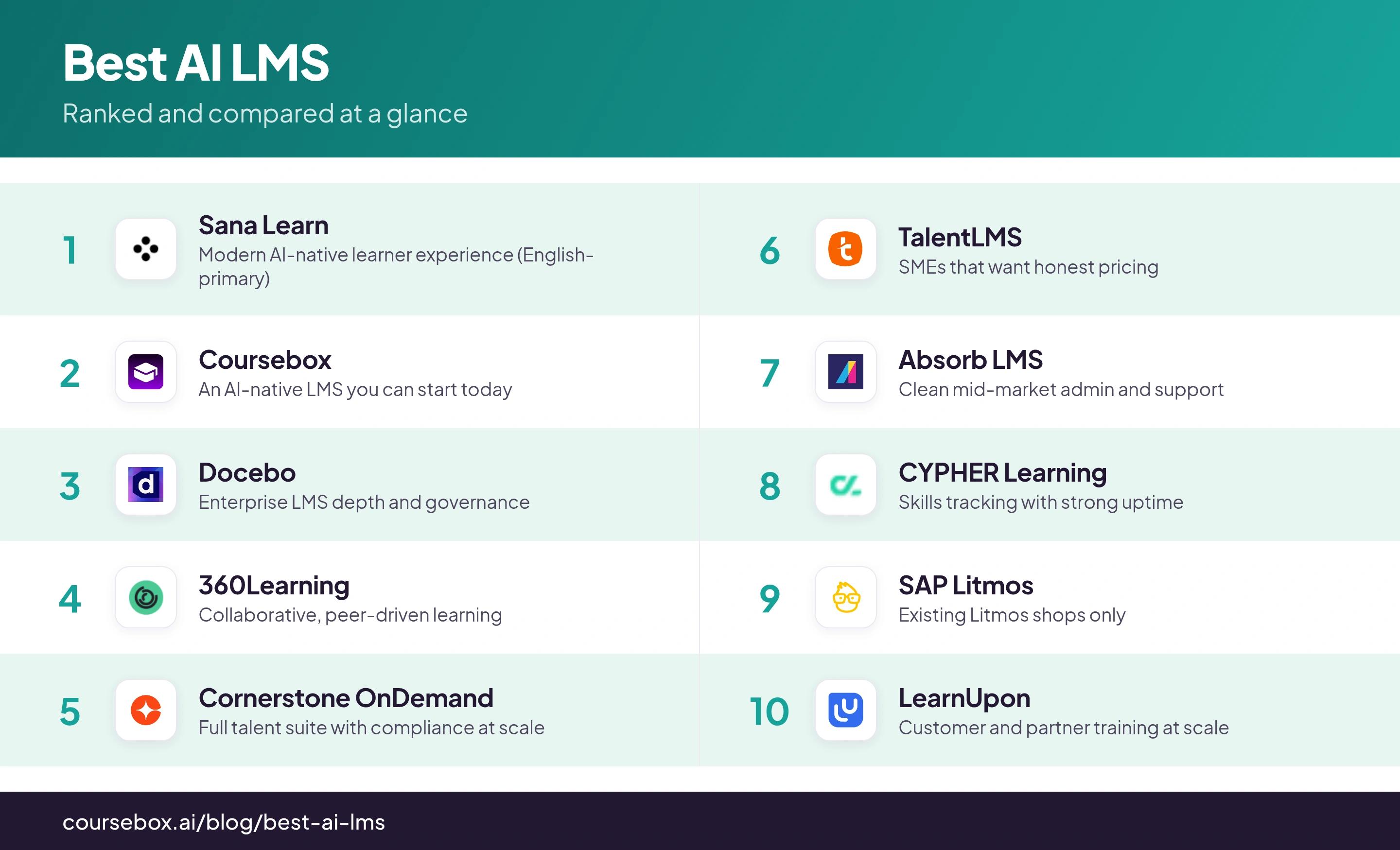
| Tool | AI approach | What the AI does | Pricing | Best for |
|---|---|---|---|---|
| Sana Learn | Native | Generates courses, conversational answers, AI search | Quote only, no trial | Modern AI-native learner experience (English-primary) |
| Coursebox | Native | Drafts courses, quizzes and grading from your material | Public, free to start | An AI-native LMS you can start today |
| Docebo | Bolted on (best incumbent) | Semantic tagging, recommendations, skills intelligence | Custom, enterprise only, no trial | Enterprise LMS depth and governance |
| 360Learning | Bolted on | Conversational search and analytics on your content | Public, from $8/user/mo, 30-day trial | Collaborative, peer-driven learning |
| Cornerstone OnDemand | Bolted on | Skills inference and content recommendation | Enterprise custom, no trial | Full talent suite with compliance at scale |
| TalentLMS | Bolted on | Drafts standard course content on AI credits | Public, free for 5, from $119/mo | SMEs that want honest pricing |
| Absorb LMS | Bolted on (newest) | Converts PowerPoint into editable courses | Custom by learner count, no trial | Clean mid-market admin and support |
| CYPHER Learning | Bolted on | Builds 80 to 90% of a course in about 10 minutes | Custom, two tiers | Skills tracking with strong uptime |
| SAP Litmos | Bolted on (thin) | Light content assistance | Quote only, 14-day trial | Existing Litmos shops only |
| LearnUpon | Bolted on (nascent) | Little AI-native yet; multi-audience delivery | Quote only, 100+ user minimums | Customer and partner training at scale |
1. Sana Learn
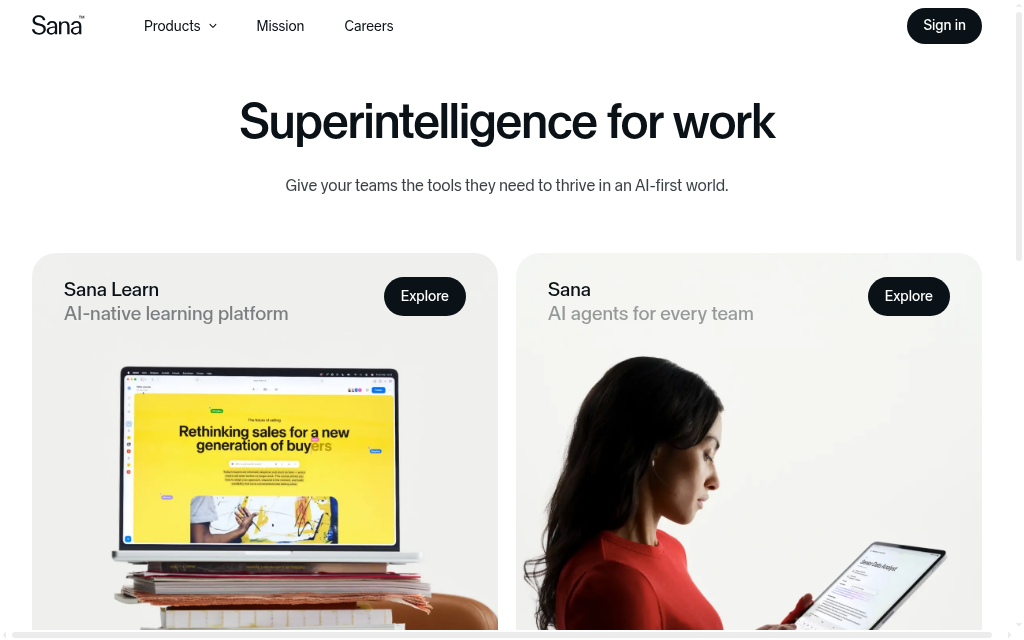
Best for: an English-primary org that wants the most modern, AI-native learner experience on this list.
Sana is a learning platform built AI-first from the ground up, aimed at modern enterprises.
AI approach: native. Search, course generation and the conversational interface sit at the foundation, not screwed onto a legacy system.
What the AI does: generates courses, answers learners conversationally and runs AI search across content; one documented switch went from 400 to 1,500 monthly active users.
Access: quote only. No public pricing, no trial.
The catch: the AI degrades in non-English contexts, and it has far less enterprise deployment history than Docebo or Cornerstone.
My take: the honest number one for a list ranked on how AI-native a platform is, if you are English-primary and can commit without a trial.
Thoughts after trying it out: I tested Sana's edit mode and found a workflow quirk: the AI coach suggests iterative improvements as you build, but does not log what you have done. I had to ask the agent to generate a summary of all steps just to record the history. A sharp co-creation tool, but bring your own note-taking if you want to track your process.
2. Coursebox
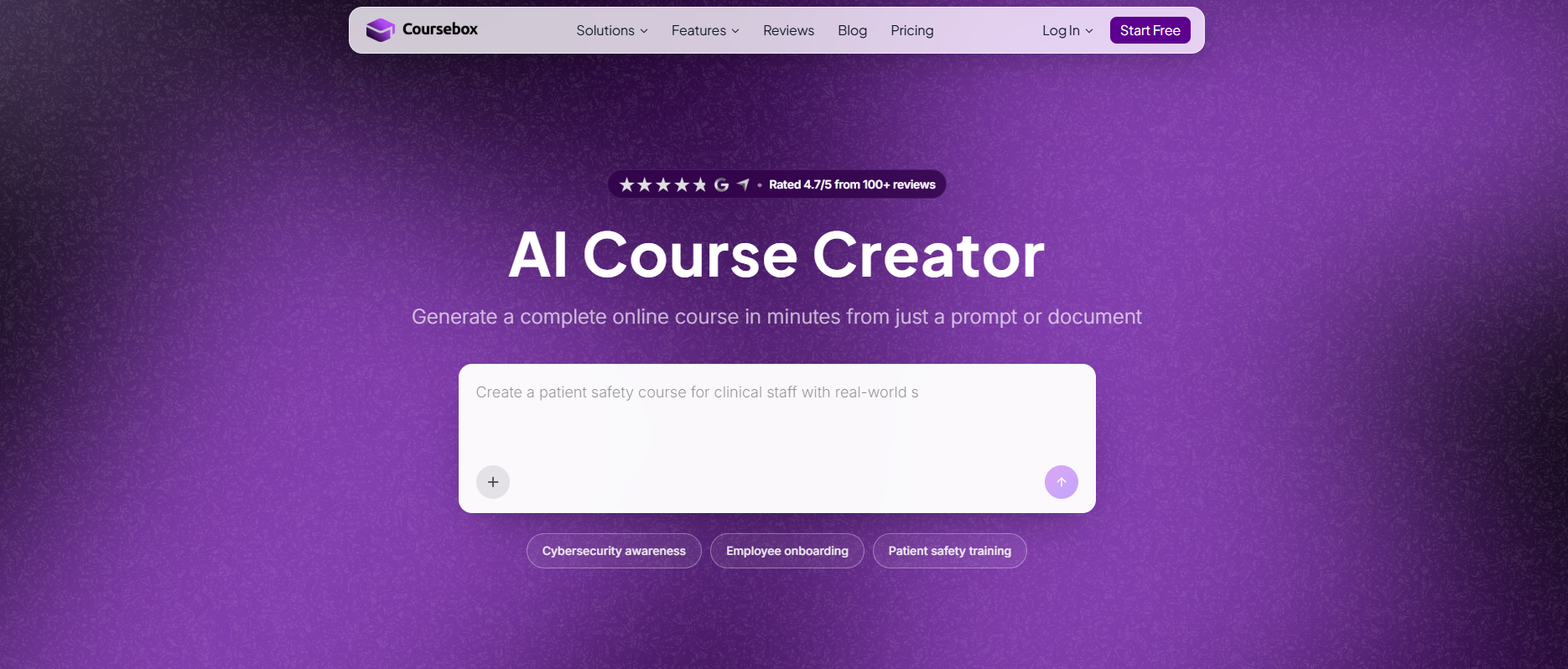
Best for: teams that want an AI-native LMS they can start using today, with AI course generation at the core.
Coursebox is an AI course builder with a full LMS on top, and yes, we built it, so weigh this accordingly.
AI approach: native. AI course generation is the core of the product, not a bolt-on; point it at a prompt or document and it builds the course, then delivers it.
What the AI does: drafts courses, quizzes and AI grading from your material, and it is a real LMS: roles, SSO, certificates, pathways, ecommerce, native apps and SCORM both ways.
Access: public. Free to start, SCORM export from Creator, full white-label from Business. See coursebox.ai/pricing.
The catch: reporting depth and learner-UI polish still trail Docebo and Cornerstone; if deep custom reporting is your first requirement, weigh it up front.
My take: the AI-native pick you can actually start today. It sits at two, not one, because Sana's learner experience is more refined.
Thoughts after trying it out: I will be honest since we built it. The point of an AI-native LMS is that the AI does the boring part: point Coursebox at a prompt or a document and it drafts the course, quizzes and grading, then you refine. What I would still pressure-test before choosing us is reporting depth, our analytics are solid for small-team training but not built for compliance-grade audit trails.
3. Docebo
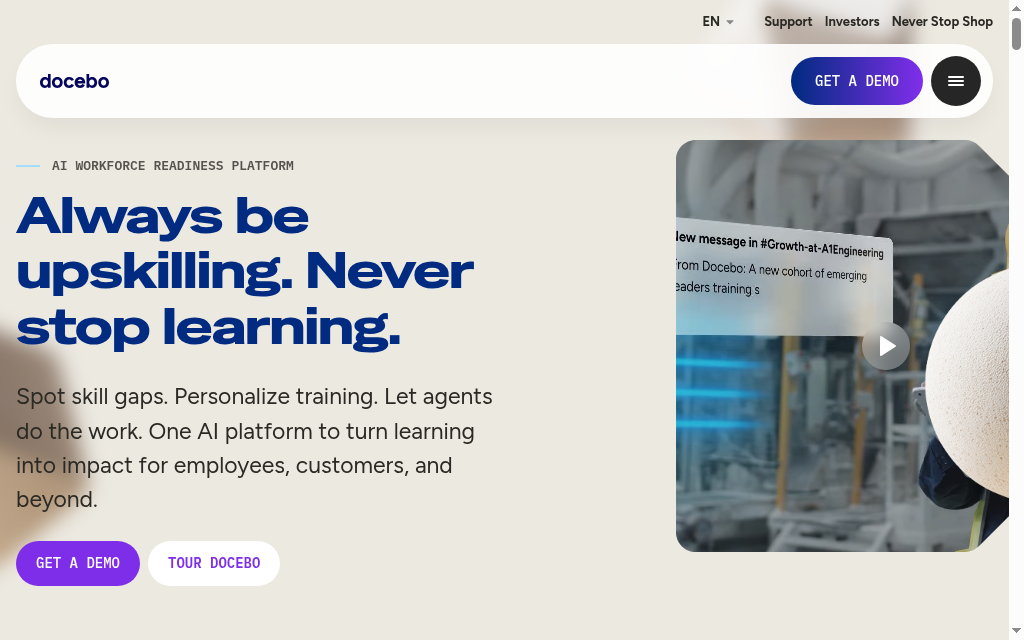
Best for: enterprises with dedicated IT and complex governance, where LMS depth matters more than how AI-native it feels.
Docebo is the strongest pure enterprise LMS here, and its AI is the most developed of the legacy incumbents.
AI approach: bolted on, but the best of the incumbents. The agentic AI (AgentHub) that anchors its story is announced for autumn 2026, so today you buy the current platform, not the roadmap.
What the AI does: semantic tagging, smart recommendations and skills intelligence on your existing content, not generation from scratch.
Access: custom, enterprise-only, no trial.
The catch: slow support, two-week waits on anything needing engineering, and a long-running Salesforce integration issue; test it with real data first.
My take: buy Docebo for LMS depth and scale and treat the AI as a bonus. Always buy the shipping product over the roadmap.
Thoughts after trying it out: I tested Docebo's AI features and found they are strongest at organising existing content through semantic tagging and smart recommendations, rather than generating new courses from scratch. It uses grounded AI that references your knowledge base, which prevents the false outputs you get from generic tools, but also means it is working with what you already have.
4. 360Learning
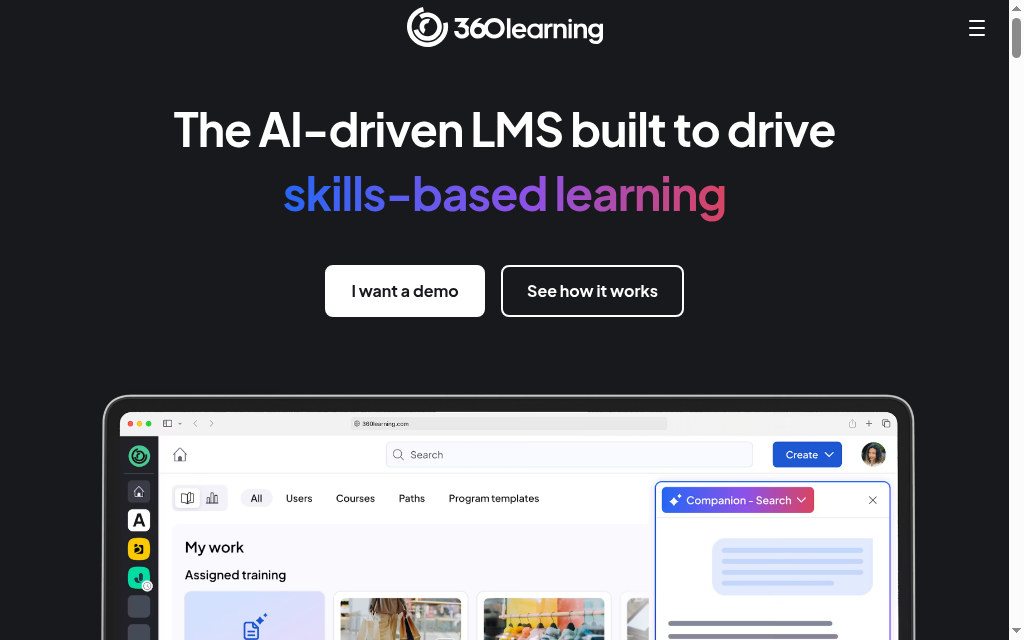
Best for: collaborative, peer-driven learning on desktop or iOS.
360Learning is a mid-market LMS built around subject-matter experts authoring their own content, and the most AI-forward of the incumbents.
AI approach: bolted on, but doing real work. The AI Companion (October 2025) runs natural-language search and conversational analytics.
What the AI does: answers questions against your content and lets you ask which modules have the lowest completion this quarter and get an answer with source links.
Access: public. Team $8/user/mo, 30-day trial no card; Business and Enterprise custom.
The catch: inflexible reports with no PDF export, a basic quiz builder, and an Android app that badly lags iOS; support is portal-only. Not for regulated compliance.
My take: strong if experts should build the training rather than a central L&D team; not for audit-trail-heavy compliance.
Thoughts after trying it out: I tested the AI Companion for reporting queries and it does not hallucinate like a generic chatbot. Ask for a compliance pathway that does not exist and it lists your actual options instead of inventing one. Managers get answers grounded in real content, but you still have to refine vague questions yourself.
5. Cornerstone OnDemand
Best for: a full talent-and-learning suite with compliance at enterprise scale.
Cornerstone serves 7,000-plus customers across 186 countries, with AI that is real but firmly secondary to a vast talent suite.
AI approach: bolted on. Skills inference and content recommendation sit on top of the suite, not an AI-native core.
What the AI does: infers skills and recommends content; the vendor ROI figures (443%, competency time cut to 90 days) are self-reported, so treat them as directional.
Access: enterprise custom quote, no trial.
The catch: the end-user interface is hard to defend in 2026, and close to 40% of documented users flag slow, ineffective support.
My take: buy it for suite depth and compliance at scale; look elsewhere if learners must feel at home on day one.
Thoughts after trying it out: I tested Cornerstone's natural-language search with 'how do I improve my team engagement' and got 1,886 courses back. The AI understood the question fine, but could not work out which results actually mattered, so sorting through thousands defeats the point of letting AI do the thinking.
6. TalentLMS
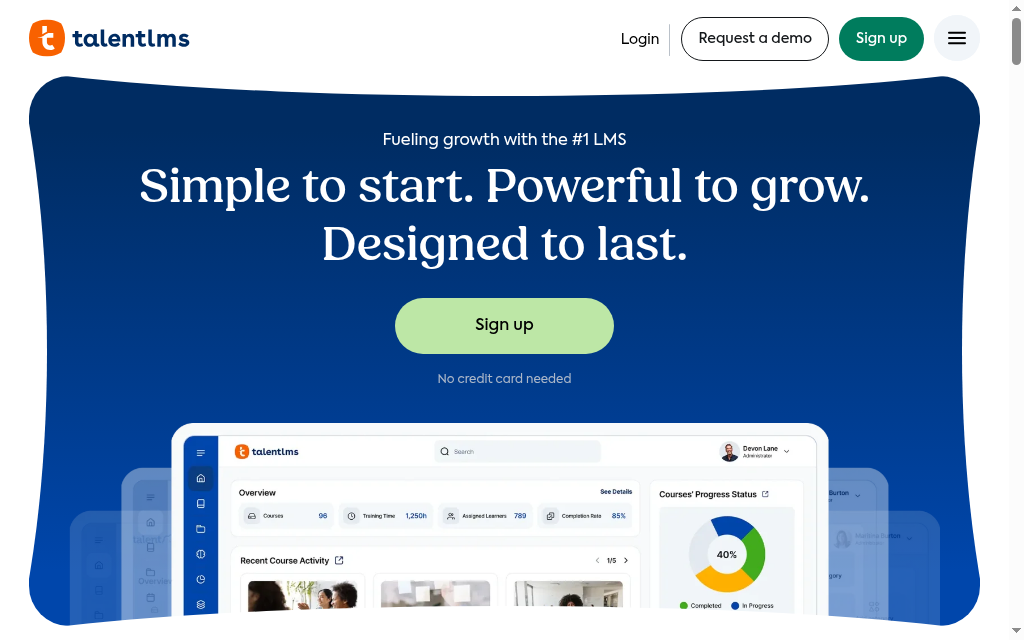
Best for: SMEs and growing teams that want honest pricing and simple structures.
TalentLMS pairs the category's most transparent pricing with a competent AI course builder, TalentCraft.
AI approach: bolted on, as a genuine assist. TalentCraft speeds up standard content rather than rethinking the LMS around AI.
What the AI does: drafts standard course content on AI credits; right-sized for everyday corporate training.
Access: public. Free for 5 users; Core $119/mo, Grow $229, Pro $449, 20% off annual, enterprise above 500.
The catch: you cannot group courses into a curriculum and report across it, which a multi-module compliance programme hits immediately.
My take: the pick for SMEs that want something that works without a procurement gauntlet; not for complex enterprise compliance.
Thoughts after trying it out: I tested TalentCraft's image generation and the text overlaid inside AI-created images often had spelling mistakes and odd formatting. Every time I generated images I had to review and delete or regenerate the bad ones. In practice it was faster to upload my own visuals and overlay the text myself.
7. Absorb LMS
Best for: mid-market teams that prize clean admin and strong support over cutting-edge AI.
Absorb is easy for both admins and learners to navigate without a training programme, which is a higher bar than it sounds.
AI approach: bolted on and newest. The AI-agents capability was only announced in April 2026, and Absorb Create covers standard content types, not AI-native authoring.
What the AI does: converts PowerPoint into editable courses and handles standard content; for an AI LMS specifically, the AI is a work in progress.
Access: custom quote by learner count, no trial.
The catch: you can report on all users or one user, but not filter to a sub-group; and the UI has aged relative to Sana, 360Learning and TalentLMS.
My take: a clean, well-supported mid-market LMS; just do not buy it for the AI yet. Test the sub-group reporting in a proof of concept.
Thoughts after trying it out: I tested Absorb Create's PowerPoint converter and it beats the screenshot-only approach rivals use. You upload a deck, edit the text directly, add questions on top, then publish. Better still, update the master lesson in Create and it flows through to every course using it.
8. CYPHER Learning
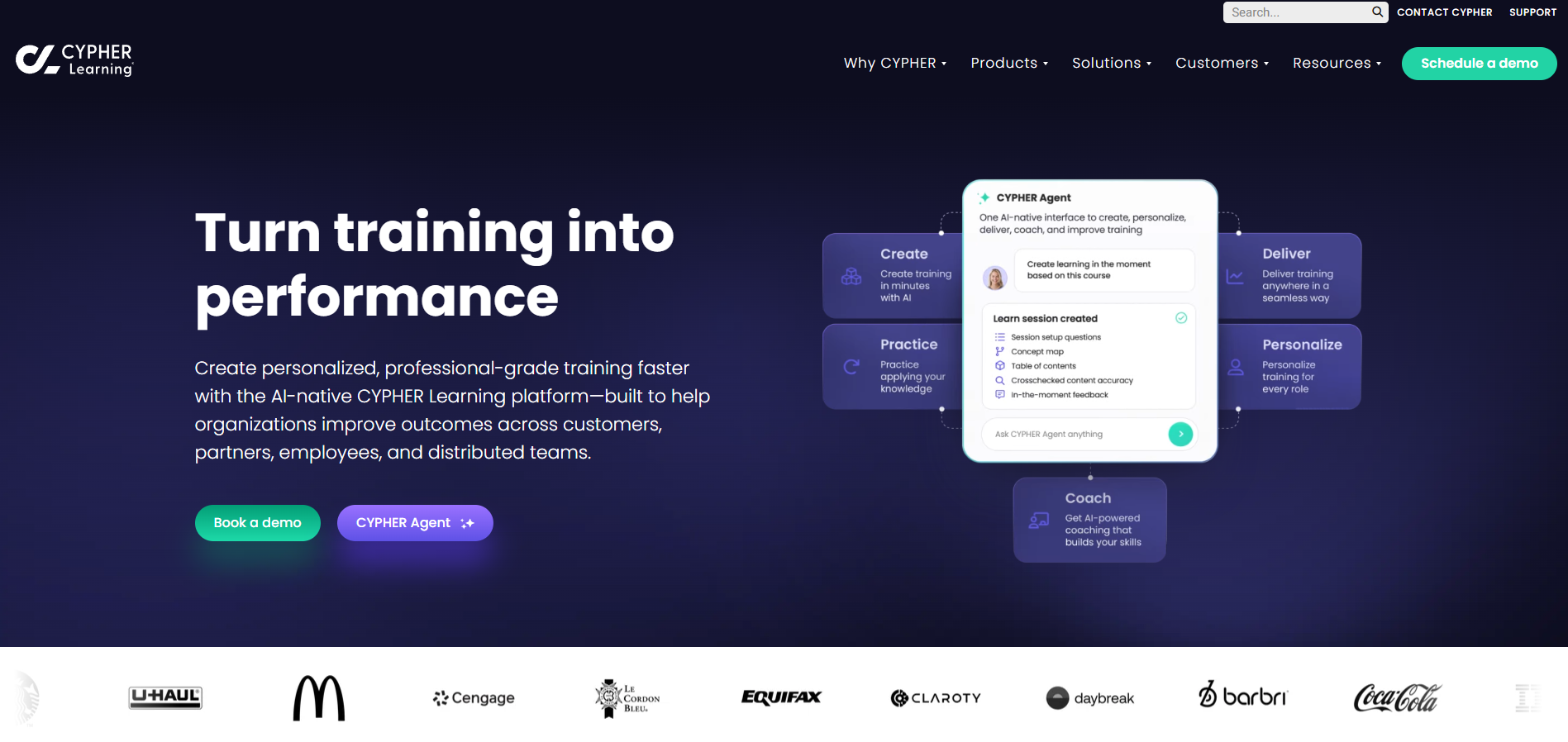
Best for: skills-based competency tracking with a premium on stability.
CYPHER Learning leads with reliability and a skills-based architecture, with AI course generation present but not the reason people choose it.
AI approach: bolted on. Copilot generates courses and assessments, but exceptional uptime is the real draw.
What the AI does: builds about 80 to 90% of a course in roughly ten minutes with competency-to-quiz alignment, then you finish it.
Access: two custom-quote tiers, Enhanced and Enterprise.
The catch: some UI elements have aged, feature requests move slowly, and setup is more hands-on than TalentLMS or Absorb.
My take: a stable, skills-first pick in a category where SAP Litmos regressed and LearnUpon ships buggy features. Reliability is the story.
Thoughts after trying it out: I watched Copilot build a course in about ten minutes, competencies through to quizzes auto-aligned. But it is a scaffold, not finished material, you still add your own videos, graphics and project specifics. It compresses what is often 40 hours of content work into a ten-minute draft, then you customise from there.
9. SAP Litmos
Best for: existing Litmos shops content to wait it out, not a new multi-year commitment today.
SAP Litmos still has a straightforward admin interface, built-in gamification and solid foundational LMS capabilities.
AI approach: bolted on and thin. The AI is peripheral next to the AI-native tools at the top, present mainly in descriptions, objectives and search.
What the AI does: light content assistance; for an AI-native LMS it is not where the frontier is.
Access: quote only (Foundation and Platinum AI). 14-day trial. Content library and Salesforce connector cost extra.
The catch: veteran users document a steady decline in stability and UX since the 2022 SAP acquisition.
My take: the one I would not sign right now. You are committing to SAP's trajectory, not the product that earned Litmos its reputation. Revisit in 2027.
10. LearnUpon
Best for: customer and partner training at scale, when AI is not your priority and your headcount clears the minimums.
LearnUpon is a genuinely well-run multi-audience LMS, and the least AI-native of the ten.
AI approach: bolted on and nascent. Its agentic positioning is early, so today you buy a solid, conventional delivery platform.
What the AI does: little that is AI-native yet; the real strength is training multiple external audiences (customers, partners, associations) from one platform.
Access: quote only, with minimums of 100 users (employee training), 300 (customer education), 150 (associations); below those you cannot buy.
The catch: the Microsoft integration needs manual workarounds, and features have shipped buggy before adequate QA.
My take: excellent for customer and partner training with fast implementation and strong support; just not an AI-first product.
What counts as an AI LMS, and what is just a chatbot bolted on
An LMS is the system that hosts, delivers and tracks your training. An AI LMS should mean the AI does real work inside that loop, not a support chatbot sitting in the corner of the screen.
Three jobs actually count. It generates courses or assessments from your material. It personalises or recommends what each learner sees. Or it answers learners and admins in plain language against your own content. A tool that does one of these well has earned the label.
What does not count: a generic chatbot bolted onto the login screen, a keyword search that was quietly relabelled AI, or an agentic feature that has been announced but has not shipped. If the impressive part lives in a press release rather than the product, it is marketing, not an AI LMS.
AI-native vs AI-added: how to tell
This is the single biggest divide on the list. AI-native platforms were built around the AI from day one, so the AI does the core job of making and delivering training; Sana and Coursebox sit here. AI-added platforms are mature systems that bolted AI on top, where the LMS is the product and the AI is a feature; Docebo, Cornerstone, TalentLMS, Absorb, CYPHER, SAP Litmos and LearnUpon sit here. Neither is automatically better, they solve different problems.
How to tell them apart in a demo:
Ask what the AI was in 2022. If the honest answer is that they did not have it, it was added on.
Ask it to build a course from your document, live. Native tools do it inside the normal flow. Added tools route you to a separate authoring tool, or to a roadmap.
Check what the AI works on. Native AI works on your raw content. Added AI often only works once content is uploaded and tagged into its catalogue.
Watch the tense. Future tense in an AI pitch, like agentic AI arriving next autumn, means you are buying a roadmap, not a product you can use now.
How to choose an AI LMS
Start from the job, not the label
If you need training built fast from existing material, an AI-native tool earns its keep. If you need deep compliance, talent management and governance at enterprise scale, a mature LMS with AI added is the safer buy and the AI is a bonus.
Insist on a live test with your own content
Every vendor demo looks flawless on the vendor data. Yours is the only test that matters.
Treat quote-only pricing as a signal
Six of the ten platforms here hide pricing behind a sales call. Public pricing, as with Coursebox, 360Learning and TalentLMS, usually means faster procurement and fewer surprises.
Buy what ships, not what is announced
Several AI stories on this list lean on features dated to late 2026. You can only use what is live the day you sign.
Pressure-test the one limitation
Every tool here has one, whether it is reporting depth, sub-group filtering or non-English quality. Find it before you commit, not after.
What I Would Actually Pick
If AI doing real work is the priority and you are English-primary, Sana is the most modern option, provided you can commit without a trial. If you want that AI-native approach as a full LMS you can start today, Coursebox is the pick, and yes I am biased, so pressure-test the reporting depth against your real requirements.
If you are a large enterprise where LMS depth and governance outweigh how AI-native the platform feels, Docebo is the call: test the Salesforce integration with real data first. Mid-market teams that want clean admin and strong support over cutting-edge AI should still look hard at Absorb, and test the sub-group reporting workflow before they commit.
The one I would not sign right now is SAP Litmos: the post-acquisition trajectory is the wrong direction for a multi-year commitment. I would revisit it in 2027.
One last question to ask every vendor on your shortlist: not whether an AI feature exists, but how many active users actually have it enabled. Our own data shows the Coursebox AI tutor, a marketed feature, sits under half a percent adoption. Most vendors will not volunteer that number, and it is the difference between an AI LMS and an LMS with an AI logo on the box.
Frequently Asked Questions
The label covers a wide range. At the useful end, the AI generates course content from documents or prompts, auto-builds quizzes and assessments, and adds features like AI tutors or automated grading. At the thinner end, it is a chatbot bolted onto a standard LMS. When you compare platforms, judge what the AI actually does day to day, not what the marketing claims.
The strong ones do both. You can bring existing SCORM packages in from authoring tools like Articulate Storyline or Rise, and export AI-built courses back out as SCORM to run inside another system. If you already have a learning platform you plan to keep, SCORM export is the feature that lets an AI LMS sit alongside it instead of replacing it. Confirm both directions before you buy.
No. A common setup is to keep your current LMS for delivery and reporting, and use an AI LMS purely as the authoring layer that generates courses and exports them as SCORM into the system you already run. Buyers who only need faster content creation, not a new platform, often take this route. Just check that the AI tool exports cleanly into your specific LMS.
It varies more than you would expect, which is where quotes get confusing. Some platforms charge per learner or per active user, which scales badly as your audience grows. Others charge per admin seat or per portal, with unlimited learners included. High user minimums (for example 100 seats or more) are common at the enterprise tools. Always model the cost at your real learner count, not the headline price.
Most AI-native platforms can generate and translate course content across many languages from a single source. Quality is usually strongest in English and can degrade in less common languages, so if you train a multilingual workforce, test the output in your actual target languages first. Ask whether translation is one click or a manual rebuild for each language.
Enterprise buyers should expect SSO, role-based access, GDPR compliance and, on request, documents like a penetration test summary or a data processing agreement. Newer AI-native tools sometimes trail the established enterprise platforms on this, so if you are in a regulated industry, ask for the security pack up front rather than assuming it exists. This is a common reason procurement stalls.
There are usually two paths. If your old courses are SCORM packages, you import them directly. If they are documents, slides or PDFs, you feed them into the AI to rebuild them as structured courses, which also modernises the content along the way. Bulk migration of a large catalogue is rarely fully automatic, so ask about the process and any help offered before you switch.
Travis Clapp
Educational technologist and instructional designer

