

I Tested 10 AI Assessment Tools: How Well Each One Actually Grades
The best AI assessment tools for L&D and training teams, compared on grading accuracy, question types and pricing by an instructional designer.

The best AI assessment tool depends on what you need to grade. Learnosity is the deepest engine for embedding assessment, Coursebox fits when grading is part of building a course, Gradescope handles exams, handwriting and code, and CoGrader and EssayGrader are the cleanest for pure essay marking.
- Learnosity grades 50+ question types plus essays, and independent testing reports 0.91 agreement with human graders, but its embeddable API needs developers and an enterprise contract.
- Coursebox grades quizzes, essays and scenarios inside the course builder, keeps an optional human-review step, and exports results over SCORM and LTI.
- EssayGrader is the value pick for high-volume essays, reporting under 4% variance from human grading across 1,000 essays, with pricing from $6.99 a month.
- Most of these tools keep a human in the loop on open-response grading; only Cognii and QuizGecko mark open answers fully automatically.
Answer three quick questions and we'll point you to the best fit from this list.

Mark assessments in seconds with fast, accurate AI grading
Every tool in this category says it uses AI to grade.
What separates the great tools from the good ones is basically
1) what they can grade
2) how much of the marking is automatic versus human-checked
3) where the results end up.
An AI grade you cannot trust to work reliably is worse than no tool at all.
This is for L&D managers, instructional designers and training leads buying for corporate or vocational programmes, not classroom quizzing. I have left out Quizizz, Kahoot and Mentimeter; they are engagement tools, not assessment systems.
The four kinds of AI assessment tool
Assessment tools are not one category, and the label "AI grading" hides four very different products. Match the type to your job before you compare features.
- Auto-graders mark work you already have: Gradescope, CoGrader and EssayGrader.
- Assessment engines and platforms run item banks, exams and open-response scoring, often embeddable: Learnosity, Questionmark and Cognii.
- Quiz generators turn a document or URL into auto-graded questions: QuizGecko, and the quiz generation built into Coursebox.
- LMS-embedded assessment is one feature inside a training platform: Coursebox, Disprz and 360Learning.
How I judged them
I weighed four things a grading team actually has to live with:
- How the grading works: whether it auto-grades or keeps a human in the loop on open responses, since AI marking still needs a check on anything high-stakes.
- What it can assess: MCQ, written and essay, competency, code, handwritten or oral. Not every tool grades what you assume.
- Where results go: SCORM, xAPI, LTI or gradebook sync. A grade trapped in the tool is a reporting problem.
- Real cost: public pricing where it exists, quote-based where it does not.
In our own support data, the assessment problems training teams hit hardest are integrity issues, and not grading accuracy. Across six months, we have received customer reports on things like question order shuffling unexpectedly, pass-or-fail logic firing wrong, lost submissions and learners resubmitting already-graded work.
Whatever you trial from this list, put those four behaviours through real submissions before you rely on the AI grade. (Coursebox support data, January to July 2026.)
Disclosure: Coursebox is my product and sits at number two. I have held it to the same tests as the rest, and where a rival is the better fit I have said so.
What each tool actually grades
| Tool | What it grades | Auto or human-reviewed | Results out |
|---|---|---|---|
| 1. Learnosity | MCQ + essay/short-answer (50+ types) | AI-assisted, human approves | Reports/data API |
| 2. Coursebox | Quizzes, essay, short-answer, scenario, file uploads | AI grades, optional human review | SCORM, LTI |
| 3. Questionmark | MCQ + long-form written | AI-assisted, human review required | LTI, SCORM, xAPI, AICC + Workday/Cornerstone |
| 4. Gradescope | Exams, handwritten, essays, code | AI groups, instructor grades | Gradebook + LMS (Institutional) |
| 5. CoGrader | Essays, open-ended written | AI drafts, teacher final say | Classroom, Canvas, Schoology |
| 6. EssayGrader | Essays, reports, DBQs; video (Pro) | AI grades, teacher reviews | Classroom, Canvas, Schoology |
| 7. Cognii | Short essays, open response | Auto-graded, instant | Not stated |
| 8. QuizGecko | MCQ + short-answer/essay | Auto-graded | CSV, Google Classroom |
| 9. Disprz | Quizzes, scenario, subjective | Auto quizzes; manager/peer for subjective | SCORM, xAPI ready |
| 10. 360Learning | MCQ, open-ended | Open-ended validated by instructor | SCORM import, LMS native |
1. Learnosity
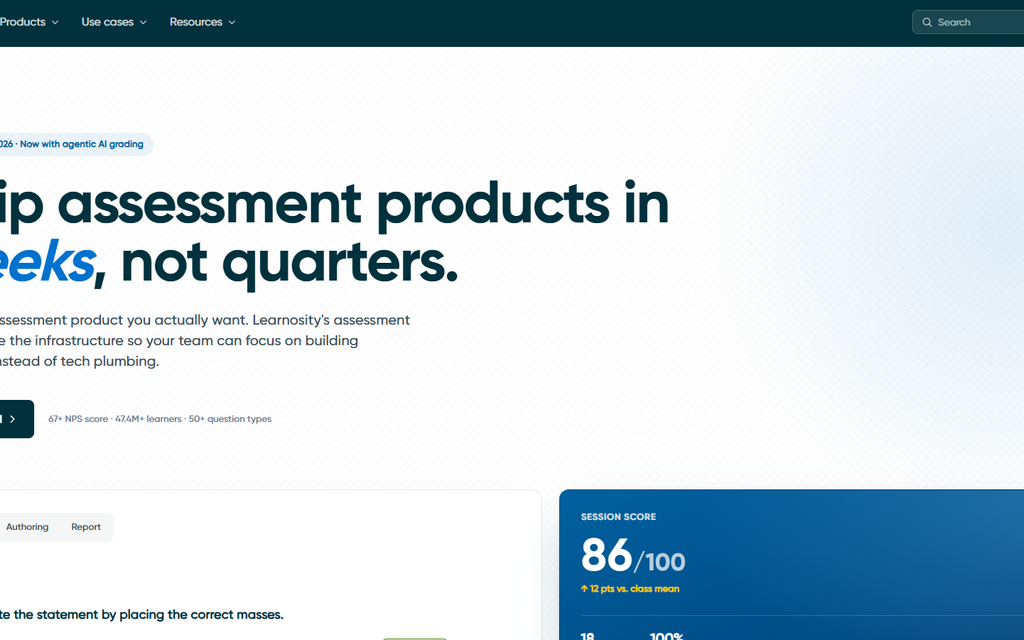
Best for: publishers and certification bodies embedding assessment into their own product.
Learnosity is an embeddable assessment API, not an app you log into; its Feedback Aide engine grades open responses at scale.
- Grades: 50+ question types (MCQ, drag-and-drop, audio and video response, formula) plus essay and short open-response via Feedback Aide.
- Accuracy: AI-assisted, a human approves; independent testing reports 0.91 agreement (quadratic weighted kappa) with human graders on 850 essays.
- Results out: via its Reports and data APIs, so you build the export; no packaged SCORM or xAPI is stated.
- Price: quote-based and enterprise, with no self-serve trial that mirrors production.
Testing notes: Digging into the tool, I felt there was a bit of an authoring friction. For instance, I was busy clicking into edit two or three times just to get from previewing a question to changing it, which adds up across a large item bank.
My take: the deepest engine on the list, but it needs developers and a contract budget. Without both, the feature depth is wasted.
2. Coursebox
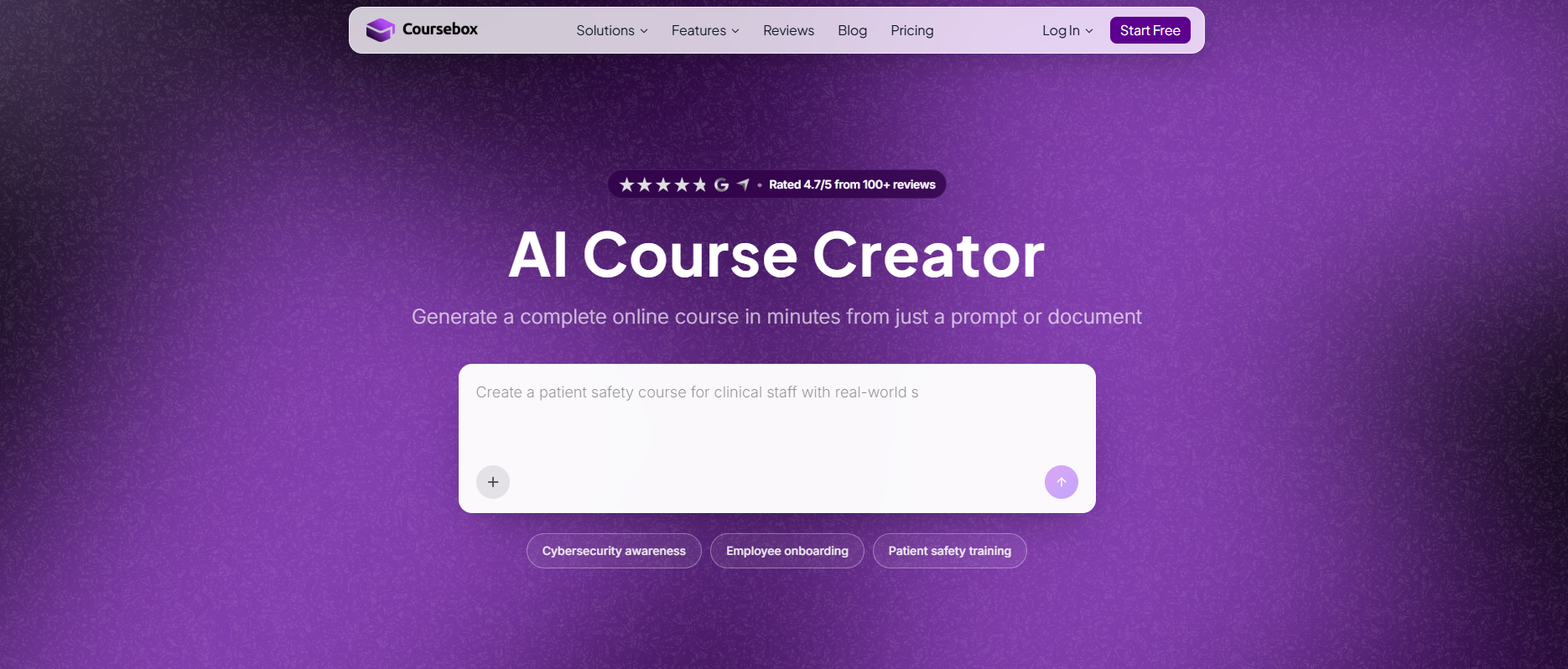
Best for: training teams that want to build the course and grade it in one place.
Coursebox is our own product, so full disclosure up front. It grades assessments inside the same tool you build and deliver the course in, rather than as a separate marking app.
- Grades: quizzes, written and essay answers, short-answer, scenario-based submissions and file uploads (PDF, DOCX, TXT).
- Accuracy: AI grades with an option for human review before the grade is final, so nothing high-stakes goes out unchecked.
- Results out: SCORM and LTI, so assessments and results move into any LMS.
- Price: free plan; paid from about $29/month; Enterprise on request.
Testing notes: Since this one is ours, I will lean on our own support data. The question we get the most on assessment is how to configure the assessment. So it would include things like quiz rules, question shuffle, pass marks, retakes and grading. The AI does the marking, but I would budget a little time to wire those rules up the way you want.
My take: the strongest fit when assessment is one step in building and delivering training. If you only need standalone essay marking, a specialist tool like CoGrader is a better fit.
3. Questionmark
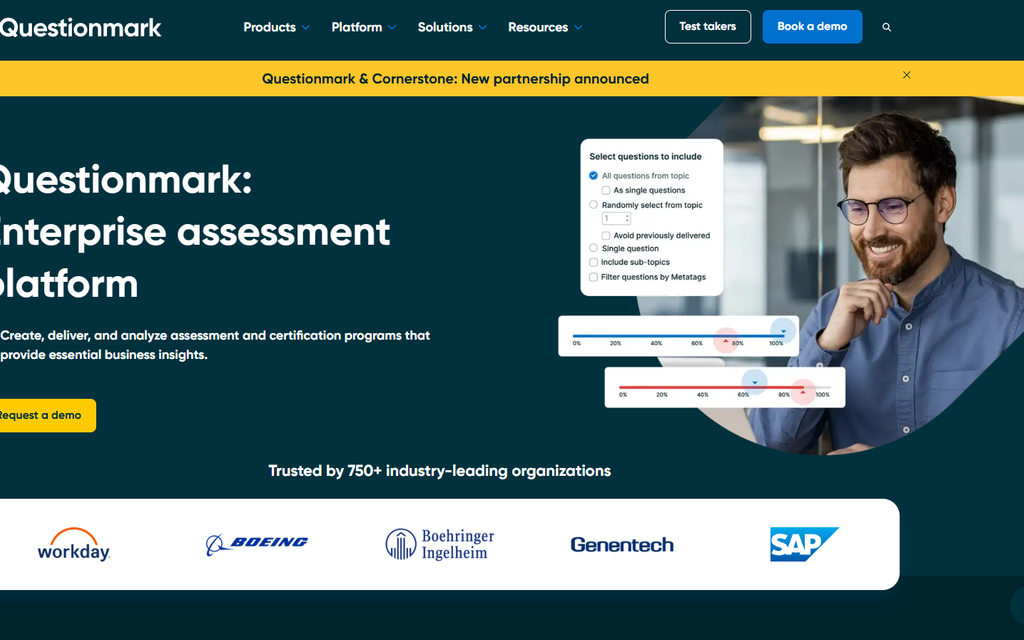
Best for: regulated, high-stakes certification and compliance exams.
Questionmark is an enterprise assessment platform, now part of Learnosity, built for defensible, audited exams.
- Grades: MCQ and item-bank exams plus long-form written answers via rubric-based AI Scoring.
- Accuracy: AI-assisted with mandatory human review; every final score requires a human to approve.
- Results out: the best standards story here, LTI, SCORM, AICC and xAPI, plus Workday, Cornerstone and SuccessFactors.
- Price: quote-based, enterprise.
Testing notes: The thing I would test before committing is how locked down it gets after publishing. I could not edit items once an assessment was live. There is no item-review step, and students and invigilators are not notified automatically.
My take: pick it when the exam has to stand up to an auditor. Overkill for informal knowledge checks, and its review count is thin (Capterra 3.8).
4. Gradescope
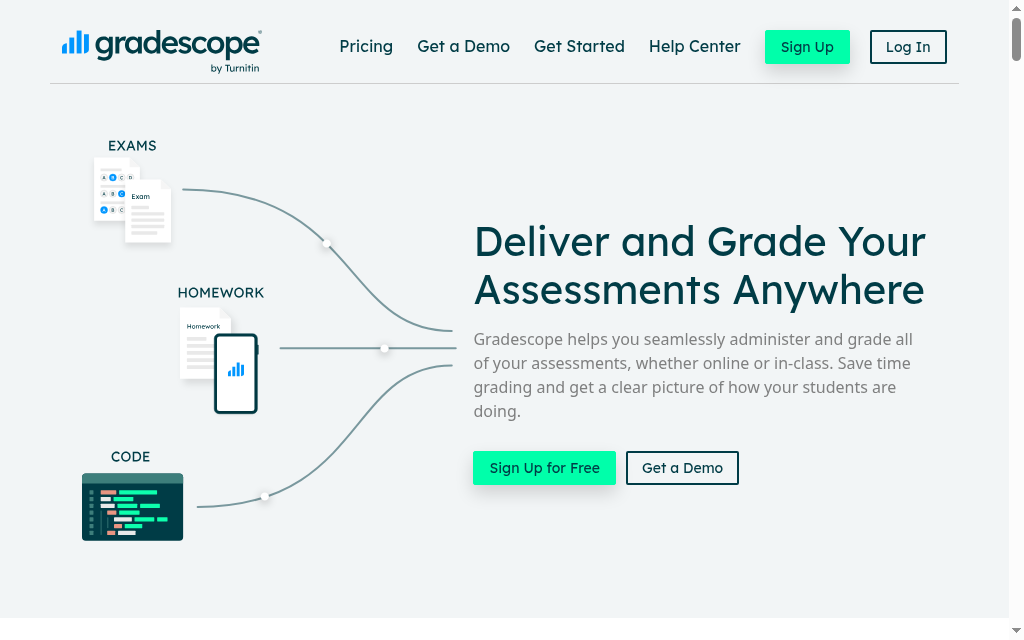
Best for: technical marking: exams, problem sets, handwriting and code.
Gradescope (by Turnitin) is the widest-format grader here, handling paper, digital and code in one place.
- Grades: bubble-sheet MCQ, handwritten work, essays and programming via an autograder, the only tool here that does handwriting and code.
- Accuracy: hybrid; AI groups similar answers and the instructor applies the grade.
- Results out: exports to your gradebook; LMS integration sits on the Institutional tier.
- Price: Basic is free; Institutional is quote-based.
Testing notes: The answer-grouping and rubric edits are quite robust. Group work is where I got stung. Gradescope makes students self-report who is in their group, and when one of them left a teammate off the list, that teammate silently scored zero until I caught it. I would push group projects to your LMS instead.
My take: unmatched for exams and STEM marking. It is higher-ed shaped, so competency and compliance workflows are not its world.
5. CoGrader
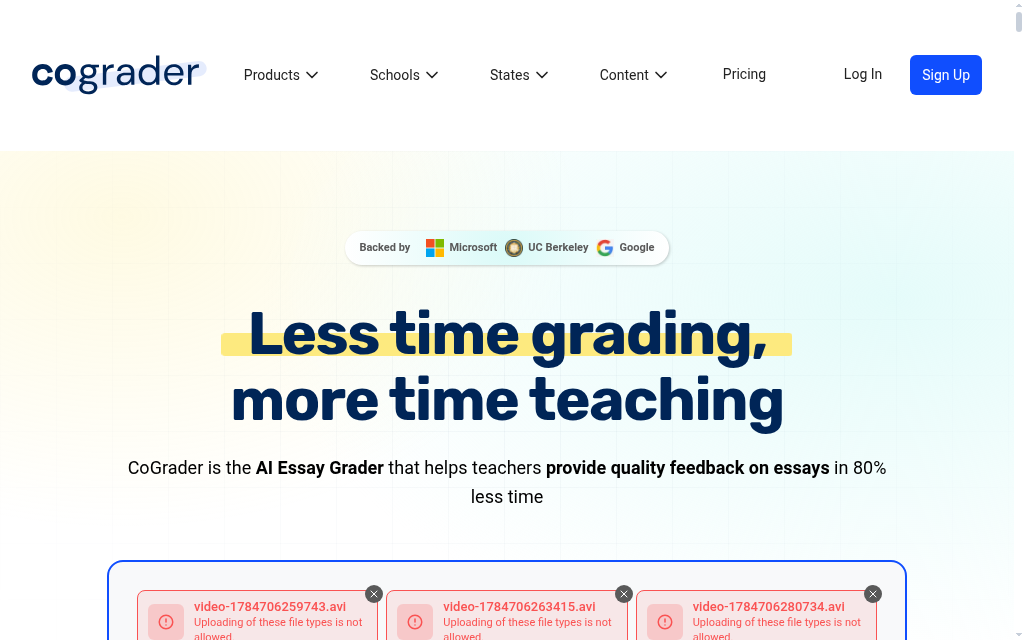
Best for: teams that mainly grade essays and written assignments.
CoGrader is a focused essay grader: import the work, set a rubric, and it drafts a grade and feedback.
- Grades: essays and open-ended written responses only.
- Accuracy: AI drafts, the teacher has the final say.
- Results out: Google Classroom for everyone, Canvas and Schoology on school plans, file import and export elsewhere.
- Price: free tier (100 submissions/month), paid from about $19/month.
Testing notes: It flew through a single, focused essay prompt. The moment I handed it an assignment that bundled three questions into one piece of writing, the rubric feedback went vague, so I kept every prompt to one clear ask after that.
My take: the cleanest written-grading workflow on this list. It does only one thing, so no quizzes or competency.
6. EssayGrader
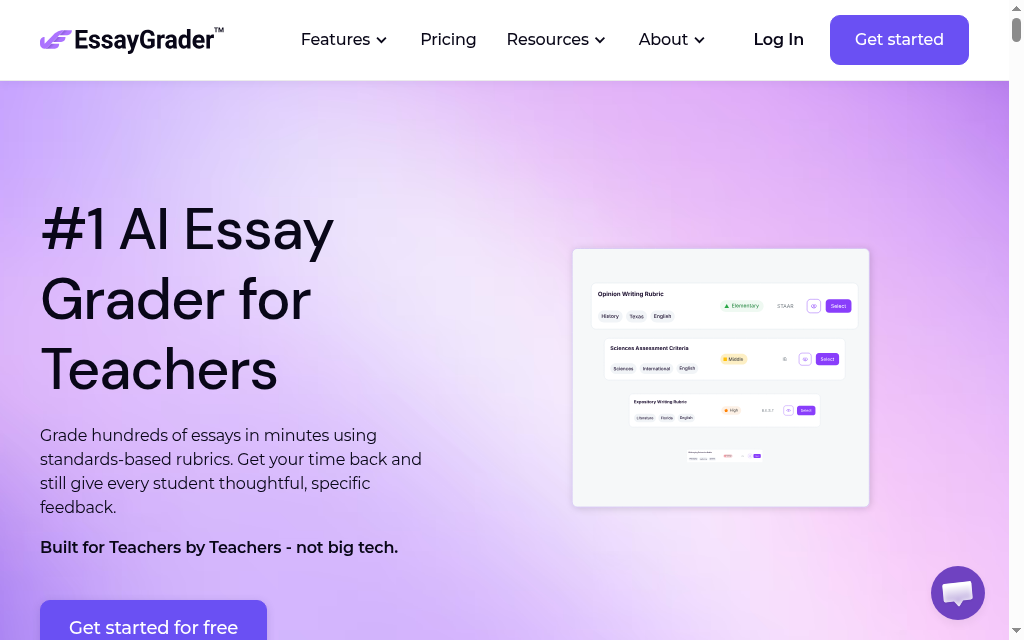
Best for: high-volume written marking on a budget.
EssayGrader grades written responses from short answers to long essays, and it publishes real accuracy data.
- Grades: essays, DBQs, reports, case studies and journals; video submissions on the Pro tier.
- Accuracy: AI grades, the teacher reviews; it reports under 4% variance against human grading from a study of over 1,000 essays.
- Results out: Google Classroom, Canvas (syncs to SpeedGrader) and Schoology.
- Price: the most transparent here, free up to 50 essays, then $6.99 to $34.99/month.
Testing notes: The custom rubrics are the strong bit and the feedback is mostly accurate. What made me cautious was consistency: I ran the same essay through twice and got two different scores back, so I would keep it to a fast first pass that a human still signs off.
My take: strong value and honest about accuracy. It is education-shaped, so there is no competency or SCORM story for training compliance.
7. Cognii

Best for: instant, formative open-response practice at scale.
Cognii is a conversational assessment engine that scores open answers in real time and coaches learners toward mastery.
- Grades: short essays and open-response questions, not MCQ by design.
- Accuracy: fully auto-graded and instant; it reports 96% agreement with human scorers on short essays.
- Results out: marketed as easy to integrate, but it publishes no LMS, SCORM or export specifics.
- Price: quote-based, with no public pricing.
My take: genuinely useful for retry-to-mastery practice. The thin public footprint (no real G2 or Capterra reviews, no export detail) makes it a harder enterprise buy.
8. QuizGecko
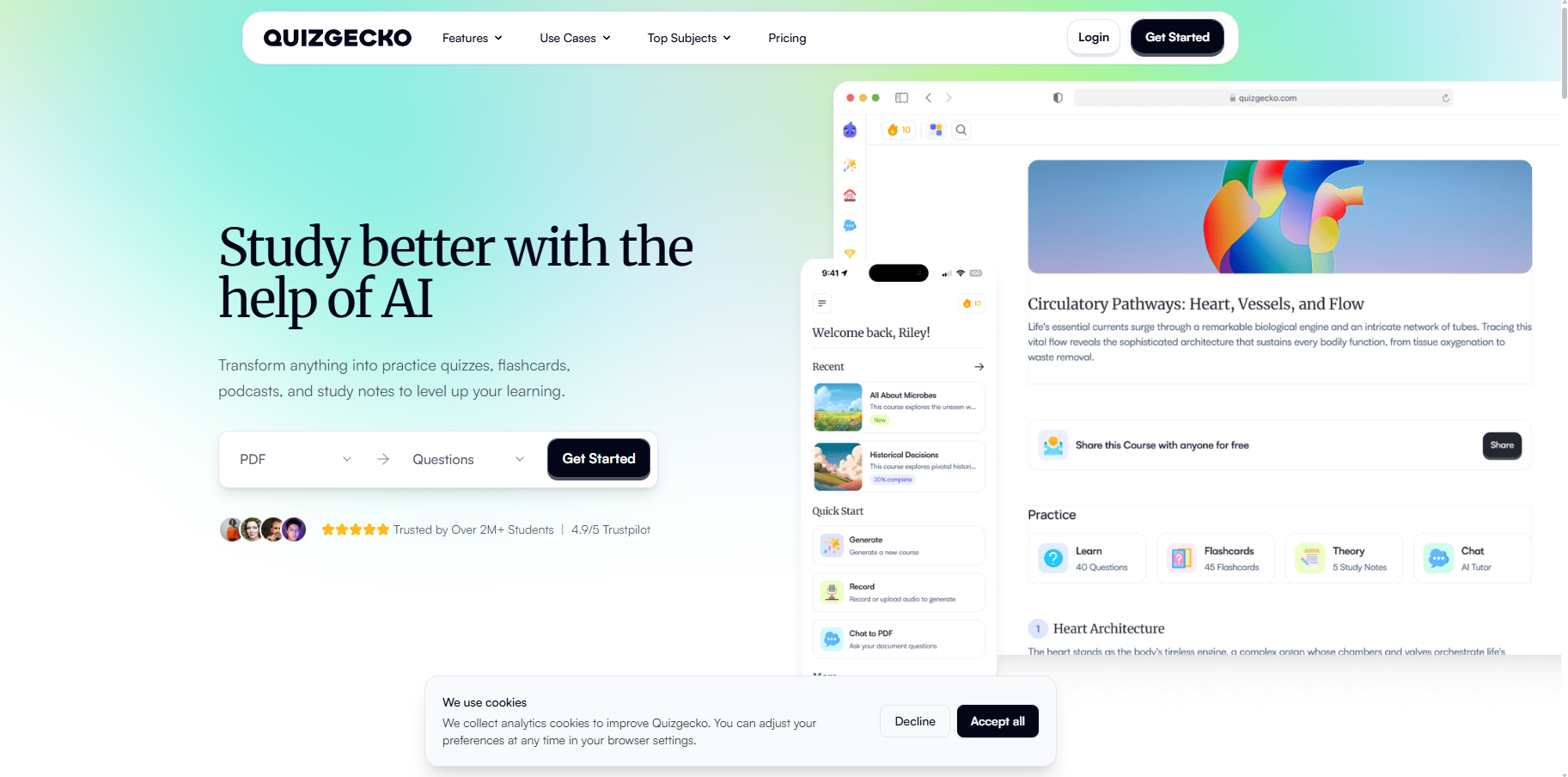
Best for: quickly turning documents into auto-graded quizzes.
QuizGecko generates quizzes from a document, URL or text and grades short-answer and essay responses automatically.
- Grades: MCQ, true or false, short answer, matching, fill-in-the-blank and essay.
- Accuracy: auto-graded, with no mandatory human step stated.
- Results out: CSV export and share or embed into tools like Google Classroom; no native SCORM or xAPI.
- Price: from about $16/month; Enterprise with API from around $500/month.
Testing notes: When I fed it my own notes, the questions came back on-topic but broad, paraphrasing the material rather than drilling the exact wording I wanted to test. The trick I landed on was giving it a web page instead of a PDF,. For me, it seemed like it worked better with URLs than with documents.
My take: fast and cheap for knowledge checks. Important to note that it is a quiz tool, not an assessment system of record.
9. Disprz
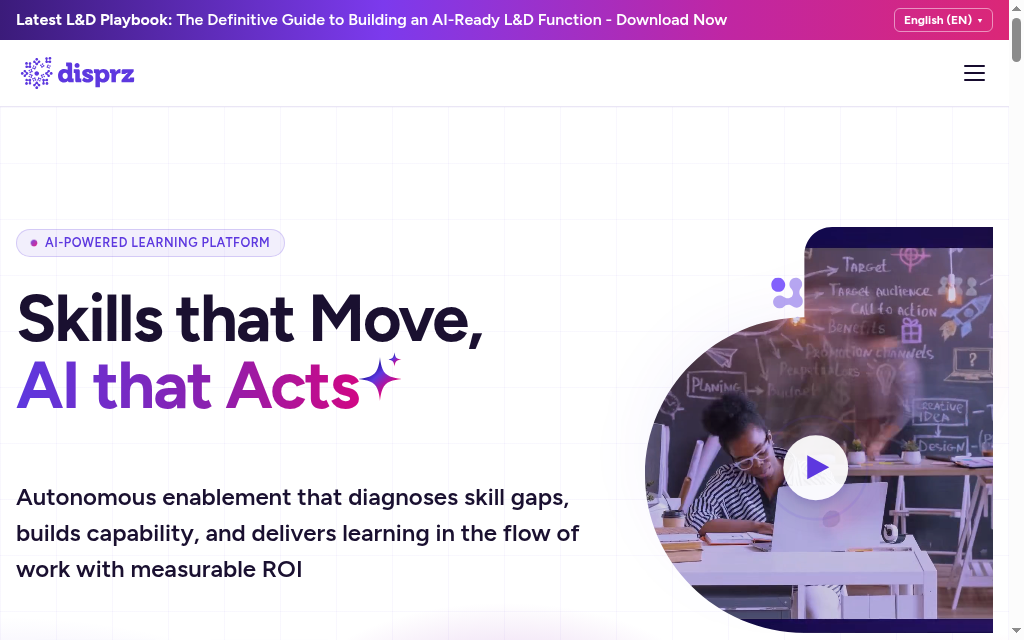
Best for: L&D teams wanting assessment inside a skilling platform.
Disprz is an L&D and skilling platform where assessment is one feature alongside learning and analytics.
- Grades: quizzes and knowledge checks plus AI-built scenario exercises; subjective evaluations run on manager and peer feedback.
- Accuracy: quizzes auto-score, but subjective work is human-reviewed, not AI-graded (a conversational-assessment feature is still upcoming).
- Results out: SCORM and xAPI ready, and LMS-agnostic.
- Price: quote-based (Capterra lists an entry tier around $3/user); rated Capterra 4.7 from 38 reviews.
Testing notes: The quizzes and modules held up fine. Reporting is where I hit the wall: the smart-analytics charts are basic and the report options limited, so I ended up exporting the data to build a more granular report myself.
My take: a fit if you want assessment bundled with skilling, not a dedicated AI grader for open response.
10. 360Learning
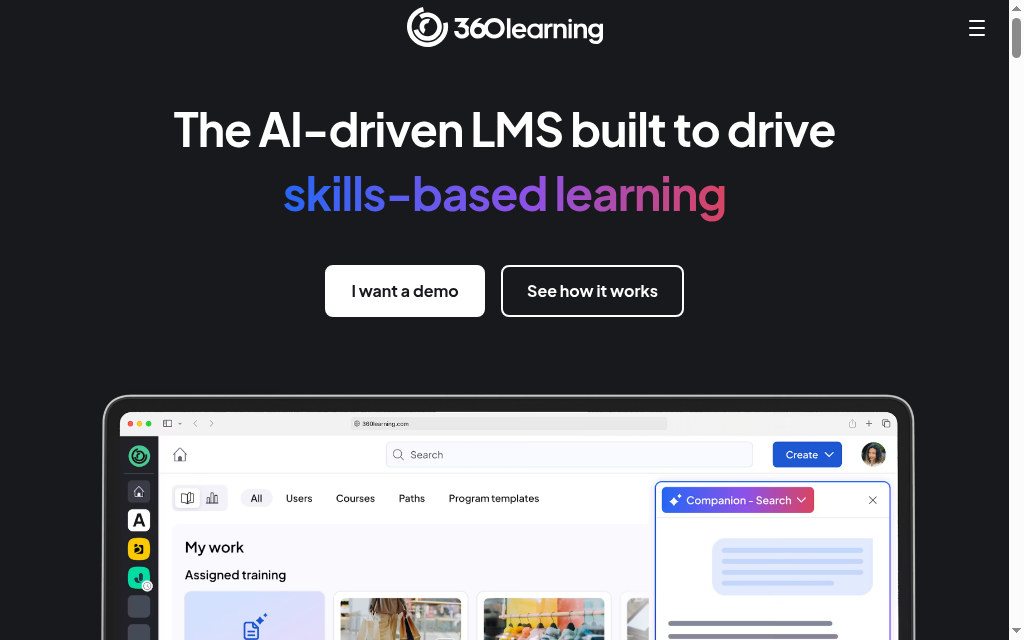
Best for: collaborative course building where assessment is a light add-on.
360Learning is a collaborative LMS; its assessment is basic and built around instructor validation.
- Grades: MCQ, fill-in-the-blank and open-ended questions.
- Accuracy: open-ended answers are validated by an instructor (Validate, Retry or Reject), not AI-graded.
- Results out: SCORM import and native LMS reporting.
- Price: Team from $8/user/month; Business quote-based; best-reviewed for scale (Capterra 4.7, 500+).
Testing notes: Assessment felt like the afterthought. Dropping a quiz into a course was clunkier than it should be, and the engine underneath is light, no real question banks, randomisation or timers, so I would trust it for a knowledge check and little more.
My take: an excellent LMS but the weakest AI-assessment fit here; its quiz engine lacks question banks, randomisation and timers.
What I would actually pick
If assessment is part of building and delivering training, Coursebox is the one to start with: it grades essays, quizzes and scenarios in one place, keeps an optional human-review step, and exports over SCORM and LTI. For assessment embedded inside your own product, Learnosity is the deepest engine, if you have the developers. For audited, high-stakes certification, Questionmark. For pure essay marking, CoGrader is the cleanest workflow and EssayGrader the best value. Gradescope owns exams, handwriting and code, and Cognii is the pick for instant formative practice. The ones to skip for a training programme are where assessment is a bolt-on (Disprz) or the quiz engine is thin (360Learning).
Disclaimer: Coursebox is our own tool and I have tried to rank it honestly on this comparison list.
Frequently Asked Questions
An AI assessment tool is software that evaluates learner responses automatically, often using algorithms or machine learning. It can grade quizzes, analyze open responses, adapt the test to the learner, and provide feedback without requiring manual grading every time.
They can complement them. AI tools excel at formative assessments, providing quick and frequent feedback, while traditional exams may still be needed for high-stakes or certification purposes.
Accuracy depends on how well questions are authored, the training of algorithms for open response grading, and human oversight. Good tools allow calibration, rubric design, and review to maintain reliability.
Multiple choice, matching, and other structured questions are easiest. Open response, essays or project-based tasks work when the tool permits rubric alignment or manual review. Adaptive formats increase engagement and support mastery learning.
Use metrics such as learner performance over time, average scores, time to competency, question-level analysis, and satisfaction. Tracking improvements in knowledge retention and behavior change is also helpful.
Coursebox supports building assessments with varied question types, custom rubrics, automatic scoring, and detailed analytics. It helps you track gaps, deliver feedback, adjust training content, and scale assessment without heavy manual effort.
Carolina Martin
Customer success lead and learning designer at Coursebox AI

