

ARCS Model of Motivation: Keller's 4 Categories and Examples
The ARCS model of motivation explained: Keller's 4 categories and 12 strategies, a worked example, how to measure motivation and two free templates.

The ARCS model is John Keller's framework for designing motivating instruction, built on four conditions learners need: attention, relevance, confidence and satisfaction, each with three subcategories of strategies.
- Keller began the work in 1979, named it ARCS in 1984, and added volition as a fifth category in 2008.
- Motivation can be too high as well as too low, so ARCS starts with an analysis of the audience before adding tactics.
- The IMMS and CIS measure learner-reported motivation. Pair them with an assessment of the knowledge or performance the course is meant to develop.
- Most ARCS research comes from schools and universities, so treat workplace results as promising and test your own course.
Five planning prompts for one course. This is an unvalidated checklist. Review each answer; the total does not establish suitability or effectiveness.

Go from storyboard to an interactive course in minutes
Picture a bank (a hypothetical example) that runs the same data-privacy refresher for its branch staff every year. Completion is 100%, and so is the clicking through. Staff have seen the policy slides before, they believe they already know it, and the course gives them no reason to think otherwise. Then a customer's account details get read out across a busy counter.
Completion alone does not explain the incident. The team needs to investigate what staff know, what happens at the counter and why they disengage from the refresher. John Keller's ARCS model helps with the motivational part of that analysis. I'm an instructional designer at Coursebox, where we make instructional design software for training teams. Below, I apply the model's twelve strategies to that refresher.
What is the ARCS model?
The ARCS model is John Keller's framework for designing motivating instruction, built on four conditions learners need: attention, relevance, confidence and satisfaction, each with three subcategories of strategies.
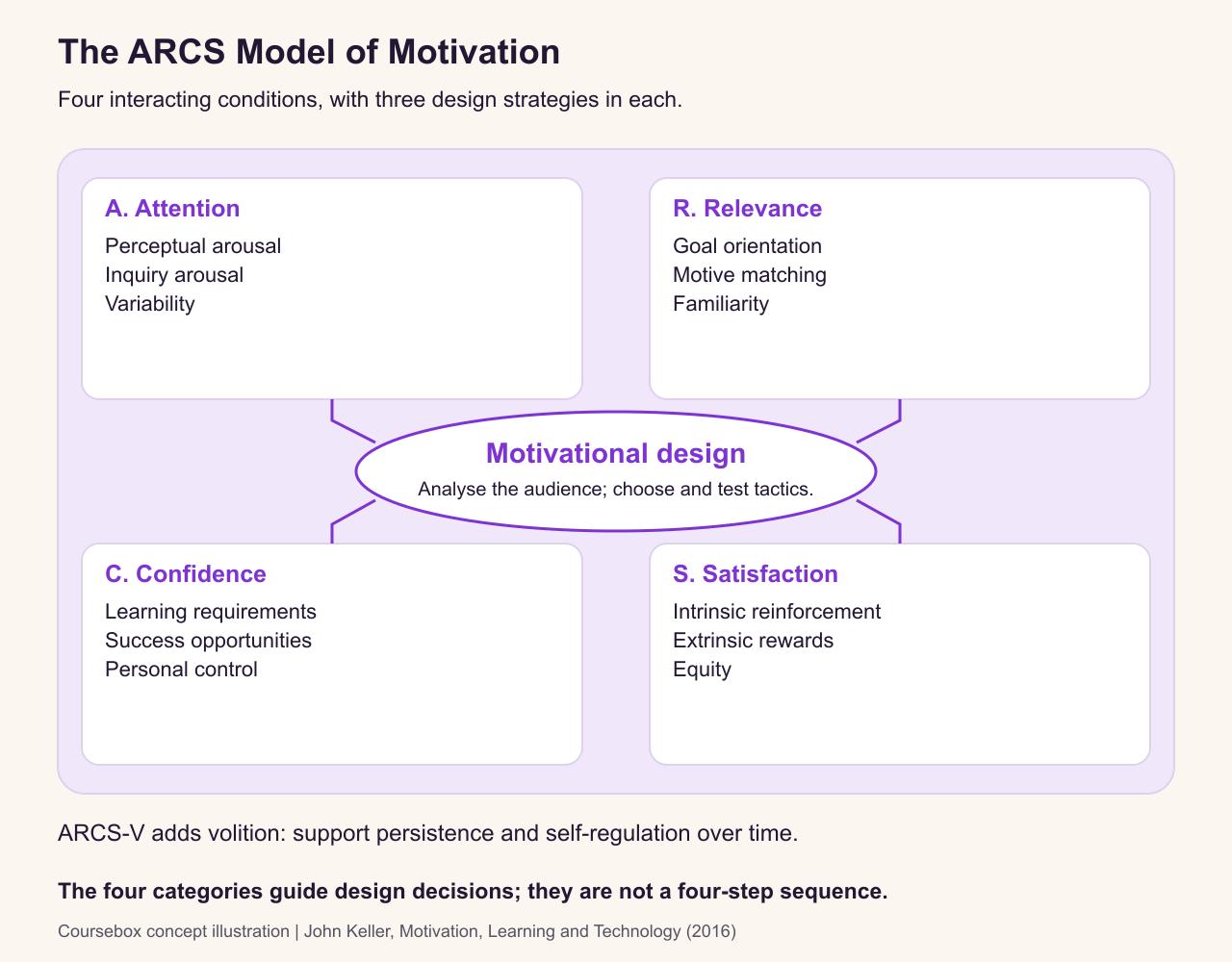
In Keller's words, the model "defines four major conditions (Attention, Relevance, Confidence, and Satisfaction) that have to be met for people to become and remain motivated" (Keller, 1987). It is a design tool for the course, with a systematic process alongside it. Keller is clear that it is "not designed as a behavioral change model" for fixing individual personality problems.
In the table below, the privacy refresher is a hypothetical annual bank course for branch staff. Its examples rehearse protecting customer information at the counter and on the phone, rather than simply recalling the policy.
| Category | Keller's description | The question it asks of your course | In the privacy refresher |
|---|---|---|---|
| Attention | Curiosity, arousal, interest and boredom | Will learners notice and stay with it? | Open with a counter incident |
| Relevance | Instruction consistent with learners' goals and connected to their experience | Will learners see why it applies to their job? | Every example happens at a branch counter or on the phone |
| Confidence | Expectancies for success, experiences of success, and success they own | Do learners believe effort will lead to success? | A pre-check that shows staff what they know, then practice with feedback |
| Satisfaction | The mix of intrinsic and extrinsic rewards that sustains learning | Will learners feel the effort paid off? | A one-page counter checklist they can use the same day |
The descriptions are paraphrased from Keller's 2016 overview (Participatory Educational Research).

Case study: Distance learning for the Canadian Forces
Dennis Margueratt evaluated an ARCS-informed redesign at the Royal Military College of Canada. Of 204 enrolled learners, 26 completed both motivation surveys. They rated the original module at 3.20 and two redesigned lessons in a later module at 3.83. Because these were different modules, with a small responding group and no effective control, the change cannot isolate the effect of ARCS. The useful design lesson is to connect distant learners with recognisable work, then test whether the revised materials improve their experience. Read the Royal Military College study.
Who created the ARCS model, and what to read
John M. Keller, Professor Emeritus at Florida State University, began the work in 1979 with four categories called interest, relevance, expectancy and outcomes. He renamed them in 1984 "to generate a useful acronym", and his best-known paper on the model followed in 1987. In 2008 he added a fifth category, volition, to explain why some learners persist and others do not.
- Start with Keller's open-access 2016 overview of ARCS-V for the categories and the design process.
- Read the 2010 book, Motivational Design for Learning and Performance: The ARCS Model Approach (Springer), when you need the full process and the measurement tools. There is one edition.
- The 1987 paper is the history. Its title is "Development and use of the ARCS model of instructional design".
The 1987 paper listed more than twenty strategy labels, such as "humor", "present worth" and "modeling", and many summaries still mix those in. The twelve below are Keller's current set, three per category.
The four categories and 12 strategies, worked through one course
Our hypothetical bank is redesigning its annual data-privacy refresher for branch staff. Staff finish the familiar policy slides, but a counter incident suggests the refresher is not preparing them to protect customer information in everyday conversations. The goal is correct privacy decisions at the counter and on the phone. This repeated, mandatory course lets us examine motivation as well as knowledge. For each category below, I give Keller's three subcategories, a design question and its application to the refresher.
1. Attention
Attention is both "an element of motivation" and "a prerequisite for learning". The job is to get it, then keep it.
- Keller's subcategories: perceptual arousal (capture interest), inquiry arousal (stimulate an attitude of inquiry), variability (keep attention with variety).
- Question to ask: "How can I stimulate an attitude of inquiry?"
- In the privacy refresher: open on a 20-second scene of a customer's details being read aloud at the counter, then ask what the staff member should have done. Use scenarios, a short demonstration and a check where each format helps the task. Variety should serve attention without making every screen a new interface to learn.
2. Relevance
Relevance is the learner's sense that the course connects to their goals and experience. Keller notes it "can come from the way something is taught; it does not have to come from the content itself".
- Keller's subcategories: goal orientation (relate to goals), motive matching (match interests), familiarity (tie to experiences).
- Question to ask: "How can I tie the instruction to the learners' experiences?"
- In the privacy refresher: every example happens at a branch counter, at the drive-through window or on a phone call, and each lesson names the part of the job it protects, one of the basics of motivating adult learners.
3. Confidence
Confidence covers whether learners expect to succeed and believe success comes from their own effort. Keller warns against creating that impression "if it is false", a real risk with a group that already thinks it knows the material.
- Keller's subcategories: learning requirements (make expectations clear), success opportunities (give chances to succeed), personal control (link success to effort).
- Question to ask: "How can I assist in building a positive expectation for success?"
- In the privacy refresher: a short pre-check shows staff what they know and what they do not, then scenario practice gives them a fair chance to get it right with feedback.
4. Satisfaction
Satisfaction is whether the effort feels worth it, through intrinsic and extrinsic rewards. Keller's guidance is to provide rewards "without overcontrolling" and to build intrinsic satisfaction.
- Keller's subcategories: intrinsic reinforcement, extrinsic rewards, equity (fair treatment).
- Question to ask: "How can I provide meaningful opportunities for learners to use their newly acquired knowledge/skill?"
- In the privacy refresher: end with a one-page counter checklist they can use on their next shift, and keep the final check consistent with what the course taught, which is part of what Keller means by equity.
Keller describes motivation analysis as "curvilinear": it can be too low, and it can be too high. When a course decides a promotion or someone's job, relevance can be so high that learners become anxious. For a group that is already motivated, extra motivational tactics waste time and, in Keller's words, "annoy the students".
What is ARCS-V? Adding volition
Volition is Keller's fifth category, added in 2008 to explain differences in persistence among learners. It covers what keeps people going after they start: stating goals in concrete terms, taking actions that support their effort, and regulating their own behaviour to stay on task. In workplace training, volition counts most in long programmes, such as a qualification studied around shifts.
How to use the ARCS model to design a course
Keller's process runs alongside your normal instructional design process. It has ten steps, and he singles out steps 3, 6 and 7 as particularly important.
- Obtain course information.
- Obtain audience information.
- Analyse the audience's motivation.
- Analyse other course elements, such as the materials and delivery.
- List motivational objectives and assessments.
- List potential tactics.
- Select and design tactics.
- Integrate the tactics with the instruction.
- Select and develop materials.
- Evaluate and revise.
Keller's colleague Suzuki cut the process down to a single matrix (Suzuki and Keller, 1996), where you mark each category as a strength or a gap for the learners, the task, the medium and the materials, then choose tactics only where there is a gap.
The privacy refresher, analysed
| Category | Learners | The task | What the old course did | Tactics to add |
|---|---|---|---|---|
| Attention | Low: they have seen it every year | Routine | Policy slides in the same order | Open on a counter incident; vary the format |
| Relevance | Low: it feels like box-ticking | High stakes for customers | Generic office examples | Branch and phone examples only |
| Confidence | High, and some are overconfident | Easy to misjudge | No check of real knowledge | A pre-check, then practice with feedback |
| Satisfaction | Low: nothing to take away | Used every shift | A completion certificate only | A counter checklist for the next shift |
Analyse each category for your learners, task and materials, choose tactics only where there is a gap, and plan with Keller's ten steps, with the privacy refresher filled in. Editable Word file, no email required.
In a targeted review of support requests between May and October 2026, I found about 17 threads from about 14 customers asking about badges, points and leaderboards. These are requests for reward features, not evidence that rewards are the audience's main need. ARCS prompts you to investigate the gap first: a leaderboard will not make an unfamiliar example relevant to someone's job.
The course requests they type show the same tilt. I sampled English requests made in Coursebox between 9 July and 6 October 2026 and kept the 89 that creators wrote in their own words, leaving out example prompts and answers to the builder's own questions. An AI classifier, checked by hand, sorted each request against the four categories.
In this exploratory classification of creator requests, relevance appeared more often than satisfaction. A spot-check found ordinary quizzes labelled as rewards, so the categories need human review. These requests describe what creators asked for, not what the finished courses delivered or how learners responded. When I review a course, I check whether the end of a lesson gives learners something they can use on their next shift.
How to measure motivation with ARCS
Keller built two surveys that map to the four categories, both free to use with his permission.
- Instructional Materials Motivation Survey (IMMS): 36 items, for self-paced materials such as an eLearning module. Keller's manual reports reliability from .81 to .92 across the four scales and notes "there are no norms for the survey".
- Course Interest Survey (CIS): 34 items, for instructor-led courses, face to face or virtual.
Independent researchers have questioned how well the IMMS holds together, and one validation study found it could be reduced to a 12-item version that fit the data better (Loorbach et al., British Journal of Educational Technology). That 12-item version was tested on 79 Dutch seniors learning to use a phone, so try it on a pilot before relying on it. Motivation scores also sit naturally at level 1 of the Kirkpatrick model, alongside learner reaction.

Case study: Communication-skills training for government employees in Oman
In a government training study in Oman, 32 employees were randomly divided between a mobile augmented-reality course and a computer-based online course. The training addressed essential workplace communication skills identified through a needs analysis.
The researchers used the ARCS-related Instructional Materials Motivation Survey to assess the experience. The mobile group reported higher motivation. The comparison changed the delivery medium and learning experience together, so it cannot establish that ARCS alone produced the difference, or that communication at work improved.
For a workplace refresher, the useful pattern is to start with an actual training need and check motivation across the four categories. Pair those ratings with a performance assessment if your claim concerns what staff can do.
Rate your learners on each ARCS-V category from too low to too high, note the signs you see, and pick tactics that fit, with prompts for a workplace audience. Editable Word file, no email required.
Does the ARCS model work?
A 2021 meta-analysis (Goksu and Bolat, Review of Education) found positive effects, from a research base built almost entirely in schools and universities.
The authors caution that their result "do[es] not represent the strength of the evidence", because it depends on the quality of the studies they pooled (ERIC). A 2018 literature review co-written by Keller (Li and Keller, Computers & Education) says "additional samples in some categories, such as employed adults, would be desirable", and notes that many studies applied the model for only a few hours. I did not find a verified private-sector company case with measured results, so the workplace evidence here comes from hospital, military and government training.

Case study: Emergency nursing education in Türkiye
An ARCS-based paediatric emergency programme studied 57 nurses in 2023. Mean scores on its 25-point knowledge test rose from 7.21 to 17.14. The study had no control group, so it cannot separate the motivational design from the teaching, practice or other influences. It does show how to evaluate more than enjoyment: test the knowledge the programme teaches as well as asking learners about motivation. Read the nursing education study.
Building an ARCS course in Coursebox
On 7 October 2026 I gave Coursebox, the course builder we make, my ARCS analysis of the privacy refresher: low attention and relevance, high confidence, some of it misplaced, low satisfaction, and the tactic I wanted for each. I asked for about 20 minutes and told it not to name sections after the four categories. Coursebox is our product, so weigh my read with that in mind.
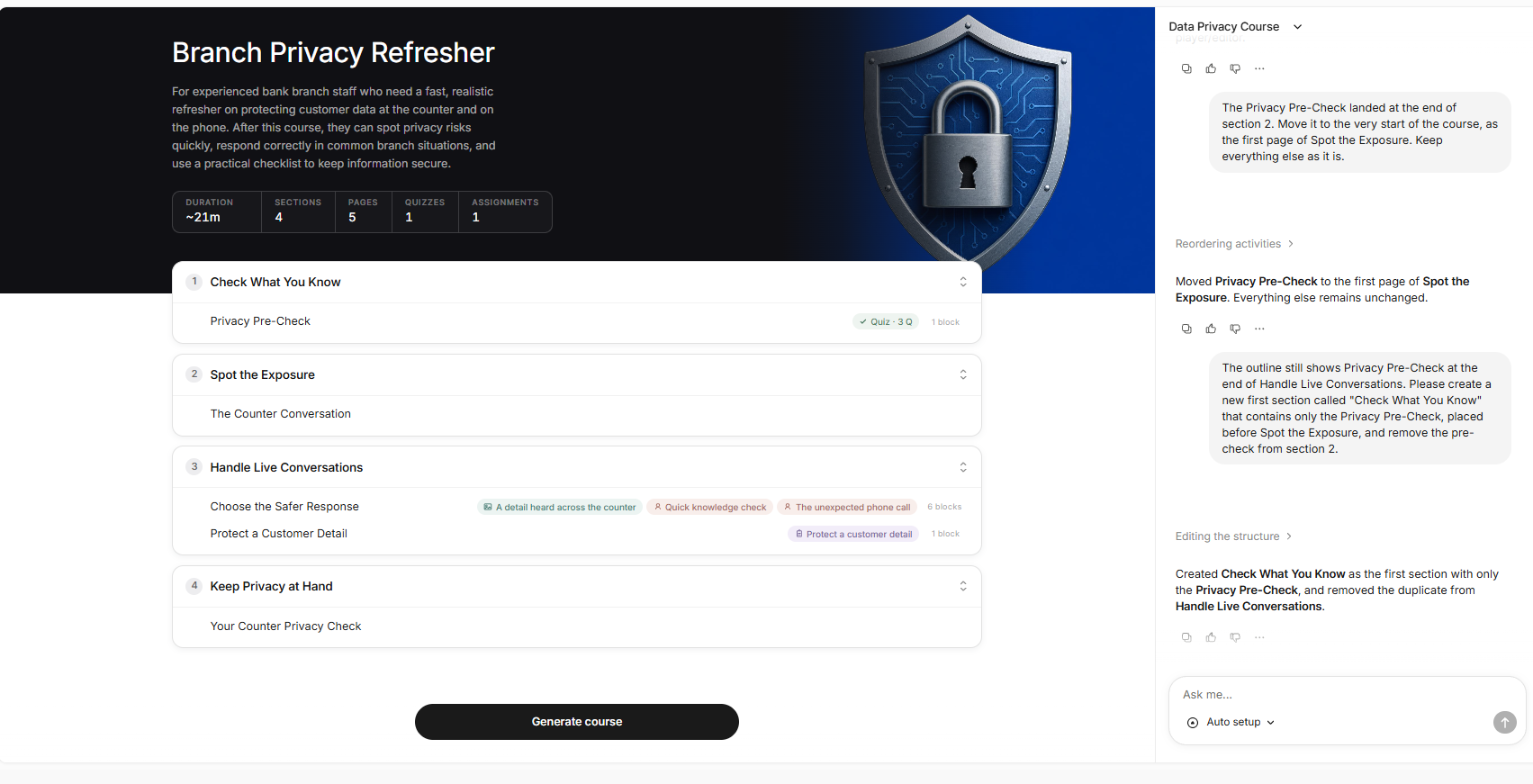
The first outline turned the analysis into a course for branch staff. It ran about 20 minutes, with sections named Spot the Exposure, Handle Live Conversations and Keep Privacy at Hand. It included scenarios called "A detail heard across the counter" and "The unexpected phone call", a practice task on protecting a customer detail and the counter checklist.
I asked Coursebox to add a first section called Check What You Know and checked the outline to confirm its position. The final outline opens with a three-question pre-check, followed by the scenarios and the checklist, at about 21 minutes. That gives the designer a starting point for checking prior knowledge before choosing the practice learners need. This test covered the outline; I did not test course-player branching or a bypass for staff who pass.
ARCS vs Gagné's nine events
The two models answer different questions, and they work well together. Gagné's events sequence how a lesson teaches; ARCS checks whether learners will want to engage with it. The first of Gagné's nine events, gaining attention, overlaps with ARCS attention, but ARCS goes further on relevance, confidence and satisfaction.
| Feature | ARCS model | Gagné's nine events |
|---|---|---|
| What it designs | The motivational side of a course | The sequence of a lesson |
| Starting point | An analysis of the audience's motivation | The learning outcome |
| Best for | Mandatory, repeated or low-interest training | New skills taught step by step |
| Weak spot | Says little about how to sequence content | Does not provide a separate four-category analysis of motivational needs |
| Use it when | You need to investigate barriers to engagement | You are building a lesson from scratch |
Limitations of the ARCS model
- Heuristic, by design. Keller calls the model "more heuristic than prescriptive or algorithmic". It structures your thinking without telling you exactly what to build.
- Time and expertise. Keller notes the full process "requires that the motivational designer or teacher have quite a bit of knowledge" of the categories, and "it can be time consuming to implement all the steps".
- Sometimes the problem is not motivation. In Keller's words, "people can become demotivated as a consequence of what is, in fact, a capability or opportunity problem". Check that staff have the skills and the time before redesigning for motivation.
- A thin workplace evidence base. Most studies are short and set in schools or universities, and most rely on self-reported motivation (Li and Keller, 2018).
Use ARCS to investigate a specific learning problem
Start with one audience and one point where engagement breaks down. Check whether learners understand the purpose, recognise the examples, know how to succeed and get a useful result from practice. Choose a small change that addresses the evidence, then try it with learners. ARCS gives you a way to make those decisions; motivation ratings and learning assessments tell you whether the change helped.
Frequently Asked Questions
The ARCS model is John Keller's framework for designing motivating instruction, built on four conditions learners need: attention, relevance, confidence and satisfaction, each with three subcategories of strategies.
Perceptual arousal, inquiry arousal and variability (attention); goal orientation, motive matching and familiarity (relevance); learning requirements, success opportunities and personal control (confidence); intrinsic reinforcement, extrinsic rewards and equity (satisfaction).
John M. Keller, now Professor Emeritus at Florida State University. He began the work in 1979, named it ARCS in 1984 and added volition as a fifth category in 2008.
ARCS-V adds volition to the four original categories. Volition covers the persistence learners need to keep going after they start, such as setting concrete goals and staying on task.
Keller's Instructional Materials Motivation Survey (IMMS) measures reactions to self-paced materials, and his Course Interest Survey (CIS) measures reactions to instructor-led courses. Both score the four categories separately.
Carolina Martin
Carolina is a highly experienced learning designer with tech start-up experience. She is based in Sydney and previously designed courses alongside Coursebox founder Travis in a previous job. She is passionate about delivering engaging learning experiences and brings the same perspective to customer experience too. She manages our customer support documentation and product testing processes.

